SUMMARY: The chapter "Business Environment" in Class 12 Business Studies focuses on understanding the various external forces that affect business operations and decision-making processes. KEY TOPICS: Definition of business environment, importance of business environment, dimensions of business environment, economic environment, social environment, political environment, technological environment, legal environment, impact of government policy changes on business, role of business environment in strategic planning.
CAll internal and external factors affecting business
DGovernment policies
Check answerHide answer
Correct answer: Option 3 — All internal and external factors affecting business
Q21 Mark
The general environment of a business includes:
ASuppliers
BEconomic forces
CCompetitors
DCustomers
Check answerHide answer
Correct answer: Option 2 — Economic forces
Q31 Mark
Liberalisation in India was started in:
A1947
B1991
C2000
D2014
Check answerHide answer
Correct answer: Option 2 — 1991
Q41 Mark
GST was implemented in India in:
A1991
B2014
C1 July 2017
D2020
Check answerHide answer
Correct answer: Option 3 — 1 July 2017
Q51 Mark
SWOT analysis is used to:
ASchedule production
BAnalyse business environment
CCalculate profit
DPay tax
Check answerHide answer
Correct answer: Option 2 — Analyse business environment
Q61 Mark
What is the primary definition of the business environment?
AThe internal factors affecting a business
BThe external forces influencing business operations
CThe financial resources available to a business
DThe organizational structure of a business
Check answerHide answer
Correct answer: Option 2 — The external forces influencing business operations
Q71 Mark
Which of the following is NOT a dimension of the business environment?
AEconomic environment
BSocial environment
CCultural environment
DTechnological environment
Check answerHide answer
Correct answer: Option 3 — Cultural environment
Q81 Mark
Why is understanding the business environment important for businesses?
AIt helps in increasing employee satisfaction
BIt aids in strategic planning and decision-making
CIt reduces operational costs
DIt guarantees profit maximization
Check answerHide answer
Correct answer: Option 2 — It aids in strategic planning and decision-making
Q91 Mark
Which of the following factors is part of the economic environment?
AConsumer behavior
BGovernment regulations
CInflation rates
DCultural trends
Check answerHide answer
Correct answer: Option 3 — Inflation rates
Q101 Mark
What role does the political environment play in business operations?
AIt determines the pricing strategies of a business
BIt influences the legal framework within which businesses operate
CIt affects the technological advancements a business can adopt
DIt has no significant impact on business operations
Check answerHide answer
Correct answer: Option 2 — It influences the legal framework within which businesses operate
Q111 Mark
Which of the following is an example of a legal environment factor?
AMarket demand
BTax policies
CConsumer preferences
DTechnological innovations
Check answerHide answer
Correct answer: Option 2 — Tax policies
Q121 Mark
How can government policy changes impact businesses?
ABy stabilizing market competition
BBy altering the legal framework and compliance requirements
CBy increasing consumer awareness
DBy reducing the need for strategic planning
Check answerHide answer
Correct answer: Option 2 — By altering the legal framework and compliance requirements
Q131 Mark
Which dimension of the business environment includes demographic trends?
AEconomic environment
BSocial environment
CPolitical environment
DTechnological environment
Check answerHide answer
Correct answer: Option 2 — Social environment
Q141 Mark
What is a significant characteristic of the technological environment?
AIt is static and unchanging
BIt includes advancements that can alter business processes
CIt is solely focused on digital technology
DIt has no relation to consumer behavior
Check answerHide answer
Correct answer: Option 2 — It includes advancements that can alter business processes
Q151 Mark
Which of the following best describes the importance of the business environment in strategic planning?
AIt provides a framework for financial forecasting
BIt helps identify opportunities and threats
CIt eliminates the need for market research
DIt ensures compliance with international standards
Check answerHide answer
Correct answer: Option 2 — It helps identify opportunities and threats
Short Answer Questions10 questions
Q163 Marks
Define business environment and state any three features.
View sample solutionHide solution
Business environment is the totality of all individuals institutions and other forces that are outside the control of business enterprise but may have a bearing on its functioning. Features: (1) TOTALITY OF EXTERNAL FORCES — sum of all external influences (economic legal political social technological international); (2) SPECIFIC AND GENERAL FORCES — specific (suppliers customers competitors) directly affect; general (economy society tech) affect industry-wide; (3) INTER-RELATEDNESS — different forces interconnect and reinforce; (4) DYNAMIC NATURE — changes constantly; (5) UNCERTAINTY — future is unpredictable; (6) COMPLEXITY — many simultaneous interacting forces; (7) RELATIVITY — affects different businesses differently; (8) IMPACT ON BUSINESS — opportunities and threats for the firm.
Q173 Marks
List the various dimensions of business environment with examples.
View sample solutionHide solution
(1) ECONOMIC — GDP, inflation, interest rates, exchange rates, fiscal and monetary policies, capital markets, business cycles. Example: high interest rates reduce demand for big-ticket items. (2) SOCIAL — culture, values, lifestyles, demographics, education levels, family structure. Example: rising health awareness benefits gym chains and organic food. (3) TECHNOLOGICAL — automation, IT, internet, AI, biotech, mobile penetration. Example: smartphones disrupted travel agencies (booking) and music industry (streaming). (4) POLITICAL — political stability, government policies, regulations, FDI rules, labour laws. Example: 1991 liberalisation opened markets to private and foreign investment. (5) LEGAL — laws, court rulings, IPR, consumer protection, GST, Companies Act. Example: GST 2017 unified India's indirect tax. (6) INTERNATIONAL — global trade, tariffs, WTO, foreign exchange, geopolitics. Example: US-China trade war affects Indian exports.
Q183 Marks
Explain the impact of liberalisation privatisation and globalisation (LPG) on Indian business.
View sample solutionHide solution
LPG reforms (1991): LIBERALISATION — abolished industrial licensing for most industries; reduced regulatory barriers; freed prices and trade. PRIVATISATION — disinvestment of PSUs; private sector encouraged in new areas (telecom, airlines, banking). GLOBALISATION — opened economy to FDI, FII, foreign trade; tariff reductions; integration with world economy. IMPACT ON INDIAN BUSINESS: (1) Increased competition from MNCs and FDI; (2) Need to upgrade quality and productivity to global standards; (3) New opportunities in IT, ITES, automotive, pharma; (4) Indian firms expanded internationally (Tata, Infosys, Reliance); (5) Consumers benefited from variety, quality, and lower prices; (6) Employment in new sectors; (7) Increased FDI inflow; (8) Currency markets opened. Result: Indian economy grew from $300 billion (1991) to $3.7+ trillion (2024) — one of the fastest-growing major economies.
Q193 Marks
What is the difference between specific and general environment?
View sample solutionHide solution
SPECIFIC ENVIRONMENT — also called 'task environment'; consists of forces that DIRECTLY affect a particular business. Examples: customers, suppliers, competitors, intermediaries (distributors, retailers), regulators specific to industry. CHANGES IN specific environment have immediate impact. GENERAL ENVIRONMENT — also called 'macro environment'; consists of broader forces that affect ALL businesses in similar ways. Examples: economic conditions, political climate, social trends, technological changes, legal framework. CHANGES IN general environment have indirect but pervasive impact. Specific environment is unique to each firm; general environment is shared across firms in an industry. PESTEL analysis examines general environment; Porter's Five Forces analyses specific environment. Both must be monitored for strategic planning.
Q203 Marks
Define SWOT analysis and state its purpose.
View sample solutionHide solution
SWOT analysis is a strategic tool to assess a firm's competitive position. Stands for Strengths, Weaknesses, Opportunities, and Threats. STRENGTHS — internal positive attributes (skilled workforce, brand, technology, financial strength). WEAKNESSES — internal negative attributes (high costs, weak distribution, outdated technology). OPPORTUNITIES — external favourable conditions (growing market, technology trends, deregulation). THREATS — external unfavourable conditions (new competitors, recession, regulation, technology disruption). PURPOSE: (1) Strategic planning — match strengths with opportunities; mitigate weaknesses against threats. (2) Decision-making — for new product launch, market entry, M&A. (3) Self-assessment — annual review of competitive position. (4) Communication — share strategic situation with stakeholders. SWOT is part of broader environmental analysis along with PESTEL (general environment) and Porter's Five Forces (industry analysis).
Q213 Marks
Define the term 'business environment'.
View sample solutionHide solution
The business environment refers to the sum of all external and internal factors that influence a company's operating situation. This includes economic, social, political, technological, legal, and environmental factors that can affect business operations and decision-making processes.
Q223 Marks
Explain the importance of understanding the business environment for a company.
View sample solutionHide solution
Understanding the business environment is crucial for a company as it helps in identifying opportunities and threats, making informed decisions, and formulating effective strategies. It also aids in anticipating changes and adapting to them to maintain competitiveness.
Q233 Marks
List the dimensions of the business environment.
View sample solutionHide solution
The dimensions of the business environment include the economic environment, social environment, political environment, technological environment, and legal environment. Each dimension has distinct factors that influence business operations.
Q243 Marks
What is the economic environment in the context of business?
View sample solutionHide solution
The economic environment encompasses all economic factors that impact a business, such as inflation rates, interest rates, economic growth, and employment levels. These factors influence consumer purchasing power and business profitability.
Q253 Marks
How does the social environment affect business operations?
View sample solutionHide solution
The social environment affects business operations through cultural norms, values, demographics, and consumer behaviors. Changes in social trends can lead to shifts in demand for products and services, requiring businesses to adapt accordingly.
Long Answer Questions6 questions
Q266 Marks
Discuss the various dimensions of business environment with their impact on business.
View sample solutionHide solution
Business environment has multiple dimensions each affecting business in different ways. (1) ECONOMIC dimension: GDP growth, inflation, interest rates, exchange rates, monetary and fiscal policy. Strong economy creates demand and capital availability; recession reduces both. (2) SOCIAL dimension: demographics, lifestyles, values, education, family structure. Aging population in West creates opportunities in healthcare; rising youth in India in tech and e-commerce. (3) POLITICAL dimension: political stability, government attitude toward business, regulatory burden. Stable democracy with pro-business policies attracts investment. (4) LEGAL dimension: laws, courts, regulations, IPR. Strong rule of law and enforcement attracts investment and protects innovation. (5) TECHNOLOGICAL dimension: digitalisation, automation, AI, biotech. Disruptive technologies create opportunities for new entrants and threaten established players. (6) INTERNATIONAL dimension: global trade, geopolitics, exchange rates, FDI policies. International integration opens markets but creates external risks. ALL dimensions interact and create COMPLEX BUSINESS ENVIRONMENT. Successful firms continuously monitor and adapt to environmental changes through strategic planning, scenario analysis, and agile execution.
Q276 Marks
Discuss the impact of changes in business environment on Indian business since 1991 liberalisation.
View sample solutionHide solution
1991 LIBERALISATION marked a watershed moment for Indian business. PRE-1991: licence raj, high taxes, restrictions on FDI, public sector dominance, closed economy. POST-1991: dismantling of licensing, opening of FDI in most sectors, privatisation of PSUs, GST replacing complex tax structure. IMPACT ON INDIAN BUSINESS: (1) INCREASED COMPETITION — entry of MNCs (Suzuki, Toyota, Microsoft, Amazon); existing firms upgraded quality and productivity. (2) NEW SECTORS EMERGED — IT/ITES (TCS, Infosys, Wipro becoming global leaders); pharma (generics for global market); automobiles (Maruti, Tata Motors, Mahindra); telecom (Airtel, Reliance Jio). (3) GLOBAL EXPANSION — Tata Group, Mahindra, Reliance expanded internationally. (4) INFRASTRUCTURE INVESTMENT — power, roads, airports, ports through PPP. (5) DIGITAL REVOLUTION — UPI, e-commerce, mobile internet — India became digital innovation hub. (6) STARTUP ECOSYSTEM — over 100 unicorns by 2024. (7) IMPROVED CONSUMER WELFARE — variety, quality, lower prices. (8) INCREASED EMPLOYMENT — in services and manufacturing. CHALLENGES: agriculture stagnation, unequal regional growth, environmental degradation, persistent inequality. NET RESULT: India is now $3.7+ trillion economy expected to be top-3 globally by 2030 — a story of how business environment changes transform an entire economy.
Q286 Marks
Discuss the importance of understanding business environment for managers.
View sample solutionHide solution
Understanding business environment is critical for managers because: (1) IDENTIFICATION OF OPPORTUNITIES — environmental changes create new markets, products, business models; firms that spot them first gain competitive advantage. EXAMPLE: Reliance Jio capitalised on smartphone proliferation. (2) IDENTIFICATION OF THREATS — competitive entrants, regulatory changes, technology disruption can destroy markets. EXAMPLE: Kodak missed digital photography. (3) STRATEGIC PLANNING — environmental analysis (SWOT, PESTEL, Five Forces) inputs into corporate strategy. (4) RESOURCE MOBILISATION — understanding environment helps in raising appropriate capital, hiring talent, securing supply chain. (5) BETTER PERFORMANCE — environment-aligned firms outperform peers. (6) COPING WITH RAPID CHANGE — pace of change increases; awareness helps adapt. (7) IMAGE BUILDING — understanding social environment helps brand positioning. (8) MEETING COMPETITION — knowing competitor moves and industry dynamics. (9) INNOVATIVE PRODUCTS AND SERVICES — environmental needs drive innovation. (10) COMPLIANCE AND RISK MANAGEMENT — understanding legal/regulatory environment reduces compliance risk. Modern firms have dedicated strategy and intelligence teams that continuously monitor multiple environmental dimensions.
Q296 Marks
Explain the concept of demonetisation and its impact on Indian business environment.
View sample solutionHide solution
DEMONETISATION (8 November 2016): the government withdrew ₹500 and ₹1000 currency notes (~86% of total currency in circulation). NEW notes (₹500, ₹2000) introduced. OBJECTIVES: (1) curb black money and counterfeit currency; (2) reduce terror financing; (3) push toward cashless economy; (4) widen tax base. IMMEDIATE IMPACT: (1) cash crunch caused major short-term disruption; small businesses hit hard; (2) long queues at banks for exchange; (3) some segments (real estate, gold, jewellery) saw activity slowdown; (4) digital payment surge — Paytm, PhonePe usage exploded; (5) GST registrations increased. LONG-TERM IMPACT: (1) DIGITAL PAYMENT REVOLUTION — UPI launched 2016 around the same time; today billions of transactions monthly; (2) FORMALISATION — many informal businesses started accepting digital payments; (3) FINANCIAL INCLUSION — Jan Dhan accounts grew. CONTROVERSY: (a) GDP growth dipped temporarily; (b) actual recovery of black money was less than expected; (c) large impact on rural and informal economy. Demonetisation is an example of how a single political-economic decision can dramatically change business environment overnight, forcing businesses to adapt.
Q306 Marks
Compare general environment and specific (task) environment with the help of a table.
Q316 Marks
Differentiate between economic environment and social environment in tabular form.
Assertion–Reason Questions8 questions
Q321 Mark
Assertion (A): Understanding business environment is essential for survival and growth.
Reason (R): The environment provides opportunities and threats that determine the success or failure of businesses.
Show explanationHide explanation
Correct answer: Option 1 —
Both A and R are true, and R is the correct explanation of A.
Q331 Mark
Assertion (A): The 1991 liberalisation opened up the Indian economy.
Reason (R): It reduced licensing privatised PSUs and welcomed foreign investment.
Show explanationHide explanation
Correct answer: Option 1 —
Both A and R are true, and R is the correct explanation of A.
Q341 Mark
Assertion (A): Business environment has multiple dimensions.
Reason (R): Economic political social technological legal and international forces all affect business.
Show explanationHide explanation
Correct answer: Option 1 —
Both A and R are true, and R is the correct explanation of A.
Q351 Mark
Assertion (A): Business environment is dynamic.
Reason (R): It changes continuously due to evolving technology political shifts and social trends.
Show explanationHide explanation
Correct answer: Option 1 —
Both A and R are true, and R is the correct explanation of A.
Q361 Mark
Assertion (A): Demonetisation accelerated digital payments in India.
Reason (R): UPI and mobile wallets saw massive adoption as cash availability reduced.
Show explanationHide explanation
Correct answer: Option 1 —
Both A and R are true, and R is the correct explanation of A.
Q371 Mark
Assertion (A): The business environment includes external factors that influence business operations.
Reason (R): The business environment is defined as the sum of all external forces affecting a business.
Show explanationHide explanation
Correct answer: Option 1 —
Both A and R are true, and R is the correct explanation of A.
Q381 Mark
Assertion (A): Economic environment has no impact on business decision-making.
Reason (R): The economic environment includes factors like inflation, interest rates, and economic growth.
Show explanationHide explanation
Correct answer: Option 3 —
A is true, but R is false.
Q391 Mark
Assertion (A): Technological advancements can lead to improved efficiency in business operations.
Reason (R): Technological environment refers to the innovations and advancements that affect production and services.
Show explanationHide explanation
Correct answer: Option 1 —
Both A and R are true, and R is the correct explanation of A.
Statement-Based Questions8 questions
Q401 Mark
Statement 1: Business environment includes all external forces affecting business.
Statement 2: These forces are beyond the control of the firm but influence its operations.
Show answerHide answer
Correct answer: Option 1 —
Both statements are true.
Q411 Mark
Statement 1: Macro environment includes economic political and social forces.
Statement 2: These broad forces affect all businesses in similar ways.
Show answerHide answer
Correct answer: Option 1 —
Both statements are true.
Q421 Mark
Statement 1: Technology is rapidly changing the business landscape.
Statement 2: Disruptive technologies create new opportunities and threats simultaneously.
Show answerHide answer
Correct answer: Option 1 —
Both statements are true.
Q431 Mark
Statement 1: Globalisation has increased competition.
Statement 2: Indian firms now compete with global players in domestic and international markets.
Show answerHide answer
Correct answer: Option 1 —
Both statements are true.
Q441 Mark
Statement 1: Government policies are part of political environment.
Statement 2: Tax rates trade policy and regulation affect business operations.
Show answerHide answer
Correct answer: Option 1 —
Both statements are true.
Q451 Mark
Statement 1: The business environment includes only the economic factors affecting a business.
Statement 2: The business environment is static and does not change over time.
Show answerHide answer
Correct answer: Option 4 —
Both statements are false.
Q461 Mark
Statement 1: Understanding the business environment is crucial for effective decision-making.
Statement 2: The business environment consists of internal and external factors.
Show answerHide answer
Correct answer: Option 1 —
Both statements are true.
Q471 Mark
Statement 1: The social environment includes cultural trends and demographics.
Statement 2: Political stability has no impact on business operations.
Show answerHide answer
Correct answer: Option 3 —
Only Statement 2 is true.
Case Study / Passage Questions4 questions
Q483 Marks
Aakash Textiles was a small Indian firm in 1990 making low-quality fabric for the protected domestic market. Post-1991 LPG reforms dropped tariffs, foreign brands entered, and customers demanded better designs. Initially Aakash struggled — sales fell 40%. The new MD invested in modern looms, hired designers, sourced cotton globally, and exported to West Asia. By 2000 the firm had tripled revenue and become an export leader.
The 1991 reforms involved:
ALiberalisation
BPrivatisation
CGlobalisation
DAll three
LPG was for Aakash initially a:
AThreat
BOpportunity
CBoth
DNeither
How did LPG reforms create both threats and opportunities for Aakash Textiles?
Show answersHide answers
1. Option 4 — All three
2. Option 3 — Both
3. LPG = Liberalisation Privatisation Globalisation (1991 reforms). Liberalisation removed industrial licensing reduced tariffs and freed pricing. Privatisation reduced government's role in commercial enterprises. Globalisation integrated India with world economy through trade and investment. Impact on Indian businesses: (1) Increased competition — domestic firms faced foreign brands; (2) Need for quality and design upgrade — customer expectations rose; (3) Access to global inputs — cheaper raw materials and better technology became available; (4) Export opportunities — open markets allowed Indian firms to sell abroad. Aakash Textiles initially saw LPG as a threat (sales down 40%) but the new MD treated it as an opportunity by upgrading capability and expanding markets. The case shows business environment is a source of both threats and opportunities — well-managed firms turn change to advantage.
Q493 Marks
Sharma General Store was a cash-only neighbourhood store. After demonetisation on 8 November 2016 customers had no Rs 500/Rs 1000 notes; sales dropped 60% in two weeks. The owner installed a card-swipe machine signed up for UPI and accepted Paytm. Sales recovered in three months and he reached new customers via WhatsApp.
Demonetisation policy is part of which dimension of business environment?
AEconomic
BPolitical
CLegal
DTechnological
Sharma's main adaptation was to embrace:
ACash-handling
BDigital payments
CInventory
DBranding
Explain how the dynamic environment forced Sharma's store to evolve.
Show answersHide answers
1. Option 2 — Political
2. Option 2 — Digital payments
3. Business environment includes all external forces affecting a firm — economic, social, political, legal, technological. Demonetisation was a political/legal/economic event with technological implications: (1) Political — sudden government decision; (2) Economic — cash supply shock; (3) Technological — accelerated digital payment adoption. The case illustrates: business environment is dynamic and uncertain; firms must continuously scan and adapt; threats can become opportunities. Sharma turned a sales crisis into an upgrade — installed card machine, joined UPI/Paytm, used WhatsApp marketing — and reached new customers (those who preferred digital payments). Lessons: (a) flexibility is a survival skill; (b) digital adoption is now table stakes; (c) policy changes can shift consumer behaviour permanently. The store became more competitive than before.
Q503 Marks
DailyMail printed newspapers were the main news source in 2005. By 2020 digital news apps free Wi-Fi and social media had captured younger readers; ad revenue fell 70%. DailyMail launched a website mobile app and a digital subscription. It now earns more from digital ads and subscriptions than from print and has expanded to YouTube and podcasts.
The shift from print to digital news reflects which environmental dimension?
APolitical
BTechnological
CSocial
DLegal
DailyMail's response was to:
AResist change
BAdapt with new digital channels
CClose down
DIncrease ad rates
Explain how the technological dimension forces firms to reinvent themselves.
Show answersHide answers
1. Option 2 — Technological
2. Option 2 — Adapt with new digital channels
3. Technological dimension covers improvements in scientific knowledge that affect production marketing and customer experience. The internet smartphones and social media have transformed media: paper to pixel, broadcast to interactive, fixed schedule to on-demand. Firms that ignore technological shifts (Kodak, Nokia) get disrupted; firms that embrace change (Reliance with Jio, DailyMail with digital) prosper. Implications for business: (1) continuously scan emerging technologies; (2) experiment with new business models; (3) reskill employees; (4) partner with tech companies; (5) measure customer behaviour to spot inflection points early. DailyMail's example shows that even traditional industries can re-invent through technology — but only if leadership recognises the shift in time and acts decisively. The technological dimension is now the most disruptive force in most industries.
Q514 Marks
Tata Motors, one of India's leading automobile manufacturers, has always been sensitive to the changes in its business environment. When the government announced stricter emission norms (BS-VI standards), Tata Motors had to invest heavily in research and development to upgrade its engines. Simultaneously, rising fuel prices (economic environment) affected consumer purchasing decisions, while growing environmental awareness among consumers (social environment) pushed the company towards electric vehicles. The company also had to navigate new legal regulations regarding vehicle safety standards. This case demonstrates how multiple dimensions of the business environment interact and influence a company's strategic decisions, forcing it to continuously adapt and innovate to remain competitive in the market.
The government announcing stricter emission norms (BS-VI standards) is an example of which dimension of the business environment?
AEconomic Environment
BSocial Environment
CLegal Environment
DTechnological Environment
Growing environmental awareness among consumers pushing Tata Motors towards electric vehicles is an example of which dimension of business environment?
APolitical Environment
BSocial Environment
CLegal Environment
DEconomic Environment
Explain why the business environment is described as 'dynamic' in nature, using the passage as a reference.
Identify any two dimensions of the business environment mentioned in the passage and briefly explain each.
Show answersHide answers
1. Option 3 — Legal Environment
2. Option 2 — Social Environment
3. The business environment is described as 'dynamic' because it keeps changing constantly. As seen in the passage, Tata Motors had to continuously respond to changing emission norms, fluctuating fuel prices, evolving consumer preferences, and new legal regulations. These changes are ongoing and unpredictable, requiring businesses to adapt their strategies regularly.
4. 1. Economic Environment: This includes factors like rising fuel prices that affect consumer purchasing power and demand patterns. It influences how much consumers are willing to spend on products. 2. Legal Environment: This refers to laws and regulations such as BS-VI emission norms and vehicle safety standards that businesses must comply with. Non-compliance can result in penalties and affect business operations.
Table-Based Questions4 questions
Q523 Marks
Five dimensions of business environment:
Dimension
Components
Example
Economic
GDP inflation interest rates
Rate cut helps borrowers
Social
Demographics culture lifestyle
Rising health awareness
Political
Govt stability ideology
Coalition vs majority govt
Legal
Acts rules regulations
GST CPA 2019
Technological
Innovation R&D internet
5G smartphones
Changes in customer lifestyles fall under which dimension?
AEconomic
BSocial
CPolitical
DLegal
The shift to electric vehicles is driven primarily by:
ATechnological
BLegal
CEconomic
DSocial
Why must managers scan all five dimensions of the business environment?
Show answersHide answers
1. Option 2 — Social
2. Option 1 — Technological
3. Business environment is multi-dimensional. Each dimension affects business differently and changes at its own pace. Economic shows up first in operating numbers (interest rates inflation GDP growth). Social changes are slower but profound (rising women in workforce, ageing populations). Political stability affects investment decisions — coalition governments are less predictable than majority governments. Legal changes such as GST, CPA 2019, FSSAI rules add compliance costs but also create level playing fields. Technological is now the fastest moving — internet, smartphones, AI, blockchain are redrawing industry boundaries. Successful firms scan all five dimensions through environmental scanning, prepare scenarios, build organisational flexibility, and act early on weak signals. Ignoring any dimension can be fatal: Kodak missed digital, Nokia missed smartphones, Blockbuster missed streaming.
Q533 Marks
Impact of LPG reforms on Indian businesses:
Reform
What changed
Impact
Liberalisation
End of licence raj
Free entry exit pricing
Privatisation
PSU disinvestment
Market discipline
Globalisation
Open trade & investment
Foreign competition + exports
Tariff
Import duties cut
Cheaper inputs
FDI
Sectoral caps raised
Foreign capital inflow
FOREX
Convertible rupee
Easier global trade
LPG stands for:
ALiberalisation
BPrivatisation
CGlobalisation
DAll three
Post-LPG competition for Indian firms generally:
AIncreased
BDecreased
CSame
DUnrelated
Discuss the major impacts of LPG reforms on Indian businesses.
Show answersHide answers
1. Option 4 — All three
2. Option 1 — Increased
3. LPG reforms launched in 1991 transformed Indian business: (1) Increased competition — firms had to upgrade quality cost and service; (2) More demanding customers — choice expanded so customer expectations rose; (3) Rapidly changing technology — global tech became available pushing local upgradation; (4) Need for change — old protected business models stopped working; (5) Need for skilled manpower — new sectors and standards emerged; (6) Greater market orientation — production became market-driven; (7) Loss of budgetary support to PSUs — PSUs had to compete on commercial terms. Winners adapted by investing in quality designing for global markets and embracing professional management. Losers stuck with old models and lost share. The reforms made Indian business more competitive but also more vulnerable — environmental scanning became a survival skill.
Q546 Marks
Match each business event with the correct dimension of business environment that affected it.
Event
Dimension
Demonetisation 2016
? Political+Economic+Legal
Rise of vegan food
? Social
5G rollout impact on telecom
? Technological
GST implementation
? Legal
Coalition government instability
? Political
RBI repo rate cut
? Economic
Q556 Marks
Identify how each LPG reform component affected Indian businesses.
Reform
Indian businesses faced
Liberalisation
? End of licence raj free entry exit pricing
Privatisation
? Disinvestment of PSUs market discipline
Globalisation
? Foreign competition + export opportunities
Tariff reduction
? Cheaper imports + competition pressure
FDI policy ease
? Foreign capital inflow + collaboration
Picture-Based Questions4 questions
Q563 Marks
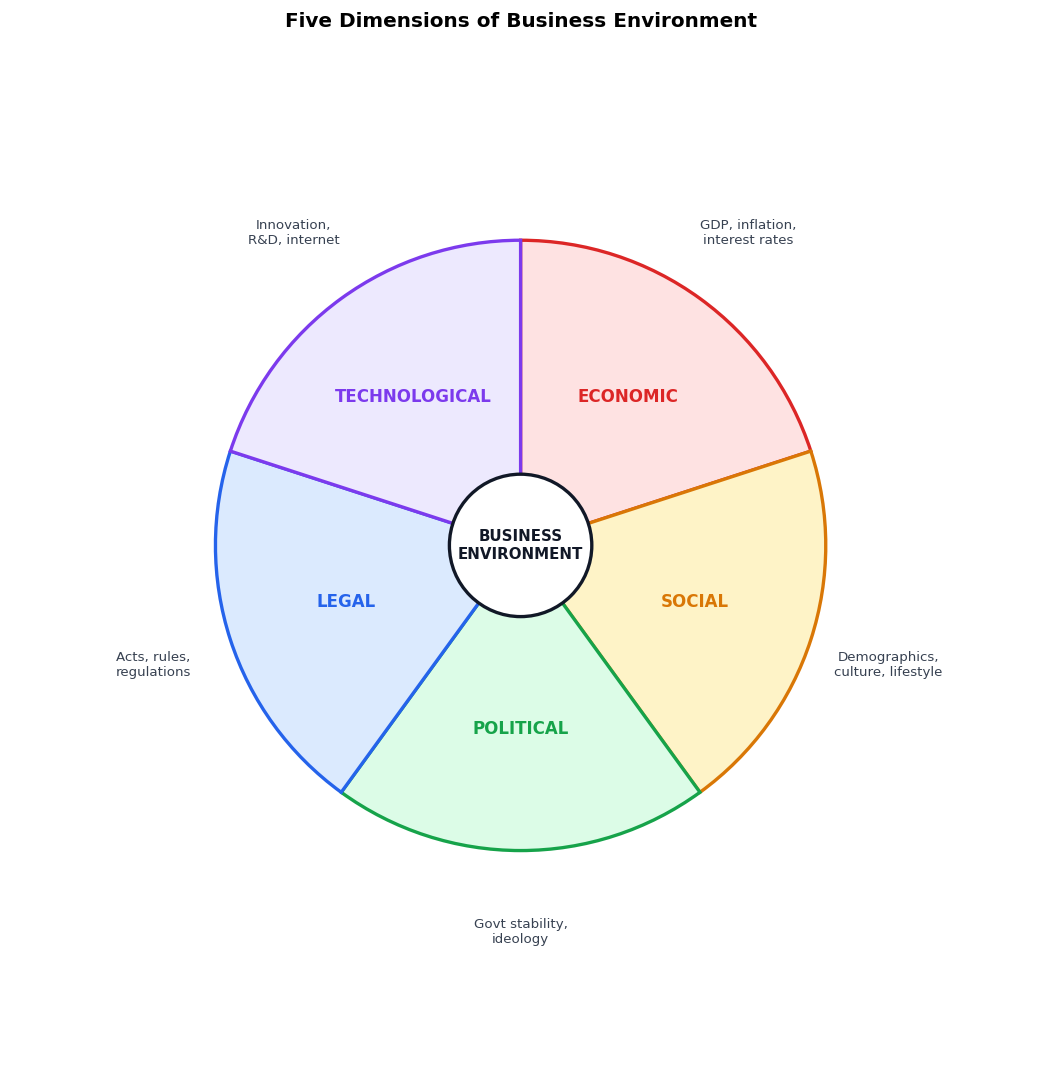
Study the five dimensions of business environment wheel and answer:
A change in customer lifestyles falls under which dimension?
AEconomic
BSocial
CPolitical
DTechnological
The Consumer Protection Act 2019 is part of which dimension?
ALegal
BTechnological
CSocial
DPolitical
Explain why managers must scan all five dimensions of the business environment.
Show answersHide answers
1. Option 2 — Social
2. Option 1 — Legal
3. Business environment is multi-dimensional. Economic dimension covers GDP, inflation, interest rates, fiscal policy — affects costs, demand, and profitability. Social dimension includes demographics, culture, lifestyle, education levels — drives long-term consumption patterns. Political dimension reflects government stability, ideology, elections — affects investment confidence. Legal dimension consists of Acts, rules, regulations such as GST, CPA 2019, FSSAI — adds compliance costs but also creates level playing fields. Technological dimension covers innovation, R&D, internet — currently the most disruptive force. Successful firms scan all five dimensions through environmental scanning, prepare scenarios, and act on weak signals. Ignoring any dimension can be fatal — Kodak missed digital, Nokia missed smartphones, Blockbuster missed streaming.
Q574 Marks
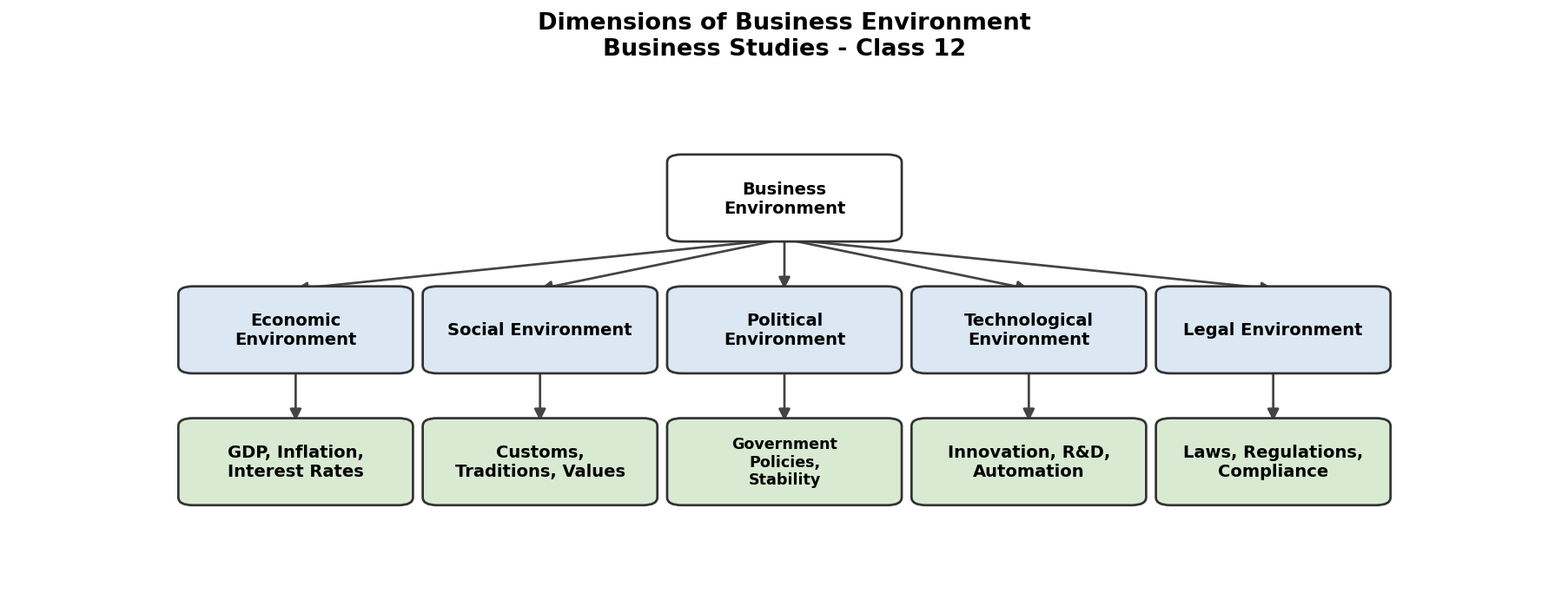
Based on the given diagram, answer the following:
How many dimensions of Business Environment are shown in the diagram?
AThree
BFour
CFive
DSix
Which dimension of business environment is associated with 'GDP, Inflation, and Interest Rates' as shown in the diagram?
ALegal Environment
BEconomic Environment
CPolitical Environment
DSocial Environment
Explain the significance of the Technological Environment dimension shown in the diagram for a business firm.
From the diagram, identify the dimension that includes 'Customs, Traditions, and Values' and explain how it can affect business decisions.
Show answersHide answers
1. Option 3 — Five
2. Option 2 — Economic Environment
3. The Technological Environment includes innovation, R&D, and automation. It is significant because it enables businesses to improve productivity, develop new products, reduce costs, and stay competitive. Firms that adapt to technological changes can gain a competitive advantage.
4. The Social Environment includes customs, traditions, and values. It affects business decisions such as product design, marketing strategies, and pricing. For example, a company must consider local customs and cultural values when launching a product in a new region to ensure acceptance.
Q584 Marks
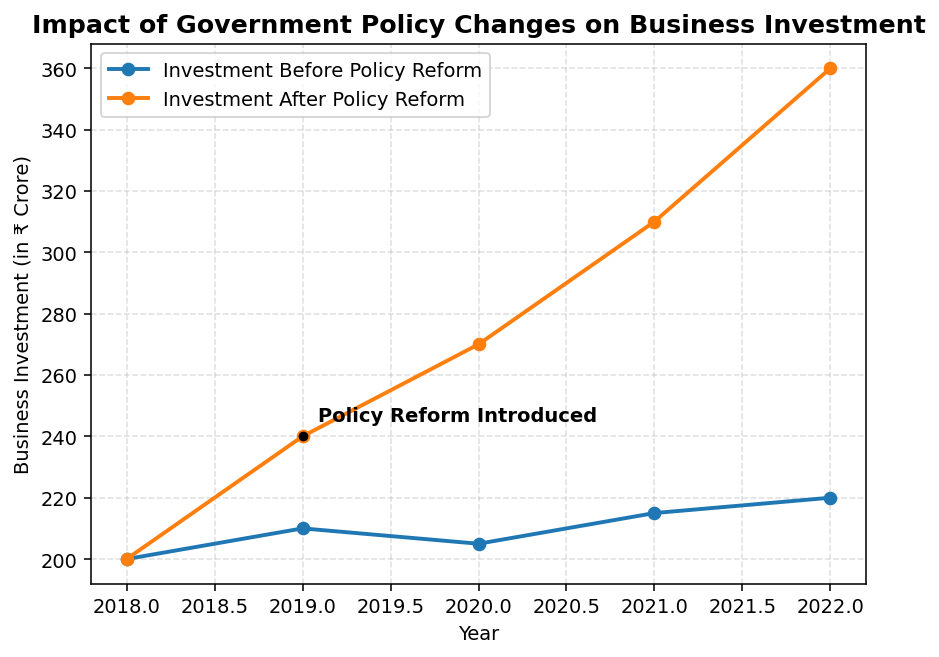
Based on the given chart showing the impact of government policy changes on business investment over five years, answer the following:
In which year was the policy reform introduced according to the chart?
A2018
B2019
C2020
D2021
What was the difference in business investment between 'After Policy Reform' and 'Before Policy Reform' in the year 2022?
A₹100 Crore
B₹120 Crore
C₹140 Crore
D₹160 Crore
What does the trend in the chart suggest about the relationship between government policy changes and business investment?
Name any two types of government policy changes that can positively impact the business environment.
Show answersHide answers
1. Option 2 — 2019
2. Option 3 — ₹140 Crore
3. The chart suggests a positive relationship between favourable government policy changes and business investment. After the policy reform in 2019, business investment grew significantly and consistently, indicating that a supportive political and economic environment encourages businesses to invest more.
4. Two government policy changes that can positively impact business environment are: (1) Liberalisation – reducing government controls and restrictions on businesses, allowing them to operate more freely. (2) Tax reforms – reducing corporate tax rates or providing tax incentives to encourage investment and expansion.
Q594 Marks
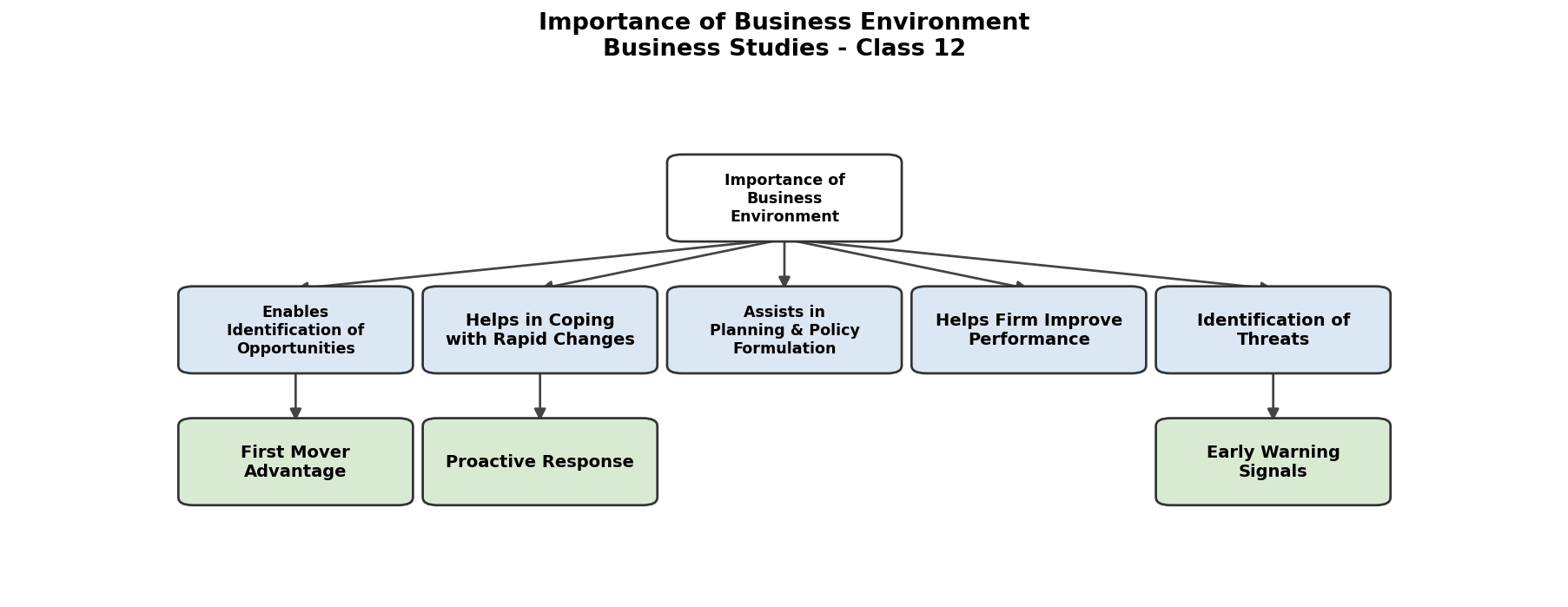
Based on the given flowchart showing the importance of understanding the business environment, answer the following:
According to the flowchart, what advantage does a business gain by identifying opportunities in the environment early?
ALate Mover Advantage
BFirst Mover Advantage
CCost Advantage
DLegal Advantage
What does 'Early Warning Signals' mean in the context of the flowchart?
ASignals that help businesses advertise early
BSignals that warn businesses about competitor pricing
CSignals that help businesses identify threats in advance and prepare responses
DSignals from the government about new laws
How does understanding the business environment assist in planning and policy formulation? Explain with an example.
From the flowchart, identify any two reasons why it is important for a business to understand its environment and explain each briefly.
Show answersHide answers
1. Option 2 — First Mover Advantage
2. Option 3 — Signals that help businesses identify threats in advance and prepare responses
3. Understanding the business environment helps managers make informed decisions while formulating plans and policies. For example, if a firm is aware that the government plans to reduce import duties, it can plan its procurement strategy accordingly — either by importing raw materials at lower costs or by preparing for increased competition from foreign goods.
4. (1) Enables Identification of Opportunities: By scanning the environment, businesses can spot new market opportunities and exploit them before competitors, gaining a first mover advantage. (2) Helps in Coping with Rapid Changes: The business environment is dynamic. Understanding it allows firms to respond proactively to changes in technology, consumer preferences, or government policies rather than reacting after damage has occurred.