Skip to content
TestMacher
Chapter 5 · Class 12 Business Studies

Financial Management — Important Questions

58 questions With answers CBSE format

SUMMARY: The chapter on Financial Management in Class 12 Business Studies focuses on the efficient and effective management of funds in a business to achieve its objectives.
KEY TOPICS: Financial planning, capital structure, fixed and working capital, financial leverage, dividend decisions, cost of capital, capital budgeting, financial risk, liquidity management, profitability management.

Q1 1 Mark

Capital budgeting decisions are also called:

AWorking capital decisions
BInvestment decisions
CDividend decisions
DFinancing decisions
Check answerHide answer
Correct answer: Option 2 — Investment decisions
Q2 1 Mark

The primary objective of financial management is:

AProfit maximisation
BSales maximisation
CWealth maximisation
DCost minimisation
Check answerHide answer
Correct answer: Option 3 — Wealth maximisation
Q3 1 Mark

A higher Debt-Equity ratio means:

AHigher financial risk
BHigher operating risk
CLower financial risk
DNo risk
Check answerHide answer
Correct answer: Option 1 — Higher financial risk
Q4 1 Mark

Which is NOT a factor affecting working capital requirements?

ANature of business
BProduction cycle
CDividend policy
DCredit allowed
Check answerHide answer
Correct answer: Option 3 — Dividend policy
Q5 1 Mark

Trading on equity refers to:

AIssue of equity shares
BUse of debt to enhance EPS
CBuy-back of shares
DBonus issue
Check answerHide answer
Correct answer: Option 2 — Use of debt to enhance EPS
Q6 1 Mark

What is the primary objective of financial management in a business?

AMaximizing employee satisfaction
BMaximizing shareholder wealth
CMinimizing operational costs
DMaximizing market share
Check answerHide answer
Correct answer: Option 2 — Maximizing shareholder wealth
Q7 1 Mark

Which of the following is a component of capital structure?

ACurrent assets
BLong-term debt
CNet income
DCash flow
Check answerHide answer
Correct answer: Option 2 — Long-term debt
Q8 1 Mark

What is the main purpose of financial planning in a business?

ATo reduce taxes
BTo ensure sufficient funds are available for future needs
CTo increase employee salaries
DTo expand the business internationally
Check answerHide answer
Correct answer: Option 2 — To ensure sufficient funds are available for future needs
Q9 1 Mark

Which type of capital is used for day-to-day operations of a business?

AFixed capital
BWorking capital
CEquity capital
DDebt capital
Check answerHide answer
Correct answer: Option 2 — Working capital
Q10 1 Mark

Financial leverage is primarily concerned with which of the following?

AThe use of debt to increase returns
BThe use of equity to reduce risk
CThe management of cash flows
DThe allocation of profits to shareholders
Check answerHide answer
Correct answer: Option 1 — The use of debt to increase returns
Q11 1 Mark

Which of the following factors does NOT affect the cost of capital?

AMarket interest rates
BCompany's risk profile
CManagement's experience
DTax rates
Check answerHide answer
Correct answer: Option 3 — Management's experience
Q12 1 Mark

What does capital budgeting primarily focus on?

ADetermining the optimal dividend policy
BEvaluating long-term investment decisions
CManaging short-term cash flows
DAssessing the cost of capital
Check answerHide answer
Correct answer: Option 2 — Evaluating long-term investment decisions
Q13 1 Mark

Which of the following is a financial risk?

AMarket risk
BOperational risk
CRegulatory risk
DAll of the above
Check answerHide answer
Correct answer: Option 1 — Market risk
Q14 1 Mark

Liquidity management is crucial for which of the following reasons?

ATo ensure profitability
BTo meet short-term obligations
CTo maximize long-term investments
DTo increase market share
Check answerHide answer
Correct answer: Option 2 — To meet short-term obligations
Q15 1 Mark

The dividend decision is primarily concerned with:

AHow much profit to reinvest in the business
BHow to minimize taxes
CHow to manage cash flows
DHow to increase sales revenue
Check answerHide answer
Correct answer: Option 1 — How much profit to reinvest in the business
Q16 3 Marks

Define financial management. State its objective.

View sample solutionHide solution
Financial management is the planning organising directing and controlling of financial activities — procurement and utilisation of funds. Objective: Wealth maximisation — maximising current market price of equity shares which represents shareholders' wealth.
Q17 3 Marks

List any three factors affecting capital structure.

View sample solutionHide solution
Cash flow position; Interest Coverage Ratio (ICR); Debt Service Coverage Ratio (DSCR); Return on Investment; Cost of debt; Tax rate; Cost of equity; Floatation costs; Risk consideration; Flexibility; Control; Regulatory framework; Stock market conditions; Capital structure of other companies — any three.
Q18 3 Marks

Distinguish between fixed capital and working capital on any three bases.

View sample solutionHide solution
Meaning (long-term assets vs short-term needs); Duration (long vs short); Source (long-term — equity, debentures vs short-term — bank credit, trade credit); Convertibility (cannot be quickly converted vs highly liquid).
Q19 3 Marks

State three factors affecting dividend decision.

View sample solutionHide solution
Stability of earnings; Growth opportunities; Cash flow position; Shareholder preference; Stability of dividends; Taxation policy; Stock market reaction; Access to capital market; Legal constraints; Contractual constraints — any three.
Q20 3 Marks

Why is capital budgeting considered the most important financial decision?

View sample solutionHide solution
Long-term implications (affects earning capacity for years); Involves large amount of funds; Irreversible decision (high cost of reversal); Affects competitive position; Most risky as returns are based on forecasts.
Q21 3 Marks

Define financial management. State its objective.

View sample solutionHide solution
Financial management is the planning organising directing and controlling of financial activities — procurement and utilisation of funds. Objective: Wealth maximisation — maximising current market price of equity shares which represents shareholders' wealth.
Q22 3 Marks

List any three factors affecting capital structure.

View sample solutionHide solution
Cash flow position; Interest Coverage Ratio (ICR); Debt Service Coverage Ratio (DSCR); Return on Investment; Cost of debt; Tax rate; Cost of equity; Floatation costs; Risk consideration; Flexibility; Control — any three.
Q23 3 Marks

Distinguish between fixed capital and working capital on any three bases.

View sample solutionHide solution
Meaning (long-term assets vs short-term needs); Duration (long vs short); Source (long-term — equity debentures vs short-term — bank credit trade credit); Convertibility (cannot be quickly converted vs highly liquid).
Q24 3 Marks

State three factors affecting dividend decision.

View sample solutionHide solution
Stability of earnings; Growth opportunities; Cash flow position; Shareholder preference; Stability of dividends; Taxation policy; Stock market reaction; Access to capital market; Legal constraints — any three.
Q25 3 Marks

Why is capital budgeting considered the most important financial decision?

View sample solutionHide solution
Long-term implications (affects earning capacity for years); Involves large amount of funds; Irreversible decision (high cost of reversal); Affects competitive position; Most risky as returns are based on forecasts.
Q26 6 Marks

Explain any five factors affecting the choice of capital structure.

View sample solutionHide solution
1) Cash flow position — strong cash flow can serve more debt. 2) Interest Coverage Ratio — higher ICR means greater ability to use debt. 3) Return on Investment — if ROI > interest rate, trading on equity benefits shareholders. 4) Cost of debt — lower cost of debt favours more debt. 5) Tax rate — interest is tax deductible, high tax rate makes debt cheaper. 6) Cost of equity — too much debt raises risk and cost of equity. 7) Floatation cost — debt usually has lower floatation cost. 8) Risk consideration — debt adds financial risk, suitable for low-business-risk firms. 9) Flexibility — too much debt reduces flexibility for future financing. 10) Control — debt does not dilute control while equity does. (any five).
Q27 6 Marks

Explain any five factors affecting working capital requirements with examples.

View sample solutionHide solution
1) Nature of business — service businesses need less, manufacturing/trading more. 2) Scale of operations — larger scale needs more WC. 3) Business cycle — boom needs more WC, recession less. 4) Seasonal factors — sugar mill needs more WC during cane season. 5) Production cycle — longer cycle ties up more WC. 6) Credit allowed — long credit period to customers means high debtors and high WC. 7) Credit availed — long credit from suppliers reduces WC need. 8) Operating efficiency — efficient firm needs less WC. 9) Availability of raw material — uncertain supply needs higher inventory. 10) Growth prospects — growing firms need more WC. 11) Inflation — higher inflation needs more WC. 12) Level of competition — more competition needs higher inventories and credit. (any five).
Q28 6 Marks

A firm has EBIT Rs 12 lakh. Capital is Rs 60 lakh — option A: all equity; option B: 50% equity 50% 10% debentures. Tax 30%. Calculate EPS at face value Rs 10 each and recommend.

View sample solutionHide solution
Option A — All equity: Equity Rs 60 lakh ÷ Rs 10 = 6 lakh shares. EBIT 12L − Tax 30% (3.6L) = PAT 8.4L. EPS = 8.4L ÷ 6L = Rs 1.40. Option B — Equity Rs 30L (3L shares) + Debentures Rs 30L @10% = Interest Rs 3L. EBT = 12L − 3L = 9L. Tax 30% (2.7L) = PAT 6.3L. EPS = 6.3L ÷ 3L = Rs 2.10. Recommendation: Option B has higher EPS (Rs 2.10 vs 1.40) — trading on equity benefits because ROI (12/60 = 20%) > interest rate (10%). However option B carries higher financial risk; if EBIT falls below debt-servicing level it can hurt EPS. With strong and stable EBIT, Option B is recommended.
Q29 6 Marks

Discuss the three types of financial decisions giving the factors that affect each.

View sample solutionHide solution
1) Investment Decision — allocating funds to long-term (capital budgeting) and short-term (working capital) assets. Factors: cash flows of project; rate of return; investment criteria (NPV, IRR). 2) Financing Decision — choosing the right mix of debt and equity (capital structure). Factors: cost; risk; floatation costs; cash flow position; control consideration; state of capital market. 3) Dividend Decision — how much profit to distribute and how much to retain. Factors: earnings; stability of earnings; stability of dividend; growth opportunities; cash flow; shareholder preference; tax; access to capital market; legal/contractual constraints. All three are interlinked and target wealth maximisation.
Q30 6 Marks

Explain the objectives and importance of financial planning.

View sample solutionHide solution
Financial planning is preparation of financial blueprint to ensure that the right amount of funds is available at the right time for right activities. Objectives: 1) Ensure availability of funds whenever required — covers procurement and quantity. 2) See that the firm does not raise resources unnecessarily — excess funds are as bad as inadequate funds (cost without return). Importance: 1) Helps in forecasting what may happen in future under different business situations. 2) Helps in avoiding business shocks and surprises by preparing for contingencies. 3) Helps in coordinating various business functions (production, sales, finance). 4) Reduces waste, duplication and gaps in planning. 5) Links present with future by anticipating future events. 6) Provides link between investment and financing decisions. 7) Makes evaluation of actual performance easier by comparing with targets.
Q31 6 Marks

Explain any five factors affecting the choice of capital structure.

View sample solutionHide solution
1) Cash flow position — strong cash flow can serve more debt. 2) Interest Coverage Ratio — higher ICR means greater ability to use debt. 3) Return on Investment — if ROI > interest rate trading on equity benefits shareholders. 4) Cost of debt — lower cost of debt favours more debt. 5) Tax rate — interest is tax deductible high tax rate makes debt cheaper. 6) Cost of equity — too much debt raises risk and cost of equity. 7) Floatation cost — debt usually has lower floatation cost. 8) Risk consideration — debt adds financial risk. 9) Flexibility — too much debt reduces flexibility. 10) Control — debt does not dilute control while equity does. (any five).
Q32 1 Mark

Assertion (A): Wealth maximisation is a better objective than profit maximisation.

Reason (R): Profit maximisation ignores risk and timing of cash flows whereas wealth maximisation considers both.

Show explanationHide explanation
Correct answer: Option 1 — Both A and R are true, and R is the correct explanation of A.
Q33 1 Mark

Assertion (A): Trading on equity benefits shareholders when ROI exceeds cost of debt.

Reason (R): Use of debt enhances EPS as long as the firm earns more than the interest cost.

Show explanationHide explanation
Correct answer: Option 1 — Both A and R are true, and R is the correct explanation of A.
Q34 1 Mark

Assertion (A): A service firm needs less working capital than a manufacturing firm.

Reason (R): Service firms hold negligible inventory and have shorter operating cycles.

Show explanationHide explanation
Correct answer: Option 1 — Both A and R are true, and R is the correct explanation of A.
Q35 1 Mark

Assertion (A): Capital budgeting decisions are largely irreversible.

Reason (R): They involve long-term commitments of funds that have a high cost of reversal.

Show explanationHide explanation
Correct answer: Option 1 — Both A and R are true, and R is the correct explanation of A.
Q36 1 Mark

Assertion (A): Higher interest coverage ratio favours more debt.

Reason (R): A high ICR indicates the firm's ability to comfortably pay interest from its earnings.

Show explanationHide explanation
Correct answer: Option 1 — Both A and R are true, and R is the correct explanation of A.
Q37 1 Mark

Assertion (A): Financial planning is essential for achieving the financial objectives of a business.

Reason (R): It helps in forecasting future financial needs and allocating resources accordingly.

Show explanationHide explanation
Correct answer: Option 1 — Both A and R are true, and R is the correct explanation of A.
Q38 1 Mark

Assertion (A): A higher degree of financial leverage increases the financial risk of a company.

Reason (R): This is because it raises the fixed financial obligations of the firm.

Show explanationHide explanation
Correct answer: Option 1 — Both A and R are true, and R is the correct explanation of A.
Q39 1 Mark

Assertion (A): Working capital management focuses solely on long-term financing decisions.

Reason (R): It involves managing short-term assets and liabilities to ensure liquidity.

Show explanationHide explanation
Correct answer: Option 4 — A is false, but R is true.
Q40 1 Mark

Statement 1: Capital structure refers to the mix of debt and equity.

Statement 2: Optimal capital structure minimises the weighted average cost of capital.

Show answerHide answer
Correct answer: Option 1 — Both statements are true.
Q41 1 Mark

Statement 1: Working capital is the excess of current assets over current liabilities.

Statement 2: Negative working capital can indicate liquidity problems.

Show answerHide answer
Correct answer: Option 1 — Both statements are true.
Q42 1 Mark

Statement 1: Dividend decision determines retention ratio.

Statement 2: A high retention ratio funds future growth from internal accruals.

Show answerHide answer
Correct answer: Option 1 — Both statements are true.
Q43 1 Mark

Statement 1: Financial planning ensures availability of funds.

Statement 2: It also ensures funds are not raised unnecessarily and excess funds are avoided.

Show answerHide answer
Correct answer: Option 1 — Both statements are true.
Q44 1 Mark

Statement 1: Wealth maximisation considers time value of money.

Statement 2: It also considers risk in cash flows.

Show answerHide answer
Correct answer: Option 1 — Both statements are true.
Q45 1 Mark

Statement 1: Financial planning is essential for achieving business objectives.

Statement 2: Capital structure refers to the mix of a company's long-term sources of funds.

Show answerHide answer
Correct answer: Option 1 — Both statements are true.
Q46 1 Mark

Statement 1: Fixed capital is required for short-term operational needs.

Statement 2: Working capital is necessary for day-to-day operations of a business.

Show answerHide answer
Correct answer: Option 3 — Only Statement 2 is true.
Q47 1 Mark

Statement 1: Financial leverage increases the potential return on equity.

Statement 2: Higher financial leverage always leads to lower financial risk.

Show answerHide answer
Correct answer: Option 2 — Only Statement 1 is true.
Q48 3 Marks
GreenLeaf has EBIT Rs 100 lakh on capital Rs 500 lakh. ROI = 20%. Bank offers debt at 10% interest. CFO compares: Option A — all equity (5 lakh shares at Rs 100) Option B — 50% equity 50% debt. Tax 30%. EPS calculated for both reveals B is higher. CFO recommends Option B but warns about increased financial risk if EBIT falls.
  1. When ROI exceeds interest rate trading on equity makes EPS:
    AHigher
    BLower
    CSame
    DCannot say
  2. Adding debt to capital structure increases:
    AYes increased
    BNo decreased
    CSame
    DRandom
  3. Compute EPS for both options and explain trading on equity.
Show answersHide answers
1. Option 1 — Higher
2. Option 1 — Yes increased
3. Capital structure is the mix of debt and equity. Trading on equity means using debt to enhance EPS — works when ROI > cost of debt. GreenLeaf calculation: Option A (all equity Rs 500 lakh = 5 lakh shares) — EBIT 100, Tax 30 (=30L), PAT 70L, EPS = 70/5 = Rs 14. Option B (Equity Rs 250 = 2.5 lakh shares + Debt Rs 250 @ 10% = interest 25L) — EBIT 100, Interest 25, EBT 75, Tax 22.5, PAT 52.5, EPS = 52.5/2.5 = Rs 21. Option B has higher EPS (21 vs 14) confirming trading on equity benefits. But financial risk increases — if EBIT falls below interest cost B's EPS could become negative. Factors affecting capital structure: cash flow position; ICR; ROI; cost of debt; tax rate; cost of equity; floatation costs; flexibility; control; risk. Optimal mix balances cost and risk.
Q49 3 Marks
FreshFoods is a fast-growing FMCG company. Sales doubled in a year but cash flow crunched — debtors stretched to 90 days suppliers demanding payment in 30 days. Inventory grew rapidly. CFO realises growth is consuming working capital faster than retained profit can fund. He arranges short-term bank loan extends supplier terms tightens credit policy and improves inventory turnover.
  1. Working capital is:
    AExcess of CA over CL
    BExcess of CL over CA
    CEqual
    DRandom
  2. For a growing firm working capital needs typically:
    AIncrease
    BDecrease
    CNo change
    DRandom
  3. Diagnose the working capital problem and suggest remedies.
Show answersHide answers
1. Option 1 — Excess of CA over CL
2. Option 1 — Increase
3. Working capital = Current Assets minus Current Liabilities — funds locked in day-to-day operations (inventory debtors cash less creditors). Growing firms need more working capital because: (a) more inventory; (b) larger debtors; (c) bigger cash float. Sources of working capital: trade credit short-term bank loans cash credit retained profit. Factors affecting WC need: nature of business (manufacturing > services); scale; production cycle length; credit allowed/availed; seasonality; growth prospects; inflation. FreshFoods' cash crunch is a classic growth trap — sales grow but cash lags. Solution actions: (1) tighten credit (reduce debtor days); (2) negotiate supplier terms (increase creditor days); (3) faster inventory turnover (reduce stock days); (4) short-term financing as bridge; (5) better cash forecasting. Operating cycle = inventory days + debtor days − creditor days; the goal is to shorten this cycle.
Q50 3 Marks
BlueChip Ltd posted record profit of Rs 200 crore. The board debates: option A — distribute Rs 100 cr as dividend (50% payout — keeps shareholders happy); option B — retain all to fund Rs 300 cr expansion plan. Analysts argue stable dividend signals confidence; growth story supports retention. Board decides 25% payout (Rs 50 cr) and rest retained — balancing both.
  1. The board's chosen policy was to:
    ADistribute all
    BRetain all
    CBalance
    DRandom
  2. Dividend decision depends on:
    AEarnings
    BCash flow
    CGrowth opportunity
    DAll
  3. Discuss factors that influenced BlueChip's dividend decision.
Show answersHide answers
1. Option 3 — Balance
2. Option 4 — All
3. Dividend decision concerns how much profit to distribute to shareholders and how much to retain for reinvestment. Factors: (1) earnings — companies pay only out of profits; (2) stability of earnings — stable earnings allow stable dividends; (3) cash flow position — cash is needed actually pay dividends not just reported profit; (4) growth opportunities — high-growth firms retain more to fund investment; (5) shareholder preference — retirees prefer income current dividend; growth investors prefer capital appreciation; (6) stability of dividend — investors value predictability; (7) taxation — high tax rates may discourage dividend; (8) access to capital market — firms with good market access can pay more dividends and raise external funds for growth; (9) legal & contractual constraints — debt covenants Companies Act 2013. BlueChip's 25%-75% split balances stable signal to shareholders with funding for growth — a balanced policy works well for mature growing firms.
Q51 4 Marks
Sunrise Textiles Ltd. is planning to expand its manufacturing unit. The finance manager, Mr. Sharma, is tasked with arranging funds for this expansion. He evaluates two options: issuing equity shares or taking a long-term loan. He notes that equity financing does not create a fixed financial obligation, while debt financing involves regular interest payments, which increases financial risk. Mr. Sharma also considers the concept of financial leverage, which measures the extent to which debt is used in the capital structure. He understands that a higher proportion of debt can magnify returns to equity shareholders but also increases the risk of insolvency. After careful analysis, he decides on a mix of both equity and debt to maintain an optimal capital structure that balances risk and return for the company.
  1. Financial leverage refers to:
    AThe use of fixed cost assets in the capital structure
    BThe proportion of debt used in the capital structure relative to equity
    CThe ratio of current assets to current liabilities
    DThe ability of a firm to pay dividends regularly
  2. Which of the following is a disadvantage of debt financing mentioned in the passage?
    ADilution of ownership
    BNo tax benefit on interest
    CFixed interest payments increase financial risk
    DReduction in earnings per share
  3. What is meant by 'optimal capital structure'? Why is it important for a business?
  4. Why does a higher proportion of debt in the capital structure increase the risk of insolvency?
Show answersHide answers
1. Option 2 — The proportion of debt used in the capital structure relative to equity
2. Option 3 — Fixed interest payments increase financial risk
3. Optimal capital structure refers to the best mix of debt and equity financing that maximizes the market value of the firm while minimizing its cost of capital and financial risk. It is important because it ensures the firm can meet its financial obligations, maintain investor confidence, and achieve maximum returns for shareholders without taking on excessive risk.
4. A higher proportion of debt means the company has larger fixed interest obligations. If the company's earnings are insufficient to cover these interest payments, it may default on its debt, leading to insolvency. Unlike dividends, interest payments are mandatory regardless of profitability, making the firm financially vulnerable during periods of low earnings.
Q52 3 Marks

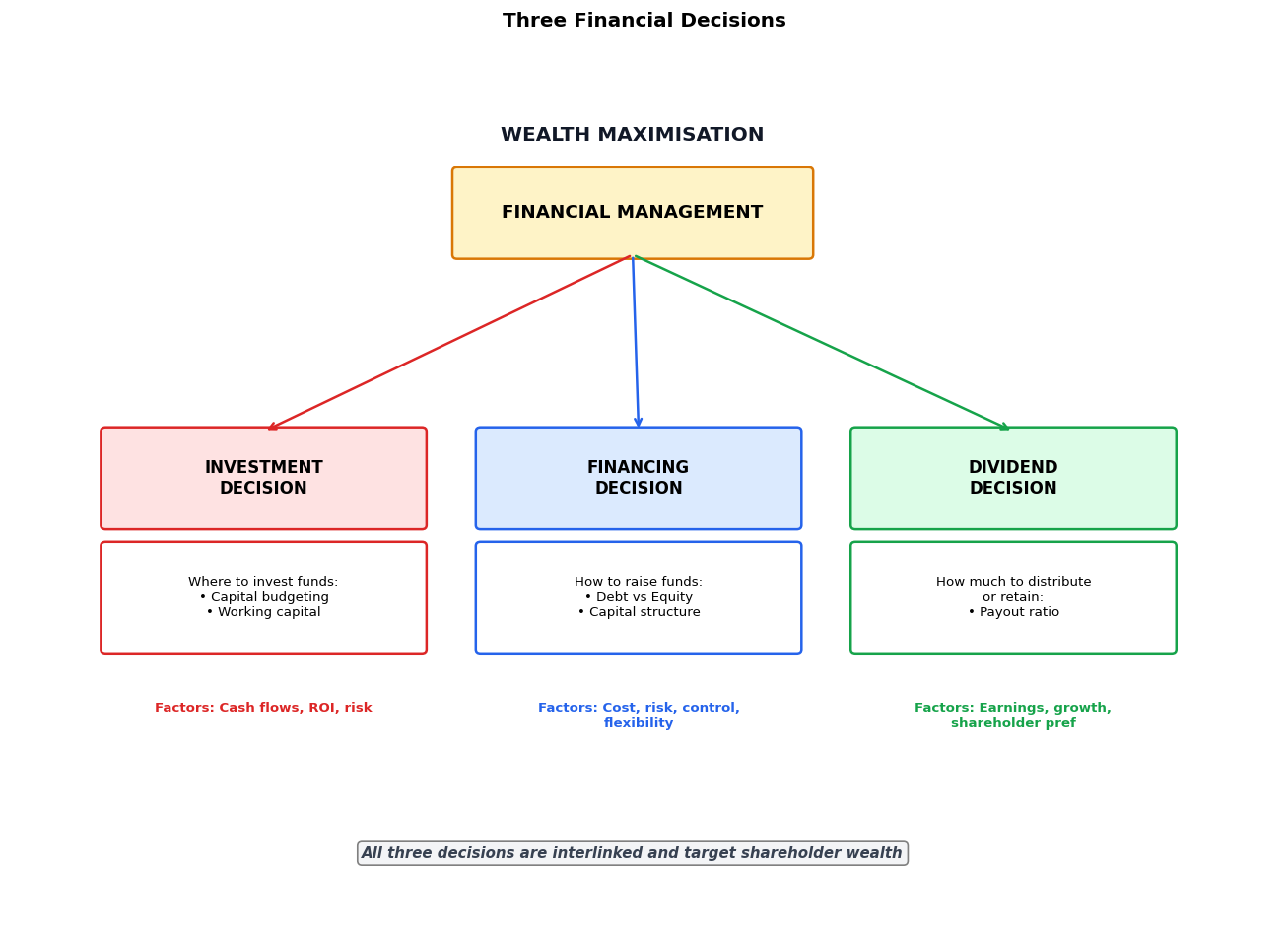
Three financial decisions:

DecisionWhat it coversKey factors
InvestmentAllocation of funds to assetsCash flows ROI risk
FinancingMix of debt & equityCost risk control flexibility
DividendDistribution vs retentionEarnings cash flow growth
  1. Capital budgeting is part of which decision?
    AInvestment
    BFinancing
    CDividend
    DAll
  2. Choosing the debt-equity mix is a:
    AInvestment
    BFinancing
    CDividend
    DOperating
  3. Explain the three financial decisions and their interlinkage.
Show answersHide answers
1. Option 1 — Investment
2. Option 2 — Financing
3. Financial management has three core decisions all targeting wealth maximisation. (1) Investment Decision (capital budgeting and working capital): allocates funds to long-term assets (factory equipment) and short-term assets (inventory debtors cash). Factors: cash flows of project; rate of return; investment criteria (NPV IRR payback). (2) Financing Decision: chooses the right mix of debt and equity (capital structure). Factors: cost; risk; floatation costs; cash flow; control consideration; state of capital market. (3) Dividend Decision: how much profit to distribute and how much to retain. Factors: earnings; cash flow; growth opportunities; shareholder preference; stability; tax; access to capital market; legal constraints. The three are interlinked: investment decisions create demand for funds; financing decisions supply funds; dividend decision retains funds for future investment. Together they shape the financial structure of the firm and determine shareholder wealth.
Q53 3 Marks

Factors affecting capital structure:

FactorEffect on debt level
Cash flow positionStrong → more debt
ICRHigher → more debt
ROIHigher (vs cost of debt) → more debt
Cost of debtLower → more debt
Tax rateHigher → debt cheaper
Cost of equityHigh → less equity
Floatation costHigher equity cost → less equity
Risk considerationHigher business risk → less debt
FlexibilityMore flex needed → less debt
ControlAvoid dilution → more debt
  1. A higher tax rate generally favours:
    AMore debt
    BLess debt
    CNo change
    DRandom
  2. High business risk should usually lead managers to:
    AIncrease
    BDecrease
    CNo change
    DRandom
  3. Discuss any five factors affecting capital structure.
Show answersHide answers
1. Option 1 — More debt
2. Option 2 — Decrease
3. Capital structure choice involves trade-offs. Cash flow strong steady means firm can service debt — favours debt. ICR (EBIT/Interest) > 3 generally indicates safe debt capacity. ROI > cost of debt makes trading on equity profitable. Cost of debt (interest rate) below ROI is the precondition for debt benefit. Tax rate high — interest is tax-deductible making after-tax cost of debt low — favours debt. Cost of equity high (volatile share price high required return) — debt is preferred. Floatation cost — bond issuance is usually cheaper than equity. Risk consideration — high operating risk firm should keep financial risk (debt) low. Flexibility — too much debt locks firm into fixed payments; some unused debt capacity helps in emergencies. Control — debt does not dilute ownership while equity does — owners may prefer debt to retain control. Capital structure decisions balance cost (debt is cheaper) against risk (debt creates fixed obligations).
Q54 6 Marks

Compute EPS for both capital structure options and recommend.

ItemOption A: All EquityOption B: 50% Equity 50% Debt
Equity capital? Rs 500L (5 lakh shares)? Rs 250L (2.5 lakh shares)
Debt @ 10%? Nil? Rs 250L
Interest? Nil? Rs 25L
EBT? Rs 100L? Rs 75L
Tax @ 30%? Rs 30L? Rs 22.5L
PAT? Rs 70L? Rs 52.5L
EPS? Rs 14? Rs 21
Q55 6 Marks

Map each financial decision to its key factors and example.

DecisionKey factorsExample
Investment? Cash flows ROI risk? Build new plant
Financing? Cost risk control flexibility? Issue debentures or equity
Dividend? Earnings cash flow growth? Pay 40% as dividend retain 60%
Q56 3 Marks

Study the three financial decisions diagram and answer:

Financial Management figure
  1. Capital budgeting is part of which decision?
    AInvestment
    BFinancing
    CDividend
    DAll
  2. Choosing the debt-equity mix is a:
    AInvestment
    BFinancing
    CDividend
    DOperating
  3. Explain the three financial decisions and their interlinkage.
Show answersHide answers
1. Option 1 — Investment
2. Option 2 — Financing
3. Financial management has three core decisions all targeting wealth maximisation. (1) Investment Decision (capital budgeting and working capital): allocates funds to long-term assets (factory, equipment) and short-term assets (inventory, debtors, cash). Factors: cash flows of project, rate of return, investment criteria (NPV, IRR, payback). (2) Financing Decision: chooses the right mix of debt and equity (capital structure). Factors: cost, risk, floatation costs, cash flow, control consideration, state of capital market. (3) Dividend Decision: how much profit to distribute and how much to retain. Factors: earnings, cash flow, growth opportunities, shareholder preference, stability, tax, access to capital market, legal constraints. The three are interlinked: investment creates demand for funds; financing supplies funds; dividend retains funds for future investment. Together they shape the financial structure of the firm and determine shareholder wealth.
Q57 8 Marks

Based on the given diagram, answer the following:

Financial Management figure
  1. Which of the following factors directly reduces the working capital requirement of a firm?
    AHigher credit allowed to customers
    BLonger operating cycle
    CMore credit availed from suppliers
    DExpansion in scale of operations
  2. A trading firm generally requires less working capital than a manufacturing firm. Which factor shown in the diagram best explains this?
    ASeasonal Factors
    BNature of Business
    CBusiness Cycle
    DOperating Efficiency
  3. Explain how 'Seasonal Factors' affect the working capital requirements of a business. Give one example.
  4. How does 'Operating Efficiency' of a firm influence its working capital needs?
  5. Financial leverage in a firm's capital structure refers to:
    AThe ratio of current assets to current liabilities
    BThe proportion of debt used in the capital structure relative to equity
    CThe total amount of equity share capital issued by the firm
    DThe dividend paid to preference shareholders
  6. As shown in the diagram, an increase in financial leverage leads to an increase in financial risk. Why?
  7. Which of the following is NOT a component of Owners' Funds as shown in the diagram?
    AEquity Share Capital
    BRetained Earnings
    CDebentures
    DBoth Equity Share Capital and Retained Earnings
  8. A company has a Debt-Equity ratio of 3:1. Comment on its capital structure from the perspective of financial risk and return to equity shareholders.
  9. A company with high growth opportunities is likely to follow which dividend policy, as indicated in the diagram?
    APay very high dividends to attract investors
    BRetain more earnings and pay lower dividends
    CPay dividends only in the form of bonus shares
    DDistribute all profits as dividends
  10. Explain how 'Cash Flow Position' of a company influences its dividend decision.
  11. Which of the following statements about dividend decisions is CORRECT?
    ADividend decision has no impact on the firm's financial planning
    BRetained earnings used for reinvestment reduce the need for external financing
    CLegal constraints encourage firms to pay maximum possible dividends
    DShareholders always prefer lower dividends over higher dividends
  12. How do 'Legal Constraints' affect the dividend policy of a company? Give one example of such a constraint.
Show answersHide answers
1. Option 3 — More credit availed from suppliers
2. Option 2 — Nature of Business
3. Seasonal factors cause fluctuations in demand during certain periods of the year. During peak seasons, a firm needs more working capital to stock inventory and meet higher production/sales demand. For example, a manufacturer of woollen garments requires higher working capital before and during winter months to build up stock.
4. A firm with higher operating efficiency can complete its operating cycle faster, converting raw materials into finished goods and then into cash more quickly. This reduces the amount of funds tied up in the working capital cycle, thereby lowering the working capital requirement.
5. Option 2 — The proportion of debt used in the capital structure relative to equity
6. An increase in financial leverage means the firm has taken on more debt. Debt carries a fixed obligation to pay interest regardless of profit levels. If the firm's earnings fall, it may still have to pay interest, increasing the risk of default and financial distress. This fixed financial burden increases the financial risk for the firm and its equity shareholders.
7. Option 3 — Debentures
8. A Debt-Equity ratio of 3:1 indicates a highly leveraged capital structure with significantly more debt than equity. This increases financial risk because the firm has large fixed interest obligations. However, if the firm earns a return higher than the cost of debt, the excess return magnifies the earnings per share for equity shareholders (trading on equity). Thus, high leverage is a double-edged sword — it amplifies both returns and risks.
9. Option 2 — Retain more earnings and pay lower dividends
10. Dividend payment requires cash outflow. Even if a company has high profits, it can only pay dividends if it has sufficient cash or liquid funds. A company with a strong cash flow position can afford to pay higher dividends, while a company facing cash shortages — even with book profits — may have to restrict or skip dividend payments to maintain liquidity for operations.
11. Option 2 — Retained earnings used for reinvestment reduce the need for external financing
12. Legal constraints set boundaries within which a company can declare dividends. For example, under the Companies Act, dividends can only be paid out of current profits or past accumulated profits, not out of capital. Also, a company must transfer a certain percentage of profits to reserves before declaring dividends. These legal provisions protect creditors and ensure the financial stability of the company, thereby restricting the maximum dividend a firm can pay.

Q58 4 Marks

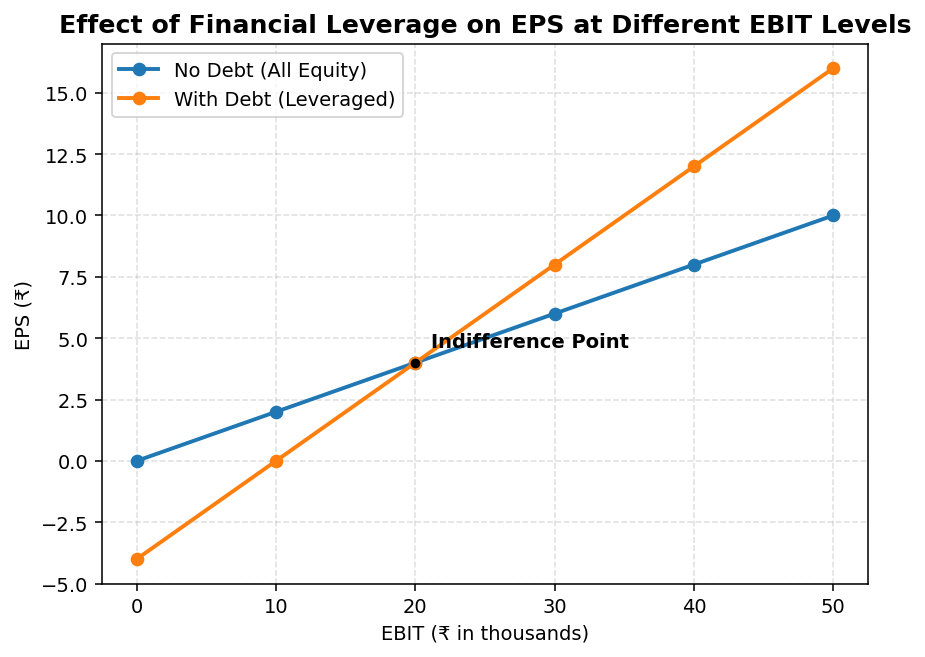
Based on the given chart, answer the following:

Financial Management figure
  1. At what EBIT level do both the 'No Debt' and 'With Debt' plans give the same EPS, as shown in the chart?
    A₹10,000
    B₹30,000
    C₹20,000
    D₹40,000
  2. Beyond the indifference point, which financing plan gives a higher EPS and why?
  3. When EBIT is ₹10,000, the leveraged plan shows an EPS of ₹0. What does a negative EPS (below ₹10,000 EBIT) in the leveraged plan indicate?
    AThe firm is earning supernormal profits
    BThe firm cannot meet its fixed interest obligations from operating earnings
    CThe equity shareholders receive bonus shares
    DThe firm has no financial risk
  4. What is the significance of the 'Indifference Point' in financial management decision-making?
Show answersHide answers
1. Option 3 — ₹20,000
2. Beyond the indifference point (EBIT > ₹20,000), the 'With Debt (Leveraged)' plan gives a higher EPS. This is because the interest on debt is a fixed cost; once EBIT exceeds the interest obligation, the additional earnings accrue entirely to a smaller equity base, magnifying EPS. This concept is known as 'Trading on Equity' or positive financial leverage.
3. Option 2 — The firm cannot meet its fixed interest obligations from operating earnings
4. The Indifference Point is the level of EBIT at which EPS is the same under two different financing plans (debt vs. equity). It helps financial managers decide the optimal capital structure. If the expected EBIT is above the indifference point, debt financing is preferable (higher EPS). If expected EBIT is below the indifference point, equity financing is preferable to avoid financial risk from fixed interest payments.

Make a full Business Studies paper on Financial Management.

Pick the question mix, set the marks, hit generate. You get a ready-to-print paper with an answer key.

Generate your paper — free