Skip to content
TestMacher
Chapter 2 · Class 12 Business Studies

Consumer Protection — Important Questions

58 questions With answers CBSE format

SUMMARY: The chapter on Consumer Protection in Class 12 Business Studies focuses on the rights of consumers and the responsibilities of businesses to ensure fair trade practices and consumer welfare.
KEY TOPICS: Consumer rights, Consumer responsibilities, Consumer Protection Act 1986, Redressal agencies, Consumer forums, Role of NGOs, Consumer awareness, Legal protection, Consumer grievances, Unfair trade practices.

Q1 1 Mark

Which Act provides the legal framework for consumer protection in India today?

AConsumer Protection Act 1986
BConsumer Protection Act 2019
CSale of Goods Act 1930
DCompanies Act 2013
Check answerHide answer
Correct answer: Option 2 — Consumer Protection Act 2019
Q2 1 Mark

Which is NOT a consumer right under CPA 2019?

ARight to safety
BRight to be informed
CRight to free goods
DRight to choose
Check answerHide answer
Correct answer: Option 3 — Right to free goods
Q3 1 Mark

The pecuniary jurisdiction of District Commission under CPA 2019 is up to:

ARs 20 lakh
BRs 1 crore
CRs 50 lakh
DRs 10 crore
Check answerHide answer
Correct answer: Option 3 — Rs 50 lakh
Q4 1 Mark

Hallmark on jewellery indicates:

ATax payment
BQuality certification of gold
CGovernment ownership
DInsurance coverage
Check answerHide answer
Correct answer: Option 2 — Quality certification of gold
Q5 1 Mark

FPO mark on food products certifies:

AFree of pesticide
BQuality of fruit and vegetable products
CForeign produce origin
DFederal price order
Check answerHide answer
Correct answer: Option 2 — Quality of fruit and vegetable products
Q6 1 Mark

Which of the following is NOT a right of consumers as per the Consumer Protection Act, 1986?

ARight to safety
BRight to be informed
CRight to choose
DRight to be heard
Check answerHide answer
Correct answer: Option 4 — Right to be heard
Q7 1 Mark

What is the primary objective of the Consumer Protection Act, 1986?

ATo promote consumer awareness
BTo regulate prices of goods
CTo enhance competition among businesses
DTo protect the interests of consumers
Check answerHide answer
Correct answer: Option 4 — To protect the interests of consumers
Q8 1 Mark

Which agency is responsible for addressing consumer grievances at the district level?

ANational Consumer Disputes Redressal Commission
BState Consumer Disputes Redressal Commission
CDistrict Consumer Forum
DConsumer Protection Council
Check answerHide answer
Correct answer: Option 3 — District Consumer Forum
Q9 1 Mark

What is the role of NGOs in consumer protection?

ATo provide legal representation to consumers
BTo promote consumer awareness and education
CTo regulate business practices
DTo enforce consumer laws
Check answerHide answer
Correct answer: Option 2 — To promote consumer awareness and education
Q10 1 Mark

Which of the following is a responsibility of consumers?

ATo report unfair trade practices
BTo ensure products are safe
CTo provide feedback to businesses
DTo be aware of their rights and duties
Check answerHide answer
Correct answer: Option 4 — To be aware of their rights and duties
Q11 1 Mark

Under the Consumer Protection Act, 1986, what is the time frame within which a consumer must file a complaint?

AWithin 1 year of the incident
BWithin 2 years of the incident
CWithin 3 years of the incident
DWithin 5 years of the incident
Check answerHide answer
Correct answer: Option 2 — Within 2 years of the incident
Q12 1 Mark

Which of the following is considered an unfair trade practice?

AProviding accurate product information
BFalse advertising
COffering discounts
DConducting market research
Check answerHide answer
Correct answer: Option 2 — False advertising
Q13 1 Mark

What does the term 'consumer awareness' refer to?

AKnowledge of consumer rights and responsibilities
BUnderstanding business regulations
CKnowledge of market trends
DAwareness of global trade practices
Check answerHide answer
Correct answer: Option 1 — Knowledge of consumer rights and responsibilities
Q14 1 Mark

Which of the following is a feature of the National Consumer Disputes Redressal Commission?

AIt operates at the state level
BIt is the apex body for consumer disputes
CIt handles cases involving less than ₹20 lakhs
DIt is a voluntary organization
Check answerHide answer
Correct answer: Option 2 — It is the apex body for consumer disputes
Q15 1 Mark

What can a consumer do if they are dissatisfied with the resolution provided by a consumer forum?

AFile a complaint with the police
BApproach the higher consumer forum
CIgnore the decision
DContact the media
Check answerHide answer
Correct answer: Option 2 — Approach the higher consumer forum
Q16 3 Marks

Define a consumer under CPA 2019.

View sample solutionHide solution
A consumer is any person who buys goods or hires services for a consideration paid/promised, and includes any user of such goods or beneficiary of such services with the consent of the buyer; excludes those who buy goods for resale or commercial purpose. Includes online transactions.
Q17 3 Marks

List any three rights of consumers.

View sample solutionHide solution
Right to safety; Right to be informed; Right to choose; Right to be heard; Right to seek redressal; Right to consumer education — any three.
Q18 3 Marks

List any three responsibilities of consumers.

View sample solutionHide solution
Be aware of various goods and services; Buy quality marked goods; Learn about risks; Read labels carefully; Assert yourself; Be honest in dealings; File complaints in genuine cases; Insist on cash memo; Form consumer societies — any three.
Q19 3 Marks

Name any three quality marks/certifications used in India.

View sample solutionHide solution
ISI mark — industrial products (BIS); AGMARK — agricultural produce; FPO — fruit and vegetable products; FSSAI — food items; Hallmark — gold/silver jewellery; Wool mark — wool; ISO — international quality; Eco-mark — eco-friendly products — any three.
Q20 3 Marks

List the three-tier redressal machinery under CPA 2019 with pecuniary jurisdiction.

View sample solutionHide solution
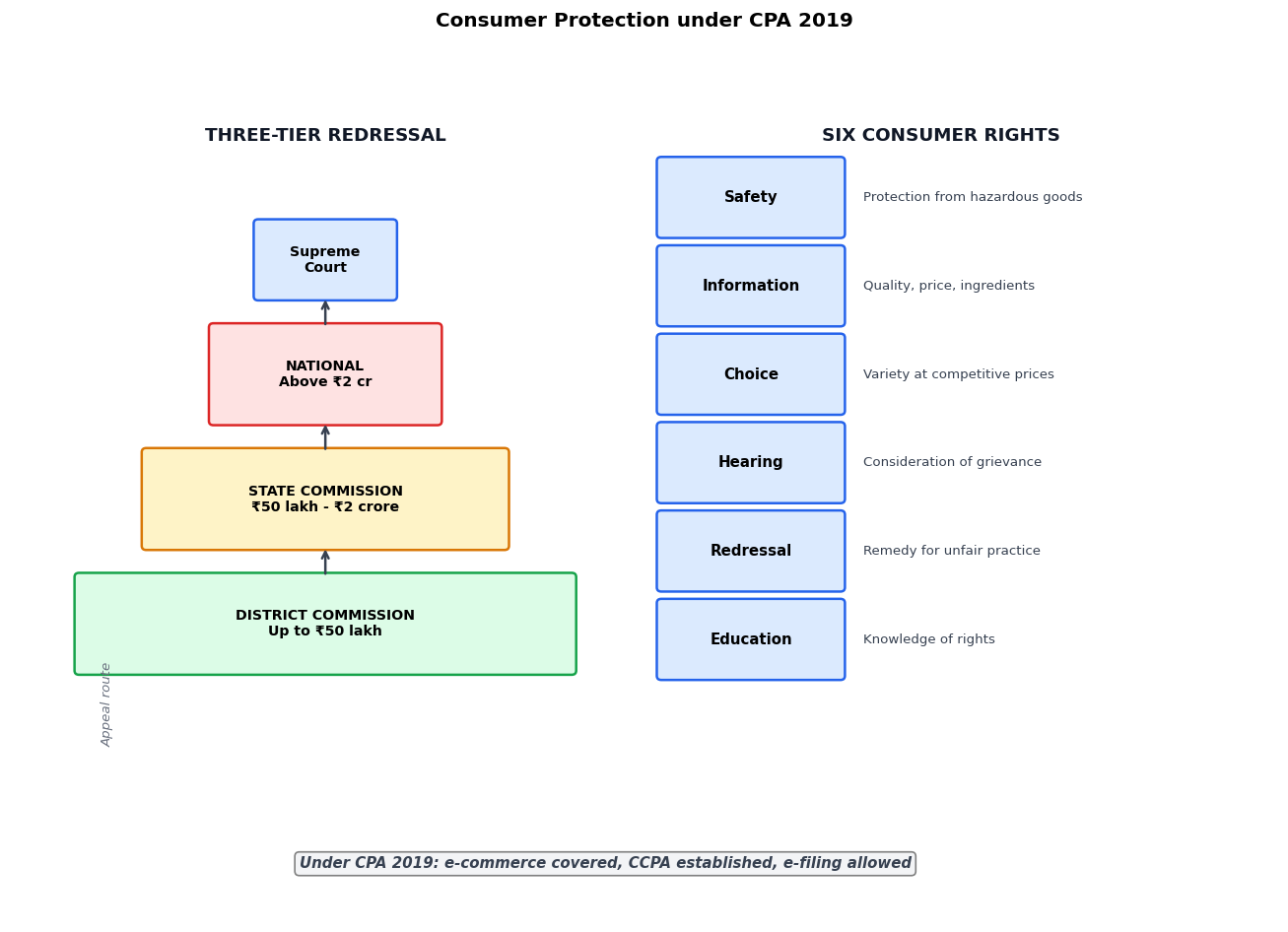
District Commission — up to Rs 50 lakh. State Commission — above Rs 50 lakh up to Rs 2 crore. National Commission — above Rs 2 crore. Appeals: District → State → National → Supreme Court within prescribed time limits.
Q21 3 Marks

Define a consumer under CPA 2019.

View sample solutionHide solution
A consumer is any person who buys goods or hires services for a consideration paid/promised and includes any user of such goods or beneficiary of such services with the consent of the buyer; excludes those who buy goods for resale or commercial purpose. Includes online transactions.
Q22 3 Marks

List any three rights of consumers.

View sample solutionHide solution
Right to safety; Right to be informed; Right to choose; Right to be heard; Right to seek redressal; Right to consumer education — any three.
Q23 3 Marks

List any three responsibilities of consumers.

View sample solutionHide solution
Be aware of various goods and services; Buy quality marked goods; Learn about risks; Read labels carefully; Assert yourself; Be honest in dealings; File complaints in genuine cases; Insist on cash memo; Form consumer societies — any three.
Q24 3 Marks

Name any three quality marks/certifications used in India.

View sample solutionHide solution
ISI mark — industrial products (BIS); AGMARK — agricultural produce; FPO — fruit and vegetable products; FSSAI — food items; Hallmark — gold/silver jewellery; Wool mark — wool; ISO — international quality; Eco-mark — eco-friendly products — any three.
Q25 3 Marks

List the three-tier redressal machinery under CPA 2019 with pecuniary jurisdiction.

View sample solutionHide solution
District Commission — up to Rs 50 lakh. State Commission — above Rs 50 lakh up to Rs 2 crore. National Commission — above Rs 2 crore. Appeals: District → State → National → Supreme Court within prescribed time limits.
Q26 6 Marks

Explain any six rights of a consumer with examples.

View sample solutionHide solution
1) Right to safety — protection against goods/services hazardous to life and property (e.g. ISI mark on electrical goods). 2) Right to be informed — about quality, quantity, purity, standard and price (MRP and ingredients on packets). 3) Right to choose — access to variety at competitive prices (anti-monopoly laws). 4) Right to be heard — assured of consideration (consumer cells in companies). 5) Right to seek redressal — against unfair trade practices (file complaint in District Commission). 6) Right to consumer education — knowledge of rights (NCERT consumer awareness chapters, Jago Grahak Jago campaign).
Q27 6 Marks

Discuss the redressal machinery under CPA 2019 in detail.

View sample solutionHide solution
Three-tier quasi-judicial machinery: 1) District Consumer Disputes Redressal Commission — pecuniary jurisdiction up to Rs 50 lakh; complaint filed by consumer or recognised consumer association. 2) State Consumer Disputes Redressal Commission — pecuniary jurisdiction above Rs 50 lakh and up to Rs 2 crore; first appellate authority for District Commission orders. 3) National Consumer Disputes Redressal Commission — above Rs 2 crore; appellate authority over State Commission; appeal lies to Supreme Court. New features under CPA 2019: Central Consumer Protection Authority (CCPA) for class actions; e-filing of complaints from buyer's location; mediation cells; product liability provisions; penalties for misleading advertisements.
Q28 6 Marks

Discuss six responsibilities of consumers under CPA 2019.

View sample solutionHide solution
1) Be aware of various goods and services available so that an intelligent and wise choice can be made. 2) Buy only standardised goods — ISI mark, FSSAI, AGMARK, etc. 3) Learn about risks associated with products and follow manufacturer's instructions. 4) Read labels carefully — price, weight, manufacturing and expiry date. 5) Assert yourself to ensure that you get a fair deal. 6) Be honest in dealings — choose only legal goods, discourage unfair trade practices. 7) Ask for cash memo on purchases and demand for warranty cards. 8) File complaints for genuine grievances. 9) Form consumer societies for protection and welfare.
Q29 6 Marks

Mr A bought a refrigerator for Rs 60000 which stopped working within 3 months. The dealer refused to repair. Discuss who he can complain to and procedure.

View sample solutionHide solution
Mr A is a consumer (bought goods for consideration not for resale). The dealer's refusal violates his right to safety, right to be heard and right to seek redressal. Forum: District Consumer Disputes Redressal Commission (pecuniary value Rs 60000 < Rs 50 lakh). Procedure: 1) File written complaint at District Commission having jurisdiction over place of purchase or consumer's residence (CPA 2019 allows e-filing from buyer's location). 2) Pay nominal fee. 3) Attach cash memo, warranty card and correspondence with dealer. 4) Commission issues notice to dealer; both sides heard; expert evidence may be sought. 5) Reliefs available: removal of defect; replacement; refund; compensation for loss; cost of litigation. If aggrieved by order, appeal to State Commission within 45 days.
Q30 6 Marks

Discuss the role of consumer organisations and NGOs in protecting consumer interests.

View sample solutionHide solution
Consumer organisations and NGOs play a vital role: 1) Educate consumers about rights and responsibilities through workshops, seminars and publications. 2) Publishing journals/magazines to spread awareness (e.g. Consumer Voice). 3) Carrying out comparative product testing in accredited labs and publishing test results. 4) Filing complaints in appropriate consumer courts on behalf of consumers — they have locus standi under CPA 2019. 5) Filing public interest litigations (PILs) for matters affecting consumers at large. 6) Organising training programmes for activists, teachers and consumers. 7) Pressurising businesses and government to take corrective action and enact consumer-friendly laws. 8) Encouraging consumers to strongly protest against unfair trade practices. Examples: VOICE, Consumer Coordination Council, Consumer Education and Research Centre (CERC), Common Cause.
Q31 6 Marks

Explain any six rights of a consumer with examples.

View sample solutionHide solution
1) Right to safety — protection against goods/services hazardous to life and property (e.g. ISI mark on electrical goods). 2) Right to be informed — about quality quantity purity standard and price (MRP and ingredients on packets). 3) Right to choose — access to variety at competitive prices (anti-monopoly laws). 4) Right to be heard — assured of consideration (consumer cells in companies). 5) Right to seek redressal — against unfair trade practices (file complaint in District Commission). 6) Right to consumer education — knowledge of rights (NCERT consumer awareness chapters Jago Grahak Jago campaign).
Q32 1 Mark

Assertion (A): The Consumer Protection Act 2019 replaced the 1986 Act.

Reason (R): The 2019 Act includes e-commerce transactions and product liability provisions which were absent earlier.

Show explanationHide explanation
Correct answer: Option 1 — Both A and R are true, and R is the correct explanation of A.
Q33 1 Mark

Assertion (A): Hallmark on gold jewellery is a quality mark.

Reason (R): It certifies the purity of precious metal as per BIS standards.

Show explanationHide explanation
Correct answer: Option 1 — Both A and R are true, and R is the correct explanation of A.
Q34 1 Mark

Assertion (A): A consumer can directly approach the National Commission if claim exceeds Rs 2 crore.

Reason (R): Pecuniary jurisdiction of National Commission is above Rs 2 crore under CPA 2019.

Show explanationHide explanation
Correct answer: Option 1 — Both A and R are true, and R is the correct explanation of A.
Q35 1 Mark

Assertion (A): Right to consumer education is essential for empowerment.

Reason (R): An informed consumer can avoid exploitation by sellers and make wise choices.

Show explanationHide explanation
Correct answer: Option 1 — Both A and R are true, and R is the correct explanation of A.
Q36 1 Mark

Assertion (A): A person who buys for resale is not a consumer.

Reason (R): The CPA 2019 specifically excludes purchases made for commercial purposes from the definition of consumer.

Show explanationHide explanation
Correct answer: Option 1 — Both A and R are true, and R is the correct explanation of A.
Q37 1 Mark

Assertion (A): Consumers have the right to be informed about the quality and quantity of goods they purchase.

Reason (R): The Consumer Protection Act 1986 mandates businesses to provide accurate information about their products.

Show explanationHide explanation
Correct answer: Option 1 — Both A and R are true, and R is the correct explanation of A.
Q38 1 Mark

Assertion (A): The Consumer Protection Act 1986 provides for the establishment of consumer forums.

Reason (R): Consumer forums are intended to resolve disputes between consumers and businesses.

Show explanationHide explanation
Correct answer: Option 1 — Both A and R are true, and R is the correct explanation of A.
Q39 1 Mark

Assertion (A): Consumers are responsible for ensuring they read the terms and conditions before making a purchase.

Reason (R): Consumer responsibilities include being aware of their rights and obligations as consumers.

Show explanationHide explanation
Correct answer: Option 1 — Both A and R are true, and R is the correct explanation of A.
Q40 1 Mark

Statement 1: District Commission's pecuniary jurisdiction is up to Rs 50 lakh.

Statement 2: State Commission handles claims above Rs 50 lakh and up to Rs 2 crore.

Show answerHide answer
Correct answer: Option 1 — Both statements are true.
Q41 1 Mark

Statement 1: Right to safety protects against hazardous goods.

Statement 2: ISI mark on electrical goods supports this right.

Show answerHide answer
Correct answer: Option 1 — Both statements are true.
Q42 1 Mark

Statement 1: CCPA is established under CPA 2019.

Statement 2: It can take suo motu action on misleading advertisements.

Show answerHide answer
Correct answer: Option 1 — Both statements are true.
Q43 1 Mark

Statement 1: A consumer association can file a complaint under CPA 2019.

Statement 2: It has the locus standi to act on behalf of aggrieved consumers.

Show answerHide answer
Correct answer: Option 1 — Both statements are true.
Q44 1 Mark

Statement 1: FSSAI mark is for food products.

Statement 2: AGMARK is for agricultural produce.

Show answerHide answer
Correct answer: Option 1 — Both statements are true.
Q45 1 Mark

Statement 1: Consumers have the right to seek redressal against unfair trade practices.

Statement 2: The Consumer Protection Act 1986 does not provide any legal protection to consumers.

Show answerHide answer
Correct answer: Option 2 — Only Statement 1 is true.
Q46 1 Mark

Statement 1: Consumer responsibilities include being informed about the products they purchase.

Statement 2: Consumer rights are only applicable to goods and not services.

Show answerHide answer
Correct answer: Option 3 — Only Statement 2 is true.
Q47 1 Mark

Statement 1: The role of NGOs in consumer protection is to promote consumer awareness.

Statement 2: Consumer forums are established to help consumers file grievances.

Show answerHide answer
Correct answer: Option 1 — Both statements are true.
Q48 3 Marks
Mrs Sharma bought a washing machine for Rs 35000 with two-year warranty. After 3 months it stopped working. The dealer refused to repair claiming 'rough use'. Mrs Sharma writes to the manufacturer — no response. She approaches the District Consumer Disputes Redressal Commission with cash memo warranty card and dealer correspondence. Commission orders replacement plus compensation of Rs 10000 for harassment.
  1. For Rs 35000 claim the appropriate forum is:
    ADistrict
    BState
    CNational
    DSupreme
  2. Mrs Sharma's right that was upheld is:
    ARight to safety
    BRight to be informed
    CRight to redressal
    DRight to choose
  3. Trace the complaint procedure and consumer rights involved.
Show answersHide answers
1. Option 1 — District
2. Option 3 — Right to redressal
3. Three-tier consumer redressal under CPA 2019: District Commission (up to Rs 50 lakh — Mrs Sharma's case at Rs 35000); State Commission (Rs 50 lakh - Rs 2 crore); National Commission (above Rs 2 crore). Procedure: file written complaint at appropriate forum (or e-file from buyer's location under CPA 2019); pay nominal fee; attach evidence (cash memo warranty card correspondence); forum issues notice to dealer manufacturer; both sides heard; forum may seek expert evidence. Reliefs: removal of defect; replacement; refund; compensation for loss; cost of litigation. Appeal: District → State (within 45 days) → National → Supreme Court. Mrs Sharma's case used right to seek redressal — the consumer's right when their safety to-be-informed or to-choose is violated. CPA 2019 also covers e-commerce product liability mediation cells and CCPA — making consumer protection stronger than the 1986 Act.
Q49 3 Marks
GlowSkin Cream advertised 'Get fair skin in 7 days'. Mrs Iyer bought the product (Rs 800) used it for 4 weeks — no change. CCPA receives multiple similar complaints. Investigation reveals false claim. CCPA issues directives: (a) discontinue misleading ad; (b) penalty of Rs 50 lakh; (c) corrective ad informing consumers of the falsity; (d) endorser penalty.
  1. Misleading advertisement complaints are best handled by:
    ADistrict
    BCCPA
    CState
    DCourt
  2. CCPA was set up under which Act?
    A1986
    B2019
    C2000
    D2015
  3. Discuss the role of CCPA under CPA 2019.
Show answersHide answers
1. Option 2 — CCPA
2. Option 2 — 2019
3. CCPA (Central Consumer Protection Authority) was established under CPA 2019 as a regulator for class actions. Its powers: (1) inquiry into violations of consumer rights unfair trade practices and false misleading advertisements; (2) suo motu action without a specific complaint; (3) order discontinuation of misleading ads; (4) impose penalties (up to Rs 10 lakh on manufacturer; Rs 50 lakh for repeat offence; up to Rs 50 lakh on endorser); (5) corrective advertisement to undo misleading effect; (6) recall of unsafe goods. CCPA fills the gap left by the 1986 Act which had no class-action mechanism. Misleading advertisements have always been a major consumer issue — fairness creams weight-loss products coaching institute claims. CCPA's enforcement raises the cost of misleading advertising and protects consumers en masse — a complement to individual redressal at District/State/National Commissions.
Q50 3 Marks
Rohan ordered a smartphone (Rs 25000) from an unknown e-commerce site. Payment went through but no delivery for 30 days. The seller's number stopped working. Rohan files complaint at the District Commission under CPA 2019. The Commission notes that CPA 2019 explicitly covers e-commerce; orders refund and Rs 5000 compensation to be recovered from the e-commerce platform that allowed the fraudulent seller.
  1. E-commerce transactions under CPA 2019 are:
    AYes covered
    BNo
    COnly physical goods
    DRandom
  2. CPA 2019 allows complaint filing at:
    ABuyer's location
    BSeller's location
    CEither
    DCourt only
  3. Discuss how CPA 2019 strengthens consumer protection in e-commerce.
Show answersHide answers
1. Option 1 — Yes covered
2. Option 3 — Either
3. CPA 2019 expanded consumer protection to include: (1) E-COMMERCE — digital purchases now covered explicitly; e-commerce platforms have liabilities for sellers on their site. (2) PRODUCT LIABILITY — manufacturer service provider seller liable for defects and harm. (3) UNFAIR CONTRACTS — any contract that limits consumer's right or imposes unreasonable obligations is voidable. (4) FILING FROM CONSUMER'S LOCATION — buyer can file at District Commission of his own residence not just seller's. (5) E-FILING of complaints. (6) MEDIATION CELLS for amicable settlement. (7) CCPA for class actions and misleading advertisements. (8) HIGHER PECUNIARY LIMITS — District up to Rs 50 lakh State up to Rs 2 crore National above. Online frauds are a growing concern; CPA 2019 ensures e-commerce platforms cannot escape responsibility. Consumers should verify seller credentials before payment use COD or escrow services keep records and complain promptly.
Q51 4 Marks
Ramesh purchased a washing machine from a local electronics store. The machine stopped working within two months of purchase. When Ramesh approached the shopkeeper, he was told that the warranty had expired, which was false. Frustrated, Ramesh decided to file a complaint with the District Consumer Disputes Redressal Forum. He gathered all his documents including the bill, warranty card, and written communication with the shopkeeper. The District Forum heard his case and ordered the shopkeeper to replace the machine and pay compensation. This case highlights the importance of the Consumer Protection Act 1986, which was enacted to protect consumers from unfair trade practices and provide them with a mechanism for redressal of grievances. The Act established a three-tier quasi-judicial machinery at the district, state, and national levels.
  1. Under the Consumer Protection Act 1986, the District Consumer Disputes Redressal Forum can handle complaints involving claims up to:
    ARs. 20 lakhs
    BRs. 1 crore
    CRs. 50 lakhs
    DRs. 5 crore
  2. Which consumer right did Ramesh exercise by filing a complaint with the District Consumer Forum?
    ARight to Safety
    BRight to Information
    CRight to Seek Redressal
    DRight to Consumer Education
  3. What is an 'unfair trade practice' as referred to in the Consumer Protection Act 1986? Give one example from the passage.
  4. Name the three-tier redressal machinery established under the Consumer Protection Act 1986 and state the pecuniary jurisdiction of the National Consumer Disputes Redressal Commission.
Show answersHide answers
1. Option 1 — Rs. 20 lakhs
2. Option 3 — Right to Seek Redressal
3. An unfair trade practice refers to a method of trade or commercial practice that is adopted by a trader to promote the sale of goods or services in an unfair or deceptive manner. In the passage, the shopkeeper falsely claimed that the warranty had expired, which is an example of an unfair trade practice as it involved providing false information to the consumer.
4. The three-tier redressal machinery under the Consumer Protection Act 1986 consists of: (1) District Consumer Disputes Redressal Forum at the district level, (2) State Consumer Disputes Redressal Commission at the state level, and (3) National Consumer Disputes Redressal Commission at the national level. The National Consumer Disputes Redressal Commission handles complaints where the value of goods or services and compensation claimed exceeds Rs. 1 crore.
Q52 3 Marks

Three-tier redressal machinery under CPA 2019:

ForumPecuniary jurisdictionAppeal lies to
District CommissionUp to Rs 50 lakhState Commission
State CommissionRs 50 lakh - Rs 2 croreNational Commission
National CommissionAbove Rs 2 croreSupreme Court
  1. Pecuniary jurisdiction of District Commission is up to:
    ARs 20 lakh
    BRs 50 lakh
    CRs 1 crore
    DRs 2 crore
  2. An order of the State Commission is appealable to:
    ASupreme Court
    BHigh Court
    CNational Commission
    DGovt
  3. Explain the three-tier redressal machinery with appeal route.
Show answersHide answers
1. Option 2 — Rs 50 lakh
2. Option 3 — National Commission
3. CPA 2019 has a three-tier quasi-judicial redressal machinery. DISTRICT COMMISSION at every district — pecuniary jurisdiction up to Rs 50 lakh; complaint by consumer or recognised consumer association; e-filing allowed. STATE COMMISSION in every state — Rs 50 lakh - Rs 2 crore; first appellate authority for District. NATIONAL COMMISSION at New Delhi — above Rs 2 crore; appellate authority over State; appeal lies to Supreme Court. Time limits: complaint within 2 years of cause; decision within 3 months (or 5 months if expert opinion needed); appeal within 30-45 days of order. Appeal filing fee 50% of award amount but not less than Rs 25000. Reliefs available: removal of defect or deficiency; replacement; refund; compensation for loss; cessation of unfair trade practices; punitive damages; cost of litigation. The three-tier system makes redressal accessible (each level handles claims appropriate to size) and ensures appeals can be made through the chain. CPA 2019 also added CCPA mediation product liability and stronger enforcement.
Q53 3 Marks

Consumer rights and responsibilities:

RightDescriptionCorresponding responsibility
Right to safetyProtection from hazardous goodsBuy quality marked goods
Right to informationQuality price ingredientsRead labels
Right to chooseVariety at competitive pricesCompare options
Right to be heardConsideration of grievanceSpeak up assert
Right to redressalRemedy for unfair practiceFile genuine complaints
Right to consumer educationKnowledge of rightsStay informed
  1. ISI mark on electrical goods primarily ensures:
    ARight to safety
    BRight to be informed
    CRight to choose
    DRight to redressal
  2. How many consumer rights does CPA 2019 recognise?
    A4
    B5
    C6
    D8
  3. List the six consumer rights with corresponding responsibilities.
Show answersHide answers
1. Option 1 — Right to safety
2. Option 3 — 6
3. CPA 2019 recognises six consumer rights. RIGHT TO SAFETY — protection against goods hazardous to life property (ISI mark FSSAI hallmark). RIGHT TO BE INFORMED — about quality quantity purity standard price (MRP and ingredients on packets). RIGHT TO CHOOSE — variety at competitive prices (anti-monopoly laws). RIGHT TO BE HEARD — assured of consideration (consumer cells in companies). RIGHT TO SEEK REDRESSAL — against unfair practices (file complaint in District Commission). RIGHT TO CONSUMER EDUCATION — knowledge of rights (Jago Grahak Jago). Each right has a corresponding responsibility: rights without responsibility lead to careless consumption. Responsibilities: stay aware buy quality goods learn risks read labels assert yourself be honest in dealings file genuine complaints insist on cash memo form consumer societies. The rights protect the consumer; the responsibilities make the consumer effective in exercising those rights. Strong consumer movement requires both — informed assertive consumers and responsive sellers.
Q54 6 Marks

Match each consumer dispute scenario to the appropriate redressal forum and right.

ScenarioForumRight invoked
Defective Rs 30000 fridge? District? Right to safety/redressal
Builder did not deliver Rs 80 lakh flat? State? Right to redressal
Class action against Rs 100 cr fraud? National? Right to redressal/CCPA
Misleading fairness cream advert? CCPA + District? Right to information
E-commerce non-delivery Rs 25000? District? Right to redressal
Quality of food unsafe (mass)? CCPA + District/State? Right to safety
Q55 6 Marks

The table below shows the number of consumer complaints filed at different redressal agencies in India in a given year. Which redressal agency received the highest number of complaints, and what percentage of total complaints does it represent? (Round to two decimal places.)

Redressal AgencyNumber of Complaints Filed
District Consumer Forum18500
State Consumer Commission7200
National Consumer Commission3300
Q56 3 Marks

Study the consumer protection diagram and answer:

Consumer Protection figure
  1. Pecuniary jurisdiction of District Commission is up to:
    ARs 20 lakh
    BRs 50 lakh
    CRs 1 crore
    DRs 2 crore
  2. An order of the State Commission is appealable to:
    AState Commission
    BHigh Court
    CNational Commission
    DGovt
  3. Explain the three-tier redressal machinery and consumer rights under CPA 2019.
Show answersHide answers
1. Option 2 — Rs 50 lakh
2. Option 3 — National Commission
3. CPA 2019 has a three-tier quasi-judicial redressal machinery. District Commission at every district — pecuniary jurisdiction up to Rs 50 lakh; complaint by consumer or recognised consumer association; e-filing allowed. State Commission in every state — Rs 50 lakh - Rs 2 crore; first appellate authority for District. National Commission at New Delhi — above Rs 2 crore; appellate authority over State; appeal lies to Supreme Court. Six consumer rights: safety (protection from hazardous goods), information (about quality, price, ingredients), choice (variety at competitive prices), hearing (consideration of grievance), redressal (remedy for unfair practice), consumer education (knowledge of rights). Each right has a corresponding responsibility. New under CPA 2019: e-commerce coverage, product liability, misleading advertisement penalty, CCPA established, mediation cells, e-filing from buyer's location, higher pecuniary limits.
Q57 34 Marks

Based on the given diagram, answer the following:

Consumer Protection figure
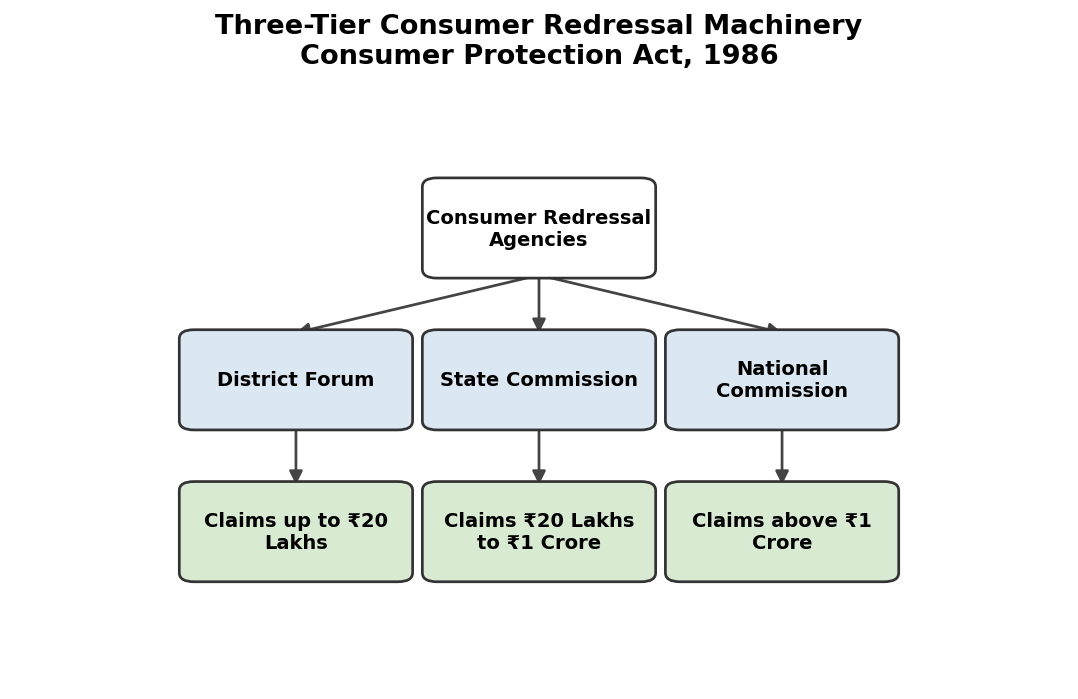
  1. Which redressal agency handles consumer complaints involving claims up to ₹20 Lakhs?
    ANational Commission
    BState Commission
    CDistrict Forum
    DHigh Court
  2. If a consumer is not satisfied with the decision of the District Forum, which body can they approach next?
    ASupreme Court
    BNational Commission
    CState Commission
    DConsumer Council
  3. Name the three-tier consumer redressal machinery established under the Consumer Protection Act, 1986.
  4. What is the significance of having a three-tier redressal system for consumer protection?
  5. Which consumer right ensures that a consumer has access to a variety of goods at competitive prices?
    ARight to Safety
    BRight to be Informed
    CRight to Choose
    DRight to be Heard
  6. Ravi purchased a mixer-grinder that gave him an electric shock due to a manufacturing defect. Which consumer right has been violated?
    ARight to be Heard
    BRight to Safety
    CRight to Choose
    DRight to Consumer Education
  7. Explain the 'Right to be Informed' as a consumer right.
  8. How does the 'Right to Consumer Education' help in empowering consumers?
  9. Which of the following is NOT a function of consumer organisations/NGOs in consumer protection?
    AFiling complaints on behalf of consumers
    BConducting awareness campaigns
    CImposing penalties on businesses
    DProviding consumer education
  10. What does COPRA stand for, and when was it enacted?
    AConsumer Organisation and Protection Rights Act, 1990
    BConsumer Protection Act, 1986
    CConsumer Operations and Practices Regulation Act, 1988
    DConsumer Ombudsman and Protection Rights Act, 1986
  11. Explain the role of NGOs in protecting consumer interests.
  12. Why is business self-regulation considered an important mechanism for consumer protection?
  13. Which quality certification mark should a consumer look for when purchasing gold jewellery?
    AISI Mark
    BAgmark
    CHallmark
    DWoolmark
  14. Why is it important for a consumer to insist on a cash memo or bill at the time of purchase?
    AIt helps the seller maintain accounts
    BIt serves as proof of purchase and is essential for filing a complaint
    CIt is required for income tax purposes only
    DIt is a legal requirement for the seller only
  15. What is the significance of the ISI mark and Agmark for consumers?
  16. A consumer purchased a defective mobile phone but did not collect the bill. Can they file a complaint in the consumer forum? What lesson does this teach about consumer responsibilities?
  17. Which redressal agency handles consumer disputes involving claims up to ₹20 Lakhs?
    ANational Commission
    BState Commission
    CDistrict Forum
    DSupreme Court
  18. If a consumer is not satisfied with the order of the State Commission, which body can they appeal to?
    ADistrict Forum
    BHigh Court
    CNational Commission
    DConsumer Council
  19. Explain the significance of the three-tier redressal machinery established under the Consumer Protection Act 1986.
  20. What is the pecuniary jurisdiction of the State Commission under the Consumer Protection Act 1986?
  21. Which consumer right ensures that a consumer gets access to a variety of goods at competitive prices?
    ARight to Safety
    BRight to be Informed
    CRight to Choose
    DRight to be Heard
  22. Riya bought a pressure cooker that exploded due to a manufacturing defect, injuring her. Which consumer right was violated?
    ARight to Consumer Education
    BRight to Safety
    CRight to be Heard
    DRight to Seek Redressal
  23. Distinguish between the 'Right to be Informed' and the 'Right to Consumer Education'.
  24. How does the 'Right to Seek Redressal' protect consumers from unfair trade practices?
  25. Which of the following is a government-initiated consumer awareness campaign in India?
    AConsumer Guidance Society of India
    BBureau of Indian Standards
    CJago Grahak Jago
    DEssential Commodities Act
  26. Which mechanism of consumer protection involves businesses voluntarily adopting ethical practices?
    ALegislative Measures
    BRole of NGOs
    CConsumer Awareness
    DBusiness Self-Regulation
  27. Explain the role of NGOs in consumer protection in India.
  28. How does the Bureau of Indian Standards (BIS) contribute to consumer protection?
  29. What is meant by 'ethical consumption' as a consumer responsibility? Give one example.
  30. A consumer purchased a refrigerator that stopped working within a month. List any two responsibilities the consumer should fulfil to successfully seek redressal.
  31. Which redressal agency handles consumer disputes involving claims up to ₹20 Lakhs under the Consumer Protection Act, 1986?
    ANational Commission
    BState Commission
    CDistrict Forum
    DSupreme Court
  32. If a consumer is dissatisfied with the order of the State Commission, which body can they appeal to?
    ADistrict Forum
    BHigh Court
    CNational Commission
    DConsumer Council
  33. Explain the significance of having a three-tier redressal machinery under the Consumer Protection Act, 1986.
  34. What is the pecuniary jurisdiction of the National Commission under the Consumer Protection Act, 1986?
  35. Riya purchased a pressure cooker that exploded due to a manufacturing defect, causing her injury. Which consumer right has been violated?
    ARight to Consumer Education
    BRight to be Heard
    CRight to Safety
    DRight to Seek Redressal
  36. Distinguish between the 'Right to be Informed' and the 'Right to Consumer Education' as shown in the diagram.
  37. How does the 'Right to Seek Redressal' empower consumers? Give one example of how a consumer can exercise this right.
Show answersHide answers
1. Option 3 — District Forum
2. Option 3 — State Commission
3. The three-tier consumer redressal machinery consists of: (1) District Forum at the district level, (2) State Commission at the state level, and (3) National Commission at the national level.
4. The three-tier system ensures that consumers at all levels have access to justice. It provides a hierarchical structure where consumers can appeal to higher bodies if dissatisfied, making redressal accessible, affordable, and efficient at local, state, and national levels.
5. Option 3 — Right to Choose
6. Option 2 — Right to Safety
7. The Right to be Informed means that consumers have the right to be informed about the quality, quantity, potency, purity, standard, and price of goods and services. This protects consumers against unfair trade practices and helps them make informed purchasing decisions.
8. The Right to Consumer Education empowers consumers by providing them with knowledge about their rights and responsibilities. An educated consumer can make informed choices, identify unfair trade practices, and effectively seek redressal when their rights are violated. It leads to a more aware and assertive consumer base.
9. Option 3 — Imposing penalties on businesses
10. Option 2 — Consumer Protection Act, 1986
11. NGOs (Non-Governmental Organisations) play a vital role in consumer protection by: (1) Educating consumers about their rights and responsibilities, (2) Conducting awareness campaigns about unfair trade practices, (3) Filing complaints and representing consumers in consumer forums, (4) Providing legal assistance to consumers, and (5) Pressuring businesses and the government to adopt fair trade practices.
12. Business self-regulation is important because it reflects the ethical responsibility of businesses towards consumers. When businesses voluntarily adopt codes of conduct, quality standards, and fair pricing policies, it reduces the need for external legal intervention. It builds consumer trust, enhances brand reputation, and ensures long-term business sustainability. Self-regulation also leads to faster resolution of consumer grievances without burdening the judicial system.
13. Option 3 — Hallmark
14. Option 2 — It serves as proof of purchase and is essential for filing a complaint
15. ISI mark (Indian Standards Institute) certifies that industrial products like electrical appliances and machinery meet the quality standards set by the Bureau of Indian Standards (BIS). Agmark is a certification mark used on agricultural products, certifying that they conform to a set of standards approved by the Directorate of Marketing and Inspection. Both marks help consumers identify quality products and make informed purchasing decisions.
16. Without a bill or cash memo, the consumer may face difficulty proving the purchase in the consumer forum, as the bill serves as primary evidence. While some forums may accept other proofs like bank statements or warranty cards, the absence of a bill weakens the case. This teaches an important consumer responsibility: always insist on and collect a cash memo or bill at the time of purchase. It is a fundamental duty of every consumer to safeguard their own interests by maintaining proper documentation.
17. Option 3 — District Forum
18. Option 3 — National Commission
19. The three-tier redressal machinery (District Forum, State Commission, National Commission) provides an accessible, affordable, and speedy mechanism for consumers to seek justice. It ensures that disputes of varying monetary values are handled at appropriate levels, and allows appeals at higher levels, thereby ensuring fairness and consumer confidence in the legal system.
20. The State Commission handles consumer disputes where the value of goods or services and compensation claimed exceeds ₹20 Lakhs but does not exceed ₹1 Crore.
21. Option 3 — Right to Choose
22. Option 2 — Right to Safety
23. Right to be Informed means the consumer has the right to get complete information about the product such as ingredients, price, expiry date, etc., before making a purchase decision. Right to Consumer Education means the consumer has the right to acquire knowledge and skills to be an informed consumer throughout life, including awareness of consumer laws and rights.
24. The Right to Seek Redressal entitles consumers to seek compensation or correction against unfair trade practices or exploitation. It allows consumers to file complaints in consumer forums and get remedies such as replacement of goods, refund of price, or compensation for any loss suffered due to defective goods or deficient services.
25. Option 3 — Jago Grahak Jago
26. Option 4 — Business Self-Regulation
27. NGOs (Non-Governmental Organisations) play a vital role in consumer protection by: (i) educating consumers about their rights and responsibilities; (ii) filing complaints and representing consumers in consumer courts; (iii) conducting research and publishing reports on consumer issues; (iv) lobbying for stronger consumer protection laws; and (v) providing guidance and assistance to consumers who have been exploited. Examples include Consumer Guidance Society of India (CGSI) and VOICE (Voluntary Organisation in Interest of Consumer Education).
28. The Bureau of Indian Standards (BIS) contributes to consumer protection by setting quality standards for goods and services in India. It grants the ISI mark (for industrial products) and Hallmark (for gold jewellery) to products that meet prescribed quality standards. This helps consumers identify safe and reliable products, protects them from substandard goods, and ensures that manufacturers maintain consistent quality in their products.
29. Ethical consumption refers to the responsibility of consumers to make purchasing decisions that are environmentally sustainable, socially responsible, and not wasteful. It means avoiding excessive consumption and being mindful of the impact of purchases on society and the environment. Example: Choosing eco-friendly products, avoiding single-use plastics, or buying from companies that follow fair labour practices.
30. Two responsibilities the consumer should fulfil: (i) Insist on and retain the cash memo/bill at the time of purchase, as it serves as proof of purchase required when filing a complaint. (ii) File a complaint promptly with the appropriate consumer redressal forum (District Forum in this case) and report the unfair trade practice or defective product, rather than staying silent about the issue.
31. Option 3 — District Forum
32. Option 3 — National Commission
33. The three-tier redressal machinery (District Forum, State Commission, National Commission) ensures that consumers at every level — local, state, and national — have access to justice. It distributes the workload based on the monetary value of claims, making the process efficient, accessible, and less burdensome. It also provides an appellate mechanism so that consumers can escalate their grievances if they are not satisfied with a lower forum's decision, ultimately up to the Supreme Court.
34. The National Commission handles consumer disputes where the value of goods or services and the compensation claimed exceeds ₹1 Crore. It also hears appeals against the orders of State Commissions.
35. Option 3 — Right to Safety
36. The Right to be Informed means the consumer has the right to receive accurate and complete information about the quality, quantity, price, ingredients, and standard of goods and services before purchase. This helps consumers make informed decisions. On the other hand, the Right to Consumer Education means the consumer has the right to acquire knowledge and skills to be a well-informed consumer throughout their life. It involves awareness of consumer laws, rights, and responsibilities so that consumers can protect themselves from exploitation on a long-term basis.
37. The Right to Seek Redressal empowers consumers by giving them the legal right to seek compensation or correction against unfair trade practices, defective goods, or deficient services. It ensures that consumers are not helpless when they are wronged. For example, if a consumer buys a refrigerator that stops working within the warranty period and the seller refuses to repair or replace it, the consumer can file a complaint at the District Forum under the Consumer Protection Act, 1986, and seek appropriate relief such as replacement, refund, or compensation.

Q58 4 Marks

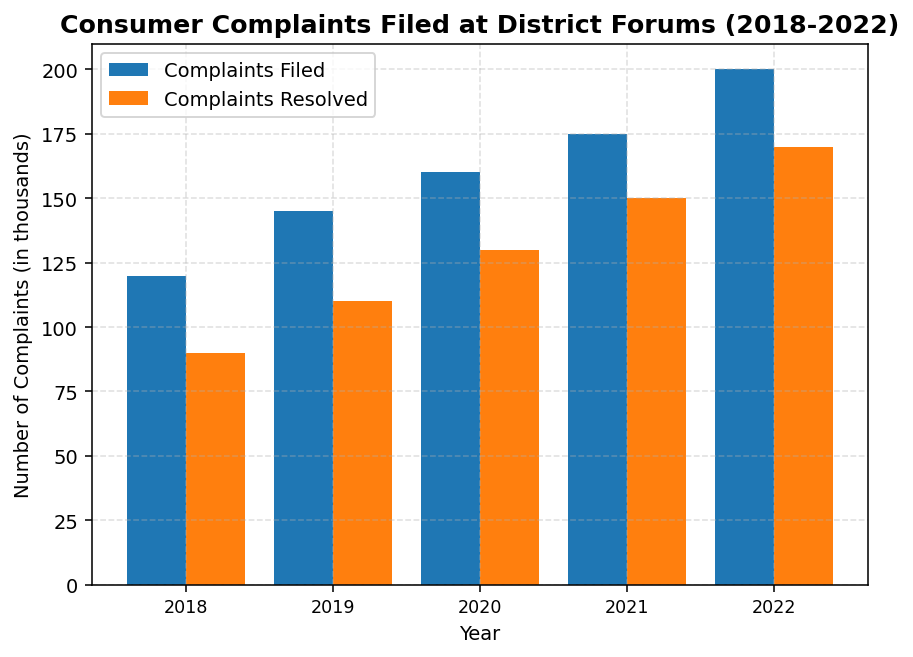
Based on the given chart, answer the following:

Consumer Protection figure
  1. In which year was the difference between complaints filed and complaints resolved the highest?
    A2018
    B2020
    C2022
    D2019
  2. What does the increasing trend in complaints filed from 2018 to 2022 indicate?
    ADecreasing consumer awareness
    BIncreasing consumer awareness and willingness to seek redressal
    CReduction in unfair trade practices
    DDecrease in the number of consumers
  3. Calculate the total number of complaints filed over the five-year period (2018–2022).
  4. What role does the District Forum play in the consumer redressal system, and why is it important for common consumers?
  5. In which year were the highest number of complaints filed at the District Forum level?
    A2019
    B2020
    C2021
    D2022
  6. Which redressal forum consistently recorded the lowest number of consumer complaints across all years shown in the chart?
    ADistrict Forum
    BState Commission
    CNational Commission
    DAll forums had equal complaints
  7. What does the decline in complaints across all forums in 2020 suggest about consumer dispute resolution?
  8. Why do District Forums receive significantly more complaints compared to State and National Commissions?
Show answersHide answers
1. Option 3 — 2022
2. Option 2 — Increasing consumer awareness and willingness to seek redressal
3. Total complaints filed = 120 + 145 + 160 + 175 + 200 = 800 thousand (i.e., 8,00,000 complaints).
4. The District Forum is the first tier of the three-tier consumer redressal machinery under the Consumer Protection Act, 1986. It handles complaints where the value of goods or services and compensation claimed does not exceed ₹20 Lakhs. It is important for common consumers because it is accessible at the local/district level, making it affordable and convenient for ordinary people to seek justice without travelling to higher courts.
5. Option 4 — 2022
6. Option 3 — National Commission
7. The decline in 2020 could suggest the impact of the COVID-19 pandemic, which led to closure of courts and consumer forums, reduced consumer activity, and limited access to redressal mechanisms. It may also reflect temporary disruptions in the formal complaint filing process rather than a genuine reduction in consumer grievances.
8. District Forums receive more complaints because they handle cases with lower monetary claims (up to ₹20 Lakhs), which represent the majority of everyday consumer disputes. They are also more accessible to the common consumer in terms of location, cost, and procedure. Most consumer grievances involve small amounts, making District Forums the first and most frequently used point of redressal.

Make a full Business Studies paper on Consumer Protection.

Pick the question mix, set the marks, hit generate. You get a ready-to-print paper with an answer key.

Generate your paper — free