Money market is a market for:
Financial Markets — Important Questions
SUMMARY: The chapter on Financial Markets in Class 12 Business Studies explains the role and functioning of financial markets in the economy, highlighting their importance in mobilizing savings and facilitating investment.
KEY TOPICS: functions of financial markets, money market, capital market, primary market, secondary market, stock exchange, SEBI (Securities and Exchange Board of India), trading procedure, depository services, dematerialization.
Treasury Bills are issued by:
Check answerHide answer
Which is NOT a function of stock exchange?
Check answerHide answer
SEBI was made statutory in:
Check answerHide answer
Trading and settlement on Indian stock exchanges follows:
Check answerHide answer
What is the primary function of financial markets?
Check answerHide answer
Which of the following is NOT a component of the capital market?
Check answerHide answer
Which market is primarily concerned with short-term borrowing and lending?
Check answerHide answer
What is the role of SEBI in the financial markets?
Check answerHide answer
In which market are new securities issued to the public for the first time?
Check answerHide answer
Which of the following best describes dematerialization?
Check answerHide answer
What is the main difference between the primary and secondary market?
Check answerHide answer
Which of the following is a feature of the stock exchange?
Check answerHide answer
What does the term 'trading procedure' refer to in the context of financial markets?
Check answerHide answer
Which of the following is NOT a function of financial markets?
Check answerHide answer
Distinguish between primary and secondary markets on three bases.
View sample solutionHide solution
List any three money market instruments.
View sample solutionHide solution
State any three functions of a stock exchange.
View sample solutionHide solution
What is the role of SEBI?
View sample solutionHide solution
Explain any two methods of floatation in primary market.
View sample solutionHide solution
Distinguish between primary and secondary markets on three bases.
View sample solutionHide solution
List any three money market instruments.
View sample solutionHide solution
State any three functions of a stock exchange.
View sample solutionHide solution
What is the role of SEBI?
View sample solutionHide solution
Explain any two methods of floatation in primary market.
View sample solutionHide solution
Discuss the functions of financial market and distinguish between money market and capital market.
View sample solutionHide solution
Explain the trading and settlement procedure on a stock exchange.
View sample solutionHide solution
Discuss the objectives and any four functions of SEBI.
View sample solutionHide solution
A company plans to raise Rs 500 crore via IPO. Discuss any five methods of floatation it can choose between and recommend.
View sample solutionHide solution
Explain any five money market instruments.
View sample solutionHide solution
Discuss the functions of financial market and distinguish between money market and capital market.
View sample solutionHide solution
Assertion (A): Money market deals in short-term funds.
Reason (R): Maturity period of money market instruments is up to one year hence they fund short-term needs.
Show explanationHide explanation
Assertion (A): Stock exchange provides liquidity to existing securities.
Reason (R): It allows investors to buy and sell securities readily at fair market prices.
Show explanationHide explanation
Assertion (A): SEBI was made statutory in 1992.
Reason (R): The SEBI Act 1992 was enacted to give it statutory powers to regulate the securities market.
Show explanationHide explanation
Assertion (A): Treasury Bills are zero-coupon instruments.
Reason (R): They are issued at a discount and redeemed at face value the difference being the implicit interest.
Show explanationHide explanation
Assertion (A): Dematerialisation has reduced settlement risk.
Reason (R): Shares are held electronically in demat accounts removing the risks of physical handling and forgery.
Show explanationHide explanation
Assertion (A): Financial markets play a crucial role in mobilizing savings.
Reason (R): They provide a platform for investors to trade securities and earn returns.
Show explanationHide explanation
Assertion (A): The money market deals with long-term securities.
Reason (R): It is primarily concerned with the borrowing and lending of short-term funds.
Show explanationHide explanation
Assertion (A): The capital market includes both the primary and secondary markets.
Reason (R): The capital market is exclusively for the trading of government securities.
Show explanationHide explanation
Statement 1: Primary market is also called new issue market.
Statement 2: Companies raise fresh capital here.
Show answerHide answer
Statement 1: Commercial paper is unsecured and short-term.
Statement 2: It is issued by large credit-worthy companies.
Show answerHide answer
Statement 1: Stock exchange has a mechanism for price discovery.
Statement 2: Continuous buying and selling reflects fair market value.
Show answerHide answer
Statement 1: Indian stock exchanges follow T+1 settlement.
Statement 2: Trades are settled within one working day after the trade date in dematerialised form.
Show answerHide answer
Statement 1: SEBI regulates merchant bankers.
Statement 2: SEBI also protects interests of retail investors.
Show answerHide answer
Statement 1: The primary market is where new securities are issued and sold for the first time.
Statement 2: The secondary market involves the buying and selling of existing securities.
Show answerHide answer
Statement 1: The money market deals with short-term funds, typically for a period of up to one year.
Statement 2: The capital market is primarily concerned with long-term investments.
Show answerHide answer
Statement 1: SEBI is responsible for regulating the stock exchanges in India.
Statement 2: SEBI's main function is to provide loans to companies in need of capital.
Show answerHide answer
-
An IPO is a function of which market?APrimaryBSecondaryCBothDNeither
-
DRHP is filed with:ASEBIBRBICStock exchangeDGovt
-
Trace the IPO process and the role of SEBI.
Show answersHide answers
-
Indian stock market settlement is now:AT+0BT+1CT+2DT+5
-
For trading shares an investor needs:ADematBTradingCBoth requiredDEither
-
Trace the steps in stock exchange trading and explain the role of Demat.
Show answersHide answers
-
SEBI's primary role here was:AInvestor protectionBTax collectionCStock pricingDCurrency
-
Trading on non-public information is:AYes legalBIllegalCOptionalDRandom
-
Discuss SEBI's role in protecting investors with reference to this case.
Show answersHide answers
-
What is the process of converting physical share certificates into electronic form called?ASecuritizationBDematerializationCDigitizationDRematerialization
-
Which of the following is NOT a depository operating in India?ANSDLBCDSLCSEBIDBoth NSDL and CDSL are depositories
-
Explain any two advantages of holding securities in dematerialized form.
-
Ramesh invests in the secondary market through BSE. What is the primary function of the secondary market?
Show answersHide answers
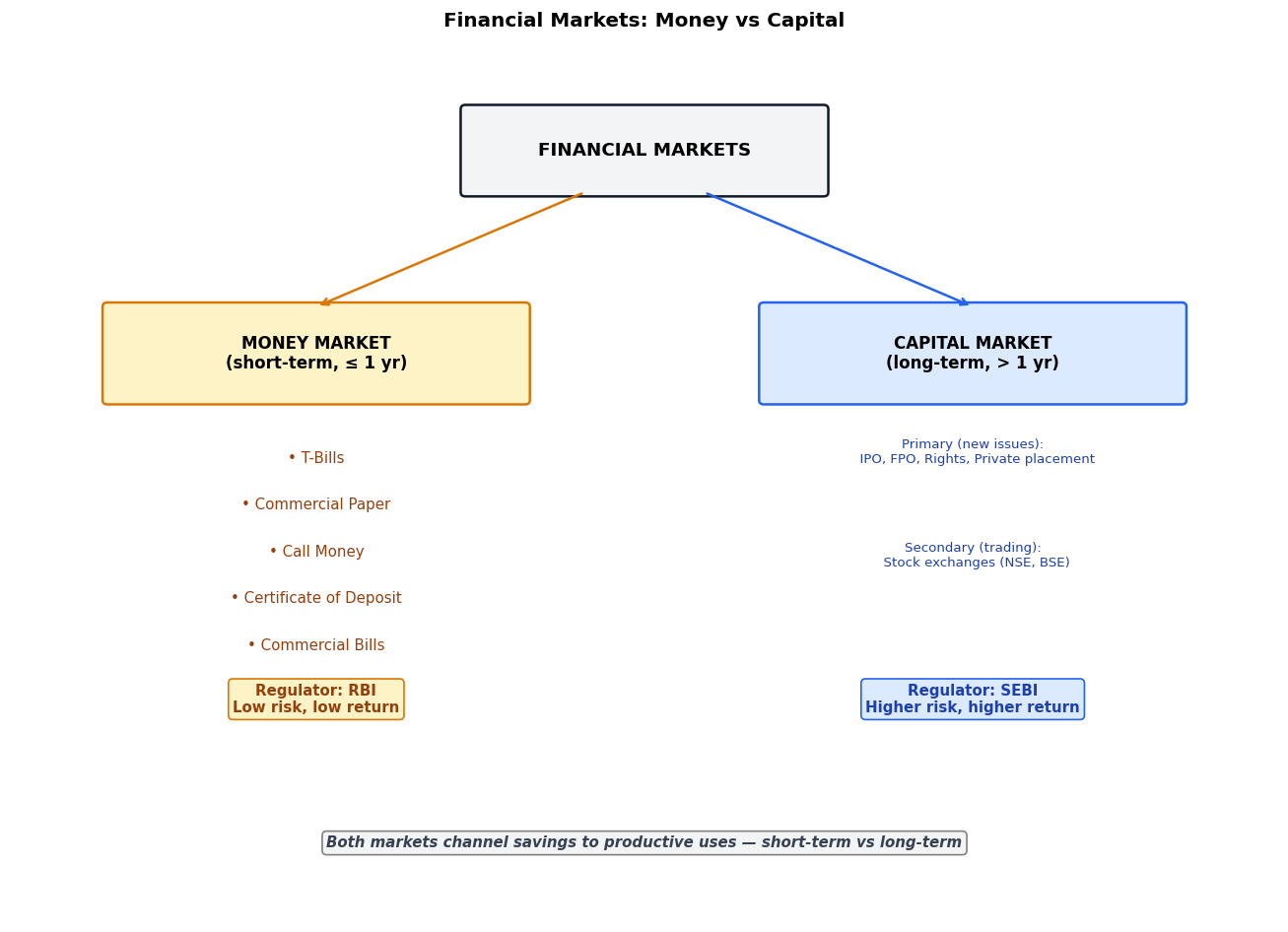
Money market vs Capital market:
| Aspect | Money market | Capital market |
|---|---|---|
| Period | ≤ 1 year | > 1 year |
| Instruments | T-bills CP CD Call money | Equity Debentures Bonds |
| Liquidity | High | Comparatively less |
| Returns | Low | Higher |
| Risk | Low | Higher |
| Regulator | RBI | SEBI |
-
Treasury Bills are traded in the:AMoney marketBCapital marketCBothDNeither
-
Capital market is regulated by:ARBIBSEBICGovtDStock exchange
-
Compare money market and capital market.
Show answersHide answers
Money market instruments:
| Instrument | Issuer | Tenure |
|---|---|---|
| Treasury Bill | RBI for Govt | 14-364 days |
| Commercial Paper | Large corporates | 15 days-1 year |
| Call Money | Banks to banks | 1-15 days |
| Certificate of Deposit | Banks/FIs | 91 days-1 year |
| Commercial Bill | Trade between firms | Up to 90 days typically |
-
Issued by RBI on behalf of Government:ATreasury BillBCommercial PaperCCall MoneyDBond
-
Inter-bank overnight borrowing market is:ATreasury BillBCommercial PaperCCall MoneyDEquity
-
Explain any five money market instruments.
Show answersHide answers
Distinguish between money market and capital market instruments.
| Aspect | Money market | Capital market |
|---|---|---|
| Period | ? ≤ 1 year | ? > 1 year |
| Instruments | ? T-Bills CP CD Call money | ? Equity Debentures Bonds |
| Liquidity | ? High | ? Less |
| Returns | ? Low | ? Higher |
| Risk | ? Low | ? Higher |
| Regulator | ? RBI | ? SEBI |
Match each role/function in the stock market to the correct entity.
| Function | Entity |
|---|---|
| Statutory regulator | ? SEBI |
| Trading platform | ? Stock exchange (NSE/BSE) |
| Settles trades | ? Clearing corporation |
| Holds shares electronically | ? Depository (NSDL/CDSL) |
| Manages an IPO | ? Merchant banker |
| Rates debentures | ? Credit rating agency |
| Opens Demat for investor | ? Depository participant |
Study the financial markets diagram and answer:
-
Treasury Bills are traded in the:AMoney marketBCapital marketCBothDNeither
-
Capital market is regulated by:ARBIBSEBICGovtDStock exchange
-
Compare money market and capital market with examples of instruments.
Show answersHide answers
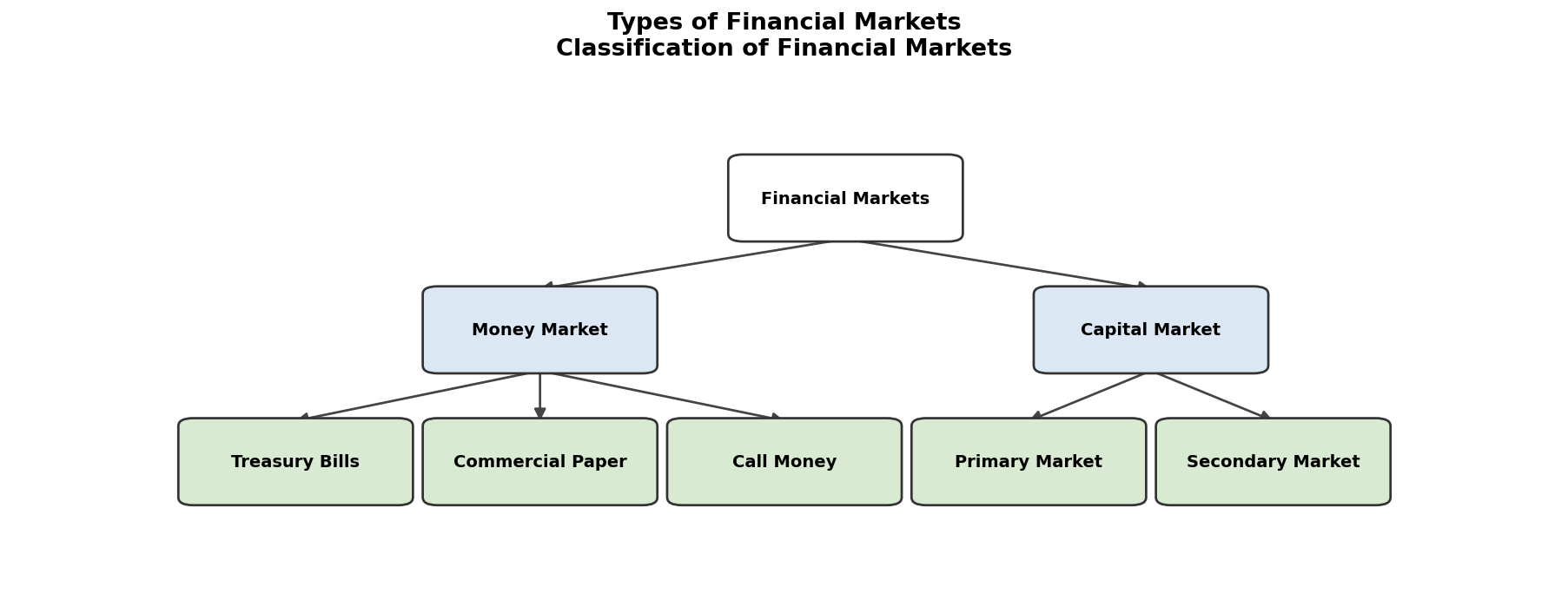
Based on the given diagram, answer the following:
-
Which of the following is an instrument of the Money Market?AEquity SharesBDebenturesCTreasury BillsDMutual Funds
-
What is the main difference between the Primary Market and the Secondary Market?
-
Which financial market deals with short-term funds having a maturity period of up to one year?ACapital MarketBMoney MarketCPrimary MarketDSecondary Market
-
Name any two functions performed by Financial Markets.
-
When a company issues shares to the public for the first time, it is called:AFollow-on Public Offer (FPO)BRights IssueCInitial Public Offer (IPO)DPrivate Placement
-
What is meant by 'Rights Issue' as a method of floatation in the Primary Market?
-
In which method of floatation are securities sold directly to a small group of investors such as financial institutions, mutual funds, or banks?APublic IssueBOffer for SaleCe-IPODPrivate Placement
-
Distinguish between 'Offer for Sale' and 'Public Issue' as methods of raising capital in the Primary Market.
-
SEBI was established as a statutory body under which Act?ASEBI Act, 1988BSEBI Act, 1992CCompanies Act, 1956DSecurities Act, 1990
-
What is 'Insider Trading' and why does SEBI prohibit it?
-
Which of the following is a Regulatory Function of SEBI?AProhibiting fraudulent and unfair trade practicesBPromoting investor educationCRegistration and regulation of brokers and sub-brokersDTraining of intermediaries of securities market
-
Explain 'Price Rigging' and how SEBI's protective functions help prevent it.
-
What is a 'Demat Account' and why is it necessary for trading on a stock exchange?
-
In the current rolling settlement system, T+2 means:ATrade is settled 2 months after the transaction dateBTrade is settled 2 working days after the transaction dateCTrade is settled 2 weeks after the transaction dateDTrade must be confirmed within 2 hours
-
A 'Contract Note' issued after trade confirmation serves as:AA certificate of company ownershipBA legal document confirming the trade details between broker and clientCA receipt of dividend paymentDAn application form for IPO
-
What is the role of a Depository in the settlement of securities transactions?
-
Which of the following capital market instruments gives its holder ownership rights in the company?ADebenturesBBondsCEquity SharesDPreference Shares
-
What is the key difference between debentures and equity shares as shown in the diagram?
-
Which capital market instrument shown in the diagram is typically issued by the Government or Public Sector Undertakings (PSUs)?AEquity SharesBPreference SharesCDebenturesDBonds
-
Why are preference shares considered safer than equity shares from an investor's perspective? Use the diagram to support your answer.
-
Under which category of SEBI's functions does 'Checking Insider Trading' fall?ADevelopmental FunctionsBRegulatory FunctionsCProtective FunctionsDAdministrative Functions
-
What is insider trading, and why does SEBI prohibit it?
-
Which of the following is a Developmental Function of SEBI as shown in the diagram?ARegistration of BrokersBAudit of Stock ExchangesCTraining of IntermediariesDRegulates Takeovers
-
Explain how SEBI's Regulatory Functions, as depicted in the diagram, help in maintaining discipline in the securities market.
Show answersHide answers
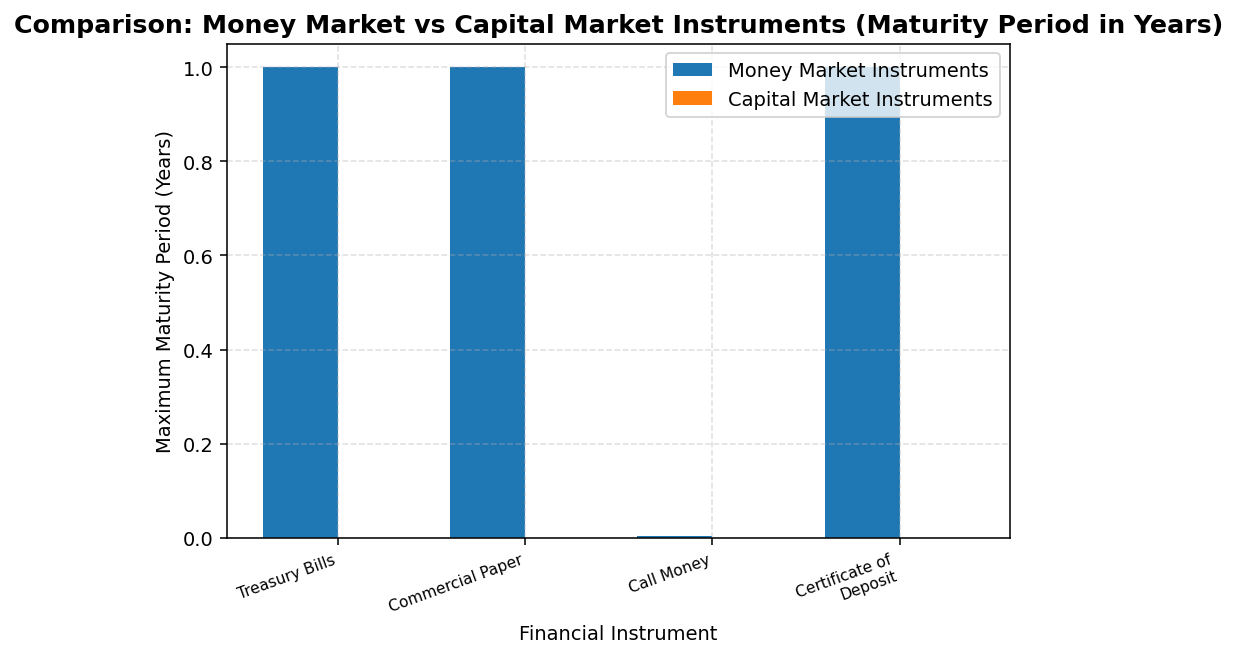
Based on the given chart, answer the following:
-
Which of the following instruments has the shortest maturity period in the Money Market?ATreasury BillsBCommercial PaperCCall MoneyDCertificate of Deposit
-
What is 'Commercial Paper' and who can issue it?
-
Treasury Bills are issued by which authority in India?AState GovernmentsBReserve Bank of India on behalf of the Central GovernmentCSecurities and Exchange Board of IndiaDNational Stock Exchange
-
On the basis of maturity period, how does the Money Market differ from the Capital Market? Give one example of an instrument from each.
Show answersHide answers
Make a full Business Studies paper on Financial Markets.
Pick the question mix, set the marks, hit generate. You get a ready-to-print paper with an answer key.
Generate your paper — free