SUMMARY: The chapter "Controlling" in Class 12 Business Studies focuses on the process of ensuring that an organization's activities are in alignment with its plans and objectives. KEY TOPICS: nature of controlling, importance of controlling, controlling process, relationship between planning and controlling, types of control, techniques of controlling, limitations of controlling, budgetary control, non-budgetary control techniques, management by exception
Which of the following best describes the nature of controlling?
AA one-time process
BA continuous process
CA reactive process
DAn optional process
Check answerHide answer
Correct answer: Option 2 — A continuous process
Short Answer Questions10 questions
Q163 Marks
Distinguish between planning and controlling on any three bases.
View sample solutionHide solution
Meaning (sets goals vs ensures conformity); Stage (first vs last function); Nature (forward looking vs backward looking — though both); Basis (forecasts vs performance reports). Both are interlinked: planning without controlling is meaningless and vice versa.
Q173 Marks
Why is feedback the essence of control?
View sample solutionHide solution
Feedback compares actual performance with planned performance and triggers corrective action so that future operations conform to plans; without feedback deviations cannot be identified or corrected.
Q183 Marks
State any three importance points of controlling.
View sample solutionHide solution
Accomplishing organisational goals; Judging accuracy of standards; Making efficient use of resources; Improving employee motivation; Ensuring order and discipline; Facilitating coordination in action — any three.
Q193 Marks
List the steps in the controlling process.
View sample solutionHide solution
Setting performance standards; Measurement of actual performance; Comparing actual performance with standards; Analysing deviations (critical point control + management by exception); Taking corrective action.
Q203 Marks
What is meant by Management by Exception? Give an example.
View sample solutionHide solution
Only significant deviations beyond a permissible limit are brought to the manager's notice. Example: A 5% material cost variance is ignored; a 30% variance is reported and investigated.
Q213 Marks
Distinguish between planning and controlling on any three bases.
View sample solutionHide solution
Meaning (sets goals vs ensures conformity); Stage (first vs last function); Nature (forward looking vs backward looking — though both); Basis (forecasts vs performance reports). Both are interlinked: planning without controlling is meaningless and vice versa.
Q223 Marks
Why is feedback the essence of control?
View sample solutionHide solution
Feedback compares actual performance with planned performance and triggers corrective action so that future operations conform to plans; without feedback deviations cannot be identified or corrected.
Q233 Marks
What is the nature of controlling in management?
View sample solutionHide solution
The nature of controlling involves monitoring and evaluating the progress of an organization towards its goals. It ensures that actual performance aligns with planned objectives through various measurement and feedback mechanisms.
Q243 Marks
Explain the importance of controlling in an organization.
View sample solutionHide solution
Controlling is crucial as it helps in ensuring that organizational activities are on track, identifies deviations from plans, and facilitates corrective actions. It enhances efficiency and effectiveness by promoting accountability and performance improvement.
Q253 Marks
Describe the controlling process in management.
View sample solutionHide solution
The controlling process consists of setting performance standards, measuring actual performance, comparing it with standards, and taking corrective actions if necessary. This cyclical process ensures continuous alignment with organizational goals.
Long Answer Questions6 questions
Q266 Marks
Explain the steps in the controlling process with one example each.
View sample solutionHide solution
1) Setting performance standards — quantitative (cost, units) or qualitative (goodwill). E.g. produce 1000 units per day. 2) Measurement of actual performance — through observation, reports, statistical methods. 3) Comparing actual with standards — find deviations (positive or negative). 4) Analysing deviations — apply critical point control (focus on KRAs) and management by exception (only significant deviations) and find causes (skill gap, machine breakdown, market conditions). 5) Taking corrective action — for minor deviations none needed; for significant ones revise plans, retrain workers, replace inputs, redesign processes.
Q276 Marks
Discuss the relationship between planning and controlling.
View sample solutionHide solution
Planning and controlling are inseparable twins of management. Planning sets goals and standards; controlling measures whether they are achieved. Planning is forward-looking — controlling looks back to see what happened, and forward to ensure future goals are met. Planning is meaningless without controlling — no review of whether plans are achieved. Controlling is blind without planning — no standards to measure against. Both functions contribute to efficient and effective achievement of objectives. Hence: 'Planning is looking ahead; controlling is looking back.' is only partly true — they are interrelated and reciprocal.
Q286 Marks
Discuss any five importance and any two limitations of controlling.
View sample solutionHide solution
Importance: Accomplishing organisational goals (measures progress, takes corrective action); Judging accuracy of standards (revises if unrealistic); Making efficient use of resources (reduces wastage); Improving employee motivation (clear standards motivate them to perform better); Ensuring order and discipline (discourages dishonest behaviour); Facilitating coordination in action (each department works in line with predetermined standards). Limitations: Difficulty in setting quantitative standards for behavioural areas; Little control on external factors (govt policy, technology); Resistance from employees who view it as restraint; Costly affair (time, effort, money) — small firms may find it unaffordable.
Q296 Marks
A factory targeted 20000 units per month at Rs 80/unit. Actual production was 18000 units at Rs 90/unit. Identify two deviations and suggest steps.
View sample solutionHide solution
Deviation 1: Volume deviation = 20000 − 18000 = 2000 units short (10% below target — significant). Deviation 2: Cost deviation = 90 − 80 = Rs 10/unit higher (12.5% above standard — significant). Total cost overrun = 18000 × 10 + 2000 × 80 (unmade) = Rs 180000 over + opportunity loss. Steps: 1) Investigate cause of low production (material shortage, machine breakdown, labour absenteeism). 2) Investigate cost increase (raw material price hike, overtime wages). 3) Apply Management by Exception — both deviations are above 5% so they need attention. 4) Take corrective action: alternate suppliers, preventive maintenance, training. 5) Revise standards if external factors (e.g. raw material inflation) are permanent.
Q306 Marks
Explain any five techniques of managerial control with examples.
View sample solutionHide solution
Traditional techniques: 1) Personal observation — manager directly observes subordinates' work; useful for small organisations. 2) Statistical reports — averages, percentages, ratios for performance analysis. 3) Break-even analysis — relationship of cost, volume and profit; identifies BEP. 4) Budgetary control — actual results compared with budgeted; variance analysis (sales budget, cash budget). Modern techniques: 5) Return on Investment (ROI) — measures overall performance (Net income / Capital employed × 100). 6) Ratio analysis — liquidity, solvency, profitability ratios. 7) Responsibility accounting — different sections set up as responsibility centres (cost centre, revenue centre, profit centre, investment centre). 8) Management Audit — systematic appraisal of overall management performance. 9) PERT/CPM — for time-bound complex projects. 10) Management Information System (MIS) — provides timely info to managers. (any five with examples).
Q316 Marks
Explain the steps in the controlling process with one example each.
View sample solutionHide solution
1) Setting performance standards — quantitative (cost units) or qualitative (goodwill). E.g. produce 1000 units per day. 2) Measurement of actual performance — through observation reports statistical methods. 3) Comparing actual with standards — find deviations (positive or negative). 4) Analysing deviations — apply critical point control (focus on KRAs) and management by exception (only significant deviations) and find causes (skill gap machine breakdown market conditions). 5) Taking corrective action — for minor deviations none needed; for significant ones revise plans retrain workers replace inputs redesign processes.
Assertion–Reason Questions8 questions
Q321 Mark
Assertion (A): Controlling is a goal-oriented function.
Reason (R): It ensures that resources are obtained and used effectively to achieve organisational objectives.
Show explanationHide explanation
Correct answer: Option 1 —
Both A and R are true, and R is the correct explanation of A.
Q331 Mark
Assertion (A): Setting performance standards is the first step of controlling.
Reason (R): Standards serve as benchmarks for comparison with actual performance.
Show explanationHide explanation
Correct answer: Option 1 —
Both A and R are true, and R is the correct explanation of A.
Q341 Mark
Assertion (A): Management by Exception is also called control by exception.
Reason (R): Only significant deviations are reported to the manager so that valuable time is not spent on minor deviations.
Show explanationHide explanation
Correct answer: Option 1 —
Both A and R are true, and R is the correct explanation of A.
Q351 Mark
Assertion (A): Controlling has little effect on external factors.
Reason (R): Government policy and competitor action lie outside the firm's control.
Show explanationHide explanation
Correct answer: Option 1 —
Both A and R are true, and R is the correct explanation of A.
Q361 Mark
Assertion (A): Planning and controlling are interrelated and inseparable.
Reason (R): Planning provides standards while controlling provides feedback to revise plans.
Show explanationHide explanation
Correct answer: Option 1 —
Both A and R are true, and R is the correct explanation of A.
Q371 Mark
Assertion (A): The controlling process ensures that organizational activities are aligned with the planned objectives.
Reason (R): Controlling involves monitoring performance and taking corrective actions to achieve goals.
Show explanationHide explanation
Correct answer: Option 1 —
Both A and R are true, and R is the correct explanation of A.
Q381 Mark
Assertion (A): Controlling is an ongoing process that occurs after planning is completed.
Reason (R): Controlling is a continuous function that runs parallel to planning.
Show explanationHide explanation
Correct answer: Option 2 —
Both A and R are true, but R is not the correct explanation of A.
Q391 Mark
Assertion (A): Management by exception allows managers to focus on significant deviations from the plan.
Reason (R): This technique helps in prioritizing issues that require managerial attention.
Show explanationHide explanation
Correct answer: Option 1 —
Both A and R are true, and R is the correct explanation of A.
Statement-Based Questions8 questions
Q401 Mark
Statement 1: Controlling is a continuous activity.
Statement 2: It is performed at all levels of management.
Show answerHide answer
Correct answer: Option 1 —
Both statements are true.
Q411 Mark
Statement 1: Critical point control focuses on key result areas.
Statement 2: Management by Exception focuses on significant deviations only.
Show answerHide answer
Correct answer: Option 1 —
Both statements are true.
Q421 Mark
Statement 1: Standards may be quantitative or qualitative.
Statement 2: Quantitative standards include cost time and units; qualitative include goodwill and morale.
Show answerHide answer
Correct answer: Option 1 —
Both statements are true.
Q431 Mark
Statement 1: Controlling is performed at all levels of management.
Statement 2: It continues throughout the operation of the business.
Show answerHide answer
Correct answer: Option 1 —
Both statements are true.
Q441 Mark
Statement 1: Corrective action is the final step of controlling.
Statement 2: If deviations are within permissible range no corrective action is needed.
Show answerHide answer
Correct answer: Option 1 —
Both statements are true.
Q451 Mark
Statement 1: The controlling process involves setting performance standards and measuring actual performance against these standards.
Statement 2: Controlling is not necessary if planning is done effectively.
Show answerHide answer
Correct answer: Option 2 —
Only Statement 1 is true.
Q461 Mark
Statement 1: Management by exception allows managers to focus on significant deviations from the plan.
Statement 2: Budgetary control is a non-budgetary control technique.
Show answerHide answer
Correct answer: Option 4 —
Both statements are false.
Q471 Mark
Statement 1: The nature of controlling is proactive, as it anticipates future challenges.
Statement 2: Controlling helps in minimizing wastage of resources.
Show answerHide answer
Correct answer: Option 1 —
Both statements are true.
Case Study / Passage Questions4 questions
Q483 Marks
BharatProducts targets 5000 units per month at Rs 100 each. April actual: 4500 units at Rs 110 each. The plant manager applies Management by Exception focusing on the deviation in cost (Rs 110 vs Rs 100 = 10% above target — significant) and ignoring small volume deviation. Investigation reveals raw material price hike. Manager negotiates a long-term contract with new supplier reducing material cost.
The manager's analysis applies which controlling steps?
A1) Setting standards 2) Measurement
BBoth done
COnly first
DOnly second
Management by Exception focuses on:
AAll deviations
BMajor deviations only
CMinor only
DNo deviations
Trace the controlling process used by the manager.
Show answersHide answers
1. Option 2 — Both done
2. Option 2 — Major deviations only
3. Controlling is the systematic comparison of actual performance with planned standards and corrective action. Steps: (1) setting performance standards; (2) measurement of actual performance; (3) comparison of actual with standards; (4) analysing deviations using critical point control (focus on KRAs) and management by exception (focus on significant deviations); (5) taking corrective action. BharatProducts manager correctly applied: (a) measurement (4500 units, Rs 110); (b) comparison (target 5000, Rs 100); (c) deviation analysis (cost variance significant, volume not); (d) Management by Exception (ignored small volume deviation); (e) root cause analysis (raw material price hike); (f) corrective action (long-term supplier contract). This methodical approach turns control from a paper exercise into real managerial action. Controlling is forward-looking — the corrective action prevents future deviations and improves planning.
Q493 Marks
At AutoServ each branch has SLA: complete servicing in 4 hours. April data shows average 6 hours and customer complaints up 30%. Branch manager diagnoses: trainee mechanics slower; new model cars need more time; tool inventory inadequate. Corrective actions: extra training; tool kit upgrade; revised SLA for new models; weekly review.
A 50% time deviation requires corrective action:
AYes
BNo corrective action needed
CRandom
DAlways
The manager applied which control concepts?
ACritical Point Control
BManagement by Exception
CBoth
DNeither
Discuss the corrective steps and importance of controlling.
Show answersHide answers
1. Option 1 — Yes
2. Option 3 — Both
3. Critical Point Control means focusing on key result areas (KRAs) — the few activities that drive performance. For AutoServ KRAs are turnaround time and customer satisfaction. Management by Exception means only significant deviations (above 5%) are flagged for action. Branch manager applied both: identified TAT as KRA; saw 50% deviation (6h vs 4h SLA); analysed root causes systematically (people skill, vehicle complexity, tools); took corrective action on each. This is good controlling — not only reactive but also preventive. Importance of controlling: ensures goals are met efficiently; identifies and corrects deviations; provides feedback for better planning; ensures order and discipline; motivates employees through clear standards. Limitations: difficult to set quantitative standards for behavioural areas; some external factors (policy weather) cannot be controlled; resistance from employees who view control as restraint; cost of control should not exceed benefits.
Q503 Marks
A construction firm budgeted Rs 50 crore for an apartment project to be completed in 18 months. After 12 months actual cost is Rs 45 crore (90% of budget) but only 60% of work is done. Site manager applies controlling: identifies cost-time variance; root causes are slow approvals scope creep and material price rise; corrective actions include re-baselining the schedule descope optional features and lock-in supplier prices.
The site manager identified:
ACost variance
BTime variance
CBoth
DNeither
The right response after deviation is:
ARe-plan and corrective action
BContinue without change
CCancel project
DRandom
Suggest a corrective plan applying controlling principles.
Show answersHide answers
1. Option 3 — Both
2. Option 1 — Re-plan and corrective action
3. In project controlling cost-and-time variance shows trouble together: at 60% work and 90% spend the project is over-budget AND behind schedule. Earned value analysis would show CPI<1 SPI<1. Steps for control: (1) freeze further changes; (2) root cause analysis — why slow approvals (regulatory delays?); why scope creep (no change-control discipline?); why material costs rose (no fixed-price contracts?); (3) develop corrective plan — re-baseline the schedule descope optional features lock in supplier prices add resources; (4) get sponsor approval for re-baseline; (5) establish weekly reviews with strict change control. Controlling not only fixes the deviation but also strengthens future planning — the firm should improve its approval process change control and procurement practices for upcoming projects. Controlling is the bridge from one project's lessons to the next project's plans.
Q514 Marks
Rajan is the production manager at a textile company. At the end of every month, he compares the actual output of his department with the targets set at the beginning of the month. Last month, the target was to produce 10,000 metres of fabric, but only 8,500 metres were produced. Rajan identified that the shortfall was due to frequent machine breakdowns and absenteeism among workers. He immediately reported this to the top management and suggested corrective actions such as preventive maintenance schedules and an attendance incentive scheme. The management appreciated his proactive approach and implemented the suggestions. This systematic approach helped the company stay on track with its annual production goals.
The process Rajan is following — comparing actual performance with planned targets — is a step in which management function?
APlanning
BOrganising
CControlling
DStaffing
Which step of the controlling process is Rajan performing when he compares actual output (8,500 metres) with the target (10,000 metres)?
ASetting performance standards
BMeasurement of actual performance
CComparison of actual performance with standards
DTaking corrective action
Identify and explain the two corrective actions suggested by Rajan to address the shortfall in production.
How does the controlling process followed by Rajan demonstrate the relationship between planning and controlling?
Show answersHide answers
1. Option 3 — Controlling
2. Option 3 — Comparison of actual performance with standards
3. The two corrective actions suggested by Rajan are: (1) Preventive maintenance schedules — to reduce frequent machine breakdowns so that production is not interrupted; and (2) Attendance incentive scheme — to motivate workers to be regular and reduce absenteeism, thereby ensuring adequate workforce availability for meeting production targets.
4. Planning and controlling are inseparable twins of management. Planning sets the targets (10,000 metres of fabric) and controlling ensures that actual performance is measured against those targets. When Rajan finds a deviation, he takes corrective action, which may also lead to revision of future plans. Thus, planning provides the basis for controlling, and controlling provides feedback that improves future planning — making them mutually dependent.
Table-Based Questions4 questions
Q523 Marks
Steps in the controlling process:
Step
Activity
Output
1
Setting performance standards
Benchmarks
2
Measurement of actual performance
Data
3
Comparing actual with standards
Variance
4
Analysing deviations
Root cause
5
Taking corrective action
Improvement
The first step of controlling is:
ASetting standards
BMeasurement
CComparison
DCorrective action
How many steps does the controlling process have?
A1
B3
C5
D7
Explain each step of the controlling process.
Show answersHide answers
1. Option 1 — Setting standards
2. Option 3 — 5
3. Controlling is a five-step process. Step 1 — set performance standards: quantitative (cost time output) and qualitative (goodwill morale). Standards should be specific measurable achievable. Step 2 — measure actual performance: through observation reports inspection statistical analysis. Step 3 — compare actual with standards: identify positive deviations (favourable) and negative deviations (unfavourable). Step 4 — analyse deviations: apply critical point control (focus on KRAs) and management by exception (focus on significant deviations); diagnose root causes. Step 5 — take corrective action: for minor deviations within tolerance no action; for significant deviations either revise plans or fix the execution. The cycle is continuous — controlling provides feedback that improves future planning. Without all five steps controlling is incomplete: standards without measurement is bureaucracy; measurement without action is paperwork.
Q533 Marks
Traditional vs modern control techniques:
Technique
Type
Purpose
Personal observation
Traditional
Direct supervision
Statistical reports
Traditional
Performance analysis
Break-even analysis
Traditional
Cost-volume-profit
Budgetary control
Traditional
Variance analysis
ROI
Modern
Overall performance
Ratio analysis
Modern
Liquidity profitability
Responsibility accounting
Modern
Cost/profit centres
MIS
Modern
Real-time info
Personal observation is a:
ATraditional
BModern
CBoth
DNeither
Return on Investment (ROI) is a:
ATraditional
BModern
CBoth
DNeither
Discuss the difference between traditional and modern control techniques.
Show answersHide answers
1. Option 1 — Traditional
2. Option 2 — Modern
3. Traditional control techniques are time-tested and still useful. Personal observation suits small firms. Statistical reports give numerical insight through ratios percentages averages. Break-even analysis links cost volume and profit — useful for pricing decisions. Budgetary control compares actual with budgeted figures and analyses variance. Modern techniques add analytical depth. Return on Investment compares net income with capital employed and gauges overall performance. Ratio analysis (current ratio debt-equity gross margin) reveals liquidity solvency profitability. Responsibility accounting sets up cost centres revenue centres profit centres and investment centres each with its own responsible manager. Management Information System (MIS) provides timely data to managers for decision making. Modern firms use a combination — traditional for routine and modern for analytical insight.
Q546 Marks
Identify the steps in the controlling process and the techniques used.
Step
Activity
Technique example
1
? Setting standards
? Budget targets
2
? Measurement
? Statistical reports MIS
3
? Comparison
? Variance analysis
4
? Analysing deviations
? Critical point control + MBE
5
? Corrective action
? Process redesign retraining
Q556 Marks
The table below shows the budgeted and actual performance of four departments of Sunrise Ltd. for the month of March. Which department shows the highest percentage deviation from its budget, and should it be prioritised under the principle of 'Management by Exception'?
Department
Budgeted Output (Units)
Actual Output (Units)
Deviation (Units)
Production
5000
4500
-500
Sales
3000
2400
-600
Finance
—
—
—
Dispatch
2000
1900
-100
Picture-Based Questions4 questions
Q563 Marks
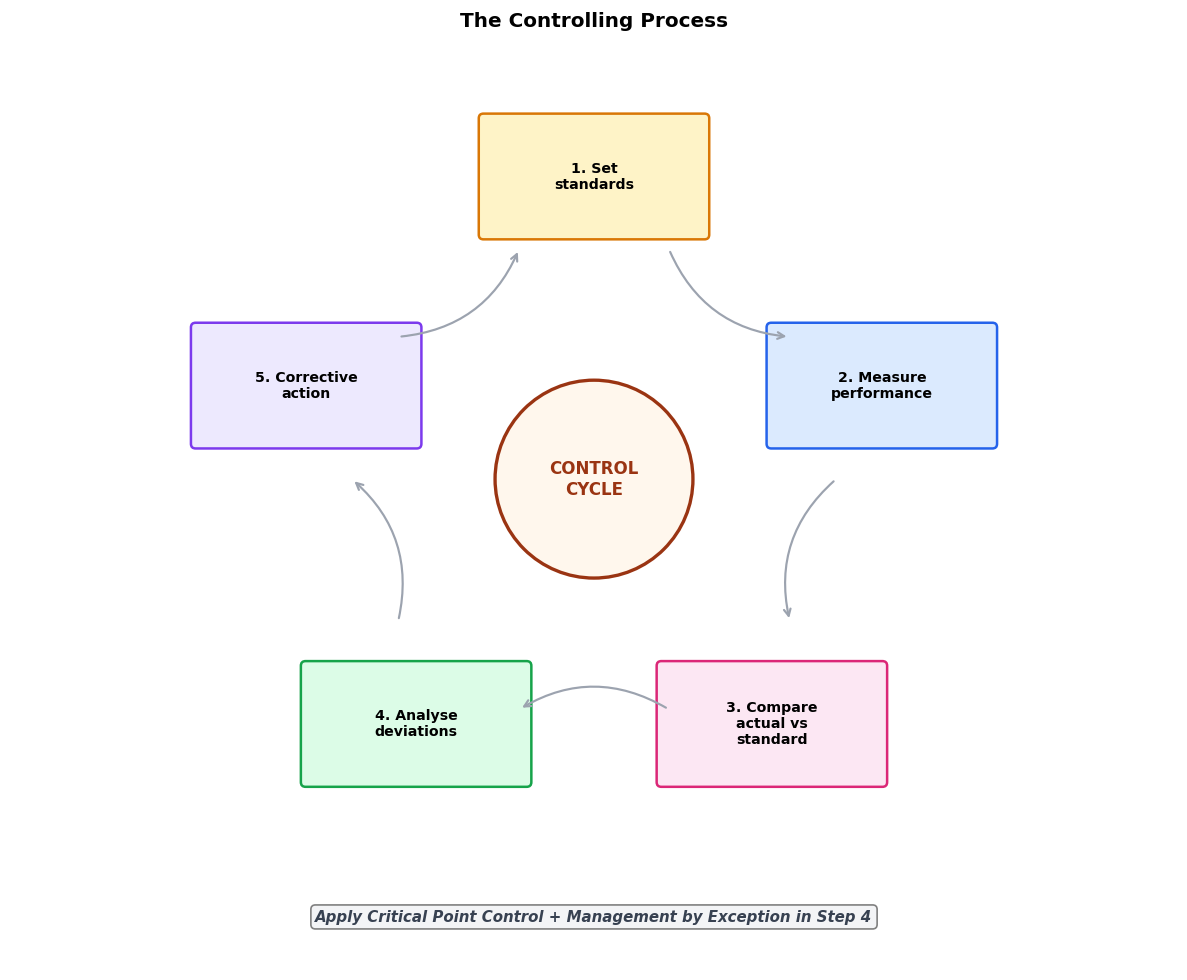
Study the controlling-cycle diagram and answer:
The first step of controlling is:
ASetting standards
BMeasurement
CComparison
DCorrective action
Management by Exception focuses on:
AAll deviations
BSignificant deviations only
CMinor only
DNo deviations
Explain each step of the controlling process with one example.
Show answersHide answers
1. Option 1 — Setting standards
2. Option 2 — Significant deviations only
3. Controlling is a five-step systematic process. Step 1 — set performance standards: quantitative (cost, time, output) and qualitative (goodwill, morale). Step 2 — measure actual performance through observation, reports, inspection, statistical analysis. Step 3 — compare actual with standards to identify positive (favourable) and negative (unfavourable) deviations. Step 4 — analyse deviations applying critical point control (focus on KRAs) and management by exception (focus on significant deviations); diagnose root causes. Step 5 — take corrective action: for minor deviations within tolerance no action; for significant deviations either revise plans or fix execution. The cycle is continuous — controlling provides feedback that improves future planning. Without all five steps controlling is incomplete.
Q574 Marks
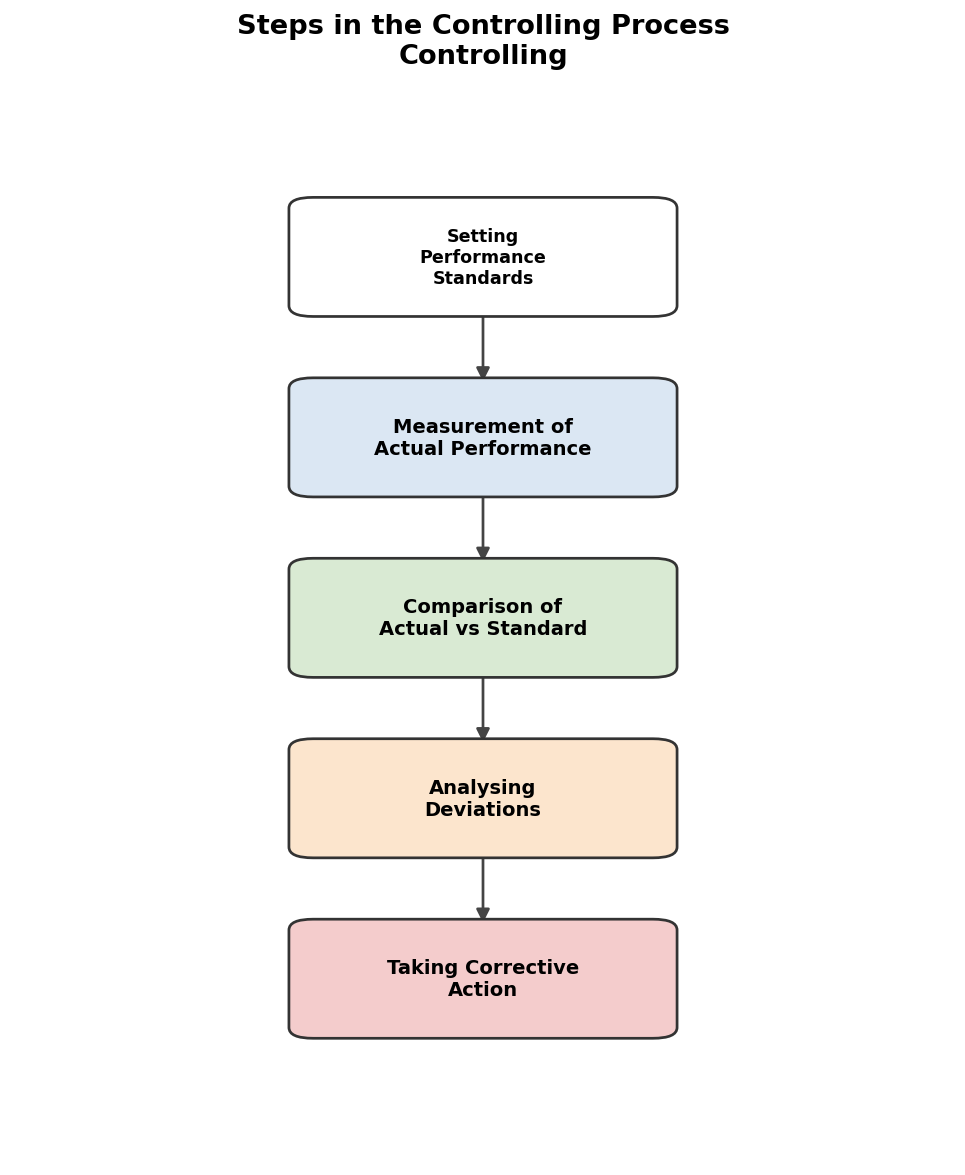
Based on the given diagram of the Controlling Process, answer the following:
Which is the FIRST step in the controlling process as shown in the diagram?
AMeasurement of Actual Performance
BTaking Corrective Action
CSetting Performance Standards
DAnalysing Deviations
What is the significance of 'Analysing Deviations' in the controlling process?
Which step in the controlling process directly follows the comparison of actual performance with standards?
ASetting Performance Standards
BTaking Corrective Action
CMeasurement of Actual Performance
DAnalysing Deviations
Explain why 'Taking Corrective Action' is considered the most critical step in the controlling process.
What is the purpose of 'Analysing Deviations' in the controlling process?
Which step immediately follows 'Comparison of Actual with Standards' in the controlling process?
ASetting Performance Standards
BTaking Corrective Action
CMeasurement of Actual Performance
DAnalysing Deviations
Explain why 'Taking Corrective Action' is considered the most important step in the controlling process.
Show answersHide answers
1. Option 3 — Setting Performance Standards
2. Analysing deviations helps managers identify the causes and extent of differences between actual and standard performance. It enables the application of the principle of management by exception, focusing attention on significant deviations that require corrective action.
3. Option 4 — Analysing Deviations
4. Taking corrective action is the most critical step because it is the step where actual improvement occurs. Without corrective action, the entire controlling process would be futile. It ensures that deviations are rectified, plans are implemented effectively, and organizational goals are achieved.
5. Analysing deviations helps managers identify the causes and extent of differences between actual performance and set standards, so that significant deviations can be addressed through corrective action. It involves applying the principle of management by exception.
6. Option 4 — Analysing Deviations
7. Taking Corrective Action is the most important step because it is the step where actual improvements are made. Without corrective action, the entire controlling process would be meaningless. It ensures that deviations are rectified, plans are implemented properly, and organisational goals are achieved.
Q58
Based on the given diagram showing the Relationship between Planning and Controlling, answer the following:
The diagram shows that controlling feeds back into planning. This relationship is best described as:
APlanning and controlling are independent functions
BPlanning and controlling are inseparable and mutually interdependent
CControlling is more important than planning
DPlanning eliminates the need for controlling
Explain how 'planning is a prerequisite for controlling' with reference to the diagram.
What does the arrow from 'Corrective Action & Revised Plans' back to 'Planning' signify in the diagram?
AThat controlling replaces planning
BThat controlling makes planning unnecessary in the future
CThat controlling provides feedback which helps in improving and revising future plans
DThat corrective action is the same as planning
Why are planning and controlling called the 'Siamese Twins' of management?
Show answersHide answers
1. Option 2 — Planning and controlling are inseparable and mutually interdependent
2. Planning is a prerequisite for controlling because controlling requires pre-determined standards against which actual performance is measured. As shown in the diagram, Planning sets the objectives and standards first. Without these standards established through planning, there would be no basis for the controlling function to compare actual performance and identify deviations.
3. Option 3 — That controlling provides feedback which helps in improving and revising future plans
4. Planning and controlling are called 'Siamese Twins' of management because they are inseparably linked. Planning without controlling is meaningless as there would be no way to check if plans are being followed. Controlling without planning is blind as there would be no standards to measure performance against. They are forward-looking and backward-looking aspects of the same management function, working in a continuous cycle.
Q594 Marks
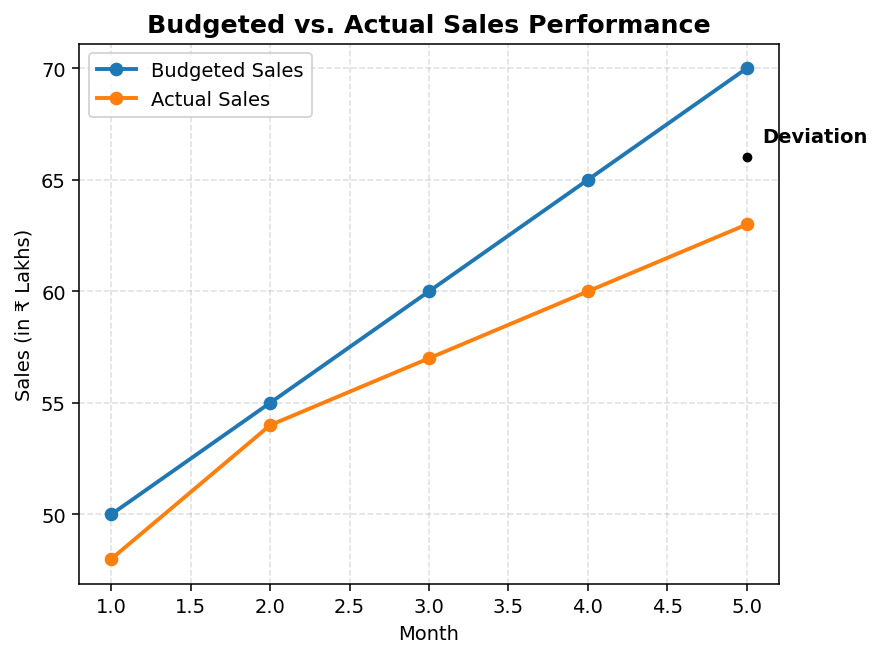
Based on the given chart showing budgeted vs. actual performance of a company over 5 months, answer the following:
What is the deviation between budgeted and actual sales in Month 5?
A₹5 Lakhs
B₹10 Lakhs
C₹7 Lakhs
D₹3 Lakhs
The chart represents a technique of controlling. Identify the technique and explain its meaning.
The trend in the chart shows that actual sales are consistently below budgeted sales. According to the principle of Management by Exception, what should the manager focus on?
AReward employees for meeting targets in Month 1
BInvestigate and address the growing negative deviation in sales
CIgnore the deviation as it is less than 20%
DRevise the budget upward to match actual performance
State any two advantages of budgetary control as a technique of controlling.
Show answersHide answers
1. Option 3 — ₹7 Lakhs
2. The chart represents Budgetary Control. It is a technique of managerial control in which all operations are planned in advance in the form of budgets, and actual results are compared with budgeted figures to identify deviations and take corrective action.
3. Option 2 — Investigate and address the growing negative deviation in sales
4. Two advantages of budgetary control are: (1) It helps in coordinating the activities of different departments by setting unified targets. (2) It facilitates comparison of actual performance with planned performance, enabling timely corrective action to achieve organisational goals.