Skip to content
TestMacher
Chapter 10 · Class 12 Business Studies

Planning — Important Questions

57 questions With answers CBSE format

SUMMARY: The chapter on Planning in Class 12 Business Studies focuses on the importance, process, and types of planning in business management.
KEY TOPICS: Definition of planning, importance of planning, features of planning, planning process, types of plans, limitations of planning, planning and decision making, planning and strategy formation.

Q1 1 Mark

Planning is concerned with:

APast
BPresent
CFuture
DAll of these
Check answerHide answer
Correct answer: Option 3 — Future
Q2 1 Mark

Which of the following is NOT a feature of planning?

AGoal-oriented
BPervasive
CAvoids decision-making
DContinuous
Check answerHide answer
Correct answer: Option 3 — Avoids decision-making
Q3 1 Mark

Strategic planning is typically done by:

ATop management
BMiddle management
CWorkers
DAll employees
Check answerHide answer
Correct answer: Option 1 — Top management
Q4 1 Mark

A budget is a:

APlan expressed in numerical terms
BPersonal account
CGoal
DProcedure
Check answerHide answer
Correct answer: Option 1 — Plan expressed in numerical terms
Q5 1 Mark

Which is a single-use plan?

APolicy
BMethod
CProject
DProcedure
Check answerHide answer
Correct answer: Option 3 — Project
Q6 1 Mark

What is the primary purpose of planning in business management?

ATo increase employee morale
BTo set organizational goals
CTo reduce operational costs
DTo enhance customer satisfaction
Check answerHide answer
Correct answer: Option 2 — To set organizational goals
Q7 1 Mark

Which step is NOT included in the planning process?

ASetting objectives
BEvaluating alternatives
CImplementing plans
DIgnoring feedback
Check answerHide answer
Correct answer: Option 4 — Ignoring feedback
Q8 1 Mark

What type of plan focuses on long-term goals and strategies?

AOperational plan
BTactical plan
CStrategic plan
DContingency plan
Check answerHide answer
Correct answer: Option 3 — Strategic plan
Q9 1 Mark

Which of the following best describes 'contingency planning'?

APlanning for unexpected events
BPlanning for daily operations
CPlanning for employee training
DPlanning for marketing strategies
Check answerHide answer
Correct answer: Option 1 — Planning for unexpected events
Q10 1 Mark

What is a limitation of planning?

APlanning provides a sense of direction
BPlanning is time-consuming
CPlanning reduces uncertainty
DPlanning encourages resource allocation
Check answerHide answer
Correct answer: Option 2 — Planning is time-consuming
Q11 1 Mark

How does planning relate to decision-making?

APlanning eliminates the need for decision-making
BPlanning provides a framework for decision-making
CPlanning is the same as decision-making
DPlanning complicates decision-making
Check answerHide answer
Correct answer: Option 2 — Planning provides a framework for decision-making
Q12 1 Mark

Which type of plan is typically short-term and specific?

AStrategic plan
BOperational plan
CTactical plan
DSingle-use plan
Check answerHide answer
Correct answer: Option 2 — Operational plan
Q13 1 Mark

What is the first step in the planning process?

AIdentifying resources
BSetting objectives
CEvaluating alternatives
DDeveloping strategies
Check answerHide answer
Correct answer: Option 2 — Setting objectives
Q14 1 Mark

Which of the following is an example of a tactical plan?

AA five-year business strategy
BA marketing campaign for the next quarter
CA budget for the entire year
DA policy for employee conduct
Check answerHide answer
Correct answer: Option 2 — A marketing campaign for the next quarter
Q15 1 Mark

What is the relationship between planning and strategy formation?

APlanning is irrelevant to strategy formation
BPlanning is a part of strategy formation
CStrategy formation is a part of planning
DPlanning and strategy formation are identical
Check answerHide answer
Correct answer: Option 2 — Planning is a part of strategy formation
Q16 3 Marks

Define planning and state any three of its features.

View sample solutionHide solution
Planning is the process of THINKING IN ADVANCE about WHAT IS TO BE DONE WHEN HOW IT IS TO BE DONE WHO IS TO DO IT and HOW THE RESULTS WILL BE EVALUATED. It is the basic management function. FEATURES: (1) GOAL-ORIENTED — every plan starts with a goal; (2) PRIMARY/PERVASIVE — planning is the FIRST function and is done at all levels; (3) CONTINUOUS — plans need revision based on changing conditions; (4) FUTURISTIC — concerned with future actions; (5) DECISION-MAKING — choosing best alternative from options; (6) MENTAL EXERCISE — requires analytical thinking and creativity.
Q17 3 Marks

Distinguish between strategic planning and operational planning.

View sample solutionHide solution
STRATEGIC PLANNING — long-term (3-5+ years); top-management; broad goals and direction; deals with environmental changes and competitive position; outcomes: company's vision mission strategy. EXAMPLE: deciding to enter a new market or develop a new product line. OPERATIONAL PLANNING — short-term (less than 1 year); lower management; specific tasks and resource allocation; deals with daily operations; outcomes: production schedules sales targets budgets. EXAMPLE: monthly sales targets, daily production plan. The two are linked: operational plans implement strategic plans. Without strategic direction operational plans become aimless; without operational execution strategic plans become wishful thinking.
Q18 3 Marks

List the various types of plans (single-use vs standing).

View sample solutionHide solution
SINGLE-USE PLANS — used once for a specific task or project; not repeated. Examples: (1) PROJECT — Apollo programme, Mumbai metro construction; one-time complex undertaking. (2) PROGRAMME — broader collection of projects with a common goal; e.g., Make in India programme. (3) BUDGET — plan in numerical/financial terms for a specific period; e.g., annual marketing budget, capital budget. STANDING PLANS — used repeatedly over time. Examples: (1) POLICY — broad guidelines for decisions; e.g., 'all customer complaints must be resolved within 48 hours'. (2) PROCEDURE — detailed step-by-step sequence to perform a task; e.g., procedure for processing a sales return. (3) METHOD — one specific way to perform a step; e.g., method of cleaning machinery. (4) RULE — specific 'do' or 'don't'; e.g., 'no smoking on premises'. (5) STRATEGY — comprehensive plan to achieve organisational objectives in a competitive environment.
Q19 3 Marks

Explain the steps in the planning process.

View sample solutionHide solution
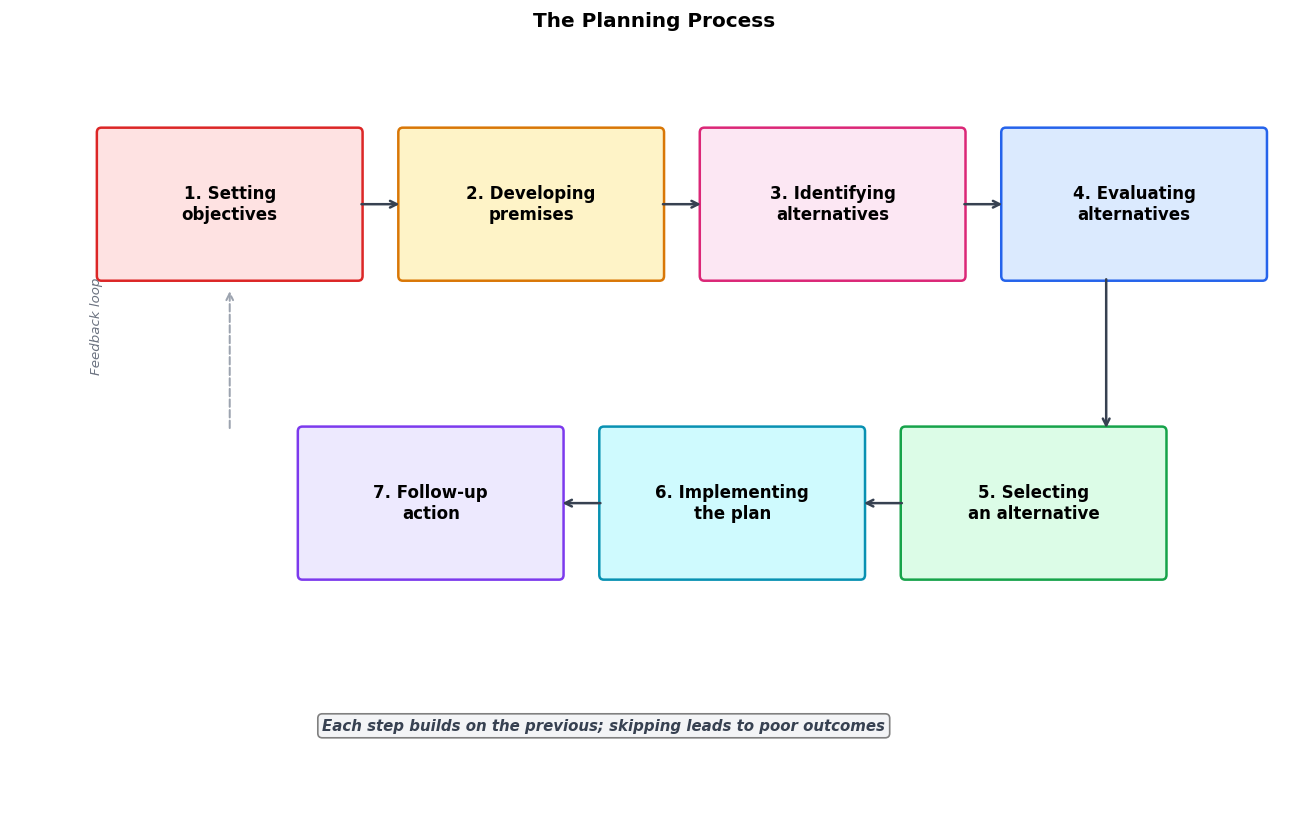
PLANNING PROCESS: (1) SETTING OBJECTIVES — what is to be achieved (specific, measurable, achievable, relevant, time-bound — SMART). (2) DEVELOPING PREMISES — assumptions about future conditions (economic political social). (3) IDENTIFYING ALTERNATIVE COURSES OF ACTION — listing all possible ways to achieve objectives. (4) EVALUATING ALTERNATIVE COURSES — analysing pros and cons; cost-benefit; risk-return. (5) SELECTING AN ALTERNATIVE — choosing the best option based on evaluation. (6) IMPLEMENTING THE PLAN — putting plan into action; assigning responsibilities; allocating resources. (7) FOLLOW-UP — monitoring progress; comparing actual with planned; corrective action if needed. The PROCESS is iterative — feedback from follow-up improves future planning. Modern planning often uses sophisticated tools (scenario planning, simulation, risk analysis) at each step.
Q20 3 Marks

What is the importance of planning for an organisation?

View sample solutionHide solution
Planning is the FIRST and FOUNDATIONAL function of management. IMPORTANCE: (1) PROVIDES DIRECTION — every member knows what to do, by when, and how. (2) REDUCES RISKS OF UNCERTAINTY — anticipates future conditions and prepares contingencies. (3) REDUCES OVERLAPPING AND WASTEFUL ACTIVITIES — ensures coordination among departments. (4) PROMOTES INNOVATIVE IDEAS — planning stimulates creative thinking about future possibilities. (5) FACILITATES DECISION-MAKING — provides framework for choosing among alternatives. (6) ESTABLISHES STANDARDS FOR CONTROL — what was planned vs what happened forms the basis for control. (7) HELPS IN COORDINATION — different departments aligned through common plans. (8) MAKES OPTIMUM USE OF RESOURCES. Without planning, organisations stumble through their environment without clear direction — a recipe for failure. Modern firms invest heavily in planning processes (annual budget, strategic plans, scenario analysis).
Q21 3 Marks

Define planning in the context of business management.

View sample solutionHide solution
Planning is the process of setting objectives and determining a course of action for achieving those objectives. It involves decision-making that helps in forecasting future conditions and preparing for them effectively.
Q22 3 Marks

What are the key features of planning?

View sample solutionHide solution
The key features of planning include goal-oriented, continuous process, involves decision-making, and is a primary function of management. It also provides direction and reduces uncertainty.
Q23 3 Marks

Explain the importance of planning in an organization.

View sample solutionHide solution
Planning is important as it provides a sense of direction, helps in resource allocation, minimizes risks, and enhances coordination among various departments. It also helps in setting clear objectives and measuring progress.
Q24 3 Marks

List and briefly describe the types of plans in business management.

View sample solutionHide solution
Types of plans include strategic plans (long-term goals), tactical plans (short-term actions to implement strategies), operational plans (day-to-day operations), and contingency plans (alternative courses of action in case of unexpected events).
Q25 3 Marks

What is the planning process? Outline its main steps.

View sample solutionHide solution
The planning process involves several steps: setting objectives, identifying resources, developing premises, evaluating alternatives, selecting an alternative, and implementing the plan. Finally, it includes monitoring and reviewing the plan's progress.
Q26 6 Marks

Discuss the various features of planning with examples.

View sample solutionHide solution
FEATURES OF PLANNING: (1) GOAL-ORIENTED — planning starts with defining goals and ends with their achievement. EXAMPLE: a company plans to increase sales by 15%; all activities aim at this goal. (2) PRIMARY/PERVASIVE — planning is the FIRST management function; done at all levels (top, middle, lower). EXAMPLE: top management plans corporate strategy; middle management plans departmental targets; lower management plans daily activities. (3) CONTINUOUS — plans must be regularly reviewed and revised to remain relevant. EXAMPLE: annual budget revised quarterly based on actual performance. (4) FUTURISTIC — looks at the future to anticipate conditions. EXAMPLE: planning for a 5-year capacity expansion. (5) DECISION-MAKING — involves choosing among alternatives. EXAMPLE: deciding whether to manufacture in-house or outsource. (6) MENTAL EXERCISE — requires logical thinking, foresight, creativity. (7) PERVADES ALL FUNCTIONS — planning is needed in production, marketing, finance, HR. (8) FOCUSED ON ACTION — plans must be implementable. (9) FLEXIBLE — adjustable based on changing conditions. Together these features make planning the foundation of effective management.
Q27 6 Marks

Explain the various types of plans giving suitable examples.

View sample solutionHide solution
PLANS BY DURATION: (1) Short-term (less than 1 year) — daily, weekly, monthly. Example: monthly production plan. (2) Medium-term (1-3 years) — annual budgets, expansion. (3) Long-term (3+ years) — strategic plans, capacity build-up. PLANS BY USE: SINGLE-USE — for specific projects: (1) PROJECT — Mumbai metro construction; (2) PROGRAMME — Make in India; (3) BUDGET — annual sales budget. STANDING PLANS — repeated use: (1) POLICY — 'employee promotions based on merit'; (2) PROCEDURE — sequence for processing leave applications; (3) METHOD — specific way to clean machines; (4) RULE — 'no smoking on premises'; (5) STRATEGY — comprehensive plan to gain market share. PLANS BY LEVEL: (1) STRATEGIC — long-term, top management; (2) TACTICAL — medium-term, middle management; (3) OPERATIONAL — short-term, lower management. PLANS BY FUNCTION: production, marketing, finance, HR plans. Each type serves a specific purpose. Effective management uses all types in coordination — strategic plans guide tactical and operational; standing plans handle recurring decisions; single-use plans manage one-time initiatives.
Q28 6 Marks

Discuss the steps in the planning process with a numerical example.

View sample solutionHide solution
PLANNING PROCESS for M/s ABC Limited: (1) SETTING OBJECTIVE — to increase sales by 20% next year (from ₹100 crore to ₹120 crore). (2) DEVELOPING PREMISES — assumptions: economy growth 7%; competitor pricing stable; raw material costs up 5%; consumer preferences shifting toward premium products. (3) IDENTIFYING ALTERNATIVES — (a) increase prices by 10%; (b) launch new premium product; (c) expand distribution to 2 new cities; (d) increase marketing spend by 30%; (e) acquire a regional competitor. (4) EVALUATING ALTERNATIVES — (a) price hike: ₹10 crore impact, risk of customer loss; (b) new product: ₹15 crore impact, requires R&D investment; (c) distribution expansion: ₹15 crore impact, requires field force; (d) marketing: ₹5 crore impact, low risk; (e) acquisition: ₹40 crore impact, high cost. (5) SELECTING ALTERNATIVE — chose (b) + (c) + (d) — combination giving expected ₹22 crore growth. (6) IMPLEMENTING — develop new product, hire field force, launch ad campaign; allocate ₹15 crore budget. (7) FOLLOW-UP — quarterly review; adjust based on market response. This systematic process ensures plans are based on analysis, not gut feel.
Q29 6 Marks

Discuss the limitations of planning.

View sample solutionHide solution
LIMITATIONS OF PLANNING: (1) RIGIDITY — once formulated plans tend to become rigid; managers reluctant to change despite environmental changes. (2) DOES NOT WORK IN DYNAMIC ENVIRONMENT — rapid change makes plans obsolete; example: pandemic disrupted all 2020 plans. (3) REDUCES CREATIVITY — top management plans may not allow creativity from lower levels; middle managers become mere implementers. (4) INVOLVES HUGE COSTS — planning consumes significant time, money, expertise; especially for big organisations. (5) TIME-CONSUMING — extensive planning processes can delay action. (6) DOES NOT GUARANTEE SUCCESS — plans are only useful if well-implemented; circumstances may change. (7) FAILS WITH INACCURATE PREMISES — wrong assumptions lead to wrong plans; future is fundamentally uncertain. (8) DIFFICULT FOR FAST-CHANGING SECTORS — tech sector for example needs agile rather than detailed planning. DESPITE THESE LIMITATIONS planning remains essential — modern firms balance planning with agility (e.g., agile methodologies, scenario planning, rolling forecasts). The limitation is not in planning itself but in poor planning practice.
Q30 6 Marks

Distinguish between policies, procedures, and rules.

View sample solutionHide solution
POLICY — broad GUIDELINES for decision-making within an organisation. Provides discretion to managers to interpret based on situation. EXAMPLE: 'we promote internal candidates first.' Allows judgement on which internal candidate. PROCEDURE — DETAILED step-by-step SEQUENCE to perform a particular task. Less flexible than policy but more flexible than rule. EXAMPLE: 'for processing a leave application: (1) employee submits in writing; (2) supervisor approves; (3) HR records; (4) email confirmation.' RULE — SPECIFIC 'do' or 'don't' statement; allows NO discretion. EXAMPLE: 'no smoking on premises'; 'reports must be submitted by 5pm Friday.' Violation has consequences. RELATIONSHIP: Policy guides general direction → Procedure specifies how → Rule defines specific dos and don'ts. APPLICATION: a company's HIRING policy might be 'hire based on merit'; the PROCEDURE is the specific sequence (job posting, screening, interviews, offer); RULES might include 'no political affiliation discrimination', 'reference checks mandatory'. Together they ensure consistent decision-making while allowing necessary flexibility.
Q31 6 Marks

Compare planning and decision-making with the help of a table on five features.

Q32 1 Mark

Assertion (A): Planning is the primary function of management.

Reason (R): All other functions (organising staffing directing controlling) follow planning.

Show explanationHide explanation
Correct answer: Option 1 — Both A and R are true, and R is the correct explanation of A.
Q33 1 Mark

Assertion (A): Plans tend to become rigid over time.

Reason (R): Once formulated managers may resist changing them despite environmental changes.

Show explanationHide explanation
Correct answer: Option 1 — Both A and R are true, and R is the correct explanation of A.
Q34 1 Mark

Assertion (A): Standing plans like policies and rules are used repeatedly.

Reason (R): They provide consistent guidance for recurring situations and decisions.

Show explanationHide explanation
Correct answer: Option 1 — Both A and R are true, and R is the correct explanation of A.
Q35 1 Mark

Assertion (A): Planning premises are assumptions about future conditions.

Reason (R): Plans are based on these assumptions which may or may not hold true.

Show explanationHide explanation
Correct answer: Option 1 — Both A and R are true, and R is the correct explanation of A.
Q36 1 Mark

Assertion (A): Planning is done at all levels of management.

Reason (R): Top management does strategic planning; middle does tactical; lower does operational.

Show explanationHide explanation
Correct answer: Option 1 — Both A and R are true, and R is the correct explanation of A.
Q37 1 Mark

Assertion (A): Planning is a continuous process in business management.

Reason (R): It involves setting objectives and determining a course of action to achieve them.

Show explanationHide explanation
Correct answer: Option 1 — Both A and R are true, and R is the correct explanation of A.
Q38 1 Mark

Assertion (A): The importance of planning is limited to only large organizations.

Reason (R): Small businesses also benefit from effective planning.

Show explanationHide explanation
Correct answer: Option 3 — A is true, but R is false.
Q39 1 Mark

Assertion (A): One of the features of planning is that it is futuristic in nature.

Reason (R): Planning helps in anticipating future trends and preparing accordingly.

Show explanationHide explanation
Correct answer: Option 1 — Both A and R are true, and R is the correct explanation of A.
Q40 1 Mark

Statement 1: Planning is goal-oriented.

Statement 2: Every plan is directed at achieving specific objectives.

Show answerHide answer
Correct answer: Option 1 — Both statements are true.
Q41 1 Mark

Statement 1: A budget is a plan expressed in numerical terms.

Statement 2: It can be a single-use plan for a specific period.

Show answerHide answer
Correct answer: Option 1 — Both statements are true.
Q42 1 Mark

Statement 1: Procedures specify the sequence of steps for a task.

Statement 2: They are more detailed than policies but less rigid than rules.

Show answerHide answer
Correct answer: Option 1 — Both statements are true.
Q43 1 Mark

Statement 1: Setting objectives is the first step in the planning process.

Statement 2: Without clear objectives subsequent planning would be aimless.

Show answerHide answer
Correct answer: Option 1 — Both statements are true.
Q44 1 Mark

Statement 1: Planning does not guarantee success.

Statement 2: External factors can change and disrupt even well-formulated plans.

Show answerHide answer
Correct answer: Option 1 — Both statements are true.
Q45 1 Mark

Statement 1: Planning is a continuous process that helps in achieving organizational goals.

Statement 2: Planning is a one-time activity that does not require regular updates.

Show answerHide answer
Correct answer: Option 2 — Only Statement 1 is true.
Q46 1 Mark

Statement 1: The planning process involves setting objectives, identifying resources, and evaluating alternatives.

Statement 2: Planning is solely about forecasting future trends without considering current resources.

Show answerHide answer
Correct answer: Option 3 — Only Statement 2 is true.
Q47 1 Mark

Statement 1: Strategic planning is a type of planning that focuses on long-term goals and direction.

Statement 2: Operational planning is more concerned with day-to-day activities and short-term objectives.

Show answerHide answer
Correct answer: Option 1 — Both statements are true.
Q48 3 Marks
FizzCo plans to launch a new fruit drink. The marketing head sets the objective (capture 5% market share in 12 months), identifies the target audience (15-25 year olds in metros), reviews competitors, lists possible strategies (TV ads, social media, college events, free sampling), evaluates each on cost and impact, picks the strategy that mixes social media + college events, formulates supporting plans (production schedule, distribution rollout, ad creative), and sets up monthly review meetings.
  1. Planning involves:
    ASet objectives
    BDevelop plans
    CImplement
    DContinuous activity
  2. A campaign plan for a new product launch is:
    ASingle-use plan
    BStanding plan
    CStrategic plan
    DOperational plan
  3. Trace the planning process used by FizzCo and identify the type of plan.
Show answersHide answers
1. Option 4 — Continuous activity
2. Option 1 — Single-use plan
3. Planning is deciding in advance what to do how when and by whom. Steps: (1) Setting objectives — what is to be achieved (5% market share); (2) Developing premises — assumptions about future (target customer behaviour, competitor moves); (3) Identifying alternative courses of action — different strategies; (4) Evaluating alternatives — cost, impact, fit with capability; (5) Selecting an alternative — best option chosen; (6) Implementing the plan — execution; (7) Follow-up action — monthly review and adjustment. FizzCo's approach is textbook: clear objective, target audience, alternatives evaluated, strategy chosen, supporting plans drafted, and review built in. Plans are of two main types — strategic (long-term, top-level) and operational (short-term, lower-level); single-use (one-time campaign) vs standing (recurring). The launch plan is a single-use operational plan supporting the larger strategic objective of brand growth.
Q49 3 Marks
Solar Power Ltd plans to expand from 100 MW to 500 MW capacity in five years. The board sets the objective approves a budget of ₹2000 crore identifies three sites evaluates them on cost grid access and labour availability picks Site A and prepares a detailed plan covering land acquisition equipment procurement workforce hiring and commissioning. Monthly progress is tracked.
  1. A 500 MW capacity in 5 years is best classified as a/an:
    AMission
    BObjective
    CStrategy
    DProcedure
  2. A long-term capacity expansion plan is:
    AStrategic plan
    BOperational plan
    CBoth
    DNeither
  3. Identify and explain the components of a strategic plan in Solar Power's expansion.
Show answersHide answers
1. Option 2 — Objective
2. Option 1 — Strategic plan
3. Strategic plan = long-term blueprint set by top management covering multiple years. Solar Power's expansion is a strategic plan. Components: objectives (specific targets), strategy (route to objective), policies (general guides for decisions), procedures (sequence of steps), method (way of doing each step), rule (specific must-do or must-not-do), programme (actions for a specific goal), budget (numerical statement of resources). The expansion plan would contain: (a) policy on technology (e.g. only solar PV); (b) procedure for site selection; (c) programme of land acquisition and equipment installation; (d) budget of ₹2000 crore; (e) milestones for each year; (f) review mechanism. Strategic planning is essential for long-term direction; without it the firm drifts. Even five-year plans are revisited annually as the environment changes — flexibility within the plan is vital.
Q50 3 Marks
FastFood-X opened five outlets in three months without a clear plan. Two outlets were near each other competing for the same customers. Suppliers were not finalised so menu items were inconsistent. Cash burned faster than projected. Two outlets shut within a year. The CEO admits: 'We rushed without planning.'
  1. FastFood-X's primary failure was due to:
    AInnovation
    BLack of planning
    CBad luck
    DHigh taxes
  2. Planning's relationship with uncertainty is to:
    AReduces uncertainty
    BEliminates uncertainty
    CIncreases uncertainty
    DHas no effect
  3. Why is planning called the foundation of management? Apply to the case.
Show answersHide answers
1. Option 2 — Lack of planning
2. Option 1 — Reduces uncertainty
3. Planning is the foundation of management. It provides direction sets standards reduces uncertainty and improves coordination. Lack of planning at FastFood-X led to: (1) overlapping outlets — caused by no market study; (2) inconsistent menu — caused by no supplier strategy; (3) cash burn — caused by no budget; (4) uncoordinated launches — caused by no project plan. Importance of planning: provides direction (where to go); reduces risks of uncertainty (by anticipating events); reduces overlapping and wasteful activities (by coordinating efforts); promotes innovative ideas (by forcing thinking); facilitates decision-making (with criteria); establishes standards for controlling (against which performance is measured). Limitations: rigidity, time consuming, may not work in dynamic environments; nevertheless lack of planning is far worse than imperfect planning. FastFood-X should have done a pilot, validated the model, then expanded gradually with a phased plan.
Q51 4 Marks
Ramesh is the owner of a mid-sized manufacturing company. Before starting each financial year, he sits with his management team to decide what the company wants to achieve and how it plans to achieve those goals. He sets specific targets for production, sales, and cost reduction. He also anticipates potential problems like raw material shortages and plans alternatives in advance. His team follows a systematic process: setting objectives, developing premises, identifying alternatives, evaluating them, and selecting the best course of action. Ramesh believes that without this exercise, his company would operate in a disorganized manner and waste valuable resources. His competitors who do not plan often face crises, while Ramesh's company remains stable and profitable even during uncertain times.
  1. Which of the following best describes the concept of 'planning premises'?
    AThe final goals set by the management
    BAssumptions about the future environment in which plans will operate
    CThe physical location where planning takes place
    DThe budget allocated for planning activities
  2. What is the FIRST step in the planning process as described in the passage?
    AIdentifying alternatives
    BEvaluating alternatives
    CSetting objectives
    DDeveloping premises
  3. How does planning help Ramesh's company remain stable during uncertain times? Explain with reference to the passage.
  4. Name any two features of planning that are evident from the passage.
Show answersHide answers
1. Option 2 — Assumptions about the future environment in which plans will operate
2. Option 3 — Setting objectives
3. Planning helps Ramesh's company remain stable during uncertain times because he anticipates potential problems in advance and prepares alternatives. By setting clear objectives and following a systematic process, the company avoids disorganization and resource wastage. This forward-looking approach reduces uncertainty and allows the company to respond effectively to challenges like raw material shortages.
4. Two features of planning evident from the passage are: (1) Planning is futuristic – Ramesh plans in advance for the upcoming financial year and anticipates future problems. (2) Planning is a mental exercise – It involves intellectual thinking, evaluation of alternatives, and decision-making by the management team.
Q52 3 Marks

Types of plans by use:

PlanTypeExample
ObjectiveStandingAchieve 10% growth
StrategyStandingDiversification
PolicyStandingPromotion from within
ProcedureStandingSteps to handle complaint
RuleStandingNo smoking on premises
ProgrammeSingle-useAnnual ad campaign
BudgetSingle-use₹100 cr for FY
MethodStandingSLM depreciation
  1. A policy on hiring is an example of a:
    AStanding plan
    BSingle-use plan
    CBoth
    DNeither
  2. A budget for FY 2024-25 is best classified as:
    AStanding plan
    BSingle-use plan
    CStrategic plan
    DOperational plan
  3. Explain the difference between single-use and standing plans with examples.
Show answersHide answers
1. Option 1 — Standing plan
2. Option 2 — Single-use plan
3. Plans are classified by use into single-use and standing plans. Single-use plans are made for a specific situation and discarded after use — programmes (one-time projects), budgets (numerical resource statements). Standing plans are reused over time — objectives, strategies, policies, procedures, methods, rules. Plans also classified by time horizon — strategic (long-term, top management), tactical (medium-term, middle management), operational (short-term, lower management). And by scope — corporate, divisional, departmental, individual. Each level of plan supports the next: corporate strategy guides division plans which in turn guide departmental and individual plans. A coherent plan hierarchy ensures effort at every level rolls up to the same objective. Policies provide guidance procedures specify steps rules are absolute. Together these plans direct the entire organisation.
Q53 3 Marks

Steps in the planning process:

StepActivityOutput
1Setting objectivesTargets
2Developing planning premisesAssumptions
3Identifying alternative coursesOptions list
4Evaluating alternativesPros & cons
5Selecting an alternativeChosen plan
6Implementing the planAction
7Follow-up actionMonitor & adjust
  1. The first step of planning is:
    ASetting objectives
    BImplementation
    CFollow-up
    DSelection
  2. Follow-up action in planning is:
    AYes always last
    BNo always first
    COptional
    DDone by another team
  3. Explain each step in the planning process.
Show answersHide answers
1. Option 1 — Setting objectives
2. Option 1 — Yes always last
3. Planning is a step-by-step process. Step 1 — Setting objectives: clear measurable specific time-bound. Step 2 — Developing planning premises: assumptions about future internal and external conditions on which the plan is built (e.g. interest rate forecast competitor reactions). Step 3 — Identifying alternative courses of action: brainstorm multiple ways to achieve the objective. Step 4 — Evaluating alternative courses: cost benefit risk fit. Step 5 — Selecting an alternative: best fit for objectives and resources. Step 6 — Implementing the plan: execute through programmes budgets and people. Step 7 — Follow-up action: monitor progress identify deviations take corrective action and refine the plan. Each step builds on the previous. Skipping steps (like FastFood-X did) leads to poor outcomes. Planning is iterative — feedback from follow-up improves future plans.
Q54 6 Marks

Identify the correct type of plan for each business decision.

Decision/ItemType of Plan
Achieve 10% growth in 2 years? Objective
Diversify into electric vehicles? Strategy
Promote internal candidates first? Policy
Steps to handle a customer complaint? Procedure
No smoking on factory floor? Rule
Annual marketing campaign? Programme
FY 2024-25 ad budget of ₹50 crore? Budget
SLM depreciation method? Method
Q55 6 Marks

Identify the steps in the planning process and the output of each.

StepActivityOutput
1? Setting objectives? Targets
2? Developing planning premises? Assumptions
3? Identifying alternatives? Options list
4? Evaluating alternatives? Pros & cons
5? Selecting an alternative? Chosen plan
6? Implementing? Action
7? Follow-up? Monitor adjust
Q56 3 Marks

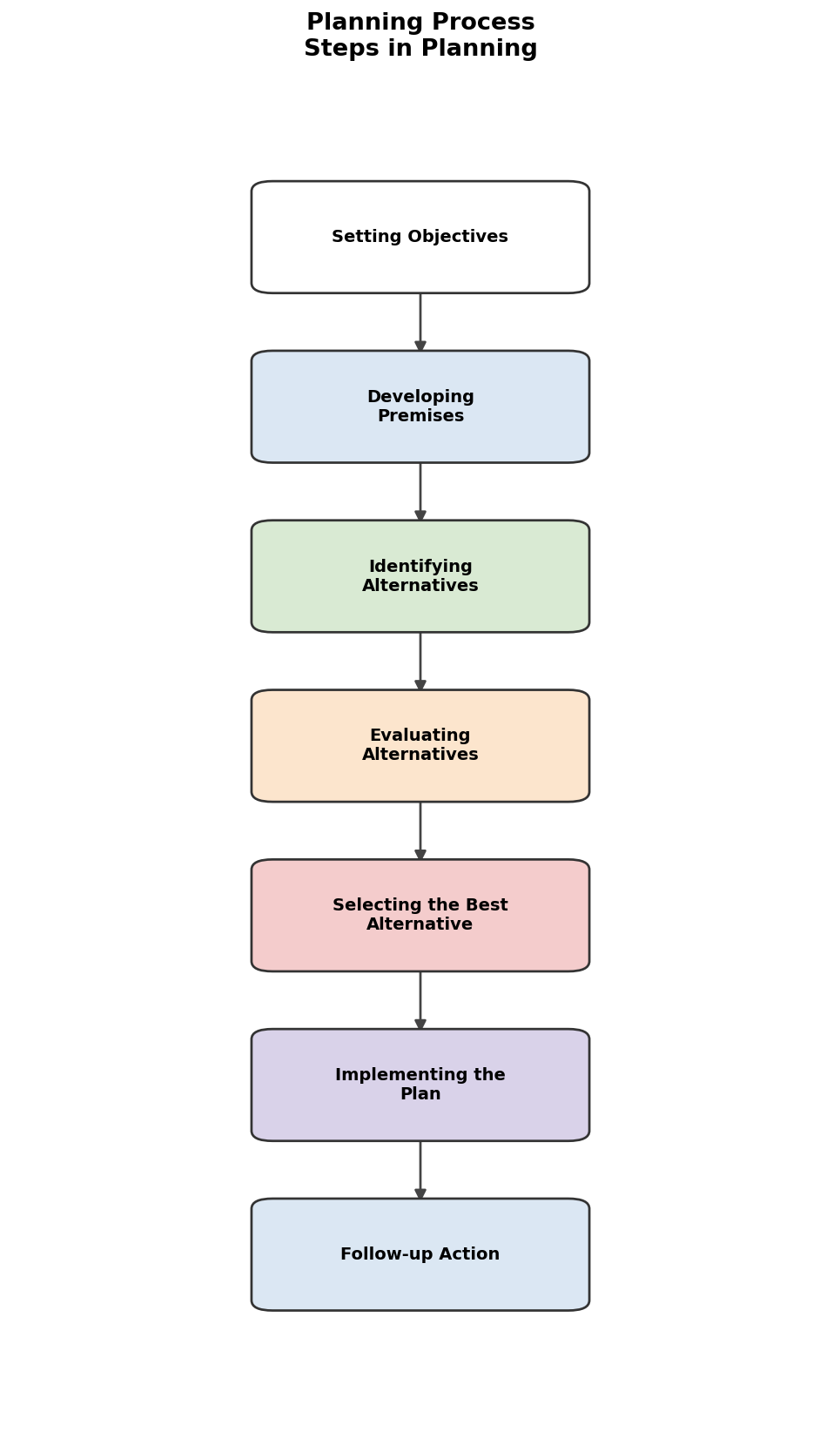
Study the planning process flow and answer:

Planning figure
  1. The first step of the planning process is:
    ASetting objectives
    BImplementation
    CFollow-up
    DSelection
  2. Implementation of the chosen plan is:
    AStep 4
    BStep 5
    CStep 6
    DStep 7
  3. Explain each step of the planning process with its output.
Show answersHide answers
1. Option 1 — Setting objectives
2. Option 3 — Step 6
3. Planning is a step-by-step systematic process. Step 1 — Setting objectives that are clear, measurable, specific, and time-bound. Step 2 — Developing planning premises: assumptions about future internal and external conditions on which the plan is built (e.g. interest-rate forecasts, competitor reactions, market growth assumptions). Step 3 — Identifying alternative courses of action: brainstorm multiple ways to achieve the objective. Step 4 — Evaluating alternatives by cost, benefit, risk, and fit with capability. Step 5 — Selecting the best alternative for objectives and resources. Step 6 — Implementing the plan through programmes, budgets, and people. Step 7 — Follow-up action: monitor progress, identify deviations, take corrective action, and refine the plan. Each step builds on the previous; skipping steps leads to poor outcomes. Planning is iterative — feedback from follow-up improves future plans.
Q57 26 Marks

Based on the given diagram, answer the following:

Planning figure
  1. Which is the FIRST step in the planning process as shown in the diagram?
    ADeveloping Premises
    BSetting Objectives
    CIdentifying Alternatives
    DFollow-up Action
  2. What does 'Developing Premises' mean in the context of the planning process?
  3. Which step comes immediately AFTER 'Evaluating Alternatives' in the planning process?
    AImplementing the Plan
    BDeveloping Premises
    CSelecting the Best Alternative
    DFollow-up Action
  4. Why is 'Follow-up Action' considered an important step in the planning process?
  5. Which of the following is a Single-use Plan?
    APolicy
    BRule
    CBudget
    DProcedure
  6. Differentiate between Single-use Plans and Standing Plans with one example each.
  7. Which of the following is NOT a Standing Plan?
    AObjectives
    BProgramme
    CStrategy
    DRule
  8. Explain the meaning of 'Procedure' as a type of Standing Plan.
  9. Planning is called a 'Primary Function of Management' because:
    AIt is performed only by top-level managers
    BIt precedes all other functions of management
    CIt is the most time-consuming function
    DIt involves the maximum number of employees
  10. What does the feature 'Pervasive' mean in the context of planning?
  11. Which feature of planning indicates that it always looks ahead and deals with the future?
    AGoal-oriented
    BContinuous Process
    CFuturistic
    DMental Exercise
  12. Explain why planning is considered a 'Mental Exercise'.
  13. Which limitation of planning suggests that managers may blindly follow established plans even when conditions change?
    AInvolves Huge Costs
    BRigidity
    CTime-consuming Process
    DReduces Creativity
  14. How does planning 'Reduce Creativity' in an organisation? Explain.
  15. A company spent months formulating a detailed plan but by the time it was ready to implement, market conditions had completely changed. Which limitation of planning does this illustrate?
    ARigidity
    BInvolves Huge Costs
    CMay not work in Dynamic Environment
    DDoes not Guarantee Success
  16. Despite its limitations, planning is considered indispensable for an organisation. Give any two reasons to justify this statement.
  17. Which of the following best describes 'Objectives' in the hierarchy of plans?
    AA numerical statement of expected results expressed in financial terms
    BThe desired end results towards which all organisational activities are directed
    CA set of rules that must be followed without any deviation
    DA sequence of steps to be followed in performing a task
  18. Distinguish between 'Policy' and 'Rule' as types of plans, with one example each.
  19. A Budget is placed at the bottom of the hierarchy of plans because:
    AIt is the least important type of plan
    BIt is prepared after all other plans are formulated and translates them into numerical terms
    CIt is only prepared by lower-level managers
    DIt does not relate to the objectives of the organisation
  20. Explain how 'Strategy' helps an organisation achieve its objectives. Give one example.
  21. Which category of plans includes Strategy, Policy, and Procedure?
    ASingle-Use Plans
    BStanding Plans
    COperational Plans
    DTactical Plans
  22. Why is 'Strategy' classified as a Standing Plan rather than a Single-Use Plan?
  23. Which feature of planning indicates that it is required at all levels of management?
    AFuturistic
    BContinuous Process
    CPervasive
    DGoal-Oriented
  24. Planning is called a 'Mental Exercise'. Which of the following best explains this feature?
    AIt involves physical inspection of resources
    BIt requires imagination, foresight, and sound judgement
    CIt is carried out only by top-level managers
    DIt depends entirely on past records
  25. Explain why planning is considered a 'Continuous Process' with a suitable example.
  26. How does the feature 'Futuristic' distinguish planning from other management functions? Explain briefly.
  27. According to the chart, which level of management spends the highest percentage of time on planning?
    ALower Level Management
    BMiddle Level Management
    CTop Level Management
    DAll levels spend equal time
  28. The chart shows that planning is a 'Pervasive' function. Which of the following correctly explains this?
    AOnly top-level managers are involved in planning
    BPlanning is carried out at all levels of management, though the extent varies
    CLower-level managers spend more time planning than executing
    DPlanning and execution take equal time at all levels
  29. Why does lower-level management spend significantly less time on planning compared to top-level management? Explain with reference to the chart.
  30. A company's top management is spending 90% of its time on day-to-day execution and only 10% on planning. Based on the concept of planning, identify the problem this may cause and suggest a corrective measure.
Show answersHide answers
1. Option 2 — Setting Objectives
2. Developing Premises means making assumptions about the future environment in which the plan will be implemented. These assumptions are based on forecasts and existing plans, and they serve as the basis for planning.
3. Option 3 — Selecting the Best Alternative
4. Follow-up Action is important because it ensures that plans are being implemented correctly and that actual results conform to the planned results. It helps in identifying deviations and taking corrective measures in time.
5. Option 3 — Budget
6. Single-use Plans are designed for a specific situation or time period and are not repeated once the objective is achieved. Example: Budget. Standing Plans are used repeatedly over a long period of time and provide guidance for recurring activities. Example: Policy.
7. Option 2 — Programme
8. Procedure is a standing plan that lays down the sequence of steps to be followed in performing a specific activity. It specifies the exact manner in which a task must be accomplished, ensuring uniformity and consistency in operations. For example, the procedure for recruitment specifies the steps from advertising a vacancy to final appointment.
9. Option 2 — It precedes all other functions of management
10. The feature 'Pervasive' means that planning is required at all levels of management and in all departments of the organisation. It is not restricted to top-level management alone; managers at every level — top, middle, and lower — have to plan within their respective areas of work.
11. Option 3 — Futuristic
12. Planning is considered a mental exercise because it is an intellectual activity that requires thinking, reasoning, and imagination. It involves the use of mind to think about what needs to be done, how it should be done, and when it should be done. It is not a physical activity but involves careful analysis and logical thinking about future courses of action.
13. Option 2 — Rigidity
14. Planning reduces creativity because once plans are made, managers and employees are expected to follow them strictly. This leaves little room for individual initiative or innovative thinking. People tend to work mechanically within the framework of pre-set plans, and any deviation from the plan is discouraged, thereby stifling creativity and innovation.
15. Option 3 — May not work in Dynamic Environment
16. 1. Planning provides direction: Planning sets clear objectives and decides in advance what needs to be done. It gives a sense of direction to all employees and ensures that everyone works towards common goals. 2. Planning reduces the risk of uncertainty: By anticipating future events and making provisions for them, planning helps managers cope with uncertainty and change, thereby reducing risks associated with business operations.
17. Option 2 — The desired end results towards which all organisational activities are directed
18. Policy: A policy is a general guideline that helps managers make decisions. It provides a framework within which decisions are made but allows some discretion. Example: 'It is our policy to give preference to internal candidates for promotions.' Rule: A rule is a specific statement that defines what must or must not be done in a given situation. It allows no discretion and must be followed strictly. Example: 'No smoking on the premises.'
19. Option 2 — It is prepared after all other plans are formulated and translates them into numerical terms
20. Strategy is a comprehensive plan that takes into account the strengths and weaknesses of the organisation as well as the opportunities and threats in the external environment. It helps an organisation achieve its objectives by determining the long-term direction and scope of the organisation's activities. For example, if an organisation's objective is to increase its market share by 20% in five years, its strategy could be to launch new products, enter new markets, or reduce prices to attract more customers. Strategy thus bridges the gap between where the organisation is and where it wants to be.
21. Option 2 — Standing Plans
22. Strategy is classified as a Standing Plan because it provides a long-term framework and general direction for the organisation. It is used repeatedly to guide decisions in response to competitive or environmental changes, rather than being created for a single specific event.
23. Option 3 — Pervasive
24. Option 2 — It requires imagination, foresight, and sound judgement
25. Planning is a continuous process because it does not end once a plan is made. Plans are reviewed and revised regularly in response to changing business conditions. For example, if a company's annual sales plan is disrupted by a sudden economic slowdown, managers must revise the plan to set new, realistic targets.
26. Planning is futuristic because it involves looking ahead and preparing for future events. Unlike other functions such as organising or controlling which deal with the present, planning anticipates future conditions, opportunities, and threats, and determines in advance what needs to be done to achieve organisational goals.
27. Option 3 — Top Level Management
28. Option 2 — Planning is carried out at all levels of management, though the extent varies
29. As shown in the chart, lower-level management spends only 15% of time on planning and 85% on execution. This is because lower-level managers are primarily responsible for implementing the plans made by top and middle management. Their planning is limited to short-term, routine, and operational decisions, whereas top-level managers focus on long-term strategic planning for the entire organisation.
30. The problem is that without adequate planning, the organisation will lack clear goals, direction, and strategies to handle future uncertainties. This can lead to poor decision-making, wastage of resources, and inability to cope with competition. The corrective measure is that top management must delegate routine execution tasks to middle and lower-level managers and focus on strategic planning, setting long-term objectives, and formulating policies to guide the entire organisation.

Make a full Business Studies paper on Planning.

Pick the question mix, set the marks, hit generate. You get a ready-to-print paper with an answer key.

Generate your paper — free