Skip to content
TestMacher
Chapter 12 · Class 12 Business Studies

Staffing — Important Questions

58 questions With answers CBSE format

SUMMARY: The chapter on Staffing in Class 12 Business Studies focuses on the process of hiring and developing the required personnel for an organization.
KEY TOPICS: staffing process, recruitment, selection, training and development, performance appraisal, promotion, compensation, human resource management, job analysis, workforce planning

Q1 1 Mark

Staffing is concerned with:

AFilling vacancies
BManpower planning to retention
CJust hiring
DPromoting only
Check answerHide answer
Correct answer: Option 2 — Manpower planning to retention
Q2 1 Mark

Recruitment refers to:

ASelecting candidates
BSearching and attracting candidates
CTraining
DPromoting
Check answerHide answer
Correct answer: Option 2 — Searching and attracting candidates
Q3 1 Mark

Selection refers to:

ASearching for candidates
BAttracting applicants
CScreening and choosing the best candidate
DTermination
Check answerHide answer
Correct answer: Option 3 — Screening and choosing the best candidate
Q4 1 Mark

Training is generally:

AEducating in general
BImproving skills for present job
CFor top management only
DOptional
Check answerHide answer
Correct answer: Option 2 — Improving skills for present job
Q5 1 Mark

Promotion is the:

ADemotion of employee
BMovement to a higher position with better salary and authority
CTermination of contract
DSideways movement
Check answerHide answer
Correct answer: Option 2 — Movement to a higher position with better salary and authority
Q6 1 Mark

What is the first step in the staffing process?

ARecruitment
BSelection
CJob Analysis
DTraining
Check answerHide answer
Correct answer: Option 3 — Job Analysis
Q7 1 Mark

Which of the following is NOT a method of recruitment?

AJob Portals
BEmployee Referrals
CPerformance Appraisal
DCampus Recruitment
Check answerHide answer
Correct answer: Option 3 — Performance Appraisal
Q8 1 Mark

What is the primary purpose of a job analysis?

ATo evaluate employee performance
BTo identify training needs
CTo determine job responsibilities and requirements
DTo set compensation levels
Check answerHide answer
Correct answer: Option 3 — To determine job responsibilities and requirements
Q9 1 Mark

Which of the following is a method of selection?

AInterviews
BJob Posting
COrientation
DCompensation Planning
Check answerHide answer
Correct answer: Option 1 — Interviews
Q10 1 Mark

What is the main focus of training and development?

ATo increase employee turnover
BTo enhance employee skills and knowledge
CTo reduce recruitment costs
DTo evaluate job performance
Check answerHide answer
Correct answer: Option 2 — To enhance employee skills and knowledge
Q11 1 Mark

Which of the following is an example of performance appraisal?

AEmployee Training
BPromotion Opportunities
CAnnual Review Meeting
DJob Analysis
Check answerHide answer
Correct answer: Option 3 — Annual Review Meeting
Q12 1 Mark

What does workforce planning involve?

AEvaluating employee performance
BForecasting future human resource needs
CSetting compensation levels
DConducting job interviews
Check answerHide answer
Correct answer: Option 2 — Forecasting future human resource needs
Q13 1 Mark

Which of the following is NOT a component of compensation?

ASalary
BBonuses
CJob Analysis
DBenefits
Check answerHide answer
Correct answer: Option 3 — Job Analysis
Q14 1 Mark

What is the primary goal of human resource management?

ATo maximize employee turnover
BTo ensure legal compliance
CTo effectively manage the organization's workforce
DTo minimize training costs
Check answerHide answer
Correct answer: Option 3 — To effectively manage the organization's workforce
Q15 1 Mark

What is the final step in the staffing process?

ARecruitment
BSelection
CTraining
DCompensation
Check answerHide answer
Correct answer: Option 3 — Training
Q16 3 Marks

Define staffing and state any three of its features.

View sample solutionHide solution
Staffing is the management function of filling and keeping filled the positions in the organisation. It includes manpower planning, recruitment, selection, placement, training, development, performance appraisal, compensation, and retention. Features: (1) PEOPLE-CENTRIC — concerned with human resources; (2) MANAGERIAL FUNCTION — done at all levels of management; (3) CONTINUOUS PROCESS — ongoing throughout the organisation's life; (4) BROAD SCOPE — covers all aspects of HR from sourcing to separation; (5) KEY TO SUCCESS — right people in right positions are critical; (6) MULTI-DIMENSIONAL — both internal (training existing) and external (recruiting new) sources; (7) PERVASIVE — applies to all sectors and sizes.
Q17 3 Marks

Distinguish between recruitment and selection.

View sample solutionHide solution
RECRUITMENT — process of SEARCHING for prospective employees and stimulating them to APPLY for jobs in the organisation. POSITIVE process — creates a pool of candidates. Methods: internal (transfer, promotion, employee referrals); external (advertisement, walk-ins, employment exchanges, campus placement, online portals like Naukri/LinkedIn). SELECTION — process of SCREENING the recruited candidates and CHOOSING the best one for the job. NEGATIVE process — eliminates unsuitable candidates. Methods: application forms, screening tests, interviews, group discussions, medical exam, reference checks. RELATIONSHIP: recruitment is the FIRST step (creating pool) and selection is the SECOND (choosing from pool). Both together form the EMPLOYMENT process. Modern firms use sophisticated tools — applicant tracking systems, AI screening, video interviews, psychometric tests.
Q18 3 Marks

List the various sources of recruitment.

View sample solutionHide solution
INTERNAL SOURCES (within the organisation): (1) TRANSFER — employee moved from one job to another at same level; (2) PROMOTION — employee moved to a higher position; (3) EMPLOYEE REFERRALS — current employees recommend acquaintances. ADVANTAGES: knows organisation culture, lower training cost, motivates existing employees. EXTERNAL SOURCES (outside the organisation): (1) ADVERTISEMENT — job ads in newspapers, websites, social media; (2) WALK-INS — open hiring days; (3) EMPLOYMENT EXCHANGES — government-run; (4) CAMPUS PLACEMENT — recruiting from colleges; (5) RECRUITMENT AGENCIES — third-party hiring services; (6) ONLINE PORTALS — Naukri, LinkedIn, Indeed; (7) TRADE UNIONS — for blue-collar jobs; (8) UNSOLICITED APPLICATIONS — random applications received. ADVANTAGES: brings fresh ideas, wider talent pool, specific skill match. CHOICE DEPENDS on cost, urgency, position seniority, and skill specificity.
Q19 3 Marks

Explain the process of selection.

View sample solutionHide solution
SELECTION PROCESS (typical sequence): (1) PRELIMINARY SCREENING — review of application forms; rejection of obvious mismatches. (2) SELECTION TESTS — aptitude, intelligence, personality, trade-specific tests. (3) EMPLOYMENT INTERVIEW — face-to-face interaction to assess communication skills, attitude, fit. (4) REFERENCE AND BACKGROUND CHECKS — verification of past employment, education, criminal record. (5) MEDICAL EXAMINATION — assessing physical fitness for the job. (6) JOB OFFER — formal offer letter with terms and conditions. (7) CONTRACT OF EMPLOYMENT — signing of formal agreement. STEPS may vary based on job: senior positions require more rigorous selection; entry-level may have fewer steps. MODERN TRENDS: AI-based resume screening; video interviews; psychometric assessments; case studies/work samples; behavioural interviews; reference checks before final offer. The PROCESS is designed to identify the best candidate while being legal and fair.
Q20 3 Marks

List the various types of training methods.

View sample solutionHide solution
TRAINING METHODS classified by location: ON-THE-JOB — at workplace while doing actual work. (1) APPRENTICESHIP — under skilled mentor; for technical trades. (2) JOB ROTATION — moving through different jobs to learn variety. (3) COACHING — direct guidance from supervisor. (4) UNDERSTUDY — learning by working with senior. ADVANTAGES: practical, less disruption, less expensive. OFF-THE-JOB — away from workplace. (1) CLASSROOM LECTURES — theoretical learning. (2) CONFERENCES AND SEMINARS. (3) CASE STUDIES — analysing real situations. (4) ROLE PLAYING — simulating workplace scenarios. (5) MANAGEMENT GAMES — competitive simulations. (6) E-LEARNING — online courses, MOOCs (Coursera, Udemy). ADVANTAGES: structured learning, no production loss, expert instructors. METHOD CHOICE depends on: training objective, complexity of skill, cost, time, number of trainees. Modern firms use BLENDED approach (on-job + off-job + e-learning).
Q21 3 Marks

What is the staffing process and why is it important for an organization?

View sample solutionHide solution
The staffing process involves recruiting, selecting, training, and developing personnel to fill roles within an organization. It is important because it ensures that the organization has the right people with the necessary skills and competencies to achieve its goals.
Q22 3 Marks

Define recruitment in the context of staffing. What are its primary objectives?

View sample solutionHide solution
Recruitment is the process of attracting, screening, and selecting qualified candidates for a job. Its primary objectives are to identify the right candidates, create a talent pool, and ensure that the organization has sufficient human resources to meet its operational needs.
Q23 3 Marks

What is the difference between recruitment and selection?

View sample solutionHide solution
Recruitment is the process of attracting candidates to apply for job openings, while selection involves evaluating and choosing the most suitable candidates from those who applied. Recruitment focuses on generating interest, whereas selection focuses on making decisions.
Q24 3 Marks

Explain the role of job analysis in the staffing process. How does it benefit an organization?

View sample solutionHide solution
Job analysis is the systematic process of collecting information about job roles, responsibilities, and requirements. It benefits an organization by providing clarity on job expectations, aiding in recruitment and selection, and ensuring that training and development efforts are aligned with job needs.
Q25 3 Marks

What are the main methods of recruitment? Provide two examples.

View sample solutionHide solution
The main methods of recruitment include internal recruitment (promoting existing employees) and external recruitment (hiring from outside the organization). Examples include job postings on company websites and recruitment fairs.
Q26 6 Marks

Discuss the various steps in the staffing process.

View sample solutionHide solution
STAFFING PROCESS involves multiple stages: (1) MANPOWER PLANNING — estimating future manpower needs based on business plans; identifying gaps; planning recruitment, training, retention. (2) RECRUITMENT — searching for and attracting prospective candidates from internal and external sources. Job description and job specification are prepared. (3) SELECTION — screening candidates through tests, interviews, reference checks; choosing the best candidate. (4) PLACEMENT AND ORIENTATION — assigning the selected candidate to the appropriate job; introducing them to the organisation, colleagues, policies, and workplace. (5) TRAINING AND DEVELOPMENT — equipping employees with required knowledge and skills; ongoing throughout career. (6) PERFORMANCE APPRAISAL — periodic evaluation of employee performance against expectations; feedback and improvement plans. (7) PROMOTION AND CAREER PLANNING — identifying high performers and providing career growth opportunities. (8) COMPENSATION MANAGEMENT — fair and competitive salary, bonus, benefits. (9) SEPARATION — managed end of employment (retirement, resignation, termination); exit interviews. The process is CYCLICAL — performance appraisal feeds back into training needs and future recruitment. Effective staffing is critical to organisational success.
Q27 6 Marks

Distinguish between training and development with examples.

View sample solutionHide solution
TRAINING — process of imparting specific skills to perform a particular job better. SHORT-TERM, JOB-SPECIFIC. EXAMPLE: training a sales executive on a new CRM software, or training a worker on a new machine. FOCUSES ON CURRENT JOB. Aims to improve productivity at present role. Methods: on-job (apprenticeship, coaching, job rotation), off-job (classroom lectures, e-learning). DEVELOPMENT — broader process of preparing employees for FUTURE roles and challenges. LONG-TERM, CAREER-FOCUSED. EXAMPLE: management development programmes, leadership training, sponsorship for MBA. FOCUSES ON FUTURE JOBS AND OVERALL GROWTH. Aims to prepare for higher responsibilities. Methods: management games, case studies, sensitivity training, executive courses. RELATIONSHIP: training is operational, development is strategic. Both together form COMPLETE LEARNING SOLUTION. Modern firms invest heavily in both — training for immediate productivity, development for future leadership pipeline. Multi-million dollar L&D budgets are common in large firms (Infosys University, Tata Management Training Centre).
Q28 6 Marks

Discuss the importance of staffing for an organisation.

View sample solutionHide solution
IMPORTANCE OF STAFFING: (1) FILLING ROLES WITH RIGHT PEOPLE — essential for execution of plans. (2) HIGHER PERFORMANCE — competent, motivated workforce delivers superior results. (3) CONTINUOUS GROWTH — investment in talent enables expansion. (4) OPTIMUM UTILISATION OF HUMAN RESOURCES — placing right person in right job avoids wastage. (5) DEVELOPMENT OF MANAGERS — careful career planning grows future leaders. (6) PROVIDES JOB SATISFACTION AND MORALE — fair recruitment, training, recognition motivate employees. (7) IMPROVED HR FUNCTION — staffing provides foundation for all HR activities. (8) ATTRACTING TALENT — strong staffing capability attracts best candidates. (9) RETAINING TALENT — through fair selection, training, compensation, career growth. (10) FINANCIAL SUCCESS — talent is the biggest determinant of long-term financial performance; even great strategy fails without good people. (11) BRAND BUILDING — employees are brand ambassadors. (12) ADAPTATION TO CHANGE — well-staffed organisations adapt better. Modern firms see staffing as STRATEGIC — at par with finance and operations. Top firms have CHRO at C-suite level. Talent is the new oil.
Q29 6 Marks

Explain the various sources of recruitment with their advantages and limitations.

View sample solutionHide solution
INTERNAL SOURCES — recruitment from existing employees: (1) TRANSFER — sideways movement; e.g., from Mumbai office to Delhi. (2) PROMOTION — moving to higher position. (3) EMPLOYEE REFERRALS — current employees recommend candidates. ADVANTAGES: (a) reduces training time (already knows org); (b) lower cost; (c) motivates existing employees; (d) fits well with culture; (e) faster onboarding. LIMITATIONS: (a) limited talent pool; (b) prevents fresh ideas; (c) creates rivalry among existing; (d) succession gaps lower in chain. EXTERNAL SOURCES — recruitment from outside: (1) ADVERTISEMENT — newspaper, online portals (Naukri, LinkedIn, Monster). (2) CAMPUS PLACEMENT — recruiting fresh graduates. (3) RECRUITMENT AGENCIES — for specialised positions. (4) WALK-INS — open hiring. (5) UNSOLICITED APPLICATIONS. (6) EMPLOYMENT EXCHANGES — government-run. (7) TRADE UNIONS — for blue-collar jobs. (8) ONLINE PROFESSIONAL NETWORKS. ADVANTAGES: (a) wider talent pool; (b) brings fresh ideas; (c) specific skills match; (d) competitive selection. LIMITATIONS: (a) longer training time; (b) higher cost; (c) cultural fit risk; (d) higher turnover initially. CHOICE depends on position seniority, urgency, cost, skill specificity. Most firms use a MIX of both — internal for senior roles, external for fresh skills.
Q30 6 Marks

Discuss the various types of selection tests used in employee selection.

View sample solutionHide solution
SELECTION TESTS measure candidate's suitability for the job. TYPES: (1) INTELLIGENCE TESTS — measure verbal, numerical, logical reasoning ability. EXAMPLES: Wechsler scale, Indian Adaptation. Used for entry-level jobs requiring analytical thinking. (2) APTITUDE TESTS — measure latent ability for specific tasks. EXAMPLES: mechanical aptitude for engineers, clerical aptitude for clerks. (3) PERSONALITY TESTS — measure personality traits, attitudes, motivation. EXAMPLES: Myers-Briggs Type Indicator, Big Five inventory. Used for sales, HR, leadership roles. (4) TRADE/PROFICIENCY TESTS — measure specific job skills. EXAMPLES: typing test for clerks, programming test for developers. (5) INTEREST TESTS — measure career preferences. EXAMPLES: Strong Interest Inventory. Used for career counselling. (6) GROUP DISCUSSION (GD) — assesses communication, teamwork, leadership. (7) CASE STUDY / PRESENTATIONS — analytical and communication ability. (8) PSYCHOMETRIC TESTS — comprehensive personality and competency assessment. (9) ASSESSMENT CENTRES — multiple exercises (interviews, role plays, in-basket exercises) over a day or two; for senior positions. SELECTION FROM TESTS combines test scores with interview, references, and judgement. Modern firms use AI-based tools (HireVue for video interviews, Pymetrics for behavioural). The aim is OBJECTIVE assessment that predicts job performance — though not perfectly.
Q31 6 Marks

Compare recruitment and selection with the help of a table on five features.

Q32 1 Mark

Assertion (A): Staffing covers the entire employment lifecycle.

Reason (R): From manpower planning to separation staffing manages all aspects of human resources.

Show explanationHide explanation
Correct answer: Option 1 — Both A and R are true, and R is the correct explanation of A.
Q33 1 Mark

Assertion (A): Recruitment is positive while selection is negative.

Reason (R): Recruitment creates a pool of candidates; selection eliminates unsuitable ones to choose the best.

Show explanationHide explanation
Correct answer: Option 1 — Both A and R are true, and R is the correct explanation of A.
Q34 1 Mark

Assertion (A): Training improves productivity and morale.

Reason (R): Trained employees perform better feel more confident and are more loyal to the organisation.

Show explanationHide explanation
Correct answer: Option 1 — Both A and R are true, and R is the correct explanation of A.
Q35 1 Mark

Assertion (A): Promotion motivates employees.

Reason (R): A higher position with more responsibility salary and authority recognises performance and encourages further effort.

Show explanationHide explanation
Correct answer: Option 1 — Both A and R are true, and R is the correct explanation of A.
Q36 1 Mark

Assertion (A): Internal sources of recruitment are usually less expensive.

Reason (R): Existing employees know the organisation reducing training and onboarding costs.

Show explanationHide explanation
Correct answer: Option 1 — Both A and R are true, and R is the correct explanation of A.
Q37 1 Mark

Assertion (A): Recruitment is the process of attracting qualified candidates to apply for job vacancies.

Reason (R): Recruitment is a crucial step in the staffing process that directly impacts the quality of hires.

Show explanationHide explanation
Correct answer: Option 1 — Both A and R are true, and R is the correct explanation of A.
Q38 1 Mark

Assertion (A): Selection is the final step in the staffing process.

Reason (R): Selection involves assessing candidates and choosing the most suitable one for the job.

Show explanationHide explanation
Correct answer: Option 1 — Both A and R are true, and R is the correct explanation of A.
Q39 1 Mark

Assertion (A): Training and development are only necessary for new employees.

Reason (R): Training and development are essential for all employees to enhance their skills and adapt to changes.

Show explanationHide explanation
Correct answer: Option 4 — A is false, but R is true.
Q40 1 Mark

Statement 1: Staffing is concerned with the human element of an organisation.

Statement 2: Right people in right jobs at right time is the goal of staffing.

Show answerHide answer
Correct answer: Option 1 — Both statements are true.
Q41 1 Mark

Statement 1: Selection involves multiple stages of screening.

Statement 2: Each stage filters out candidates not fitting the job requirements.

Show answerHide answer
Correct answer: Option 1 — Both statements are true.
Q42 1 Mark

Statement 1: Training can be on-the-job or off-the-job.

Statement 2: On-job training is practical and efficient for skill development on the actual workplace.

Show answerHide answer
Correct answer: Option 1 — Both statements are true.
Q43 1 Mark

Statement 1: Performance appraisal evaluates employee performance.

Statement 2: It provides feedback for improvement and forms basis for promotion and rewards.

Show answerHide answer
Correct answer: Option 1 — Both statements are true.
Q44 1 Mark

Statement 1: Compensation should be fair and competitive.

Statement 2: Fair pay attracts and retains talent and motivates employees to perform.

Show answerHide answer
Correct answer: Option 1 — Both statements are true.
Q45 1 Mark

Statement 1: Staffing is a continuous process because new jobs may be created and existing employees may leave the organisation.

Statement 2: Staffing is a one-time function performed only at the time of starting a new enterprise.

Show answerHide answer
Correct answer: Option 2 — Only Statement 1 is true.
Q46 1 Mark

Statement 1: Recruitment is a negative process as it aims at rejecting unsuitable candidates.

Statement 2: Selection is a positive process because it seeks to attract more and more candidates to apply for the job.

Show answerHide answer
Correct answer: Option 4 — Both statements are false.
Q47 1 Mark

Statement 1: Workload analysis enables an assessment of the number and types of human resources necessary for the performance of various jobs.

Statement 2: Workforce analysis reveals the number and type of human resources actually available in the organisation.

Show answerHide answer
Correct answer: Option 1 — Both statements are true.
Q48 3 Marks
GreenTech a 50-person startup needs to hire 20 engineers in three months. The CHRO posts on LinkedIn and Naukri attracts 600 applications screens 200 conducts technical tests on 80 interviews 40 makes offers to 25 and finally 20 accept and join. The CHRO observes the hit-rate is 1 in 30 applications.
  1. LinkedIn and Naukri are examples of:
    AInternal
    BExternal
    CBoth
    DNeither
  2. Conducting tests and interviews to choose applicants is:
    ARecruitment
    BSelection
    CTraining
    DPlacement
  3. Trace the recruitment and selection steps used by GreenTech.
Show answersHide answers
1. Option 2 — External
2. Option 2 — Selection
3. Staffing is the process of filling and keeping filled the positions in the organisation structure. Staffing process: (1) Estimating manpower requirements; (2) Recruitment — searching for and inviting candidates; (3) Selection — choosing the best candidates; (4) Placement and orientation; (5) Training and development; (6) Performance appraisal; (7) Promotion and career planning; (8) Compensation. Recruitment sources: INTERNAL — promotions, transfers (cheap, fast, motivates current staff but limited pool); EXTERNAL — direct recruitment, advertisements, job portals (LinkedIn, Naukri), placement agencies, campus recruitment, referrals. GreenTech used external recruitment via job portals. The hit-rate (1 in 30) indicates a competitive process — not unusual for skilled engineering roles. Improvements: better job description, employer branding, employee referrals, campus partnerships to widen the funnel and improve quality.
Q49 3 Marks
FlexiCorp hires 100 fresh graduates each year. Earlier they were given a one-day orientation and put on the job. Many quit within six months. The new HR head designs a six-week structured programme: induction (1 wk), classroom training on products (2 wks), shadowing senior staff (2 wks), supervised real-work assignments (1 wk). Attrition drops from 40% to 12%.
  1. The six-week structured programme is:
    ARecruitment
    BSelection
    CTraining
    DPlacement
  2. The programme combines:
    AOn-the-job
    BOff-the-job
    CBoth
    DNeither
  3. Identify the training methods used and discuss benefits of training to the firm.
Show answersHide answers
1. Option 3 — Training
2. Option 3 — Both
3. Training is the process of increasing an employee's knowledge and skill to perform the present job. Development is broader — preparing for future responsibilities. Methods: ON-THE-JOB — training while doing the actual job (apprenticeship internship coaching mentoring job rotation); OFF-THE-JOB — training away from the workplace (classroom lectures simulations conferences case studies). FlexiCorp's six-week programme combines BOTH: classroom training (off-the-job) and shadowing+supervised work (on-the-job). Benefits of training: (1) better employee performance; (2) reduced turnover (proven in this case — from 40% to 12%); (3) higher morale and motivation; (4) faster ramp-up; (5) reduced supervision needed; (6) safer operations. Investment in training pays back through productivity and retention. Even small firms can structure orientation effectively — the key is treating training as investment not cost.
Q50 3 Marks
At ABC Corp two equally qualified candidates apply for an engineer post — Anita (woman) and Anil (man). The interviewer favours Anil due to his belief that 'engineering is male-dominated'. Anita performs better in the technical test but is rejected. ABC's diversity ratio remains poor and innovation suffers because of homogeneous teams.
  1. The selection process at ABC was:
    ABias-free
    BBiased
    CRandom
    DEffective
  2. Gender stereotype as a basis for hiring is:
    AYes valid criteria
    BNo invalid criteria
    CAcceptable
    DMandatory
  3. Discuss why a fair and unbiased selection process matters.
Show answersHide answers
1. Option 2 — Biased
2. Option 2 — No invalid criteria
3. Selection is choosing the best candidates from those who applied. A valid selection process must be: (1) job-related — based on skills knowledge and abilities required by the role; (2) bias-free — gender age caste religion regional background must not influence; (3) consistent — same standards for all candidates; (4) transparent — clear criteria and process. ABC's selection failed because the interviewer applied a gender-based stereotype (an irrelevant non-job factor) — this is illegal under Indian labour laws (Equal Remuneration Act 1976; Articles 14 15 16 of Constitution; Companies Act CSR provisions on diversity). Consequences: (a) ABC loses better talent (Anita); (b) homogeneous teams reduce innovation; (c) reputational damage; (d) legal exposure. Fix: structured interviews with rubrics, multiple interviewers, blind résumé screening, diversity training for interviewers, regular audit of selection patterns. Diversity is not just a moral imperative but a competitive advantage.
Q51 4 Marks
Ramesh recently joined as the HR Manager of a mid-sized manufacturing company. On his first day, he noticed that the company had no formal process for hiring employees. Workers were recruited through word of mouth, and there was no structured interview or selection process. Ramesh decided to implement a proper staffing process. He began with workforce planning to determine the number and type of employees needed. He then conducted job analysis to understand the duties, responsibilities, and qualifications required for each position. After this, he initiated recruitment drives both internally and externally. He designed a multi-step selection process including written tests, interviews, and medical examinations. Once selected, employees were enrolled in training programs to enhance their skills and prepare them for their roles.
  1. What is the primary purpose of job analysis in the staffing process?
    ATo determine the salary of employees
    BTo understand duties, responsibilities, and qualifications required for a job
    CTo evaluate employee performance
    DTo plan promotional activities for the company
  2. Which step in the staffing process involves determining the number and type of employees needed?
    ARecruitment
    BSelection
    CWorkforce Planning
    DPerformance Appraisal
  3. Why is a structured selection process important for an organization? Explain with reference to the passage.
  4. Name any two sources of recruitment mentioned or implied in the passage.
Show answersHide answers
1. Option 2 — To understand duties, responsibilities, and qualifications required for a job
2. Option 3 — Workforce Planning
3. A structured selection process ensures that the most suitable candidates are chosen for the job. As seen in the passage, Ramesh introduced written tests, interviews, and medical examinations to replace the informal word-of-mouth hiring. This helps in objectively evaluating candidates, reducing bias, and ensuring that only qualified individuals are hired, which ultimately improves organizational efficiency and productivity.
4. The two sources of recruitment implied in the passage are: (1) Internal Recruitment – hiring from within the organization, and (2) External Recruitment – hiring from outside the organization through recruitment drives.
Q52 3 Marks

Sources of recruitment — internal vs external:

SourceTypeExample
PromotionInternalMove up to higher post
TransferInternalMove sideways
ReferralsExternal or internalExisting employees recommend
DirectExternalWalk-in interview
AdvertisementExternalNewspaper/portal
CampusExternalCollege placements
AgencyExternalPlacement consultants
WebExternalLinkedIn Naukri
  1. Promotion of an employee from within is:
    AInternal
    BExternal
    CBoth
    DNeither
  2. Cost of internal recruitment is generally:
    ALower
    BHigher
    CSame
    DRandom
  3. Discuss internal vs external sources of recruitment with pros and cons.
Show answersHide answers
1. Option 1 — Internal
2. Option 1 — Lower
3. Internal sources — promotion (vertical move) and transfer (horizontal). Pros: motivates existing staff; lower cost; faster (people known); reduced training; loyalty. Cons: limited pool; risk of inbreeding; politics. External sources — direct recruitment (walk-ins), advertisements (newspaper job portal), placement agencies, campus recruitment, referrals (employee recommendations), labour contractors, web sources (LinkedIn Naukri). Pros: wider pool; fresh ideas; specialised skills; diversity. Cons: higher cost; longer time; risk of mis-fit. Best practice: balance internal and external sources. For senior strategic roles look broadly externally; for routine roles internal first. Modern firms also build talent pipelines through campus partnerships internships and employer branding to lower cost-per-hire and improve quality.
Q53 3 Marks

Methods of training — on-the-job vs off-the-job:

MethodTypeDescription
ApprenticeshipOn-the-jobLearn under skilled worker
InternshipOn-the-jobCombine study and work
CoachingOn-the-jobSenior coaches junior
Job rotationOn-the-jobMove across roles
VestibuleOff-the-jobUse replica equipment
Class roomOff-the-jobLectures and discussion
ConferenceOff-the-jobGroup meet on a topic
SimulatorOff-the-jobReal-like practice
  1. Apprenticeship training is:
    AOn-the-job
    BOff-the-job
    CBoth
    DNeither
  2. Vestibule training using replica equipment is:
    AOn-the-job
    BOff-the-job
    CBoth
    DNeither
  3. Compare on-the-job and off-the-job training methods.
Show answersHide answers
1. Option 1 — On-the-job
2. Option 2 — Off-the-job
3. On-the-job training happens at the workplace while doing the actual work — apprenticeship internship coaching mentoring job rotation. Pros: learning by doing, real-world skills, no production loss after initial period, lower cost. Cons: trainer (senior worker) may not be a good teacher; mistakes may affect production. Off-the-job training happens away from the workplace using simulated or classroom settings — vestibule training (replica equipment), classroom lectures, films, conferences, case studies, simulators. Pros: structured, no risk to production, can train large numbers, focused. Cons: theoretical, may not transfer well to real job, higher cost. Most effective programmes COMBINE both — start with off-the-job (build foundation), then on-the-job (apply and master). Match method to content: technical skills need hands-on; conceptual skills need classroom; behavioural skills need role-play.
Q54 6 Marks

Identify each recruitment source as internal or external and its key advantage.

SourceInternal/ExternalKey advantage
Promotion? Internal? Motivates current staff
Transfer? Internal? Better fit faster
Campus recruitment? External? Fresh talent at scale
LinkedIn? External? Wide professional reach
Employee referral? Mix (mostly external)? Pre-screened candidates
Placement agency? External? Specialised search
Q55 6 Marks

Match each training method to its type (on-the-job or off-the-job) and best use.

MethodTypeBest use
Apprenticeship? On-the-job? Skilled trades
Classroom lecture? Off-the-job? Theory and concepts
Job rotation? On-the-job? Cross-training
Vestibule training? Off-the-job? Risky equipment
Coaching? On-the-job? Personalised growth
Case study? Off-the-job? Decision-making
Q56 3 Marks

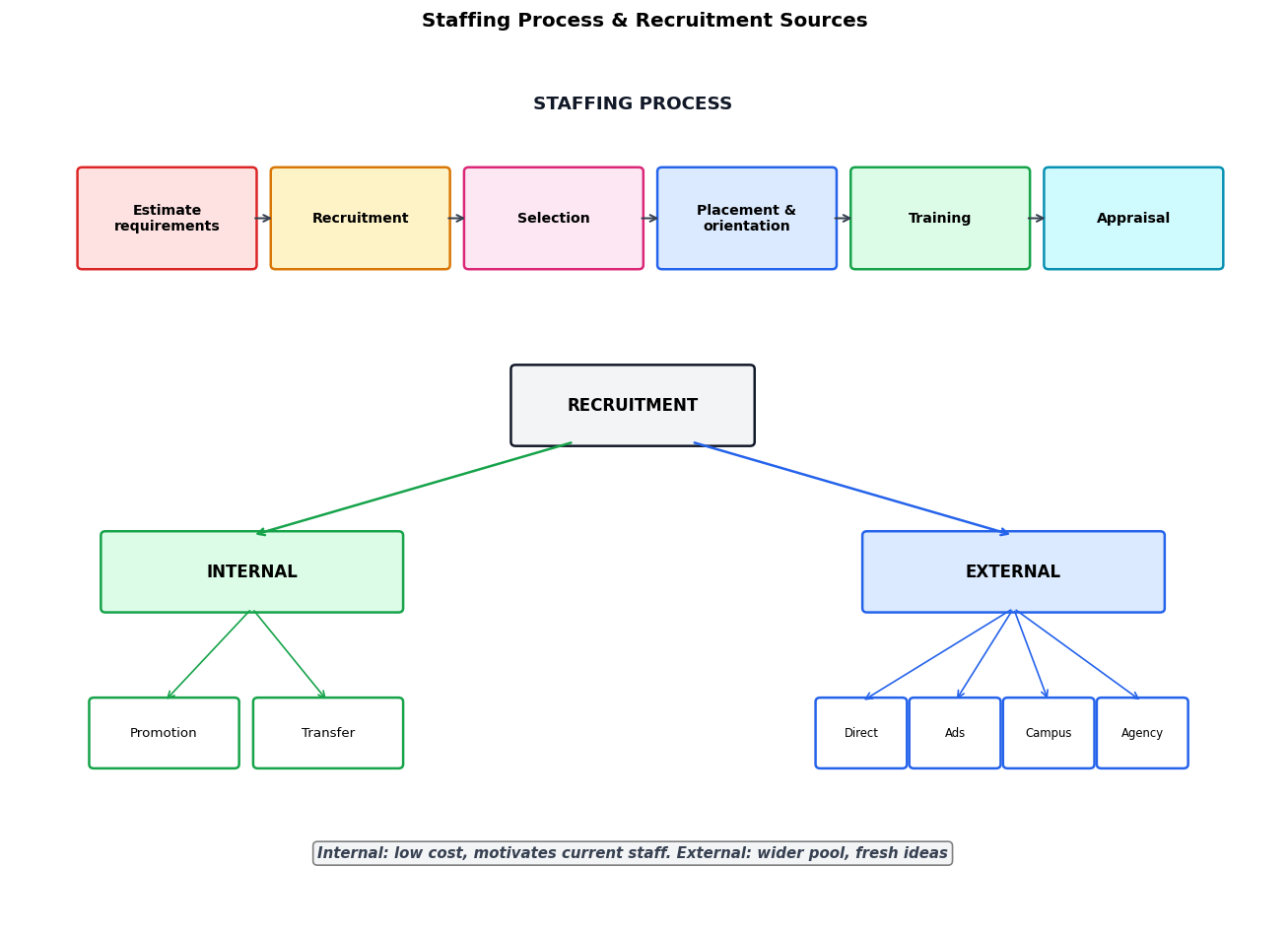
Study the staffing process and recruitment sources and answer:

Staffing figure
  1. Promotion of an employee from within is:
    AInternal
    BExternal
    CBoth
    DNeither
  2. The first step in the staffing process is:
    AEstimate requirements
    BRecruitment
    CSelection
    DTraining
  3. Trace the staffing process and contrast internal vs external recruitment.
Show answersHide answers
1. Option 1 — Internal
2. Option 1 — Estimate requirements
3. Staffing process: estimate manpower requirements; recruitment (search and invite candidates); selection (choose the best); placement and orientation; training and development; performance appraisal; promotion and career planning; compensation. Recruitment sources: INTERNAL — promotion (vertical move) and transfer (horizontal move). Pros: motivates existing staff, lower cost, faster (people known), reduced training, loyalty. Cons: limited pool, risk of inbreeding, politics. EXTERNAL — direct recruitment (walk-ins), advertisements (newspaper, job portals), placement agencies, campus recruitment, referrals (employee recommendations), labour contractors, web sources (LinkedIn, Naukri). Pros: wider pool, fresh ideas, specialised skills, diversity. Cons: higher cost, longer time, risk of mis-fit. Best practice: balance internal and external sources.
Q57 20 Marks

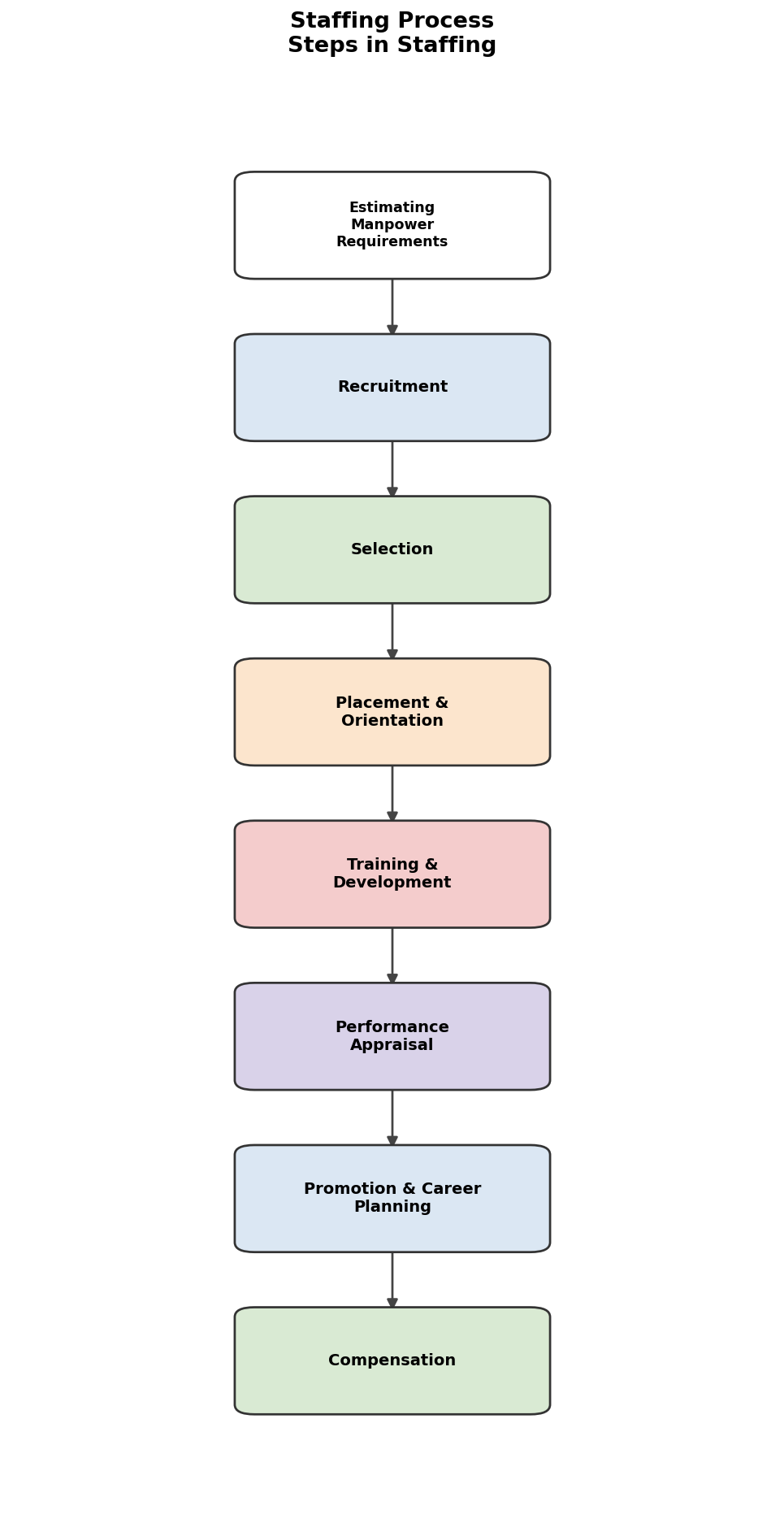
Based on the given diagram, answer the following:

Staffing figure
  1. Which step in the staffing process immediately follows Recruitment?
    ATraining & Development
    BSelection
    CPlacement & Orientation
    DPerformance Appraisal
  2. What is the first step in the staffing process as shown in the diagram?
    ARecruitment
    BJob Analysis
    CEstimating Manpower Requirements
    DSelection
  3. Explain the significance of 'Placement & Orientation' as a step in the staffing process.
  4. Why is Performance Appraisal placed after Training & Development in the staffing process?
  5. Which of the following is an internal source of recruitment?
    AAdvertisement
    BCampus Recruitment
    CTransfers
    DEmployment Exchange
  6. Campus Recruitment is an example of which type of source of recruitment?
    AInternal Source
    BExternal Source
    CBoth Internal and External
    DNeither Internal nor External
  7. State any two merits of using internal sources of recruitment.
  8. Explain 'Direct Recruitment' as an external source of recruitment.
  9. Which step in the selection process comes immediately after Employment Interview?
    ASelection Decision
    BMedical Examination
    CReference & Background Checks
    DJob Offer
  10. Why is Medical Examination conducted before issuing a Job Offer in the selection process?
    ATo check the candidate's educational qualifications
    BTo ensure the candidate is physically and mentally fit for the job
    CTo verify the candidate's references
    DTo assess the candidate's communication skills
  11. Distinguish between 'Preliminary Screening' and 'Employment Interview' as steps in the selection process.
  12. What is the purpose of 'Selection Tests' in the selection process? Name any two types of selection tests.
  13. Vestibule Training is a method of which type of training?
    AOn-the-Job Training
    BBoth On-the-Job and Off-the-Job
    COff-the-Job Training
    DNone of the above
  14. Which of the following is an On-the-Job Training method?
    ACase Study Method
    BClassroom Lectures
    CProgrammed Instruction
    DJob Rotation
  15. Explain 'Apprenticeship Training' as a method of On-the-Job Training.
  16. State any two differences between On-the-Job Training and Off-the-Job Training.
  17. Which step in the selection process immediately follows the Employment Interview?
    ASelection Tests
    BPreliminary Screening
    CReference & Background Checks
    DMedical Examination
  18. Why is Medical Examination conducted after the Selection Decision and not at the beginning of the selection process?
  19. What is the purpose of Preliminary Screening in the selection process?
    ATo offer the job to the best candidate
    BTo eliminate unsuitable candidates at the very outset
    CTo check the physical fitness of candidates
    DTo verify the educational qualifications of candidates
  20. Distinguish between 'Selection' and 'Recruitment' as steps in the staffing process.
  21. Which of the following is an Off-the-Job method of training?
    AJob Rotation
    BCoaching
    CVestibule Training
    DApprenticeship Training
  22. Explain the concept of 'Job Rotation' as a method of On-the-Job Training.
  23. A newly recruited software engineer is trained by working alongside an experienced senior developer on live projects at the workplace. Which training method is being used here?
    ACase Study
    BVestibule Training
    CProgrammed Instruction
    DInternship Training
  24. State any two differences between On-the-Job and Off-the-Job methods of training.
Show answersHide answers
1. Option 2 — Selection
2. Option 3 — Estimating Manpower Requirements
3. Placement refers to assigning the selected candidate to the most suitable job. Orientation involves introducing the new employee to the organisation, its policies, and colleagues. It helps the employee settle in, reduces anxiety, and increases productivity from the start.
4. Performance Appraisal is placed after Training & Development because the employee's performance is evaluated after they have been trained. The appraisal measures the effectiveness of training and determines whether the employee has improved, which then informs decisions about promotion, compensation, and further development needs.
5. Option 3 — Transfers
6. Option 2 — External Source
7. Two merits of internal sources of recruitment are: (1) It is economical as it saves costs on advertising and selection procedures. (2) It motivates existing employees as they see opportunities for growth and promotion within the organisation, improving morale and loyalty.
8. Direct Recruitment involves placing a notice at the factory or office gate inviting applications from suitable candidates. It is used for unskilled or semi-skilled workers. Interested candidates appear at the gate and are selected on the spot based on their suitability for the job.
9. Option 3 — Reference & Background Checks
10. Option 2 — To ensure the candidate is physically and mentally fit for the job
11. Preliminary Screening is the initial step where applications are reviewed to eliminate candidates who do not meet the basic job requirements. It is a quick, paper-based process. Employment Interview, on the other hand, is a face-to-face interaction between the interviewer and candidate to assess personality, communication skills, knowledge, and suitability for the job in greater depth.
12. Selection Tests are used to objectively assess a candidate's abilities, aptitude, personality, and suitability for the job. They help in comparing candidates on a standard scale. Two types of selection tests are: (1) Intelligence Test – measures mental ability and reasoning power. (2) Aptitude Test – measures a candidate's potential to learn new skills required for the job.
13. Option 3 — Off-the-Job Training
14. Option 4 — Job Rotation
15. Apprenticeship Training is a method where a trainee works under the guidance of an experienced master worker or craftsman. The trainee learns the skills of the trade while working. It is commonly used in skilled trades such as plumbing, carpentry, and electrical work. The trainee receives a stipend during the training period and gains practical, hands-on experience.
16. Differences: (1) Location – On-the-Job Training is conducted at the actual workplace while Off-the-Job Training is conducted away from the workplace in a separate training facility or classroom. (2) Productivity – In On-the-Job Training, the employee contributes to production while learning, whereas in Off-the-Job Training, the employee is away from work and does not contribute to production during the training period.
17. Option 3 — Reference & Background Checks
18. Medical Examination is conducted after the Selection Decision because it is an expensive and time-consuming step. Conducting it at the beginning would waste resources on candidates who may be rejected on other grounds such as skills, qualifications, or interview performance. It is done near the end to ensure only the most suitable candidates are medically evaluated.
19. Option 2 — To eliminate unsuitable candidates at the very outset
20. Recruitment is the process of searching for prospective employees and stimulating them to apply for jobs in an organisation. It is a positive process as it attracts a large number of applicants. Selection, on the other hand, is the process of choosing the most suitable candidates from the pool of applicants. It is a negative process as it involves rejection of unsuitable candidates. Recruitment precedes selection in the staffing process.
21. Option 3 — Vestibule Training
22. Job Rotation is an On-the-Job training method in which an employee is systematically moved from one job to another within the organisation. The purpose is to broaden the employee's understanding of different functions and departments, develop versatility, reduce monotony, and prepare employees for higher responsibilities. It helps in creating a pool of multi-skilled workers.
23. Option 4 — Internship Training
24. 1. Location: On-the-Job training is imparted at the actual workplace while the employee performs the job, whereas Off-the-Job training is provided away from the actual work environment in a separate training facility or classroom. 2. Productivity: In On-the-Job training, the employee contributes to actual production while learning, so there is no loss of output. In Off-the-Job training, the employee is away from work, so there may be a temporary loss of productivity during the training period.

Q58 4 Marks

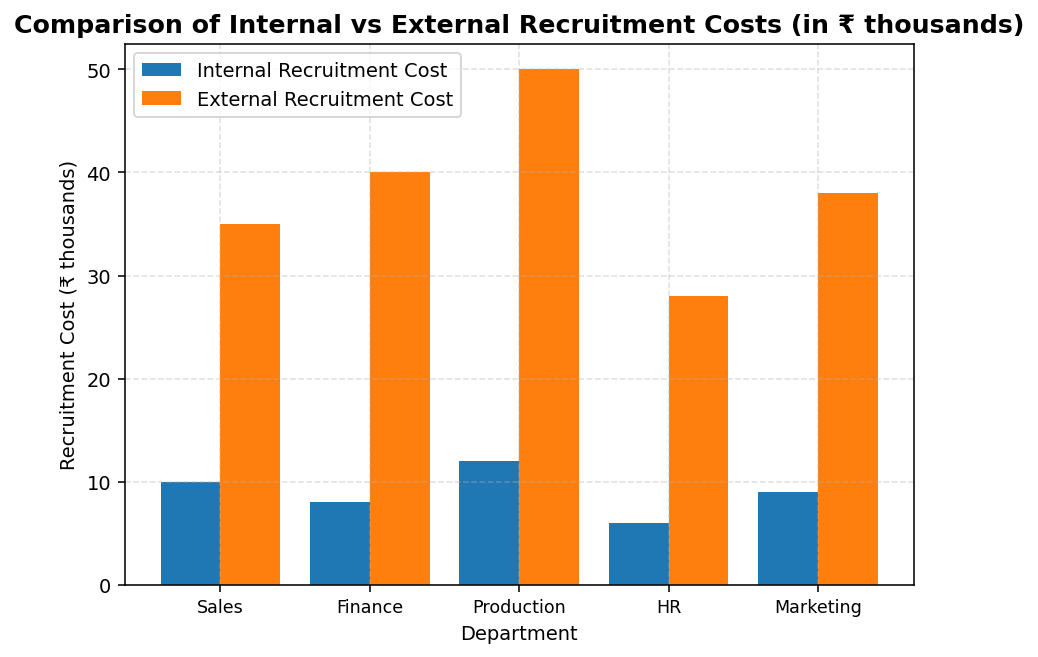
Based on the given chart, answer the following:

Staffing figure
  1. For which department is the difference between External and Internal Recruitment Cost the highest?
    ASales
    BFinance
    CProduction
    DMarketing
  2. What does the chart suggest about the cost-effectiveness of internal vs external recruitment?
    AExternal recruitment is always cheaper than internal recruitment
    BInternal recruitment is more cost-effective than external recruitment across all departments
    CBoth methods cost the same
    DExternal recruitment is cheaper only for the HR department
  3. Calculate the total external recruitment cost across all five departments as shown in the chart.
  4. Despite being costlier, why do organisations prefer external sources of recruitment for certain positions?
Show answersHide answers
1. Option 3 — Production
2. Option 2 — Internal recruitment is more cost-effective than external recruitment across all departments
3. Total External Recruitment Cost = ₹35,000 + ₹40,000 + ₹50,000 + ₹28,000 + ₹38,000 = ₹1,91,000 (i.e., ₹1.91 lakh).
4. Organisations prefer external sources of recruitment for certain positions because: (1) Fresh Talent – External recruitment brings in new ideas, skills, and perspectives that may not be available internally. (2) Specialised Skills – For highly technical or specialised roles, suitable candidates may not exist within the organisation. (3) Wider Choice – External recruitment provides a larger pool of candidates, increasing the chances of finding the most suitable person. (4) Organisational Growth – When the organisation is expanding rapidly, internal sources may not be sufficient to fill all vacancies.

Make a full Business Studies paper on Staffing.

Pick the question mix, set the marks, hit generate. You get a ready-to-print paper with an answer key.

Generate your paper — free