Skip to content
TestMacher
Chapter 4 · Class 12 Business Studies

Directing — Important Questions

57 questions With answers CBSE format

SUMMARY: The chapter "Directing" in Class 12 Business Studies focuses on the managerial function of directing, which involves guiding, leading, and motivating employees to achieve organizational goals.
KEY TOPICS: Meaning of directing, importance of directing, principles of directing, elements of directing, supervision, motivation, leadership, communication, barriers to effective communication, techniques of motivation.

Q1 1 Mark

Which element of directing involves stimulating people to take desired course of action?

ASupervision
BMotivation
CLeadership
DCommunication
Check answerHide answer
Correct answer: Option 2 — Motivation
Q2 1 Mark

Maslow's hierarchy of needs places which need at the top?

APhysiological
BSafety
CEsteem
DSelf-actualisation
Check answerHide answer
Correct answer: Option 4 — Self-actualisation
Q3 1 Mark

Which leadership style permits group to set own goals and methods?

AAutocratic
BDemocratic
CLaissez-faire
DPaternalistic
Check answerHide answer
Correct answer: Option 3 — Laissez-faire
Q4 1 Mark

Grapevine communication is also known as:

AFormal communication
BVertical communication
CInformal communication
DWritten communication
Check answerHide answer
Correct answer: Option 3 — Informal communication
Q5 1 Mark

Which is a non-financial incentive?

ABonus
BProfit sharing
CJob security
DStock option
Check answerHide answer
Correct answer: Option 3 — Job security
Q6 1 Mark

What is the primary purpose of directing in an organization?

ATo create organizational structure
BTo guide and lead employees
CTo establish policies
DTo manage financial resources
Check answerHide answer
Correct answer: Option 2 — To guide and lead employees
Q7 1 Mark

Which of the following is NOT an element of directing?

ASupervision
BMotivation
CPlanning
DCommunication
Check answerHide answer
Correct answer: Option 3 — Planning
Q8 1 Mark

Why is motivation considered an essential part of directing?

AIt helps in planning
BIt ensures compliance with rules
CIt encourages employees to perform better
DIt reduces the need for supervision
Check answerHide answer
Correct answer: Option 3 — It encourages employees to perform better
Q9 1 Mark

Which principle of directing emphasizes the importance of clear communication?

AUnity of command
BScalar chain
CHarmony of objectives
DEffective communication
Check answerHide answer
Correct answer: Option 4 — Effective communication
Q10 1 Mark

What is a common barrier to effective communication in directing?

AClear instructions
BLanguage differences
CRegular feedback
DOpen-door policy
Check answerHide answer
Correct answer: Option 2 — Language differences
Q11 1 Mark

Which leadership style focuses on making decisions without consulting employees?

ADemocratic
BAutocratic
CLaissez-faire
DParticipative
Check answerHide answer
Correct answer: Option 2 — Autocratic
Q12 1 Mark

What is the role of supervision in the directing function?

ATo develop new policies
BTo monitor employee performance
CTo conduct market research
DTo manage financial budgets
Check answerHide answer
Correct answer: Option 2 — To monitor employee performance
Q13 1 Mark

Which motivation technique involves providing rewards for achieving specific goals?

AJob enrichment
BPerformance appraisal
CIncentive programs
DTeam-building activities
Check answerHide answer
Correct answer: Option 3 — Incentive programs
Q14 1 Mark

What is the significance of leadership in the directing process?

AIt reduces costs
BIt fosters a positive work environment
CIt eliminates the need for communication
DIt focuses solely on task completion
Check answerHide answer
Correct answer: Option 2 — It fosters a positive work environment
Q15 1 Mark

Which of the following is a key characteristic of effective communication in directing?

AOne-way communication
BAmbiguity
CTimeliness
DComplexity
Check answerHide answer
Correct answer: Option 3 — Timeliness
Q16 3 Marks

List any three financial incentives for employees.

View sample solutionHide solution
Pay and allowances; Productivity-linked wage incentive; Bonus; Profit sharing; Co-partnership/Stock option; Retirement benefits; Perquisites — any three.
Q17 3 Marks

State any three features of motivation.

View sample solutionHide solution
Internal feeling; Produces goal-directed behaviour; Can be positive or negative; Complex process — varies among individuals.
Q18 3 Marks

Differentiate between formal and informal communication on any three bases.

View sample solutionHide solution
Meaning (official vs unofficial); Channel (organisation chart vs grapevine); Speed (slow vs fast); Authenticity (high vs low); Records (maintained vs not).
Q19 3 Marks

What is meant by supervision? State its importance.

View sample solutionHide solution
Supervision is overseeing subordinates at work and giving instructions. Importance: ensures issuance of instructions, facilitates control, provides on-the-job training, builds morale, links workers and management.
Q20 3 Marks

List any three barriers to effective communication.

View sample solutionHide solution
Semantic barriers (badly expressed message, faulty translations); Psychological (premature evaluation, lack of attention); Organisational (rigid policies, status); Personal (lack of confidence in subordinates) — any three.
Q21 3 Marks

What is the meaning of directing in management?

View sample solutionHide solution
Directing is the managerial function that involves guiding, leading, and motivating employees to achieve organizational goals. It ensures that all members of the organization are working towards the same objectives.
Q22 3 Marks

Why is directing considered an essential function of management?

View sample solutionHide solution
Directing is essential because it helps in achieving organizational goals by ensuring that employees are motivated and guided effectively. It also facilitates communication and coordination among team members.
Q23 3 Marks

List the key elements of directing.

View sample solutionHide solution
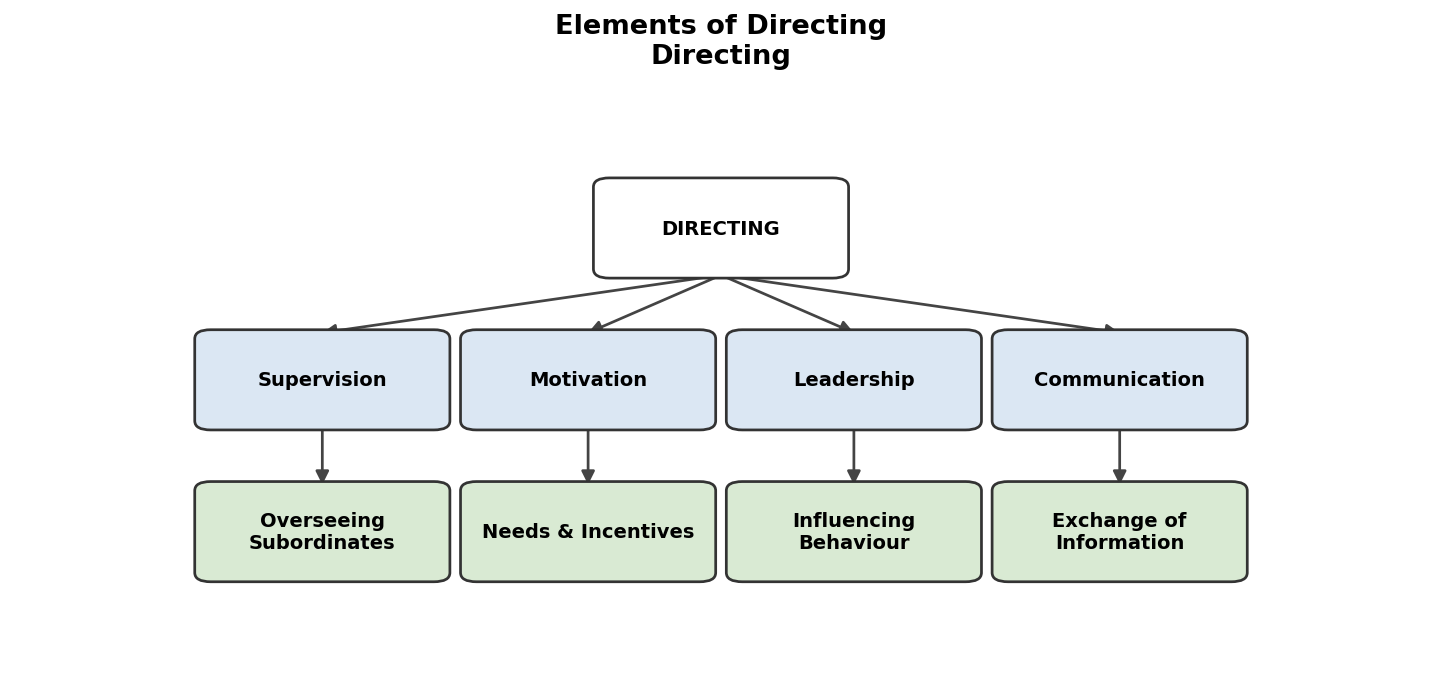
The key elements of directing include supervision, motivation, leadership, and communication. Each of these elements plays a crucial role in ensuring effective management and employee performance.
Q24 3 Marks

What are the principles of directing?

View sample solutionHide solution
The principles of directing include unity of command, clarity of objectives, effective communication, and motivation. These principles help ensure that employees understand their roles and responsibilities clearly.
Q25 3 Marks

Explain the role of supervision in directing.

View sample solutionHide solution
Supervision in directing involves overseeing the work of employees to ensure that tasks are completed effectively and efficiently. It helps in providing guidance, support, and feedback to enhance performance.
Q26 6 Marks

Explain the elements of directing and discuss why it is called the heart of management.

View sample solutionHide solution
Elements: Supervision — instructing subordinates and ensuring tasks are done as planned; Motivation — inspiring people to perform; Leadership — influencing behaviour towards goals; Communication — exchange of ideas and information. Heart of management because: it initiates action (planning, organising and staffing only prepare the setting); integrates employees' efforts with organisational goals; means of motivation through which managers create willingness; facilitates change by reducing resistance; brings stability and balance through better communication, motivation, leadership.
Q27 6 Marks

Discuss Maslow's need-hierarchy theory of motivation with diagram description.

View sample solutionHide solution
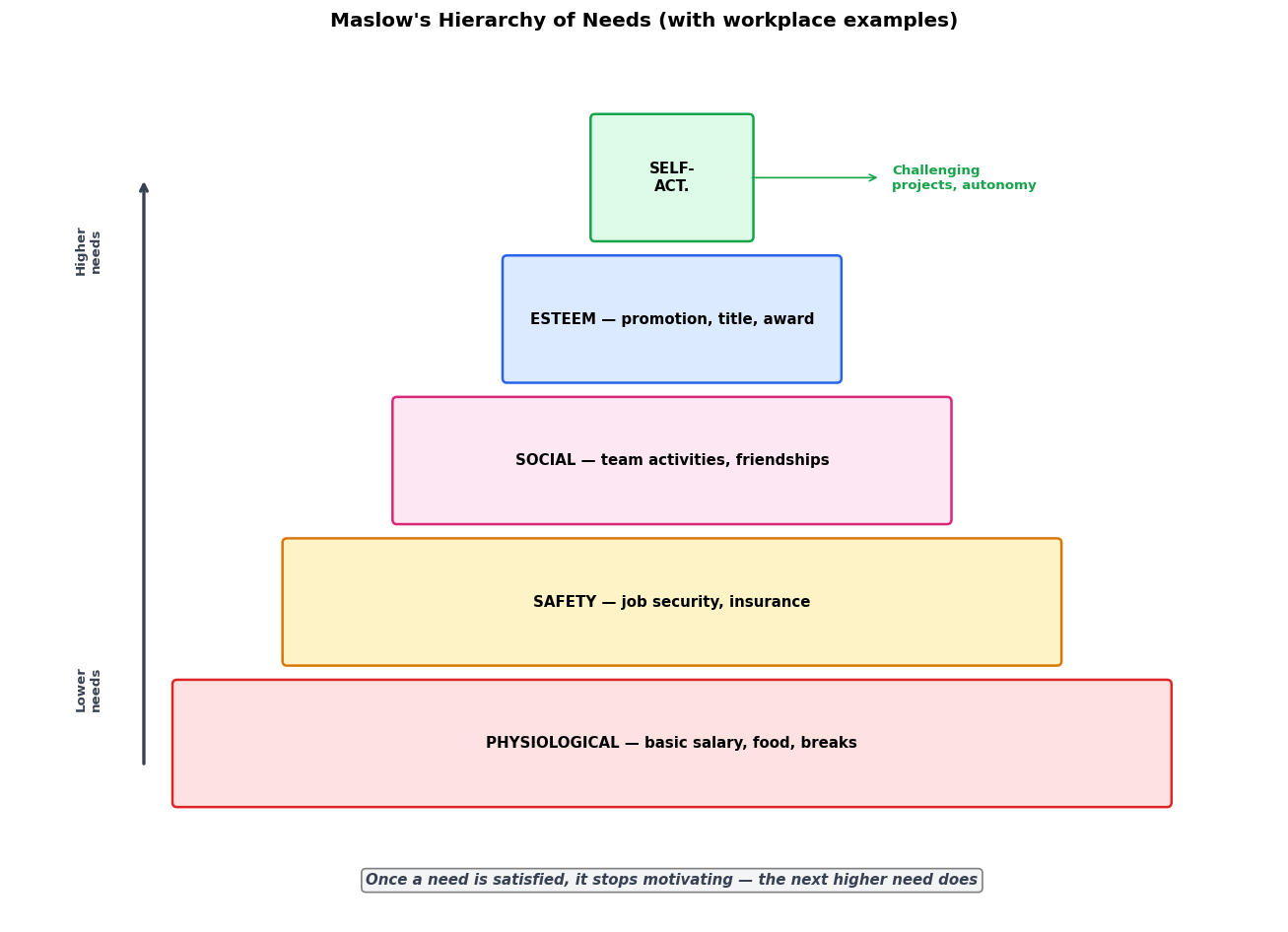
Maslow proposed five levels of needs: 1) Physiological — food, shelter, clothing (basic salary); 2) Safety — job security, insurance (employment contract); 3) Social/Belonging — affection, friendship (team work); 4) Esteem — self-respect, recognition (titles, awards); 5) Self-actualisation — achieving full potential (challenging assignments). Assumptions: needs are arranged in hierarchy; satisfied need no longer motivates; next higher need emerges only after the lower is satisfied. Useful for managers to identify which level an employee is at and design appropriate incentives.
Q28 6 Marks

Explain any five qualities of a good leader and four leadership styles.

View sample solutionHide solution
Qualities: Physical features (good health, stamina); Knowledge (sound technical and managerial knowledge); Integrity (honesty in dealings); Initiative (must seize opportunities); Communication skills; Motivation skills; Self-confidence; Decisiveness; Social skills — any five. Styles: Autocratic — leader takes all decisions, expects compliance; Democratic/Participative — encourages subordinates to participate in decision-making; Laissez-faire/Free-rein — leader gives complete freedom to group; Paternalistic — leader treats employees like family.
Q29 6 Marks

Discuss the process of communication and seven elements involved.

View sample solutionHide solution
Process: Sender has an idea → Encoding (converting into symbols) → Message (encoded subject) → Media (channel like phone, email) → Decoding (receiver interprets symbols) → Receiver (understands and responds) → Feedback (response to confirm understanding). Noise — any obstruction (ambiguity, jargon, distraction) — affects the entire process. Effective communication requires clarity, completeness, conciseness, courtesy and feedback. Without feedback the loop is incomplete.
Q30 6 Marks

Distinguish between financial and non-financial incentives with five examples each.

View sample solutionHide solution
Financial incentives — direct or indirect monetary rewards. Examples: Pay and allowances; Productivity-linked wage incentive; Bonus; Profit sharing; Co-partnership/stock option; Retirement benefits; Perquisites. Non-financial incentives — focus on psychological, social and emotional needs. Examples: Status; Organisational climate; Career advancement opportunity; Job enrichment; Employee recognition programmes; Job security; Employee participation; Employee empowerment. Both kinds are needed — financial alone do not motivate beyond a point.
Q31 6 Marks

Explain the elements of directing and discuss why it is called the heart of management.

View sample solutionHide solution
Elements: Supervision — instructing subordinates and ensuring tasks are done as planned; Motivation — inspiring people to perform; Leadership — influencing behaviour towards goals; Communication — exchange of ideas and information. Heart of management because: it initiates action (planning organising and staffing only prepare the setting); integrates employees' efforts with organisational goals; means of motivation through which managers create willingness; facilitates change by reducing resistance; brings stability and balance through better communication motivation leadership.
Q32 1 Mark

Assertion (A): Directing initiates action.

Reason (R): Without directing planning organising and staffing remain preparation activities and never produce results.

Show explanationHide explanation
Correct answer: Option 1 — Both A and R are true, and R is the correct explanation of A.
Q33 1 Mark

Assertion (A): Maslow's theory assumes that a satisfied need no longer motivates.

Reason (R): Only the next higher unsatisfied need acts as a motivator according to the hierarchy.

Show explanationHide explanation
Correct answer: Option 1 — Both A and R are true, and R is the correct explanation of A.
Q34 1 Mark

Assertion (A): Communication is essential for coordination.

Reason (R): Communication enables managers to share information and align activities of different departments.

Show explanationHide explanation
Correct answer: Option 1 — Both A and R are true, and R is the correct explanation of A.
Q35 1 Mark

Assertion (A): Leadership influences subordinates' behaviour.

Reason (R): A leader uses motivation guidance and personal example to direct subordinate behaviour towards goals.

Show explanationHide explanation
Correct answer: Option 1 — Both A and R are true, and R is the correct explanation of A.
Q36 1 Mark

Assertion (A): Job enrichment is a non-financial incentive.

Reason (R): It satisfies higher-order needs by adding more variety and responsibility to a job.

Show explanationHide explanation
Correct answer: Option 1 — Both A and R are true, and R is the correct explanation of A.
Q37 1 Mark

Assertion (A): Directing is a crucial managerial function that helps in achieving organizational goals.

Reason (R): Effective directing ensures that employees are motivated and guided towards the achievement of these goals.

Show explanationHide explanation
Correct answer: Option 1 — Both A and R are true, and R is the correct explanation of A.
Q38 1 Mark

Assertion (A): Motivation is a key element of directing.

Reason (R): Motivation can be achieved through financial incentives alone.

Show explanationHide explanation
Correct answer: Option 3 — A is true, but R is false.
Q39 1 Mark

Assertion (A): Supervision is an important aspect of directing.

Reason (R): Supervision involves overseeing the work of employees to ensure tasks are completed correctly.

Show explanationHide explanation
Correct answer: Option 1 — Both A and R are true, and R is the correct explanation of A.
Q40 1 Mark

Statement 1: Motivation is an internal feeling that arises from needs.

Statement 2: A satisfied need ceases to motivate behaviour.

Show answerHide answer
Correct answer: Option 1 — Both statements are true.
Q41 1 Mark

Statement 1: Grapevine is informal communication.

Statement 2: It spreads quickly and may distort facts.

Show answerHide answer
Correct answer: Option 1 — Both statements are true.
Q42 1 Mark

Statement 1: Esteem need refers to self-respect and recognition.

Statement 2: It comes after physiological safety and social needs in Maslow's hierarchy.

Show answerHide answer
Correct answer: Option 1 — Both statements are true.
Q43 1 Mark

Statement 1: Supervision is part of directing.

Statement 2: A supervisor links workers with management.

Show answerHide answer
Correct answer: Option 1 — Both statements are true.
Q44 1 Mark

Statement 1: Feedback completes the communication cycle.

Statement 2: Without feedback the receiver's understanding cannot be verified.

Show answerHide answer
Correct answer: Option 1 — Both statements are true.
Q45 1 Mark

Statement 1: Directing is a managerial function that involves guiding and leading employees.

Statement 2: Directing is solely about issuing commands to employees.

Show answerHide answer
Correct answer: Option 2 — Only Statement 1 is true.
Q46 1 Mark

Statement 1: Motivation is an essential element of directing.

Statement 2: Supervision is not a part of the directing process.

Show answerHide answer
Correct answer: Option 3 — Only Statement 2 is true.
Q47 1 Mark

Statement 1: Effective communication is crucial for successful directing.

Statement 2: Barriers to communication can enhance the directing process.

Show answerHide answer
Correct answer: Option 4 — Both statements are false.
Q48 3 Marks
At CodeWorks the team works long hours but morale is low. The new manager Priya analyses needs: junior engineers worry about basic salary (physiological); senior engineers are anxious about layoffs (safety); the team feels disconnected after remote work (social); senior architects want recognition (esteem); two top performers seek challenging assignments (self-actualisation). Priya designs different incentives for each group.
  1. Concerns about basic salary fall under which need?
    ASelf-actualisation
    BEsteem
    CPhysiological
    DSafety
  2. Per Maslow a satisfied need:
    AYes always
    BOnce satisfied no longer motivates
    CAlways motivates
    DRandom
  3. Apply Maslow's theory to explain why differentiated incentives work better than uniform ones.
Show answersHide answers
1. Option 3 — Physiological
2. Option 2 — Once satisfied no longer motivates
3. Maslow's hierarchy of needs is a five-level pyramid: physiological (food shelter — basic salary); safety (job security insurance — employment contract); social (belonging affection — team activities); esteem (respect recognition — titles awards); self-actualisation (potential — challenging assignments). A satisfied need no longer motivates — only the next higher unsatisfied need does. So Priya's tailored approach is correct: stable salaries for juniors; job security and insurance for those worried about layoffs; team-building events for the disconnected; recognition awards for senior architects; stretch projects for top performers. One-size-fits-all incentives fail because employees are at different need levels. Maslow's theory is conceptually elegant but its limitations include — needs may not be strictly hierarchical, may overlap, and cultural differences exist. Yet it remains a useful diagnostic tool for managers to understand individual motivation.
Q49 3 Marks
At BuildSoft the project manager (PM) gives instructions verbally and assumes the team understood. When the client demoed the product key features were missing because some tasks were not communicated to the developers. Conflict arose; deadlines slipped; client trust eroded. A new PM introduced written task tickets daily stand-ups and feedback loops.
  1. Effective communication is:
    AOne-way
    BTwo-way with feedback
    CRandom
    DOptional
  2. Communication process needs:
    ASender
    BReceiver
    CFeedback
    DAll required
  3. Identify barriers in the old PM's communication and discuss the fix.
Show answersHide answers
1. Option 2 — Two-way with feedback
2. Option 4 — All required
3. Communication is the exchange of ideas and information between sender and receiver. Process: sender encodes message → channel → receiver decodes → feedback. Feedback completes the loop and confirms understanding. Without feedback the sender does not know whether the receiver understood. Verbal-only one-way communication (the old PM's style) often fails because: ambiguity is not detected; receiver may forget; no record exists; cultural and language differences cause misinterpretation. The new PM fixed this with: (a) written task tickets — clear unambiguous record; (b) daily stand-ups — two-way verbal feedback; (c) feedback loops — explicit confirmation of understanding. Barriers to effective communication: semantic (jargon); psychological (premature evaluation); organisational (rigid hierarchy); personal (lack of confidence). Solutions: clarity simple language active listening proper feedback channel selection.
Q50 3 Marks
At MedRescue Hospital a fire breaks out at midnight. The on-duty manager Anil immediately gives clear specific orders: 'You evacuate Ward A; you call fire brigade; you secure ICU; you close O2 valves.' No discussion no consultation — just commands. Everyone follows. All patients are saved. The next week for routine policy updates Anil holds a participative meeting and seeks team input.
  1. During the fire Anil's leadership style was:
    AAutocratic
    BDemocratic
    CLaissez-faire
    DPaternalistic
  2. For routine policy updates Anil's style was:
    AAutocratic
    BDemocratic
    CLaissez-faire
    DPaternalistic
  3. Discuss how Anil applied situational leadership.
Show answersHide answers
1. Option 1 — Autocratic
2. Option 2 — Democratic
3. Leadership styles: AUTOCRATIC — leader takes all decisions and expects compliance; works in crisis time-critical situations or with low-skill teams; pros — fast decisions clear authority; cons — demotivates skilled workers no learning. DEMOCRATIC/PARTICIPATIVE — leader involves team in decisions; works for routine policy creative work skilled teams; pros — higher commitment better ideas; cons — slow may dilute responsibility. LAISSEZ-FAIRE/FREE-REIN — leader gives complete freedom; works for highly skilled self-driven teams (research scientists artists); pros — autonomy creativity; cons — may lack direction. PATERNALISTIC — leader treats team like family; emotional bond. Best leaders are SITUATIONAL — they adapt style to context. Anil correctly used autocratic in fire emergency (fast life-saving decisions needed) and democratic for routine policy (team buy-in matters). Adaptive leadership combines task urgency with people needs.
Q51 4 Marks
Ramesh is a senior manager at a manufacturing company. He recently noticed that despite having well-laid plans and a proper organizational structure, the company was not achieving its targets. After careful analysis, he realized that employees lacked motivation and clear guidance. He decided to focus on directing his team effectively. He started conducting regular meetings, providing clear instructions, and giving feedback on performance. He also introduced a reward system to motivate employees. Within a few months, productivity improved significantly. Ramesh understood that directing is the heart of management because it initiates action and links all other managerial functions. It is a continuous process that takes place at every level of management and involves supervision, motivation, leadership, and communication.
  1. Which of the following best describes the function of 'Directing' in management?
    APlanning future activities of the organization
    BGuiding, leading, and motivating employees to achieve organizational goals
    CDesigning the organizational structure
    DRecruiting and selecting employees
  2. Why is directing considered the 'heart of management'?
  3. Which of the following is NOT an element of directing?
    ASupervision
    BMotivation
    CBudgeting
    DCommunication
  4. Explain any two importance of directing as highlighted in the passage.
Show answersHide answers
1. Option 2 — Guiding, leading, and motivating employees to achieve organizational goals
2. Directing is considered the heart of management because it initiates action in the organization. While planning, organizing, and staffing are preparatory functions, it is directing that actually sets the organization in motion. It links all other managerial functions and ensures that employees work towards achieving organizational goals.
3. Option 3 — Budgeting
4. 1. Initiates Action: Directing initiates action in the organization by guiding employees to perform their tasks effectively, which is evident when Ramesh started giving clear instructions and the company's productivity improved. 2. Motivates Employees: Directing helps in motivating employees through reward systems and feedback, which encourages them to put in their best efforts towards achieving organizational goals.
Q52 3 Marks

Maslow's hierarchy of needs:

LevelNeedExamples in workplace
1PhysiologicalBasic salary food breaks
2SafetyJob security insurance
3Social/BelongingTeam activities friendships
4EsteemPromotion title award
5Self-actualisationChallenging projects autonomy
  1. Need for personal growth and autonomy is:
    APhysiological
    BSafety
    CEsteem
    DSelf-actualisation
  2. Maslow's pyramid has how many levels?
    AOne
    BFive
    CThree
    DTwo
  3. Discuss how managers can use Maslow's hierarchy in designing incentives.
Show answersHide answers
1. Option 4 — Self-actualisation
2. Option 2 — Five
3. Maslow's pyramid is a useful framework for understanding human motivation. Its core insights: (1) needs exist at different levels of urgency; (2) lower needs must be satisfied before higher ones become motivators; (3) once satisfied a need no longer motivates — managers must address the NEXT level. Workplace applications: pay handles physiological needs; insurance and stable employment handles safety; teamwork and offsites handle social; recognition awards titles handle esteem; stretch assignments coaching and innovation projects handle self-actualisation. Limitations: the strict hierarchy doesn't always hold (some pursue self-actualisation despite unmet lower needs); cultural variations exist; people may seek multiple needs simultaneously. Despite limitations Maslow remains widely used because it gives managers a structured way to think about diversified motivation strategies.
Q53 3 Marks

Comparison of leadership styles:

StyleDecision-makingBest for
AutocraticLeader aloneCrisis low-skill workers
DemocraticGroup involvedRoutine creative work
Laissez-faireGroup decidesHighly skilled experts
PaternalisticLeader as parentLoyal traditional firms
  1. A fire-emergency situation calls for which style?
    AAutocratic
    BDemocratic
    CLaissez-faire
    DPaternalistic
  2. A team of senior research scientists is best led with:
    AAutocratic
    BDemocratic
    CLaissez-faire
    DPaternalistic
  3. Discuss how leadership style should adapt to the situation.
Show answersHide answers
1. Option 1 — Autocratic
2. Option 3 — Laissez-faire
3. Leadership style is the manner in which a leader influences subordinates. No style is universally best — situational leadership matches style to context. Factors influencing choice: (1) follower characteristics (skill maturity motivation); (2) task nature (routine creative urgent); (3) organisational culture (hierarchical flat); (4) leader's own personality; (5) external pressure (crisis vs stability). Autocratic works in emergencies and with novice workers. Democratic works for routine policy and creative teams. Laissez-faire works with highly self-driven experts. Paternalistic works in traditional family-run firms. Modern leaders combine elements as needed and shift style as the situation evolves. Effective leaders also build trust delegate well listen actively and provide feedback — these behaviours matter more than the labelled 'style'.
Q54 6 Marks

Map each Maslow need level to suitable workplace incentives.

Maslow levelWorkplace incentive examples
Physiological? Basic salary lunch breaks
Safety? Job security insurance
Social? Team building offsites
Esteem? Promotion title award
Self-actualisation? Challenging projects autonomy
Q55 6 Marks

Match the leadership style to the situation it best suits.

SituationBest leadership style
Fire/medical emergency? Autocratic
Routine policy update? Democratic
R&D scientist team? Laissez-faire
Long-tenured loyal workforce? Paternalistic
New trainee shop floor? Autocratic
Creative ad-agency team? Democratic/Laissez-faire
Q56 3 Marks

Study Maslow's hierarchy with workplace incentives and answer:

Directing figure
  1. Need for personal growth and autonomy is at which level?
    APhysiological
    BSafety
    CEsteem
    DSelf-actualisation
  2. Per Maslow a satisfied need:
    AYes always
    BOnce satisfied no longer motivates
    CAlways motivates
    DRandom
  3. Apply Maslow's theory to design incentives for different employee groups.
Show answersHide answers
1. Option 4 — Self-actualisation
2. Option 2 — Once satisfied no longer motivates
3. Maslow's hierarchy is a five-level pyramid: physiological (food, shelter — basic salary); safety (job security, insurance); social/belonging (affection, friendships — team activities); esteem (respect, recognition — promotion, title, award); self-actualisation (full potential — challenging assignments, autonomy). A satisfied need no longer motivates — only the next higher unsatisfied need does. Differentiated incentives based on individual need level work better than uniform incentives. Workplace applications: stable salaries handle physiological; insurance handles safety; teamwork handles social; recognition handles esteem; stretch projects handle self-actualisation. Limitations: hierarchy not strictly observed, cultural variations exist, multiple needs may be active. Despite limits Maslow remains a useful framework for designing motivation strategies.
Q57 27 Marks

Based on the given diagram, answer the following:

Directing figure
  1. Which element of directing involves overseeing the work of subordinates to ensure tasks are performed as planned?
    AMotivation
    BLeadership
    CSupervision
    DCommunication
  2. From the diagram, identify the element of directing that involves the exchange of information between two or more persons.
    ASupervision
    BMotivation
    CLeadership
    DCommunication
  3. Explain why Directing is considered the 'heart' of management. Mention any two elements shown in the diagram that justify this.
  4. Which of the following is NOT an element of Directing as shown in the diagram?
    ASupervision
    BPlanning
    CMotivation
    DCommunication
  5. According to Maslow's Hierarchy of Needs, which need forms the base (Level 1) of the pyramid?
    ASafety Needs
    BEsteem Needs
    CPhysiological Needs
    DSocial Needs
  6. Ravi is a senior manager who has achieved all his targets and now wants to realise his full potential by taking on creative challenges. Which level of Maslow's hierarchy does this represent?
    AEsteem Needs
    BSocial Needs
    CSafety Needs
    DSelf-Actualisation Needs
  7. Distinguish between Esteem Needs and Social Needs as shown in Maslow's hierarchy.
  8. According to Maslow's theory, a lower-level need must be satisfied before a higher-level need becomes a motivator. State whether this statement is True or False and justify your answer.
  9. In the communication process diagram, what does 'Encoding' refer to?
    AInterpreting the message by the receiver
    BConverting the message into symbols, words or gestures by the sender
    CSending feedback to the sender
    DSelecting the medium of communication
  10. Identify the element in the diagram that disrupts the flow of communication between the sender and receiver.
    AFeedback
    BDecoding
    CNoise / Barrier
    DChannel
  11. What is the significance of 'Feedback' in the communication process? Explain with reference to the diagram.
  12. Give any two examples of barriers (noise) that can affect the communication process as shown in the diagram.
  13. Which type of communication follows the official chain of command and is shown as a major branch in the diagram?
    AGrapevine
    BInformal Communication
    CFormal Communication
    DHorizontal Communication
  14. From the diagram, 'Grapevine' is a form of which type of communication?
    AVertical Communication
    BFormal Communication
    CHorizontal Communication
    DInformal Communication
  15. Differentiate between Downward Communication and Upward Communication as shown in the diagram.
  16. State any two advantages and two disadvantages of Informal Communication (Grapevine) as identified in the diagram.
  17. According to the bar chart, what is the productivity (units per day) when the motivation level is 'High'?
    A55
    B90
    C75
    D35
  18. What trend does the bar chart show about the relationship between motivation and employee productivity?
    AProductivity decreases as motivation increases
    BProductivity remains constant regardless of motivation
    CProductivity increases as motivation increases
    DProductivity first increases then decreases with motivation
  19. Based on the chart, calculate the increase in productivity (units per day) when motivation level moves from 'Low' to 'Very High'.
  20. Explain any two financial incentives that a manager can use to improve motivation levels and thereby increase productivity, as suggested by the trend in the chart.
  21. Identify the two types of communication shown under the 'Communication' element in the diagram.
  22. Which element of Directing involves directly overseeing the work of subordinates to ensure tasks are performed as planned?
    ALeadership
    BMotivation
    CCommunication
    DSupervision
  23. Explain why Directing is considered the 'heart' of management with reference to its elements shown in the diagram.
  24. A manager ignores an employee's suggestion because he assumes it is irrelevant without fully hearing it. Which barrier to communication does this represent?
    ASemantic Barrier
    BOrganisational Barrier
    CPsychological Barrier
    DPersonal Barrier
  25. Referring to the diagram, explain any two Semantic Barriers to communication with examples.
  26. Which of the following is an example of an Organisational Barrier to communication?
    AA sender using technical jargon unknown to the receiver
    BA rigid hierarchical structure that delays message flow
    CA manager's fear of being questioned by subordinates
    DDistrust between sender and receiver
  27. Suggest any two measures to overcome the barriers to communication shown in the diagram.
  28. When a CEO sends a policy circular to all department heads, which type of formal communication is being used?
    AUpward Communication
    BHorizontal Communication
    CDownward Communication
    DDiagonal Communication
  29. Distinguish between Downward Communication and Upward Communication with one example each.
  30. Which of the following best describes Horizontal Communication as shown in the diagram?
    ACommunication from a manager to a worker in a different department
    BCommunication between employees at the same hierarchical level
    CCommunication from a subordinate to a senior manager
    DCommunication that flows across different levels and departments simultaneously
  31. Explain the concept of 'Grapevine' (informal communication) and state any two features that distinguish it from the formal communication network shown in the diagram.
Show answersHide answers
1. Option 3 — Supervision
2. Option 4 — Communication
3. Directing is considered the heart of management because it directly deals with human beings and initiates action. Two elements that justify this are: (1) Motivation – it energises employees to work towards goals, and (2) Leadership – it guides and influences employees to achieve organisational objectives.
4. Option 2 — Planning
5. Option 3 — Physiological Needs
6. Option 4 — Self-Actualisation Needs
7. Social Needs (Level 3) refer to the need for love, affection, belonging, and association with others, e.g., friendship and group membership. Esteem Needs (Level 4) refer to the need for self-respect, recognition, status, and prestige, e.g., job title, awards, and promotions.
8. True. According to Maslow's Hierarchy of Needs, needs are arranged in a hierarchical order. A person is motivated by a higher-level need only after the lower-level need is substantially satisfied. For example, once physiological needs are met, safety needs become the motivating factor.
9. Option 2 — Converting the message into symbols, words or gestures by the sender
10. Option 3 — Noise / Barrier
11. Feedback is the response or reaction of the receiver sent back to the sender. It makes communication a two-way process and helps the sender know whether the message has been correctly understood. In the diagram, feedback flows from the Receiver back to the Sender, completing the communication loop and ensuring effective communication.
12. Two examples of barriers in the communication process are: (1) Semantic Barriers – arising from the use of ambiguous words or language differences, e.g., technical jargon not understood by the receiver. (2) Psychological Barriers – arising from the mental state of the sender or receiver, e.g., premature evaluation or distrust between parties.
13. Option 3 — Formal Communication
14. Option 4 — Informal Communication
15. Downward Communication flows from superiors to subordinates, e.g., instructions, orders, and policies passed from managers to employees. Upward Communication flows from subordinates to superiors, e.g., reports, suggestions, grievances, and feedback sent from employees to managers.
16. Advantages of Grapevine: (1) It spreads information quickly throughout the organisation. (2) It provides emotional and social satisfaction to employees. Disadvantages of Grapevine: (1) It may carry distorted or incomplete information, leading to rumours. (2) It is difficult to control and may harm the organisational environment.
17. Option 3 — 75
18. Option 3 — Productivity increases as motivation increases
19. Productivity at 'Very High' motivation = 90 units per day. Productivity at 'Low' motivation = 35 units per day. Increase in productivity = 90 – 35 = 55 units per day.
20. Two financial incentives a manager can use to improve motivation are: (1) Pay and Allowances – Providing competitive salaries, increments, and allowances such as HRA and DA encourages employees to perform better. (2) Bonus – Offering additional monetary rewards over and above the regular salary for achieving or exceeding targets motivates employees to increase their productivity.
21. The two types of communication shown are Formal Communication and Informal Communication.
22. Option 4 — Supervision
23. Directing is called the heart of management because it directly involves guiding, motivating, leading, and communicating with employees. All other functions like planning and organising remain ineffective unless managers direct employees properly. Through its elements — supervision, motivation, leadership, and communication — directing ensures that human efforts are channelled towards achieving organisational goals.
24. Option 3 — Psychological Barrier
25. 1. Badly Expressed Message: When a manager uses vague or unclear language, the subordinate may misunderstand the instructions. For example, saying 'finish the work soon' without specifying a deadline. 2. Symbols with Different Meanings: The same word or symbol may mean different things to different people. For example, the word 'value' can mean price to a customer and importance to a manager.
26. Option 2 — A rigid hierarchical structure that delays message flow
27. 1. Clarity in Message: The sender should use simple, clear, and precise language to avoid semantic barriers and ensure the message is understood correctly. 2. Building Trust: Managers should create an environment of mutual trust and openness so that psychological and personal barriers are reduced, encouraging employees to communicate freely.
28. Option 3 — Downward Communication
29. Downward Communication flows from superiors to subordinates. It is used to give instructions, policies, and directives. Example: A manager informing employees about new work procedures. Upward Communication flows from subordinates to superiors. It is used to give feedback, suggestions, or grievances. Example: An employee submitting a performance report to the manager.
30. Option 2 — Communication between employees at the same hierarchical level
31. Grapevine refers to the informal channel of communication that arises spontaneously among employees due to social interactions, not through official channels. Two distinguishing features compared to formal communication: 1. Speed: Grapevine spreads information much faster than formal communication as it does not follow a prescribed path or hierarchy. 2. Lack of Accountability: Unlike formal communication, grapevine messages are unofficial and the source is often unknown, making it difficult to hold anyone accountable for the information shared.

Make a full Business Studies paper on Directing.

Pick the question mix, set the marks, hit generate. You get a ready-to-print paper with an answer key.

Generate your paper — free