Organising means:
Organising — Important Questions
SUMMARY: The chapter "Organising" in Class 12 Business Studies focuses on the process of defining and grouping activities, establishing authority relationships, and allocating resources to achieve organizational objectives.
KEY TOPICS: Importance of organising, steps in the organising process, organisational structure, types of organisational structures, formal and informal organisation, delegation of authority, decentralisation, importance of delegation, barriers to effective delegation.
Span of management refers to:
Check answerHide answer
Functional structure groups activities by:
Check answerHide answer
Centralisation means:
Check answerHide answer
Delegation involves:
Check answerHide answer
What is the primary purpose of the organising function in management?
Check answerHide answer
Which of the following is NOT a step in the organising process?
Check answerHide answer
A company uses a hierarchical structure where authority flows from top to bottom. This is an example of which type of organisational structure?
Check answerHide answer
Which of the following best describes a formal organisation?
Check answerHide answer
Decentralisation in an organisation primarily refers to:
Check answerHide answer
Which of the following is a barrier to effective delegation?
Check answerHide answer
What is the importance of delegation in an organisation?
Check answerHide answer
In a matrix organisational structure, employees report to:
Check answerHide answer
Which of the following is a key benefit of having a well-defined organisational structure?
Check answerHide answer
Which of the following statements about informal organisation is true?
Check answerHide answer
Define organising and state any three of its features.
View sample solutionHide solution
Distinguish between functional and divisional organisation structure.
View sample solutionHide solution
Explain the steps in the process of organising.
View sample solutionHide solution
Distinguish between centralisation and decentralisation.
View sample solutionHide solution
What is delegation? List its three elements.
View sample solutionHide solution
What is the importance of organising in a business?
View sample solutionHide solution
List the steps in the organising process.
View sample solutionHide solution
What are the key characteristics of a formal organisation?
View sample solutionHide solution
Explain the difference between formal and informal organisation.
View sample solutionHide solution
What are the different types of organisational structures?
View sample solutionHide solution
Discuss the various types of organisation structures with examples.
View sample solutionHide solution
Discuss the importance of organising for the achievement of organisational objectives.
View sample solutionHide solution
Explain the various principles of effective delegation.
View sample solutionHide solution
Compare functional and divisional structure: their advantages limitations and when each is appropriate.
View sample solutionHide solution
Discuss the principle of 'unity of command' and 'span of management' in organising.
View sample solutionHide solution
Compare functional and divisional structures of organisation with the help of a table.
Assertion (A): Division of work is essential for organising.
Reason (R): Specialisation through division of work increases efficiency and expertise.
Show explanationHide explanation
Assertion (A): Functional structure is suitable for small businesses.
Reason (R): It allows specialisation and economies of scale within each function.
Show explanationHide explanation
Assertion (A): Authority can be delegated but responsibility cannot.
Reason (R): The manager remains ultimately accountable for the delegated work.
Show explanationHide explanation
Assertion (A): Centralisation concentrates decision-making at the top.
Reason (R): It allows uniform decisions and clear control but may slow response.
Show explanationHide explanation
Assertion (A): A wider span of management leads to flatter organisation.
Reason (R): With more subordinates per manager fewer management levels are needed.
Show explanationHide explanation
Assertion (A): Organising is essential for achieving organizational objectives.
Reason (R): Organising helps in defining and grouping activities systematically.
Show explanationHide explanation
Assertion (A): Decentralisation leads to a more flexible organisational structure.
Reason (R): Decentralisation involves distributing authority to lower levels of management.
Show explanationHide explanation
Assertion (A): Formal organisations are more effective than informal organisations.
Reason (R): Informal organisations can lead to misunderstandings and conflicts.
Show explanationHide explanation
Statement 1: Organising establishes structure of authority.
Statement 2: It defines who has the authority over what activities.
Show answerHide answer
Statement 1: Departments are formed by grouping similar activities.
Statement 2: Each department has a head responsible for its operations.
Show answerHide answer
Statement 1: Chain of command flows from top to bottom.
Statement 2: Each level has a clear authority and reporting relationship.
Show answerHide answer
Statement 1: Matrix structure combines functional and divisional.
Statement 2: Employees may report to both functional and project managers.
Show answerHide answer
Statement 1: Authority should match responsibility.
Statement 2: Without sufficient authority a manager cannot effectively discharge responsibilities.
Show answerHide answer
Statement 1: The process of organising involves defining and grouping activities.
Statement 2: Organising is not essential for achieving organizational objectives.
Show answerHide answer
Statement 1: Decentralisation refers to the systematic delegation of authority throughout all levels of management.
Statement 2: Centralisation means that decision-making is concentrated at the top levels of management.
Show answerHide answer
Statement 1: A formal organisation is characterized by a structured hierarchy and defined roles.
Statement 2: Informal organisations do not exist within formal structures.
Show answerHide answer
-
Currently GlowCare uses:AFunctional structureBDivisional structureCNo structureDMatrix only
-
A divisional structure typically provides:AFaster launchesBBetter cross-product sharingCSlower decisionsDHigher costs
-
Should GlowCare shift to divisional structure? Justify with pros and cons.
Show answersHide answers
-
Verma's current style is:ADelegationBDecentralisationCCentralisationDAll three
-
Delegation involves transferring:AAuthorityBResponsibilityCAccountabilityDAll three
-
Explain delegation and decentralisation; advise Verma on what to retain.
Show answersHide answers
-
Span of management refers to the number of subordinates a manager:AWiderBNarrowerCNo changeDEqual
-
Adding a supervisor layer to reduce span creates a:ATall structureBFlat structureCMixedDRandom
-
Compare tall and flat structures and recommend a span for AutoServ.
Show answersHide answers
-
What is the FIRST step in the organising process that Rajan followed?AAssigning duties to individualsBIdentifying and dividing workCEstablishing authority relationshipsDAllocating resources to departments
-
The process of grouping similar activities into departments is known as:ADelegationBDecentralisationCDepartmentalisationDCoordination
-
Explain any two benefits of organising that Rajan's company experienced after implementing the organising process.
-
Why is establishing authority-responsibility relationships an essential step in the organising process?
Show answersHide answers
Functional vs Divisional Structure:
| Aspect | Functional | Divisional |
|---|---|---|
| Basis of grouping | Function | Product/region/market |
| Specialisation | Functional | General managerial |
| Cost | Lower (no duplication) | Higher (duplication) |
| Accountability | Functional | Divisional P&L |
| Coordination | Difficult across functions | Easier within division |
| Suitability | Single product | Multiple products/markets |
-
A small bakery making one product line is best organised under:AFunctional structureBDivisional structureCBothDNeither
-
Cost of running a divisional structure is generally:ALowerBHigherCSameDCannot say
-
Compare functional and divisional structures and discuss when each is suitable.
Show answersHide answers
Delegation vs Decentralisation:
| Aspect | Delegation | Decentralisation |
|---|---|---|
| Nature | Process | Result/policy |
| Scope | Limited to two persons | Organisation-wide |
| Authority retained | More by superior | Spread to lower levels |
| Purpose | Reduce manager workload | Develop future managers |
| Necessity | Required in every org | Optional |
| Control | Stays with delegator | Strategic only at top |
-
Delegation is essentially a:AProcessBResultCBothDNeither
-
Decentralisation is for the organisation:AYes alwaysBOptionalCForbiddenDRandom
-
Explain the difference between delegation and decentralisation; discuss importance of decentralisation.
Show answersHide answers
Compare functional and divisional organisational structures across the criteria below.
| Criterion | Functional | Divisional |
|---|---|---|
| Basis | ? Function | ? Product/region/market |
| Specialisation | ? Functional depth | ? General management |
| Cost | ? Lower | ? Higher |
| Coordination | ? Difficult cross-function | ? Easier within division |
| Suitability | ? Single product | ? Multiple products |
The table below shows the number of subordinates reporting to each manager in two different companies. Which company demonstrates a wider span of control, and what does this imply about the number of hierarchical levels in that company?
| Manager Level | Number of Subordinates in Company A | Number of Subordinates in Company B |
|---|---|---|
| Top Level Manager | 4 | 8 |
| Middle Level Manager | 4 | 8 |
| Lower Level Manager | 4 | 8 |
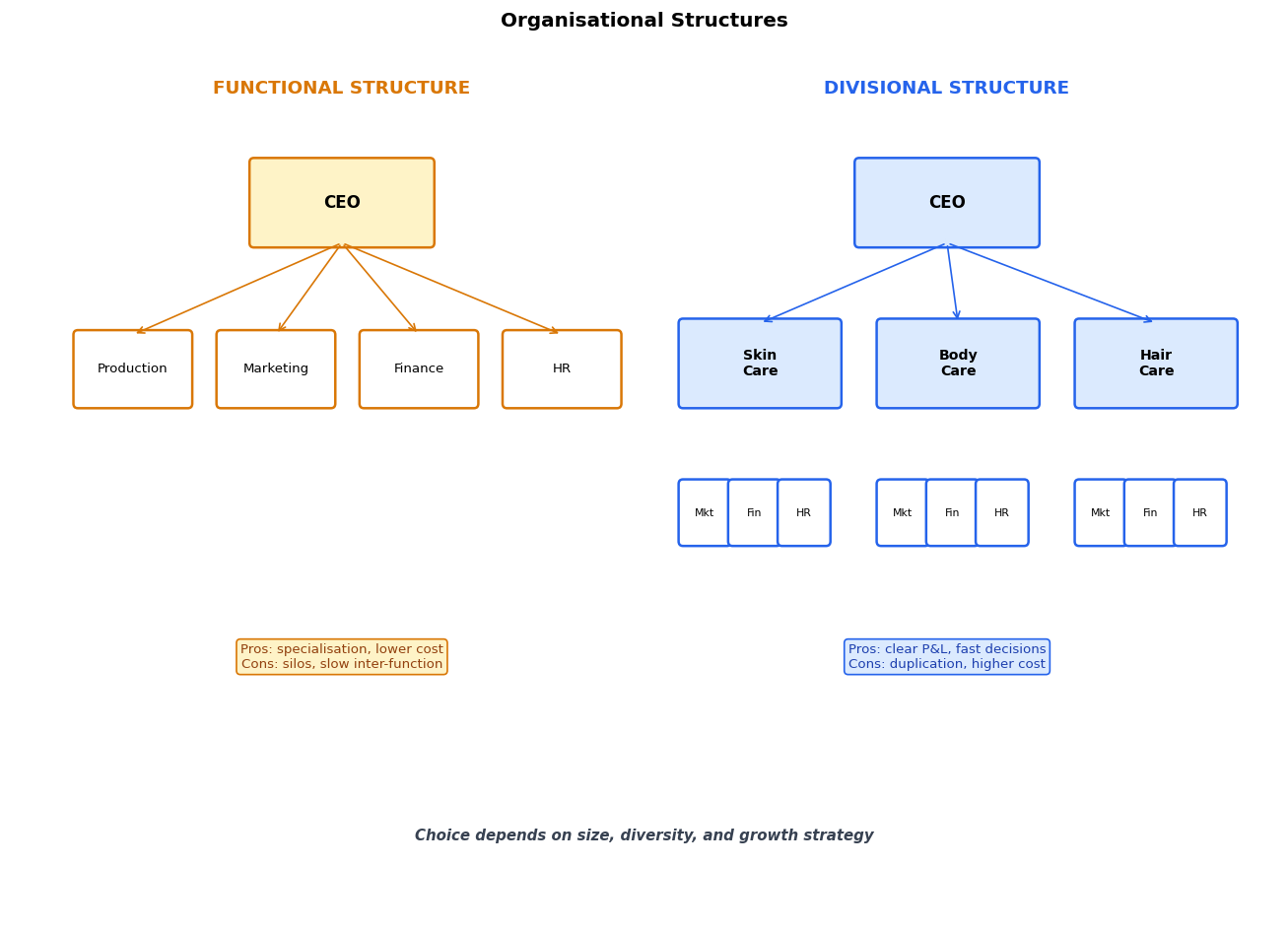
Study the functional vs divisional structure diagram and answer:
-
A small bakery making one product line is best organised under:AFunctionalBDivisionalCBoth equalDNeither
-
Cost of running a divisional structure is generally:ALowerBHigherCSameDCannot say
-
Compare functional and divisional structures and discuss when each is suitable.
Show answersHide answers
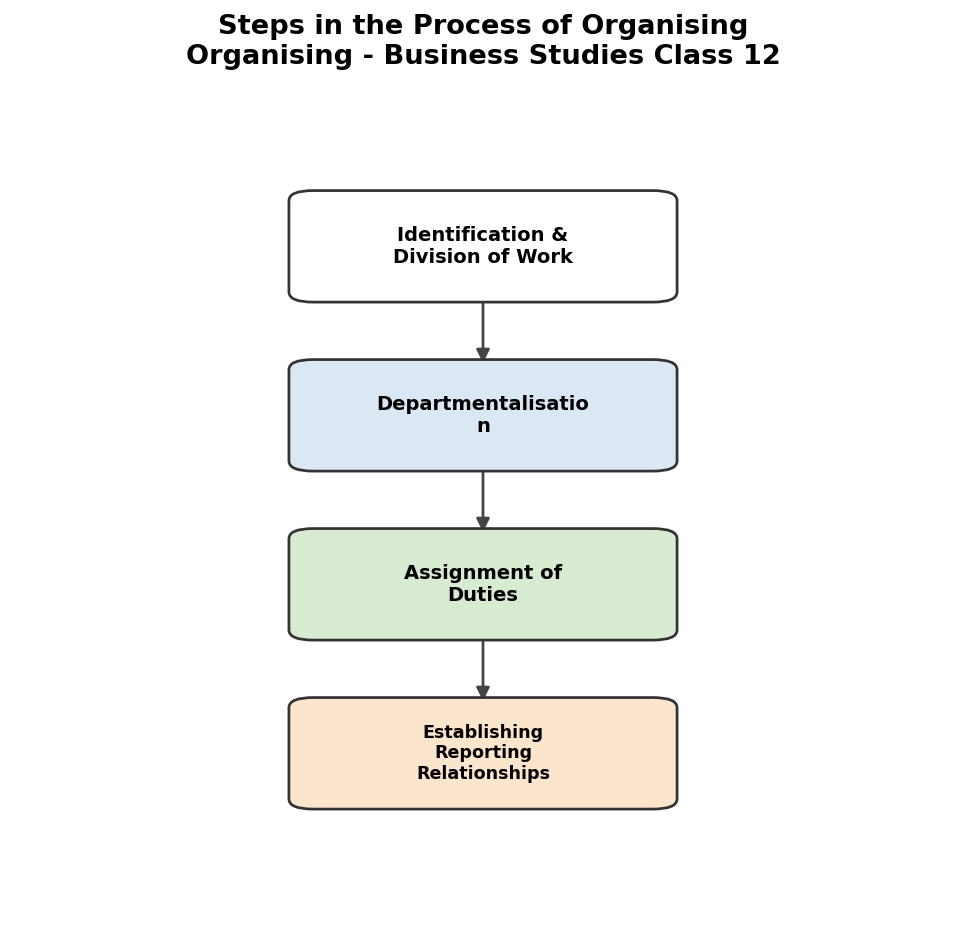
Based on the given diagram, answer the following:
-
Which is the FIRST step in the process of organising?ADepartmentalisationBAssignment of DutiesCIdentification and Division of WorkDEstablishing Reporting Relationships
-
What is the purpose of 'Departmentalisation' in the organising process?
-
Which step in the organising process creates a hierarchy and defines authority-responsibility relationships?AIdentification and Division of WorkBDepartmentalisationCAssignment of DutiesDEstablishing Reporting Relationships
-
Why is 'Division of Work' considered essential in the organising process? Explain with one benefit.
-
In which type of organisational structure are departments created on the basis of functions performed?ADivisional StructureBFunctional StructureCCommittee StructureDMatrix Structure
-
State any TWO advantages of a Divisional Organisational Structure.
-
Which organisational structure is most suitable for a large organisation dealing in multiple product lines?AFunctional StructureBInformal StructureCDivisional StructureDLine Structure
-
Mention any ONE limitation of Functional Organisational Structure.
-
Which element of delegation refers to the obligation of a subordinate to perform the assigned work?AAuthorityBAccountabilityCResponsibilityDPower
-
Distinguish between 'Authority' and 'Accountability' as elements of delegation.
-
Which of the following statements about accountability is CORRECT?AAccountability can be delegated to subordinates.BAccountability flows downward in the organisation.CAccountability cannot be delegated; it always rests with the delegator.DAccountability is the same as responsibility.
-
Why is it said that 'authority can be delegated but responsibility cannot'? Explain briefly.
-
Which type of organisation emerges spontaneously out of social interactions among employees?AFormal OrganisationBDivisional OrganisationCFunctional OrganisationDInformal Organisation
-
State any TWO features of Formal Organisation as shown in the diagram.
-
Which of the following is a DISADVANTAGE of Informal Organisation?AIt fulfils social needs of employees.BIt speeds up communication.CIt may spread rumours and resist change.DIt supplements formal organisation.
-
Can informal organisation exist without formal organisation? Justify your answer.
-
How does decentralisation facilitate the growth of an organisation?
-
Which of the following BEST describes how decentralisation provides relief to top management?ATop management takes all operational decisions.BTop management is freed from routine decisions and can focus on strategic policy-making.CTop management delegates accountability to subordinates.DTop management eliminates the need for middle-level managers.
-
Distinguish between 'Delegation' and 'Decentralisation' on the basis of scope.
-
Which importance of decentralisation is reflected when lower-level managers are given authority to make decisions independently?ARelief to Top ManagementBFacilitates GrowthCDevelops Initiative in SubordinatesDQuick Decision Making
-
Which is the FIRST step in the process of organising as shown in the diagram?ADepartmentalisationBAssignment of DutiesCIdentification and Division of WorkDEstablishing Reporting Relationships
-
Which step in the organising process directly leads to the creation of a chain of command?AIdentification and Division of WorkBDepartmentalisationCAssignment of DutiesDEstablishing Reporting Relationships
-
Why is 'Assignment of Duties' considered an important step in the organising process? Explain briefly.
-
According to the diagram, which element of delegation 'cannot be delegated'?AAuthorityBResponsibilityCAccountabilityDBoth Authority and Responsibility
-
Distinguish between 'Authority' and 'Responsibility' as elements of delegation.
-
Which of the following statements about delegation is CORRECT?AResponsibility can be fully delegated to subordinates.BAccountability flows downward from superior to subordinate.CA manager can delegate authority but remains accountable for results.DDelegation removes the superior's responsibility entirely.
-
Explain how the principle of 'parity of authority and responsibility' is related to effective delegation.
-
Which type of organisation 'emerges spontaneously' according to the diagram?AFormal OrganisationBInformal OrganisationCBoth Formal and InformalDNeither of the two
-
State any two features of Formal Organisation as depicted in the diagram.
-
Can informal organisation be completely eliminated by management? Give reasons to support your answer.
Show answersHide answers
Make a full Business Studies paper on Organising.
Pick the question mix, set the marks, hit generate. You get a ready-to-print paper with an answer key.
Generate your paper — free