Nature and Significance of Management — Important Questions
59 questions
With answersCBSE format
SUMMARY: This chapter explores the fundamental concepts of management, its importance, and its role in achieving organizational goals. KEY TOPICS: Definition of management, characteristics of management, objectives of management, importance of management, management as a science and art, levels of management, functions of management, coordination as an essence of management.
Which of the following is NOT a characteristic of management?
AGoal-oriented
BUniversal activity
CStatic process
DMultidisciplinary
Check answerHide answer
Correct answer: Option 3 — Static process
Q81 Mark
Management is often described as a science because it involves:
AIntuition and creativity
BSystematic body of knowledge
CPersonal experiences
DTrial and error
Check answerHide answer
Correct answer: Option 2 — Systematic body of knowledge
Q91 Mark
Which of the following levels of management is primarily responsible for day-to-day operations?
ATop management
BMiddle management
CLower management
DExecutive management
Check answerHide answer
Correct answer: Option 3 — Lower management
Q101 Mark
Coordination is considered the essence of management because it:
AHelps in decision making
BEnsures unity of action
CFacilitates communication
DReduces costs
Check answerHide answer
Correct answer: Option 2 — Ensures unity of action
Q111 Mark
Which function of management involves setting objectives and determining a course of action?
APlanning
BOrganizing
CLeading
DControlling
Check answerHide answer
Correct answer: Option 1 — Planning
Q121 Mark
The importance of management can be seen in its ability to:
AIncrease employee turnover
BCreate a competitive edge
CReduce organizational structure
DEliminate all risks
Check answerHide answer
Correct answer: Option 2 — Create a competitive edge
Q131 Mark
Management is considered an art because it requires:
AScientific methods
BCreative skills and personal judgment
CStandardized procedures
DMathematical calculations
Check answerHide answer
Correct answer: Option 2 — Creative skills and personal judgment
Q141 Mark
Which of the following is NOT a function of management?
APlanning
BOrganizing
CMarketing
DControlling
Check answerHide answer
Correct answer: Option 3 — Marketing
Q151 Mark
What does the term 'goal-oriented' imply in the context of management?
AManagement focuses on profits only
BManagement aims to achieve specific objectives
CManagement ignores employee welfare
DManagement is concerned with personal goals
Check answerHide answer
Correct answer: Option 2 — Management aims to achieve specific objectives
Short Answer Questions10 questions
Q163 Marks
Define management and state any three of its features.
View sample solutionHide solution
Management is the process of getting things done through and with the people of an organisation efficiently and effectively to achieve organisational goals. Features: (i) goal-oriented process — every management activity is directed at achieving objectives; (ii) all-pervasive — applicable to all organisations regardless of size, type, or location; (iii) multidimensional — covers work (production, marketing), people, and operations; (iv) continuous process — planning organising directing controlling go on continuously; (v) group activity — accomplished through teamwork; (vi) dynamic function — adapts to changing environment; (vii) intangible force — felt through results.
Q173 Marks
Distinguish between efficiency and effectiveness in management.
View sample solutionHide solution
EFFICIENCY — doing the task with the least cost and resources; getting more output per unit of input; about HOW the task is done. EFFECTIVENESS — completing the task and achieving the goal; about WHAT is achieved. A manager can be efficient but not effective (low cost but wrong outcome) or effective but not efficient (right outcome but high cost). Good management aims for BOTH — high efficiency (low resource use) AND high effectiveness (right goals achieved). Example: a sales team that meets target with minimal time and effort is both efficient and effective.
Q183 Marks
Explain the three levels of management.
View sample solutionHide solution
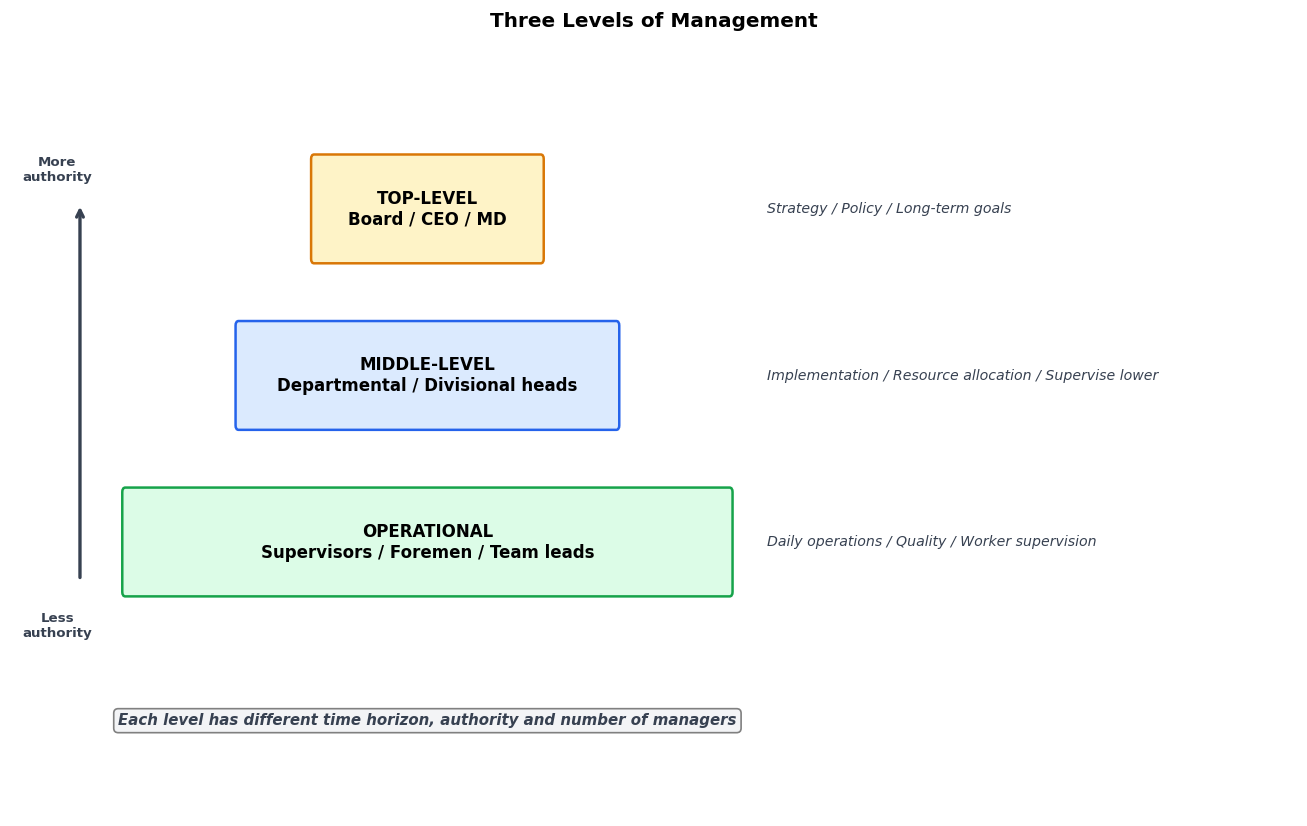
(1) TOP-LEVEL — board of directors, CEO, MD; sets organisational objectives, formulates policies, takes major decisions; long-term focus; few in number; highest authority and responsibility. (2) MIDDLE-LEVEL — departmental heads, branch managers, divisional managers; implement plans and policies; supervise lower-level managers; communicate between top and lower levels; medium-term focus. (3) LOWER/OPERATIONAL — supervisors, foremen, section officers; direct daily operations; supervise workers; ensure work is completed; short-term focus. Each level has different responsibilities, time horizons, and decision-making authority.
Q193 Marks
List any three importance of management for an organisation.
View sample solutionHide solution
(1) ACHIEVES GROUP GOALS — coordinates individual efforts toward common objectives. (2) INCREASES EFFICIENCY — through optimal resource use, eliminates waste. (3) CREATES DYNAMIC ORGANISATION — adapts to environmental changes. (4) ACHIEVES PERSONAL OBJECTIVES — through motivation and recognition. (5) DEVELOPS SOCIETY — creates jobs, generates wealth, supports community. (6) PROFITABILITY — through cost control and revenue growth. (7) BETTER COORDINATION among departments. Without management, even talented individuals would produce chaotic outcomes. Management transforms inputs into desired outputs.
Q203 Marks
Why is coordination called the essence of management?
View sample solutionHide solution
Coordination is integrating different activities of various departments and individuals to ensure they work together harmoniously toward common goals. It is called the ESSENCE of management because: (1) every management function (planning organising directing controlling) involves coordination; (2) it is needed at ALL LEVELS of management; (3) it is the COMMON THREAD running through all activities; (4) it ensures unity of action despite division of work; (5) it converts individual efforts into group efforts. Without coordination, even well-planned activities would fail because departments would work at cross-purposes.
Q213 Marks
Define management and explain its significance in an organization.
View sample solutionHide solution
Management is the process of planning, organizing, leading, and controlling resources to achieve specific goals. Its significance lies in ensuring efficient resource utilization, achieving organizational objectives, and adapting to changes in the environment.
Q223 Marks
List and explain any three characteristics of management.
View sample solutionHide solution
Three characteristics of management are: 1) Goal-oriented: Management focuses on achieving specific objectives. 2) Continuous process: Management is an ongoing activity that adapts to changes. 3) Multidisciplinary: It draws knowledge from various fields like economics, sociology, and psychology.
Q233 Marks
What are the primary objectives of management?
View sample solutionHide solution
The primary objectives of management include achieving organizational goals, optimizing resource use, ensuring employee satisfaction, and adapting to market changes. These objectives guide managerial actions and decisions.
Q243 Marks
Explain the importance of management in today's business environment.
View sample solutionHide solution
Management is crucial in today's business environment as it helps organizations navigate complexities, improve efficiency, foster innovation, and maintain competitive advantage. Effective management ensures that resources are used wisely to meet changing demands.
Q253 Marks
Discuss how management is considered both a science and an art.
View sample solutionHide solution
Management is considered a science because it involves systematic knowledge, principles, and theories that can be studied and applied. It is also an art as it requires creativity, intuition, and interpersonal skills to motivate and lead people effectively.
Long Answer Questions6 questions
Q266 Marks
Explain the various features of management with appropriate examples.
View sample solutionHide solution
FEATURES OF MANAGEMENT: (1) GOAL-ORIENTED — every management decision is directed toward achieving organisational goals; example: setting sales target and aligning all departments. (2) ALL-PERVASIVE — applies to all organisations: businesses, NGOs, government, hospitals, sports clubs. (3) MULTI-DIMENSIONAL — manages work (production, marketing), people (HR, motivation), and operations (logistics, finance). (4) CONTINUOUS — planning organising directing controlling cycle never stops; example: monthly sales reviews lead to revised targets. (5) GROUP ACTIVITY — requires team effort; one person cannot manage alone in modern organisations. (6) DYNAMIC FUNCTION — adapts to environmental changes (technology, regulations, competition); example: responding to GST implementation. (7) INTANGIBLE FORCE — felt through results not directly visible. Together these features distinguish management from other activities and explain why it is critical to organisational success.
Q276 Marks
Discuss the various objectives of management.
View sample solutionHide solution
OBJECTIVES OF MANAGEMENT: (1) ORGANISATIONAL OBJECTIVES — for the organisation: (a) survival; (b) profit (essential for survival and growth); (c) growth — increase in size, sales, market share; (d) market standing — strong reputation. (2) SOCIAL OBJECTIVES — duties to society: (a) supplying quality products and services at fair prices; (b) avoiding unfair practices; (c) generating employment opportunities; (d) protecting the environment; (e) contributing to community welfare through CSR. (3) PERSONAL OBJECTIVES — for individual employees: (a) competitive salary; (b) social recognition; (c) personal development; (d) career growth; (e) job satisfaction; (f) work-life balance. Good management balances all three sets of objectives. Sole focus on organisational objectives at the cost of social or personal objectives leads to long-term failure.
Q286 Marks
Discuss management as a profession science and art.
View sample solutionHide solution
MANAGEMENT AS A SCIENCE: has systematic body of knowledge, principles based on observation and experimentation, universal applicability, can be tested. EXAMPLE: the principle that 'authority and responsibility should be equal' has been validated. NOT A PURE SCIENCE because human behaviour is unpredictable. MANAGEMENT AS AN ART: requires creativity, personalised application based on situation, skill developed through practice. EXAMPLE: motivating employees requires understanding individual personalities. AS PROFESSION: (1) has body of knowledge; (2) requires formal education (MBA, PGDM); (3) has professional bodies (AIMA, IIA); (4) has code of conduct; (5) members get specialised education. NOT A FULL PROFESSION because: anyone can become a manager without certification (unlike doctor or CA). HENCE — management is part-science, part-art, and a developing profession. The best managers combine scientific knowledge with artistic skill and professional ethics.
Q296 Marks
Discuss the importance of coordination and explain how coordination is achieved through different management functions.
View sample solutionHide solution
COORDINATION integrates activities of various departments and individuals to achieve common goals. IMPORTANCE: (1) achieves goals harmoniously — without coordination departments would work at cross-purposes; (2) eliminates conflicts — between departments competing for resources; (3) ensures unity of action — despite division of work; (4) optimises resource use — avoids duplication; (5) responds to environmental changes — coordinates response across functions. ACHIEVED THROUGH MANAGEMENT FUNCTIONS: (1) PLANNING — creates the common framework; departmental plans must align with organisational plans. (2) ORGANISING — defines roles and responsibilities; clear authority structure prevents conflicts. (3) STAFFING — places right person in right job; reduces miscommunication. (4) DIRECTING — provides leadership; communication keeps departments aligned. (5) CONTROLLING — measures performance; identifies and corrects deviations. Each function inherently involves coordination. Hence coordination is called the ESSENCE of management — it is the common thread running through all activities.
Q306 Marks
Explain the levels of management and the role at each level.
View sample solutionHide solution
Three levels of management form a hierarchy: TOP-LEVEL — Board of Directors, CEO, MD, COO, CFO; sets the organisational objectives, formulates policies, takes major capital allocation decisions, represents organisation externally; long-term horizon (5+ years); few in number; highest authority. ROLES: setting vision, strategic planning, key appointments, performance review, stakeholder communication. MIDDLE-LEVEL — divisional managers, departmental heads, branch managers; bridge between top and operational; implement plans, supervise lower-level; medium-term horizon (1-3 years); larger in number than top. ROLES: translating strategies to action, allocating resources, motivating subordinates, reporting upward. LOWER/OPERATIONAL — supervisors, foremen, section officers, team leads; direct daily operations, supervise workers, monitor quality and productivity; short-term horizon (days/weeks); largest in number. ROLES: ensuring work completion, quality control, training new workers, reporting issues. The three levels work together — strategy from top, implementation in middle, execution at bottom. Effective management requires good communication and coordination across levels.
Q316 Marks
Differentiate between management and administration in tabular form on five features.
Assertion–Reason Questions8 questions
Q321 Mark
Assertion (A): Management is the process of getting things done through others.
Reason (R): A manager achieves goals by coordinating efforts of subordinates and using resources efficiently and effectively.
Show explanationHide explanation
Correct answer: Option 1 —
Both A and R are true, and R is the correct explanation of A.
Q331 Mark
Assertion (A): Coordination is the essence of management.
Reason (R): Every management function involves integrating different activities for common goals.
Show explanationHide explanation
Correct answer: Option 1 —
Both A and R are true, and R is the correct explanation of A.
Q341 Mark
Assertion (A): Top management is primarily concerned with strategic decisions.
Reason (R): These decisions affect the long-term direction of the organisation and need broad perspective.
Show explanationHide explanation
Correct answer: Option 1 —
Both A and R are true, and R is the correct explanation of A.
Q351 Mark
Assertion (A): Management is both an art and a science.
Reason (R): It has a systematic body of knowledge (science) and requires creativity in application (art).
Show explanationHide explanation
Correct answer: Option 1 —
Both A and R are true, and R is the correct explanation of A.
Q361 Mark
Assertion (A): Management is a continuous process.
Reason (R): Planning organising directing controlling cycle keeps repeating as the organisation operates.
Show explanationHide explanation
Correct answer: Option 1 —
Both A and R are true, and R is the correct explanation of A.
Q371 Mark
Assertion (A): Management is defined as a process of planning, organizing, leading, and controlling.
Reason (R): The definition of management emphasizes its dynamic and continuous nature.
Show explanationHide explanation
Correct answer: Option 1 —
Both A and R are true, and R is the correct explanation of A.
Q381 Mark
Assertion (A): Coordination is considered the essence of management.
Reason (R): Management involves various functions that require coordination to achieve organizational goals.
Show explanationHide explanation
Correct answer: Option 1 —
Both A and R are true, and R is the correct explanation of A.
Q391 Mark
Assertion (A): Management is only an art and not a science.
Reason (R): Management incorporates both scientific principles and artistic skills to achieve effectiveness.
Show explanationHide explanation
Correct answer: Option 3 —
A is true, but R is false.
Statement-Based Questions8 questions
Q401 Mark
Statement 1: Management is a goal-oriented process.
Statement 2: All management activities aim at achieving organisational objectives.
Show answerHide answer
Correct answer: Option 1 —
Both statements are true.
Q411 Mark
Statement 1: Efficiency is doing things right.
Statement 2: Effectiveness is doing the right things.
Show answerHide answer
Correct answer: Option 1 —
Both statements are true.
Q421 Mark
Statement 1: Top-level management makes strategic decisions.
Correct answer: Option 1 —
Both statements are true.
Q431 Mark
Statement 1: Coordination runs through all management functions.
Statement 2: From planning to controlling integration of efforts is required.
Show answerHide answer
Correct answer: Option 1 —
Both statements are true.
Q441 Mark
Statement 1: Management is required in all types of organisations.
Statement 2: Whether business hospital school or NGO management is needed for goal achievement.
Show answerHide answer
Correct answer: Option 1 —
Both statements are true.
Q451 Mark
Statement 1: Management is defined as the process of planning, organizing, leading, and controlling resources to achieve organizational goals.
Statement 2: Management is solely about controlling the workforce in an organization.
Show answerHide answer
Correct answer: Option 2 —
Only Statement 1 is true.
Q461 Mark
Statement 1: One of the characteristics of management is that it is a continuous process.
Statement 2: Management is only required during the initial setup of an organization.
Show answerHide answer
Correct answer: Option 4 —
Both statements are false.
Q471 Mark
Statement 1: The primary objective of management is to maximize profits.
Statement 2: Management aims to achieve organizational goals efficiently and effectively.
Show answerHide answer
Correct answer: Option 2 —
Only Statement 1 is true.
Case Study / Passage Questions4 questions
Q483 Marks
Ramesh started a small bakery alone. He baked, served customers, kept accounts, and ordered supplies. Sales grew but quality dipped, deliveries were late, and his health suffered. A friend advised him to apply 'management' — define goals, divide work, hire staff, and supervise. Within six months, output doubled, customer complaints fell, and Ramesh focused on new product development.
Management can be best defined as:
AA separate task
BThe process of getting things done through and with others efficiently and effectively
CWorking harder
DHiring more workers
Ramesh's experience after applying management shows which features?
AGoal-orientation
BAll-pervasiveness
CGroup activity
DAll of the above
Explain how the case illustrates the importance and features of management.
Show answersHide answers
1. Option 2 — The process of getting things done through and with others efficiently and effectively
2. Option 4 — All of the above
3. Management is the process of getting things done with and through people efficiently (least cost) and effectively (achieving goals). Ramesh moved from one-man chaos to a structured organisation by: defining goals (output and quality targets), dividing work (separating baking, accounting, and selling), staffing (hiring helpers), directing (supervising and motivating), and controlling (checking quality and complaints). The case shows management is goal-oriented, all-pervasive (applies even to a small bakery), continuous, multi-dimensional, and a group activity. Without management, even a talented person produces chaotic outcomes; with management, ordinary people achieve extraordinary results.
Q493 Marks
TCS is one of India's largest IT companies with 600000+ employees worldwide. It manages diverse work (software development, consulting, BPO), people (engineers, managers, support staff across 50+ countries), and operations (delivery centres, training academies, R&D labs). Top leadership sets strategy, middle managers run business units, operational managers handle daily delivery. The company adapts continuously to new technologies (AI, cloud, blockchain) and global events (pandemic, recession).
TCS's case best illustrates that management is:
ASingle function
BMulti-dimensional function
CStatic activity
DPersonal hobby
Setting overall strategy at TCS is the role of:
ATop
BMiddle
COperational
DAll three
Discuss the multi-dimensional nature of management as illustrated by TCS.
Show answersHide answers
1. Option 2 — Multi-dimensional function
2. Option 1 — Top
3. Multi-dimensional means management deals with several aspects simultaneously: (1) management of work — deciding what tasks need doing (development, delivery, support); (2) management of people — recruiting, motivating, training employees; (3) management of operations — converting inputs into outputs with quality. TCS demonstrates all three dimensions. The three levels work in tandem: top-level (CEO and board) sets strategy; middle (delivery heads, BU heads) implements through resource allocation and supervision; operational (project managers, team leads) runs daily delivery. Effective management requires balance across dimensions and coordination across levels — this is what makes large global firms operate smoothly.
Q503 Marks
At Style Garments, the marketing team promised a major retailer 50000 shirts in 30 days. Production scheduled the order but procurement was unaware and ran out of fabric mid-run. HR was on a hiring freeze so extra workers could not be hired. The order got delivered late with quality issues. The retailer cancelled future orders.
The root cause of Style Garments' problem was:
ALack of motivation
BLack of coordination
CLack of profit
DLack of capital
Coordination is described in management theory as the:
AOptional management activity
BEssence of management
CA separate function
DOnly top-level concern
Why did Style Garments fail despite having capable individual departments? Suggest corrective measures.
Show answersHide answers
1. Option 2 — Lack of coordination
2. Option 2 — Essence of management
3. Coordination integrates the activities of different departments to ensure unified action towards common goals. At Style Garments marketing made commitments without consulting production, procurement and HR — the four departments worked at cross-purposes. Coordination is the essence of management because: every function (planning organising directing controlling) inherently requires it; it is needed at all levels and across departments; it converts individual efforts into group efforts. Steps to fix: (1) set up cross-functional planning meetings; (2) install an Order Management System that triggers raw-material and HR alerts; (3) appoint an account manager to coordinate with the retailer; (4) align KPIs so all functions are accountable for on-time delivery. Without coordination even talented teams produce poor outcomes.
Q514 Marks
Ravi joined a newly established manufacturing company as a manager. On his first day, he observed that workers were performing tasks without any clear direction, resources were being wasted, and there was no coordination among departments. The owner of the company, Mr. Sharma, had technical knowledge but lacked managerial skills. Ravi explained to Mr. Sharma that management involves planning what to do, organizing resources, staffing the right people, directing them effectively, and controlling outcomes. He emphasized that management helps in achieving organizational goals, maintaining efficiency, and ensuring that all individuals work toward a common purpose. Ravi also pointed out that without proper management, even abundant resources cannot be utilized optimally, and the organization would fail to survive in a competitive environment.
Which of the following best describes the primary goal of management as highlighted in the passage?
AMaximizing individual employee salaries
BAchieving organizational goals efficiently and effectively
CEliminating competition in the market
DReducing the number of employees in the organization
According to the passage, which function of management involves assigning tasks and grouping resources?
APlanning
BControlling
COrganising
DDirecting
Why did Ravi feel that Mr. Sharma's company needed proper management? Explain with reference to the passage.
State any two importance of management that Ravi explained to Mr. Sharma.
Show answersHide answers
1. Option 2 — Achieving organizational goals efficiently and effectively
2. Option 3 — Organising
3. Ravi observed that workers lacked clear direction, resources were being wasted, and there was no coordination among departments. Mr. Sharma had technical knowledge but lacked managerial skills. Ravi felt that proper management was needed to plan, organize, staff, direct, and control activities so that organizational goals could be achieved efficiently and resources could be utilized optimally.
4. 1. Management helps in achieving organizational goals by directing the efforts of all individuals toward a common purpose. 2. Management ensures optimal utilization of resources, thereby reducing wastage and improving efficiency.
Table-Based Questions4 questions
Q523 Marks
Compare the three levels of management:
Aspect
Top-level
Middle-level
Operational
Examples
CEO/MD/Board
Departmental heads
Supervisors/foremen
Time horizon
Long-term (5+ yrs)
Medium-term (1-3 yrs)
Short-term (days/weeks)
Authority
Highest
Medium
Lowest
Numbers
Few
More
Largest
Focus
Strategy & policy
Implementation
Day-to-day operations
The primary role of top-level management is:
ASetting objectives
BDaily supervision
CFiling reports
DCleaning
The number of top-level managers is usually:
ALargest
BSmallest
CMedium
DAlways 5
Explain how the three levels work together for organisational effectiveness.
Show answersHide answers
1. Option 1 — Setting objectives
2. Option 2 — Smallest
3. Three levels form a hierarchy with different roles, time horizons and authority. Top level focuses on long-term strategic decisions affecting the whole organisation — they are few in number with the highest authority. Middle level translates strategy into action and supervises operational managers — medium-term focus, larger in number. Operational level directly oversees daily work — short-term focus, largest in number. Effective coordination across levels is essential: strategy from top, implementation in middle, execution at the bottom. Communication must flow both upward (reports, feedback) and downward (decisions, instructions). Without clear distinction confusion arises; without coordination across levels effort is wasted.
Q533 Marks
Compare Efficiency and Effectiveness in management:
Aspect
Efficiency
Effectiveness
Definition
Doing things right
Doing the right things
Focus
Resources/inputs
Goals/outputs
Measure
Output ÷ Input
Goals achieved
Question
How much did it cost?
Did we hit the target?
Ideal
Maximum output per unit of input
Goals met fully
Efficiency in management means:
ADoing things right
BDoing the right things
CWorking hard
DWorking long hours
Effectiveness primarily focuses on:
ACost minimisation
BGoal achievement
CProfit
DCustomer count
Why is it important to be both efficient and effective in management?
Show answersHide answers
1. Option 1 — Doing things right
2. Option 2 — Goal achievement
3. Efficiency means using minimum resources for a given output — it is about doing things right at low cost. Effectiveness means achieving the desired goal — it is about doing the right things. The two are not mutually exclusive but distinct: a manager could be efficient (low cost) but ineffective (wrong outcome); or effective (right outcome) but inefficient (high cost). Good management aims for BOTH — high efficiency AND high effectiveness. For example: producing 1000 shirts at low cost shows efficiency; producing the right design that customers want shows effectiveness. Together they ensure the organisation achieves its goals with optimal use of resources.
Q546 Marks
Identify the nature of management — as science as art and as a profession — using the criteria below and justify each.
Aspect
Science
Art
Profession
Body of knowledge
? Yes systematic
? Yes theoretical base
? Yes formalised
Universal principles
? Yes (Fayol etc)
? Personalised use
? Code of conduct
Skill development
? Through study
? Through practice
? Education + experience
Restricted entry
? Open
? Open
? Not strictly restricted
Q556 Marks
Match each role and time horizon to the appropriate level of management.
Role/Activity
Best fits which level
Approving annual budget
? Top
Setting daily production schedule
? Operational
Allocating resources between departments
? Middle
Long-term capacity expansion strategy
? Top
Supervising worker quality
? Operational
Implementing top management's plans
? Middle
Picture-Based Questions4 questions
Q563 Marks
Study the levels-of-management pyramid and answer:
Setting organisational strategy is the role of:
ATop-level
BMiddle-level
COperational
DAll same
The number of top-level managers is usually:
ALargest
BSmallest
CMedium
DAlways 5
Explain the three levels of management and their roles.
Show answersHide answers
1. Option 1 — Top-level
2. Option 2 — Smallest
3. Three levels of management form a hierarchy with distinct roles, time horizons, and authority. Top-level (Board, CEO, MD, CFO) sets organisational strategy, formulates policies, takes major capital allocation decisions, and represents the firm externally; long-term focus (5+ years); few in number; highest authority. Middle-level (departmental and divisional heads) bridges top and operational levels; implements plans, allocates resources, supervises lower-level managers; medium-term focus (1-3 years); larger in number. Operational level (supervisors, foremen, team leads) directly oversees daily operations and worker quality; short-term focus; largest in number. Communication must flow both upward (reports, feedback) and downward (decisions, instructions) for the system to function.
Q574 Marks
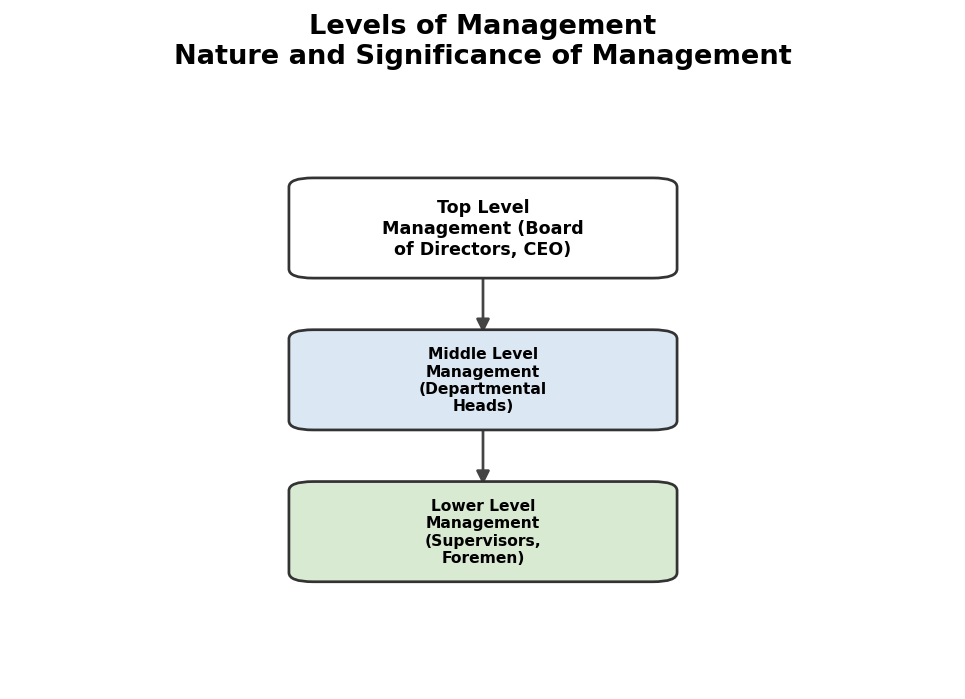
Based on the given diagram showing the Levels of Management, answer the following:
Which level of management is responsible for framing the overall policies and objectives of the organisation?
ALower Level Management
BMiddle Level Management
CTop Level Management
DSupervisory Level Management
Which level of management acts as a link between top level and lower level management?
ATop Level Management
BMiddle Level Management
CLower Level Management
DOperational Management
State any two functions performed by Lower Level Management (Supervisory Level).
Which of the following is NOT a function of Top Level Management?
ASetting organisational goals
BDirectly supervising workers on the shop floor
CCoordinating activities of different departments
DRepresenting the organisation to the outside world
Show answersHide answers
1. Option 3 — Top Level Management
2. Option 2 — Middle Level Management
3. Two functions of Lower Level Management: (1) They assign tasks and duties to workers and ensure their completion. (2) They maintain discipline and motivate workers at the operational level.
4. Option 2 — Directly supervising workers on the shop floor
Q584 Marks
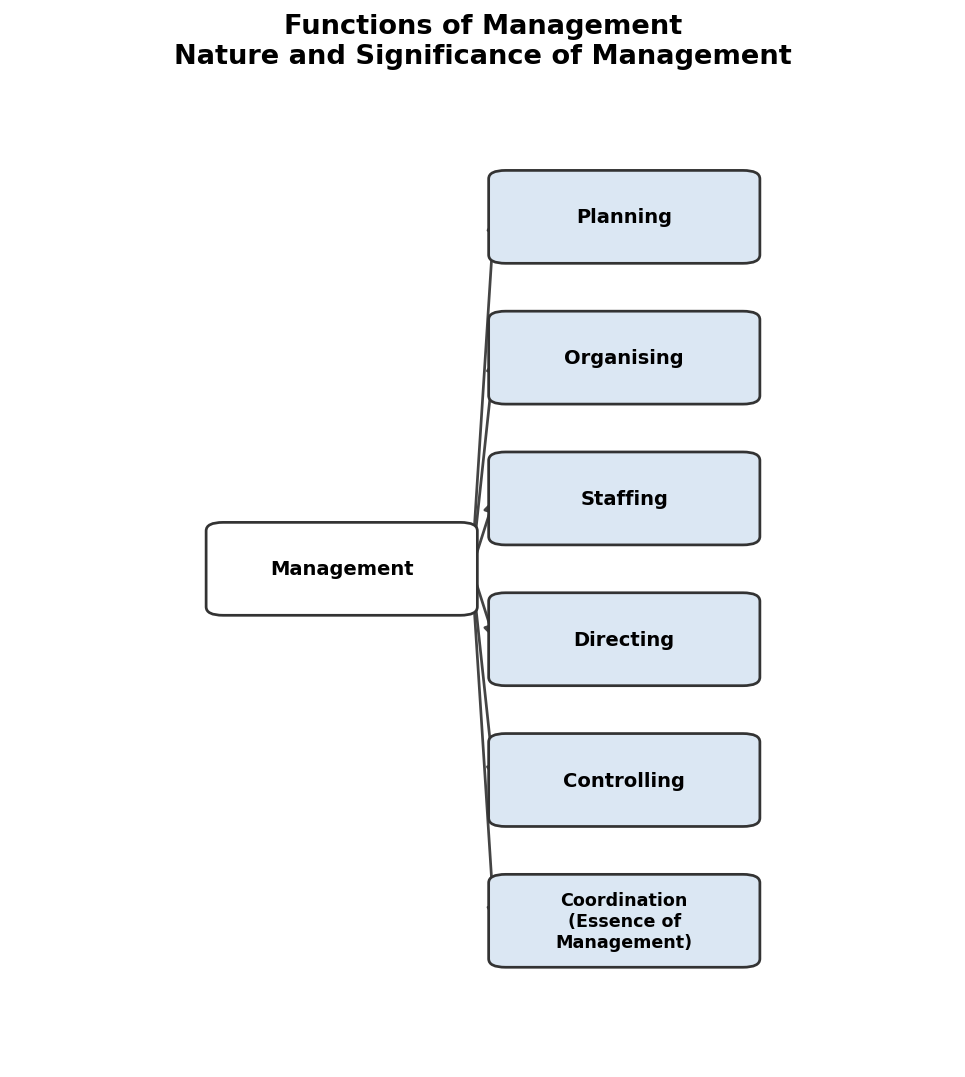
Based on the given diagram showing the Functions of Management, answer the following:
Which function of management is considered the 'essence of management' as shown in the diagram?
APlanning
BControlling
CCoordination
DDirecting
Which function of management involves deciding in advance what to do, how to do it, when to do it, and who is to do it?
AOrganising
BStaffing
CDirecting
DPlanning
Explain why Coordination is called the 'essence of management' rather than a separate function.
Which function of management ensures that actual performance matches planned performance?
APlanning
BOrganising
CControlling
DStaffing
Show answersHide answers
1. Option 3 — Coordination
2. Option 4 — Planning
3. Coordination is called the essence of management because it is not a separate function but is inherent in all managerial functions. It integrates the efforts of all individuals and departments towards common organisational goals. Every function — planning, organising, staffing, directing, and controlling — requires coordination to be effective.
4. Option 3 — Controlling
Q594 Marks
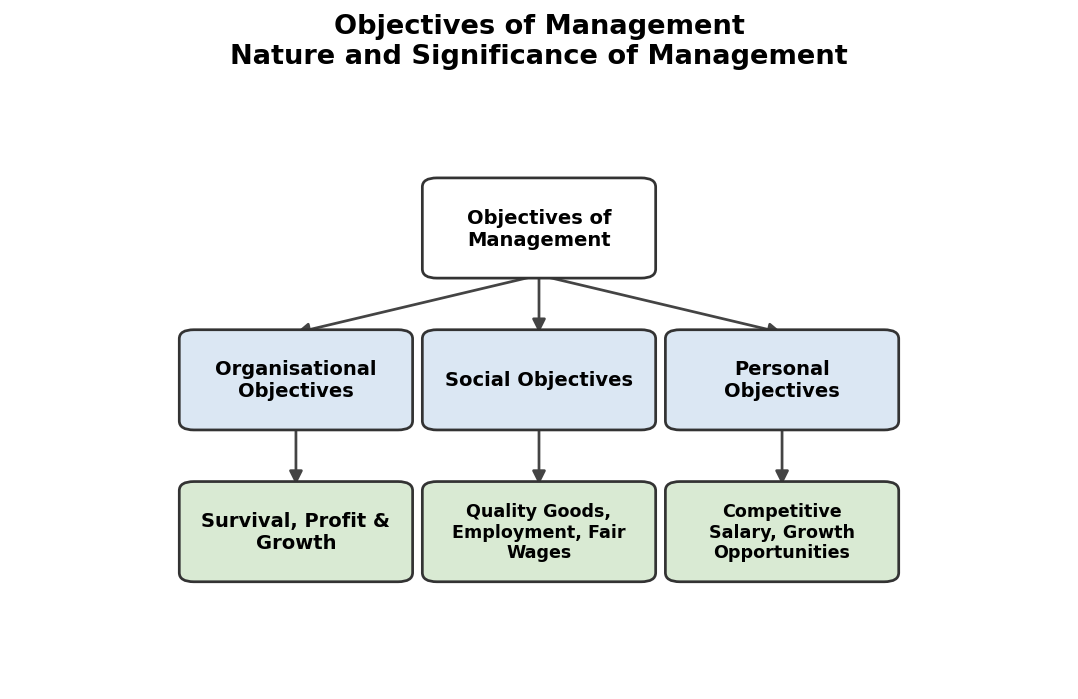
Based on the given diagram showing the Objectives of Management, answer the following:
Which of the following is an Organisational Objective of management?
AProviding fair wages to employees
BSupplying quality goods to consumers
CEnsuring survival, profit and growth of the organisation
DProviding growth opportunities to managers
Distinguish between Social Objectives and Personal Objectives of management with one example each.
Among the three objectives of management shown in the diagram, which one is considered the most basic for an organisation's continued existence?
ASocial Objectives
BPersonal Objectives
COrganisational Objectives
DAll are equally important
How does management help in fulfilling Social Objectives? Give two examples.
Show answersHide answers
1. Option 3 — Ensuring survival, profit and growth of the organisation
2. Social Objectives refer to the obligations of management towards society, e.g., providing quality goods at fair prices, generating employment. Personal Objectives refer to the goals of individual employees within the organisation, e.g., competitive salaries, recognition, and career growth opportunities.
3. Option 3 — Organisational Objectives
4. Management fulfils Social Objectives by: (1) Producing quality goods and services at reasonable prices for consumers. (2) Generating employment opportunities and paying fair wages to workers, thereby contributing to the welfare of society.