Skip to content
TestMacher
Chapter 7 · Class 12 Business Studies

Marketing Management — Important Questions

59 questions With answers CBSE format

SUMMARY: The chapter "Marketing Management" in Class 12 Business Studies focuses on the concepts, strategies, and functions involved in managing marketing activities effectively.
KEY TOPICS: Marketing management, marketing mix, product planning, pricing strategies, promotion strategies, distribution channels, consumer behavior, market segmentation, branding, marketing research.

Q1 1 Mark

Marketing concept evolved through stages — the latest stage is:

AProduction concept
BSelling concept
CMarketing concept
DSocietal marketing concept
Check answerHide answer
Correct answer: Option 4 — Societal marketing concept
Q2 1 Mark

Which is NOT a function of marketing?

AGathering market information
BPromotion
CProduction
DCustomer support service
Check answerHide answer
Correct answer: Option 3 — Production
Q3 1 Mark

Skimming pricing is used to:

APenetrate the market
BCharge a high initial price
CMatch competitors' prices
DEliminate competition
Check answerHide answer
Correct answer: Option 2 — Charge a high initial price
Q4 1 Mark

Which is NOT an element of physical distribution?

AOrder processing
BTransportation
CAdvertising
DInventory
Check answerHide answer
Correct answer: Option 3 — Advertising
Q5 1 Mark

A 'TVC' refers to:

ATrade vendor contract
BTelevision commercial
CTotal variable cost
DTop vehicle category
Check answerHide answer
Correct answer: Option 2 — Television commercial
Q6 1 Mark

Which of the following is NOT a component of the marketing mix?

AProduct
BPrice
CPromotion
DPerformance
Check answerHide answer
Correct answer: Option 4 — Performance
Q7 1 Mark

What is the primary goal of market segmentation?

ATo increase production
BTo identify target customers
CTo reduce costs
DTo enhance distribution channels
Check answerHide answer
Correct answer: Option 2 — To identify target customers
Q8 1 Mark

In the context of pricing strategies, what does 'penetration pricing' aim to achieve?

AMaximize profits immediately
BIncrease market share quickly
CEstablish a premium brand image
DReduce competition
Check answerHide answer
Correct answer: Option 2 — Increase market share quickly
Q9 1 Mark

Which of the following best defines 'branding'?

AThe process of creating a unique name and image for a product
BThe method of setting a price for a product
CThe strategy of promoting a product through advertisements
DThe distribution of products to various retailers
Check answerHide answer
Correct answer: Option 1 — The process of creating a unique name and image for a product
Q10 1 Mark

What is a key function of marketing research?

ATo develop new products
BTo understand consumer preferences
CTo set prices for products
DTo manage supply chains
Check answerHide answer
Correct answer: Option 2 — To understand consumer preferences
Q11 1 Mark

Which of the following is an example of a distribution channel?

ARetail stores
BAdvertising campaigns
CMarket surveys
DProduct features
Check answerHide answer
Correct answer: Option 1 — Retail stores
Q12 1 Mark

What does the term 'consumer behavior' refer to?

AThe study of how consumers make purchasing decisions
BThe analysis of market trends
CThe evaluation of product features
DThe assessment of sales performance
Check answerHide answer
Correct answer: Option 1 — The study of how consumers make purchasing decisions
Q13 1 Mark

Which pricing strategy involves setting a high price initially and then lowering it over time?

APrice skimming
BCost-plus pricing
CValue-based pricing
DDynamic pricing
Check answerHide answer
Correct answer: Option 1 — Price skimming
Q14 1 Mark

What is the purpose of promotion in marketing management?

ATo create awareness and interest in a product
BTo determine the cost of production
CTo manage inventory levels
DTo analyze competitor strategies
Check answerHide answer
Correct answer: Option 1 — To create awareness and interest in a product
Q15 1 Mark

Which of the following is a characteristic of a good product plan?

AFocus on maximizing short-term profits
BIncorporate consumer feedback and preferences
CEmphasize cost-cutting measures
DLimit product variations
Check answerHide answer
Correct answer: Option 2 — Incorporate consumer feedback and preferences
Q16 3 Marks

List the 4 Ps of marketing mix.

View sample solutionHide solution
Product (features, quality, branding, packaging, labelling); Price (pricing strategies); Place (distribution channels and physical distribution); Promotion (advertising, personal selling, sales promotion, publicity).
Q17 3 Marks

State any three functions of packaging.

View sample solutionHide solution
Product identification; Product protection (during transit, storage); Facilitating use of the product; Product promotion (good packaging acts as silent salesman); Convenience to handle and store.
Q18 3 Marks

Distinguish between advertising and personal selling on any three bases.

View sample solutionHide solution
Form (impersonal vs personal); Reach (mass audience vs limited); Cost per contact (low vs high); Flexibility (less flexible vs flexible); Feedback (delayed vs immediate); Authority (no authority vs immediate authority to clarify).
Q19 3 Marks

List any three factors affecting price determination.

View sample solutionHide solution
Product cost; Utility and demand; Extent of competition; Government and legal regulations; Pricing objectives; Marketing methods used — any three.
Q20 3 Marks

What is the difference between selling and marketing?

View sample solutionHide solution
Selling focuses on the seller's needs — converting product into cash. Marketing focuses on consumer needs — satisfying customers profitably. Selling is a part of marketing; marketing begins before production (identify customer needs) and continues after sale (after-sales service).
Q21 3 Marks

List the 4 Ps of marketing mix.

View sample solutionHide solution
Product (features quality branding packaging labelling); Price (pricing strategies); Place (distribution channels and physical distribution); Promotion (advertising personal selling sales promotion publicity).
Q22 3 Marks

State any three functions of packaging.

View sample solutionHide solution
Product identification; Product protection (during transit storage); Facilitating use of the product; Product promotion (good packaging acts as silent salesman); Convenience to handle and store.
Q23 3 Marks

Distinguish between advertising and personal selling on any three bases.

View sample solutionHide solution
Form (impersonal vs personal); Reach (mass audience vs limited); Cost per contact (low vs high); Flexibility (less flexible vs flexible); Feedback (delayed vs immediate); Authority (no authority vs immediate authority to clarify).
Q24 3 Marks

List any three factors affecting price determination.

View sample solutionHide solution
Product cost; Utility and demand; Extent of competition; Government and legal regulations; Pricing objectives; Marketing methods used — any three.
Q25 3 Marks

What is the difference between selling and marketing?

View sample solutionHide solution
Selling focuses on the seller's needs — converting product into cash. Marketing focuses on consumer needs — satisfying customers profitably. Selling is a part of marketing; marketing begins before production (identify customer needs) and continues after sale (after-sales service).
Q26 6 Marks

Explain any five functions of marketing.

View sample solutionHide solution
1) Gathering and analysing market information — understanding customer needs and competitor offerings. 2) Marketing planning — setting marketing objectives and developing plans. 3) Product designing and development — designing product features that match customer needs. 4) Standardisation and grading — ensuring uniform quality. 5) Packaging and labelling — protect, inform, promote. 6) Branding — giving distinct identity. 7) Customer support service — handling complaints, after-sales service, technical support. 8) Pricing — setting profitable yet competitive prices. 9) Promotion — informing and persuading customers. 10) Physical distribution — moving goods from producer to consumer. 11) Transportation. 12) Storage and warehousing. (any five).
Q27 6 Marks

Discuss the elements of product mix and their importance.

View sample solutionHide solution
Elements of product mix: 1) Branding — assigning a distinct identity (name, sign, symbol). Importance: differentiation, customer loyalty, premium pricing. 2) Packaging — designing the wrapper. Importance: protection, identification, promotion (silent salesman), convenience. 3) Labelling — providing detailed information on the product. Importance: identification, grading, helps in promotion, provides legal information (MRP, batch number, expiry). 4) Quality — meeting customer expectations. 5) Features — characteristics of product. 6) Design — appearance and ergonomics. 7) Warranty and Service — assurance. Together, these elements determine how the product is perceived and accepted by customers.
Q28 6 Marks

Discuss the elements of promotion mix.

View sample solutionHide solution
1) Advertising — paid impersonal mass communication through media (TV, print, digital, outdoor). Merits: wide reach, cost-effective per contact, repetition. Demerits: impersonal, no immediate feedback. 2) Personal Selling — direct interaction with prospective buyers. Merits: flexibility, immediate feedback, builds relationship. Demerits: high cost per contact, limited reach. 3) Sales Promotion — short-term incentives like discounts, coupons, free samples, premium offers. Merits: spurs immediate response. Demerits: temporary effect, may erode brand value if overused. 4) Publicity and Public Relations — non-paid form of communication through news stories, press releases. Merits: high credibility. Demerits: limited control. An optimal mix combines all four for maximum impact.
Q29 6 Marks

Explain factors affecting choice of channels of distribution and types of channels.

View sample solutionHide solution
Factors: Product factors (perishability, value, technical complexity); Company factors (financial strength, control desired); Competitive factors (channels used by rivals); Market factors (size, geography, buyer behaviour); Environmental factors (economy, legal); Cost (each level adds to cost). Types: Direct (zero-level) — Producer → Consumer (e.g. e-commerce, manufacturer outlets). Indirect — One-level: Producer → Retailer → Consumer (FMCG sometimes); Two-level: Producer → Wholesaler → Retailer → Consumer (most common); Three-level: Producer → Agent → Wholesaler → Retailer → Consumer (used by manufacturers covering wide market with limited resources).
Q30 6 Marks

Explain any five factors affecting price determination of a product.

View sample solutionHide solution
1) Product cost — total cost (fixed + variable + semi-variable) sets the floor price; firm must recover all costs in long run plus profit margin. 2) Utility and demand — higher utility/inelastic demand allows higher prices (luxury items); price elasticity guides volume-margin trade-offs. 3) Extent of competition — more rivals force prices closer to competitor levels; monopoly allows higher pricing. 4) Government and legal regulations — DPCO regulates essential drugs; MRP rules; anti-profiteering provisions under GST. 5) Pricing objectives — profit maximisation; market-share leadership; product-quality leadership; survival pricing. 6) Marketing methods used — promotion intensity, channel margins, packaging quality all affect price. 7) Stage in product life cycle — skimming in introduction; penetration to grow share; mature stage matches competitors. (any five with examples).
Q31 6 Marks

Explain any five functions of marketing.

View sample solutionHide solution
1) Gathering and analysing market information — understanding customer needs and competitor offerings. 2) Marketing planning — setting marketing objectives and developing plans. 3) Product designing and development — designing product features that match customer needs. 4) Standardisation and grading — ensuring uniform quality. 5) Packaging and labelling — protect inform promote. 6) Branding — giving distinct identity. 7) Customer support service — handling complaints after-sales service technical support. 8) Pricing — setting profitable yet competitive prices. 9) Promotion — informing and persuading customers. 10) Physical distribution — moving goods from producer to consumer. (any five).
Q32 1 Mark

Assertion (A): Marketing is broader than selling.

Reason (R): Marketing begins before production (identifying needs) and continues after the sale (service) whereas selling is only a transactional activity.

Show explanationHide explanation
Correct answer: Option 1 — Both A and R are true, and R is the correct explanation of A.
Q33 1 Mark

Assertion (A): Brand loyal customers are less price sensitive.

Reason (R): A strong brand creates emotional attachment and trust beyond price considerations.

Show explanationHide explanation
Correct answer: Option 1 — Both A and R are true, and R is the correct explanation of A.
Q34 1 Mark

Assertion (A): Packaging is termed as the silent salesman.

Reason (R): Attractive packaging communicates quality and persuades the customer at the point of purchase.

Show explanationHide explanation
Correct answer: Option 1 — Both A and R are true, and R is the correct explanation of A.
Q35 1 Mark

Assertion (A): Penetration pricing helps capture market share quickly.

Reason (R): A low introductory price attracts price-sensitive customers and discourages new entrants.

Show explanationHide explanation
Correct answer: Option 1 — Both A and R are true, and R is the correct explanation of A.
Q36 1 Mark

Assertion (A): Personal selling is the most flexible form of promotion.

Reason (R): The salesperson can adapt the message to each prospect and respond to immediate feedback.

Show explanationHide explanation
Correct answer: Option 1 — Both A and R are true, and R is the correct explanation of A.
Q37 1 Mark

Assertion (A): Marketing management involves planning, organizing, directing, and controlling marketing activities.

Reason (R): Effective marketing management helps in achieving organizational goals.

Show explanationHide explanation
Correct answer: Option 1 — Both A and R are true, and R is the correct explanation of A.
Q38 1 Mark

Assertion (A): The marketing mix consists of four elements: product, price, place, and promotion.

Reason (R): The marketing mix is also referred to as the 4Ps of marketing.

Show explanationHide explanation
Correct answer: Option 1 — Both A and R are true, and R is the correct explanation of A.
Q39 1 Mark

Assertion (A): Pricing strategies are irrelevant in marketing management.

Reason (R): Pricing strategies directly influence consumer purchasing decisions.

Show explanationHide explanation
Correct answer: Option 4 — A is false, but R is true.
Q40 1 Mark

Statement 1: Marketing mix is the combination of 4 Ps.

Statement 2: Each element can be adjusted to suit customer needs.

Show answerHide answer
Correct answer: Option 1 — Both statements are true.
Q41 1 Mark

Statement 1: Labelling provides legal information.

Statement 2: It helps consumers in identification and use.

Show answerHide answer
Correct answer: Option 1 — Both statements are true.
Q42 1 Mark

Statement 1: Channel length depends on product nature.

Statement 2: Perishable products require shorter channels.

Show answerHide answer
Correct answer: Option 1 — Both statements are true.
Q43 1 Mark

Statement 1: Sales promotion offers short-term incentives.

Statement 2: Such incentives spur immediate response from customers.

Show answerHide answer
Correct answer: Option 1 — Both statements are true.
Q44 1 Mark

Statement 1: Advertising has wide reach.

Statement 2: Per-contact cost of advertising is low.

Show answerHide answer
Correct answer: Option 1 — Both statements are true.
Q45 1 Mark

Statement 1: Marketing management involves planning, organizing, directing, and controlling marketing activities.

Statement 2: The primary goal of marketing management is to minimize costs.

Show answerHide answer
Correct answer: Option 2 — Only Statement 1 is true.
Q46 1 Mark

Statement 1: The marketing mix consists of four elements: product, price, place, and promotion.

Statement 2: The marketing mix is also known as the 4Ps.

Show answerHide answer
Correct answer: Option 1 — Both statements are true.
Q47 1 Mark

Statement 1: Product planning includes the development of new products and the modification of existing ones.

Statement 2: Product planning is solely focused on pricing strategies.

Show answerHide answer
Correct answer: Option 3 — Only Statement 2 is true.
Q48 3 Marks
NutriSnack a healthy snack startup designs its launch using 4Ps: PRODUCT — multi-grain chips with no preservative; PRICE — Rs 60 for a 60g pack (premium positioning vs Rs 30 mass brands); PLACE — initially modern trade outlets and online channels not kirana; PROMOTION — Instagram influencers nutrition bloggers and small TV slots. Within 6 months it captures 5% market share in target metros.
  1. The 4 Ps refer to:
    AProduct Price Place Promotion
    B4 Cs
    C4 As
    D3 Ps
  2. Pricing premium at Rs 60 is closest to:
    ASkimming
    BPenetration
    CCost-plus
    DRandom
  3. Discuss how each P was tailored to NutriSnack's target customer.
Show answersHide answers
1. Option 1 — Product Price Place Promotion
2. Option 1 — Skimming
3. Marketing mix = 4 Ps which firms calibrate to deliver value to target customers. PRODUCT: features quality branding packaging labelling differentiation. NutriSnack chose health positioning preservative-free clean ingredients. PRICE: price level price strategy discounts. NutriSnack chose price-skimming/premium positioning vs mass brands because health-conscious customers will pay more. PLACE/DISTRIBUTION: channels logistics inventory. NutriSnack chose modern trade and online — matches its premium positioning and target customer (urban metro). PROMOTION: advertising personal selling sales promotion publicity. NutriSnack chose digital influencers and targeted TV — most cost-effective for the target. The 4 Ps work TOGETHER — price aligned with positioning channel aligned with customer promotion aligned with target. Inconsistency (e.g. premium price + kirana channel) destroys brand. Effective marketing mix is integrated and customer-centric.
Q49 3 Marks
Tata launched a new electric car. Two options: Option A — price Rs 8 lakh (penetration pricing — to capture mass market quickly); Option B — price Rs 12 lakh (skimming — premium positioning higher margin). Cost is Rs 6 lakh. Marketing manager analyses customer segments competitor pricing brand positioning and recommends Option A because EV market is in early adoption phase and rapid scale matters more than margin.
  1. Pricing low to capture mass market is:
    APenetration
    BSkimming
    CCost-plus
    DRandom
  2. Pricing depends on:
    ACost
    BDemand
    CCompetition
    DAll
  3. Discuss factors that should inform Tata's EV pricing decision.
Show answersHide answers
1. Option 1 — Penetration
2. Option 4 — All
3. Pricing strategies: Penetration pricing — low introductory price to capture market share quickly; works when demand is price-sensitive economies of scale exist competition is fierce. Skimming pricing — high initial price aimed at innovators willing to pay; works when product is unique imitation is difficult brand is strong. Cost-plus pricing — cost + margin; simple but ignores demand and competition. Competitive pricing — match competitors. Premium pricing — much higher than competitors signalling quality. Promotional pricing — temporary low price to attract trial. Tata chose penetration because the EV market is early-stage scale will reduce future costs and grabbing share now is valuable. Factors affecting pricing: cost (floor); demand and elasticity; competition (ceiling); pricing objectives (profit market share survival quality leadership); government regulation; product life cycle stage; marketing methods.
Q50 3 Marks
FreshFruits sells premium imported fruits in metros. Channel options: (1) direct online portal; (2) wholesalers + supermarkets; (3) retail outlets only. Manager chooses online + supermarkets — direct channel for repeat customers (better margin) supermarket for impulse buyers and city-wide reach. Avoids wholesalers because shelf life is short and intermediaries add days.
  1. Direct online channel is zero-level meaning:
    AYes Producer to Consumer
    BNo
    COptional
    DRandom
  2. Channel choice depends on:
    ACost
    BSpeed
    CCustomer reach
    DAll
  3. Discuss factors influencing channel choice and the decision in this case.
Show answersHide answers
1. Option 1 — Yes Producer to Consumer
2. Option 4 — All
3. Channels of distribution move goods from producer to consumer. Types: (a) direct (zero-level) — Producer → Consumer (e-commerce manufacturer outlets); (b) one-level — Producer → Retailer → Consumer; (c) two-level — Producer → Wholesaler → Retailer → Consumer (most common); (d) three-level — Producer → Agent → Wholesaler → Retailer → Consumer. Factors: PRODUCT — perishability (short channel for fresh fruits) value (high-value direct) complexity (technical needs intermediaries who can demonstrate); MARKET — size geography buyer behaviour; COMPANY — financial strength control desired; COMPETITIVE — channels used by rivals; ENVIRONMENTAL — economic conditions; COST — each level adds cost. FreshFruits correctly avoided wholesalers because of perishability and chose direct + supermarket — balancing margin (direct) and reach (supermarkets). Channel choice should align with product characteristics customer behaviour and brand positioning. Wrong channel destroys product (long channel for perishables) or alienates customers (mass channel for premium product).
Q51 4 Marks
Ramesh started a new company manufacturing organic skincare products. He realized that simply producing good products was not enough; he needed to understand his customers and create value for them. He conducted market research to identify his target audience — young urban professionals aged 22-35 who preferred chemical-free products. Based on this research, he segmented the market and positioned his brand as a premium, eco-friendly option. He set a higher price to reflect quality, chose selective distribution through specialty stores and his own website, and promoted his products through social media influencers. His integrated approach to marketing helped him achieve strong brand recognition within a year.
  1. Which concept did Ramesh use when he divided the market based on age group and lifestyle preferences?
    AMarket Positioning
    BMarket Segmentation
    CProduct Planning
    DBranding
  2. Ramesh set a higher price to reflect the quality of his organic products. Which pricing strategy does this represent?
    APenetration Pricing
    BEconomy Pricing
    CPremium Pricing
    DCompetitive Pricing
  3. What is the role of marketing research in Ramesh's business strategy? Explain briefly.
  4. The four elements Ramesh used — product, price, place, and promotion — together form the:
    ABusiness Plan
    BMarketing Mix
    CDistribution Strategy
    DConsumer Behavior Model
Show answersHide answers
1. Option 2 — Market Segmentation
2. Option 3 — Premium Pricing
3. Marketing research helped Ramesh identify his target audience, understand their preferences, and make informed decisions about product positioning, pricing, and promotion. It reduced uncertainty and enabled him to design a marketing mix suited to his customers' needs.
4. Option 2 — Marketing Mix
Q52 3 Marks

4 Ps of marketing mix:

PElementExamples
ProductFeatures quality branding packaging labellingiPhone with ecosystem
PriceStrategies discountsPremium skimming penetration
PlaceDistribution channels logisticsOnline retail wholesale
PromotionAdvertising personal selling sales promotion publicityTV digital outdoor PR
  1. Choosing distribution channels and logistics is which P?
    AProduct
    BPrice
    CPlace
    DPromotion
  2. Influencer marketing is part of which P?
    APromotion
    BProduct
    CPrice
    DPlace
  3. Explain the 4 Ps with examples and why they should be integrated.
Show answersHide answers
1. Option 3 — Place
2. Option 1 — Promotion
3. Marketing mix is the combination of marketing decisions that a firm uses to achieve its objectives — the 4 Ps. PRODUCT: includes quality features design brand packaging labelling warranty service — what the customer buys. PRICE: includes price level pricing strategy discounts payment terms — what the customer pays. PLACE: includes distribution channels intermediaries logistics inventory transport warehousing — how the product reaches the customer. PROMOTION: includes advertising personal selling sales promotion publicity public relations — how the customer is informed and persuaded. The 4 Ps must be INTEGRATED — product positioning must align with price channel and promotion. A premium product with cheap promotion or mass-market channel destroys positioning. Modern marketing also adds People Process Physical Evidence (7 Ps) for services. Customer perspective: 4 Cs (Customer value Cost Convenience Communication). Whatever framework the manager uses the goal is to deliver superior customer value and capture profit.
Q53 3 Marks

Promotion mix elements:

ElementDescriptionBest for
AdvertisingPaid impersonal mass communicationWide reach awareness
Personal sellingDirect face-to-face interactionComplex high-value B2B
Sales promotionShort-term incentivesTrial fast response
Publicity/PRNon-paid news media coverageCredibility
  1. Selling industrial machinery is best done via:
    AAdvertising
    BPersonal selling
    CSales promotion
    DPublicity
  2. A 'buy 1 get 1 free' offer is:
    AAdvertising
    BPersonal selling
    CSales promotion
    DPublicity
  3. Discuss the four elements of promotion mix and when each is best used.
Show answersHide answers
1. Option 2 — Personal selling
2. Option 3 — Sales promotion
3. Promotion mix has four elements that work together. ADVERTISING — paid impersonal mass communication; merits wide reach low cost per contact repetition; demerits impersonal no immediate feedback. Best for awareness and brand-building. PERSONAL SELLING — direct two-way interaction with prospects; merits flexibility immediate feedback relationship; demerits high cost per contact limited reach. Best for complex high-value B2B and consultative selling. SALES PROMOTION — short-term incentives (discounts coupons free samples premium offers contests); merits spurs immediate action; demerits temporary effect may erode brand. Best for trial generation and clearing inventory. PUBLICITY/PR — non-paid mention through news stories press releases events; merits high credibility low cost; demerits limited control. Best for credibility-building. Optimal mix combines all four — each plays a distinct role in moving customers through awareness → interest → desire → action (AIDA).
Q54 6 Marks

Identify which P of marketing mix each activity belongs to and one decision under it.

ActivityP categoryDecision
Selecting an Instagram influencer? Promotion? Choose right reach for target
Setting Rs 60 vs Rs 30? Price? Premium vs mass positioning
Choosing modern trade vs kirana? Place? Channel reach and brand fit
Adding 'no preservative' tagline? Product? Positioning and packaging
Sponsoring marathon? Promotion? Brand association
Designing biodegradable packaging? Product? Sustainability differentiator
Q55 6 Marks

The table below shows the monthly advertising expenditure and corresponding sales revenue (in ₹ lakhs) for a consumer goods company over six months. Calculate the average advertising expenditure and average sales revenue, and identify the month in which the sales-to-advertising ratio was the highest.

MonthAdvertising Expenditure (₹ Lakhs)Sales Revenue (₹ Lakhs)
January560
February888
March672
April10115
May784
June999
Q56 3 Marks

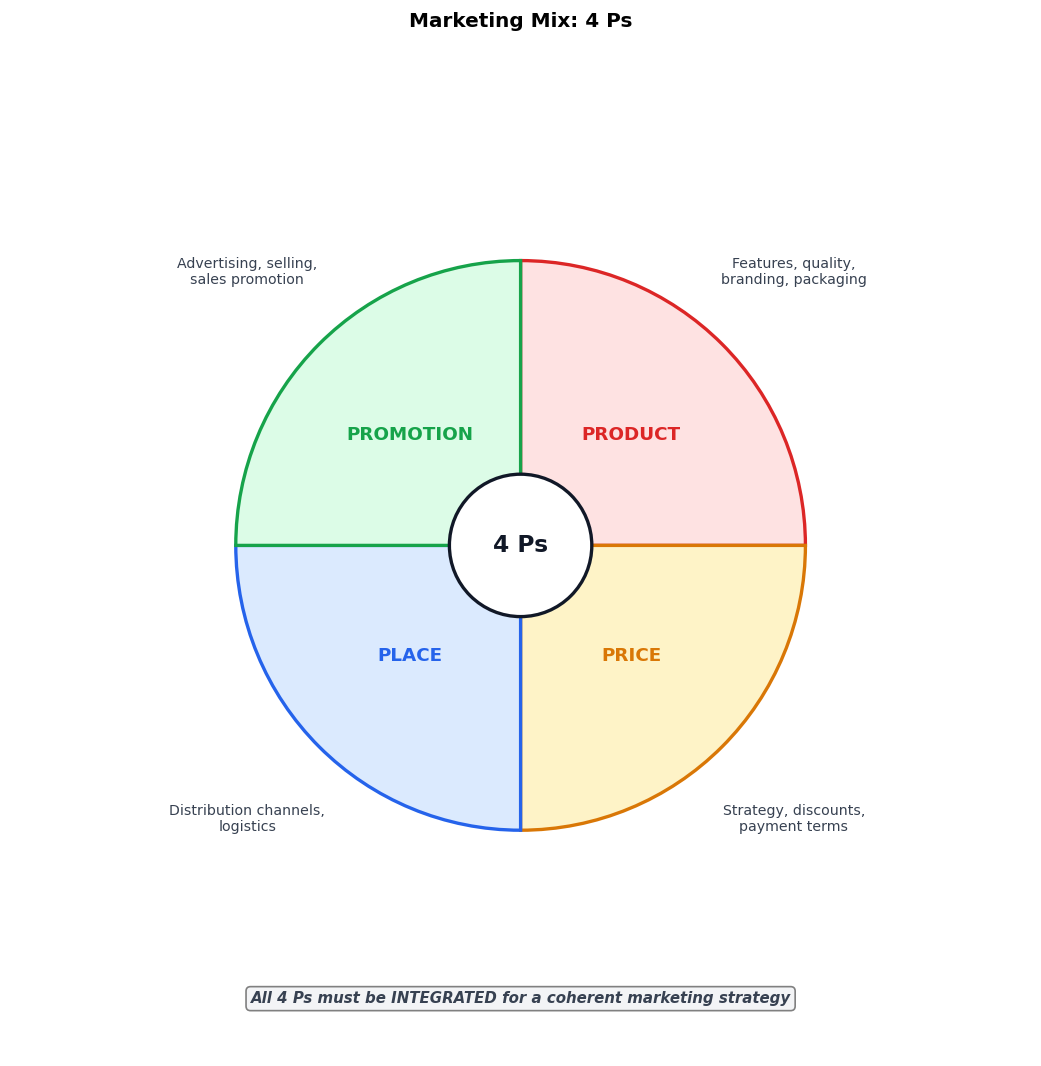
Study the 4 Ps marketing-mix wheel and answer:

Marketing Management figure
  1. Choosing distribution channels and logistics is which P?
    AProduct
    BPrice
    CPlace
    DPromotion
  2. Influencer marketing is part of which P?
    APromotion
    BProduct
    CPrice
    DPlace
  3. Explain the 4 Ps with examples and why they should be integrated.
Show answersHide answers
1. Option 3 — Place
2. Option 1 — Promotion
3. Marketing mix is the combination of marketing decisions a firm uses to achieve its objectives — the 4 Ps. PRODUCT: includes quality, features, design, brand, packaging, labelling, warranty, service — what the customer buys. PRICE: includes price level, pricing strategy (skimming, penetration, cost-plus, competitive, premium), discounts, payment terms — what the customer pays. PLACE/DISTRIBUTION: includes distribution channels (zero, one, two, three level), intermediaries, logistics, inventory, transport, warehousing — how the product reaches the customer. PROMOTION: includes advertising, personal selling, sales promotion, publicity, public relations — how the customer is informed and persuaded. The 4 Ps must be INTEGRATED — premium product with cheap promotion or mass-market channel destroys positioning. Effective marketing delivers superior customer value and captures profit.
Q57 16 Marks

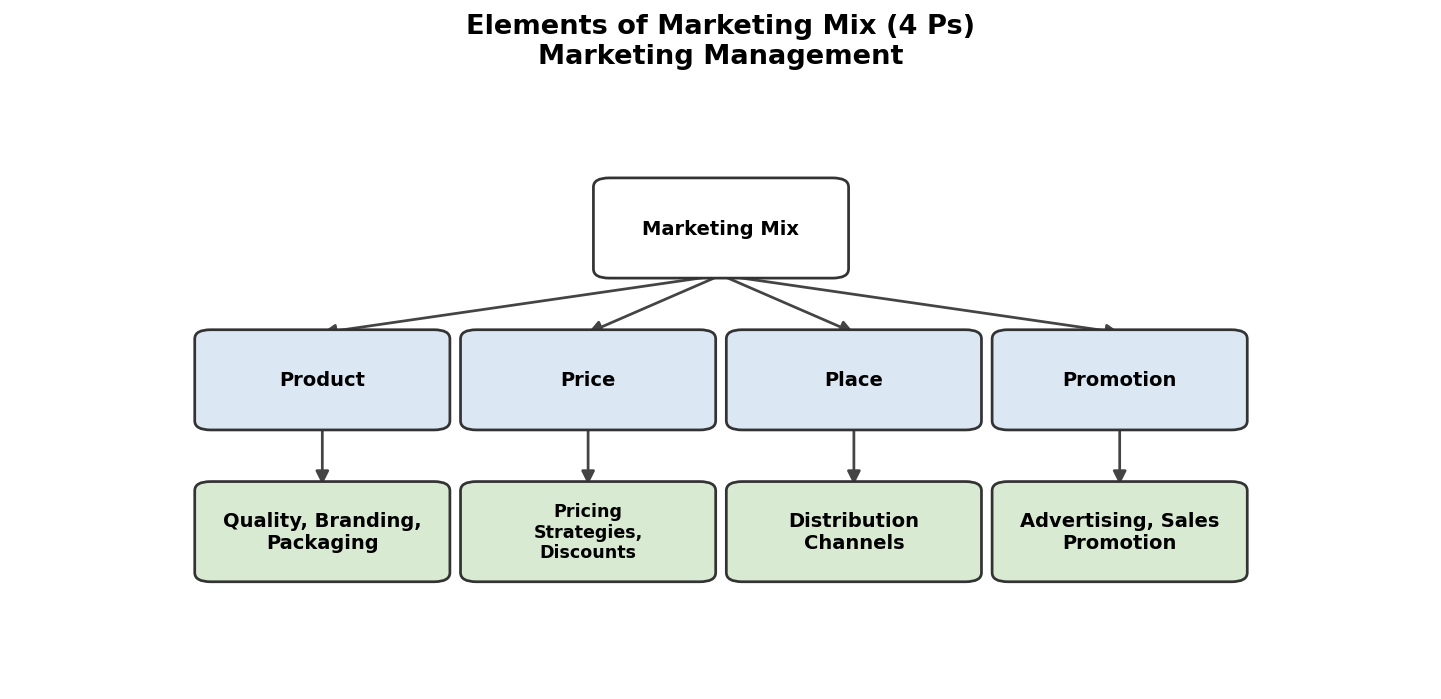
Based on the given diagram, answer the following:

Marketing Management figure
  1. How many elements are there in the traditional Marketing Mix?
    A2
    B3
    C4
    D5
  2. Which element of the Marketing Mix deals with branding and packaging?
    APrice
    BProduct
    CPlace
    DPromotion
  3. Explain the role of 'Place' as an element of the Marketing Mix.
  4. Why is the Marketing Mix considered a dynamic concept?
  5. In which channel of distribution does the producer sell directly to the consumer?
    AOne Level Channel
    BTwo Level Channel
    CZero Level Channel
    DThree Level Channel
  6. Which channel of distribution involves the maximum number of intermediaries?
    AZero Level
    BOne Level
    CTwo Level
    DThree Level
  7. State any two factors that influence the choice of distribution channel.
  8. What is the role of a wholesaler in the Two Level Channel of distribution?
  9. Which element of the Promotion Mix involves face-to-face communication with potential buyers?
    AAdvertising
    BPublic Relations
    CSales Promotion
    DPersonal Selling
  10. Coupons and contests are tools of which promotional element?
    AAdvertising
    BSales Promotion
    CPersonal Selling
    DPublic Relations
  11. Differentiate between Advertising and Personal Selling on the basis of reach and cost.
  12. Explain the importance of Public Relations as a tool of the Promotion Mix.
  13. During which stage of the Product Life Cycle are sales at their peak?
    AIntroduction Stage
    BGrowth Stage
    CMaturity Stage
    DDecline Stage
  14. Which stage of the PLC is characterised by high promotional costs and low or no profits?
    AGrowth Stage
    BMaturity Stage
    CDecline Stage
    DIntroduction Stage
  15. What pricing strategy is most commonly used during the Introduction Stage of the PLC? Give a reason.
  16. Explain any two marketing strategies a firm can adopt during the Decline Stage of the Product Life Cycle.
  17. Which channel of distribution is also known as the 'Direct Channel'?
    AOne Level Channel
    BTwo Level Channel
    CZero Level Channel
    DThree Level Channel
  18. Identify the intermediaries involved in a Two Level Channel of distribution.
  19. Which of the following products is MOST likely to use a Zero Level Channel of distribution?
    APackaged biscuits sold through grocery stores
    BIndustrial machinery sold directly by the manufacturer
    CSoft drinks distributed through wholesalers
    DClothing sold through retail chains
  20. State any two factors that influence the choice of channel of distribution for a product.
Show answersHide answers
1. Option 3 — 4
2. Option 2 — Product
3. 'Place' refers to the distribution channels and logistics used to make the product available to consumers at the right location and time. It includes decisions about warehousing, transportation, and channel intermediaries.
4. The Marketing Mix is dynamic because its elements need to be continuously adjusted in response to changes in consumer preferences, competition, market conditions, and the product life cycle stage.
5. Option 3 — Zero Level Channel
6. Option 4 — Three Level
7. Two factors: (1) Nature of the product — perishable goods require shorter channels; (2) Market considerations — if the market is geographically spread, longer channels may be needed.
8. A wholesaler buys goods in bulk from the producer and sells them in smaller quantities to retailers. They help in storage, transportation, and financing, thereby bridging the gap between producers and retailers.
9. Option 4 — Personal Selling
10. Option 2 — Sales Promotion
11. Advertising has a wide reach as it targets a large audience through mass media and has a lower cost per person. Personal Selling has a limited reach as it targets individuals one at a time and has a higher cost per contact, but it allows for customised communication and immediate feedback.
12. Public Relations helps a firm build and maintain a positive image among the public, media, and stakeholders. It uses tools like press releases, events, and sponsorships to create goodwill, manage reputation, and indirectly support sales without paid advertising.
13. Option 3 — Maturity Stage
14. Option 4 — Introduction Stage
15. Two common strategies: (1) Skimming Pricing — a high price is charged initially to recover costs quickly from early adopters; (2) Penetration Pricing — a low price is set to attract a large customer base quickly. The choice depends on the nature of the product and target market.
16. Two strategies: (1) Product Modification — the firm can modify the product by improving features or quality to revive consumer interest; (2) Market Withdrawal — if the product is no longer profitable, the firm may decide to discontinue it and redirect resources to more profitable products. Alternatively, reducing prices to clear remaining inventory is also used.
17. Option 3 — Zero Level Channel
18. In a Two Level Channel, the intermediaries involved are the Wholesaler and the Retailer. The flow is: Producer → Wholesaler → Retailer → Consumer.
19. Option 2 — Industrial machinery sold directly by the manufacturer
20. Two factors influencing the choice of channel of distribution are: (1) Nature of the product – Perishable goods require shorter channels, while durable goods may use longer channels. (2) Market considerations – If the market is geographically widespread and has a large number of buyers, longer channels with wholesalers and retailers are preferred.

Q58 4 Marks

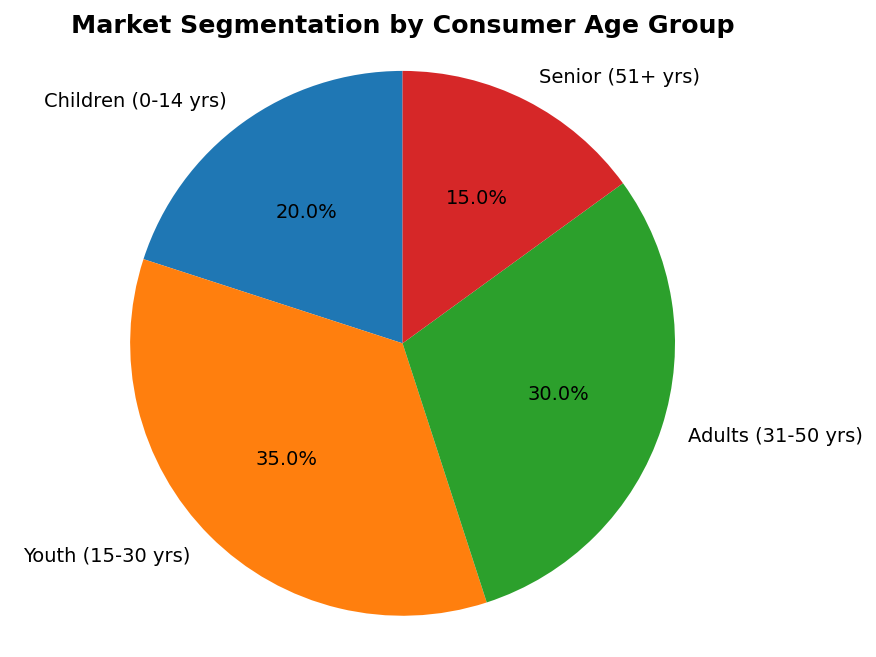
Based on the given chart, answer the following:

Marketing Management figure
  1. Which age group forms the largest market segment according to the chart?
    AChildren (0-14 yrs)
    BAdults (31-50 yrs)
    CYouth (15-30 yrs)
    DSenior (51+ yrs)
  2. What type of market segmentation is depicted in the chart?
    AGeographic Segmentation
    BPsychographic Segmentation
    CBehavioural Segmentation
    DDemographic Segmentation
  3. A company manufacturing energy drinks wants to target the most profitable segment. Based on the chart, which segment should it target and why?
  4. State any two benefits of market segmentation for a business firm.
Show answersHide answers
1. Option 3 — Youth (15-30 yrs)
2. Option 4 — Demographic Segmentation
3. The company should target the Youth segment (15-30 yrs) as it is the largest segment at 35%. Youth are more likely to consume energy drinks due to active lifestyles, sports participation, and social trends, making this segment the most profitable for such a product.
4. Two benefits: (1) Better satisfaction of consumer needs — firms can design products and marketing strategies tailored to specific groups; (2) Efficient use of resources — marketing efforts and budgets are focused on the most relevant segments, reducing wastage.
Q59 4 Marks

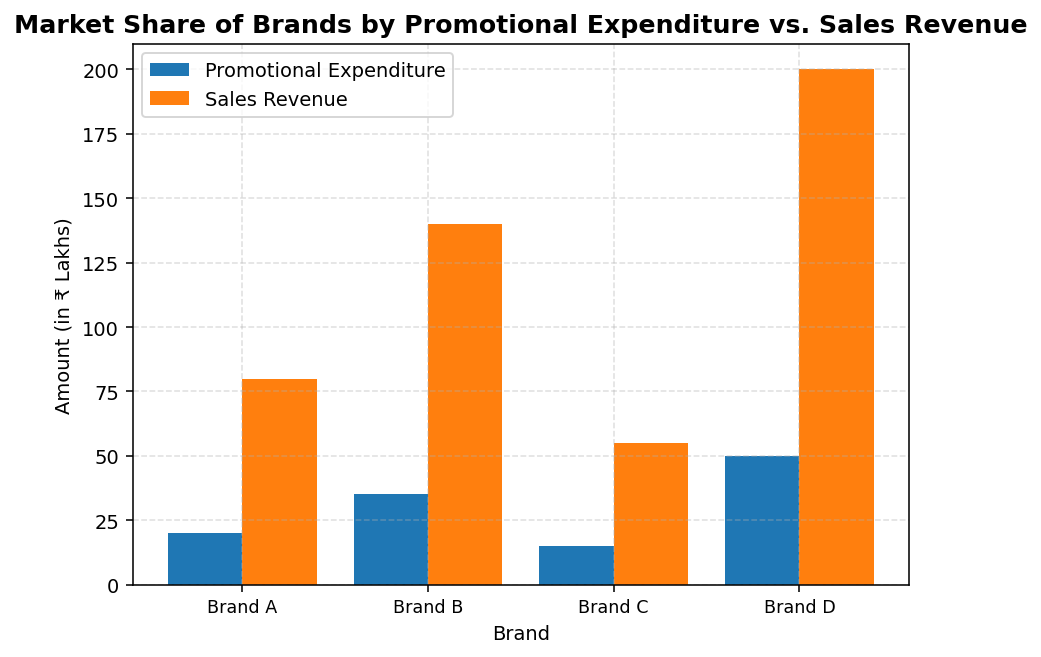
Based on the given graph, answer the following:

Marketing Management figure
  1. Which brand has the highest promotional expenditure as shown in the chart?
    ABrand A
    BBrand B
    CBrand C
    DBrand D
  2. Calculate the ratio of promotional expenditure to sales revenue for Brand B and comment on its promotional effectiveness compared to Brand C.
  3. Which of the following is NOT an element of the promotion mix in marketing management?
    AAdvertising
    BPersonal Selling
    CProduct Packaging
    DSales Promotion
  4. Based on the chart, Brand D spends the most on promotion and also earns the highest sales revenue. Does higher promotional expenditure always guarantee higher sales? Give a reason to support your answer.
Show answersHide answers
1. Option 4 — Brand D
2. For Brand B: Ratio = 35/140 = 1:4. For Brand C: Ratio = 15/55 ≈ 1:3.67. Brand B generates ₹4 of sales revenue for every ₹1 spent on promotion, while Brand C generates approximately ₹3.67. Hence, Brand B's promotional strategy is slightly more effective than Brand C's in terms of revenue generated per rupee spent on promotion.
3. Option 3 — Product Packaging
4. No, higher promotional expenditure does not always guarantee higher sales. While Brand D shows a positive correlation between promotion spending and revenue, other factors such as product quality, pricing strategy, distribution efficiency, consumer preferences, and competition also significantly influence sales. For example, Brand C spends less than Brand A on promotion but the ratio of revenue to expenditure is comparable, indicating that effective targeting and product quality can compensate for lower promotional spending.

Make a full Business Studies paper on Marketing Management.

Pick the question mix, set the marks, hit generate. You get a ready-to-print paper with an answer key.

Generate your paper — free