SUMMARY: The chapter on Reproductive Health in Class 12 Biology focuses on the importance of reproductive health, the problems associated with it, and the strategies for achieving it in society. KEY TOPICS: Reproductive health problems, family planning, birth control methods, sexually transmitted diseases, infertility, assisted reproductive technologies, maternal and child health, population explosion, reproductive health programs.
Which of the following is a hormonal contraceptive?
ACondom
BDiaphragm
CIUD
DOral pills
Check answerHide answer
Correct answer: Option 4 — Oral pills
Q21 Mark
IUDs are inserted into:
AVagina
BUterus
CFallopian tube
DCervix
Check answerHide answer
Correct answer: Option 2 — Uterus
Q31 Mark
MTP stands for:
AMaximum Time Period
BMedical Termination of Pregnancy
CMid Term Pregnancy
DModified Tube Plan
Check answerHide answer
Correct answer: Option 2 — Medical Termination of Pregnancy
Q41 Mark
Vasectomy is a sterilisation procedure in:
AFemales
BMales
CBoth
DChildren
Check answerHide answer
Correct answer: Option 2 — Males
Q51 Mark
IVF stands for:
AIn Vivo Fertilisation
BIn Vitro Fertilisation
CInternal Vital Function
DInter Vesicular Function
Check answerHide answer
Correct answer: Option 2 — In Vitro Fertilisation
Short Answer Questions5 questions
Q63 Marks
List the various methods of contraception.
Q73 Marks
What is amniocentesis? Why is it banned for sex determination?
Q83 Marks
Explain the methods of assisted reproductive technology (ART).
Q93 Marks
What are STDs? List four common STDs.
Q103 Marks
Discuss the importance of reproductive health in society.
Long Answer Questions6 questions
Q116 Marks
Describe the various contraceptive methods used by males and females.
Q126 Marks
Discuss the various assisted reproductive technologies and their applications.
Q136 Marks
Explain the causes, symptoms, and prevention of common sexually transmitted diseases.
Q146 Marks
Describe the components and significance of the Reproductive and Child Health Care Programme (RCH).
Q156 Marks
Explain medical termination of pregnancy and the conditions where it is recommended.
Q166 Marks
Differentiate between tubectomy and vasectomy in tabular form.
Assertion–Reason Questions5 questions
Q171 Mark
Assertion (A): Tubectomy is sterilisation in females.
Reason (R): Fallopian tubes are tied and cut to prevent fertilisation.
Show explanationHide explanation
Correct answer: Option 1 —
Both A and R are true, and R is the correct explanation of A.
Q181 Mark
Assertion (A): Condoms also help prevent STDs.
Reason (R): They form a barrier to body fluid exchange.
Show explanationHide explanation
Correct answer: Option 1 —
Both A and R are true, and R is the correct explanation of A.
Q191 Mark
Assertion (A): Sex determination test before birth is illegal in India.
Reason (R): The PNDT Act prohibits prenatal sex determination.
Show explanationHide explanation
Correct answer: Option 1 —
Both A and R are true, and R is the correct explanation of A.
Q201 Mark
Assertion (A): GIFT is a form of assisted reproductive technology.
Reason (R): It involves transfer of an ovum and sperm to the fallopian tube of another woman.
Show explanationHide explanation
Correct answer: Option 1 —
Both A and R are true, and R is the correct explanation of A.
Q211 Mark
Assertion (A): IUDs prevent implantation.
Reason (R): They release copper or hormones that interfere with sperm and embryo.
Show explanationHide explanation
Correct answer: Option 1 —
Both A and R are true, and R is the correct explanation of A.
Statement-Based Questions5 questions
Q221 Mark
Statement 1: Lactational amenorrhea is a natural contraceptive.
Statement 2: Breast feeding suppresses ovulation.
Show answerHide answer
Correct answer: Option 1 —
Both statements are true.
Q231 Mark
Statement 1: AIDS is caused by HIV.
Statement 2: HIV destroys helper T cells of immune system.
Show answerHide answer
Correct answer: Option 1 —
Both statements are true.
Q241 Mark
Statement 1: Saheli is an oral contraceptive for females.
Statement 2: It is a non-steroidal once-a-week pill.
Show answerHide answer
Correct answer: Option 1 —
Both statements are true.
Q251 Mark
Statement 1: Test tube baby is born from IVF.
Statement 2: Fertilisation occurs outside the body and embryo is transferred to uterus.
Show answerHide answer
Correct answer: Option 1 —
Both statements are true.
Q261 Mark
Statement 1: Infertility may be due to causes in either partner.
Statement 2: Counselling and ART can help such couples.
Show answerHide answer
Correct answer: Option 1 —
Both statements are true.
Case Study / Passage Questions4 questions
Q273 Marks
A young couple visits a family welfare clinic to discuss contraception. The doctor explains the available options — barrier methods (condom, diaphragm), hormonal pills, IUDs (CuT), and surgical sterilisation. They are advised to choose a method based on their family planning goals and medical history.
Which method also helps prevent sexually transmitted diseases?
ACondom
BOral pill
CIUD
DTubectomy
A surgical sterilisation method for males is:
ATubectomy
BVasectomy
CBoth
DNeither
Discuss the various methods of contraception with their advantages and limitations.
Show answersHide answers
1. Option 1 — Condom
2. Option 2 — Vasectomy
3. Contraceptives can be classified into natural (rhythm, coitus interruptus, lactational amenorrhea), barrier (condom, diaphragm), IUDs (CuT, multiload), hormonal (pills, injections, implants), surgical (vasectomy, tubectomy) and emergency methods. Each has advantages and side effects. Condoms also prevent transmission of STDs and so are widely recommended.
Q283 Marks
A childless couple after years of trying is offered IVF treatment. The fertility specialist explains that ova are removed from the woman fertilised by sperm in the laboratory and the embryo is then transferred back to the uterus. The first IVF baby was born in 1978.
The technique of fertilisation outside the body and transfer of embryo to the uterus is called:
AIVF
BGIFT
CZIFT
DIUI
In IVF the fertilisation occurs in the:
ALab
BUterus
CFallopian tube
DOvary
Discuss the various assisted reproductive technologies and the social-ethical issues involved.
Show answersHide answers
1. Option 1 — IVF
2. Option 1 — Lab
3. Assisted Reproductive Technologies (ART) help infertile couples have children. IVF (in vitro fertilisation) involves fertilising the egg outside the body and transferring the embryo to the uterus (test tube baby). GIFT (gamete intrafallopian transfer) places ovum and sperm into the fallopian tube. ZIFT places a zygote into the fallopian tube. ICSI (intracytoplasmic sperm injection) directly injects a sperm into an ovum. Surrogacy and gamete donation are other options.
Q293 Marks
Reproductive health is a state of complete physical, mental, and social well-being in all matters relating to the reproductive system. It encompasses a wide range of issues including family planning, prevention of sexually transmitted diseases (STDs), and the management of infertility. Effective family planning can help in controlling population growth and ensuring that children are born into families that are ready and able to provide for them. The use of contraceptives is a crucial aspect of family planning, as it allows couples to decide the number and spacing of their children. Moreover, reproductive health programs aim to educate individuals about reproductive rights and responsibilities, promoting safe practices and access to healthcare services.
What is the primary focus of reproductive health?
APhysical fitness
BMental health
CComplete well-being in reproductive matters
DSocial interactions
Explain the importance of family planning in reproductive health.
Which of the following is a key component of family planning?
AContraceptive use
BDietary supplements
CPhysical exercise
DMental health therapy
Show answersHide answers
1. Option 3 — Complete well-being in reproductive matters
2. Family planning is important as it helps in controlling population growth and ensures that children are born into families that are ready and able to provide for them.
3. Option 1 — Contraceptive use
Q303 Marks
Sexually transmitted diseases (STDs) are infections that are primarily transmitted through sexual contact. They can have serious health implications if left untreated, including infertility and increased risk of certain cancers. Prevention strategies include the use of condoms, regular health check-ups, and education about safe sexual practices. Public health initiatives aim to raise awareness about STDs and promote testing and treatment options. Understanding the symptoms and risks associated with STDs is crucial for maintaining reproductive health and preventing their spread within the community.
What are STDs primarily transmitted through?
AAirborne particles
BSexual contact
CContaminated water
DInsect bites
Discuss the impact of untreated STDs on reproductive health.
Which preventive measure is effective against STDs?
ACondom use
BVaccination
CRegular exercise
DHealthy diet
Show answersHide answers
1. Option 2 — Sexual contact
2. Untreated STDs can lead to serious health issues such as infertility and increased risk of certain cancers.
3. Option 1 — Condom use
Table-Based Questions4 questions
Q313 Marks
Study the table on common sexually transmitted diseases:
Disease
Causative organism
Transmission
AIDS
HIV (virus)
Sexual contact, blood, mother-to-child
Syphilis
Treponema pallidum (bacterium)
Sexual contact
Gonorrhoea
Neisseria gonorrhoeae
Sexual contact
Hepatitis B
HBV (virus)
Blood, sexual contact
Genital herpes
Herpes simplex virus
Sexual contact
AIDS is caused by a:
ABacteria
BVirus
CFungus
DProtozoan
Syphilis is caused by:
ATreponema pallidum
BNeisseria gonorrhoeae
CHIV
DHerpes virus
Explain the cause, transmission and prevention of any two STDs.
Show answersHide answers
1. Option 2 — Virus
2. Option 1 — Treponema pallidum
3. STDs are infections transmitted mainly through sexual contact though some can also be transmitted through blood transfusion, contaminated needles or from mother to child. Common STDs are bacterial (syphilis, gonorrhoea), viral (AIDS, hepatitis B, herpes) and fungal (candidiasis). Use of condoms, monogamous relationships and screening of blood are key preventive measures. Most bacterial STDs are curable while viral STDs often need lifelong management.
Q326 Marks
Match each contraceptive method with its category and key feature.
Method
Category
Key feature
Condom
?
?
Oral pill
?
?
IUD
?
?
Vasectomy
?
?
Tubectomy
?
?
Q336 Marks
Which contraceptive method has the highest effectiveness rate according to the data provided?
Contraceptive Method
Effectiveness Rate (%)
Type
Condom
85
Barrier
Oral Contraceptives
99
Hormonal
IUD
99
Intrauterine
Q342 Marks
Study the following data and answer the questions below:
Sexually Transmitted Disease
Prevalence (%)
Treatment Available
Chlamydia
3
Yes
Gonorrhea
1.5
Yes
Syphilis
0.5
Yes
What is the prevalence of Chlamydia?
Which disease has the lowest prevalence?
Show answersHide answers
1.
2.
Picture-Based Questions4 questions
Q352 Marks
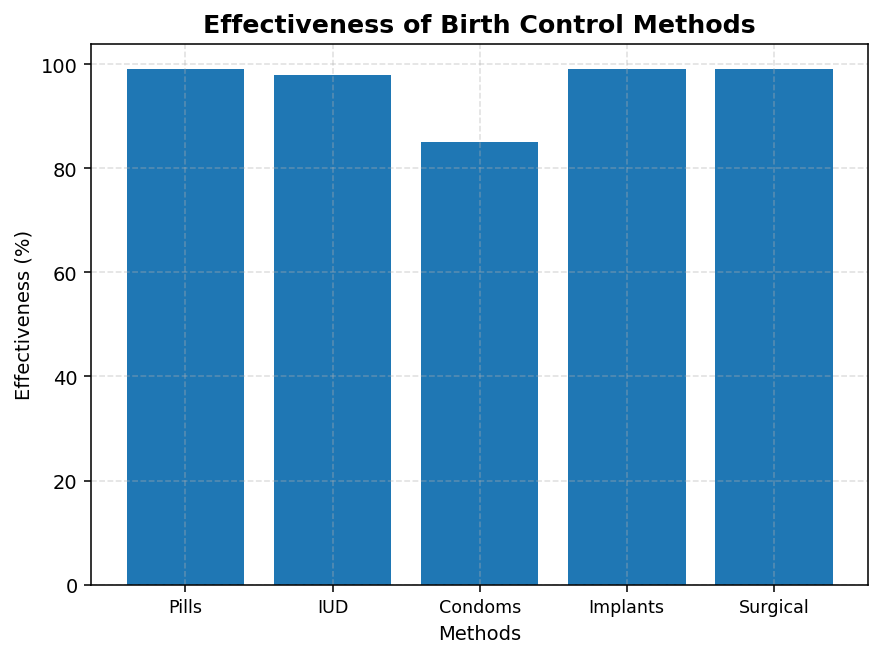
Based on the given chart showing various birth control methods, answer the following:
Which birth control method has the highest effectiveness?
AContraceptive Pills
BIUD
CCondoms
DImplants
What is the effectiveness percentage of Condoms?
Show answersHide answers
1. Option 1 — Contraceptive Pills
2. 85
Q362 Marks
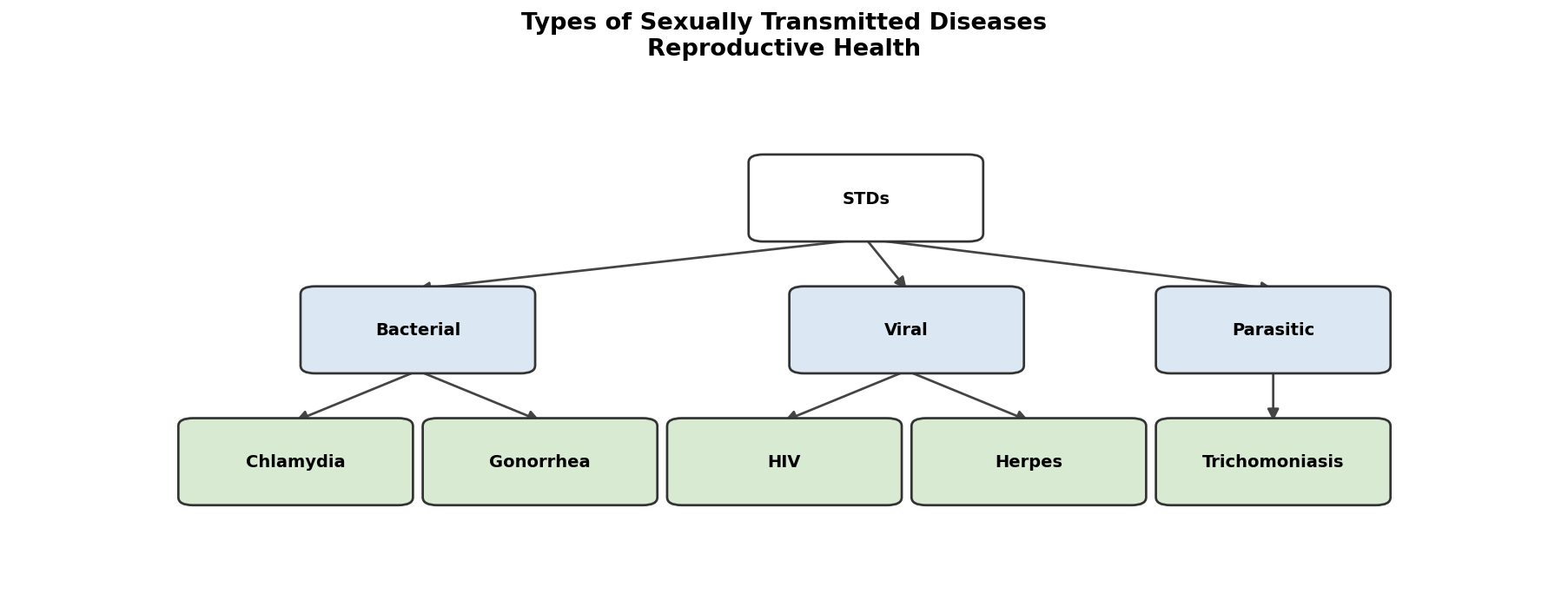
Based on the given flowchart of sexually transmitted diseases (STDs), answer the following:
Name one bacterial STD mentioned in the flowchart.
Which type of STD is HIV classified as?
ABacterial
BViral
CParasitic
DFungal
Show answersHide answers
1. Chlamydia or Gonorrhea
2. Option 2 — Viral
Q372 Marks
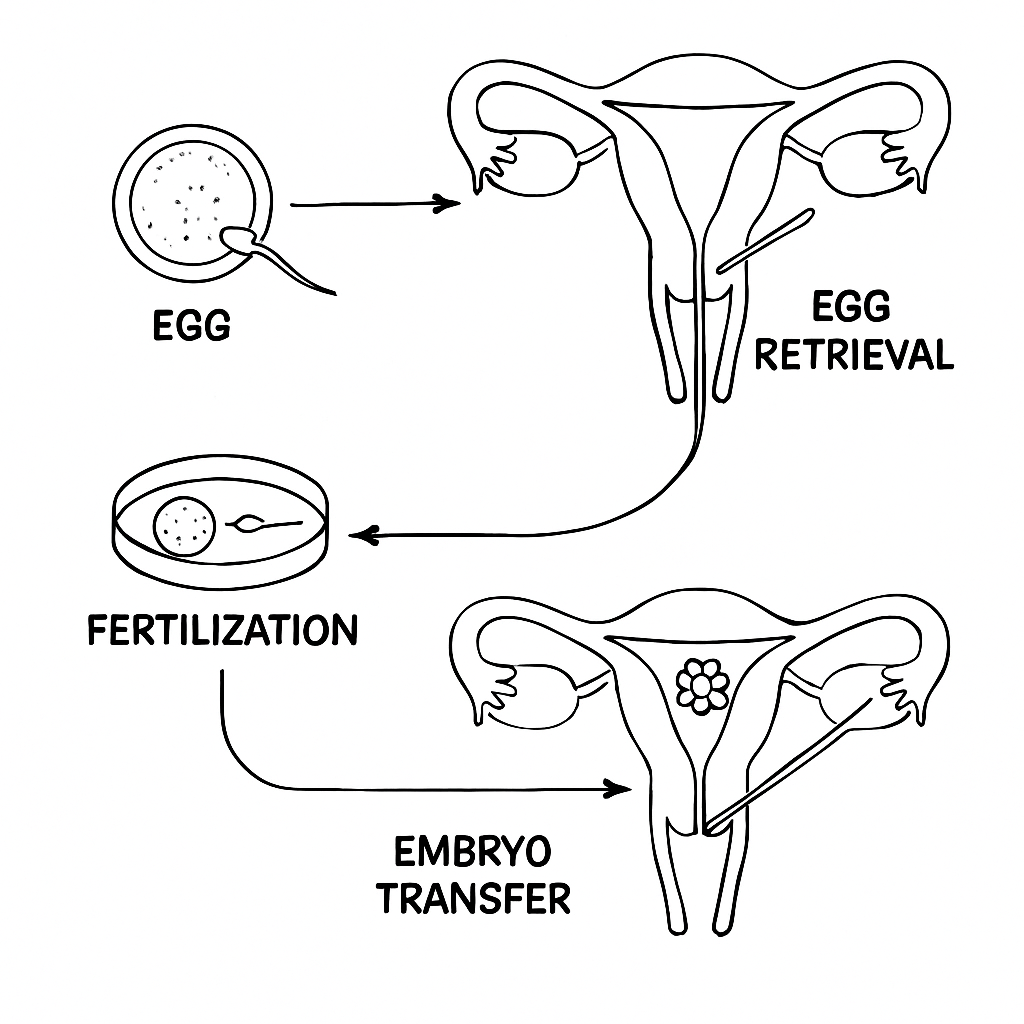
Based on the given diagram of assisted reproductive technologies, answer the following:
What is the first step in the IVF process shown in the diagram?
AFertilization
BEgg Retrieval
CEmbryo Transfer
DSperm Collection
Explain the significance of embryo transfer in IVF.
Show answersHide answers
1. Option 2 — Egg Retrieval
2. Embryo transfer is crucial as it places the fertilized embryo into the uterus for potential implantation.
Q382 Marks
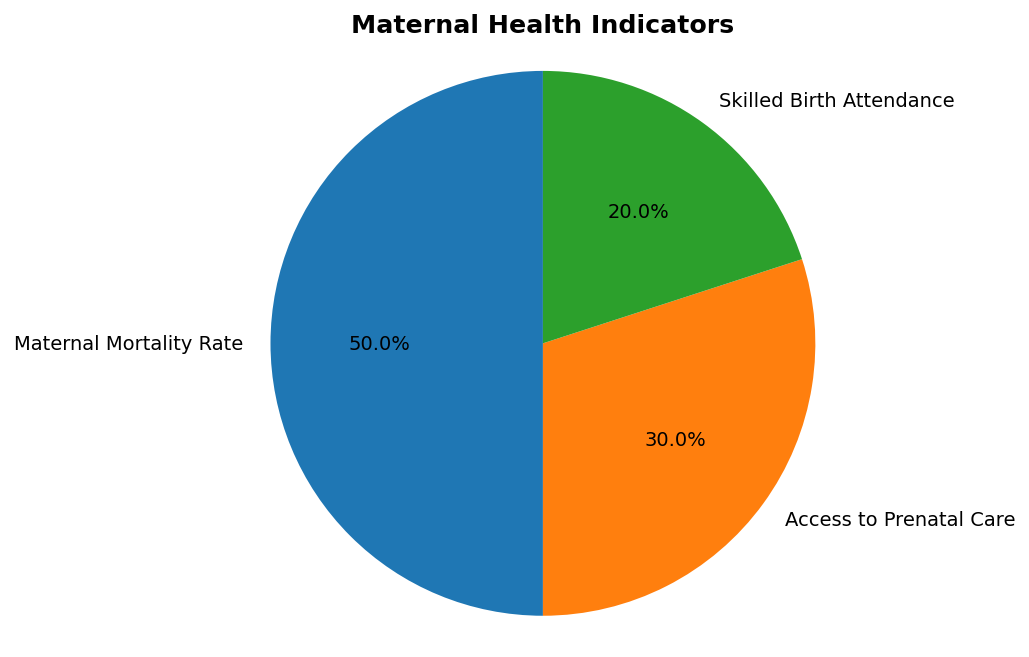
Based on the given chart showing maternal and child health indicators, answer the following:
What percentage of the pie chart represents Access to Prenatal Care?
A50%
B30%
C20%
DNone of the above
Identify one factor that can improve maternal health outcomes.