Biotechnology and its Applications — Important Questions
59 questions
With answersCBSE format
SUMMARY: This chapter explores the various applications of biotechnology in fields such as agriculture, medicine, and environmental management. KEY TOPICS: genetically modified organisms, Bt cotton, gene therapy, biopesticides, biofortification, ethical issues in biotechnology, transgenic animals, bioremediation, molecular diagnostics, RNA interference
Correct answer: Option 2 — Clean up contaminated environments
Q141 Mark
Which of the following is a potential ethical issue in biotechnology?
AIncreased food production
BEnvironmental impact of GMOs
CImproved health outcomes
DEnhanced agricultural efficiency
Check answerHide answer
Correct answer: Option 2 — Environmental impact of GMOs
Q151 Mark
What is the primary goal of using biopesticides in sustainable agriculture?
ATo maximize profit
BTo minimize environmental impact
CTo reduce labor costs
DTo increase crop diversity
Check answerHide answer
Correct answer: Option 2 — To minimize environmental impact
Short Answer Questions10 questions
Q163 Marks
Explain the production of human insulin by genetic engineering.
Q173 Marks
What is gene therapy? Give an example.
Q183 Marks
How are pest-resistant crops developed using biotechnology?
Q193 Marks
What are transgenic animals? Give two examples.
Q203 Marks
Discuss biopiracy and the need for patents.
Q213 Marks
What is biofortification and how does it benefit human health?
View sample solutionHide solution
Biofortification is the process of increasing the nutritional value of crops through biotechnology. It aims to enhance the levels of essential vitamins and minerals in food crops, thereby addressing micronutrient deficiencies in populations that rely heavily on staple foods.
Q223 Marks
Describe the role of Bt cotton in agriculture. How does it contribute to pest management?
View sample solutionHide solution
Bt cotton is a genetically modified organism that contains a gene from the bacterium Bacillus thuringiensis, which produces a toxin harmful to specific pests. This reduces the need for chemical pesticides, leading to lower environmental impact and increased crop yields.
Q233 Marks
What are biopesticides and how do they differ from conventional pesticides?
View sample solutionHide solution
Biopesticides are natural organisms or substances derived from plants, bacteria, or minerals used to control pests. Unlike conventional pesticides, which are often synthetic chemicals, biopesticides are generally considered safer for the environment and non-target organisms.
Q243 Marks
Explain the concept of RNA interference and its potential applications in biotechnology.
View sample solutionHide solution
RNA interference (RNAi) is a biological process in which RNA molecules inhibit gene expression or translation. It has potential applications in gene silencing, crop improvement, and the development of therapies for diseases such as cancer and viral infections.
Q253 Marks
What ethical issues are associated with the use of genetically modified organisms (GMOs) in agriculture?
View sample solutionHide solution
Ethical issues surrounding GMOs include concerns about food safety, environmental impact, and the rights of farmers. There are debates about the long-term effects of GMOs on biodiversity and the potential for corporate control over food supply.
Long Answer Questions6 questions
Q266 Marks
Explain the applications of biotechnology in agriculture.
Q276 Marks
Discuss the applications of biotechnology in medicine with examples.
Q286 Marks
Describe the production of recombinant insulin and the importance of this technology.
Q296 Marks
Explain the concept and methods of gene therapy with examples.
Q306 Marks
Discuss transgenic animals, their applications, and ethical issues.
Q316 Marks
Compare Bt cotton and Golden rice with the help of a table on source gene trait improved and benefit.
Assertion–Reason Questions8 questions
Q321 Mark
Assertion (A): Bt cotton is resistant to bollworm.
Reason (R): It produces a toxin from Bacillus thuringiensis that kills the insect.
Show explanationHide explanation
Correct answer: Option 1 —
Both A and R are true, and R is the correct explanation of A.
Q331 Mark
Assertion (A): Recombinant insulin is safer than insulin from animal sources.
Reason (R): It is identical to human insulin and does not cause allergic reactions.
Show explanationHide explanation
Correct answer: Option 1 —
Both A and R are true, and R is the correct explanation of A.
Q341 Mark
Assertion (A): Golden rice contains beta-carotene.
Reason (R): It is genetically engineered to combat Vitamin A deficiency.
Show explanationHide explanation
Correct answer: Option 1 —
Both A and R are true, and R is the correct explanation of A.
Q351 Mark
Assertion (A): GEAC regulates GMOs in India.
Reason (R): It assesses the safety of GMOs before release for public use.
Show explanationHide explanation
Correct answer: Option 1 —
Both A and R are true, and R is the correct explanation of A.
Q361 Mark
Assertion (A): Molecular diagnosis is more sensitive than traditional methods.
Reason (R): It can detect pathogens at very early stages of infection.
Show explanationHide explanation
Correct answer: Option 1 —
Both A and R are true, and R is the correct explanation of A.
Q371 Mark
Assertion (A): Gene therapy can be used to treat genetic disorders.
Reason (R): Gene therapy involves the insertion of genes into an individual's cells to treat disease.
Show explanationHide explanation
Correct answer: Option 1 —
Both A and R are true, and R is the correct explanation of A.
Q381 Mark
Assertion (A): Biopesticides are chemical pesticides derived from natural sources.
Reason (R): Biopesticides are derived from natural materials like plants and microorganisms.
Show explanationHide explanation
Correct answer: Option 1 —
Both A and R are true, and R is the correct explanation of A.
Q391 Mark
Assertion (A): Transgenic animals are created by introducing foreign DNA into their genome.
Reason (R): Transgenic animals are used for research and pharmaceutical production.
Show explanationHide explanation
Correct answer: Option 1 —
Both A and R are true, and R is the correct explanation of A.
Statement-Based Questions8 questions
Q401 Mark
Statement 1: ADA deficiency is treated by gene therapy.
Statement 2: A functional ADA gene is inserted into lymphocytes.
Show answerHide answer
Correct answer: Option 1 —
Both statements are true.
Q411 Mark
Statement 1: PCR can be used to detect HIV in suspected patients.
Statement 2: It amplifies the viral DNA for detection.
Show answerHide answer
Correct answer: Option 1 —
Both statements are true.
Q421 Mark
Statement 1: Transgenic mice can model human diseases.
Statement 2: They help in studying disease mechanisms and testing treatments.
Show answerHide answer
Correct answer: Option 1 —
Both statements are true.
Q431 Mark
Statement 1: Biopiracy refers to unauthorised use of bioresources.
Statement 2: Patents like neem and turmeric have been challenged by India.
Show answerHide answer
Correct answer: Option 1 —
Both statements are true.
Q441 Mark
Statement 1: ELISA is used to detect specific proteins.
Statement 2: It uses antigen-antibody interaction.
Show answerHide answer
Correct answer: Option 1 —
Both statements are true.
Q451 Mark
Statement 1: Bt cotton is engineered to be resistant to certain pests.
Statement 2: Gene therapy can only treat genetic disorders and not infectious diseases.
Show answerHide answer
Correct answer: Option 2 —
Only Statement 1 is true.
Q461 Mark
Statement 1: Biopesticides are derived from natural materials.
Statement 2: Transgenic animals are created by introducing foreign DNA into their genome.
Show answerHide answer
Correct answer: Option 1 —
Both statements are true.
Q471 Mark
Statement 1: Biofortification aims to enhance the nutritional quality of food crops.
Statement 2: RNA interference is a technique used to increase gene expression.
Show answerHide answer
Correct answer: Option 3 —
Only Statement 2 is true.
Case Study / Passage Questions4 questions
Q483 Marks
A cotton farmer adopts Bt cotton — a genetically modified variety that contains a bacterial gene from Bacillus thuringiensis. The Bt protein produced in the plant tissues is toxic to bollworms but harmless to mammals. The farmer reports a significant reduction in pesticide use and an increase in yield.
The Bt gene is obtained from:
ABacillus thuringiensis
BE. coli
CStreptomyces
DPenicillium
The Bt toxin is harmful to:
ABacteria
BInsects
CMammals
DAll
Explain the working principle of Bt cotton and discuss its advantages and concerns.
Show answersHide answers
1. Option 1 — Bacillus thuringiensis
2. Option 2 — Insects
3. Bacillus thuringiensis (Bt) is a soil bacterium that produces crystal proteins toxic to certain insect larvae. The Cry gene encoding the protein has been cloned and introduced into cotton, brinjal, corn and other crops. Inside the alkaline insect midgut the protein is activated and binds to specific receptors on gut cells causing cell lysis and death. Mammals lack these receptors and so are unaffected. Bt crops reduce pesticide use but raise concerns about resistance development and gene flow.
Q493 Marks
Until 1983 diabetic patients used insulin extracted from pig and cattle pancreas which sometimes caused allergic reactions. Eli Lilly used recombinant DNA technology to produce human insulin in E. coli — branded as Humulin. The two chains of insulin (A and B) are produced separately and then joined by disulfide bonds.
Recombinant human insulin (Humulin) is produced in:
APig
BCattle
CE. coli
DYeast
Insulin has two polypeptide chains called:
AA and B
BAlpha and beta
CHeavy and light
DSense and antisense
Explain the production of recombinant human insulin and its advantages over animal-source insulin.
Show answersHide answers
1. Option 3 — E. coli
2. Option 1 — A and B
3. Mature insulin consists of two short polypeptide chains — A (21 amino acids) and B (30 amino acids) — connected by disulfide bridges. In humans it is produced as a precursor pro-insulin that has an extra C-peptide which is removed during maturation. Eli Lilly produced the A and B chains separately in E. coli and then assembled them by forming disulfide bonds. Recombinant insulin is identical to human insulin and avoids the allergic reactions caused by animal-source insulin.
Q503 Marks
Biotechnology has revolutionized agriculture through the development of genetically modified organisms (GMOs). One significant example is Bt cotton, which has been engineered to express a protein from the bacterium Bacillus thuringiensis. This protein acts as a biopesticide, providing resistance against certain pests, particularly the cotton bollworm. As a result, farmers using Bt cotton have reported higher yields and reduced reliance on chemical pesticides, leading to both economic and environmental benefits. However, the use of GMOs also raises ethical concerns regarding biodiversity and the long-term impacts on ecosystems.
What is the primary benefit of using Bt cotton for farmers?
AHigher yields
BIncreased labor costs
CMore pesticide use
DLower seed quality
Explain one ethical concern associated with the use of genetically modified organisms in agriculture.
Which bacterium's gene is used in Bt cotton?
AEscherichia coli
BBacillus thuringiensis
CStreptomyces coelicolor
DPseudomonas aeruginosa
Show answersHide answers
1. Option 1 — Higher yields
2. One ethical concern is the potential impact on biodiversity, as GMOs may outcompete native species or lead to a reduction in genetic diversity.
3. Option 2 — Bacillus thuringiensis
Q513 Marks
Gene therapy is a promising biotechnological application aimed at treating genetic disorders by correcting defective genes. This technique involves the introduction of a healthy copy of a gene into a patient's cells to replace or repair the faulty one. One of the most notable successes in gene therapy has been the treatment of certain inherited forms of blindness. However, challenges remain, including the delivery of the therapeutic gene to the right cells and the potential for immune reactions. The ethical implications of gene therapy, particularly concerning germline modifications, are also a significant area of debate.
What is the main goal of gene therapy?
ATo enhance physical appearance
BTo correct defective genes
CTo increase lifespan
DTo produce more offspring
Discuss one challenge faced in the implementation of gene therapy.
Which condition has seen notable success in gene therapy treatments?
ACystic fibrosis
BInherited forms of blindness
CDiabetes
DHeart disease
Show answersHide answers
1. Option 2 — To correct defective genes
2. One challenge is the effective delivery of the therapeutic gene to the appropriate cells in the body.
3. Option 2 — Inherited forms of blindness
Table-Based Questions4 questions
Q523 Marks
Study the table on applications of biotechnology in medicine:
Application
Example
Use
Recombinant therapeutics
Insulin, Growth hormone
Treatment of diabetes, dwarfism
Gene therapy
ADA gene
Treat SCID
Molecular diagnostics
PCR, ELISA
Disease diagnosis
Vaccines
Hepatitis B
Disease prevention
Pharmacogenomics
HER2 testing
Personalised medicine
Gene therapy was first attempted to treat:
ASCID
BCancer
CDiabetes
DHemophilia
Molecular diagnosis of HIV uses:
APCR
BELISA
CBoth
DNeither
Discuss the major applications of biotechnology in medicine with examples.
Show answersHide answers
1. Option 1 — SCID
2. Option 3 — Both
3. Biotechnology has revolutionised medicine. Recombinant therapeutics like insulin, growth hormone and erythropoietin are produced in safe quantities. Gene therapy aims to correct genetic defects by inserting a functional gene — first attempted in 1990 for ADA deficiency causing SCID. Molecular diagnostics like PCR and ELISA detect pathogens at very early stages. Recombinant vaccines (e.g. hepatitis B) are safer than traditional vaccines. Pharmacogenomics tailors drug therapy to the patient's genetic profile.
Q536 Marks
Which genetically modified crop is known for its resistance to pests and has been widely adopted in agriculture?
Crop
Trait
Year Introduced
Bt Cotton
Pest Resistance
1996
Golden Rice
Vitamin A Enrichment
2000
Q542 Marks
Study the following data and answer the questions below:
Biotechnology Application
Field
Example
Gene Therapy
Medicine
Cystic Fibrosis Treatment
Biopesticides
Agriculture
Bacillus thuringiensis
Bioremediation
Environmental Management
Oil Spill Cleanup
What is an example of biopesticides?
In which field is gene therapy applied?
Show answersHide answers
1.
2.
Q556 Marks
Calculate the average year of introduction for the listed genetically modified organisms.
Organism
Year Introduced
Bt Cotton
1996
Golden Rice
2000
Herbicide-resistant Soybean
1996
Picture-Based Questions4 questions
Q563 Marks
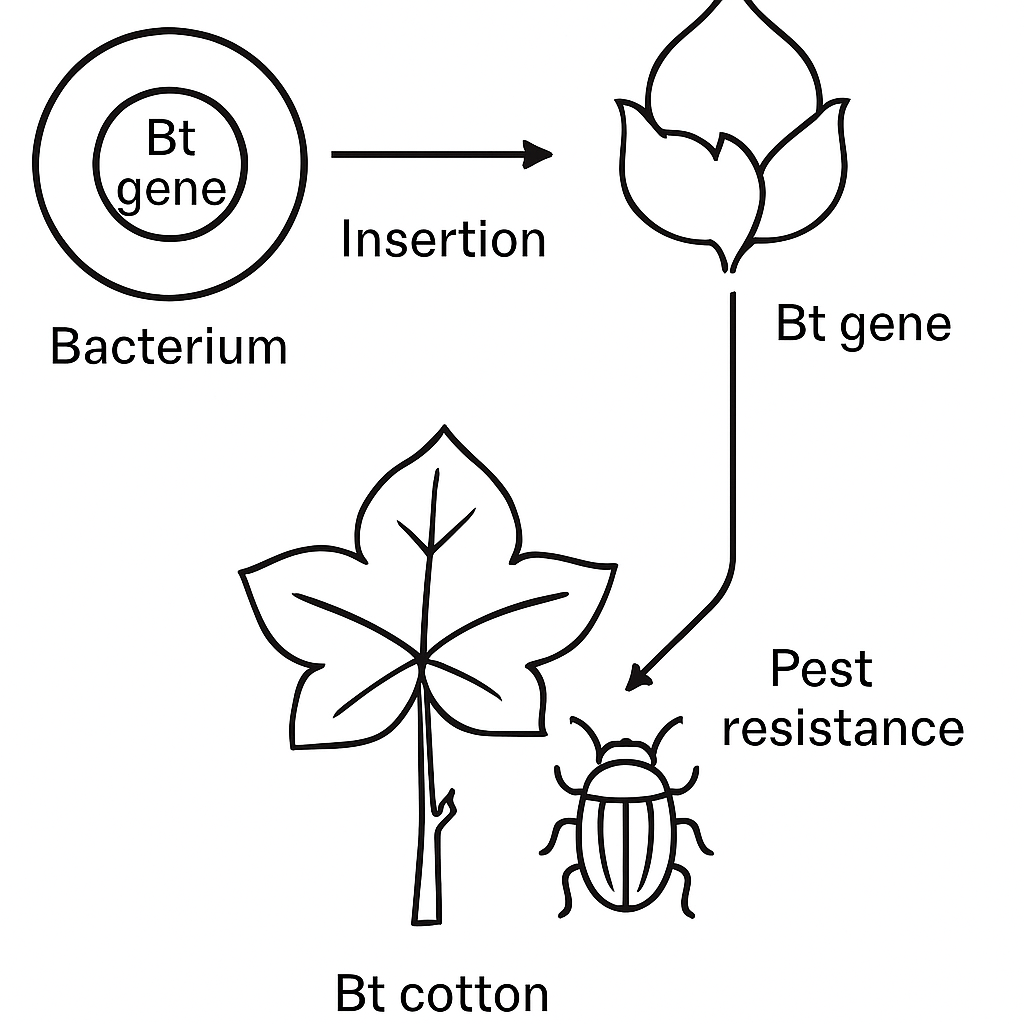
Based on the given diagram of Bt cotton, answer the following:
What is the primary benefit of Bt cotton?
AIncreased yield
BPest resistance
CDrought tolerance
DHigher nutritional value
Describe the role of the Bt gene in Bt cotton.
Which pest is primarily targeted by Bt cotton?
AWhitefly
BCotton bollworm
CAphid
DSpider mite
Show answersHide answers
1. Option 2 — Pest resistance
2. The Bt gene provides resistance against specific pests by producing a toxin.
3. Option 2 — Cotton bollworm
Q573 Marks
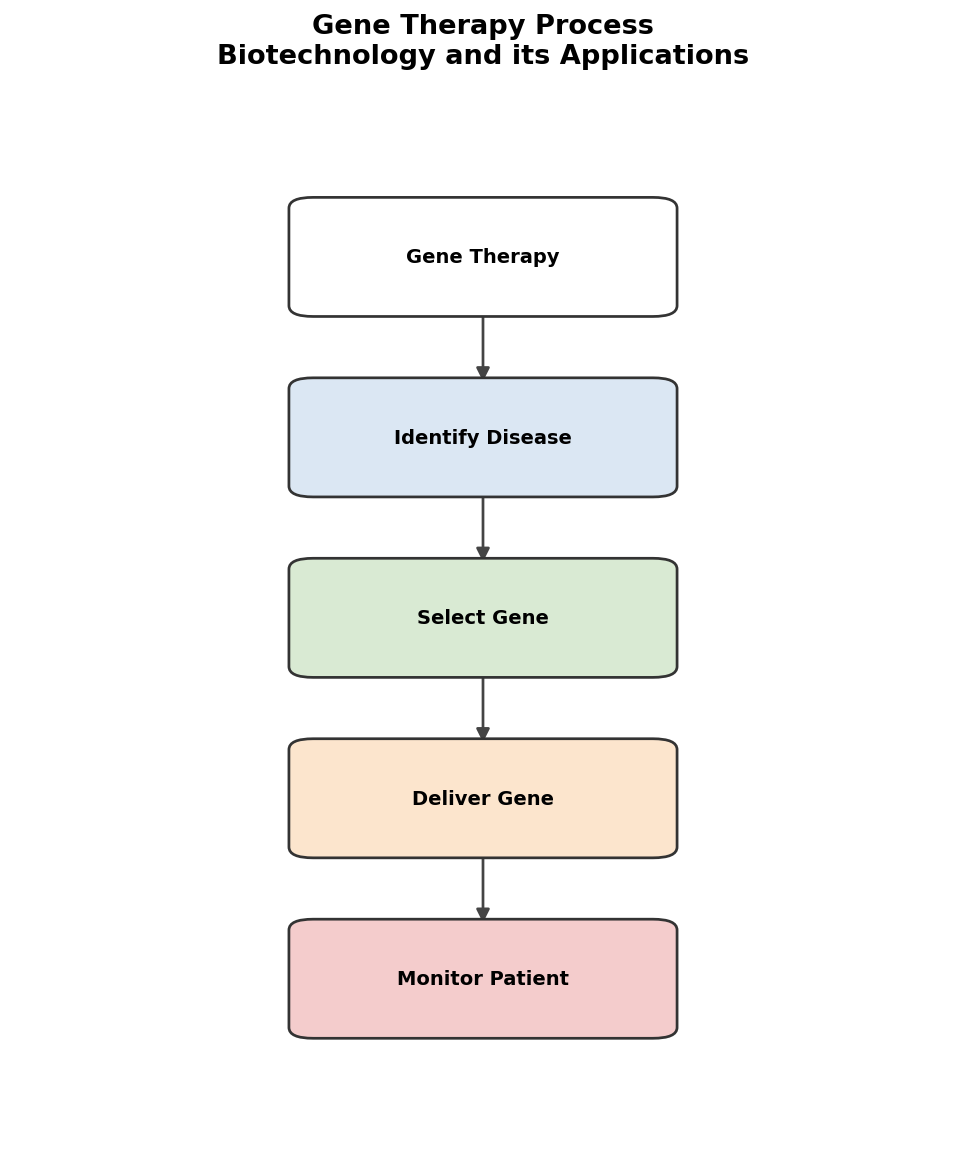
Based on the given flowchart, answer the following:
What is the first step in the gene therapy process?
ASelect Gene
BIdentify Disease
CDeliver Gene
DMonitor Patient
Explain the importance of monitoring the patient in gene therapy.
What is the purpose of selecting a gene in the gene therapy process?
ATo cure the disease
BTo identify the disease
CTo deliver the gene
DTo monitor the patient
What is the final step in the biofortification process?
AIdentify Nutrient Deficiency
BSelect Crop
CEnhance Nutrient Content
DEvaluate Impact
Explain the significance of selecting a crop in biofortification.
What is the purpose of enhancing nutrient content in crops?
ATo increase yield
BTo improve taste
CTo combat nutrient deficiencies
DTo reduce pests
Show answersHide answers
1. Option 2 — Identify Disease
2. Monitoring ensures the effectiveness of the therapy and checks for side effects.
3. Option 1 — To cure the disease
4. Option 4 — Evaluate Impact
5. Selecting a crop ensures that the enhanced nutrient content addresses specific dietary deficiencies.
6. Option 3 — To combat nutrient deficiencies
Q583 Marks
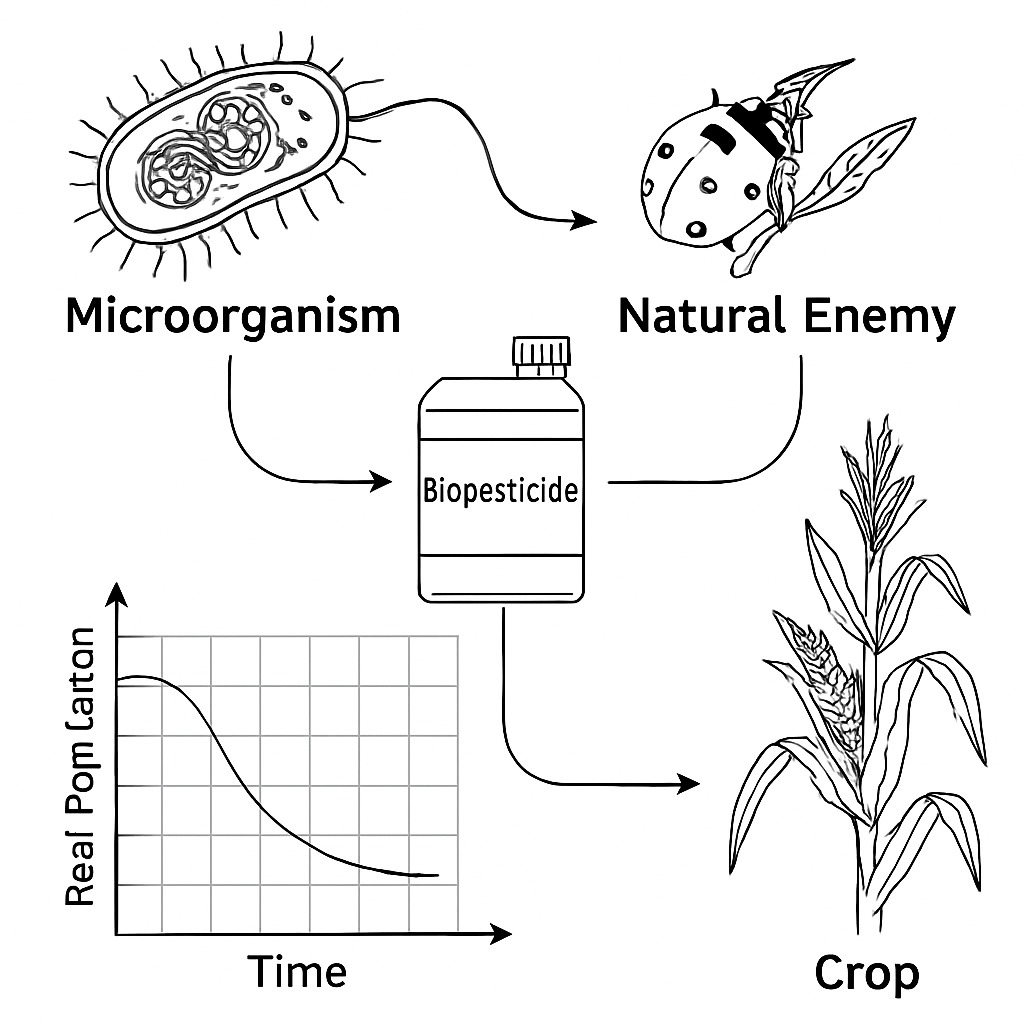
Based on the given diagram of biopesticides, answer the following:
What are biopesticides primarily derived from?
ASynthetic chemicals
BNatural organisms
CMineral sources
DPetrochemicals
Discuss one advantage of using biopesticides over chemical pesticides.
Name one common biopesticide used in agriculture.
ABacillus thuringiensis
BChlorpyrifos
CGlyphosate
DAtrazine
Show answersHide answers
1. Option 2 — Natural organisms
2. Biopesticides are less harmful to non-target organisms and the environment.
3. Option 1 — Bacillus thuringiensis
Q593 Marks
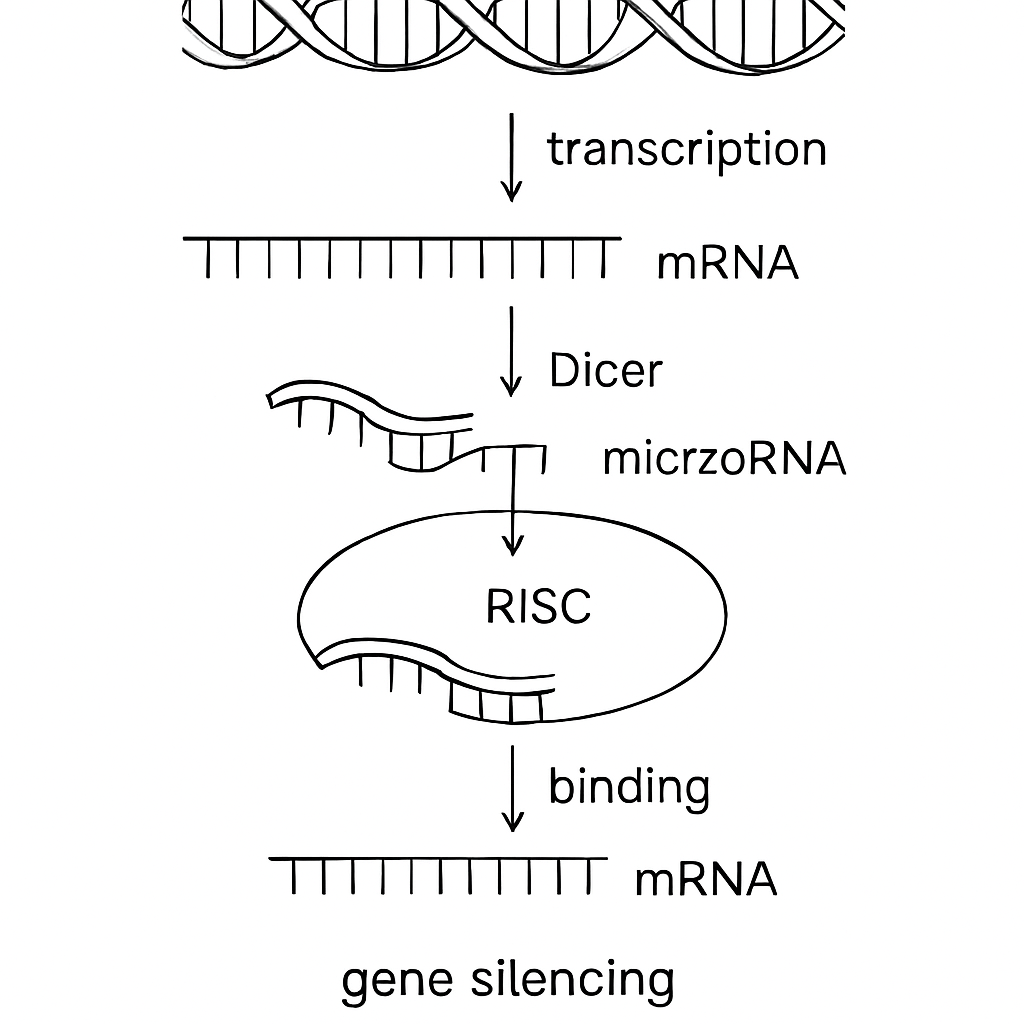
Based on the given diagram of RNA interference, answer the following:
What is the primary function of RNA interference?
AEnhance gene expression
BSilence gene expression
CModify DNA
DIncrease mutation rate
Describe the role of small interfering RNA (siRNA) in RNA interference.
What is one application of RNA interference in biotechnology?
AGene therapy
BCrop enhancement
CDisease diagnosis
DAll of the above
Show answersHide answers
1. Option 2 — Silence gene expression
2. siRNA binds to complementary mRNA, leading to its degradation and preventing translation.