SUMMARY: The chapter on Evolution in Class 12 Biology explores the origin and development of life on Earth, detailing the processes and evidence that support the theory of evolution. KEY TOPICS: Origin of life, theories of evolution, natural selection, adaptive radiation, evidences of evolution, Hardy-Weinberg principle, human evolution, molecular evolution, speciation, convergent and divergent evolution.
The first form of life on Earth is believed to have been:
APhotosynthetic
BChemosynthetic
CHeterotrophic
DAnaerobic
Check answerHide answer
Correct answer: Option 4 — Anaerobic
Q21 Mark
The Miller-Urey experiment supported the theory of:
ASpecial creation
BChemical evolution
CBiogenesis
DSpontaneous generation
Check answerHide answer
Correct answer: Option 2 — Chemical evolution
Q31 Mark
Industrial melanism in peppered moth is an example of:
AGenetic drift
BNatural selection
CMutation
DGene flow
Check answerHide answer
Correct answer: Option 2 — Natural selection
Q41 Mark
The forelimbs of human and bat are examples of:
AAnalogous organs
BHomologous organs
CVestigial organs
DConvergent organs
Check answerHide answer
Correct answer: Option 2 — Homologous organs
Q51 Mark
Hardy-Weinberg principle assumes:
ARandom mating
BNo mutation
CNo migration
DAll of these
Check answerHide answer
Correct answer: Option 4 — All of these
Short Answer Questions10 questions
Q63 Marks
Differentiate between homologous and analogous organs with examples.
Q73 Marks
Briefly explain the origin of life on Earth.
Q83 Marks
What is genetic drift? Explain founder effect.
Q93 Marks
Explain Darwin's theory of natural selection.
Q103 Marks
What is adaptive radiation? Give an example.
Q113 Marks
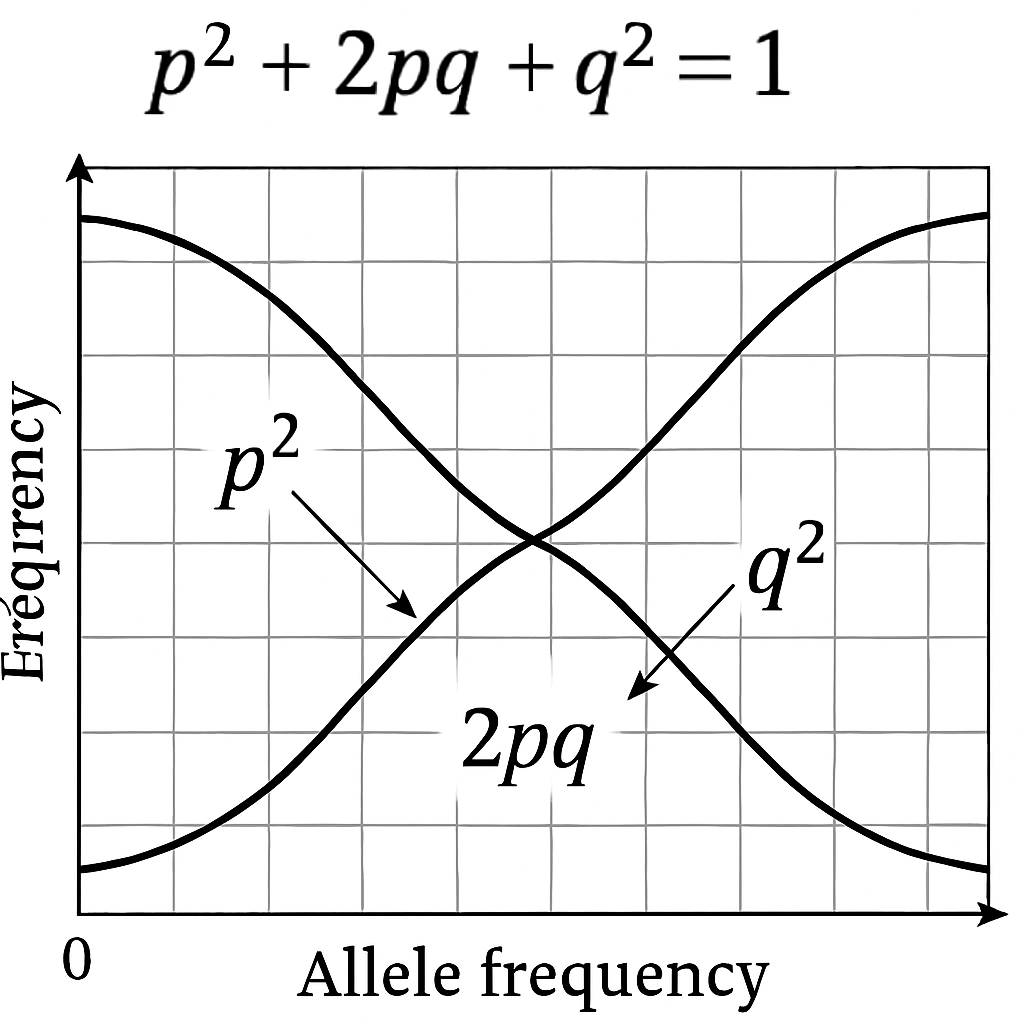
What is the Hardy-Weinberg principle and how does it relate to population genetics?
View sample solutionHide solution
The Hardy-Weinberg principle states that allele and genotype frequencies in a population will remain constant from generation to generation in the absence of evolutionary influences. It serves as a model to measure genetic variation and predict genetic makeup in a population under ideal conditions.
Q123 Marks
Describe the process of speciation and its significance in evolution.
View sample solutionHide solution
Speciation is the process by which new species arise from existing species due to genetic divergence. It is significant in evolution as it leads to biodiversity and the adaptation of organisms to different ecological niches.
Q133 Marks
What evidence supports the theory of evolution? Provide two examples.
View sample solutionHide solution
Evidence supporting the theory of evolution includes fossil records, which show gradual changes in species over time, and comparative anatomy, which reveals similarities in structure among different species indicating common ancestry. Molecular evidence, such as DNA sequencing, also supports evolutionary relationships.
Q143 Marks
Explain the concept of convergent evolution with an example.
View sample solutionHide solution
Convergent evolution occurs when unrelated species develop similar traits due to adapting to similar environments or ecological niches. An example is the wings of bats and birds, which evolved independently but serve the same function of flight.
Q153 Marks
What role does molecular evolution play in understanding evolutionary relationships?
View sample solutionHide solution
Molecular evolution examines the changes in genetic material over time, providing insights into the evolutionary relationships between species. By comparing DNA and protein sequences, scientists can infer how closely related different organisms are and trace their evolutionary history.
Long Answer Questions6 questions
Q166 Marks
Discuss the various theories of origin of life on Earth.
Q176 Marks
Explain the evidences in favour of organic evolution.
Q186 Marks
Describe the Hardy-Weinberg principle and the factors that affect genetic equilibrium.
Q196 Marks
Discuss the theory of natural selection and its modern synthesis.
Q206 Marks
Trace the evolution of human beings from their primate ancestors.
Q216 Marks
Differentiate between homologous and analogous organs in tabular form with examples.
Assertion–Reason Questions5 questions
Q221 Mark
Assertion (A): Vestigial organs are evidence of evolution.
Reason (R): They are remnants of organs that were functional in ancestors.
Show explanationHide explanation
Correct answer: Option 1 —
Both A and R are true, and R is the correct explanation of A.
Q231 Mark
Assertion (A): Homo sapiens evolved from earlier hominids.
Reason (R): Fossil evidence supports a gradual evolution of Homo sapiens.
Show explanationHide explanation
Correct answer: Option 1 —
Both A and R are true, and R is the correct explanation of A.
Q241 Mark
Assertion (A): Adaptive radiation produces diverse species from a common ancestor.
Reason (R): Darwin's finches are an example of adaptive radiation.
Show explanationHide explanation
Correct answer: Option 1 —
Both A and R are true, and R is the correct explanation of A.
Q251 Mark
Assertion (A): Natural selection acts on phenotypes.
Reason (R): Phenotypes are shaped by genotypes which can be inherited.
Show explanationHide explanation
Correct answer: Option 1 —
Both A and R are true, and R is the correct explanation of A.
Q261 Mark
Assertion (A): Convergent evolution leads to analogous organs.
Reason (R): Different species evolve similar features in similar environments.
Show explanationHide explanation
Correct answer: Option 1 —
Both A and R are true, and R is the correct explanation of A.
Statement-Based Questions5 questions
Q271 Mark
Statement 1: Lamarck proposed inheritance of acquired characters.
Statement 2: This theory has been largely refuted by modern genetics.
Show answerHide answer
Correct answer: Option 1 —
Both statements are true.
Q281 Mark
Statement 1: Hardy-Weinberg equilibrium describes a non-evolving population.
Statement 2: Real populations rarely meet all the conditions of this equilibrium.
Show answerHide answer
Correct answer: Option 1 —
Both statements are true.
Q291 Mark
Statement 1: Fossils are remains of past life.
Statement 2: They provide direct evidence of evolution.
Show answerHide answer
Correct answer: Option 1 —
Both statements are true.
Q301 Mark
Statement 1: Archaeopteryx is a transitional form between reptiles and birds.
Statement 2: It had features of both groups.
Show answerHide answer
Correct answer: Option 1 —
Both statements are true.
Q311 Mark
Statement 1: Speciation can occur due to geographic isolation.
Statement 2: Geographic isolation prevents gene flow between populations.
Show answerHide answer
Correct answer: Option 1 —
Both statements are true.
Case Study / Passage Questions4 questions
Q323 Marks
Before the Industrial Revolution most peppered moths in England were light coloured and rested unnoticed on lichen-covered tree trunks. After industrialisation soot blackened the tree trunks and the dark variant of the moth became more common as the lighter forms were now visible to predators. This is a classic example of natural selection in action.
Industrial melanism is a famous example of:
AGenetic drift
BNatural selection
CMutation
DGene flow
After industrialisation the surviving moths were predominantly:
ALight moths
BDark moths
CBoth equally
DNeither
Explain how industrial melanism in peppered moths illustrates the action of natural selection.
Show answersHide answers
1. Option 2 — Natural selection
2. Option 2 — Dark moths
3. The peppered moth Biston betularia exists in light and dark colour forms. The dark form was once rare. After the Industrial Revolution soot from coal-burning factories blackened the tree trunks. Light coloured moths now stood out and were eaten by birds while dark moths blended in and survived. The frequency of the dark form rose sharply in industrial areas — a documented case of evolution by natural selection within a few generations.
Q333 Marks
Anthropologists trace human ancestry back through fossil hominids — Australopithecus, Homo habilis, Homo erectus, Neanderthals and finally Homo sapiens. The increase in cranial capacity, bipedalism and the development of stone tools mark the major milestones in human evolution.
The first hominid known to make stone tools is:
AAustralopithecus
BHomo habilis
CHomo erectus
DHomo sapiens
Modern humans are believed to have originated in:
AAsia
BAfrica
CEurope
DAmerica
Trace the evolution of humans from their hominid ancestors highlighting the major milestones.
Show answersHide answers
1. Option 2 — Homo habilis
2. Option 2 — Africa
3. Modern humans (Homo sapiens) emerged in Africa about 2 lakh years ago. Earlier ancestors include Australopithecus (about 4 mya), Homo habilis (the toolmaker, 2 mya), Homo erectus (about 1.5 mya, who used fire) and Neanderthals (in Europe and Asia, about 1 lakh years ago). Cranial capacity increased from about 450 cc in Australopithecus to about 1400 cc in Homo sapiens reflecting the development of complex behaviour and language.
Q343 Marks
The theory of natural selection, proposed by Charles Darwin, explains how species evolve over time through a process where individuals with favorable traits are more likely to survive and reproduce. This leads to the gradual adaptation of species to their environments. For example, in a population of beetles, those that are better camouflaged from predators are more likely to survive and pass on their genes. Over generations, the traits that enhance survival become more common in the population, demonstrating the mechanism of evolution in action.
Who proposed the theory of natural selection?
AGregory Mendel
BCharles Darwin
CJean-Baptiste Lamarck
DAlfred Wallace
Explain how natural selection contributes to the adaptation of species.
What is an example of natural selection in action?
AIncreased size of mammals over time
BBeetles with better camouflage surviving longer
CMigration of birds to warmer climates
DDevelopment of antibiotic resistance in bacteria
Show answersHide answers
1. Option 2 — Charles Darwin
2. Natural selection contributes to the adaptation of species by favoring individuals with traits that enhance survival and reproduction, leading to those traits becoming more common in the population over generations.
3. Option 2 — Beetles with better camouflage surviving longer
Q353 Marks
Adaptive radiation is a process in which organisms diversify rapidly into a wide variety of forms to adapt to different environments. This phenomenon often occurs when a species colonizes a new habitat with diverse ecological niches. For instance, the finches of the Galápagos Islands are a classic example of adaptive radiation, where different species evolved distinct beak shapes to exploit various food sources available on the islands. This diversification illustrates how environmental factors can drive evolutionary change.
What is adaptive radiation?
AThe extinction of species due to environmental changes
BRapid diversification of organisms into different forms
CThe process of natural selection
DThe gradual evolution of species over time
Describe the significance of the Galápagos finches in the study of evolution.
What drives the process of adaptive radiation?
AGenetic drift
BEnvironmental factors
CMutation rates
DPopulation size
Show answersHide answers
1. Option 2 — Rapid diversification of organisms into different forms
2. The Galápagos finches are significant in the study of evolution as they exemplify adaptive radiation, showcasing how different species evolved distinct traits (like beak shapes) to adapt to various ecological niches.
3. Option 2 — Environmental factors
Table-Based Questions4 questions
Q363 Marks
Study the table on evidences of evolution and answer:
Evidence
Type
Example
Forelimb of mammals
Homologous
Same basic structure
Wings of insects and birds
Analogous
Different origin same function
Vermiform appendix
Vestigial
Functionless remnant
Archaeopteryx
Connecting link
Reptile-bird transition
Embryonic gill slits
Embryological
Common ancestry
The wings of insects and birds are:
AHomologous
BAnalogous
CVestigial
DConnecting link
Vestigial organs in humans include:
AVermiform appendix
BCoccyx
CWisdom teeth
DAll
Discuss the major lines of evidence supporting the theory of organic evolution.
Show answersHide answers
1. Option 2 — Analogous
2. Option 4 — All
3. Evidences for evolution come from many sources. Comparative anatomy provides homologous organs (same structure different function — supporting common ancestry) and analogous organs (different structure same function — supporting convergent evolution). Vestigial organs are remnants of structures that were functional in ancestors. Embryology shows similarities between embryos of different vertebrates. Fossils like Archaeopteryx serve as connecting links and provide direct evidence of evolutionary change.
Q376 Marks
Match each hominid species with its approximate cranial capacity and time period.
Species
Cranial capacity
Time period
Australopithecus
?
?
Homo habilis
?
?
Homo erectus
?
?
Neanderthals
?
?
Homo sapiens
?
?
Q386 Marks
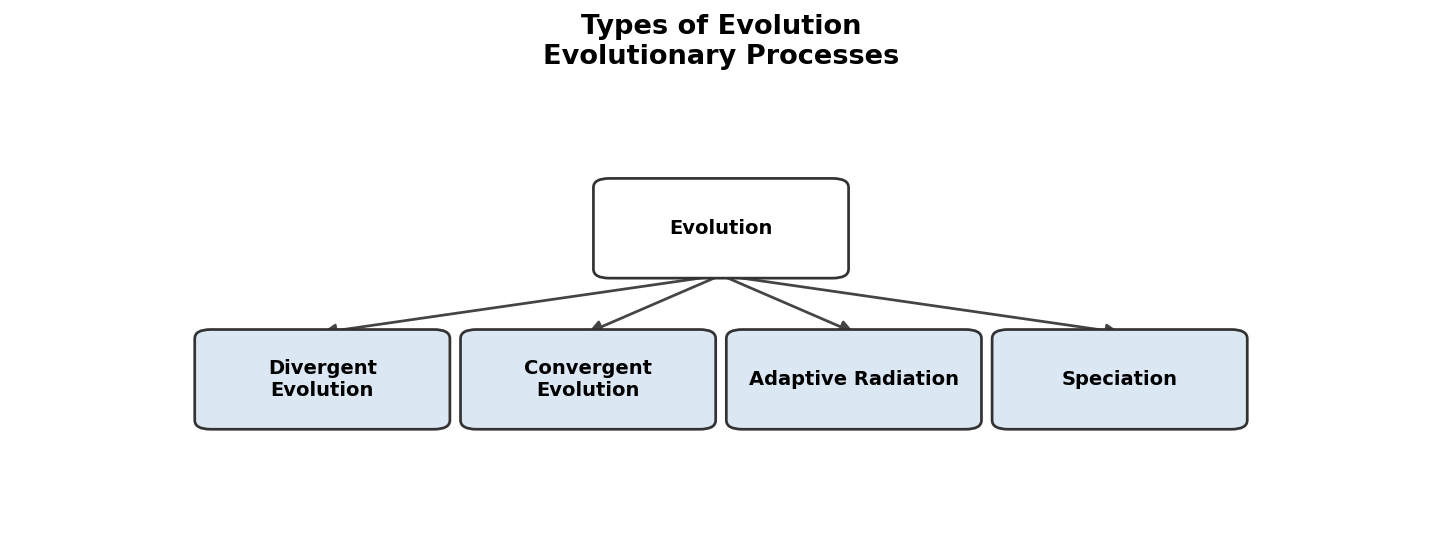
Which type of evolution is represented by the similarities in the wing structure of bats and birds despite their different evolutionary paths?
Type of Evolution
Description
Convergent Evolution
Different species evolve similar traits
Divergent Evolution
Related species evolve different traits
Q393 Marks
Study the following data and answer the questions below:
Species
Cranial Capacity (cc)
Time Period (million years ago)
Homo habilis
510
2.4-1.5
Homo erectus
900
1.9-0.1
Homo sapiens
1350
0.3-present
Which species had the largest cranial capacity?
Calculate the average cranial capacity of the species listed.
Which species existed the longest ago?
Show answersHide answers
1.
2.
3.
Picture-Based Questions4 questions
Q402 Marks
Based on the given diagram of the Hardy-Weinberg principle, answer the following:
What does 'p' represent in the Hardy-Weinberg equation?
AFrequency of dominant allele
BFrequency of recessive allele
CTotal population size
DMutation rate
Explain the significance of the Hardy-Weinberg principle in population genetics.
Show answersHide answers
1. Option 1 — Frequency of dominant allele
2. The Hardy-Weinberg principle provides a baseline to measure genetic variation in a population and helps to understand the effects of evolutionary forces.
Q412 Marks
Based on the given flowchart, answer the following:
Which type of evolution involves species evolving different traits from a common ancestor?
ADivergent Evolution
BConvergent Evolution
CAdaptive Radiation
DSpeciation
Describe adaptive radiation and provide an example.
What is the first step in the natural selection process?
AVariation
BCompetition
CSurvival of the Fittest
DReproduction
Describe how competition influences natural selection.
Show answersHide answers
1. Option 1 — Divergent Evolution
2. Adaptive radiation is the process by which organisms diversify rapidly into a wide variety of forms to adapt to different environments. An example is the finches of the Galápagos Islands.
3. Option 1 — Variation
4. Competition for resources leads to the survival of individuals with advantageous traits, thereby driving the process of natural selection.
Q422 Marks
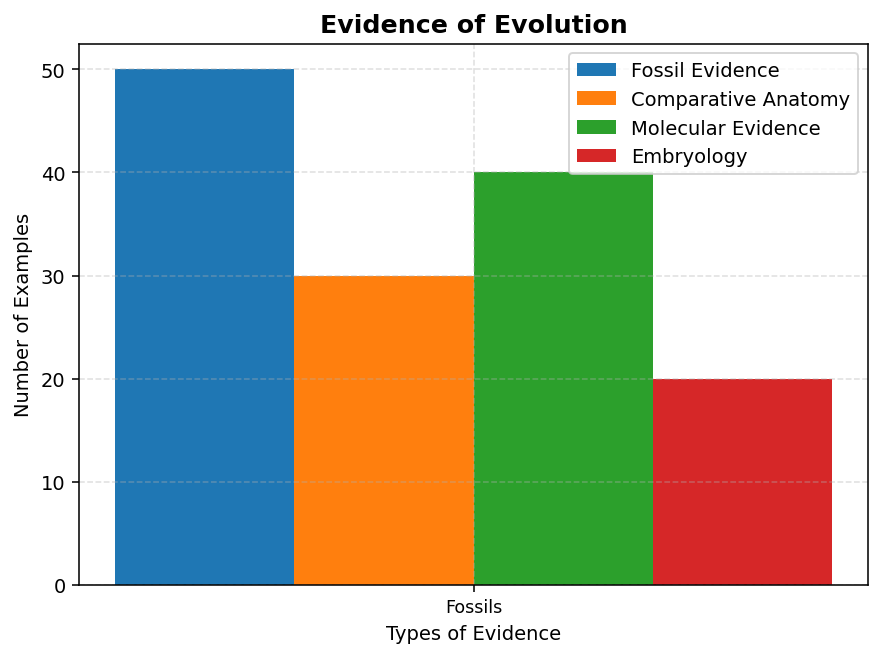
Based on the given chart, answer the following:
Which type of evidence has the highest number of examples?
AFossil Evidence
BComparative Anatomy
CMolecular Evidence
DEmbryology
Discuss the importance of molecular evidence in supporting the theory of evolution.
Show answersHide answers
1. Option 1 — Fossil Evidence
2. Molecular evidence, such as DNA and protein similarities, provides insights into the genetic relationships between species, supporting the idea of common ancestry.
Q432 Marks
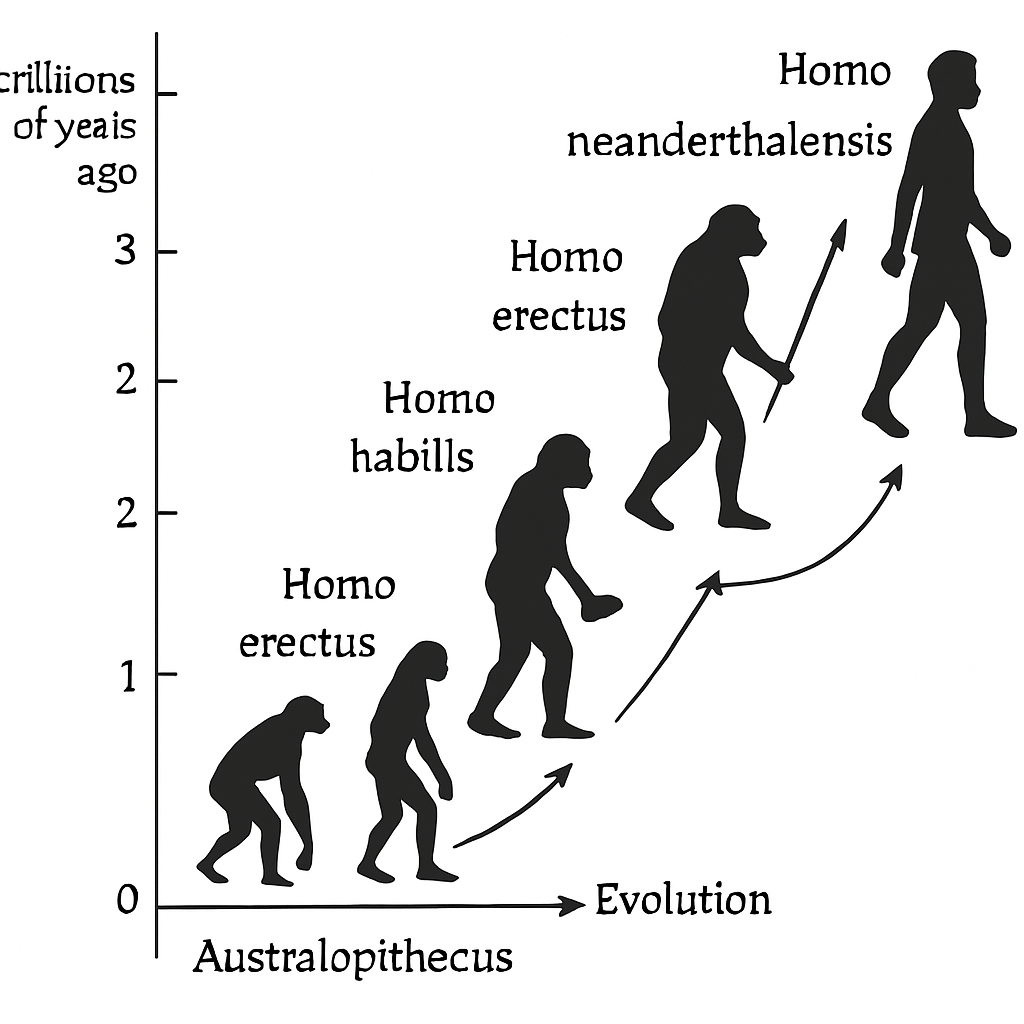
Based on the given diagram of human evolution, answer the following:
Name the earliest known hominid species in the diagram.
AHomo habilis
BAustralopithecus
CHomo erectus
DNeanderthal
Explain how the environment influenced human evolution.
Show answersHide answers
1. Option 2 — Australopithecus
2. Environmental changes, such as climate shifts and habitat alterations, led to adaptations in early hominids, influencing their survival and evolutionary path.