Biotechnology Principles and Processes — Important Questions
59 questions
With answersCBSE format
SUMMARY: This chapter focuses on the fundamental principles and processes involved in biotechnology, including the techniques and tools used in genetic engineering. KEY TOPICS: recombinant DNA technology, cloning vectors, restriction enzymes, polymerase chain reaction (PCR), gel electrophoresis, transformation, competent cells, bioreactors, downstream processing, applications of biotechnology.
The vector commonly used in genetic engineering is:
APlasmid
BChromosome
CMitochondria
DRibosome
Check answerHide answer
Correct answer: Option 1 — Plasmid
Q51 Mark
Taq polymerase is used in PCR because:
AIt is heat stable
BIt is fast
CIt is cheap
DIt is plant-derived
Check answerHide answer
Correct answer: Option 1 — It is heat stable
Q61 Mark
Which of the following is NOT a property of cloning vectors?
AAbility to replicate independently
BPresence of a selectable marker
CAbility to integrate into the host genome
DAbility to degrade RNA
Check answerHide answer
Correct answer: Option 4 — Ability to degrade RNA
Q71 Mark
What is the primary purpose of gel electrophoresis in biotechnology?
ATo amplify DNA sequences
BTo separate DNA fragments based on size
CTo clone genes into vectors
DTo transform competent cells
Check answerHide answer
Correct answer: Option 2 — To separate DNA fragments based on size
Q81 Mark
Which of the following statements about transformation is true?
AIt involves the uptake of RNA by cells
BIt can occur naturally or be induced artificially
CIt is a process exclusive to prokaryotic cells
DIt requires the presence of a virus
Check answerHide answer
Correct answer: Option 2 — It can occur naturally or be induced artificially
Q91 Mark
In recombinant DNA technology, what role do restriction enzymes play?
AThey amplify DNA
BThey cut DNA at specific sequences
CThey ligate DNA fragments
DThey synthesize RNA
Check answerHide answer
Correct answer: Option 2 — They cut DNA at specific sequences
Q101 Mark
What is the function of competent cells in biotechnology?
ATo produce proteins
BTo carry out PCR
CTo take up foreign DNA
DTo degrade plasmids
Check answerHide answer
Correct answer: Option 3 — To take up foreign DNA
Q111 Mark
Which of the following is a common application of bioreactors in biotechnology?
ADNA sequencing
BProtein production
CGene editing
DRNA extraction
Check answerHide answer
Correct answer: Option 2 — Protein production
Q121 Mark
What is the significance of downstream processing in biotechnology?
AIt involves the synthesis of DNA
BIt is the purification of products after fermentation
CIt is the initial step in genetic engineering
DIt is the transformation of cells
Check answerHide answer
Correct answer: Option 2 — It is the purification of products after fermentation
Q131 Mark
Which of the following is a key feature of the polymerase chain reaction (PCR)?
AIt requires a high temperature for all steps
BIt can amplify DNA from a single copy
CIt uses RNA polymerase for amplification
DIt is only applicable to bacterial DNA
Check answerHide answer
Correct answer: Option 2 — It can amplify DNA from a single copy
Q141 Mark
What is the role of ligase in recombinant DNA technology?
ATo cut DNA at specific sites
BTo amplify DNA fragments
CTo join DNA fragments together
DTo degrade unwanted DNA
Check answerHide answer
Correct answer: Option 3 — To join DNA fragments together
Q151 Mark
Which of the following is NOT a type of cloning vector?
APlasmid
BBacteriophage
CCosmid
DRibosome
Check answerHide answer
Correct answer: Option 4 — Ribosome
Short Answer Questions10 questions
Q163 Marks
What is recombinant DNA technology? Mention its tools.
Q173 Marks
Explain the role of restriction enzymes in genetic engineering.
Q183 Marks
Describe the principle of PCR.
Q193 Marks
What are cloning vectors? Mention their important features.
Q203 Marks
Explain how recombinant DNA is introduced into a host cell.
Q213 Marks
What is the function of competent cells in genetic engineering?
View sample solutionHide solution
Competent cells are bacterial cells that have been treated to allow them to take up foreign DNA more efficiently. This property is essential for the transformation process, where recombinant DNA is introduced into the host cell.
Q223 Marks
Describe the process of gel electrophoresis and its purpose in biotechnology.
View sample solutionHide solution
Gel electrophoresis is a technique used to separate DNA, RNA, or proteins based on their size and charge. It involves applying an electric field to a gel matrix, causing the molecules to migrate; smaller fragments move faster, allowing for analysis and purification of specific biomolecules.
Q233 Marks
What are bioreactors and their role in biotechnology?
View sample solutionHide solution
Bioreactors are vessels or containers used to provide a controlled environment for the growth of microorganisms or cells during biotechnological processes. They facilitate optimal conditions for fermentation, cell culture, and production of bioproducts such as enzymes or pharmaceuticals.
Q243 Marks
Explain the significance of downstream processing in biotechnology.
View sample solutionHide solution
Downstream processing refers to the recovery and purification of biosynthetic products after fermentation or cell culture. It is crucial for ensuring the quality and safety of bioproducts, involving steps like filtration, chromatography, and drying to isolate the desired product from other cellular materials.
Q253 Marks
What is the role of polymerase in the polymerase chain reaction (PCR)?
View sample solutionHide solution
In PCR, DNA polymerase is the enzyme responsible for synthesizing new DNA strands by adding nucleotides complementary to the template strand during the amplification process. It is essential for replicating the target DNA sequence exponentially with each cycle of the reaction.
Long Answer Questions6 questions
Q266 Marks
Describe the steps involved in recombinant DNA technology.
Q276 Marks
Explain the structure and use of cloning vectors with examples.
Q286 Marks
Describe the working principle and applications of polymerase chain reaction (PCR).
Q296 Marks
Explain the use of bioreactors and downstream processing in biotechnology.
Q306 Marks
Describe the role of various enzymes in genetic engineering.
Q316 Marks
Differentiate between plasmid and cosmid in tabular form.
Assertion–Reason Questions8 questions
Q321 Mark
Assertion (A): Restriction enzymes recognise specific palindromic sequences.
Reason (R): They cut DNA only at these specific sites.
Show explanationHide explanation
Correct answer: Option 1 —
Both A and R are true, and R is the correct explanation of A.
Q331 Mark
Assertion (A): DNA ligase is used to join DNA fragments.
Reason (R): It catalyses the formation of phosphodiester bonds.
Show explanationHide explanation
Correct answer: Option 1 —
Both A and R are true, and R is the correct explanation of A.
Q341 Mark
Assertion (A): Plasmids can replicate independently in bacteria.
Reason (R): They have their own origin of replication.
Show explanationHide explanation
Correct answer: Option 1 —
Both A and R are true, and R is the correct explanation of A.
Q351 Mark
Assertion (A): Selectable markers are used in cloning vectors.
Reason (R): They help in identifying transformed cells.
Show explanationHide explanation
Correct answer: Option 1 —
Both A and R are true, and R is the correct explanation of A.
Q361 Mark
Assertion (A): Microinjection is a method of transferring DNA into animal cells.
Reason (R): Recombinant DNA is directly injected into the nucleus.
Show explanationHide explanation
Correct answer: Option 1 —
Both A and R are true, and R is the correct explanation of A.
Q371 Mark
Assertion (A): Recombinant DNA technology involves the combination of DNA from different sources.
Reason (R): This technology allows for the creation of genetically modified organisms (GMOs).
Show explanationHide explanation
Correct answer: Option 1 —
Both A and R are true, and R is the correct explanation of A.
Q381 Mark
Assertion (A): Cloning vectors are essential for the propagation of recombinant DNA.
Reason (R): Cloning vectors can carry foreign DNA into host cells for replication.
Show explanationHide explanation
Correct answer: Option 1 —
Both A and R are true, and R is the correct explanation of A.
Q391 Mark
Assertion (A): Polymerase chain reaction (PCR) can amplify specific DNA sequences.
Reason (R): PCR requires a DNA template, primers, and DNA polymerase to function.
Show explanationHide explanation
Correct answer: Option 1 —
Both A and R are true, and R is the correct explanation of A.
Statement-Based Questions8 questions
Q401 Mark
Statement 1: Sticky ends are formed by restriction enzymes.
Statement 2: They facilitate joining of DNA fragments.
Show answerHide answer
Correct answer: Option 1 —
Both statements are true.
Q411 Mark
Statement 1: Bioreactors maintain optimal conditions for microbial growth.
Statement 2: They control temperature, pH, oxygen, and nutrients.
Show answerHide answer
Correct answer: Option 1 —
Both statements are true.
Q421 Mark
Statement 1: Gel electrophoresis separates DNA fragments by size.
Statement 2: Smaller fragments move faster through the gel.
Show answerHide answer
Correct answer: Option 1 —
Both statements are true.
Q431 Mark
Statement 1: Gene gun is used in plant transformation.
Statement 2: Microprojectiles coated with DNA are shot into plant cells.
Show answerHide answer
Correct answer: Option 1 —
Both statements are true.
Q441 Mark
Statement 1: Downstream processing involves separation and purification.
Statement 2: It is the final step before product is marketed.
Show answerHide answer
Correct answer: Option 1 —
Both statements are true.
Q451 Mark
Statement 1: Recombinant DNA technology can be used to produce insulin.
Statement 2: Cloning vectors are only used in animal cells.
Show answerHide answer
Correct answer: Option 2 —
Only Statement 1 is true.
Q461 Mark
Statement 1: Restriction enzymes can cut DNA at specific sequences.
Statement 2: PCR is used to amplify DNA sequences.
Show answerHide answer
Correct answer: Option 1 —
Both statements are true.
Q471 Mark
Statement 1: Competent cells are required for the transformation process.
Statement 2: Bioreactors are not necessary for microbial fermentation.
Show answerHide answer
Correct answer: Option 4 —
Both statements are false.
Case Study / Passage Questions4 questions
Q483 Marks
A biotechnology lab wants to insert a human gene into a bacterial plasmid. The student uses the restriction enzyme EcoRI to cut both the plasmid and the human DNA at the same recognition site producing complementary sticky ends. DNA ligase then joins the human DNA fragment into the plasmid producing a recombinant DNA molecule.
The molecular scissors used in the experiment is:
AEcoRI
BDNA polymerase
CHelicase
DReverse transcriptase
The enzyme that joins DNA fragments is:
ADNA ligase
BDNA polymerase
CHelicase
DTopoisomerase
Explain the role of restriction enzymes and DNA ligase in recombinant DNA technology.
Show answersHide answers
1. Option 1 — EcoRI
2. Option 1 — DNA ligase
3. Restriction enzymes recognise specific palindromic sequences in DNA and cut at fixed positions. EcoRI for example cuts GAATTC between G and A leaving 4-nucleotide single-stranded overhangs called sticky ends. The same enzyme cuts the foreign DNA and the vector at the same sequence producing complementary sticky ends that base pair. DNA ligase then seals the phosphodiester backbone forming recombinant DNA. This is the basis of gene cloning.
Q493 Marks
Forensic scientists analyse a tiny blood sample from a crime scene. They use the polymerase chain reaction (PCR) to amplify specific DNA segments billions of times. PCR involves three steps that are repeated 30-35 times — denaturation at 94 degrees C annealing at 50-60 degrees C and extension at 72 degrees C using Taq polymerase.
PCR is used to:
ACuts DNA
BJoins DNA
CAmplifies DNA
DSequences DNA
Taq polymerase is preferred because it is:
AHeat stable
BCheap
CFast
DPlant derived
Describe the three steps of PCR and explain why Taq polymerase is used.
Show answersHide answers
1. Option 3 — Amplifies DNA
2. Option 1 — Heat stable
3. Polymerase Chain Reaction (PCR) amplifies a specific DNA region exponentially. Each cycle has three steps — denaturation (separating the two DNA strands at 94 degrees C), annealing (primers binding to flanking sequences at 50-60 degrees C) and extension (synthesis by Taq polymerase at 72 degrees C). Taq polymerase from Thermus aquaticus is heat stable and survives the denaturation step. After 30 cycles a single DNA molecule yields about a billion copies. PCR is used in diagnosis, forensics and gene cloning.
Q503 Marks
Recombinant DNA technology is a cornerstone of modern biotechnology, allowing scientists to manipulate genetic material for various applications. This process involves the use of restriction enzymes to cut DNA at specific sequences, creating fragments that can be joined together using DNA ligase. Cloning vectors, such as plasmids, are then used to carry the recombinant DNA into host cells. Once inside, the host cells can replicate the DNA, producing multiple copies of the gene of interest. This technology is essential in producing insulin, growth hormones, and other therapeutic proteins.
What is the primary purpose of recombinant DNA technology?
ATo create genetically modified organisms
BTo analyze DNA sequences
CTo produce therapeutic proteins
DTo clone entire organisms
Explain the role of restriction enzymes in recombinant DNA technology.
Which of the following is a common cloning vector used in recombinant DNA technology?
ABacteriophage
BCosmid
CPlasmid
DAll of the above
Show answersHide answers
1. Option 3 — To produce therapeutic proteins
2. Restriction enzymes cut DNA at specific sequences, allowing for the isolation and manipulation of genetic material.
3. Option 4 — All of the above
Q513 Marks
The polymerase chain reaction (PCR) is a revolutionary technique that allows for the amplification of specific DNA sequences. By using a DNA polymerase enzyme, PCR can create millions of copies of a target DNA segment in a matter of hours. The process involves repeated cycles of denaturation, annealing, and extension, which exponentially increases the amount of DNA. PCR is widely used in various fields, including medical diagnostics, forensic science, and genetic research, making it an invaluable tool in biotechnology.
What are the three main steps of the PCR process?
ADenaturation, Annealing, Extension
BCutting, Joining, Transforming
CAmplifying, Sequencing, Analyzing
DCloning, Screening, Harvesting
Describe one application of PCR in biotechnology.
Why is PCR considered a vital tool in forensic science?
Show answersHide answers
1. Option 1 — Denaturation, Annealing, Extension
2. PCR is used in medical diagnostics to detect the presence of pathogens in a patient's sample.
3. PCR allows forensic scientists to amplify tiny amounts of DNA from crime scene evidence, making it possible to identify suspects.
Table-Based Questions4 questions
Q523 Marks
Study the table of basic tools of recombinant DNA technology:
Tool
Function
Restriction enzymes
Cut DNA at specific sequences
DNA ligase
Joins DNA fragments
Plasmids
Vectors for carrying foreign DNA
Bacteriophages
Vectors for carrying foreign DNA
DNA polymerase
Synthesises DNA
Selectable markers
Identify transformed cells
DNA fragments are joined by:
ARestriction enzyme
BDNA ligase
CPlasmid
DSelectable marker
Antibiotic resistance genes serve as:
ARestriction enzyme
BDNA ligase
CDNA polymerase
DSelectable marker
List the main tools of recombinant DNA technology and explain their roles.
Show answersHide answers
1. Option 2 — DNA ligase
2. Option 4 — Selectable marker
3. Recombinant DNA technology relies on a few key tools. Restriction enzymes cut DNA at specific palindromic sequences. DNA ligase joins compatible DNA ends. Vectors (plasmids, bacteriophages, BACs, YACs) carry the foreign DNA into the host cell. Selectable markers (typically antibiotic resistance) help identify transformed cells. PCR amplifies the gene of interest. Together these tools enable the cloning, expression and large-scale production of any gene.
Q536 Marks
Match each restriction enzyme with its recognition sequence and cut.
Enzyme
Recognition site
End type
EcoRI
GAATTC
?
Hind III
AAGCTT
?
BamHI
GGATCC
?
Hae III
GGCC
?
Sma I
CCCGGG
?
Q546 Marks
Identify the temperature and event in each step of one PCR cycle.
Step
Temperature
Event
Denaturation
?
?
Annealing
?
?
Extension
?
?
Q556 Marks
List the essential features of a useful cloning vector and explain each.
Feature
Role
ori
?
Selectable marker
?
MCS
?
Small size
?
Reporter gene
?
Picture-Based Questions4 questions
Q563 Marks
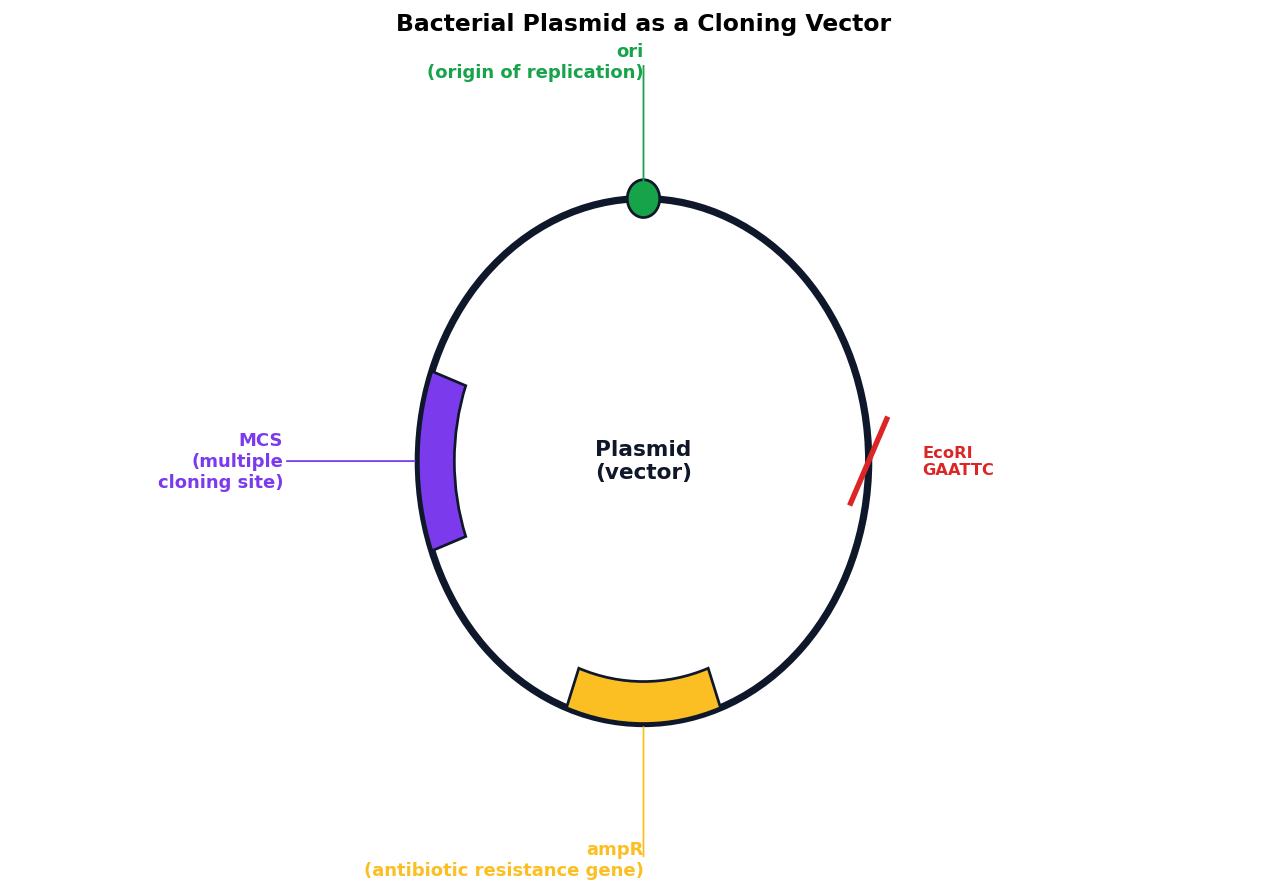
Study the labelled diagram of a bacterial plasmid vector and answer:
The site where DNA is cut by a restriction enzyme to insert a foreign DNA fragment is the:
Aori
BampR
CMCS
DGAATTC
The ampR gene serves as a:
ASelectable marker
BOrigin of replication
CCloning site
DPromoter
List the essential features of a cloning vector and explain the role of each.
Show answersHide answers
1. Option None
2. Option None
3. A bacterial plasmid is a small circular extrachromosomal DNA used as a cloning vector. A useful vector has three essential features - an origin of replication (ori) that allows it to replicate inside the host cell a selectable marker (e.g. antibiotic resistance gene like ampR) that lets us identify transformed cells and unique restriction sites or a multiple cloning site (MCS) where foreign DNA can be inserted.
Q573 Marks
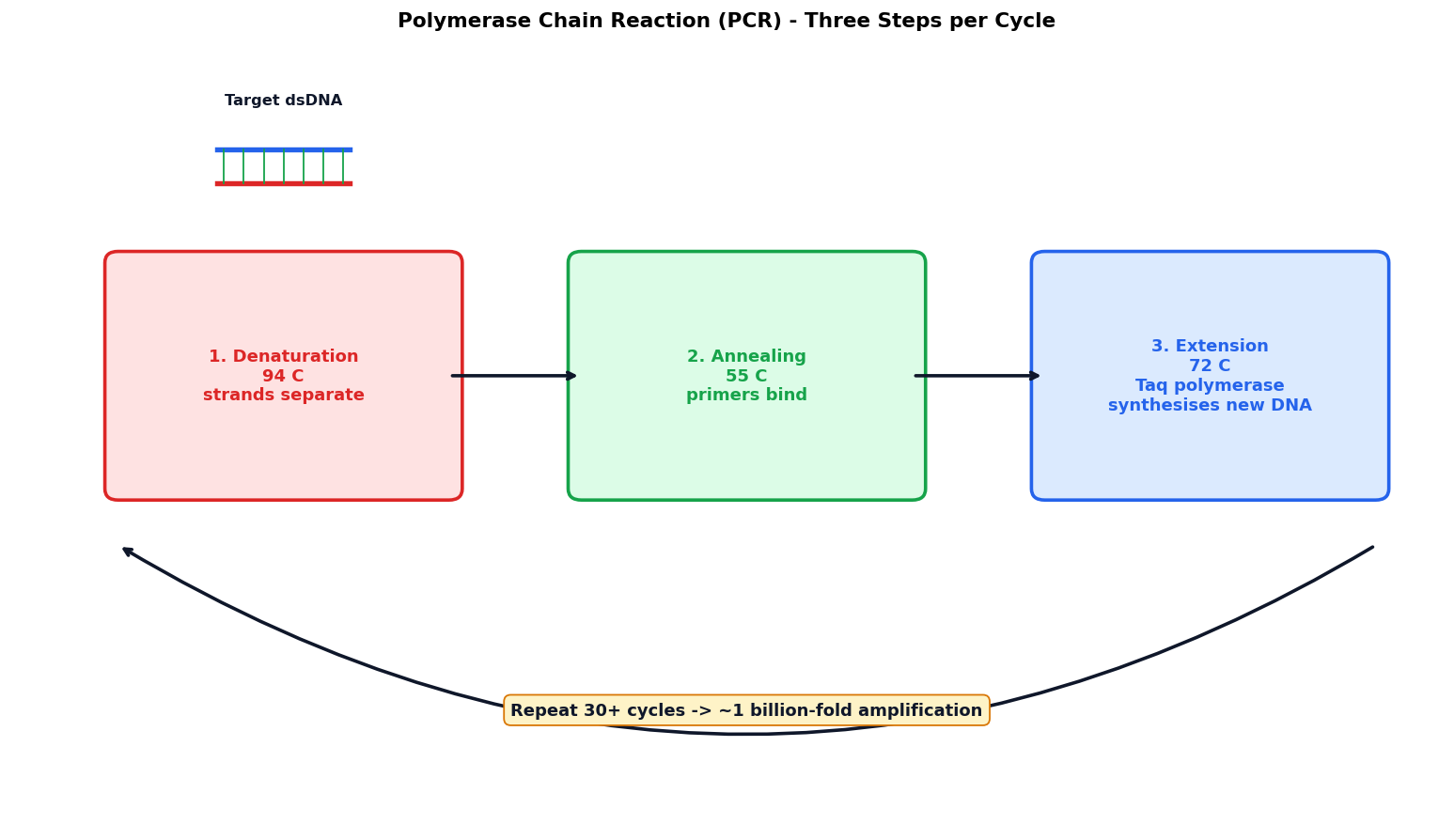
Study the PCR cycle schematic and answer:
The first step of a PCR cycle is:
AAnnealing
BDenaturation
CExtension
DLigation
The enzyme used during the extension step is:
ADNA polymerase
BTaq polymerase
CReverse transcriptase
DDNA ligase
Describe the three steps of PCR and explain why Taq polymerase is used.
Show answersHide answers
1. Option None
2. Option None
3. The polymerase chain reaction (PCR) amplifies a target DNA region exponentially. Each cycle has three steps. Denaturation at 94 C separates DNA strands. Annealing at 50-60 C allows primers to bind. Extension at 72 C uses Taq polymerase to synthesise new DNA. Taq is heat-stable and survives the denaturation step. Repeating the cycle 30+ times amplifies the DNA about a billion-fold.
Q583 Marks
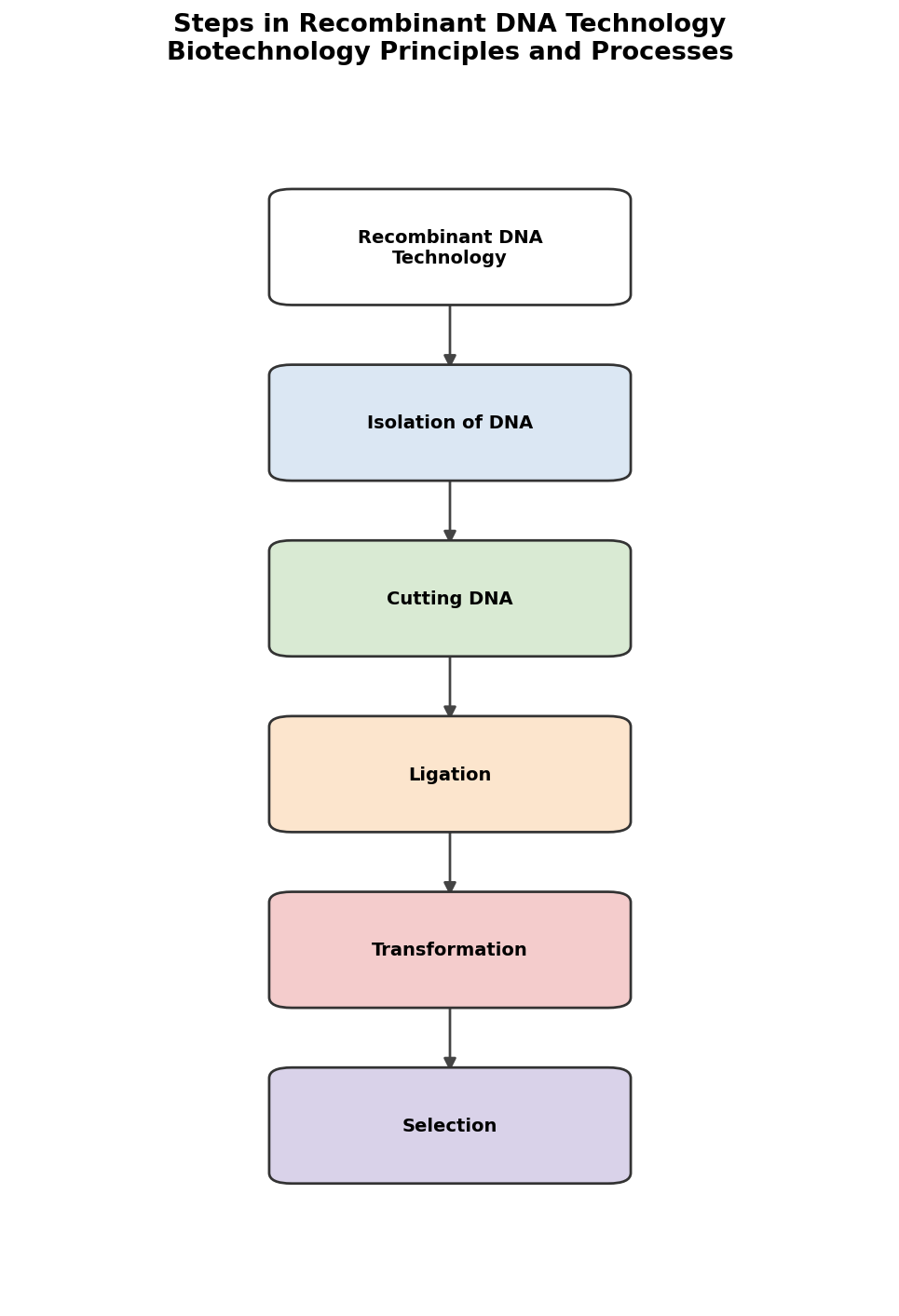
Based on the given flowchart of the steps involved in recombinant DNA technology, answer the following:
What is the first step in recombinant DNA technology?
ACutting DNA
BIsolation of DNA
CLigation
DTransformation
What process follows the cutting of DNA?
AIsolation of DNA
BLigation
CTransformation
DSelection
Explain the significance of the transformation step in recombinant DNA technology.
Show answersHide answers
1. Option 2 — Isolation of DNA
2. Option 2 — Ligation
3. Transformation allows the uptake of recombinant DNA by host cells, enabling the expression of foreign genes.
Q593 Marks
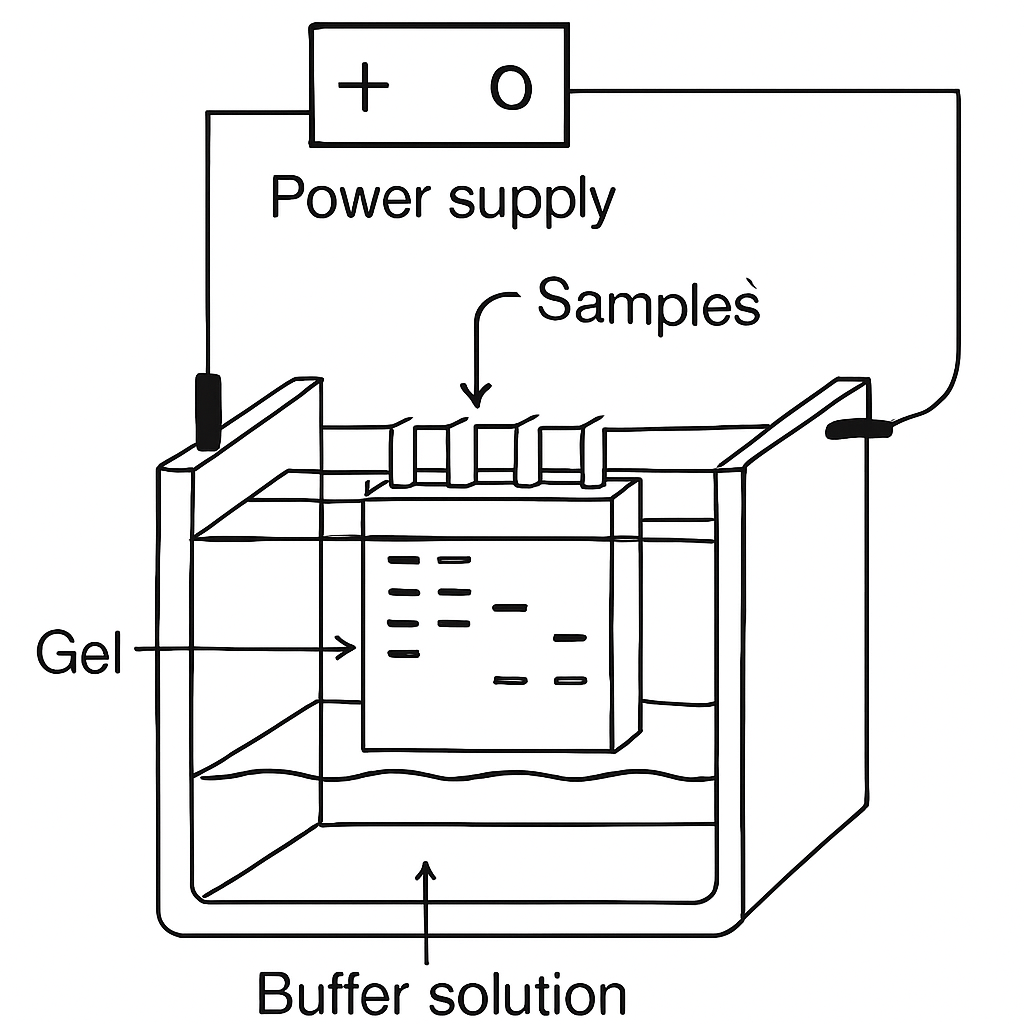
Based on the given diagram of a gel electrophoresis setup, answer the following:
What is the purpose of the buffer solution in gel electrophoresis?
ATo provide nutrients to the gel
BTo maintain pH and conduct electricity
CTo stain the DNA
DTo cool the apparatus
In which direction do the DNA fragments move during electrophoresis?
ATowards the positive electrode
BTowards the negative electrode
CThey do not move
DRandomly
Describe how the size of DNA fragments affects their movement through the gel.
Show answersHide answers
1. Option 2 — To maintain pH and conduct electricity
2. Option 1 — Towards the positive electrode
3. Smaller DNA fragments move faster and travel further through the gel compared to larger fragments.