Biodiversity and Conservation — Important Questions
59 questions
With answersCBSE format
SUMMARY: The chapter "Biodiversity and Conservation" in Class 12 Biology discusses the variety of life forms on Earth, the importance of biodiversity, and the strategies for its conservation. KEY TOPICS: biodiversity hotspots, species diversity, genetic diversity, ecosystem diversity, threats to biodiversity, extinction, conservation of biodiversity, in-situ conservation, ex-situ conservation, biodiversity conservation strategies.
Which of the following statements about species diversity is true?
AIt only refers to the number of species present.
BIt includes both species richness and evenness.
CIt is unaffected by environmental changes.
DIt is only relevant in terrestrial ecosystems.
Check answerHide answer
Correct answer: Option 2 — It includes both species richness and evenness.
Short Answer Questions10 questions
Q163 Marks
What is biodiversity? Mention its three levels.
Q173 Marks
Differentiate between in-situ and ex-situ conservation.
Q183 Marks
List four causes of biodiversity loss.
Q193 Marks
What are biodiversity hotspots? Give two examples from India.
Q203 Marks
Mention any three reasons for conserving biodiversity.
Q213 Marks
What is species diversity and why is it important for ecosystems?
View sample solutionHide solution
Species diversity refers to the variety of different species within a given ecosystem. It is important because it enhances ecosystem productivity, stability, and resilience, allowing ecosystems to better withstand environmental changes and disturbances.
Q223 Marks
Define genetic diversity and explain its significance in conservation efforts.
View sample solutionHide solution
Genetic diversity is the variation of genes within a species. It is significant in conservation efforts as it enables populations to adapt to changing environments, resist diseases, and maintain overall ecosystem health.
Q233 Marks
What are the main threats to biodiversity? Provide two examples.
View sample solutionHide solution
The main threats to biodiversity include habitat destruction and climate change. Habitat destruction, such as deforestation, reduces the living space for many species, while climate change alters the conditions necessary for their survival.
Q243 Marks
Explain the concept of ecosystem diversity and its role in maintaining ecological balance.
View sample solutionHide solution
Ecosystem diversity refers to the variety of ecosystems within a particular area. It plays a crucial role in maintaining ecological balance by providing different habitats that support various species and ecological processes, contributing to overall environmental health.
Q253 Marks
What is the significance of biodiversity conservation strategies?
View sample solutionHide solution
Biodiversity conservation strategies are essential for protecting the variety of life on Earth, ensuring ecosystem services, and maintaining genetic diversity. They help mitigate the impacts of human activities and climate change, promoting sustainability for future generations.
Long Answer Questions6 questions
Q266 Marks
Explain the patterns of biodiversity with respect to latitude and altitude.
Q276 Marks
Discuss the various causes and consequences of biodiversity loss.
Q286 Marks
Describe the methods of biodiversity conservation: in-situ and ex-situ.
Q296 Marks
Explain the importance of biodiversity hotspots in conservation efforts.
Q306 Marks
Discuss the narrowly utilitarian, broadly utilitarian, and ethical reasons for conserving biodiversity.
Q316 Marks
Compare in-situ and ex-situ conservation with the help of a table on examples and merits.
Assertion–Reason Questions8 questions
Q321 Mark
Assertion (A): The Western Ghats is a biodiversity hotspot.
Reason (R): It has high species richness and high endemism.
Show explanationHide explanation
Correct answer: Option 1 —
Both A and R are true, and R is the correct explanation of A.
Q331 Mark
Assertion (A): National parks are an in-situ conservation strategy.
Reason (R): Species are conserved in their natural habitats.
Show explanationHide explanation
Correct answer: Option 1 —
Both A and R are true, and R is the correct explanation of A.
Q341 Mark
Assertion (A): Tropical regions have higher biodiversity than temperate regions.
Reason (R): They have stable climates and longer time for speciation.
Show explanationHide explanation
Correct answer: Option 1 —
Both A and R are true, and R is the correct explanation of A.
Q351 Mark
Assertion (A): Habitat loss is the main cause of biodiversity loss.
Reason (R): Loss of habitat removes the species' resource base.
Show explanationHide explanation
Correct answer: Option 1 —
Both A and R are true, and R is the correct explanation of A.
Correct answer: Option 1 —
Both statements are true.
Q421 Mark
Statement 1: Biosphere reserves protect biodiversity along with human use.
Statement 2: They have core, buffer, and transition zones.
Show answerHide answer
Correct answer: Option 1 —
Both statements are true.
Q431 Mark
Statement 1: India has 4 biodiversity hotspots.
Statement 2: They include Himalayas, Indo-Burma, Western Ghats, and Sundaland.
Show answerHide answer
Correct answer: Option 1 —
Both statements are true.
Q441 Mark
Statement 1: Alien species can threaten native species.
Statement 2: They may outcompete or prey upon native species.
Show answerHide answer
Correct answer: Option 1 —
Both statements are true.
Q451 Mark
Statement 1: Biodiversity hotspots are regions with a high level of endemic species that are under significant threat from human activities.
Statement 2: Conservation strategies can only be implemented in areas with high species diversity.
Show answerHide answer
Correct answer: Option 1 —
Both statements are true.
Q461 Mark
Statement 1: In-situ conservation refers to the conservation of species in their natural habitats.
Statement 2: Ex-situ conservation involves protecting species by removing them from their natural habitats.
Show answerHide answer
Correct answer: Option 1 —
Both statements are true.
Q471 Mark
Statement 1: Genetic diversity is important for the adaptability of species to changing environments.
Statement 2: Species diversity is not influenced by genetic diversity within a population.
Show answerHide answer
Correct answer: Option 2 —
Only Statement 1 is true.
Case Study / Passage Questions4 questions
Q483 Marks
A team of conservationists surveys the Western Ghats in India. They find an extraordinary number of endemic plants and amphibians along with a high rate of habitat destruction due to agriculture and urban expansion. The team reports the area as one of the world's biodiversity hotspots warranting urgent conservation attention.
Which of the following is NOT one of India's biodiversity hotspots?
AWestern Ghats
BIndo-Burma
CEastern Ghats
DSundaland
The criteria for a biodiversity hotspot include:
AHigh species richness
BHigh endemism
CSignificant habitat loss
DAll of these
Define biodiversity hotspots and discuss why they are important for conservation.
Show answersHide answers
1. Option 3 — Eastern Ghats
2. Option 4 — All of these
3. Biodiversity hotspots are regions with very high species richness, very high endemism (species found nowhere else) and significant habitat loss (less than 30 percent of original natural vegetation). They cover only about 2 percent of Earth's land surface but contain a disproportionately high share of species. India has four hotspots — the Himalayas, Indo-Burma, Western Ghats and Sundaland (Andaman and Nicobar Islands). Conservation efforts focus on these hotspots to protect the maximum biodiversity with limited resources.
Q493 Marks
Project Tiger was launched in India in 1973 to protect the Bengal tiger from extinction. Tiger reserves were established as in-situ conservation sites. Strict anti-poaching measures, habitat protection and monitoring of tiger populations have helped raise the tiger numbers from about 1800 in 1972 to over 3000 today.
Tiger reserves are an example of:
ABotanical garden
BNational park
CSeed bank
DCryopreservation
Project Tiger was launched in India in:
A1968
B1973
C1985
D2000
Distinguish between in-situ and ex-situ conservation and discuss their relative merits.
Show answersHide answers
1. Option 2 — National park
2. Option 2 — 1973
3. Biodiversity conservation strategies are broadly classified into in-situ (in the natural habitat) and ex-situ (outside the natural habitat). In-situ methods include national parks, wildlife sanctuaries, biosphere reserves and sacred groves. Ex-situ methods include zoos, botanical gardens, seed banks and cryopreservation of gametes. In-situ conservation is preferred as it conserves the entire ecosystem while ex-situ conservation is useful for endangered species and scientific research.
Q503 Marks
Biodiversity is the variety of life on Earth, encompassing the diversity of species, genetic variation within species, and the variety of ecosystems. Biodiversity hotspots are regions that are both rich in endemic species and significantly threatened by human activities. These areas are crucial for conservation efforts as they contain a large number of species that are not found anywhere else. Protecting these hotspots is essential for maintaining global biodiversity and ensuring the survival of many species. Conservation strategies such as in-situ conservation, which involves protecting species in their natural habitats, and ex-situ conservation, which involves preserving species outside their natural environments, are vital for addressing the threats posed by habitat loss, climate change, and pollution.
What are biodiversity hotspots?
ARegions with high species richness and low human impact
BRegions with high endemic species and significant threats
CRegions with low species diversity
DRegions that are completely protected from human activities
Explain the difference between in-situ and ex-situ conservation.
Which of the following is a major threat to biodiversity?
AHabitat loss
BIncreased biodiversity
CSpecies protection
DNatural disasters
Show answersHide answers
1. Option 2 — Regions with high endemic species and significant threats
2. In-situ conservation refers to the protection of species in their natural habitats, while ex-situ conservation involves preserving species outside their natural environments, such as in zoos or botanical gardens.
3. Option 1 — Habitat loss
Q513 Marks
The extinction of species is a significant concern in biodiversity conservation. Human activities, such as deforestation, pollution, and climate change, have accelerated the rate of extinction. Conservationists emphasize the importance of protecting endangered species through various strategies. In-situ conservation efforts include the establishment of protected areas like national parks and wildlife reserves, where species can thrive in their natural environments. Ex-situ conservation includes breeding programs in captivity and the establishment of seed banks to preserve genetic diversity. Both strategies are essential for maintaining the balance of ecosystems and ensuring the survival of threatened species.
What human activities contribute to species extinction?
AReforestation
BDeforestation and pollution
CWildlife conservation
DSustainable farming
What role do protected areas play in biodiversity conservation?
Which conservation strategy involves breeding programs in captivity?
AIn-situ conservation
BEx-situ conservation
CHabitat restoration
DCommunity conservation
Show answersHide answers
1. Option 2 — Deforestation and pollution
2. Protected areas, such as national parks and wildlife reserves, provide safe habitats for endangered species, allowing them to thrive and reproduce in their natural environments.
3. Option 2 — Ex-situ conservation
Table-Based Questions4 questions
Q523 Marks
Study the table of IUCN categories and answer:
Category
Definition
Example
Extinct
No surviving individual
Dodo
Critically endangered
Extreme risk of extinction
Bengal florican
Endangered
Very high risk
Bengal tiger
Vulnerable
High risk
Snow leopard
Near threatened
Likely to become threatened
Asian elephant
The dodo is classified as:
AExtinct
BCritically endangered
CEndangered
DVulnerable
The Bengal tiger is classified as:
AExtinct
BCritically endangered
CEndangered
DVulnerable
Discuss the IUCN Red List categories and their importance in biodiversity conservation.
Show answersHide answers
1. Option 1 — Extinct
2. Option 3 — Endangered
3. The IUCN (International Union for Conservation of Nature) classifies species into Red List categories based on extinction risk. From most to least threatened — Extinct, Extinct in Wild, Critically Endangered, Endangered, Vulnerable, Near Threatened, Least Concern. The Red List is regularly updated and serves as a global indicator of biodiversity loss. India publishes a national Red Data Book to track its threatened species and prioritise conservation efforts.
Q536 Marks
Match each species with its IUCN Red List threat category.
Species
Threat category
Dodo
?
Bengal florican
?
Bengal tiger
?
Snow leopard
?
Asian elephant
?
Q546 Marks
Identify the four biodiversity hotspots in India and one feature of each.
Hotspot
Approx endemics
Notable feature
Himalayas
3160
?
Indo-Burma
1200
?
Western Ghats
7000
?
Sundaland
6000
?
Q556 Marks
Which biodiversity hotspot has the highest number of endemic species according to the data provided?
Biodiversity Hotspot
Number of Endemic Species
Himalaya
10,000
Western Ghats
7,402
Indo-Burma
5,000
Picture-Based Questions4 questions
Q562 Marks
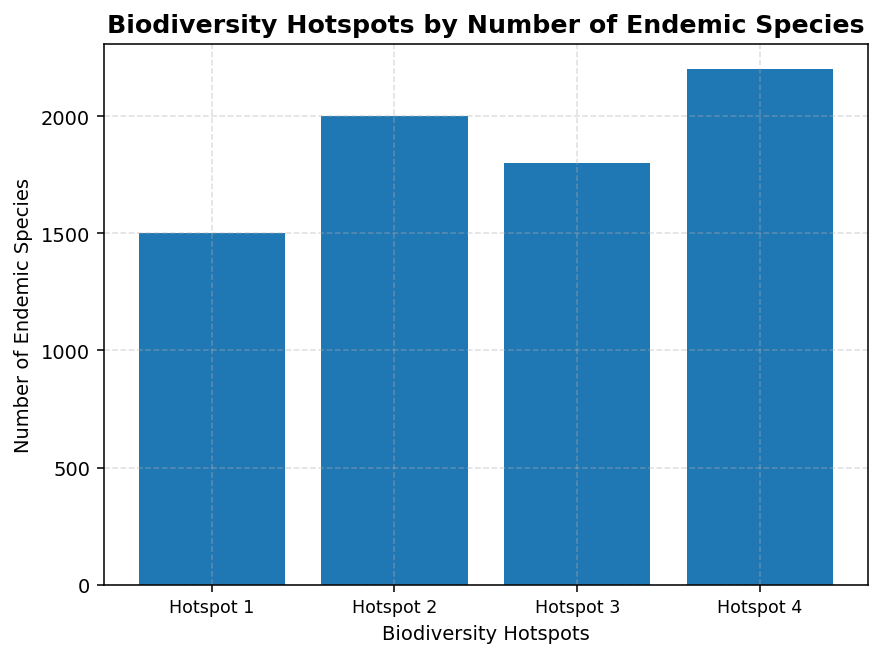
Based on the given chart showing biodiversity hotspots, answer the following:
Which hotspot has the highest number of endemic species?
AHotspot 1
BHotspot 2
CHotspot 3
DHotspot 4
What is the total number of endemic species in all hotspots?
Show answersHide answers
1. Option 4 — Hotspot 4
2. 8000
Q572 Marks
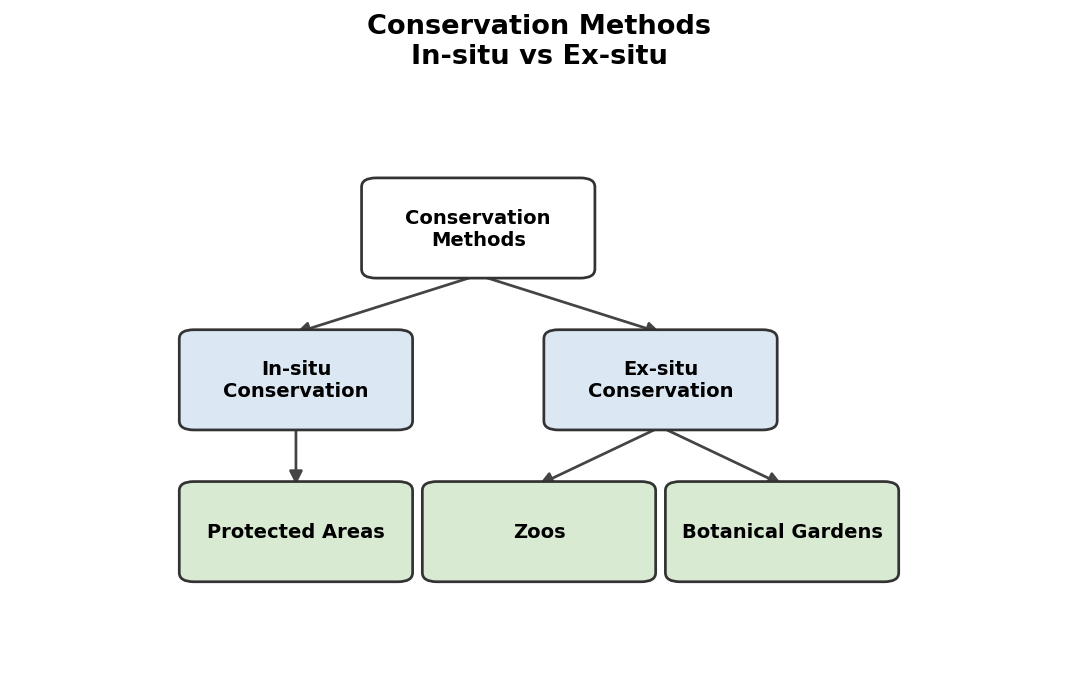
Based on the given flowchart illustrating in-situ and ex-situ conservation methods, answer the following:
What is an example of in-situ conservation?
AZoos
BProtected Areas
CBotanical Gardens
DSeed Banks
List one method of ex-situ conservation.
Show answersHide answers
1. Option 2 — Protected Areas
2. Zoos
Q582 Marks
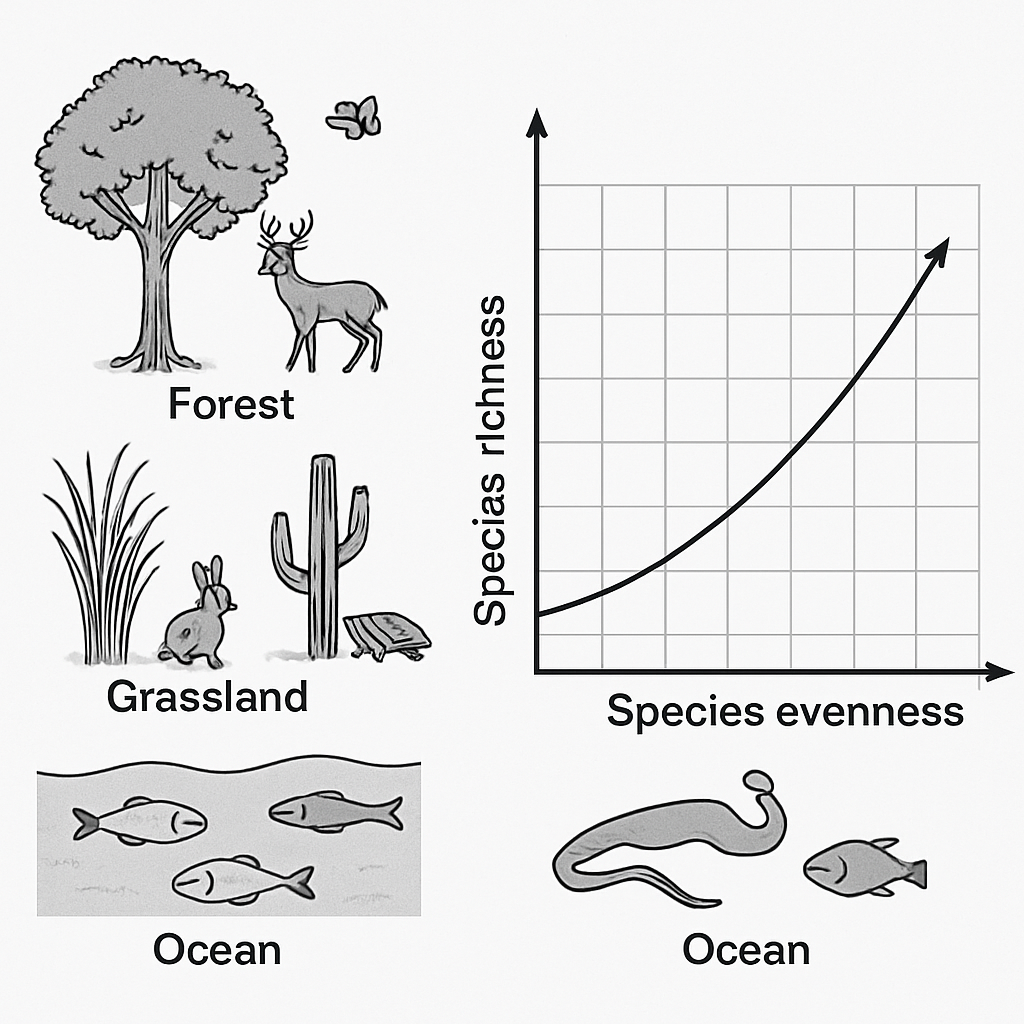
Based on the given diagram of species diversity, answer the following:
What does species richness refer to in this diagram?
ATotal number of species
BDistribution of species
CEndemic species count
DSpecies extinction rate
Explain the concept of species evenness as depicted in the diagram.
Show answersHide answers
1. Option 1 — Total number of species
2. Species evenness refers to how evenly the individuals are distributed among the different species.
Q592 Marks
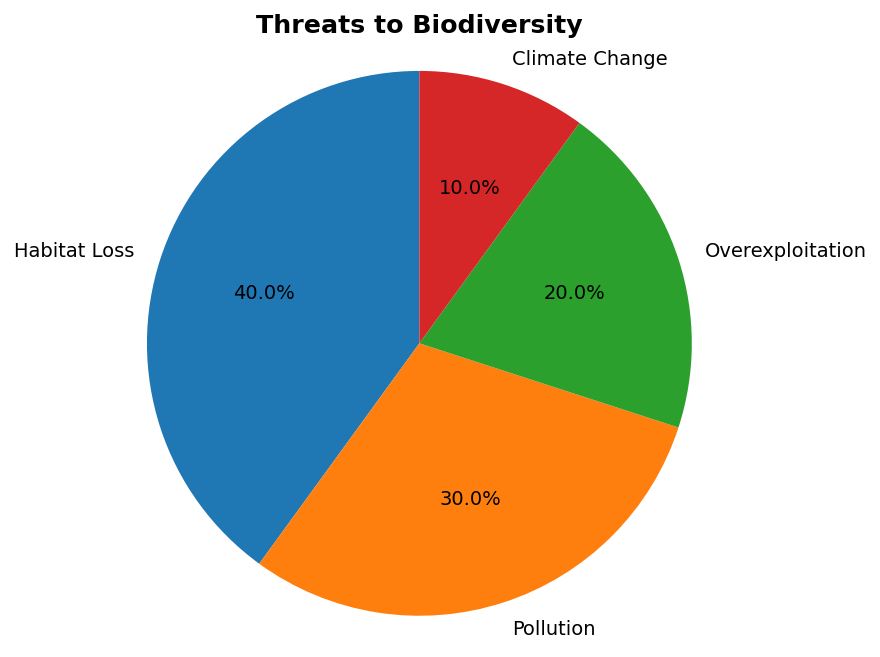
Based on the given chart showing threats to biodiversity, answer the following:
Which threat contributes the most to biodiversity loss?
APollution
BOverexploitation
CHabitat Loss
DClimate Change
What percentage of biodiversity loss is attributed to climate change?