Principles of Inheritance and Variation — Important Questions
38 questions
With answersCBSE format
SUMMARY: This chapter explores the fundamental principles of genetics, including how traits are inherited and the variations that occur in organisms. KEY TOPICS: Mendel's laws of inheritance, monohybrid and dihybrid crosses, chromosomal theory of inheritance, sex determination, genetic disorders, pedigree analysis, mutation, genetic variation, linkage and recombination.
The phenotypic ratio in a typical dihybrid cross is:
A3:1
B1:2:1
C9:3:3:1
D1:1
Check answerHide answer
Correct answer: Option 3 — 9:3:3:1
Q41 Mark
A condition in which a gene has more than two alleles is called:
ACodominance
BMultiple allelism
CPolyploidy
DLinkage
Check answerHide answer
Correct answer: Option 2 — Multiple allelism
Q51 Mark
Down syndrome is due to:
ATrisomy of chromosome 21
BMonosomy of chromosome X
CTrisomy of chromosome 18
DTrisomy of chromosome 13
Check answerHide answer
Correct answer: Option 1 — Trisomy of chromosome 21
Short Answer Questions5 questions
Q63 Marks
State Mendel's laws of inheritance.
Q73 Marks
Differentiate between incomplete dominance and codominance with examples.
Q83 Marks
Explain the inheritance of ABO blood group in humans.
Q93 Marks
What is sex linkage? Give an example.
Q103 Marks
What is pedigree analysis? Why is it important?
Long Answer Questions6 questions
Q116 Marks
Discuss Mendel's monohybrid and dihybrid cross experiments with examples.
Q126 Marks
Explain the chromosomal theory of inheritance and its experimental basis.
Q136 Marks
Describe the inheritance of ABO blood group as an example of multiple allelism and codominance.
Q146 Marks
Explain the sex determination in humans, birds, and honey bees.
Q156 Marks
Discuss the various chromosomal disorders in humans with their causes and symptoms.
Q166 Marks
Compare complete dominance and incomplete dominance with the help of a table.
Assertion–Reason Questions5 questions
Q171 Mark
Assertion (A): Mendel's laws are universal.
Reason (R): They apply to all sexually reproducing organisms.
Show explanationHide explanation
Correct answer: Option 1 —
Both A and R are true, and R is the correct explanation of A.
Q181 Mark
Assertion (A): Hemophilia is a sex-linked disorder.
Reason (R): The gene for hemophilia is present on the X chromosome.
Show explanationHide explanation
Correct answer: Option 1 —
Both A and R are true, and R is the correct explanation of A.
Q191 Mark
Assertion (A): Mendel chose pea plant for his experiments.
Reason (R): Pea plants have many easily distinguishable characters and short life cycle.
Show explanationHide explanation
Correct answer: Option 1 —
Both A and R are true, and R is the correct explanation of A.
Q201 Mark
Assertion (A): Punnet square shows possible genotypes from a cross.
Reason (R): It helps in predicting the offspring of a genetic cross.
Show explanationHide explanation
Correct answer: Option 1 —
Both A and R are true, and R is the correct explanation of A.
Q211 Mark
Assertion (A): Sickle cell anaemia is an autosomal recessive disorder.
Reason (R): Two copies of the defective gene are needed for the disease to manifest.
Show explanationHide explanation
Correct answer: Option 1 —
Both A and R are true, and R is the correct explanation of A.
Statement-Based Questions5 questions
Q221 Mark
Statement 1: F1 generation in a monohybrid cross shows the dominant phenotype.
Statement 2: The recessive trait reappears in F2 generation in 1:3 ratio.
Show answerHide answer
Correct answer: Option 1 —
Both statements are true.
Q231 Mark
Statement 1: Linked genes do not show independent assortment.
Statement 2: Linkage was first studied by T. H. Morgan in Drosophila.
Show answerHide answer
Correct answer: Option 1 —
Both statements are true.
Q241 Mark
Statement 1: Klinefelter syndrome has 47 XXY chromosomes.
Statement 2: Such individuals show physical and mental abnormalities.
Show answerHide answer
Correct answer: Option 1 —
Both statements are true.
Q251 Mark
Statement 1: Colour blindness is more common in males than females.
Statement 2: It is a recessive sex-linked trait carried on X chromosome.
Show answerHide answer
Correct answer: Option 1 —
Both statements are true.
Q261 Mark
Statement 1: Crossing over leads to recombination of linked genes.
Statement 2: It contributes to genetic variation in offspring.
Show answerHide answer
Correct answer: Option 1 —
Both statements are true.
Case Study / Passage Questions4 questions
Q273 Marks
Mendel crossed a true-breeding tall pea plant (TT) with a true-breeding dwarf plant (tt). The F1 generation was all tall (Tt). When F1 plants were self-pollinated the F2 generation showed both tall and dwarf plants in a 3:1 ratio. He concluded that traits are controlled by discrete factors (genes) inherited in pairs.
The phenotypic ratio in F2 generation is:
A3 tall : 1 dwarf
B1 tall : 1 dwarf
CAll tall
DAll dwarf
The genotype of F1 generation is:
ATt
BTT
Ctt
DTt and TT
Explain Mendel's monohybrid cross and the laws derived from it.
Show answersHide answers
1. Option 1 — 3 tall : 1 dwarf
2. Option 1 — Tt
3. Mendel's monohybrid cross illustrates two laws — the law of dominance and the law of segregation. The law of dominance states that one allele of a gene (T) is dominant over the other (t) so the heterozygote (Tt) shows the dominant trait. The law of segregation states that during gamete formation the two alleles of a gene separate so each gamete carries only one allele. Self-pollination of F1 (Tt × Tt) gives a 1:2:1 genotypic ratio (TT:Tt:tt) corresponding to a 3:1 phenotypic ratio.
Q283 Marks
A genetic counsellor explains the ABO blood group system to a couple. The wife is blood group A (genotype IA i) and the husband is blood group B (genotype IB i). The counsellor uses a Punnett square to predict the possible blood groups of their children.
The possible blood groups of children from this cross are:
AA and B only
BO only
CA B AB and O
DAB only
The ABO system illustrates:
AMultiple allelism
BCodominance
CBoth
DNeither
Explain how the ABO blood group system illustrates multiple allelism and codominance.
Show answersHide answers
1. Option 3 — A B AB and O
2. Option 3 — Both
3. The ABO system has three alleles — IA, IB and i. IA and IB are codominant (both expressed in heterozygote AB) while i is recessive to both. A cross between IAi and IBi gives four possible offspring genotypes — IAIB (AB), IAi (A), IBi (B) and ii (O). Each occurs with 25 percent probability. The system illustrates two important genetic concepts — multiple allelism (more than two alleles for one gene) and codominance.
Q293 Marks
Mendel's experiments with pea plants laid the foundation for the principles of inheritance. He observed that certain traits, such as height, flower color, and seed shape, were passed from one generation to the next in predictable patterns. By performing monohybrid crosses, he established the concept of dominant and recessive alleles. For instance, when he crossed a tall plant with a dwarf plant, all offspring in the F1 generation exhibited the tall phenotype. Upon self-pollination of the F1 generation, a phenotypic ratio of 3:1 was observed in the F2 generation, confirming the segregation of alleles. This led to the formulation of Mendel's first law, the Law of Segregation, which states that allele pairs separate during gamete formation, ensuring that offspring inherit one allele from each parent.
What is the phenotypic ratio observed in the F2 generation of Mendel's monohybrid cross?
A1:2:1
B3:1
C9:3:3:1
D1:1
Explain Mendel's Law of Segregation in your own words.
Which trait was dominant in Mendel's pea plant experiments?
ADwarf height
BTall height
CGreen seed color
DWrinkled seed shape
Show answersHide answers
1. Option 2 — 3:1
2. Mendel's Law of Segregation states that allele pairs separate during gamete formation, so each gamete carries only one allele for each gene.
3. Option 2 — Tall height
Q303 Marks
In a dihybrid cross, Mendel studied the inheritance of two different traits simultaneously. For example, he crossed plants that were round yellow seeds (RRYY) with those that had wrinkled green seeds (rryy). The F1 generation produced all round yellow seeds (RrYy), indicating that both traits were dominant. When the F1 plants were self-pollinated, the F2 generation exhibited a phenotypic ratio of 9:3:3:1. This result demonstrated the principle of independent assortment, which states that alleles for different traits segregate independently of one another during gamete formation. This principle is crucial for understanding genetic variation in offspring.
What is the phenotypic ratio of the F2 generation in a dihybrid cross?
A3:1
B9:3:3:1
C1:1:1:1
D1:2:1
Define the principle of independent assortment.
What were the parental genotypes used in Mendel's dihybrid cross example?
ARrYy and RrYy
BRRYY and rryy
CRr and rr
DRR and rr
Show answersHide answers
1. Option 2 — 9:3:3:1
2. The principle of independent assortment states that alleles for different traits segregate independently during gamete formation.
3. Option 2 — RRYY and rryy
Table-Based Questions4 questions
Q313 Marks
Study the table of human genetic disorders and answer:
Disorder
Type
Cause
Sickle cell anaemia
Autosomal recessive
Substitution mutation in beta-globin
Hemophilia
X-linked recessive
Defective clotting factor VIII
Down syndrome
Chromosomal
Trisomy of chromosome 21
Klinefelter syndrome
Chromosomal
47 XXY
Turner syndrome
Chromosomal
45 XO
Down syndrome is caused by:
ATrisomy 21
BTrisomy 18
CXXY
DXO
Hemophilia is inherited as:
AAutosomal dominant
BAutosomal recessive
CX-linked recessive
DY-linked
Differentiate between Mendelian and chromosomal disorders with examples.
Show answersHide answers
1. Option 1 — Trisomy 21
2. Option 3 — X-linked recessive
3. Genetic disorders may be Mendelian (caused by single gene mutations) or chromosomal (involving abnormal chromosome number or structure). Mendelian disorders include autosomal recessive (sickle cell anaemia), autosomal dominant and sex-linked (hemophilia, colour blindness). Chromosomal disorders include aneuploidies like Down syndrome (trisomy 21), Klinefelter syndrome (XXY) and Turner syndrome (XO). Pedigree analysis helps trace the inheritance pattern.
Q326 Marks
Predict the F2 phenotypic ratio for each Mendelian cross type.
Cross type
F2 ratio
Monohybrid
?
Test cross
?
Incomplete dominance
?
Dihybrid
?
Q336 Marks
Identify the type and cause of each human genetic disorder.
Disorder
Type
Cause
Sickle cell anaemia
?
?
Hemophilia
?
?
Colour blindness
?
?
Down syndrome
?
?
Klinefelter syndrome
?
?
Turner syndrome
?
?
Q346 Marks
Predict the possible blood groups of children for each parental ABO genotype combination.
Parent 1
Parent 2
Possible blood groups
IAIA
IAIA
?
IAi
IBi
?
IBIB
ii
?
IAIB
ii
?
Picture-Based Questions4 questions
Q353 Marks
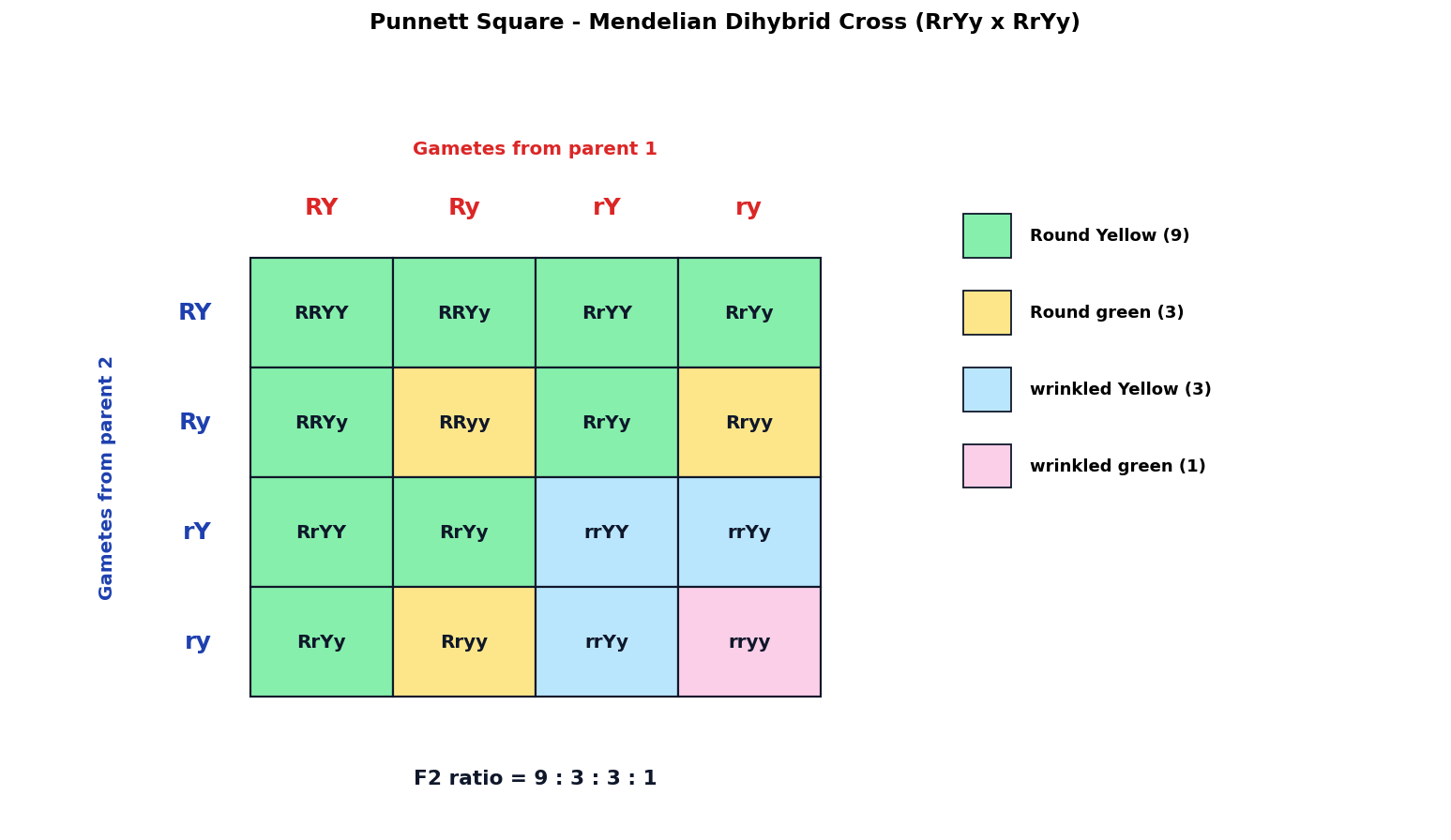
Study the Punnett square of a dihybrid cross and answer:
The F2 phenotypic ratio in a typical Mendelian dihybrid cross is:
A3:1
B1:2:1
C9:3:3:1
D1:1:1:1
The 9:3:3:1 ratio illustrates Mendel's:
ALaw of dominance
BLaw of segregation
CLaw of independent assortment
DLaw of linkage
Explain how the law of independent assortment leads to the 9:3:3:1 phenotypic ratio in F2.
Show answersHide answers
1. Option None
2. Option None
3. Mendel's law of independent assortment states that during gamete formation alleles of different genes segregate independently. In a dihybrid cross between RrYy x RrYy each parent produces four types of gametes (RY Ry rY ry). The Punnett square gives 16 possible combinations leading to a 9:3:3:1 phenotypic ratio.
Q362 Marks
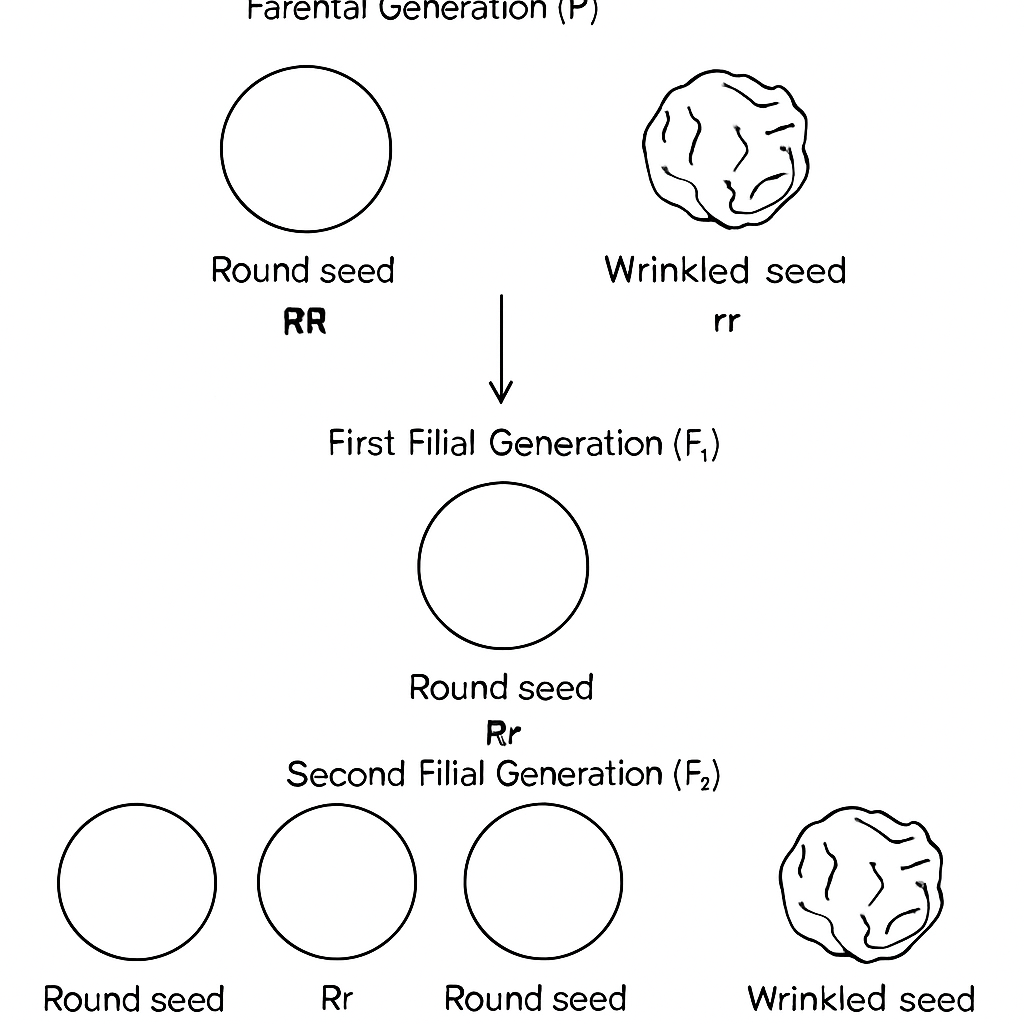
Based on the given diagram of a monohybrid cross, answer the following:
What is the phenotypic ratio of the offspring in the F2 generation?
A1:2:1
B3:1
C1:1
D9:3:3:1
Identify the dominant trait in the cross shown.
Show answersHide answers
1. Option 2 — 3:1
2. dominant trait name
Q372 Marks
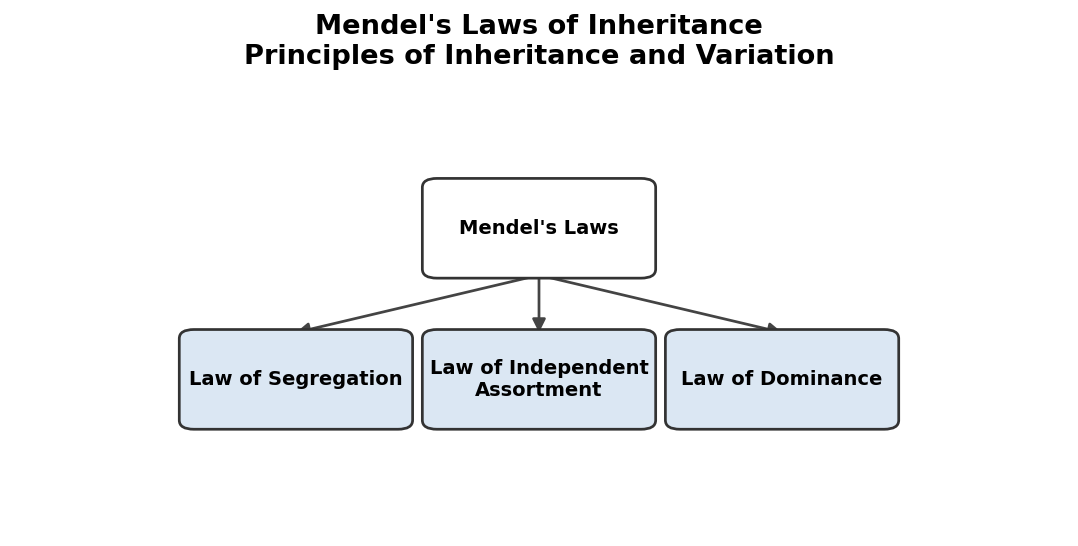
Based on the given flowchart, answer the following:
Which law states that allele pairs separate during gamete formation?
ALaw of Segregation
BLaw of Independent Assortment
CLaw of Dominance
DNone of the above
Explain the significance of the Law of Independent Assortment.
Show answersHide answers
1. Option 1 — Law of Segregation
2. answer text
Q382 Marks
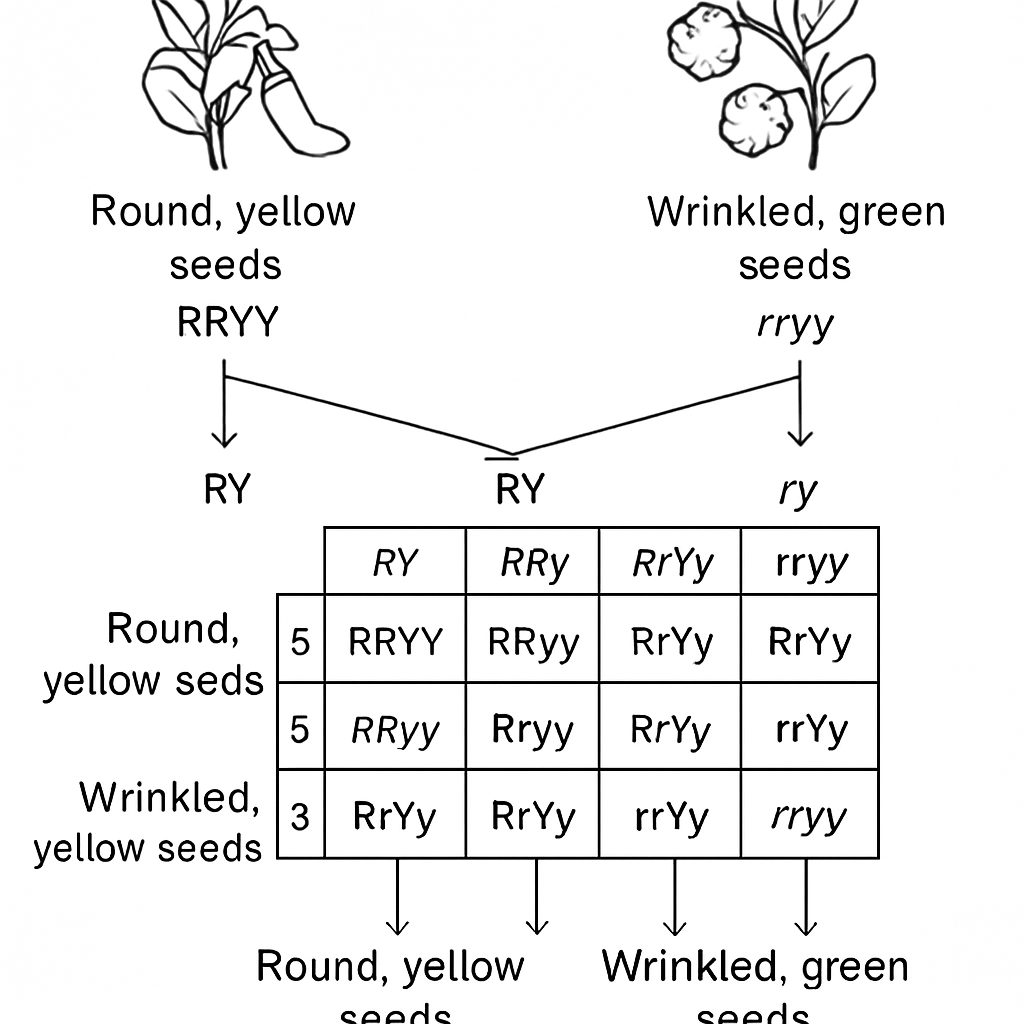
Based on the given diagram of a dihybrid cross, answer the following:
What is the expected phenotypic ratio in the F2 generation of a dihybrid cross?
A3:1
B9:3:3:1
C1:1:1:1
D1:2:1
Identify the traits being studied in this dihybrid cross.