SUMMARY: The chapter on Ecosystem in Class 12 Biology explores the structure, function, and dynamics of ecosystems, including energy flow and nutrient cycling. KEY TOPICS: ecosystem structure, energy flow, food chains and food webs, ecological pyramids, nutrient cycling, ecological succession, productivity, decomposition, ecosystem services, human impact on ecosystems.
Which of the following is a primary producer in an ecosystem?
AHerbivore
BCarnivore
CAlgae
DDecomposer
Check answerHide answer
Correct answer: Option 3 — Algae
Q71 Mark
In a food web, which of the following roles does a secondary consumer play?
AProducer
BHerbivore
CCarnivore
DDecomposer
Check answerHide answer
Correct answer: Option 3 — Carnivore
Q81 Mark
What is the primary source of energy for most ecosystems?
AGeothermal energy
BSolar energy
CWind energy
DNuclear energy
Check answerHide answer
Correct answer: Option 2 — Solar energy
Q91 Mark
Which of the following best describes ecological succession?
AThe process of energy flow in an ecosystem
BThe gradual change in species composition over time
CThe recycling of nutrients in an ecosystem
DThe interaction between biotic and abiotic factors
Check answerHide answer
Correct answer: Option 2 — The gradual change in species composition over time
Q101 Mark
The process by which nutrients are returned to the soil is called:
APhotosynthesis
BDecomposition
CRespiration
DTranspiration
Check answerHide answer
Correct answer: Option 2 — Decomposition
Q111 Mark
Which ecological pyramid represents the number of organisms at each trophic level?
APyramid of energy
BPyramid of biomass
CPyramid of numbers
DPyramid of productivity
Check answerHide answer
Correct answer: Option 3 — Pyramid of numbers
Q121 Mark
What is the main role of decomposers in an ecosystem?
ATo produce energy
BTo consume primary producers
CTo break down dead organic matter
DTo compete with herbivores
Check answerHide answer
Correct answer: Option 3 — To break down dead organic matter
Q131 Mark
Which of the following is NOT a service provided by ecosystems?
APollination
BSoil formation
CAir pollution
DWater purification
Check answerHide answer
Correct answer: Option 3 — Air pollution
Q141 Mark
In an ecosystem, the flow of energy is typically represented by:
AFood chains
BFood webs
CBoth food chains and food webs
DNutrient cycles
Check answerHide answer
Correct answer: Option 3 — Both food chains and food webs
Q151 Mark
Which of the following factors can significantly impact ecosystems due to human activities?
ANatural disasters
BClimate change
CSeasonal changes
DGeological processes
Check answerHide answer
Correct answer: Option 2 — Climate change
Short Answer Questions10 questions
Q163 Marks
Differentiate between a food chain and a food web.
Q173 Marks
Explain the energy pyramid of an ecosystem.
Q183 Marks
What is the carbon cycle? Briefly describe its main steps.
Q193 Marks
Define the term ecological succession. Mention its types.
Q203 Marks
Explain the concept of ecosystem productivity.
Q213 Marks
What are the primary producers in an ecosystem, and why are they important?
View sample solutionHide solution
Primary producers, such as plants and phytoplankton, are organisms that convert solar energy into chemical energy through photosynthesis. They form the base of the food chain and are essential for providing energy to all other trophic levels in the ecosystem.
Q223 Marks
Describe the role of decomposers in nutrient cycling within an ecosystem.
View sample solutionHide solution
Decomposers, including bacteria and fungi, break down dead organic matter, returning essential nutrients to the soil. This process is crucial for maintaining soil fertility and supporting the growth of primary producers.
Q233 Marks
What is a trophic level, and how does it relate to energy flow in an ecosystem?
View sample solutionHide solution
A trophic level refers to the position an organism occupies in a food chain, such as producer, primary consumer, or secondary consumer. Energy flow decreases as it moves up trophic levels due to energy loss at each stage, primarily through metabolic processes.
Q243 Marks
Explain the concept of ecological pyramids and name the three types.
View sample solutionHide solution
Ecological pyramids visually represent the distribution of energy, biomass, or numbers among trophic levels in an ecosystem. The three types are the pyramid of energy, pyramid of biomass, and pyramid of numbers.
Q253 Marks
What is the significance of biodiversity in an ecosystem?
View sample solutionHide solution
Biodiversity enhances ecosystem resilience, productivity, and stability. It allows ecosystems to better withstand environmental changes and provides a wider range of ecosystem services, such as pollination and nutrient cycling.
Long Answer Questions6 questions
Q266 Marks
Describe the structure and function of an ecosystem.
Q276 Marks
Discuss the various ecological pyramids with examples and their limitations.
Q286 Marks
Explain the carbon and phosphorus cycles in nature.
Q296 Marks
Describe the process of ecological succession with primary and secondary succession.
Q306 Marks
Discuss energy flow in an ecosystem with reference to grazing food chain and detritus food chain.
Q316 Marks
Differentiate between gross primary productivity (GPP) and net primary productivity (NPP) in tabular form.
Assertion–Reason Questions8 questions
Q321 Mark
Assertion (A): Energy flow in an ecosystem is unidirectional.
Reason (R): Energy is lost as heat at each trophic level.
Show explanationHide explanation
Correct answer: Option 1 —
Both A and R are true, and R is the correct explanation of A.
Q331 Mark
Assertion (A): Decomposers are vital for nutrient cycling.
Reason (R): They break down dead organic matter and release nutrients.
Show explanationHide explanation
Correct answer: Option 1 —
Both A and R are true, and R is the correct explanation of A.
Q341 Mark
Assertion (A): Producers fix solar energy into chemical energy.
Reason (R): They are the base of any food chain.
Show explanationHide explanation
Correct answer: Option 1 —
Both A and R are true, and R is the correct explanation of A.
Q351 Mark
Assertion (A): The pyramid of biomass in a forest is upright.
Reason (R): Producers (trees) have more biomass than consumers.
Show explanationHide explanation
Correct answer: Option 1 —
Both A and R are true, and R is the correct explanation of A.
Q361 Mark
Assertion (A): The 10 percent law is given by Lindemann.
Reason (R): Only 10 percent of energy is transferred to the next trophic level.
Show explanationHide explanation
Correct answer: Option 1 —
Both A and R are true, and R is the correct explanation of A.
Q371 Mark
Assertion (A): Ecological succession leads to a stable community over time.
Reason (R): During ecological succession, species composition changes until a climax community is established.
Show explanationHide explanation
Correct answer: Option 1 —
Both A and R are true, and R is the correct explanation of A.
Q381 Mark
Assertion (A): Food webs provide a more accurate representation of energy flow than food chains.
Reason (R): Food webs illustrate the interconnectedness of various food chains in an ecosystem.
Show explanationHide explanation
Correct answer: Option 1 —
Both A and R are true, and R is the correct explanation of A.
Q391 Mark
Assertion (A): Nutrient cycling is essential for maintaining ecosystem productivity.
Reason (R): Nutrient cycling ensures the availability of essential elements for organisms in an ecosystem.
Show explanationHide explanation
Correct answer: Option 1 —
Both A and R are true, and R is the correct explanation of A.
Statement-Based Questions8 questions
Q401 Mark
Statement 1: Climax community is the final stage of succession.
Statement 2: It remains in equilibrium with the environment.
Show answerHide answer
Correct answer: Option 1 —
Both statements are true.
Q411 Mark
Statement 1: Detritus food chain begins with dead organic matter.
Statement 2: Grazing food chain begins with green plants.
Show answerHide answer
Correct answer: Option 1 —
Both statements are true.
Q421 Mark
Statement 1: Hydrosere starts in water bodies.
Statement 2: It ends in a forest community.
Show answerHide answer
Correct answer: Option 1 —
Both statements are true.
Q431 Mark
Statement 1: Standing crop is the biomass at any point in time.
Statement 2: It is expressed in dry weight per unit area.
Show answerHide answer
Correct answer: Option 1 —
Both statements are true.
Q441 Mark
Statement 1: Net primary productivity equals GPP minus respiration.
Statement 2: NPP is available to consumers.
Show answerHide answer
Correct answer: Option 1 —
Both statements are true.
Q451 Mark
Statement 1: Energy flow in an ecosystem is unidirectional.
Statement 2: Nutrient cycling is a linear process.
Show answerHide answer
Correct answer: Option 2 —
Only Statement 1 is true.
Q461 Mark
Statement 1: Food webs provide a more realistic representation of energy flow than food chains.
Statement 2: Producers are the primary consumers in an ecosystem.
Show answerHide answer
Correct answer: Option 3 —
Only Statement 2 is true.
Q471 Mark
Statement 1: Ecological pyramids can represent biomass, numbers, and energy.
Statement 2: The pyramid of numbers can sometimes be inverted.
Show answerHide answer
Correct answer: Option 1 —
Both statements are true.
Case Study / Passage Questions4 questions
Q483 Marks
A marine biologist measures the biomass at each trophic level in an oceanic ecosystem. He finds that the biomass of phytoplankton (producers) is much less than that of zooplankton (primary consumers) — giving an inverted pyramid of biomass. He explains this anomaly using the rapid turnover of phytoplankton.
The pyramid of biomass in a sea is:
AUpright
BInverted
CSpindle
DLinear
The reason for the inverted biomass pyramid in the sea is:
AProducers have small biomass but high turnover
BConsumers eat producers
CSea has more consumers
DProducers have small biomass and low turnover
Explain why the pyramid of biomass in a sea is inverted while that of a forest is upright.
Show answersHide answers
1. Option 2 — Inverted
2. Option 1 — Producers have small biomass but high turnover
3. The pyramid of biomass shows the standing crop at each trophic level. In a forest the pyramid is upright because trees (producers) have a large biomass. In a sea however phytoplankton have a small standing crop but multiply rapidly so they can sustain a much larger biomass of zooplankton above them — giving an inverted pyramid. The pyramid of energy is always upright because energy is lost as heat at each level (10 percent law).
Q493 Marks
Climate scientists track carbon through the atmosphere, ocean, biosphere and lithosphere. Plants fix CO2 into glucose by photosynthesis. Respiration, decomposition and combustion of fossil fuels release CO2 back to the atmosphere. Burning of fossil fuels has increased atmospheric CO2 from 280 ppm in pre-industrial times to over 420 ppm today.
The largest reservoir of carbon is the:
AAtmosphere
BOcean
CLithosphere
DBiosphere
The process that removes CO2 from the atmosphere is:
APhotosynthesis
BRespiration
CDecomposition
DCombustion
Describe the carbon cycle and explain how human activities have altered it.
Show answersHide answers
1. Option 2 — Ocean
2. Option 1 — Photosynthesis
3. The carbon cycle is the movement of carbon between the atmosphere, oceans, biosphere and lithosphere. Photosynthesis fixes atmospheric CO2 into organic matter. Respiration and decomposition return CO2 to the atmosphere. Carbon also moves through the food chain as consumers eat producers. Long-term reservoirs include sedimentary rocks and fossil fuels. Human activities — especially fossil fuel burning and deforestation — have disturbed the natural balance leading to increased atmospheric CO2 and global warming.
Q503 Marks
Ecosystems are complex networks of living organisms and their physical environment, interacting as a system. They can be classified into various types, such as terrestrial and aquatic ecosystems. Each ecosystem has a distinct structure, which includes both biotic (living) and abiotic (non-living) components. Energy flow within an ecosystem begins with the sun, as it is captured by producers through photosynthesis. This energy is then transferred through various trophic levels via food chains and food webs, illustrating the interconnectedness of species. Decomposers play a crucial role in recycling nutrients back into the ecosystem, ensuring sustainability and productivity.
What are the two main components of an ecosystem?
ABiotic and abiotic
BProducers and consumers
CPrimary and secondary
DHerbivores and carnivores
Explain the role of decomposers in an ecosystem.
What initiates the energy flow in an ecosystem?
AProducers
BDecomposers
CThe sun
DConsumers
Show answersHide answers
1. Option 1 — Biotic and abiotic
2. Decomposers break down dead organic matter, returning nutrients to the soil and maintaining ecosystem health.
3. Option 3 — The sun
Q513 Marks
Energy flow in ecosystems is often represented by ecological pyramids, which illustrate the distribution of energy or biomass among trophic levels. The pyramid of energy shows that energy decreases as it moves up the trophic levels, with producers at the base and top predators at the apex. This decrease in energy is due to the inefficiency of energy transfer, where only about 10% of the energy is passed on to the next level. Additionally, food webs provide a more complex representation of feeding relationships, highlighting the interconnectedness of various species within an ecosystem.
What does the pyramid of energy illustrate?
AThe number of organisms at each level
BThe distribution of energy among trophic levels
CThe biomass of producers only
DThe types of consumers in an ecosystem
Describe the significance of food webs in ecosystems.
Why is only about 10% of energy transferred to the next trophic level?
ADue to energy loss as heat
BBecause of predator-prey dynamics
CDue to competition among species
DBecause of habitat destruction
Show answersHide answers
1. Option 2 — The distribution of energy among trophic levels
2. Food webs illustrate the complex feeding relationships and interactions among different species, showing how energy and nutrients flow through the ecosystem.
3. Option 1 — Due to energy loss as heat
Table-Based Questions4 questions
Q523 Marks
Study the table of ecological pyramids and answer:
Pyramid
Forest
Pond
Sea
Number
Inverted (parasites)
Upright
Upright
Biomass
Upright
Upright
Inverted
Energy
Upright
Upright
Upright
The pyramid that is always upright is the pyramid of:
ANumber
BBiomass
CEnergy
DAll
The pyramid that is inverted in a sea ecosystem is:
ANumber
BBiomass
CEnergy
DAll
Discuss the various types of ecological pyramids and explain why the energy pyramid is always upright.
Show answersHide answers
1. Option 3 — Energy
2. Option 2 — Biomass
3. Ecological pyramids represent the trophic structure of an ecosystem. The pyramid of number shows the number of individuals at each level. The pyramid of biomass shows the standing crop. The pyramid of energy shows the energy flow. While number and biomass pyramids may sometimes be inverted (e.g., parasitic food chains, oceanic ecosystems), the pyramid of energy is always upright because energy is lost as heat at each transfer (only about 10 percent of energy is transferred to the next trophic level).
Q536 Marks
Compare the three types of ecological pyramids in three ecosystems.
Pyramid
Forest
Pond
Sea
Number
Upright
Upright
?
Biomass
?
Upright
Inverted
Energy
Upright
Upright
?
Q546 Marks
Which ecosystem type has the highest net primary productivity according to the table?
Ecosystem Type
Net Primary Productivity (g/m²/year)
Tropical Rainforest
2200
Temperate Forest
1200
Desert
200
Q552 Marks
Study the following data and answer the questions below:
Trophic Level
Energy Available (kcal/m²/year)
Biomass (kg/m²)
Producers
10000
100
Primary Consumers
1000
10
Secondary Consumers
100
1
What is the energy available to primary consumers?
Calculate the ratio of energy available to secondary consumers compared to producers.
Show answersHide answers
1.
2.
Picture-Based Questions4 questions
Q563 Marks
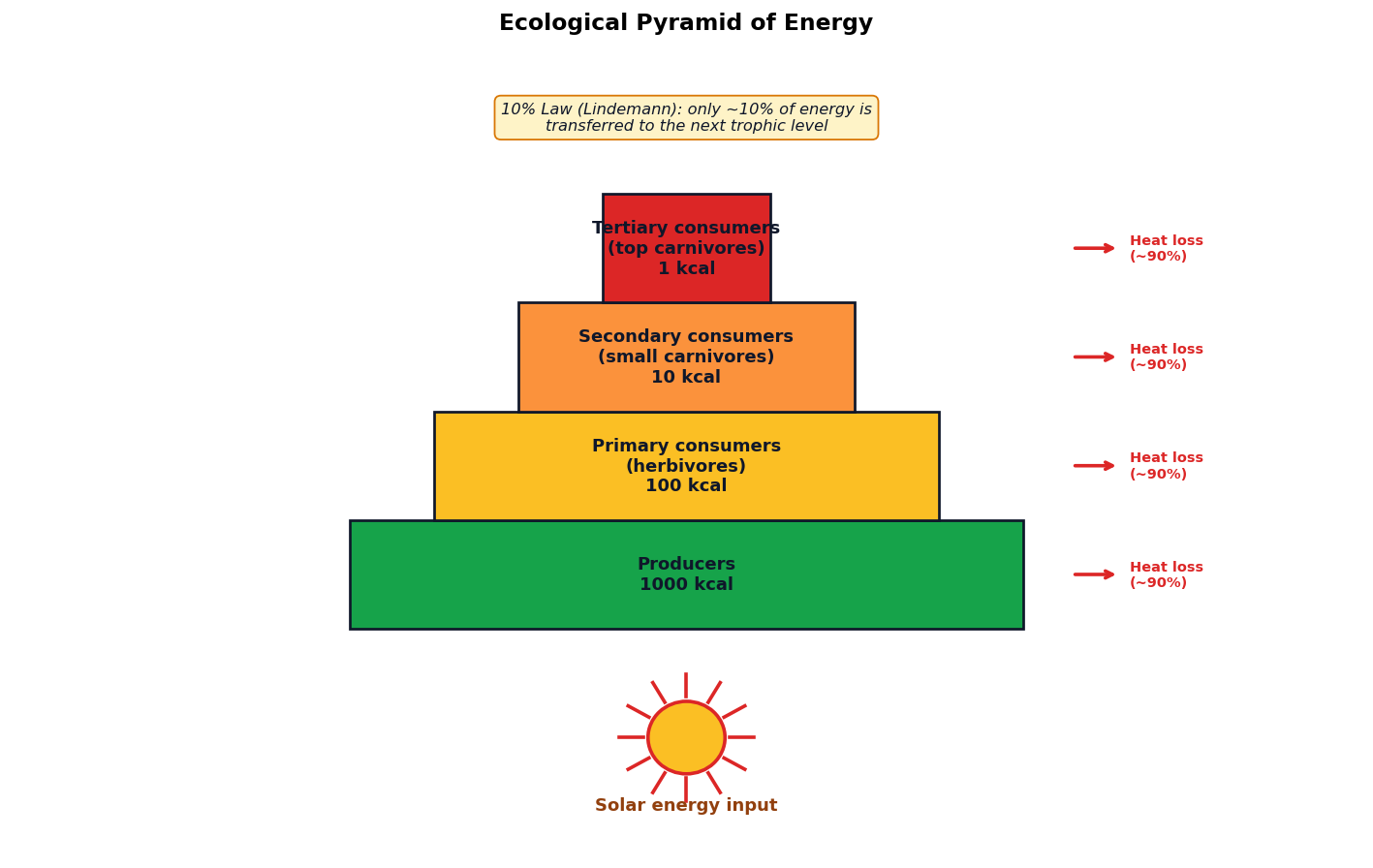
Study the ecological pyramid of energy and answer:
According to Lindemann's 10 percent law the energy transferred to the next trophic level is:
A1 percent
B10 percent
C50 percent
D90 percent
The largest amount of energy in any ecosystem is found at the level of:
AProducers
BPrimary consumers
CSecondary consumers
DTertiary consumers
Explain the pyramid of energy and Lindemann's 10 percent law.
Show answersHide answers
1. Option None
2. Option None
3. An ecological pyramid of energy shows the energy content at each trophic level. The pyramid is always upright because energy decreases as we move up the food chain - at each transfer about 90 percent of the energy is lost as heat through respiration and only about 10 percent is passed on (Lindemann's 10 percent law). Producers form the base of the pyramid containing the most energy.
Q572 Marks
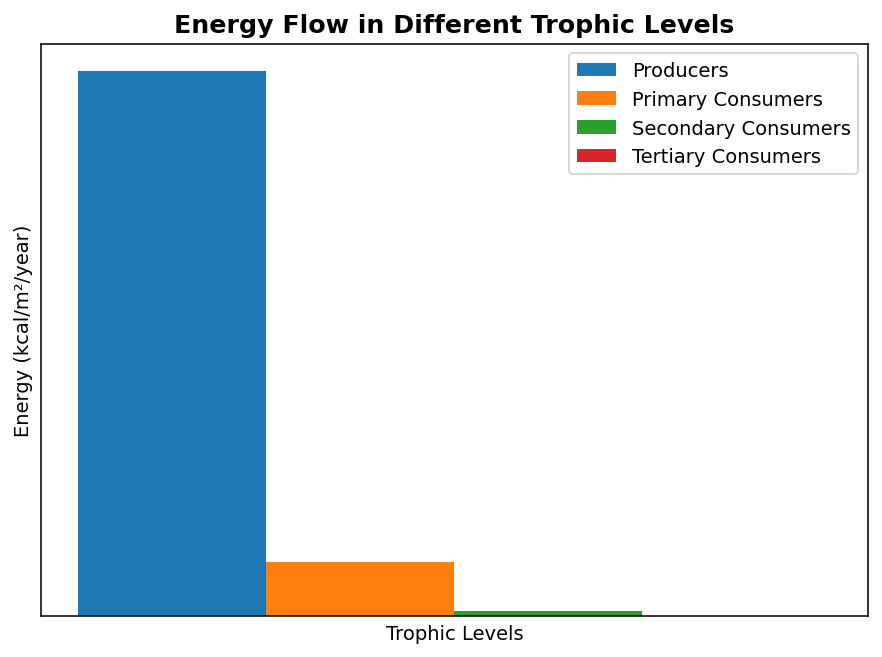
Based on the given chart of energy flow in an ecosystem, answer the following:
Which trophic level has the highest energy?
AProducers
BPrimary Consumers
CSecondary Consumers
DTertiary Consumers
What is the energy available to the tertiary consumers?
Show answersHide answers
1. Option 1 — Producers
2. 10 kcal/m²/year
Q582 Marks
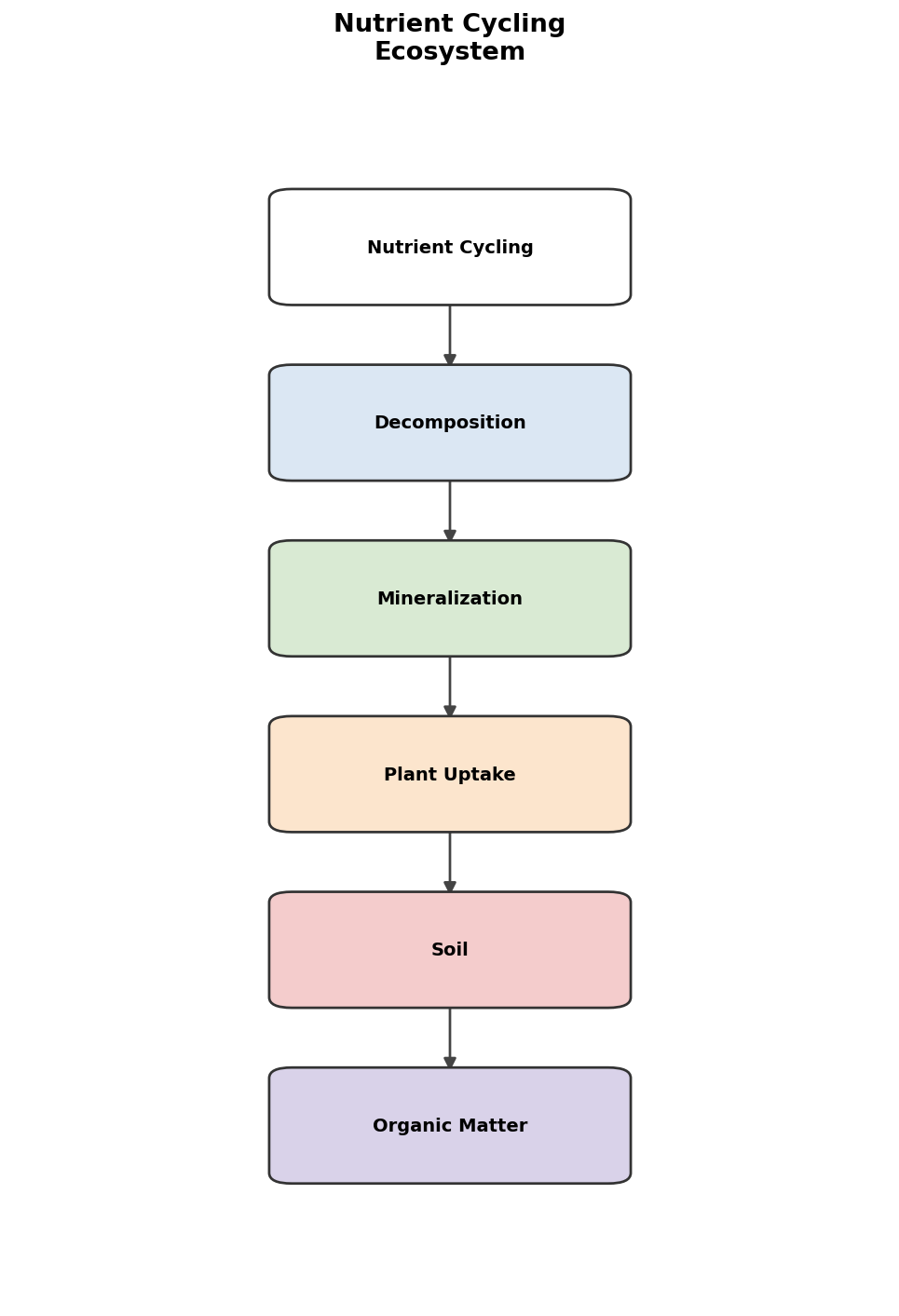
Based on the given flowchart of nutrient cycling in an ecosystem, answer the following:
What is the first step in nutrient cycling?
ADecomposition
BMineralization
CPlant Uptake
DSoil
Describe the role of organic matter in nutrient cycling.
Show answersHide answers
1. Option 1 — Decomposition
2. Organic matter provides nutrients to the soil.
Q592 Marks
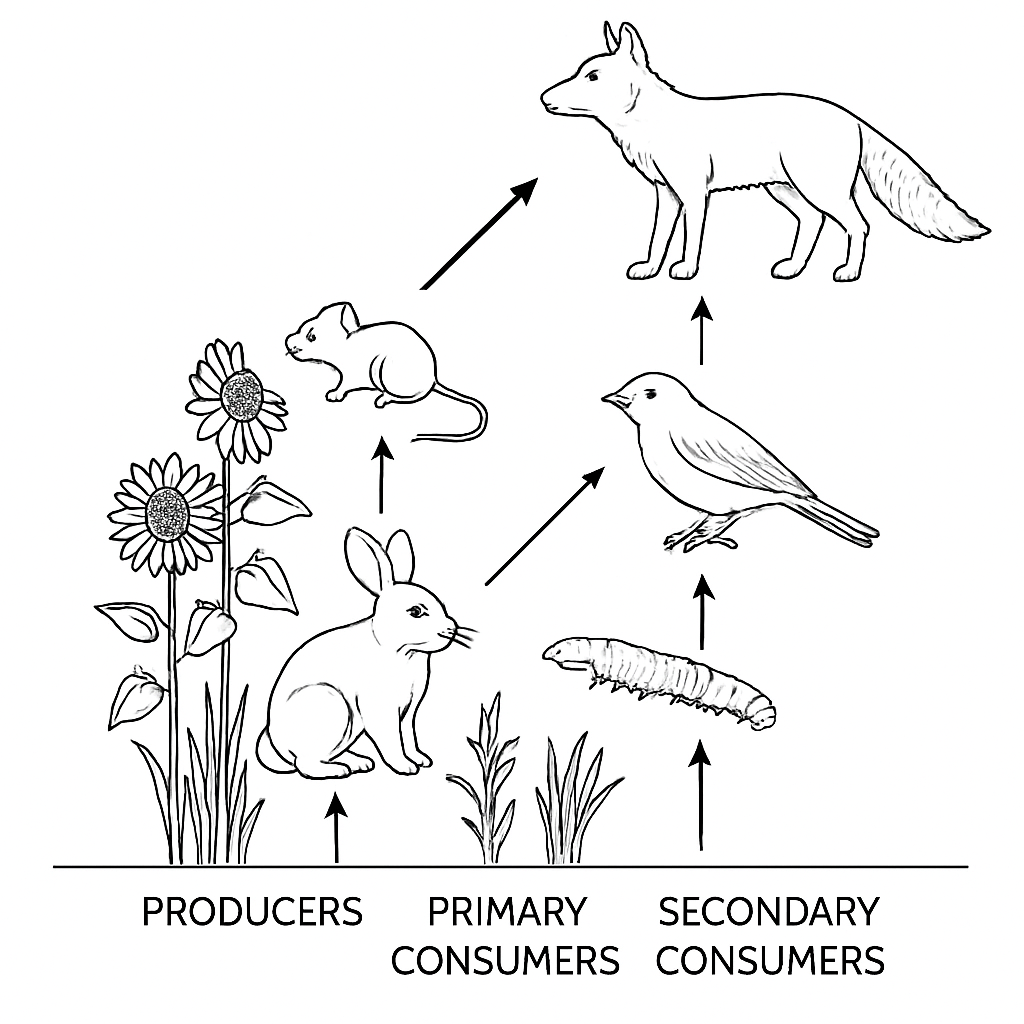
Based on the given diagram of a food web, answer the following:
Identify one primary consumer in the food web.
AGrass
BRabbit
CFox
DEagle
Explain the significance of producers in the food web.
Show answersHide answers
1. Option 2 — Rabbit
2. Producers convert solar energy into chemical energy.