SUMMARY: This chapter focuses on the interactions between organisms and their environments, exploring ecological concepts at the level of individuals and populations. KEY TOPICS: ecology, habitat, niche, population interactions, population attributes, growth models, life history variations, population density, age distribution, carrying capacity
Reason (R): They prevent unchecked population growth of prey species.
Show explanationHide explanation
Correct answer: Option 1 —
Both A and R are true, and R is the correct explanation of A.
Q191 Mark
Assertion (A): Hibernation is a survival strategy in winter.
Reason (R): Animals reduce their metabolic rate to conserve energy.
Show explanationHide explanation
Correct answer: Option 1 —
Both A and R are true, and R is the correct explanation of A.
Q201 Mark
Assertion (A): Carrying capacity is the maximum population a habitat can support.
Reason (R): It is determined by available resources.
Show explanationHide explanation
Correct answer: Option 1 —
Both A and R are true, and R is the correct explanation of A.
Q211 Mark
Assertion (A): Some plants have thick cuticle in dry habitats.
Reason (R): The cuticle reduces transpirational water loss.
Show explanationHide explanation
Correct answer: Option 1 —
Both A and R are true, and R is the correct explanation of A.
Statement-Based Questions5 questions
Q221 Mark
Statement 1: Eurythermal organisms tolerate wide temperature range.
Statement 2: Stenothermal organisms tolerate only narrow temperature range.
Show answerHide answer
Correct answer: Option 1 —
Both statements are true.
Q231 Mark
Statement 1: Brood parasitism is found in cuckoo.
Statement 2: Cuckoo lays eggs in the nest of crow.
Show answerHide answer
Correct answer: Option 1 —
Both statements are true.
Q241 Mark
Statement 1: Population density can be measured in different ways.
Statement 2: Number of individuals per unit area is one of them.
Show answerHide answer
Correct answer: Option 1 —
Both statements are true.
Q251 Mark
Statement 1: Verhulst-Pearl logistic equation describes population growth.
Statement 2: It assumes a maximum sustainable population called K.
Show answerHide answer
Correct answer: Option 1 —
Both statements are true.
Q261 Mark
Statement 1: Allen's rule states that mammals from cold areas have shorter ears.
Statement 2: This minimises heat loss.
Show answerHide answer
Correct answer: Option 1 —
Both statements are true.
Case Study / Passage Questions4 questions
Q273 Marks
An ecologist studies lichens growing on tree bark in a deciduous forest. He notes that the lichen body has fungal hyphae enclosing photosynthetic algal cells. The fungus provides shelter and absorbs water and minerals while the alga provides food. This is a classic example of mutualism.
Lichens are an example of:
AMutualism
BCommensalism
CPredation
DCompetition
The lichen body consists of:
AAlgae and bacteria
BAlgae and fungi
CTwo algae
DTwo fungi
Define mutualism and explain the lichen association as an example.
Show answersHide answers
1. Option 1 — Mutualism
2. Option 2 — Algae and fungi
3. Lichens are mutualistic associations of a fungus (mycobiont) and a photosynthetic partner — either an alga or a cyanobacterium (phycobiont). The fungus provides protection and absorbs water and minerals from the substrate. The phycobiont provides food via photosynthesis. Lichens can grow in extreme habitats including bare rocks and tree bark and are pioneer species in primary succession. They are also sensitive to air pollution and serve as bioindicators.
Q283 Marks
A microbiologist inoculates a flask of nutrient broth with a small amount of yeast. The population grows exponentially in the early hours but then slows and reaches a plateau (carrying capacity) as nutrients are depleted. The growth follows the classic S-shaped (sigmoid) logistic curve.
Logistic growth produces a curve shaped like:
AJ-shaped
BS-shaped
CL-shaped
DLinear
The carrying capacity of an environment is denoted by:
Ar
BK
CN
Dt
Explain the logistic growth model and the concept of carrying capacity.
Show answersHide answers
1. Option 2 — S-shaped
2. Option 2 — K
3. Population growth in nature usually follows the logistic (S-shaped) curve described by the Verhulst-Pearl equation dN/dt = rN(K-N)/K. Initial growth is slow (lag phase) followed by exponential growth (log phase) and finally a stationary phase as the population reaches the carrying capacity (K) of the environment. The exponential J-shaped curve only occurs in artificial conditions with unlimited resources.
Q293 Marks
In a temperate forest ecosystem, various species of trees, shrubs, and herbaceous plants coexist, forming a complex habitat. Each species occupies a specific niche, which includes its role in the ecosystem, its habitat preferences, and its interactions with other organisms. For instance, oak trees provide acorns that serve as food for squirrels and birds, while also offering shelter. The population dynamics of these trees can be influenced by factors such as soil quality, light availability, and competition with other plant species. Understanding these interactions helps ecologists predict how changes in one population can affect others within the ecosystem.
What is a niche in the context of an ecosystem?
Which of the following trees provides acorns that serve as food for various animals?
APine trees
BMaple trees
COak trees
DBirch trees
How can soil quality affect the population dynamics of trees in a forest?
Show answersHide answers
1. A niche refers to the role and position a species has in its environment, including all interactions with biotic and abiotic factors.
2. Option 3 — Oak trees
3. Soil quality affects nutrient availability, water retention, and root growth, which can influence tree health and growth rates.
Q303 Marks
Population density refers to the number of individuals of a species per unit area or volume. In a given habitat, factors such as resource availability, predation, and disease can influence population density. For example, in a grassland ecosystem, a high density of herbivores may lead to overgrazing, which can reduce plant cover and subsequently decrease the herbivore population due to food scarcity. Conversely, a low population density might allow for greater resource availability, leading to population growth. Understanding these dynamics is crucial for wildlife management and conservation efforts.
What is population density?
Which factor can lead to a decrease in herbivore population in a grassland ecosystem?
AIncreased rainfall
BOvergrazing
CPredation
DDisease resistance
How does resource availability impact population density?
Show answersHide answers
1. Population density is the number of individuals of a species per unit area or volume.
2. Option 2 — Overgrazing
3. Resource availability directly affects the carrying capacity of an environment, influencing how many individuals can survive and reproduce.
Table-Based Questions4 questions
Q313 Marks
Study the table on population interactions and answer:
Interaction
Species A
Species B
Example
Mutualism
+
+
Lichens
Commensalism
+
0
Cattle egret on cattle
Predation
+
-
Lion-deer
Competition
-
-
Two plants for water
Parasitism
+
-
Tick on dog
A relationship in which both partners benefit is called:
AMutualism
BCommensalism
CPredation
DParasitism
Cattle egret feeding near grazing cattle is an example of:
AMutualism
BCommensalism
CCompetition
DPredation
Differentiate between mutualism, commensalism, predation and parasitism with one example each.
Show answersHide answers
1. Option 1 — Mutualism
2. Option 2 — Commensalism
3. Population interactions can be classified by their effects on the participants. Mutualism (+,+) benefits both. Commensalism (+,0) benefits one without affecting the other. Predation (+,-) and parasitism (+,-) benefit one at the expense of the other. Competition (-,-) hurts both. These interactions shape community structure and drive co-evolution among species.
Q326 Marks
Match each type of population interaction with its effect on the two species.
Interaction
Species A
Species B
Mutualism
+
+
Commensalism
+
0
Predation
+
-
Parasitism
+
-
Competition
-
-
Q336 Marks
What is the average carrying capacity of the populations listed in the table?
Species
Population Size
Carrying Capacity
Deer
150
200
Bears
80
100
Wolves
50
60
Q343 Marks
Study the following data and answer the questions below:
Population Density (individuals/km²)
Species A
Species B
Low
20
30
Medium
50
70
High
80
60
What is the population density of Species A at medium density?
Which species has a higher population density at low density?
What trend can be observed for Species B as population density increases?
Show answersHide answers
1.
2.
3.
Picture-Based Questions4 questions
Q352 Marks
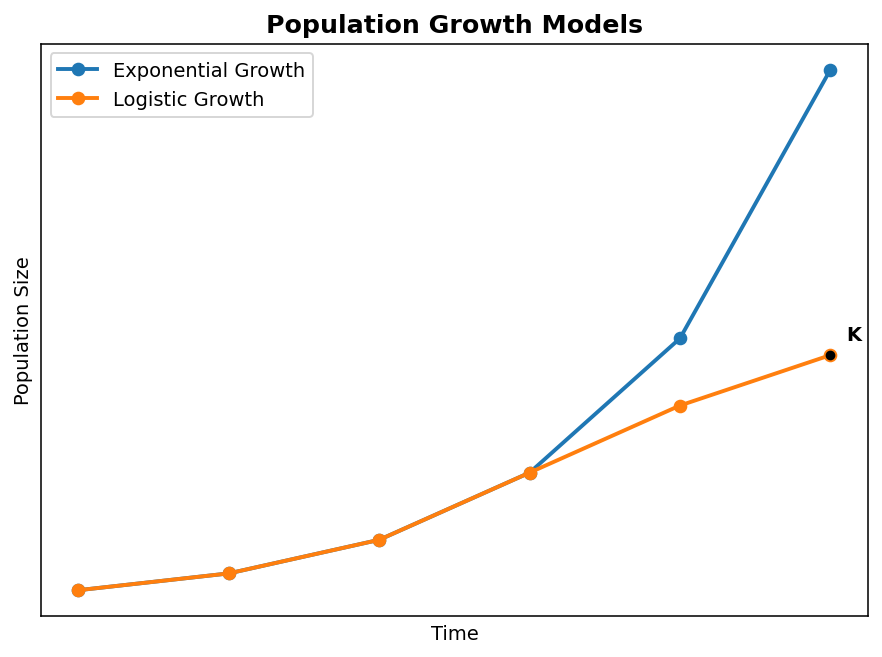
Based on the given graph of population growth models, answer the following:
Which model shows unlimited growth?
AExponential Growth
BLogistic Growth
CBoth
DNeither
What does 'K' represent in the logistic growth model?
Show answersHide answers
1. Option 1 — Exponential Growth
2. Carrying capacity
Q362 Marks
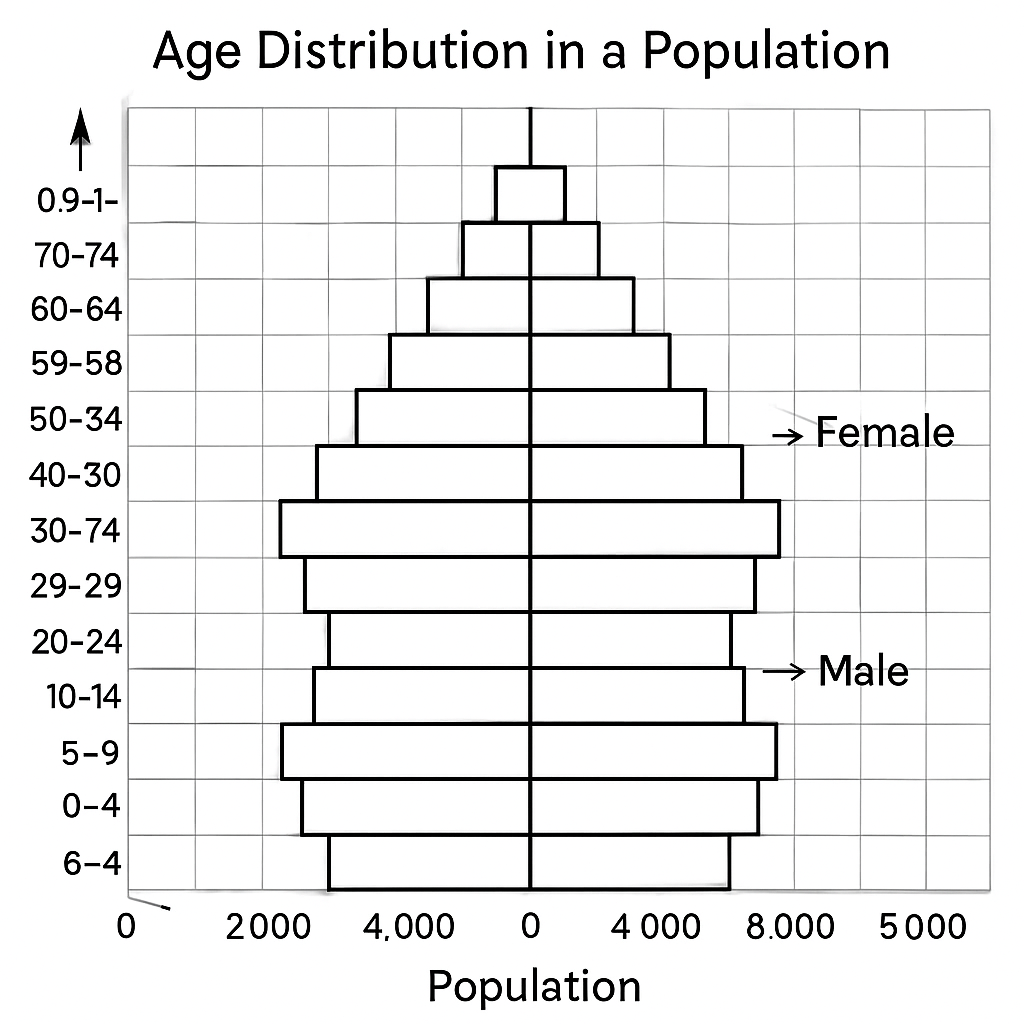
Based on the given diagram of age distribution in a population, answer the following:
What type of population structure is represented if the diagram shows a pyramid shape?
AStable
BDeclining
CGrowing
DNone of the above
Explain the significance of age distribution in understanding population dynamics.
Show answersHide answers
1. Option 3 — Growing
2. It helps predict future population growth and resource needs.
Q372 Marks
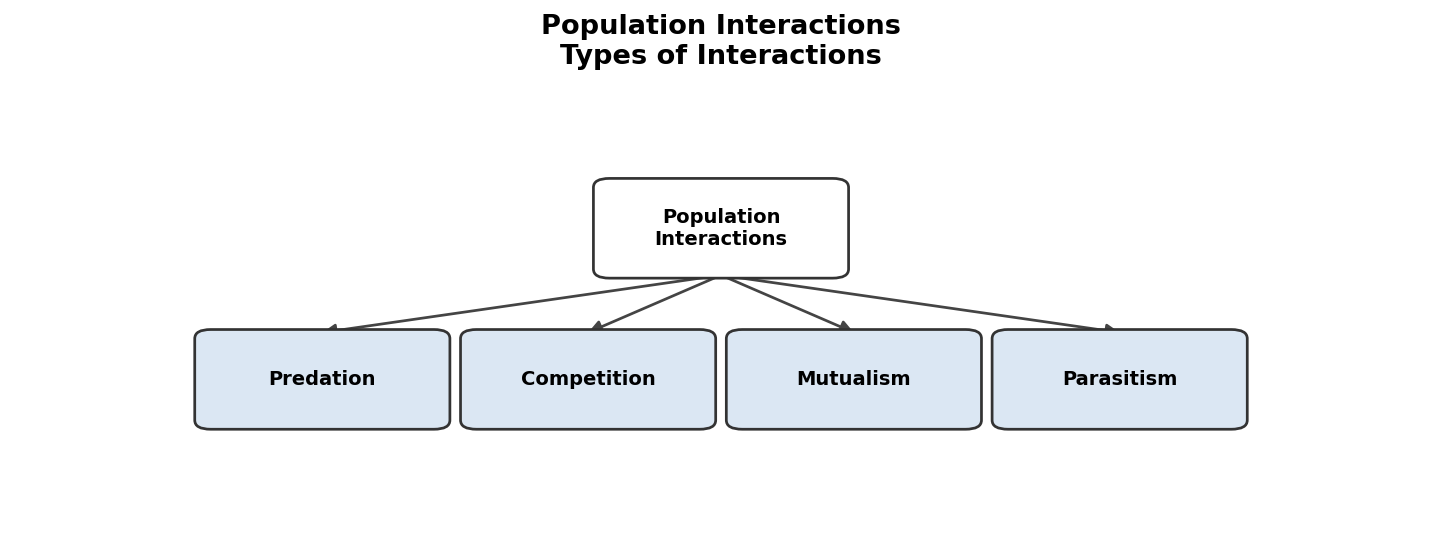
Based on the given flowchart of population interactions, answer the following:
Which interaction is characterized by one organism benefiting at the expense of another?
APredation
BCompetition
CMutualism
DParasitism
Describe the role of competition in population dynamics.
Show answersHide answers
1. Option 4 — Parasitism
2. It limits population growth and resource availability.
Q382 Marks
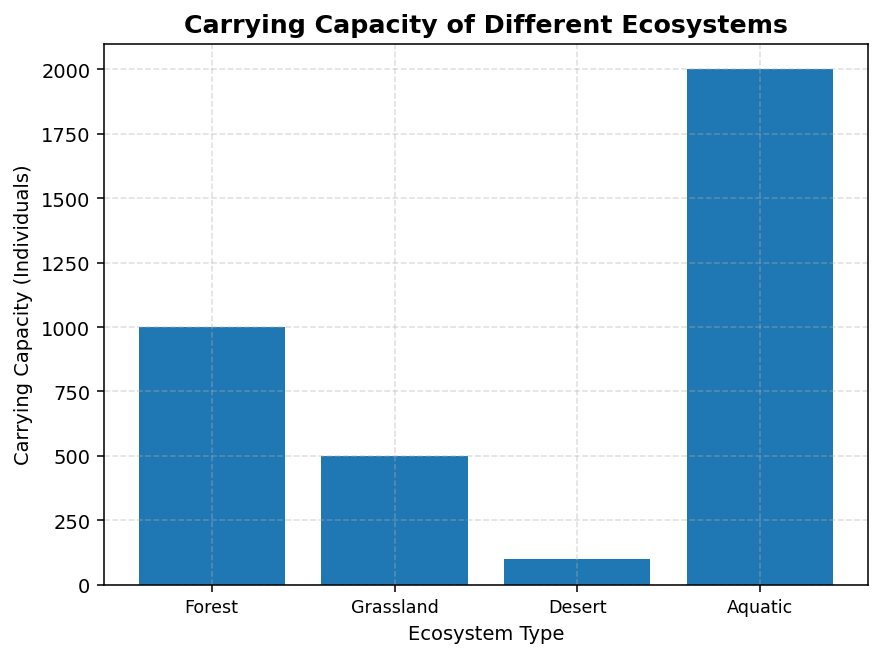
Based on the given chart of carrying capacity, answer the following:
Which ecosystem has the highest carrying capacity?
AForest
BGrassland
CDesert
DAquatic
What factors might influence the carrying capacity of an ecosystem?
Show answersHide answers
1. Option 1 — Forest
2. Availability of resources, habitat space, and environmental conditions.