Molecular Basis of Inheritance — Important Questions
38 questions
With answersCBSE format
SUMMARY: The chapter "Molecular Basis of Inheritance" in Class 12 Biology explores the structure, function, and replication of DNA, as well as the mechanisms of genetic inheritance and expression. KEY TOPICS: DNA structure, DNA replication, genetic code, transcription, translation, regulation of gene expression, human genome project, DNA fingerprinting, RNA types, mutations
The double helical structure of DNA was proposed by:
AWatson and Crick
BHershey and Chase
CMeselson and Stahl
DBeadle and Tatum
Check answerHide answer
Correct answer: Option 1 — Watson and Crick
Q31 Mark
DNA replication is:
AConservative
BSemi-conservative
CDispersive
DNon-conservative
Check answerHide answer
Correct answer: Option 2 — Semi-conservative
Q41 Mark
The enzyme involved in DNA replication is:
ADNA polymerase
BRNA polymerase
CReverse transcriptase
DLigase
Check answerHide answer
Correct answer: Option 1 — DNA polymerase
Q51 Mark
The Human Genome Project was completed in:
A1990
B2000
C2003
D2010
Check answerHide answer
Correct answer: Option 3 — 2003
Short Answer Questions5 questions
Q63 Marks
Differentiate between DNA and RNA.
Q73 Marks
Describe the experiment of Hershey and Chase that proved DNA is the genetic material.
Q83 Marks
What is the central dogma of molecular biology?
Q93 Marks
Explain the salient features of the genetic code.
Q103 Marks
Mention the key findings of the Human Genome Project.
Long Answer Questions6 questions
Q116 Marks
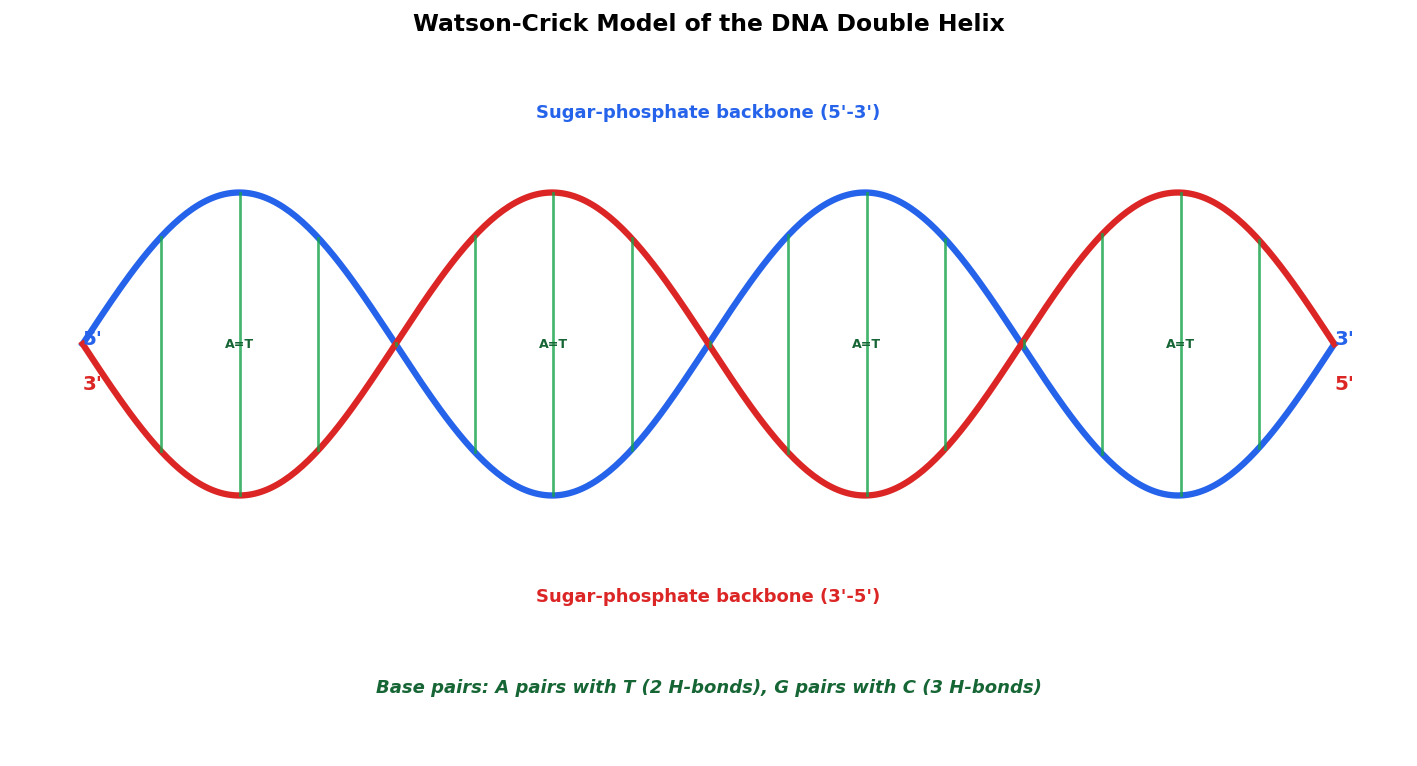
Describe the Watson-Crick model of DNA with a labelled diagram.
Q126 Marks
Explain the process of DNA replication with a diagram.
Q136 Marks
Describe the process of transcription in eukaryotes.
Q146 Marks
Explain the process of translation and the role of ribosomes.
Q156 Marks
Discuss the lac operon as an example of gene regulation in prokaryotes.
Q166 Marks
Differentiate between DNA and RNA in tabular form on at least six features.
Assertion–Reason Questions5 questions
Q171 Mark
Assertion (A): DNA carries genetic information.
Reason (R): Hershey-Chase experiment proved DNA to be the genetic material.
Show explanationHide explanation
Correct answer: Option 1 —
Both A and R are true, and R is the correct explanation of A.
Q181 Mark
Assertion (A): DNA replication is semi-conservative.
Reason (R): Each daughter DNA has one parental and one new strand.
Show explanationHide explanation
Correct answer: Option 1 —
Both A and R are true, and R is the correct explanation of A.
Q191 Mark
Assertion (A): The genetic code is degenerate.
Reason (R): Most amino acids are coded by more than one codon.
Show explanationHide explanation
Correct answer: Option 1 —
Both A and R are true, and R is the correct explanation of A.
Q201 Mark
Assertion (A): tRNA is the adapter molecule in translation.
Reason (R): It carries amino acids to the ribosome and matches with the mRNA codon.
Show explanationHide explanation
Correct answer: Option 1 —
Both A and R are true, and R is the correct explanation of A.
Q211 Mark
Assertion (A): Lac operon is induced by lactose.
Reason (R): Lactose binds to the repressor and frees the operator allowing transcription.
Show explanationHide explanation
Correct answer: Option 1 —
Both A and R are true, and R is the correct explanation of A.
Statement-Based Questions5 questions
Q221 Mark
Statement 1: DNA is a polymer of nucleotides.
Statement 2: Each nucleotide consists of a sugar, a phosphate, and a nitrogen base.
Show answerHide answer
Correct answer: Option 1 —
Both statements are true.
Q231 Mark
Statement 1: Okazaki fragments are short DNA segments on the lagging strand.
Statement 2: They are joined by DNA ligase.
Show answerHide answer
Correct answer: Option 1 —
Both statements are true.
Q241 Mark
Statement 1: AUG is the initiator codon.
Statement 2: It also codes for methionine.
Show answerHide answer
Correct answer: Option 1 —
Both statements are true.
Q251 Mark
Statement 1: Eukaryotic mRNA undergoes splicing.
Statement 2: Introns are removed and exons are joined together.
Show answerHide answer
Correct answer: Option 1 —
Both statements are true.
Q261 Mark
Statement 1: DNA fingerprinting is based on VNTRs.
Statement 2: VNTRs vary highly between individuals and are inherited.
Show answerHide answer
Correct answer: Option 1 —
Both statements are true.
Case Study / Passage Questions4 questions
Q273 Marks
Alfred Hershey and Martha Chase worked with bacteriophage T2. They labelled DNA with radioactive 32-P and protein coat with 35-S. After infecting bacteria they found that 32-P entered the bacterial cells but 35-S remained outside. They concluded that DNA and not protein is the genetic material.
The Hershey-Chase experiment proved that the genetic material is:
ADNA
BProtein
CLipid
DCarbohydrate
DNA was labelled with the radioactive isotope:
A32-P
B35-S
C3-H
D14-C
Describe the Hershey-Chase experiment that confirmed DNA as the genetic material.
Show answersHide answers
1. Option 1 — DNA
2. Option 1 — 32-P
3. Hershey and Chase used T2 bacteriophage that consists of a DNA core surrounded by a protein coat. They labelled the protein with 35-S and the DNA with 32-P. After allowing the phages to infect E. coli they separated the bacterial cells from the phage coats by centrifugation. The bacteria contained 32-P (DNA) but not 35-S (protein). The progeny phages were also radioactive proving that DNA was transferred to the next generation. This established DNA as the genetic material.
Q283 Marks
Meselson and Stahl grew E. coli in a medium containing heavy nitrogen (15-N) for many generations until all DNA was heavy. They then transferred the cells to a normal 14-N medium. After one generation all DNA was of intermediate density. After two generations half was intermediate and half was light. They concluded that DNA replication is semi-conservative.
The Meselson-Stahl experiment proved replication is:
AConservative
BSemi-conservative
CDispersive
DRandom
The number of bands seen after the first round of replication in 14-N medium is:
A1
B2
C3
D4
Describe the Meselson-Stahl experiment and explain how it proves the semi-conservative nature of DNA replication.
Show answersHide answers
1. Option 2 — Semi-conservative
2. Option 1 — 1
3. Semi-conservative replication means that each new DNA molecule has one parental strand and one newly synthesised strand. The Meselson-Stahl experiment provided experimental support — after one round of replication in light medium all DNA showed intermediate density (one heavy and one light strand). After two rounds half was intermediate and half was light. This pattern is incompatible with conservative or dispersive models.
Q293 Marks
The structure of DNA, discovered by James Watson and Francis Crick, is a double helix formed by two strands of nucleotides. Each nucleotide consists of a phosphate group, a sugar molecule (deoxyribose), and a nitrogenous base (adenine, thymine, cytosine, or guanine). The specific pairing of bases (A with T and C with G) is crucial for the accurate replication of DNA. During DNA replication, the double helix unwinds, and each strand serves as a template for the formation of a new complementary strand. This semi-conservative method of replication ensures that each daughter cell receives an exact copy of the DNA.
What are the components of a nucleotide in DNA?
Which nitrogenous bases pair together in DNA?
AAdenine with Cytosine
BThymine with Guanine
CAdenine with Thymine
DCytosine with Thymine
What is the significance of the semi-conservative method of DNA replication?
Show answersHide answers
1. A phosphate group, a sugar molecule (deoxyribose), and a nitrogenous base.
2. Option 3 — Adenine with Thymine
3. It ensures that each daughter cell receives an exact copy of the DNA.
Q303 Marks
The genetic code is a set of rules that defines how the sequence of nucleotides in DNA is translated into the amino acid sequence of proteins. This code is composed of triplets of nucleotides, known as codons. Each codon corresponds to a specific amino acid or a stop signal during protein synthesis. The process of transcription involves the synthesis of messenger RNA (mRNA) from a DNA template, while translation is the process where ribosomes read the mRNA and assemble the corresponding amino acids to form a protein. The regulation of gene expression is essential for cellular function and adaptation.
What is a codon?
What are the two main processes involved in protein synthesis?
AReplication and Transcription
BTranscription and Translation
CTranslation and Replication
DTranscription and Duplication
Why is the regulation of gene expression important?
Show answersHide answers
1. A triplet of nucleotides that corresponds to a specific amino acid or stop signal.
2. Option 2 — Transcription and Translation
3. It is essential for cellular function and adaptation.
Table-Based Questions4 questions
Q313 Marks
Study the table on RNA types and their functions:
Type
Full name
Function
mRNA
Messenger RNA
Carries genetic information from DNA to ribosome
tRNA
Transfer RNA
Brings amino acids to ribosome
rRNA
Ribosomal RNA
Structural and catalytic role in ribosome
snRNA
Small nuclear RNA
Splicing of pre-mRNA
miRNA
MicroRNA
Regulation of gene expression
The RNA that carries amino acids to the ribosome is:
AmRNA
BtRNA
CrRNA
DmiRNA
snRNAs participate in:
ATranslation
BSplicing
CReplication
DRepair
Explain the role of mRNA, tRNA and rRNA in protein synthesis.
Show answersHide answers
1. Option 2 — tRNA
2. Option 2 — Splicing
3. Three major types of RNA participate in protein synthesis. mRNA carries the genetic message from DNA to ribosomes. tRNA reads the mRNA codons and brings the corresponding amino acid. rRNA is the structural and catalytic component of ribosomes. Other RNA types like snRNA participate in mRNA splicing and miRNAs regulate gene expression. The discovery of catalytic RNAs (ribozymes) suggests RNA may have been the first genetic molecule.
Q326 Marks
Identify each RNA type and its role in protein synthesis.
RNA type
Role
mRNA
?
tRNA
?
rRNA
?
snRNA
?
miRNA
?
Q336 Marks
Compare DNA and RNA on the listed features.
Feature
DNA
RNA
Sugar
?
?
Bases
?
?
Strand
?
?
Stability
?
?
Function
?
?
Q346 Marks
Match each codon with the amino acid it encodes (genetic code).
Codon
Amino acid
AUG
?
UUU
?
GCU
?
UAA / UAG / UGA
?
UGG
?
Picture-Based Questions4 questions
Q353 Marks
Study the labelled DNA double helix and answer:
The backbone of each DNA strand is composed of:
ASugar
BPhosphate
CSugar-phosphate
DNitrogen base
The two strands of DNA are held together by:
AIonic bonds
BHydrogen bonds
CDisulfide bonds
DPeptide bonds
Describe the salient features of the Watson-Crick model of DNA.
Show answersHide answers
1. Option None
2. Option None
3. Watson and Crick (1953) proposed that DNA is a right-handed double helix. The two strands are antiparallel - one runs 5' to 3' and the other 3' to 5'. The sugar-phosphate backbones are on the outside and the nitrogen bases project inward forming complementary base pairs (A-T with two H-bonds and G-C with three H-bonds). One full turn of the helix is 3.4 nm and contains about 10 base pairs.
Q363 Marks
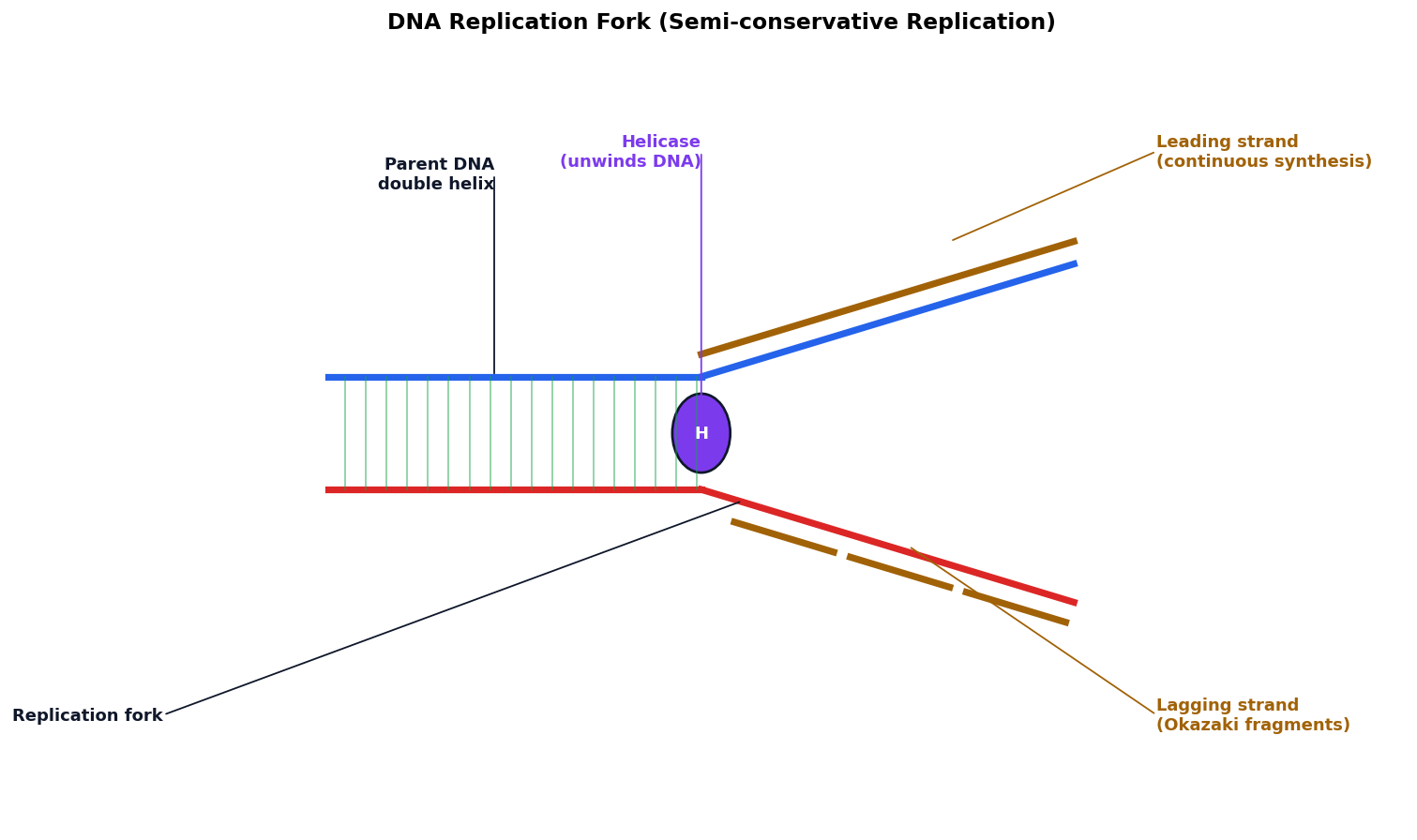
Study the DNA replication fork and answer:
The enzyme that unwinds the parent DNA at the replication fork is:
ADNA polymerase
BDNA ligase
CHelicase
DTopoisomerase
Okazaki fragments are formed on the:
ALeading strand only
BLagging strand only
CBoth strands
DNeither
Explain the events at a DNA replication fork and the difference between leading and lagging strand.
Show answersHide answers
1. Option None
2. Option None
3. DNA replication is semi-conservative - each new molecule has one parental and one newly synthesised strand. At the replication fork helicase unwinds the parent DNA. DNA polymerase synthesises new strands in 5' to 3' direction. On the leading strand synthesis is continuous. On the lagging strand it is discontinuous in short Okazaki fragments later joined by DNA ligase.
Q372 Marks
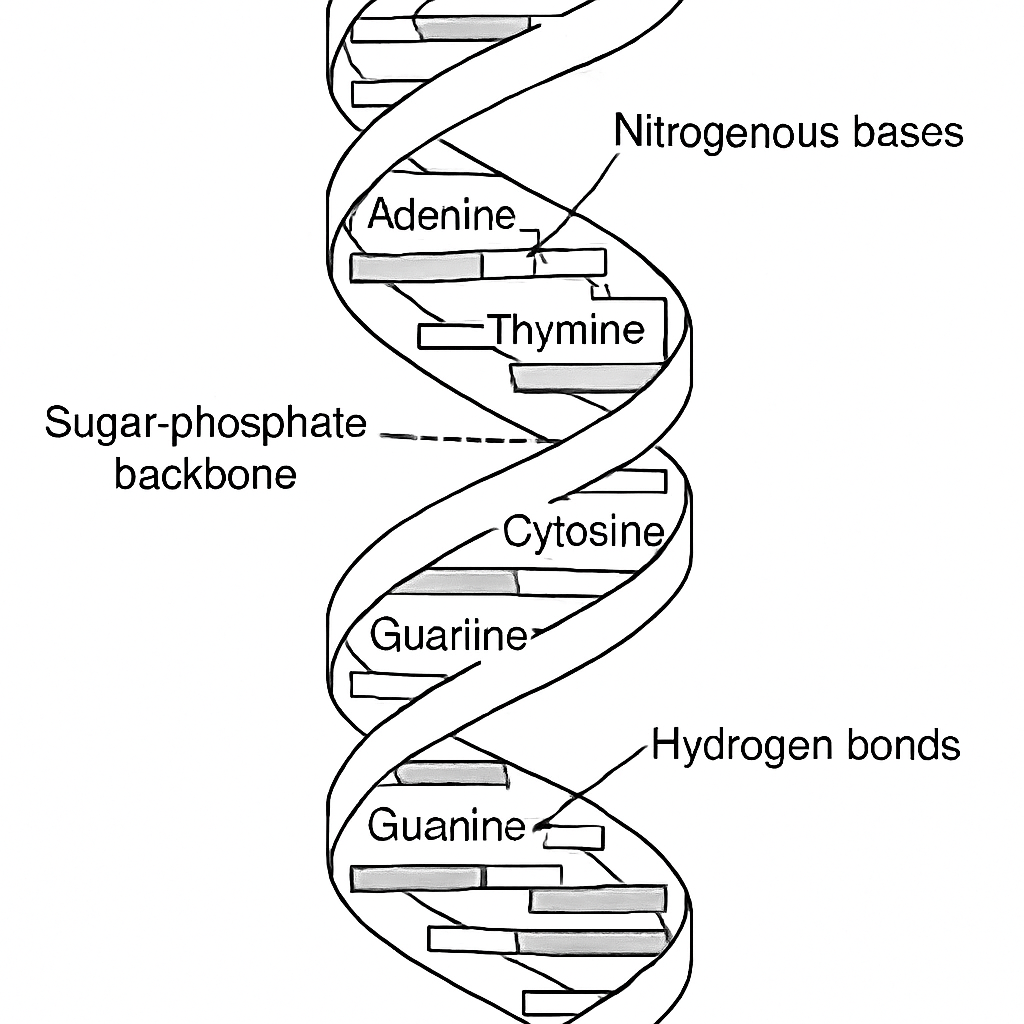
Based on the given diagram of the DNA double helix structure, answer the following:
What type of bond holds the two strands of DNA together?
ACovalent bond
BIonic bond
CHydrogen bond
DPeptide bond
Identify the nitrogenous base that pairs with adenine.
Show answersHide answers
1. Option 3 — Hydrogen bond
2. Thymine
Q382 Marks
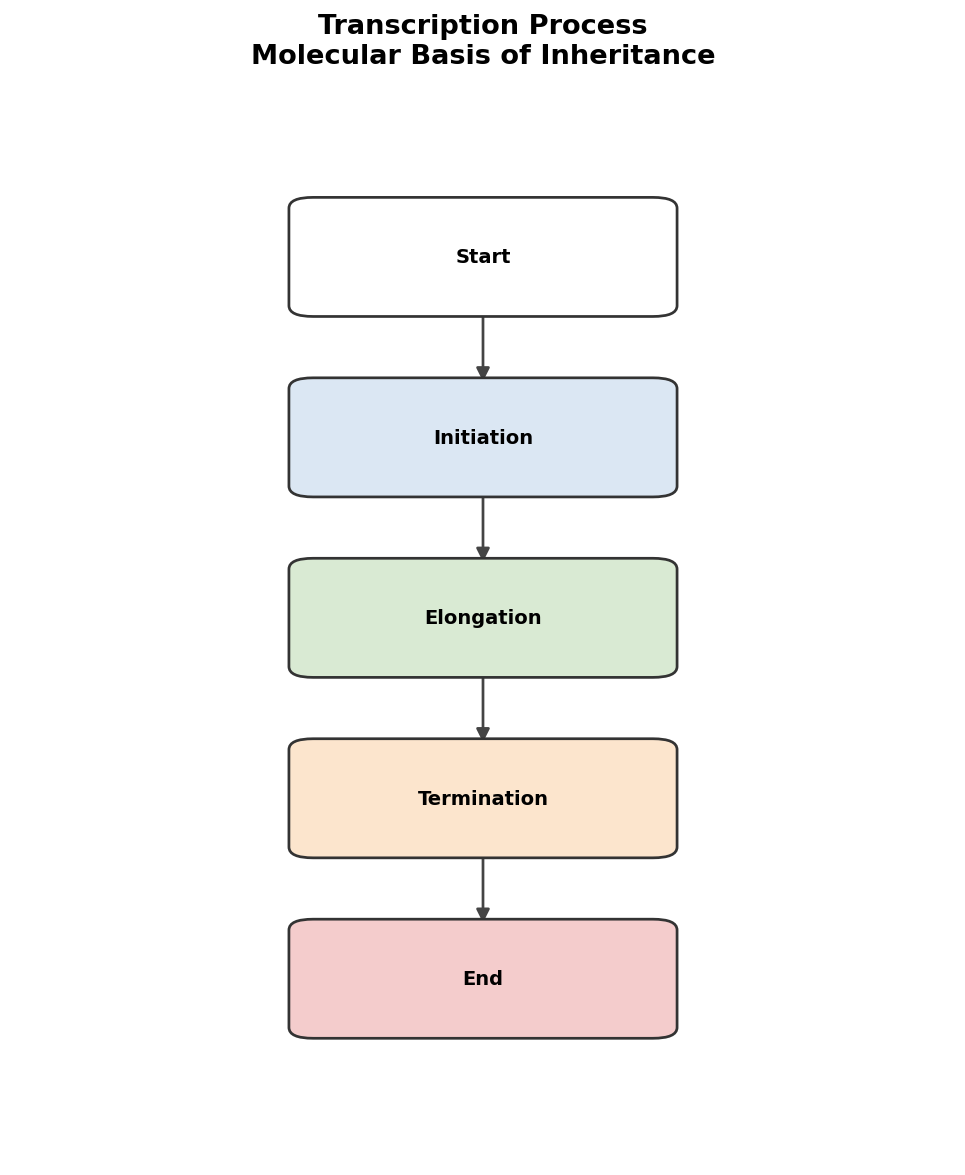
Based on the given flowchart of the process of transcription, answer the following:
What occurs during the elongation phase of transcription?
Which enzyme is primarily responsible for transcription?
ADNA polymerase
BRNA polymerase
CLigase
DHelicase
Show answersHide answers
1. RNA polymerase synthesizes RNA strand complementary to the DNA template.