SUMMARY: The chapter on Waves in Class 11 Physics explores the fundamental concepts and types of waves, their properties, and the mathematical description of wave motion. KEY TOPICS: types of waves, wave speed, frequency and wavelength, superposition principle, standing waves, resonance, Doppler effect, wave equation, reflection and transmission of waves, sound waves
A wave that requires a medium to propagate is called:
AElectromagnetic wave
BMechanical wave
CLight wave
DRadio wave
Check answerHide answer
Correct answer: Option 2 — Mechanical wave
Q21 Mark
The speed of sound in air at 0°C is approximately:
A330 m/s
B3 × 10⁸ m/s
C1500 m/s
D343 m/s
Check answerHide answer
Correct answer: Option 1 — 330 m/s
Q31 Mark
The frequency of a wave is the number of:
AWavelengths per metre
BComplete oscillations per second
CCrests at any time
DTroughs per metre
Check answerHide answer
Correct answer: Option 2 — Complete oscillations per second
Q41 Mark
The speed wavelength and frequency of a wave are related by:
Av = λ + f
Bv = λ × f
Cv = λ/f
Dv = f/λ
Check answerHide answer
Correct answer: Option 2 — v = λ × f
Q51 Mark
The phenomenon of beats arises from:
AReflection
BRefraction
CSuperposition of two waves of nearly equal frequencies
DDiffraction
Check answerHide answer
Correct answer: Option 3 — Superposition of two waves of nearly equal frequencies
Short Answer Questions5 questions
Q63 Marks
Distinguish between transverse and longitudinal waves with examples.
View sample solutionHide solution
Transverse wave: particles vibrate perpendicular to the direction of wave propagation. Examples: light EM waves waves on a string surface water waves. Longitudinal wave: particles vibrate parallel to the direction of wave propagation; alternating compressions and rarefactions. Examples: sound waves seismic P-waves waves in a slinky. Transverse waves can be polarized; longitudinal cannot.
Q73 Marks
State the principle of superposition of waves.
View sample solutionHide solution
When two or more waves travelling in the same medium meet at a point the resultant displacement at that point at any instant is the algebraic sum of the displacements of the individual waves. y = y₁ + y₂. This principle leads to interference (constructive when waves are in phase destructive when in antiphase) beats and standing waves.
Q83 Marks
Define wavelength frequency and time period of a wave. Write the relation between them.
View sample solutionHide solution
Wavelength (λ): distance between two consecutive points in same phase (e.g. crest to crest). Frequency (f or ν): number of complete oscillations per second; SI unit Hz. Time period (T): time for one complete oscillation = 1/f. Wave speed: v = f λ = λ/T. Independent of amplitude — depends on medium properties.
Q93 Marks
A wave of frequency 500 Hz travels in a medium with speed 340 m/s. Find its wavelength.
View sample solutionHide solution
v = f λ ⇒ λ = v/f = 340/500 = 0.68 m. (For comparison: sound waves in air at audible frequencies have wavelengths from ~17 m at 20 Hz to ~17 mm at 20000 Hz — large range across the audible band.)
Q103 Marks
What is meant by Doppler effect? Give one example.
View sample solutionHide solution
Doppler effect: the apparent change in frequency of a wave due to relative motion between the source and observer. When source approaches observer: observed frequency > emitted (compression of waves). When receding: observed < emitted. Example: ambulance siren sounds higher pitched as it approaches you and lower as it recedes. Used in radar speed guns medical ultrasound and astronomical redshift measurements.
Long Answer Questions6 questions
Q116 Marks
Derive the formula for the speed of a transverse wave on a stretched string.
View sample solutionHide solution
Consider a small element ds of a string under tension T. Let the wave displace the element vertically by y. The two ends of ds make angles θ₁ and θ₂ with the horizontal; their tension components combine to give a net vertical restoring force F = T(sin θ₂ − sin θ₁) ≈ T (∂y/∂x evaluated at the two ends) = T (∂²y/∂x²) ds. By Newton's second law (μ ds)(∂²y/∂t²) = T(∂²y/∂x²)ds where μ is mass per unit length. So ∂²y/∂t² = (T/μ) ∂²y/∂x² — the standard wave equation. Comparing with general form ∂²y/∂t² = v² ∂²y/∂x²: v² = T/μ ⇒ v = √(T/μ).
Q126 Marks
Discuss standing waves and derive the conditions for nodes and antinodes on a string fixed at both ends.
View sample solutionHide solution
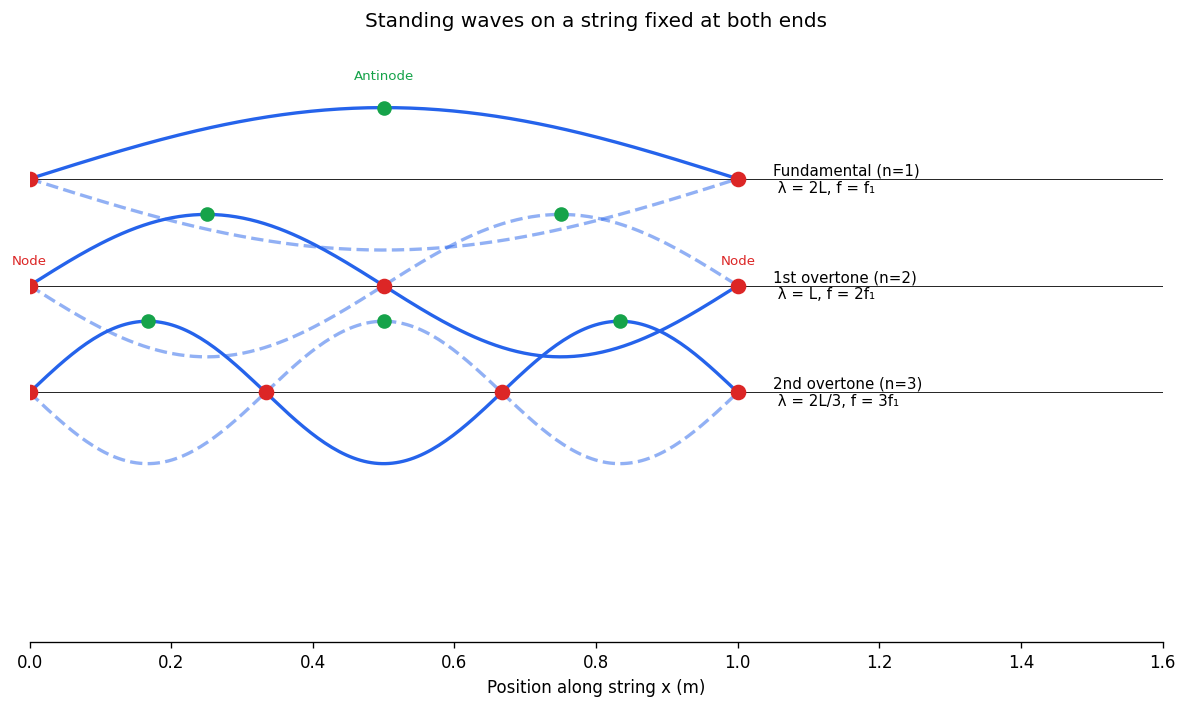
Standing waves arise when two identical waves travelling in opposite directions superpose. y = A sin(kx − ωt) + A sin(kx + ωt) = 2A sin(kx) cos(ωt). Nodes (zero displacement): sin(kx) = 0 ⇒ x = nλ/2 (n = 0 1 2 ...). Antinodes (max displacement): kx = (n + 1/2)π ⇒ x = (n + 1/2)λ/2. For string fixed at both ends (length L) we need nodes at x = 0 and x = L: L = nλ/2 ⇒ λ_n = 2L/n. Frequencies: f_n = nv/(2L). n = 1: fundamental; n = 2 first overtone; n = 3 second overtone; etc.
Q136 Marks
A train moving at 30 m/s sounds a whistle of frequency 500 Hz. Find the apparent frequency heard by (i) a stationary observer ahead of the train (ii) a stationary observer behind. Speed of sound = 340 m/s.
View sample solutionHide solution
Doppler effect (source moving toward/away from stationary observer): f' = f × v/(v ± v_s); minus sign when source approaches plus when receding. (i) Approaching: f' = 500 × 340/(340 − 30) = 500 × 340/310 = 548.4 Hz (higher pitch). (ii) Receding: f' = 500 × 340/(340 + 30) = 500 × 340/370 = 459.5 Hz (lower pitch). The pitch shift is symmetric about 500 Hz only approximately because the formula is asymmetric (source velocity changes effective wavelength differently for approach vs recede).
Q146 Marks
Two tuning forks of frequencies 256 Hz and 260 Hz are sounded together. Calculate the beat frequency. Discuss the phenomenon of beats.
View sample solutionHide solution
Beat frequency = |f₁ − f₂| = |256 − 260| = 4 Hz. So 4 beats per second are heard — alternating loud and soft pulses at 4 Hz. Beats arise from superposition of two waves of nearly equal frequencies: y = A sin(2πf₁t) + A sin(2πf₂t) = 2A cos(π(f₁ − f₂)t) sin(π(f₁ + f₂)t). The slowly varying cosine term modulates the amplitude — producing alternations of loud (constructive) and quiet (destructive) every (f₁ + f₂)/2 oscillations of the carrier. Used to tune musical instruments by ear.
Q156 Marks
A sonometer wire of length 1 m is stretched by a 20 N tension. If its mass per unit length is 0.005 kg/m calculate (i) the wave speed (ii) the fundamental frequency.
View sample solutionHide solution
(i) v = √(T/μ) = √(20/0.005) = √4000 = 63.25 m/s. (ii) Fundamental: λ = 2L = 2 m so f = v/λ = 63.25/2 = 31.6 Hz. The wire vibrates at this frequency when plucked at its centre with both ends held fixed — supporting the lowest standing-wave mode.
Q166 Marks
Compare longitudinal and transverse waves with the help of a table on five features.
Assertion–Reason Questions5 questions
Q171 Mark
Assertion (A): Sound waves are longitudinal waves.
Reason (R): In sound waves the particles vibrate parallel to the direction of wave propagation.
Show explanationHide explanation
Correct answer: Option 1 —
Both A and R are true, and R is the correct explanation of A.
Q181 Mark
Assertion (A): The speed of sound in a medium depends on its elasticity and density.
Reason (R): Sound speed is given by v = √(elastic modulus/density) — Newton-Laplace formula.
Show explanationHide explanation
Correct answer: Option 1 —
Both A and R are true, and R is the correct explanation of A.
Q191 Mark
Assertion (A): Two waves can interfere with each other.
Reason (R): The principle of superposition allows the resultant displacement to be the algebraic sum of individual displacements.
Show explanationHide explanation
Correct answer: Option 1 —
Both A and R are true, and R is the correct explanation of A.
Q201 Mark
Assertion (A): The pitch of a moving siren appears to change as it approaches and recedes.
Reason (R): The Doppler effect causes apparent frequency shifts due to relative motion between source and observer.
Show explanationHide explanation
Correct answer: Option 1 —
Both A and R are true, and R is the correct explanation of A.
Q211 Mark
Assertion (A): A string fixed at both ends supports standing waves only at certain frequencies.
Reason (R): Boundary conditions (nodes at the fixed ends) restrict the allowed wavelengths to λ_n = 2L/n.
Show explanationHide explanation
Correct answer: Option 1 —
Both A and R are true, and R is the correct explanation of A.
Statement-Based Questions5 questions
Q221 Mark
Statement 1: Mechanical waves require a medium for propagation.
Statement 2: Electromagnetic waves can propagate through vacuum.
Show answerHide answer
Correct answer: Option 1 —
Both statements are true.
Q231 Mark
Statement 1: Wave speed v = f λ.
Statement 2: Frequency and wavelength are inversely related at constant speed.
Show answerHide answer
Correct answer: Option 1 —
Both statements are true.
Q241 Mark
Statement 1: Constructive interference occurs when waves are in phase.
Statement 2: Destructive interference occurs when waves are exactly out of phase.
Show answerHide answer
Correct answer: Option 1 —
Both statements are true.
Q251 Mark
Statement 1: An approaching source has higher apparent frequency.
Statement 2: A receding source has lower apparent frequency.
Show answerHide answer
Correct answer: Option 1 —
Both statements are true.
Q261 Mark
Statement 1: Beat frequency = |f₁ − f₂|.
Statement 2: Beats occur when two waves of slightly different frequencies superpose.
Show answerHide answer
Correct answer: Option 1 —
Both statements are true.
Case Study / Passage Questions3 questions
Q273 Marks
A guitar string has length 0.65 m mass per unit length 5 × 10⁻³ kg/m and is tuned by a tension of 200 N. The musician wants to find the wave speed on the string and the fundamental frequency it produces.
The wave speed on the string equals:
A100 m/s
B200 m/s
C300 m/s
D400 m/s
The fundamental frequency equals approximately:
A77 Hz
B154 Hz
C308 Hz
D440 Hz
How does pressing a fret change the frequency?
Show answersHide answers
1. Option 2 — 200 m/s
2. Option 2 — 154 Hz
3. v = √(T/μ) = √(200 / 5 × 10⁻³) = √40000 = 200 m/s. For a string fixed at both ends fundamental wavelength = 2L = 1.3 m. f₁ = v/λ = 200/1.3 ≈ 154 Hz. Tightening the string raises both v and f₁; lengthening lowers both. To go from 154 Hz to A4 (440 Hz) the string must be shortened by a factor 154/440 — done in a guitar by pressing a finger on the fretboard.
Q283 Marks
An ambulance siren emits sound at 1000 Hz. The ambulance approaches a stationary observer at 30 m/s. Speed of sound in air = 340 m/s. The observer wants to find the apparent frequency heard during approach and after the ambulance passes by.
The apparent frequency during approach equals approximately:
A1097 Hz
B1100 Hz
C1086 Hz
D1170 Hz
The apparent frequency after passing equals approximately:
A919 Hz
B910 Hz
C917 Hz
D950 Hz
Why is the pitch drop clearly perceived but the loudness change is more gradual?
Show answersHide answers
1. Option 1 — 1097 Hz
2. Option 1 — 919 Hz
3. Doppler formula (source moving stationary observer): f' = f · v/(v ∓ v_s); minus for approach plus for receding. Approach: f' = 1000 × 340/(340 − 30) = 1000 × 340/310 ≈ 1097 Hz. Receding: f' = 1000 × 340/(340 + 30) = 1000 × 340/370 ≈ 919 Hz. Total drop in pitch: ≈ 178 Hz — clearly audible. Used in radar speed traps and astronomical redshifts.
Q293 Marks
An open organ pipe of length 1 m supports standing waves. Speed of sound in air = 340 m/s. The musician wants to find the fundamental frequency and the first two overtones.
The fundamental frequency equals:
A170 Hz
B340 Hz
C510 Hz
D680 Hz
The frequencies of fundamental and overtones in an OPEN pipe are in the ratio:
A1 : 2 : 3
B1 : 3 : 5
C1 : 4 : 9
D1 : 1 : 1
Compare open and closed pipe harmonic series.
Show answersHide answers
1. Option 1 — 170 Hz
2. Option 1 — 1 : 2 : 3
3. Open pipe: antinodes at both ends. Length L = nλ/2 ⇒ λ_n = 2L/n. f_n = v/λ_n = nv/(2L). For L = 1 m v = 340: f₁ = 340/2 = 170 Hz; f₂ = 340 Hz; f₃ = 510 Hz. Ratio 1 : 2 : 3 — open pipe has all integer harmonics (rich timbre — like flute). A closed pipe (one end open) would have only ODD harmonics (1 : 3 : 5) — different timbre (clarinet).
Table-Based Questions4 questions
Q303 Marks
Study standing waves on strings and pipes:
System
Boundary
λ_n
Harmonics
String fixed both ends
Nodes at both ends
2L/n
All integers (1 2 3 ...)
Open organ pipe
Antinodes at both ends
2L/n
All integers
Closed organ pipe
Node at closed end antinode at open
4L/(2n−1)
Only odd (1 3 5 ...)
The harmonic ratios for an open pipe are:
A1 : 2 : 3
B1 : 3 : 5
C1 : 4 : 9
DAll same
The harmonic ratios for a closed pipe are:
A1 : 2 : 3
B1 : 3 : 5
C1 : 4 : 9
DAll same
Why does a closed pipe sound an octave lower than an open pipe of the same length?
Show answersHide answers
1. Option 1 — 1 : 2 : 3
2. Option 2 — 1 : 3 : 5
3. String (both ends fixed) and open pipe (both ends antinode): both support all integer harmonics so timbre is bright. Closed pipe (one end open): only odd harmonics; explains why a closed pipe produces a 'hollow' sound. Both pipes also have different fundamental frequencies for the same length: f₁(open) = v/(2L) f₁(closed) = v/(4L). Closed pipe sounds an octave lower than open pipe of same length.
Q313 Marks
Study common wave phenomena:
Phenomenon
Description
Example
Reflection
Wave bounces off a boundary
Echo from a wall
Refraction
Wave bends at an interface
Light bending into water
Diffraction
Wave bends around an obstacle
Sound around a corner
Interference
Two waves superpose constructively/destructively
Thin-film colours
Doppler
Apparent frequency change due to motion
Siren pitch
Beats
Two close frequencies superpose
Tuning a guitar by ear
Sound bending around a corner is an example of:
AReflection
BRefraction
CDiffraction
DDoppler
Two close frequencies superposing produce:
ABeats
BDoppler
CInterference
DDiffraction
Why is diffraction more pronounced for sound than for light?
Show answersHide answers
1. Option 3 — Diffraction
2. Option 1 — Beats
3. All wave phenomena listed are observable for both light and sound waves (and other types of waves). Diffraction is more pronounced for sound (wavelength ~ 1 m) than for visible light (wavelength ~ 500 nm) — that's why we hear around corners but don't see around them. Beats are heard when two close audio frequencies superpose: f_beat = |f₁ − f₂|. Used by musicians to tune instruments by ear.
Q326 Marks
For each system, compute the wave speed. (T = tension, μ = mass per unit length, B = bulk modulus, ρ = density, Y = Young's modulus)
System
Formula
String
v = √(T/μ)
Air (Newton)
v = √(P/ρ)
Air (Laplace)
v = √(γP/ρ)
Water
v = √(B/ρ)
Steel
v = √(Y/ρ)
Q336 Marks
An ambulance siren emits 850 Hz. Compute the apparent frequency heard by a stationary observer when the ambulance (i) approaches at 25 m/s, (ii) moves away at 25 m/s. (Speed of sound = 340 m/s)
Quantity
Value
Source frequency f
850 Hz
Source speed v_s
25 m/s
Speed of sound v
340 m/s
Picture-Based Questions1 question
Q343 Marks
Study the standing wave patterns on a string fixed at both ends and answer:
In a standing wave on a string fixed at both ends, the nodes occur:
AAt the ends only
BAt the middle only
CAt both ends and at fixed points along the string
DThere are no nodes
The frequencies of fundamental, first overtone, and second overtone are in the ratio:
Af₁ : f₂ : f₃ = 1 : 1 : 1
Bf₁ : f₂ : f₃ = 1 : 2 : 3
Cf₁ : f₂ : f₃ = 1 : 3 : 5
Df₁ : f₂ : f₃ = 2 : 3 : 5
Explain the relationship between harmonics on a string fixed at both ends.
Show answersHide answers
1. Option 3 — At both ends and at fixed points along the string
2. Option 2 — f₁ : f₂ : f₃ = 1 : 2 : 3
3. A string fixed at both ends supports standing waves with nodes at the fixed ends. The boundary condition λ_n = 2L/n gives allowed wavelengths and frequencies f_n = nv/(2L). Fundamental (n = 1): one antinode in the middle, two nodes at the ends; λ₁ = 2L. 1st overtone (n = 2): three nodes (ends + middle), two antinodes; λ₂ = L; f₂ = 2f₁. 2nd overtone (n = 3): four nodes, three antinodes; f₃ = 3f₁. So harmonic series: 1, 2, 3, ... — all integer multiples of fundamental. This rich harmonic content gives a stringed instrument (guitar, violin) its bright timbre.