SUMMARY: This chapter focuses on the fundamental concepts of units and measurements, which are essential for scientific experiments and understanding physical quantities. KEY TOPICS: Physical quantities, SI units, measurement of length, measurement of mass, measurement of time, accuracy and precision, significant figures, dimensional analysis, errors in measurement.
Define fundamental and derived quantities with two examples each.
View sample solutionHide solution
Fundamental quantities cannot be expressed in terms of others. SI has 7: length (m) mass (kg) time (s) electric current (A) thermodynamic temperature (K) amount of substance (mol) and luminous intensity (cd). Derived quantities are combinations of fundamentals: velocity (m/s) force (kg m/s² = N) energy (kg m²/s² = J) etc.
Q73 Marks
State the principle of homogeneity of dimensions.
View sample solutionHide solution
Principle of homogeneity: a physical equation is dimensionally correct only if all terms on both sides have the same dimensions. Used to verify equations and to derive relationships among physical quantities. Example: v = u + at — all three terms have dimensions [LT⁻¹] ✓.
Q83 Marks
Find the dimensional formula of (a) energy, (b) angular momentum.
View sample solutionHide solution
(a) Energy = force × distance = [MLT⁻²][L] = [ML²T⁻²]. (b) Angular momentum L = mvr → [M][LT⁻¹][L] = [ML²T⁻¹]. Both can be derived from the basic dimensional formulas of mass length and time.
Q93 Marks
How many significant figures are in (a) 4.560 × 10⁻³ (b) 0.000450?
View sample solutionHide solution
(a) 4.560 × 10⁻³: leading zeros (none) ignored; 4 5 6 0 are all significant — 4 sig figs. (b) 0.000450: leading zeros (3) not significant; 4 5 0 (the trailing zero after a decimal IS significant) — 3 sig figs.
Q103 Marks
Convert 60 km/h to m/s.
View sample solutionHide solution
60 km/h = 60 × 1000 m / 3600 s = 60000/3600 = 16.67 m/s. Useful conversion: divide by 3.6 to convert km/h → m/s; multiply by 3.6 to go m/s → km/h.
Long Answer Questions6 questions
Q116 Marks
Verify dimensionally the equation s = ut + (1/2)at², where s is displacement, u initial velocity, a acceleration, t time.
View sample solutionHide solution
LHS: s = [L]. RHS: ut = [LT⁻¹][T] = [L]; (1/2)at² = [LT⁻²][T²] = [L]. All terms have dimension [L] so the equation is dimensionally homogeneous. Hence the equation is dimensionally correct. (Note: dimensional check confirms correctness only up to a dimensionless constant — it cannot fix the factor 1/2.)
Q126 Marks
Using dimensional analysis derive the formula for the time period T of a simple pendulum in terms of its length L, mass m, and acceleration due to gravity g.
View sample solutionHide solution
Assume T = k · L^a · m^b · g^c where k is dimensionless. Dimensions: [T] = [L]^a [M]^b [LT⁻²]^c = [M^b · L^(a+c) · T^(−2c)]. Equating: M: b = 0; L: a + c = 0; T: −2c = 1 ⇒ c = −1/2. Then a = 1/2. So T = k √(L/g). Experimentally k = 2π. Note that mass does not appear — pendulum period is independent of bob mass.
Q136 Marks
Calculate the relative error in the volume of a sphere if the error in its radius is 1%.
View sample solutionHide solution
V = (4/3)πr³. Taking ln: ln V = ln(4π/3) + 3 ln r. Differentiating: ΔV/V = 3 (Δr/r). With Δr/r = 1% = 0.01: ΔV/V = 3 × 0.01 = 0.03 = 3%. The relative error in volume is 3 times the relative error in radius (since V ∝ r³). General rule: in z = x^a y^b z^c the relative error is |a|(Δx/x) + |b|(Δy/y) + |c|(Δz/z).
Q146 Marks
Discuss the rules for determining significant figures and round 4.567 to 3 significant figures.
View sample solutionHide solution
Rules: (1) Non-zero digits are always significant. (2) Zeros between non-zero digits are significant. (3) Leading zeros are NOT significant. (4) Trailing zeros after a decimal ARE significant; without a decimal they are ambiguous. (5) In scientific notation all digits in the coefficient are significant. Rounding 4.567 to 3 sig figs: look at the 4th digit (7); since 7 ≥ 5 round up the third digit (6 → 7). Result: 4.57.
Q156 Marks
Distinguish between accuracy and precision with examples.
View sample solutionHide solution
Accuracy: closeness of a measurement to the true value. Precision: closeness of repeated measurements to each other (reproducibility). Example: true mass = 5.00 g. Measurements (a) 4.95 4.96 4.97 → highly precise (close to each other) but only fairly accurate. (b) 4.50 5.00 5.50 → less precise but average is accurate. Good experiments aim for both. Systematic errors hurt accuracy; random errors hurt precision.
Q166 Marks
Differentiate between accuracy and precision in tabular form with one example each.
Assertion–Reason Questions5 questions
Q171 Mark
Assertion (A): Dimensional analysis can verify whether an equation is correct.
Reason (R): Both sides of a physically meaningful equation must have the same dimensions.
Show explanationHide explanation
Correct answer: Option 1 —
Both A and R are true, and R is the correct explanation of A.
Q181 Mark
Assertion (A): Mass length and time are fundamental physical quantities.
Reason (R): They cannot be expressed as combinations of other physical quantities.
Show explanationHide explanation
Correct answer: Option 1 —
Both A and R are true, and R is the correct explanation of A.
Q191 Mark
Assertion (A): Trailing zeros after a decimal point are significant.
Reason (R): They convey the precision of the measurement.
Show explanationHide explanation
Correct answer: Option 1 —
Both A and R are true, and R is the correct explanation of A.
Q201 Mark
Assertion (A): The relative error in volume of a sphere is three times the relative error in its radius.
Reason (R): V = (4/3)πr³ and the exponent of r becomes a multiplier in the error formula.
Show explanationHide explanation
Correct answer: Option 1 —
Both A and R are true, and R is the correct explanation of A.
Q211 Mark
Assertion (A): Dimensional analysis cannot determine the value of dimensionless constants in a formula.
Reason (R): Dimensionless constants like 2π or 1/2 do not affect the dimensions of either side of an equation.
Show explanationHide explanation
Correct answer: Option 1 —
Both A and R are true, and R is the correct explanation of A.
Statement-Based Questions5 questions
Q221 Mark
Statement 1: The SI system has seven base units.
Statement 2: Other units are derived from these base units.
Show answerHide answer
Correct answer: Option 1 —
Both statements are true.
Q231 Mark
Statement 1: Force has dimensions [MLT⁻²].
Statement 2: Energy has dimensions [ML²T⁻²].
Show answerHide answer
Correct answer: Option 1 —
Both statements are true.
Q241 Mark
Statement 1: Systematic errors arise from a fixed cause and bias all readings the same way.
Statement 2: Random errors arise from many small sources and average out over many readings.
Show answerHide answer
Correct answer: Option 1 —
Both statements are true.
Q251 Mark
Statement 1: A precise measurement need not be accurate.
Statement 2: An accurate measurement need not be precise.
Show answerHide answer
Correct answer: Option 1 —
Both statements are true.
Q261 Mark
Statement 1: The number of significant figures depends on precision of the measurement.
Statement 2: Leading zeros are not significant but trailing zeros after a decimal are.
Show answerHide answer
Correct answer: Option 1 —
Both statements are true.
Case Study / Passage Questions3 questions
Q273 Marks
A student is asked to derive a formula for the time period T of a simple pendulum using dimensional analysis. The student assumes T depends on the length L of the pendulum the mass m of the bob and the acceleration due to gravity g. Without performing any actual experiment the student must use the principle of homogeneity of dimensions to find the dependence.
The correct dimensional dependence is:
AT ∝ L
BT ∝ √L
CT ∝ L²
DT ∝ √(L/g)
Regarding mass m the dimensional analysis shows that:
AMass appears
BMass does not appear
CCannot determine
DDepends on bob shape
Why does mass not appear in the dimensional analysis?
Show answersHide answers
1. Option 4 — T ∝ √(L/g)
2. Option 2 — Mass does not appear
3. Assume T = k · L^a · m^b · g^c. Dimensions: [T] = [L]^a [M]^b [LT⁻²]^c = [M^b L^(a+c) T^(−2c)]. Equating exponents: M: b = 0; L: a + c = 0; T: −2c = 1 ⇒ c = −1/2 ⇒ a = +1/2. Hence T = k √(L/g). Mass disappears (b = 0). Experimentally k = 2π but dimensional analysis cannot fix this dimensionless constant.
Q283 Marks
In a physics laboratory a student measures the length of a rod using a metre scale (least count 1 mm) and finds it to be 56.4 cm. Another student uses a vernier calliper (least count 0.01 cm) and obtains 56.42 cm. The teacher asks the class to identify the number of significant figures in each reading and to explain why both are correct.
The number of significant figures in 56.4 cm and 56.42 cm respectively is:
A2 and 3
B3 and 4
C4 and 5
D2 and 4
The reading with higher precision is:
AThe first one
BThe second one
CBoth equal
DCannot decide
Why is the second measurement more precise than the first?
Show answersHide answers
1. Option 2 — 3 and 4
2. Option 2 — The second one
3. 56.4 cm has 3 significant figures (5, 6, 4); 56.42 cm has 4 significant figures (5, 6, 4, 2). The instrument with smaller least count (vernier 0.01 cm vs scale 0.1 cm) gives a measurement with one more significant digit — hence the second is more precise. Both are correct readings; precision is limited by the instrument used.
Q293 Marks
A satellite orbiting Earth has its data given in mixed units: orbital radius = 7000 km altitude above surface = 600 km speed = 27000 km/h period = 100 min. To use the Newton's law of gravitation in SI units the engineer needs to convert all the values. R_E = 6400 km.
The orbital radius in SI units (m) equals:
A7000 km
B7 × 10³ m
C7 × 10⁶ m
D7 × 10⁹ m
27000 km/h in m/s equals:
A7.5 m/s
B75 m/s
C750 m/s
D7500 m/s
Convert the orbital period 100 min to SI seconds.
Show answersHide answers
1. Option 3 — 7 × 10⁶ m
2. Option 4 — 7500 m/s
3. 7000 km = 7000 × 1000 m = 7 × 10⁶ m. Speed: 27000 km/h × (1000 m/km)/(3600 s/h) = 7500 m/s. Period: 100 min × 60 s/min = 6000 s. Conversion to SI is essential before using physical formulas because constants like G are quoted in SI (G = 6.67 × 10⁻¹¹ N·m²/kg²). Mixing units leads to incorrect results.
Table-Based Questions4 questions
Q303 Marks
Study the SI base units and answer:
Quantity
SI Unit
Symbol
Length
metre
m
Mass
kilogram
kg
Time
second
s
Electric current
ampere
A
Thermodynamic temperature
kelvin
K
Amount of substance
mole
mol
Luminous intensity
candela
cd
The number of SI base units is:
A5
B6
C7
D8
Which of the following is an SI base unit (not derived)?
ACoulomb
BPascal
CNewton
DAmpere
Express the unit newton in terms of SI base units.
Show answersHide answers
1. Option 3 — 7
2. Option 4 — Ampere
3. SI has 7 base units corresponding to 7 fundamental quantities — none can be expressed in terms of others. Derived units (newton coulomb pascal joule etc.) are products/quotients of base units. For instance 1 N = 1 kg·m/s² (combines kg m and s).
Q313 Marks
Study the dimensional formulas:
Quantity
Dimensional formula
Velocity
[LT⁻¹]
Acceleration
[LT⁻²]
Force
[MLT⁻²]
Pressure
[ML⁻¹T⁻²]
Energy
[ML²T⁻²]
Power
[ML²T⁻³]
Angular momentum
[ML²T⁻¹]
The dimensional formula of energy is:
A[ML⁻¹T⁻²]
B[MLT⁻²]
C[ML²T⁻²]
D[ML²T⁻¹]
Which quantity has dimensional formula [ML⁻¹T⁻²]?
AVelocity
BAcceleration
CPressure
DPower
Why is dimensional analysis useful in physics?
Show answersHide answers
1. Option 3 — [ML²T⁻²]
2. Option 3 — Pressure
3. Dimensional formulas show how a quantity depends on the fundamental dimensions M L T (and others when needed). They are useful to verify equations check unit conversions and derive relationships through dimensional analysis. Two quantities with the same dimensions can be added/equated; quantities with different dimensions cannot.
Q326 Marks
Use dimensional analysis to derive the formula for the time period T of a simple pendulum in terms of length L, mass m, and g.
Quantity
Symbol
Dimension
Time period
T
[T]
Length
L
[L]
Mass
m
[M]
Acceleration due to gravity
g
[LT⁻²]
Q336 Marks
Compute the relative error in the volume of a sphere if the error in radius is 1.5%, and the percentage error in surface area for the same Δr/r.
Quantity
Formula
Relation to r
Volume V
(4/3)πr³
V ∝ r³
Surface area S
4πr²
S ∝ r²
Δr/r
1.5%
Given
Picture-Based Questions1 question
Q343 Marks
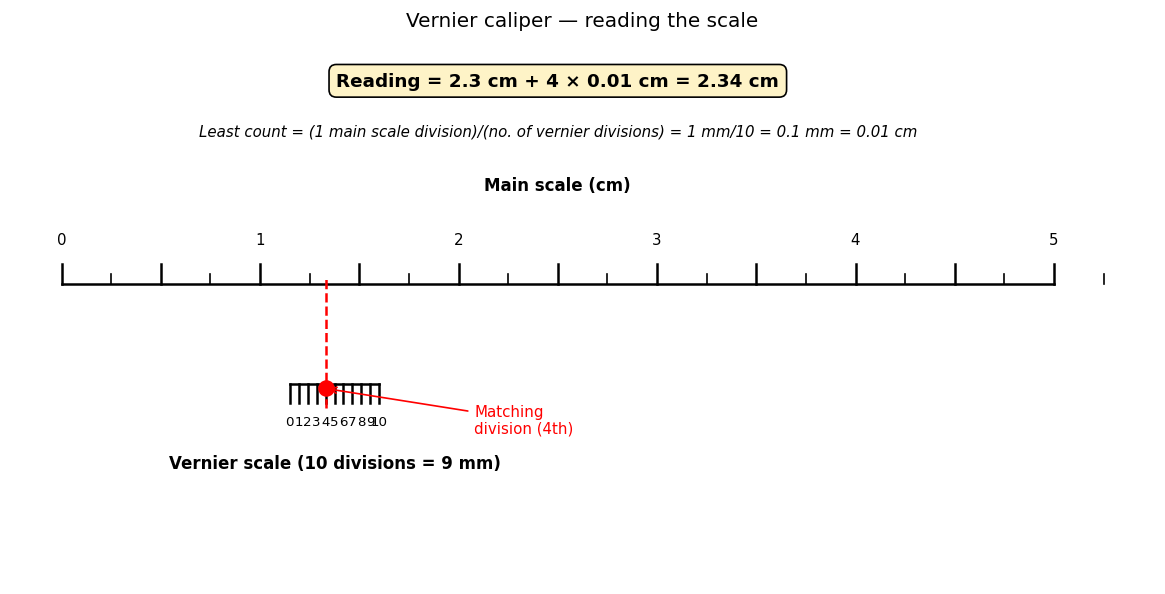
Study the vernier caliper diagram and answer:
The least count of this vernier caliper is:
A0.001 cm
B0.01 cm
C0.1 cm
D1 cm
The reading shown by the vernier caliper is:
A2.04 cm
B2.34 cm
C2.40 cm
D2.44 cm
Explain how the vernier scale increases the precision of measurement.
Show answersHide answers
1. Option 2 — 0.01 cm
2. Option 2 — 2.34 cm
3. Least count = (1 main scale division)/(no. of vernier scale divisions) = 1 mm / 10 = 0.1 mm = 0.01 cm. Vernier reading = main scale value just before zero of vernier (2.3 cm) + (matching division × least count) = 2.3 + 4 × 0.01 = 2.34 cm. The vernier increases precision tenfold over the main scale.