SUMMARY: This chapter focuses on the concepts of motion in two dimensions, including vector analysis and projectile motion. KEY TOPICS: vectors, vector addition, scalar and vector products, motion in a plane, projectile motion, uniform circular motion, relative velocity in two dimensions, equations of motion in vector form, centripetal acceleration.
The horizontal range of a projectile is maximum when its angle of projection is:
A30°
B45°
C60°
D90°
Check answerHide answer
Correct answer: Option 2 — 45°
Q21 Mark
At the highest point of a projectile's path the velocity is:
AZero
BVertical only
CHorizontal only
DSame as initial
Check answerHide answer
Correct answer: Option 3 — Horizontal only
Q31 Mark
Two vectors A and B have magnitudes 3 and 4 and the angle between them is 90°. Their resultant has magnitude:
A1
B5
C7
D12
Check answerHide answer
Correct answer: Option 2 — 5
Q41 Mark
A boat moving with velocity v in still water faces a river current u. To cross perpendicular to the bank:
ABoat heads straight across
BBoat heads upstream at angle
CBoat heads downstream at angle
DCannot cross
Check answerHide answer
Correct answer: Option 2 — Boat heads upstream at angle
Q51 Mark
Centripetal acceleration is directed:
ATangent to the path
BToward the centre
CAway from the centre
DAlong the velocity
Check answerHide answer
Correct answer: Option 2 — Toward the centre
Short Answer Questions5 questions
Q63 Marks
Distinguish between scalar and vector quantities.
View sample solutionHide solution
Scalars: have only magnitude (e.g., mass, time, energy, speed). Vectors: have magnitude AND direction (e.g., displacement, velocity, force, acceleration). Vectors follow special addition rules (parallelogram or triangle law). Scalars can be added by ordinary arithmetic.
Q73 Marks
Find the magnitude and direction of the resultant of two vectors of magnitudes 3 N and 4 N at right angles to each other.
View sample solutionHide solution
Resultant magnitude: R = √(3² + 4²) = √25 = 5 N. Direction: tan θ = 4/3 ⇒ θ = tan⁻¹(4/3) ≈ 53.13° from the 3 N vector toward the 4 N vector. The 3-4-5 right triangle gives a clean numerical example.
Q83 Marks
A projectile is launched at 30° above horizontal with speed 20 m/s. Find the time of flight. (g = 10 m/s²)
View sample solutionHide solution
Initial vertical velocity u_y = 20 sin 30° = 10 m/s. Time to reach max height = u_y / g = 10/10 = 1 s. By symmetry total time of flight = 2 × 1 = 2 s.
Q93 Marks
Define centripetal acceleration and write its formula.
View sample solutionHide solution
Centripetal acceleration is the acceleration of a particle moving in a circle directed toward the centre of the circle. Magnitude: a_c = v²/r = ω²r where v is linear speed r the radius and ω the angular velocity. It changes the direction of velocity (not the magnitude) so the speed remains constant in uniform circular motion.
Q103 Marks
A car moves on a circular track of radius 50 m at 10 m/s. Calculate its centripetal acceleration.
View sample solutionHide solution
a_c = v²/r = 10²/50 = 100/50 = 2 m/s². Directed toward the centre of the circular track. The force needed to provide this acceleration is F = ma_c provided by friction between tyres and road.
Long Answer Questions6 questions
Q116 Marks
Derive the expressions for time of flight, maximum height, and horizontal range of a projectile launched at angle θ with speed u from horizontal ground.
View sample solutionHide solution
Initial velocity components: u_x = u cos θ (constant) u_y = u sin θ (acted on by g). (i) Time of flight T: vertical displacement = 0 ⇒ 0 = u_y T − (1/2) g T² ⇒ T = (2 u sin θ)/g. (ii) Max height H: at apex v_y = 0; 0 = u_y² − 2gH ⇒ H = (u sin θ)²/(2g) = u² sin²θ / (2g). (iii) Range R: R = u_x · T = (u cos θ)(2 u sin θ / g) = u² sin(2θ)/g. R is max when sin 2θ = 1 ⇒ θ = 45°.
Q126 Marks
A stone is thrown horizontally from a 20 m high cliff with speed 10 m/s. Find: (i) time of flight, (ii) horizontal range, (iii) velocity just before hitting ground. (g = 10 m/s²)
View sample solutionHide solution
(i) Vertical: 20 = (1/2)(10) t² ⇒ t² = 4 ⇒ t = 2 s. (ii) Horizontal range: x = v_x · t = 10 × 2 = 20 m. (iii) Final velocities: v_x = 10 m/s (unchanged); v_y = g t = 10 × 2 = 20 m/s downward. Resultant: √(10² + 20²) = √500 = 22.36 m/s. Direction: tan α = 20/10 = 2 ⇒ α ≈ 63.4° below horizontal.
Q136 Marks
Discuss the motion of a particle in uniform circular motion and derive the formula for centripetal acceleration.
View sample solutionHide solution
In UCM the particle moves at constant speed v on a circle of radius r. The velocity vector changes direction continuously (not magnitude) so there must be acceleration. Using the geometry of two velocity vectors at small time interval Δt: |Δv| ≈ v(Δθ); |Δθ| = (vΔt)/r. So |a| = |Δv|/Δt = v · (v/r) = v²/r. The direction of Δv (and hence a) points toward the centre — centripetal. Force required: F = mv²/r provided by gravity (orbits) friction (cars) or string tension (pendulum).
Q146 Marks
Two forces of 5 N and 12 N act at right angles. Find the resultant and its direction. Then find the net force if a third force of 13 N is added antiparallel to the resultant.
View sample solutionHide solution
(i) Resultant of 5 N and 12 N at 90°: R = √(5² + 12²) = √169 = 13 N. Direction: tan θ = 12/5 ⇒ θ = tan⁻¹(2.4) ≈ 67.4° from the 5 N force. (ii) A third force of 13 N antiparallel to R: net force = 13 − 13 = 0 N. The system is in equilibrium.
Q156 Marks
State and explain the parallelogram law of vector addition. Use it to find the resultant of two equal vectors A acting at angle 60°.
View sample solutionHide solution
Parallelogram law: if two vectors are represented by two adjacent sides of a parallelogram drawn from the same point the diagonal from that point gives their resultant. Magnitude formula: R² = A² + B² + 2AB cos θ where θ is the angle between A and B. For two equal vectors A at 60°: R² = A² + A² + 2A² cos 60° = 2A² + A² = 3A² ⇒ R = A√3. Direction: tan α = (A sin 60°)/(A + A cos 60°) = (√3/2)/(3/2) = 1/√3 ⇒ α = 30°.
Q166 Marks
Differentiate between scalar and vector quantities in tabular form with two examples each.
Assertion–Reason Questions5 questions
Q171 Mark
Assertion (A): The horizontal range of a projectile is maximum when angle of projection is 45°.
Reason (R): The range R = u² sin(2θ)/g is maximum when sin(2θ) = 1 i.e. 2θ = 90°.
Show explanationHide explanation
Correct answer: Option 1 —
Both A and R are true, and R is the correct explanation of A.
Q181 Mark
Assertion (A): A body moving in a horizontal circle at constant speed has acceleration.
Reason (R): The direction of velocity changes continuously even though the magnitude is constant — change in velocity means acceleration.
Show explanationHide explanation
Correct answer: Option 1 —
Both A and R are true, and R is the correct explanation of A.
Q191 Mark
Assertion (A): Two vectors of equal magnitude can have a zero resultant.
Reason (R): If they are equal in magnitude but opposite in direction their sum is zero.
Show explanationHide explanation
Correct answer: Option 1 —
Both A and R are true, and R is the correct explanation of A.
Q201 Mark
Assertion (A): At the highest point of a projectile's trajectory the velocity is non-zero.
Reason (R): The horizontal component of velocity is constant throughout the flight (no horizontal force).
Show explanationHide explanation
Correct answer: Option 1 —
Both A and R are true, and R is the correct explanation of A.
Q211 Mark
Assertion (A): A boat needs to head upstream to cross a river perpendicular to its banks.
Reason (R): The boat's resultant velocity must point straight across — so its heading must compensate for the downstream river current.
Show explanationHide explanation
Correct answer: Option 1 —
Both A and R are true, and R is the correct explanation of A.
Statement-Based Questions5 questions
Q221 Mark
Statement 1: A vector quantity has both magnitude and direction.
Statement 2: Vector addition follows the triangle or parallelogram law not ordinary arithmetic.
Show answerHide answer
Correct answer: Option 1 —
Both statements are true.
Q231 Mark
Statement 1: The path of a projectile under gravity is parabolic.
Statement 2: Time of flight depends on the vertical component of initial velocity and g.
Show answerHide answer
Correct answer: Option 1 —
Both statements are true.
Q241 Mark
Statement 1: Centripetal acceleration is directed toward the centre.
Statement 2: The force providing centripetal acceleration is called the centripetal force.
Show answerHide answer
Correct answer: Option 1 —
Both statements are true.
Q251 Mark
Statement 1: The resultant of two perpendicular vectors A and B has magnitude √(A² + B²).
Statement 2: Their direction can be found using tan θ = B/A.
Show answerHide answer
Correct answer: Option 1 —
Both statements are true.
Q261 Mark
Statement 1: The relative velocity of A with respect to B is v_AB = v_A − v_B.
Statement 2: The relative velocity reverses sign when viewed from B's frame instead of A's.
Show answerHide answer
Correct answer: Option 1 —
Both statements are true.
Case Study / Passage Questions3 questions
Q273 Marks
A football is kicked with initial velocity 20 m/s at angle 30° above horizontal. Ignoring air resistance the coach wants to determine the time of flight maximum height reached and horizontal range. Use g = 10 m/s².
The total time of flight is:
A1 s
B2 s
C3 s
D4 s
The maximum height reached is:
A5 m
B10 m
C15 m
D20 m
Calculate the horizontal range and verify R = u_x × T.
Show answersHide answers
1. Option 2 — 2 s
2. Option 1 — 5 m
3. u = 20 m/s θ = 30°. u_x = 20 cos 30° = 17.32 m/s; u_y = 20 sin 30° = 10 m/s. Time of flight: T = 2u_y/g = 20/10 = 2 s. Max height: H = u_y²/(2g) = 100/20 = 5 m. Range: R = u² sin(2θ)/g = 400 × sin 60°/10 = 400 × 0.866/10 = 34.64 m.
Q283 Marks
A river flows at 3 m/s. A boat that can move at 5 m/s in still water is to cross the river. The captain wants to know the resultant velocity if the boat heads (i) straight across and (ii) the angle the boat must make with the bank to cross perpendicular to the bank.
If boat heads straight across (perpendicular to current) the resultant speed is:
A3 m/s
B4 m/s
C5 m/s
D√34 m/s
To cross perpendicular to the bank the boat must head upstream at angle θ where:
Asin θ = 3/5
Bcos θ = 3/5
Ctan θ = 3/5
Dsin θ = 5/3
Compute the time to cross a 100 m wide river in case (ii).
Show answersHide answers
1. Option 4 — √34 m/s
2. Option 1 — sin θ = 3/5
3. (i) Boat velocity 5 m/s perpendicular to bank; current 3 m/s along bank. Resultant magnitude = √(5² + 3²) = √34 ≈ 5.83 m/s; direction at angle tan⁻¹(3/5) ≈ 31° from perpendicular (drifted downstream). (ii) For purely perpendicular crossing horizontal component of boat velocity must cancel current: 5 sin θ = 3 ⇒ sin θ = 3/5 ⇒ θ = 36.87° upstream of normal. Then resultant = 5 cos θ = 4 m/s straight across.
Q293 Marks
A car of mass 800 kg goes around a curve of radius 50 m at speed 20 m/s. The road is banked at angle θ. Ignoring friction the engineer wants to find the centripetal force the banking angle for which no friction is needed and the time period of one full circle.
The centripetal force needed equals:
A3200 N
B6400 N
C12800 N
D16000 N
The banking angle for friction-free turning satisfies:
Atan θ = v²/(rg)
Btan θ = rg/v²
Ctan θ = v/(rg)
Dtan θ = vr/g
Why are roads banked on sharp turns?
Show answersHide answers
1. Option 2 — 6400 N
2. Option 1 — tan θ = v²/(rg)
3. F_centripetal = mv²/r = 800 × 400/50 = 6400 N. For frictionless banked road: tan θ = v²/(rg) = 400/(50 × 10) = 0.8 ⇒ θ ≈ 38.7°. Time period of one full circle T = 2πr/v = 2π × 50/20 = 5π ≈ 15.7 s. The banking allows the horizontal component of normal force to provide the centripetal force eliminating reliance on friction.
Table-Based Questions3 questions
Q303 Marks
Study the projectile motion at angle of 45°:
Quantity
Formula at θ = 45°
u_x
u/√2
u_y
u/√2
Time of flight T
u√2/g
Max height H
u²/(4g)
Range R
u²/g (max!)
Range is maximum at angle:
A30°
B45°
C60°
D90°
At θ = 45° the ratio u_x : u_y is:
A√2:1
B1:√2
C1:1
D1:2
Verify the range R = u²/g at θ = 45° using R = u² sin(2θ)/g.
Show answersHide answers
1. Option 2 — 45°
2. Option 3 — 1:1
3. At θ = 45° the horizontal and vertical components of initial velocity are equal (u/√2 each). This balances time-aloft (depends on u_y) with horizontal speed (u_x) so range = (u² × 2 sin θ cos θ)/g = u²/g × sin(2θ); maximum when sin(2θ) = 1 ⇒ 2θ = 90° ⇒ θ = 45°. Note: this assumes flat ground; non-zero starting height shifts the optimum angle.
Q313 Marks
Study the resultant of two vectors with magnitudes |A| and |B| at angle θ:
Angle θ
|R|
0°
|A| + |B|
90°
√(A² + B²)
180°
||A| − |B|||
60°
√(A² + B² + AB)
For A = 3 N B = 4 N at angle 0° the resultant equals:
A5 N
B7 N
C12 N
D√34 N
For A = 3 N B = 4 N at angle 90° the resultant equals:
A5 N
B7 N
C12 N
D√34 N
Find the resultant of A = 3 N and B = 4 N at θ = 60°.
Show answersHide answers
1. Option 2 — 7 N
2. Option 1 — 5 N
3. R² = A² + B² + 2AB cos θ. For θ = 0°: R = A + B (vectors aligned). For θ = 90°: R = √(A² + B²) (perpendicular). For θ = 180°: R = |A − B| (anti-parallel — minimum). General formula: R² = A² + B² + 2AB cos θ. The resultant magnitude varies from |A − B| to A + B as θ varies from 180° to 0°.
Q326 Marks
A projectile is launched at 60° above horizontal with speed 40 m/s. Compute (i) time of flight, (ii) maximum height reached, (iii) horizontal range. (g = 10 m/s²)
Quantity
Value
Launch speed u
40 m/s
Launch angle θ
60°
g
10 m/s²
Picture-Based Questions1 question
Q333 Marks
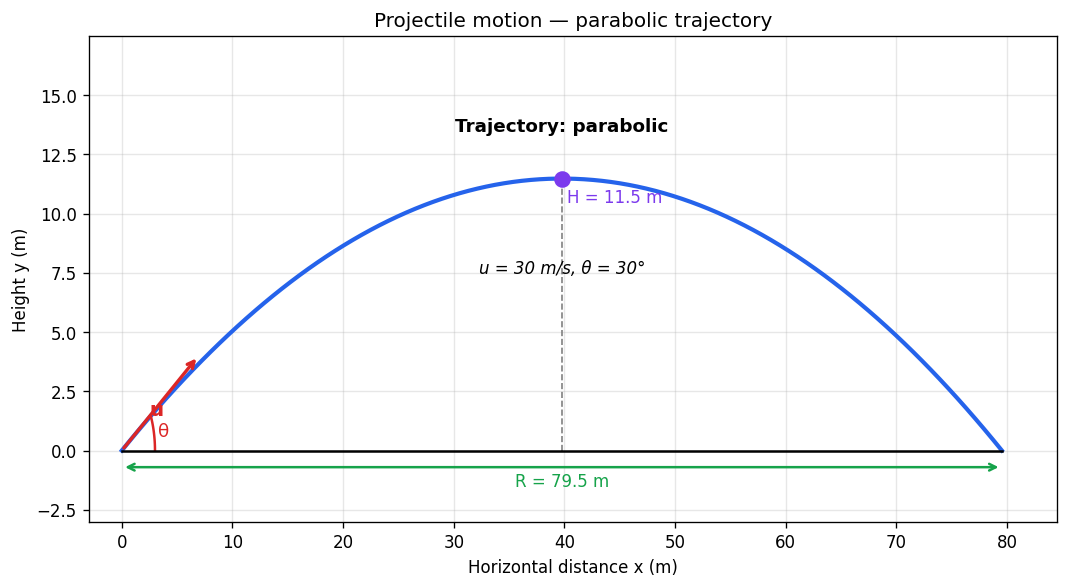
Study the projectile trajectory diagram and answer:
The path of a projectile launched at an angle is:
ALinear
BParabolic
CHyperbolic
DCircular
The horizontal range R is maximum when angle of projection equals:
A30°
B45°
C60°
D90°
Derive the formulas for time of flight, maximum height, and range.
Show answersHide answers
1. Option 2 — Parabolic
2. Option 2 — 45°
3. Horizontal motion: x = (u cos θ) t (uniform velocity). Vertical motion: y = (u sin θ) t − (1/2)gt² (uniformly accelerated). Eliminating t: y = x tan θ − (g x²)/(2u² cos² θ) — a parabola. Time of flight T = 2u sin θ/g. Maximum height H = u² sin² θ/(2g). Horizontal range R = u² sin(2θ)/g — maximised at θ = 45° where sin(2θ) = 1.