SUMMARY: This chapter explores the concepts of work, energy, and power, and their interrelations in physical systems. KEY TOPICS: work done by a constant force, kinetic energy, work-energy theorem, potential energy, conservation of mechanical energy, power, scalar product of vectors, gravitational potential energy, elastic potential energy, law of conservation of energy.
Correct answer: Option 1 — Force and displacement are in the same direction
Q21 Mark
The kinetic energy of a body of mass m moving with velocity v is:
Amv
B(1/2)mv
C(1/2)mv²
Dmv²
Check answerHide answer
Correct answer: Option 3 — (1/2)mv²
Q31 Mark
The SI unit of power is:
AJoule
BNewton
CWatt
DPascal
Check answerHide answer
Correct answer: Option 3 — Watt
Q41 Mark
An elastic collision conserves:
AOnly momentum
BOnly kinetic energy
CBoth momentum and kinetic energy
DNeither
Check answerHide answer
Correct answer: Option 3 — Both momentum and kinetic energy
Q51 Mark
1 kWh equals:
A3.6 × 10⁶ J
B3.6 × 10⁵ J
C3.6 × 10³ J
D3.6 J
Check answerHide answer
Correct answer: Option 1 — 3.6 × 10⁶ J
Short Answer Questions5 questions
Q63 Marks
State the work-energy theorem.
View sample solutionHide solution
The work done by the net force on a body equals the change in its kinetic energy: W = ΔKE = (1/2)mv² − (1/2)mu². If the work is positive the body speeds up; if negative it slows down. Useful when applying forces aren't constant — only the start and end states matter.
Q73 Marks
Distinguish between conservative and non-conservative forces with examples.
View sample solutionHide solution
Conservative force: work done depends only on initial and final positions (independent of path); a potential energy function exists; work in a closed loop is zero. Examples: gravity electrostatic spring force. Non-conservative force: work done depends on the path; no potential function exists. Examples: friction air resistance viscous drag. Mechanical energy is conserved only when conservative forces act.
Q83 Marks
A body of mass 2 kg falls freely from a height of 10 m. Calculate its kinetic energy just before hitting the ground. (g = 10 m/s²)
View sample solutionHide solution
By conservation of energy: PE at top = KE at bottom (taking ground as reference). KE = mgh = 2 × 10 × 10 = 200 J. Verification: v = √(2gh) = √200 ≈ 14.14 m/s; KE = (1/2)(2)(200) = 200 J. ✓
Q93 Marks
A man pulls a 50 kg load up a 5 m high inclined plane at constant speed. Calculate the work done against gravity. (g = 10 m/s²)
View sample solutionHide solution
Work against gravity = m·g·h = 50 × 10 × 5 = 2500 J. The work done depends only on the vertical height (gravity is conservative); the inclined-plane length doesn't appear in this calculation — it just changes the force needed (smaller force × longer path).
Q103 Marks
Define power and write its formula.
View sample solutionHide solution
Power is the rate of doing work or the rate of energy transfer. P = W/t (average power) or P = dW/dt (instantaneous). For a constant force F moving with velocity v: P = F · v. SI unit: watt (W) = J/s. 1 horsepower (hp) ≈ 746 W.
Long Answer Questions6 questions
Q116 Marks
State and prove the law of conservation of mechanical energy for a body falling freely under gravity.
View sample solutionHide solution
Conservation of mechanical energy: in absence of non-conservative forces (friction etc.) the sum of kinetic + potential energy of a system is constant. Proof for free fall: at height h above ground PE = mgh KE = 0. After falling distance h speed v = √(2gh) so KE = (1/2)m(2gh) = mgh; PE at ground = 0. Total = mgh + 0 = 0 + mgh ✓. The same total energy mgh holds at every point during the fall — only the partition between KE and PE changes.
Q126 Marks
A ball of mass 0.5 kg is thrown upward with velocity 20 m/s. Calculate (i) maximum height reached, (ii) potential energy at max height, (iii) kinetic energy at half max height. (g = 10 m/s²)
View sample solutionHide solution
(i) v² = u² − 2gh; at max: 0 = 400 − 20h ⇒ h = 20 m. (ii) PE at max = mgh = 0.5 × 10 × 20 = 100 J. (iii) At half max height (10 m): PE = 0.5 × 10 × 10 = 50 J; total energy is conserved = 100 J; KE = 100 − 50 = 50 J.
Q136 Marks
Distinguish between elastic and inelastic collisions. Show that in a perfectly elastic 1D collision between two bodies, the relative velocity of approach equals the relative velocity of separation.
View sample solutionHide solution
Elastic: both KE and momentum conserved (e.g. molecular collisions, billiards approximately). Inelastic: only momentum conserved; KE not conserved (e.g. bullet embedding in block — perfectly inelastic). For 1D elastic collision: m₁u₁ + m₂u₂ = m₁v₁ + m₂v₂ (momentum) AND (1/2)m₁u₁² + (1/2)m₂u₂² = (1/2)m₁v₁² + (1/2)m₂v₂² (KE). Algebraic manipulation gives v₁ − v₂ = −(u₁ − u₂) — i.e. velocity of separation = velocity of approach. The minus sign shows direction reversal.
Q146 Marks
A 5 kg block on a horizontal surface is given an initial velocity of 10 m/s. Coefficient of friction is 0.4. Calculate (i) deceleration, (ii) distance travelled before stopping, (iii) work done by friction. (g = 10 m/s²)
View sample solutionHide solution
Friction force f = μmg = 0.4 × 5 × 10 = 20 N. (i) Deceleration a = f/m = 20/5 = 4 m/s². (ii) v² = u² − 2as: 0 = 100 − 8s ⇒ s = 12.5 m. (iii) Work done by friction W = f × s with negative sign (opposing motion): W = −20 × 12.5 = −250 J. Verification by work-energy: ΔKE = 0 − (1/2)(5)(100) = −250 J ✓.
Q156 Marks
A pump can lift 1000 kg of water through a height of 10 m in 20 s. Calculate the power of the pump. (g = 10 m/s²)
View sample solutionHide solution
Work done in lifting: W = mgh = 1000 × 10 × 10 = 10⁵ J = 100 kJ. Power = Work/time = 10⁵/20 = 5000 W = 5 kW. (Equivalently 5/0.746 ≈ 6.7 hp.) This is mechanical output power; an actual pump has efficiency < 100% so input electrical power would be higher.
Q166 Marks
Differentiate between conservative and non-conservative forces in tabular form with examples.
Assertion–Reason Questions5 questions
Q171 Mark
Assertion (A): Kinetic energy depends on the square of velocity.
Reason (R): KE = (1/2)mv² so doubling v quadruples KE.
Show explanationHide explanation
Correct answer: Option 1 —
Both A and R are true, and R is the correct explanation of A.
Q181 Mark
Assertion (A): In free fall mechanical energy is conserved.
Reason (R): Only conservative force (gravity) acts and air resistance is neglected.
Show explanationHide explanation
Correct answer: Option 1 —
Both A and R are true, and R is the correct explanation of A.
Q191 Mark
Assertion (A): The unit of power is watt.
Reason (R): 1 watt equals 1 joule per second.
Show explanationHide explanation
Correct answer: Option 1 —
Both A and R are true, and R is the correct explanation of A.
Q201 Mark
Assertion (A): No work is done by a porter holding a load on his head while standing still.
Reason (R): Work = force × displacement; with zero displacement work is zero regardless of the force exerted.
Show explanationHide explanation
Correct answer: Option 1 —
Both A and R are true, and R is the correct explanation of A.
Q211 Mark
Assertion (A): In an elastic collision both kinetic energy and momentum are conserved.
Reason (R): Elastic means no energy is lost to deformation or heat — KE is preserved as well as momentum.
Show explanationHide explanation
Correct answer: Option 1 —
Both A and R are true, and R is the correct explanation of A.
Statement-Based Questions5 questions
Q221 Mark
Statement 1: Work is a scalar quantity.
Statement 2: Work has the same units as energy.
Show answerHide answer
Correct answer: Option 1 —
Both statements are true.
Q231 Mark
Statement 1: Kinetic energy = (1/2)mv².
Statement 2: Gravitational PE near Earth's surface = mgh.
Show answerHide answer
Correct answer: Option 1 —
Both statements are true.
Q241 Mark
Statement 1: In an isolated system mechanical energy is conserved if only conservative forces act.
Statement 2: If non-conservative forces act mechanical energy decreases (lost as heat sound etc.).
Show answerHide answer
Correct answer: Option 1 —
Both statements are true.
Q251 Mark
Statement 1: Power is the rate of doing work.
Statement 2: For a constant force P = F · v.
Show answerHide answer
Correct answer: Option 1 —
Both statements are true.
Q261 Mark
Statement 1: In a perfectly elastic collision both KE and momentum are conserved.
Statement 2: In a perfectly inelastic collision only momentum is conserved.
Show answerHide answer
Correct answer: Option 1 —
Both statements are true.
Case Study / Passage Questions3 questions
Q273 Marks
A worker pushes a 50 kg load up a frictionless inclined plane of length 5 m and angle 30° above horizontal. The supervisor wants to determine the work done against gravity the change in potential energy and the minimum force needed (along the incline) to maintain constant velocity. Use g = 10 m/s².
Work done against gravity equals:
A250 J
B500 J
C1250 J
D2500 J
The minimum force needed along the incline is:
A200 N
B250 N
C400 N
D500 N
Compare the work against gravity with the work the worker did using F × L.
Show answersHide answers
1. Option 3 — 1250 J
2. Option 2 — 250 N
3. Vertical height gained: h = L sin θ = 5 × 0.5 = 2.5 m. Work against gravity: W = mgh = 50 × 10 × 2.5 = 1250 J. ΔPE = +1250 J (gravity is conservative). Force along incline (constant velocity ⇒ net force = 0): F = mg sin θ = 50 × 10 × 0.5 = 250 N. Verification: W = F × L = 250 × 5 = 1250 J ✓.
Q283 Marks
A ball is dropped from a height of 5 m onto a hard floor. It rebounds to a height of 3.2 m. The student wants to compute the coefficient of restitution the percentage of energy lost in the collision and determine if the collision is elastic.
The coefficient of restitution e equals:
A0.6
B0.7
C0.8
D0.9
The percentage of mechanical energy lost in the collision is:
A16%
B24%
C36%
D64%
Why does the ball lose energy during each bounce?
Show answersHide answers
1. Option 3 — 0.8
2. Option 3 — 36%
3. v_down (just before impact) = √(2gh₁) = √100 = 10 m/s. v_up (just after impact) = √(2gh₂) = √64 = 8 m/s. Coefficient of restitution e = v_after/v_before = 8/10 = 0.8. Energy lost: KE before = (1/2)mv² ∝ v² = 100; KE after ∝ 64. Percentage loss = (100 − 64)/100 × 100 = 36%. Since e ≠ 1 the collision is INELASTIC (some KE converted to heat sound deformation).
Q293 Marks
A water pump can lift 2000 kg of water through a height of 15 m in 1 minute. The engineer wants to compute the power of the pump in watts and horsepower and the power if the same job is done in 30 s. Use g = 10 m/s².
The power of the pump equals:
A2.5 kW
B5 kW
C7.5 kW
D10 kW
The power in horsepower (1 hp ≈ 746 W) is:
A3.4 hp
B6.7 hp
C8.7 hp
D13.4 hp
Calculate the power if the lift took 2 minutes instead.
Show answersHide answers
1. Option 2 — 5 kW
2. Option 2 — 6.7 hp
3. Work done = mgh = 2000 × 10 × 15 = 300000 J = 300 kJ. Power = W/t = 300000/60 = 5000 W = 5 kW. In horsepower: P/746 = 5000/746 ≈ 6.7 hp. If the job is done in 30 s: P = 300000/30 = 10000 W = 10 kW. Power doubles when time is halved (same work in less time means higher power).
Table-Based Questions4 questions
Q303 Marks
Study energy forms and conservation:
Form of energy
Formula
Kinetic
(1/2)mv²
Gravitational PE
mgh
Spring PE
(1/2)kx²
Heat
mc·ΔT
Electrical (battery)
W = qV
Kinetic energy formula:
A(1/2)mv
B(1/2)mv²
Cmv²
D(1/2)mv³
(1/2)kx² is the formula for:
AKE
BPE
CSpring PE
DHeat
Convert the spring PE for k = 100 N/m and x = 0.1 m to numerical value.
Show answersHide answers
1. Option 2 — (1/2)mv²
2. Option 3 — Spring PE
3. Energy comes in many forms but the law of conservation states that the total energy of an isolated system is constant — only converted between forms. KE = (1/2)mv² for a moving body; PE near surface of Earth = mgh; spring PE = (1/2)kx² where x is extension/compression. In a closed system: KE + PE + heat + ... = constant. Engines convert one form to another with some loss (always to heat).
Q313 Marks
Study elastic vs inelastic collisions:
Type
Momentum
Kinetic energy
Perfectly elastic
Conserved
Conserved
Inelastic
Conserved
Not conserved
Perfectly inelastic
Conserved
Maximum loss (bodies stick)
In an inelastic collision what is conserved?
ABoth
BOnly momentum
COnly KE
DNeither
When two bodies stick together after collision the collision is:
APerfectly elastic
BInelastic
CPerfectly inelastic
DCannot decide
Calculate the velocity after a perfectly inelastic collision: 1 kg at 6 m/s hits 2 kg at rest.
Show answersHide answers
1. Option 2 — Only momentum
2. Option 3 — Perfectly inelastic
3. Momentum is ALWAYS conserved in any collision (no external force acts during the collision). Kinetic energy is conserved only in PERFECTLY ELASTIC collisions (e.g. atomic-scale or hard-sphere idealised cases). In real world most collisions are inelastic — some KE is lost to heat sound deformation. Perfectly inelastic = bodies stick; the maximum possible energy loss occurs.
Q326 Marks
A spring of force constant k = 200 N/m is compressed by 0.10 m. Compute (i) the elastic potential energy stored, (ii) the maximum velocity attained by a 0.5 kg mass attached to the spring when released, (iii) the maximum acceleration.
Quantity
Value
Spring constant k
200 N/m
Compression x
0.10 m
Mass
0.5 kg
Q336 Marks
A 2 kg ball moving at 5 m/s collides head-on with a stationary 3 kg ball. Compute the final velocities if the collision is (a) perfectly elastic, (b) perfectly inelastic.
Quantity
Value
m₁
2 kg
u₁
5 m/s
m₂
3 kg
u₂
0
Picture-Based Questions1 question
Q343 Marks
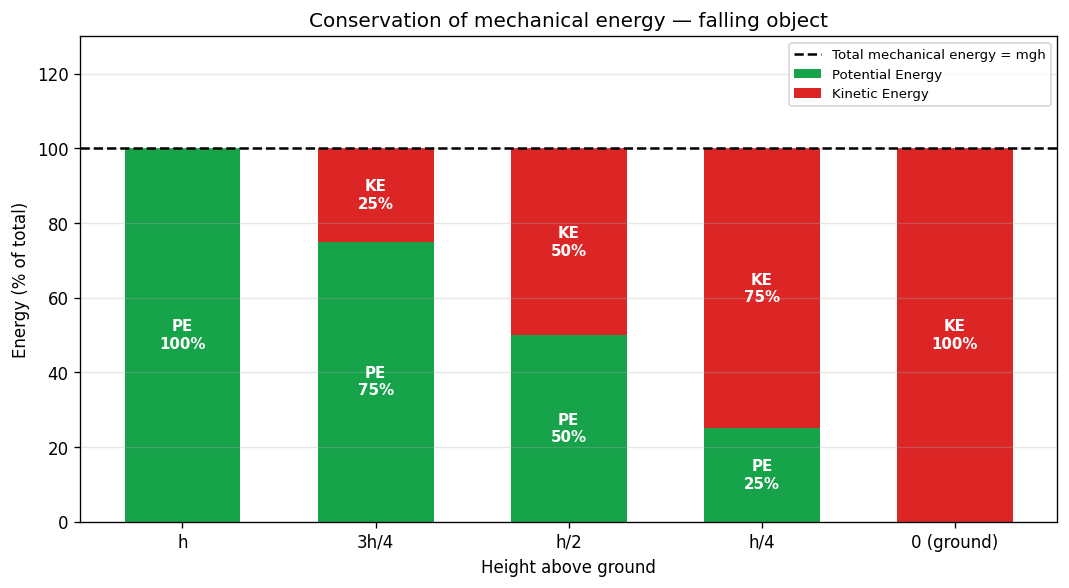
Study the energy partition during free fall and answer:
The total mechanical energy (KE + PE) during free fall is:
AMaximum at top, minimum at ground
BMinimum at top, maximum at ground
CConstant throughout the fall
DZero at all points
At half the original height the energy partition is:
A100% PE, 0% KE
B50% PE, 50% KE
C0% PE, 100% KE
D25% PE, 75% KE
Verify the law of conservation of mechanical energy using the chart.
Show answersHide answers
1. Option 3 — Constant throughout the fall
2. Option 2 — 50% PE, 50% KE
3. Conservation of mechanical energy: in absence of air resistance KE + PE = constant during free fall. At top: all PE (= mgh), zero KE. At any height h': PE = mgh', KE = mg(h − h'). At ground: PE = 0, KE = mgh. The total energy mgh remains constant throughout. The bar chart shows the fraction in each form at five heights — inversely related, summing to 100%.