Mechanical Properties of Fluids — Important Questions
33 questions
With answersCBSE format
SUMMARY: This chapter explores the behavior and properties of fluids, including their mechanical properties and the principles governing fluid dynamics and statics. KEY TOPICS: fluid pressure, Pascal's law, Archimedes' principle, buoyancy, Bernoulli's principle, viscosity, streamline flow, turbulent flow, surface tension, capillarity
The buoyant force on a body immersed in a fluid equals:
AWeight of body
BVolume of body
CWeight of fluid displaced
DDensity of fluid
Check answerHide answer
Correct answer: Option 3 — Weight of fluid displaced
Q41 Mark
Bernoulli's equation is a statement of conservation of:
AMass
BEnergy
CMomentum
DPressure
Check answerHide answer
Correct answer: Option 2 — Energy
Q51 Mark
The terminal velocity of a sphere falling in a viscous fluid is determined by:
ANewton's law
BStokes' law
CHooke's law
DPascal's law
Check answerHide answer
Correct answer: Option 2 — Stokes' law
Short Answer Questions5 questions
Q63 Marks
State Pascal's law and give one application.
View sample solutionHide solution
Pascal's law: pressure applied at any point in an enclosed incompressible fluid is transmitted equally and undiminished in all directions throughout the fluid. Application: hydraulic press / hydraulic brakes — small force on small piston produces large force on big piston (multiplied by area ratio).
Q73 Marks
State Archimedes' principle.
View sample solutionHide solution
Archimedes' principle: a body wholly or partially immersed in a fluid experiences an upward buoyant force equal to the weight of the fluid displaced. F_buoyancy = ρ_fluid × V_displaced × g. This is why ships float (their average density is less than water due to hollow interior) and how submarines control depth.
Q83 Marks
State Bernoulli's principle and write its equation.
View sample solutionHide solution
For an ideal incompressible non-viscous flowing fluid in steady (laminar) flow: P + (1/2)ρv² + ρgh = constant along a streamline. P = static pressure (1/2)ρv² = dynamic pressure ρgh = pressure due to height. Higher velocity ⇒ lower pressure (explains aerofoil lift atomizers Venturi effect).
Q93 Marks
Define viscosity. State the SI unit of coefficient of viscosity.
View sample solutionHide solution
Viscosity is the property of a fluid by which it resists relative motion between its layers — fluid 'friction'. It arises from intermolecular forces and momentum exchange. Coefficient of viscosity η: F = η A (dv/dx) where A is contact area and dv/dx is velocity gradient. SI unit: pascal-second (Pa·s) or N·s/m². Honey is much more viscous than water.
Q103 Marks
A solid block of mass 5 kg and volume 0.002 m³ is fully immersed in water. Find the buoyant force and apparent weight. (ρ_water = 1000 kg/m³; g = 10 m/s²)
View sample solutionHide solution
Buoyant force = ρ_water × V × g = 1000 × 0.002 × 10 = 20 N. Real weight = mg = 5 × 10 = 50 N. Apparent weight = real weight − buoyant = 50 − 20 = 30 N. The block sinks because its weight exceeds the buoyant force.
Long Answer Questions6 questions
Q116 Marks
Derive Bernoulli's equation for steady incompressible non-viscous flow of fluid through a tube of varying cross-section.
View sample solutionHide solution
Apply work-energy theorem to a fluid element flowing from section A (cross-section A₁ height h₁ velocity v₁ pressure P₁) to section B (A₂ h₂ v₂ P₂). Work done by pressure: W_P = P₁A₁L₁ − P₂A₂L₂ = (P₁ − P₂)V (since A₁L₁ = A₂L₂ = V by continuity). Change in KE: ΔKE = (1/2) m (v₂² − v₁²) = (1/2)ρV(v₂² − v₁²). Change in PE: ΔPE = ρVg(h₂ − h₁). Energy conservation (W_P = ΔKE + ΔPE): (P₁ − P₂)V = (1/2)ρV(v₂² − v₁²) + ρVg(h₂ − h₁). Dividing by V and rearranging: P₁ + (1/2)ρv₁² + ρgh₁ = P₂ + (1/2)ρv₂² + ρgh₂.
Q126 Marks
Derive the expression for the terminal velocity of a sphere falling in a viscous fluid using Stokes' law.
View sample solutionHide solution
Stokes' law for sphere of radius r moving with velocity v in fluid of viscosity η: F_viscous = 6πηrv. At terminal velocity v_t the net force is zero: weight = buoyancy + viscous drag. m·g − ρ_fluid·V·g = 6πηrv_t. Where m = ρ_sphere V V = (4/3)πr³. Solving: v_t = (2/9)(ρ_sphere − ρ_fluid)gr²/η. Terminal velocity scales as r² so larger droplets fall faster than mist. Used in centrifuge design and to determine viscosity from falling-ball experiments.
Q136 Marks
A hydraulic lift has cylinders of cross-sectional areas 10 cm² (small) and 500 cm² (large). What force on the small piston is needed to lift a 5000 N load on the large piston?
View sample solutionHide solution
Pascal's law: pressure transmitted equally. P = F₁/A₁ = F₂/A₂. Solve: F₁ = F₂ × A₁/A₂ = 5000 × (10/500) = 5000 × 0.02 = 100 N. So 100 N on the small piston balances 5000 N on the large — a mechanical advantage of 50. (Energy is conserved: small piston travels 50× the distance of the large piston.)
Q146 Marks
Explain the origin of surface tension and discuss capillary rise.
View sample solutionHide solution
Surface tension arises because molecules at a fluid surface experience inward attractive forces from neighbours below but no compensating force from above. The surface acts like a stretched membrane. Surface tension T = force per unit length at the surface (N/m). Capillary rise: when a fine tube is dipped in a fluid the fluid rises (or falls) because of adhesion (fluid-tube) and cohesion (fluid-fluid) forces. Height: h = (2T cos θ)/(ρgr) where θ is the contact angle r is the tube radius. h is large for narrow tubes — Jurin's law.
Q156 Marks
A horizontal water pipe narrows from a section of area 0.1 m² to 0.05 m². The velocity in the wider section is 2 m/s. Find (i) velocity in the narrower section (ii) pressure difference between the two sections. (ρ = 1000 kg/m³)
View sample solutionHide solution
(i) Continuity equation: A₁v₁ = A₂v₂ ⇒ v₂ = (0.1)(2)/0.05 = 4 m/s. (ii) Bernoulli (horizontal flow ignores h): P₁ + (1/2)ρv₁² = P₂ + (1/2)ρv₂². P₁ − P₂ = (1/2)ρ(v₂² − v₁²) = (1/2)(1000)(16 − 4) = 6000 Pa. Pressure is higher in the wider section (slower flow). This is the basis of the Venturi flowmeter.
Q166 Marks
Differentiate between streamline and turbulent flow in tabular form.
Assertion–Reason Questions5 questions
Q171 Mark
Assertion (A): Pressure applied at any point in an enclosed fluid is transmitted equally to all parts.
Reason (R): This is Pascal's law and is the basis for hydraulic devices.
Show explanationHide explanation
Correct answer: Option 1 —
Both A and R are true, and R is the correct explanation of A.
Q181 Mark
Assertion (A): Iron sinks in water but a ship made of iron floats.
Reason (R): A ship has air-filled hollow regions making its average density less than that of water.
Show explanationHide explanation
Correct answer: Option 1 —
Both A and R are true, and R is the correct explanation of A.
Q191 Mark
Assertion (A): An aircraft wing generates lift due to faster airflow on top.
Reason (R): By Bernoulli's principle higher velocity above the wing means lower pressure above creating a net upward force.
Show explanationHide explanation
Correct answer: Option 1 —
Both A and R are true, and R is the correct explanation of A.
Q201 Mark
Assertion (A): Honey is more viscous than water at the same temperature.
Reason (R): Honey has stronger intermolecular forces resisting flow — higher coefficient of viscosity.
Show explanationHide explanation
Correct answer: Option 1 —
Both A and R are true, and R is the correct explanation of A.
Q211 Mark
Assertion (A): Water rises in a narrow capillary tube but mercury falls.
Reason (R): Water wets glass (contact angle < 90° adhesion > cohesion); mercury does not wet glass (contact angle > 90°).
Show explanationHide explanation
Correct answer: Option 1 —
Both A and R are true, and R is the correct explanation of A.
Statement-Based Questions5 questions
Q221 Mark
Statement 1: Pressure increases with depth in a fluid.
Statement 2: Pressure at the same horizontal level in a connected fluid is equal.
Show answerHide answer
Correct answer: Option 1 —
Both statements are true.
Q231 Mark
Statement 1: An object floats if its average density is less than that of the fluid.
Statement 2: An object sinks if its average density exceeds that of the fluid.
Show answerHide answer
Correct answer: Option 1 —
Both statements are true.
Q241 Mark
Statement 1: Bernoulli's equation conserves energy for streamline flow.
Statement 2: Where velocity is high pressure is low.
Show answerHide answer
Correct answer: Option 1 —
Both statements are true.
Q251 Mark
Statement 1: Viscosity arises from intermolecular friction.
Statement 2: Coefficient of viscosity has units Pa·s.
Show answerHide answer
Correct answer: Option 1 —
Both statements are true.
Q261 Mark
Statement 1: Surface tension causes a fluid to minimise its surface area.
Statement 2: A liquid drop tends to be spherical because the sphere has the minimum surface-to-volume ratio.
Show answerHide answer
Correct answer: Option 1 —
Both statements are true.
Case Study / Passage Questions3 questions
Q273 Marks
A hydraulic press has a small piston of area 5 × 10⁻⁴ m² and a large piston of area 2.5 × 10⁻² m². A force of 50 N is applied to the small piston. The mechanic wants to compute the force exerted by the large piston and the mechanical advantage.
The force exerted by the large piston equals:
A500 N
B1500 N
C2500 N
D5000 N
The mechanical advantage of the press is:
A5
B10
C25
D50
If the small piston moves by 5 cm by how much does the large piston move?
Show answersHide answers
1. Option 3 — 2500 N
2. Option 4 — 50
3. By Pascal's law pressure is transmitted equally: P = F₁/A₁ = F₂/A₂. F₂ = F₁ × A₂/A₁ = 50 × 2.5 × 10⁻² / 5 × 10⁻⁴ = 50 × 50 = 2500 N. Mechanical advantage = F₂/F₁ = 50. Note: the small piston travels 50× the distance the large piston moves (energy conservation: F₁·d₁ = F₂·d₂).
Q283 Marks
A wooden block of volume 0.001 m³ and density 800 kg/m³ floats in water of density 1000 kg/m³. The student wants to find the fraction of the block submerged the buoyant force at equilibrium and the weight of water displaced.
The fraction of the block submerged equals:
A0.6
B0.7
C0.8
D0.9
The buoyant force on the block equals:
A4 N
B8 N
C12 N
D16 N
Verify the buoyant force equals the weight of the block.
Show answersHide answers
1. Option 3 — 0.8
2. Option 2 — 8 N
3. For floating: weight = buoyant force ⇒ ρ_block × V_total × g = ρ_water × V_submerged × g ⇒ V_sub/V_total = ρ_block/ρ_water = 800/1000 = 0.8. So 80% of the block is submerged. Buoyant force = ρ_water × V_sub × g = 1000 × 0.0008 × 10 = 8 N. This equals the weight of the block: 800 × 0.001 × 10 = 8 N ✓.
Q293 Marks
An aircraft wing has air flowing over its top at 100 m/s and underneath at 80 m/s. The wing area is 50 m². The aircraft engineer wants to compute the pressure difference between top and bottom of the wing and the lift force generated. Air density ρ = 1.2 kg/m³.
The pressure difference (bottom − top) equals:
A1080 Pa
B2160 Pa
C4320 Pa
D8640 Pa
The total lift force on the wing equals:
A5400 N
B54000 N
C108000 N
D216000 N
Why does air flow faster over the curved upper surface of the wing?
Show answersHide answers
1. Option 2 — 2160 Pa
2. Option 3 — 108000 N
3. By Bernoulli (horizontal): P_top + (1/2)ρv_top² = P_bottom + (1/2)ρv_bottom². Pressure difference = (1/2)ρ(v_top² − v_bottom²) = (1/2)(1.2)(100² − 80²) = 0.6 × 3600 = 2160 Pa. Lift force = ΔP × A = 2160 × 50 = 108000 N = 108 kN. This lift supports the aircraft — equal to about 11000 kg of weight. The wing's curved upper surface forces faster airflow on top creating lower pressure (suction) above and net upward force.
Table-Based Questions3 questions
Q303 Marks
Study fluid pressure-related laws:
The principle behind aircraft lift is:
APascal
BArchimedes
CBernoulli
DStokes
A ship floats due to:
APascal
BArchimedes
CBernoulli
DStokes
Use Stokes' law to compute the terminal velocity of a 1 mm raindrop in air.
Show answersHide answers
1. Option 3 — Bernoulli
2. Option 2 — Archimedes
3. These four laws cover most fluid statics and dynamics in NCERT. Pascal: enclosed-fluid pressure transmission (used in hydraulic systems). Archimedes: buoyancy (used in flotation density measurements). Bernoulli: streamline-flow energy conservation (used in lift Venturi atomizer). Stokes: viscous drag on small spheres (used in terminal velocity sedimentation).
Q313 Marks
Study viscosity coefficients of common fluids at 20°C:
Fluid
η (Pa·s)
Air
1.8 × 10⁻⁵
Water
1.0 × 10⁻³
Blood
3-4 × 10⁻³
Glycerine
1.49
Honey
10
Tar
3 × 10⁵
The most viscous fluid in the table is:
AAir
BWater
CHoney
DTar
Generally as temperature increases the viscosity of a liquid:
AIncreases
BDecreases
CRemains constant
DHas no trend
Why does honey flow more easily when warmed?
Show answersHide answers
1. Option 4 — Tar
2. Option 2 — Decreases
3. Viscosity quantifies internal friction of a fluid. Air is ~10⁵ times less viscous than water explaining why aerodynamic drag is much smaller than hydraulic resistance for objects of similar speed. Honey is ~10⁴ times more viscous than water. Tar is essentially solid at room temperature. Liquid viscosity decreases with temperature (molecules vibrate more bonds break easier); gas viscosity INCREASES with temperature (more molecular collisions).
Q326 Marks
A water pipe narrows from cross-section 0.04 m² to 0.01 m². Water enters the wider section at 1 m/s. Compute (i) velocity in narrower section, (ii) pressure difference between the two sections (assume horizontal flow, ρ = 1000 kg/m³).
Quantity
Value
A₁ (wide)
0.04 m²
A₂ (narrow)
0.01 m²
v₁
1 m/s
ρ_water
1000 kg/m³
Picture-Based Questions1 question
Q333 Marks
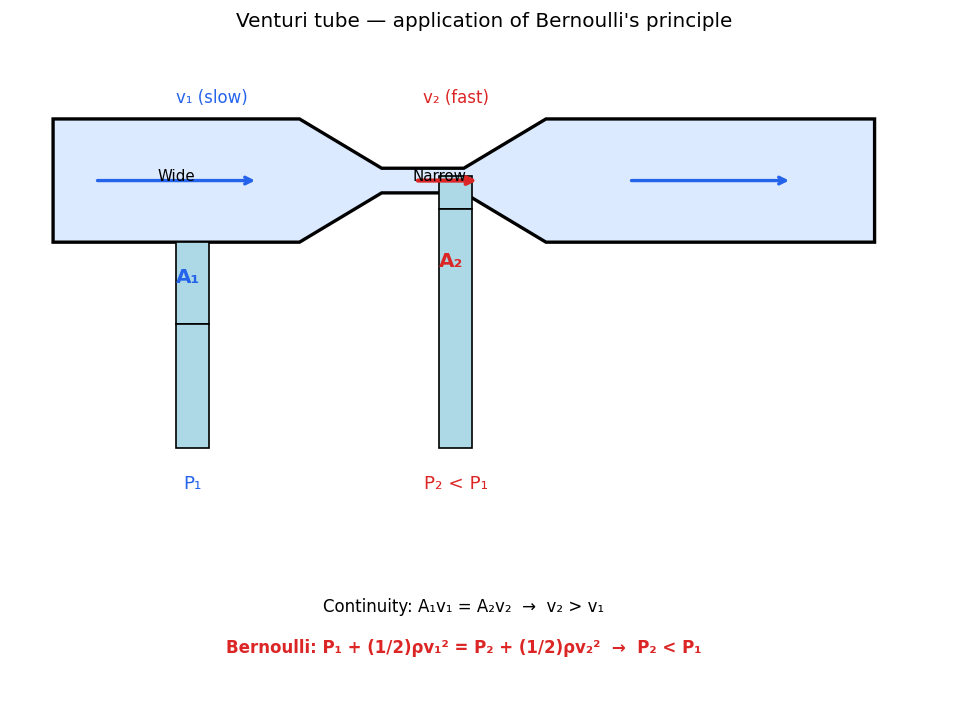
Study the Venturi tube schematic and answer:
By the equation of continuity (A₁v₁ = A₂v₂):
Av₁ < v₂
Bv₁ > v₂
Cv₁ = v₂
Dv₁ = 0
By Bernoulli's principle:
AP₁ > P₂
BP₁ < P₂
CP₁ = P₂
DP₁ = 0
Explain how the Venturi tube uses Bernoulli's principle and continuity to measure flow speed.
Show answersHide answers
1. Option 1 — v₁ < v₂
2. Option 1 — P₁ > P₂
3. Equation of continuity (mass conservation): for an incompressible fluid in steady flow A₁v₁ = A₂v₂. So where the pipe narrows (A₂ < A₁) the flow speeds up (v₂ > v₁). Bernoulli's principle (energy conservation along a streamline): P + (1/2)ρv² + ρgh = constant. For horizontal flow: P₁ + (1/2)ρv₁² = P₂ + (1/2)ρv₂². Faster flow ⇒ lower pressure. Hence P₂ < P₁ — visible as the higher manometer column on the right. This is the basis of the Venturi flowmeter: measure ΔP and use Bernoulli + continuity to find v.