SUMMARY: This chapter focuses on the fundamental principles governing the motion of objects and the forces acting upon them, as formulated by Newton. KEY TOPICS: Newton's First Law, Newton's Second Law, Newton's Third Law, inertia, momentum, equilibrium of a particle, common forces in mechanics, friction, circular motion, dynamics of uniform circular motion.
A body moving in a horizontal circle at constant speed has a force called:
AFrictional force
BCentripetal force
CCentrifugal force
DCoriolis force
Check answerHide answer
Correct answer: Option 2 — Centripetal force
Short Answer Questions5 questions
Q63 Marks
State Newton's three laws of motion.
View sample solutionHide solution
First law (inertia): a body remains at rest or in uniform motion unless acted upon by an external force. Second law: F = dp/dt = ma — net force equals rate of change of momentum. Third law: for every action there is an equal and opposite reaction.
Q73 Marks
Define impulse and write its relation with change in momentum.
View sample solutionHide solution
Impulse = force × time of action = F · Δt (for constant force). It equals the change in momentum: F · Δt = Δp = m(v − u). SI unit: N·s = kg·m/s. A large force acting for a short time (e.g. a hammer hit) gives the same impulse as a small force over a long time.
Q83 Marks
State the law of conservation of linear momentum.
View sample solutionHide solution
In an isolated system (no external force) the total linear momentum is conserved. Σ p_initial = Σ p_final. Follows from Newton's third law: in any internal interaction the equal-and-opposite forces produce equal-and-opposite changes in momentum which cancel.
Q93 Marks
A force of 10 N acts on a body of mass 2 kg for 5 s. Find the change in momentum and the resulting velocity if the body started from rest.
View sample solutionHide solution
Impulse = F · t = 10 × 5 = 50 N·s. Change in momentum = 50 kg·m/s. Final velocity v: m·v − m·u = 50; with u = 0 m = 2: 2v = 50 ⇒ v = 25 m/s.
Q103 Marks
What is friction? Distinguish between static and kinetic friction.
View sample solutionHide solution
Friction is the resisting force at the interface between two surfaces in contact. Static friction (f_s ≤ μ_s N) prevents an object from starting to move; can take any value up to μ_s N. Kinetic friction (f_k = μ_k N) acts on an already-moving object; usually μ_k < μ_s. Friction enables walking but causes wear and inefficiency in machines.
Long Answer Questions6 questions
Q116 Marks
State Newton's second law of motion and derive F = ma from it.
View sample solutionHide solution
Newton's second law: the rate of change of momentum is proportional to the net external force and is in the direction of that force. Mathematically: F ∝ dp/dt. Choosing units to make the constant of proportionality equal to 1: F = dp/dt. For a particle of constant mass m: p = mv ⇒ dp/dt = m dv/dt = ma. Therefore F = ma. The general form F = dp/dt is more fundamental — it applies even when mass changes (rocket motion).
Q126 Marks
A 2 kg block on a horizontal surface is pulled by a horizontal force of 10 N. The coefficient of friction is 0.2. Find the acceleration of the block. (g = 10 m/s²)
View sample solutionHide solution
Normal force N = mg = 2(10) = 20 N. Friction force f = μN = 0.2(20) = 4 N opposing motion. Net force = 10 − 4 = 6 N. Acceleration a = F_net/m = 6/2 = 3 m/s² in the direction of pulling.
Q136 Marks
Two bodies of masses m₁ = 5 kg and m₂ = 3 kg connected by a light inextensible string pass over a frictionless pulley (Atwood machine). Find the acceleration of the system and the tension in the string. (g = 10 m/s²)
View sample solutionHide solution
Heavier (m₁) descends; lighter (m₂) rises with same acceleration a. For m₁: m₁g − T = m₁a. For m₂: T − m₂g = m₂a. Adding: (m₁ − m₂)g = (m₁ + m₂)a ⇒ a = (m₁ − m₂)g / (m₁ + m₂) = (5 − 3)(10)/8 = 20/8 = 2.5 m/s². Tension: T = m₂(g + a) = 3(10 + 2.5) = 37.5 N. Check with m₁: 5(10 − 2.5) = 37.5 N ✓.
Q146 Marks
Derive an expression for the maximum speed at which a vehicle can take a turn on a banked road of radius r and banking angle θ. Friction is absent.
View sample solutionHide solution
On a banked road without friction the horizontal component of the normal force provides the centripetal force. Let N = normal force angle θ with vertical. Vertical equilibrium: N cos θ = mg. Horizontal (centripetal): N sin θ = mv²/r. Dividing: tan θ = v²/(rg) ⇒ v² = rg tan θ. Maximum (also called design) speed: v_max = √(rg tan θ). At this speed the vehicle stays on track without needing friction. Faster: needs additional friction inward; slower: needs friction outward to prevent skidding.
Q156 Marks
A 50 g bullet moving at 200 m/s strikes a 5 kg block at rest and embeds in it. Find their common velocity after collision.
View sample solutionHide solution
Mass of bullet m₁ = 0.05 kg; velocity u₁ = 200 m/s. Mass of block m₂ = 5 kg; u₂ = 0. After collision they move together with velocity v. Conservation of momentum: m₁u₁ + m₂u₂ = (m₁ + m₂)v. 0.05(200) + 0 = 5.05(v). 10 = 5.05 v ⇒ v ≈ 1.98 m/s.
Q166 Marks
Compare mass and weight with the help of a table on five points.
Assertion–Reason Questions5 questions
Q171 Mark
Assertion (A): A body in motion continues in motion unless acted upon by an external force.
Reason (R): This is Newton's first law of motion (law of inertia).
Show explanationHide explanation
Correct answer: Option 1 —
Both A and R are true, and R is the correct explanation of A.
Q181 Mark
Assertion (A): Action and reaction never cancel each other.
Reason (R): Newton's third law forces act on different bodies — to cancel forces they must act on the same body.
Show explanationHide explanation
Correct answer: Option 1 —
Both A and R are true, and R is the correct explanation of A.
Q191 Mark
Assertion (A): The total momentum of an isolated system is conserved.
Reason (R): Internal forces (action-reaction pairs) cancel and external forces are absent in an isolated system.
Show explanationHide explanation
Correct answer: Option 1 —
Both A and R are true, and R is the correct explanation of A.
Q201 Mark
Assertion (A): Static friction is generally greater than kinetic friction.
Reason (R): Once motion starts molecular bonds at the interface break and re-form less effectively — μ_k < μ_s.
Show explanationHide explanation
Correct answer: Option 1 —
Both A and R are true, and R is the correct explanation of A.
Q211 Mark
Assertion (A): A long follow-through reduces the force needed to change momentum by a given amount.
Reason (R): Impulse = F × Δt; for the same change in momentum a longer Δt needs a smaller F.
Show explanationHide explanation
Correct answer: Option 1 —
Both A and R are true, and R is the correct explanation of A.
Statement-Based Questions5 questions
Q221 Mark
Statement 1: Mass is a measure of inertia.
Statement 2: A body with greater mass is harder to accelerate.
Show answerHide answer
Correct answer: Option 1 —
Both statements are true.
Q231 Mark
Statement 1: The SI unit of force is the newton.
Statement 2: 1 N is the force needed to give a 1 kg mass an acceleration of 1 m/s².
Show answerHide answer
Correct answer: Option 1 —
Both statements are true.
Q241 Mark
Statement 1: Action and reaction forces are equal in magnitude and opposite in direction.
Statement 2: Action and reaction forces act on different bodies.
Show answerHide answer
Correct answer: Option 1 —
Both statements are true.
Q251 Mark
Statement 1: Friction depends on the nature of surfaces in contact.
Statement 2: Friction does not depend significantly on the area of contact.
Show answerHide answer
Correct answer: Option 1 —
Both statements are true.
Q261 Mark
Statement 1: A body in uniform circular motion has a centripetal force directed toward the centre.
Statement 2: The centripetal force is the net force in the radial direction.
Show answerHide answer
Correct answer: Option 1 —
Both statements are true.
Case Study / Passage Questions3 questions
Q273 Marks
A passenger sitting on a chair in a moving bus suddenly leans forward when the bus brakes. The driver wonders why this happens — was the passenger pushed forward by some force or does the explanation lie in Newton's first law of motion?
The passenger leans forward due to:
AA backward force
BInertia of rest
CInertia of motion
DFriction
The phenomenon is best explained by:
ANewton's first law
BNewton's second law
CNewton's third law
DLaw of conservation
Why is wearing a seat belt important during sudden braking?
Show answersHide answers
1. Option 3 — Inertia of motion
2. Option 1 — Newton's first law
3. Newton's first law (law of inertia): a body in motion continues in motion with the same velocity unless acted on by an external force. The passenger was moving forward with the bus. When the bus brakes (decelerates) the passenger's body — having no external retarding force on it — tries to continue forward. This is inertia of motion. Seat belts apply the necessary backward force to keep the passenger from continuing forward into the windshield.
Q283 Marks
A rocket of total mass 1000 kg burns fuel at the rate of 5 kg/s expelling exhaust gases at 2000 m/s relative to the rocket. The mission engineer wants to determine the thrust force the initial acceleration and to verify that the principle is Newton's third law in action.
The thrust on the rocket is:
A5000 N
B10000 N
C20000 N
D400000 N
The principle behind rocket propulsion is:
ANewton's first law
BNewton's second law
CNewton's third law
DConservation of mass
Why does the rocket's acceleration increase as fuel burns?
Show answersHide answers
1. Option 2 — 10000 N
2. Option 3 — Newton's third law
3. Thrust F = (dm/dt) × v_exhaust = 5 × 2000 = 10000 N. Initial acceleration (assuming weight is negligible compared to thrust for now): a = F/M = 10000/1000 = 10 m/s². Including gravity: a_net = (F − Mg)/M = (10000 − 9800)/1000 = 0.2 m/s² (just barely lifting off). As fuel burns M decreases so a increases. Newton's third law: rocket pushes gases backward gases push rocket forward — equal and opposite forces.
Q293 Marks
In an Atwood machine two masses m₁ = 6 kg and m₂ = 4 kg are connected by a light inextensible string passing over a frictionless pulley. The student wants to compute the acceleration of the system the tension in the string and to identify which mass moves up. Use g = 10 m/s².
The acceleration of the system equals:
A1 m/s²
B2 m/s²
C4 m/s²
D5 m/s²
The tension in the string equals:
A40 N
B48 N
C60 N
D72 N
If both masses were equal what would the acceleration be?
Show answersHide answers
1. Option 2 — 2 m/s²
2. Option 2 — 48 N
3. For Atwood machine with m₁ > m₂: heavier descends and lighter rises with common acceleration a. From Newton's 2nd law: m₁g − T = m₁a (descending) and T − m₂g = m₂a (ascending). Adding: (m₁ − m₂)g = (m₁ + m₂)a ⇒ a = (6 − 4)(10)/10 = 2 m/s². Tension: T = m₂(g + a) = 4(12) = 48 N. Verification: m₁(g − a) = 6 × 8 = 48 N ✓.
Table-Based Questions4 questions
Q303 Marks
Study Newton's three laws of motion:
Law
Statement
1st (Inertia)
A body remains at rest or in uniform motion unless acted on by a net external force.
2nd
F = dp/dt = ma — net force produces acceleration in its direction.
3rd
For every action there is an equal and opposite reaction.
The law of inertia is:
A1st
B2nd
C3rd
DAll three
The 2nd law gives the formula:
AF = ma
BAction-reaction
CConservation of momentum
DBanking
Give one practical example of each of Newton's three laws.
Show answersHide answers
1. Option 1 — 1st
2. Option 1 — F = ma
3. Newton's three laws underpin all of classical mechanics. 1st law defines a force as something that changes state of motion (introduces inertia). 2nd law quantifies the effect of force as proportional to rate of change of momentum. 3rd law states that forces always act in pairs — explains rocket propulsion walking and recoil. Together they predict motion in all situations from atomic scale to planetary scale.
Q313 Marks
Study the friction coefficients on different surfaces:
Surface pair
μ_s (static)
μ_k (kinetic)
Glass on glass
0.94
0.40
Steel on steel
0.74
0.57
Rubber on dry concrete
1.0
0.8
Rubber on wet concrete
0.7
0.5
Teflon on Teflon
0.04
0.04
Which surface gives the maximum static friction coefficient?
AGlass on glass
BSteel on steel
CRubber on dry concrete
DTeflon on Teflon
Generally:
Aμ_s > μ_k
Bμ_s < μ_k
Cμ_s = μ_k
DCannot decide
Why is the kinetic friction coefficient generally less than the static one?
Show answersHide answers
1. Option 3 — Rubber on dry concrete
2. Option 1 — μ_s > μ_k
3. Static friction (μ_s) is generally greater than kinetic friction (μ_k) — once an object starts moving the molecular bonds at the interface break and reform less effectively making it easier to keep moving than to start. Rubber-on-dry-concrete has very high μ — explains why car tyres grip well (and why wet roads are dangerous). Teflon famously has very low μ — used in non-stick cookware and bearings.
Q326 Marks
Two masses 4 kg and 6 kg are connected by a string over a frictionless pulley (Atwood machine). Compute (i) the acceleration of the system, (ii) the tension in the string. (g = 10 m/s²)
Mass
Value (kg)
m₁ (heavier)
6
m₂ (lighter)
4
Q336 Marks
A 5 kg block on a horizontal surface is pulled by a horizontal force of 25 N. The coefficient of kinetic friction between block and surface is μ_k = 0.2. Compute (i) the friction force, (ii) the net force, (iii) the acceleration. (g = 10 m/s²)
Quantity
Value
Mass
5 kg
Applied force
25 N
μ_k
0.2
g
10 m/s²
Picture-Based Questions1 question
Q343 Marks
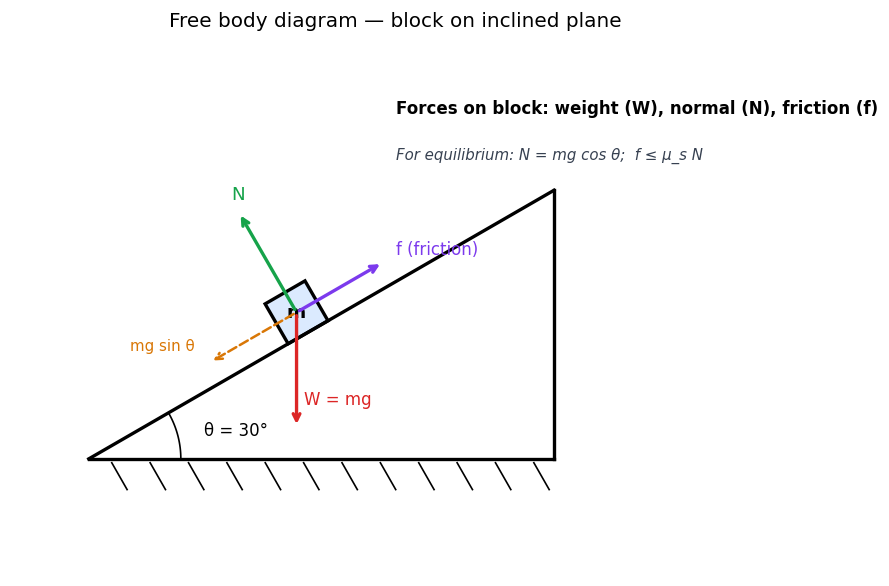
Study the free body diagram of a block on an inclined plane and answer:
The component of weight perpendicular to the incline (= normal force N) is:
Amg sin θ
Bmg cos θ
Cmg tan θ
Dmg
The block remains stationary on the incline if:
Aμ_s ≥ tan θ
Bμ_s ≤ tan θ
Cμ_s = sin θ
Dμ_s = cos θ
Explain when the block remains in equilibrium on the incline.
Show answersHide answers
1. Option 2 — mg cos θ
2. Option 1 — μ_s ≥ tan θ
3. Resolve weight W = mg into two components: along the incline (downward, mg sin θ) and perpendicular to the incline (mg cos θ). Normal force balances perpendicular component: N = mg cos θ. Maximum static friction available: f_s,max = μ_s N = μ_s mg cos θ. The block is on the verge of sliding when f_s,max = mg sin θ ⇒ μ_s = tan θ. So if μ_s ≥ tan θ the block is stationary; if μ_s < tan θ it slides down with acceleration a = g(sin θ − μ_k cos θ).