SUMMARY: This chapter covers the universal law of gravitation and its applications in understanding the motion of celestial bodies and phenomena related to gravity. KEY TOPICS: Universal law of gravitation, gravitational constant, acceleration due to gravity, motion of planets, Kepler's laws, gravitational potential energy, escape velocity, satellites, weightlessness, variation of g with altitude and depth.
Newton's law of universal gravitation states that F is proportional to:
Am₁m₂
Bm₁m₂/r
Cm₁m₂/r²
Dm₁/m₂
Check answerHide answer
Correct answer: Option 3 — m₁m₂/r²
Q21 Mark
The acceleration due to gravity at the surface of Earth is approximately:
A4.9 m/s²
B9.8 m/s²
C19.6 m/s²
D98 m/s²
Check answerHide answer
Correct answer: Option 2 — 9.8 m/s²
Q31 Mark
The gravitational force between two masses is independent of:
AThe product of the masses
BThe distance between them
CThe medium between them
DAll of these
Check answerHide answer
Correct answer: Option 3 — The medium between them
Q41 Mark
The escape velocity from the surface of the Earth is approximately:
A7.9 km/s
B11.2 km/s
C15.6 km/s
D30 km/s
Check answerHide answer
Correct answer: Option 2 — 11.2 km/s
Q51 Mark
A satellite in a stable orbit around the Earth has:
AConstant speed
BConstant velocity
CZero acceleration
DZero gravitational force on it
Check answerHide answer
Correct answer: Option 1 — Constant speed
Short Answer Questions5 questions
Q63 Marks
State Newton's law of universal gravitation.
View sample solutionHide solution
Every particle in the universe attracts every other particle with a force directly proportional to the product of their masses and inversely proportional to the square of the distance between their centres. F = G m₁m₂/r² where G = 6.67 × 10⁻¹¹ N·m²/kg² is the universal gravitational constant. The force acts along the line joining the centres.
Q73 Marks
Define gravitational field intensity and write its formula.
View sample solutionHide solution
Gravitational field intensity at a point is the gravitational force experienced per unit mass placed at that point. E = F/m = GM/r² (for a point mass M at distance r). It is a vector quantity directed toward the source mass. SI unit: N/kg or m/s² (same as acceleration due to gravity).
Q83 Marks
Derive the expression for escape velocity from the surface of a planet.
View sample solutionHide solution
Escape velocity v_e: minimum velocity to escape gravitational pull (reach infinity with zero KE). Total energy at surface = total energy at infinity (= 0 for marginal escape). (1/2)mv_e² − GMm/R = 0. So v_e = √(2GM/R) = √(2gR) (using g = GM/R²). For Earth: v_e = √(2 × 9.8 × 6.4 × 10⁶) ≈ 11.2 km/s.
Q93 Marks
State Kepler's three laws of planetary motion.
View sample solutionHide solution
K1 (Law of orbits): each planet moves in an elliptical orbit with the sun at one focus. K2 (Law of areas): the line joining a planet to the sun sweeps equal areas in equal time intervals — implies angular momentum conservation. K3 (Law of periods): T² ∝ a³ where T is orbital period and a is semi-major axis — i.e. T²/a³ is the same for all planets around the same central body.
Q103 Marks
Calculate the gravitational force between two 5 kg masses placed 0.5 m apart. (G = 6.67 × 10⁻¹¹ N·m²/kg²)
View sample solutionHide solution
F = G m₁m₂/r² = (6.67 × 10⁻¹¹)(5)(5)/(0.5)² = (6.67 × 10⁻¹¹)(25)/0.25 = 6.67 × 10⁻⁹ N. Extremely small — gravitational forces between everyday objects are negligible compared to other forces.
Long Answer Questions6 questions
Q116 Marks
Derive the expression for the orbital velocity and time period of a satellite revolving close to the Earth's surface.
View sample solutionHide solution
For a satellite in orbit at radius r the gravitational force provides the centripetal force: GMm/r² = mv²/r ⇒ v = √(GM/r). For an orbit close to Earth's surface r ≈ R: v_orbit = √(GM/R) = √(gR) (since g = GM/R²) ≈ √(9.8 × 6.4 × 10⁶) ≈ 7.9 km/s. Time period: T = 2πr/v = 2π√(R/g) ≈ 84 minutes — the famous low Earth orbit period.
Q126 Marks
State and prove the law of conservation of mechanical energy for a body falling under gravity from height h.
View sample solutionHide solution
At height h: PE = mgh (taking ground as reference); KE = 0. While falling distance s velocity v = √(2gs) so KE at depth s below initial = (1/2)mv² = mgs; PE = mg(h − s). Total = mgs + mg(h − s) = mgh ✓. Conservation holds throughout the fall — only the partition between KE and PE changes. Total = mgh = constant.
Q136 Marks
Discuss the variation of acceleration due to gravity with altitude and depth.
View sample solutionHide solution
At Earth's surface: g₀ = GM/R². With altitude h above surface: g_h = GM/(R + h)² = g₀ R²/(R + h)². For small h ≪ R: g_h ≈ g₀ (1 − 2h/R) — decreases with altitude. With depth d below surface (assuming uniform density): g_d = g₀ (1 − d/R) — also decreases linearly, reaching zero at the centre. So g is maximum at the surface; both moving up AND moving down reduces it.
Q146 Marks
A satellite of mass 1000 kg is to be placed in orbit at an altitude of 800 km above the Earth's surface. Calculate (i) orbital velocity, (ii) period of revolution. (R = 6.4 × 10⁶ m, g_surface = 9.8 m/s²)
View sample solutionHide solution
Orbital radius r = R + h = 6.4 × 10⁶ + 0.8 × 10⁶ = 7.2 × 10⁶ m. Orbital velocity: v = √(gR²/r) = √(9.8 × (6.4 × 10⁶)²/(7.2 × 10⁶)) = √(9.8 × 6.4² × 10¹² / 7.2 × 10⁶) = √(5.57 × 10⁷) ≈ 7464 m/s ≈ 7.46 km/s. Period: T = 2πr/v = 2π × 7.2 × 10⁶ / 7464 ≈ 6062 s ≈ 101 minutes.
Q156 Marks
Define gravitational potential and gravitational potential energy. Derive expressions for both for a point mass M.
View sample solutionHide solution
Gravitational potential V at a point = work done per unit mass in bringing a unit test mass from infinity to that point. V = −GM/r (taking V = 0 at infinity; sign is negative because gravity is attractive). Gravitational potential energy U of a mass m at distance r from M is U = −GMm/r. Both quantities are negative because work must be done ON the system to separate the masses. Difference (V_b − V_a) is the work done per unit mass against gravity moving from a to b.
Q166 Marks
Differentiate between gravitational potential and gravitational potential energy in tabular form.
Assertion–Reason Questions5 questions
Q171 Mark
Assertion (A): All bodies near Earth's surface fall with the same acceleration g.
Reason (R): Newton's second law gives a = F/m = (GMm/R²)/m = GM/R² = g — independent of m.
Show explanationHide explanation
Correct answer: Option 1 —
Both A and R are true, and R is the correct explanation of A.
Q181 Mark
Assertion (A): Kepler's second law (equal areas in equal times) is a consequence of conservation of angular momentum.
Reason (R): The torque of gravity about the central body (Sun) is zero since the force is along r — so angular momentum is conserved.
Show explanationHide explanation
Correct answer: Option 1 —
Both A and R are true, and R is the correct explanation of A.
Q191 Mark
Assertion (A): Escape velocity is independent of the mass of the projectile.
Reason (R): v_e = √(2GM/R) where M is the mass of the planet — the projectile mass cancels out.
Show explanationHide explanation
Correct answer: Option 1 —
Both A and R are true, and R is the correct explanation of A.
Q201 Mark
Assertion (A): An astronaut in a satellite feels weightless.
Reason (R): The astronaut and the satellite are both in free fall — there is no normal force from the satellite floor on the astronaut.
Show explanationHide explanation
Correct answer: Option 1 —
Both A and R are true, and R is the correct explanation of A.
Q211 Mark
Assertion (A): g decreases below the surface of the Earth.
Reason (R): Only the mass within the spherical shell of radius r contributes to gravity at depth d — mass outside the shell exerts zero net gravity.
Show explanationHide explanation
Correct answer: Option 1 —
Both A and R are true, and R is the correct explanation of A.
Statement-Based Questions5 questions
Q221 Mark
Statement 1: The gravitational force is always attractive.
Statement 2: F = G m₁m₂/r² with G > 0.
Show answerHide answer
Correct answer: Option 1 —
Both statements are true.
Q231 Mark
Statement 1: Acceleration due to gravity is approximately 9.8 m/s² near Earth's surface.
Statement 2: g varies slightly with latitude and altitude.
Show answerHide answer
Correct answer: Option 1 —
Both statements are true.
Q241 Mark
Statement 1: Kepler's third law: T² ∝ a³.
Statement 2: The constant of proportionality equals 4π²/(GM) where M is the mass of the central body.
Show answerHide answer
Correct answer: Option 1 —
Both statements are true.
Q251 Mark
Statement 1: A geostationary satellite has a period of 24 hours.
Statement 2: A geostationary satellite is at altitude ≈ 36000 km above the equator.
Show answerHide answer
Correct answer: Option 1 —
Both statements are true.
Q261 Mark
Statement 1: Gravitational potential is negative for an attractive system.
Statement 2: Gravitational potential at infinity is taken as zero by convention.
Show answerHide answer
Correct answer: Option 1 —
Both statements are true.
Case Study / Passage Questions3 questions
Q273 Marks
Two students of mass 60 kg each stand 1 m apart. They wonder whether the gravitational force between them is detectable. They calculate this force using G = 6.67 × 10⁻¹¹ N·m²/kg² and compare it with their weights.
The gravitational force between them equals:
A2.4 × 10⁻⁷ N
B2.4 × 10⁻⁵ N
C2.4 × 10⁻³ N
D2.4 × 10⁻¹ N
Compared with their weights (≈ 600 N each) this force is:
AComparable
BNegligible
CGreater
DCannot decide
Why is gravity the weakest fundamental force yet dominant in cosmology?
Show answersHide answers
1. Option 1 — 2.4 × 10⁻⁷ N
2. Option 2 — Negligible
3. F = G m₁m₂/r² = (6.67 × 10⁻¹¹)(60)(60)/(1²) = 2.4 × 10⁻⁷ N. Their weights are 60 × 9.8 ≈ 588 N. Ratio: 2.4 × 10⁻⁷ / 588 ≈ 4 × 10⁻¹⁰. The gravitational force between two people is about 10⁻⁹ times their weight — utterly undetectable in everyday life. Gravity is the weakest of the four fundamental forces — but its long-range universal nature makes it dominant on astronomical scales.
Q283 Marks
A spacecraft is to be launched from the surface of the Moon. The Moon has mass 7.35 × 10²² kg and radius 1.74 × 10⁶ m. The mission engineer wants to compute the escape velocity from the Moon and compare it with that from Earth (≈ 11.2 km/s).
The escape velocity from the Moon equals:
A1.7 km/s
B2.4 km/s
C5.6 km/s
D11.2 km/s
Compared with Earth the escape velocity from the Moon is:
ASame
BLower
CHigher
DCannot decide
Why is the escape velocity smaller on the Moon than on Earth?
Show answersHide answers
1. Option 2 — 2.4 km/s
2. Option 2 — Lower
3. v_e = √(2GM/R) = √((2)(6.67 × 10⁻¹¹)(7.35 × 10²²)/(1.74 × 10⁶)) = √(5.63 × 10⁶) ≈ 2374 m/s ≈ 2.4 km/s. Compared to Earth's 11.2 km/s the Moon's escape velocity is ~5× lower because the Moon is less massive and larger (per unit mass). This is why the Apollo lander could leave the Moon with just a small ascent stage but a giant Saturn V was needed to leave Earth.
Q293 Marks
A communications satellite is to be placed in a geostationary orbit. This means it must have a 24-hour period (matching Earth's rotation) so it stays above the same point on the equator. The engineer needs to find the altitude of the orbit and the orbital speed. Earth's mass = 5.98 × 10²⁴ kg radius = 6.4 × 10⁶ m G = 6.67 × 10⁻¹¹.
The orbital radius of a geostationary satellite is approximately:
A4.2 × 10⁷ m
B3.0 × 10⁷ m
C1.0 × 10⁸ m
D6.4 × 10⁷ m
The orbital speed of a geostationary satellite is approximately:
A1.5 km/s
B3.1 km/s
C5.0 km/s
D7.9 km/s
Why is the geostationary altitude unique (≈ 36000 km)?
Show answersHide answers
1. Option 1 — 4.2 × 10⁷ m
2. Option 2 — 3.1 km/s
3. From T = 2π√(r³/(GM)) with T = 86400 s: r³ = T²GM/(4π²) = (86400² × 6.67e-11 × 5.98e24)/(4π²) ≈ 7.54 × 10²² m³ ⇒ r ≈ 4.22 × 10⁷ m. Altitude = r − R = 4.22e7 − 6.4e6 ≈ 35800 km. Orbital speed v = 2πr/T = 2π × 4.22e7 / 86400 ≈ 3070 m/s ≈ 3.1 km/s. Geostationary satellites are used for direct broadcast TV weather imaging and communications.
Table-Based Questions4 questions
Q303 Marks
Study Kepler's three laws of planetary motion:
Law
Statement
1st
Each planet moves in an elliptical orbit with the sun at one focus.
2nd
The line joining a planet to the sun sweeps equal areas in equal times.
3rd
T² is proportional to a³ (T = period, a = semi-major axis).
Which Kepler's law gives T² ∝ a³?
A1st
B2nd
C3rd
DAll three
Kepler's 2nd law (equal areas) is equivalent to:
AConservation of energy
BConservation of momentum
CConservation of angular momentum
DConservation of mass
Use Kepler's 3rd law to estimate the orbital period of Mars (a ≈ 1.52 AU).
Show answersHide answers
1. Option 3 — 3rd
2. Option 3 — Conservation of angular momentum
3. Kepler's three laws (early 1600s) describe planetary motion empirically; Newton later derived them from his law of universal gravitation. 1st law: orbits are ellipses (not perfect circles). 2nd law: a planet moves faster when closer to the sun (perihelion) and slower at apohelion — equivalent to angular momentum conservation. 3rd law: planets farther from the sun have longer years; T² ∝ a³ holds for all bodies orbiting the same primary.
Q313 Marks
Study the gravitational acceleration g at various locations:
Location
g (m/s²)
Earth surface
9.8
Top of Mt. Everest
9.78
Geostationary orbit (36000 km)
0.22
Moon surface
1.62
Mars surface
3.71
Sun's surface
274
Centre of Earth
0
The maximum value of g (other than centre) is at:
AEarth surface
BMoon surface
CSun's surface
DMars surface
At the centre of Earth g is:
AMaximum
BZero
CMinimum
DAbout 9.8
Why does g decrease both as we go up from the surface AND down into the Earth?
Show answersHide answers
1. Option 3 — Sun's surface
2. Option 2 — Zero
3. Acceleration due to gravity g varies with location. At surface: g = GM/R². On more massive bodies (Sun) g is much larger. With altitude: g decreases as 1/r². At centre: g = 0 (mass shell theorem — only mass within smaller radius contributes; mass closer to centre is zero). At satellite altitudes g is reduced; this is why astronauts feel weightless (they and the satellite are in free fall together).
Q326 Marks
Compute (i) the orbital velocity of a satellite at altitude 400 km above Earth, (ii) its time period. (Earth's mass M = 6 × 10²⁴ kg, R = 6.4 × 10⁶ m, G = 6.67 × 10⁻¹¹ N·m²/kg²)
Quantity
Value
Altitude h
400 km
Earth radius R
6.4 × 10⁶ m
Earth mass M
6 × 10²⁴ kg
G
6.67 × 10⁻¹¹ N·m²/kg²
Q336 Marks
Compute the escape velocity from (i) Earth, (ii) Moon, (iii) Jupiter using v_e = √(2gR).
Body
g (m/s²)
R (m)
Earth
9.8
6.4 × 10⁶
Moon
1.6
1.74 × 10⁶
Jupiter
24.8
7.0 × 10⁷
Picture-Based Questions1 question
Q343 Marks
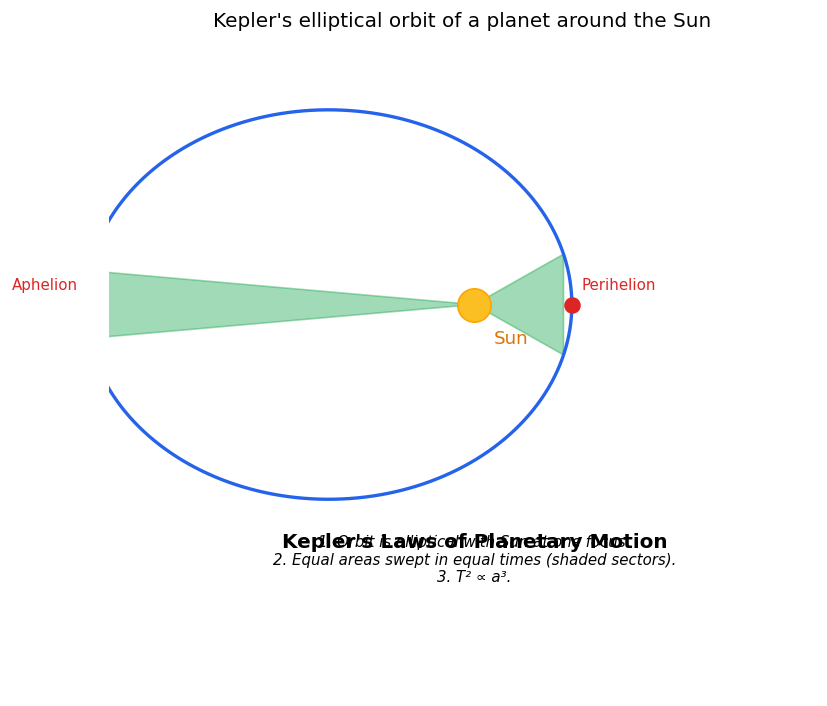
Study Kepler's elliptical orbit diagram and answer:
According to Kepler's first law the Sun is located:
AAt the centre of the ellipse
BAt one focus
CAt both foci
DOutside the ellipse
Kepler's second law (equal areas in equal times) is a consequence of:
AConservation of energy
BConservation of momentum
CConservation of angular momentum
DConservation of mass
State Kepler's three laws and explain the physics behind the second law.
Show answersHide answers
1. Option 2 — At one focus
2. Option 3 — Conservation of angular momentum
3. Kepler's three laws: (1) Each planet moves in an elliptical orbit with the Sun at one focus. (2) The line joining a planet to the Sun sweeps equal areas in equal times — so a planet moves faster at perihelion (closer) and slower at aphelion (farther). This is equivalent to conservation of angular momentum L = mvr (since the gravitational force is along r, its torque about the Sun is zero, so L is conserved). (3) T² ∝ a³ where T is orbital period and a is the semi-major axis.