Mechanical Properties of Solids — Important Questions
33 questions
With answersCBSE format
SUMMARY: This chapter explores the mechanical properties of solids, focusing on how they deform and respond to external forces. KEY TOPICS: Elasticity, stress and strain, Hooke's Law, Young's modulus, bulk modulus, shear modulus, Poisson's ratio, elastic potential energy, stress-strain curve, applications of elasticity.
The ratio of lateral strain to longitudinal strain is:
AYoung's modulus
BBulk modulus
CPoisson's ratio
DShear modulus
Check answerHide answer
Correct answer: Option 3 — Poisson's ratio
Q51 Mark
Bulk modulus measures resistance to:
ATensile strain
BVolumetric strain
CShear strain
DLateral strain
Check answerHide answer
Correct answer: Option 2 — Volumetric strain
Short Answer Questions5 questions
Q63 Marks
Define stress and strain.
View sample solutionHide solution
Stress is the restoring force per unit area developed inside a deformed body. Stress = F/A; SI unit Pa (= N/m²). Strain is the relative change (fractional) in dimension caused by stress. Linear strain = ΔL/L (dimensionless). Both must be defined together since Hooke's law states stress ∝ strain within elastic limit.
Q73 Marks
State Hooke's law and define modulus of elasticity.
View sample solutionHide solution
Hooke's law: within the elastic limit stress is directly proportional to strain. Stress/Strain = constant = modulus of elasticity. Three main moduli: Young's modulus Y (longitudinal stress to longitudinal strain) Bulk modulus K (volumetric) Shear modulus G (shear stress to shear strain). All have units of Pa.
Q83 Marks
A wire of length 2 m and area of cross-section 10⁻⁶ m² is stretched by 1 mm under a force of 100 N. Calculate Young's modulus.
View sample solutionHide solution
Y = (F/A)/(ΔL/L) = (100/10⁻⁶)/(10⁻³/2) = 10⁸ / (5 × 10⁻⁴) = 2 × 10¹¹ Pa. Typical for a metal wire (steel ≈ 2 × 10¹¹ Pa).
Q93 Marks
Distinguish between elastic and plastic deformation.
View sample solutionHide solution
Elastic deformation: temporary; the body returns to its original shape when the deforming force is removed. Below the elastic limit. Obeys Hooke's law (linear region of stress-strain curve). Plastic deformation: permanent; the body does not fully return to its original shape. Beyond the yield point. Used in cold rolling forging etc.
Q103 Marks
Define Poisson's ratio.
View sample solutionHide solution
Poisson's ratio σ is the negative of the ratio of lateral strain to longitudinal strain when a body is stretched (or compressed). σ = −(Δd/d)/(ΔL/L). For most materials 0 < σ < 0.5. Pure incompressible materials (rubber close to) have σ = 0.5. Cork has σ ≈ 0 — useful for bottle stoppers since lateral expansion is minimal.
Long Answer Questions6 questions
Q116 Marks
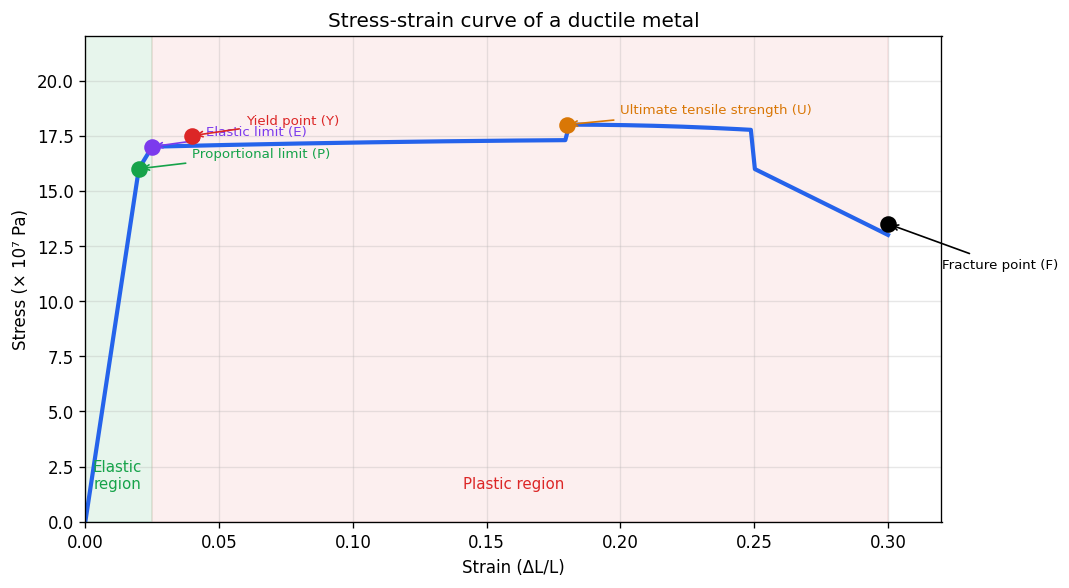
Discuss the stress-strain curve for a typical metal and label the proportional limit elastic limit yield point ultimate tensile strength and breaking point.
View sample solutionHide solution
Stress-strain curve regions: (1) Proportional limit — Hooke's law obeyed (linear OA). (2) Elastic limit — material returns to original shape on unloading (just past A). (3) Yield point — plastic deformation begins. (4) Ultimate tensile strength — maximum stress the material can withstand. (5) Breaking point — fracture occurs. Beyond yield point neckling occurs in ductile materials. Curve shape distinguishes ductile (large plastic region — copper aluminium) from brittle (sharp break — glass cast iron).
Q126 Marks
A steel wire of length 2 m and diameter 0.5 mm hangs vertically. A 5 kg mass is attached to its lower end. Calculate (i) stress (ii) strain (iii) elongation. (Y_steel = 2 × 10¹¹ Pa; g = 10 m/s²)
View sample solutionHide solution
Force F = mg = 5(10) = 50 N. Area A = π(d/2)² = π(0.25 × 10⁻³)² = 1.963 × 10⁻⁷ m². (i) Stress = F/A = 50/1.963 × 10⁻⁷ = 2.546 × 10⁸ Pa. (ii) Strain = Stress/Y = 2.546 × 10⁸ / 2 × 10¹¹ = 1.273 × 10⁻³. (iii) Elongation ΔL = strain × L = 1.273 × 10⁻³ × 2 = 2.546 × 10⁻³ m = 2.55 mm.
Q136 Marks
Define and derive the relation between Young's modulus Bulk modulus and Shear modulus.
View sample solutionHide solution
Y = stress/longitudinal strain (linear). K = pressure/(−ΔV/V) (volumetric — minus sign because volume decreases with positive pressure). G = tangential stress/shear strain (angular). Relations (for isotropic materials with Poisson's ratio σ): Y = 3K(1 − 2σ); Y = 2G(1 + σ); 9/Y = 1/K + 3/G. So given any two moduli the third can be computed if σ is known. For most metals σ ≈ 0.3 giving Y ≈ 2.6G ≈ K (approximately).
Q146 Marks
A copper wire of original length 1 m and cross-sectional area 10⁻⁶ m² is stretched by a force F producing an elongation of 0.5 mm. Calculate (i) the work done in stretching the wire (ii) the elastic potential energy stored. (Y_copper = 1.1 × 10¹¹ Pa)
View sample solutionHide solution
Y = (F · L)/(A · ΔL) ⇒ F = Y A ΔL / L = (1.1 × 10¹¹)(10⁻⁶)(0.5 × 10⁻³)/1 = 55 N. (i) Work done in stretching = average force × elongation = (F/2) × ΔL = (55/2)(0.5 × 10⁻³) = 1.375 × 10⁻² J = 13.75 mJ. (ii) Elastic PE = work done = 13.75 mJ. Equivalently U = (1/2) × stress × strain × volume.
Q156 Marks
Explain why hollow shafts are preferred over solid shafts of equal mass for transmitting torque.
View sample solutionHide solution
For a circular shaft the polar moment of inertia I = ∫r² dA. Hollow shaft of outer radius R₂ inner R₁: I = π(R₂⁴ − R₁⁴)/2. Solid shaft of same mass and material has smaller outer radius. The shear stress τ = T·r/I varies as r/I. Since hollow shaft has larger r at periphery and removed material was contributing little (small r) the I/r ratio is HIGHER for hollow shaft. So for the same maximum stress hollow shaft can carry MORE torque than solid of equal mass. This is why automobile drive shafts and aircraft components are made hollow.
Q166 Marks
Differentiate between stress and strain in tabular form on at least four features.
Assertion–Reason Questions5 questions
Q171 Mark
Assertion (A): Hooke's law is valid only within the elastic limit.
Reason (R): Beyond the elastic limit the material undergoes permanent deformation and stress is no longer proportional to strain.
Show explanationHide explanation
Correct answer: Option 1 —
Both A and R are true, and R is the correct explanation of A.
Q181 Mark
Assertion (A): Steel has higher Young's modulus than rubber.
Reason (R): Steel resists deformation more strongly than rubber for the same stress.
Show explanationHide explanation
Correct answer: Option 1 —
Both A and R are true, and R is the correct explanation of A.
Q191 Mark
Assertion (A): Poisson's ratio of cork is approximately zero.
Reason (R): When compressed cork shows negligible lateral expansion making it a useful bottle stopper.
Show explanationHide explanation
Correct answer: Option 1 —
Both A and R are true, and R is the correct explanation of A.
Q201 Mark
Assertion (A): Solids have larger bulk modulus than liquids and gases.
Reason (R): Solids have stronger interatomic bonds and resist volume change more than fluids.
Show explanationHide explanation
Correct answer: Option 1 —
Both A and R are true, and R is the correct explanation of A.
Q211 Mark
Assertion (A): Ductile materials show large plastic deformation before fracture.
Reason (R): The yield region in their stress-strain curve is extensive — examples include copper and mild steel.
Show explanationHide explanation
Correct answer: Option 1 —
Both A and R are true, and R is the correct explanation of A.
Statement-Based Questions5 questions
Q221 Mark
Statement 1: Stress is force per unit area.
Statement 2: Strain is fractional change in dimension and is dimensionless.
Show answerHide answer
Correct answer: Option 1 —
Both statements are true.
Q231 Mark
Statement 1: Young's modulus measures resistance to length change.
Statement 2: Bulk modulus measures resistance to volume change.
Show answerHide answer
Correct answer: Option 1 —
Both statements are true.
Q241 Mark
Statement 1: Hooke's law applies in the elastic region.
Statement 2: Beyond the elastic limit the deformation is plastic.
Show answerHide answer
Correct answer: Option 1 —
Both statements are true.
Q251 Mark
Statement 1: Steel is stronger than copper.
Statement 2: Steel has higher ultimate tensile strength.
Show answerHide answer
Correct answer: Option 1 —
Both statements are true.
Q261 Mark
Statement 1: Elastic potential energy in a stretched wire is (1/2)(stress)(strain)(volume).
Statement 2: This energy is released when the deforming force is removed.
Show answerHide answer
Correct answer: Option 1 —
Both statements are true.
Case Study / Passage Questions3 questions
Q273 Marks
A steel wire of length 2 m and cross-sectional area 1 mm² is suspended vertically. A 5 kg mass is attached at the lower end. The student wants to find the stress strain and elongation produced. Y_steel = 2 × 10¹¹ Pa; g = 10 m/s².
The stress in the wire equals:
A5 × 10⁶ Pa
B5 × 10⁷ Pa
C5 × 10⁸ Pa
D5 × 10⁹ Pa
The strain in the wire equals:
A2.5 × 10⁻⁴
B5 × 10⁻⁴
C2.5 × 10⁻³
D5 × 10⁻³
Compute the elongation in mm.
Show answersHide answers
1. Option 2 — 5 × 10⁷ Pa
2. Option 1 — 2.5 × 10⁻⁴
3. Force F = mg = 50 N. Area A = 1 mm² = 10⁻⁶ m². Stress = F/A = 50/10⁻⁶ = 5 × 10⁷ Pa. Strain = Stress/Y = 5 × 10⁷ / 2 × 10¹¹ = 2.5 × 10⁻⁴. Elongation ΔL = strain × L = 2.5 × 10⁻⁴ × 2 = 5 × 10⁻⁴ m = 0.5 mm. Despite the low strain (only 0.025%) the wire's length increases by half a millimetre due to the high Young's modulus of steel.
Q283 Marks
At a depth of 4 km in the ocean the pressure is approximately 4 × 10⁷ Pa. The Bulk modulus of water is K = 2.2 × 10⁹ Pa. The oceanographer wants to compute the fractional decrease in volume of water at this depth.
The fractional decrease in volume is approximately:
A9 × 10⁻⁴
B1.8 × 10⁻²
C1.8 × 10⁻³
D1.8 × 10⁻⁵
Compared to the bulk volume of water this change is:
ANegligible
BSignificant
CCannot decide
DDepends on temperature
Why is water often treated as incompressible despite this 1.8% change?
Show answersHide answers
1. Option 3 — 1.8 × 10⁻³
2. Option 1 — Negligible
3. Bulk modulus K = −P/(ΔV/V) ⇒ ΔV/V = −P/K = −4 × 10⁷ / 2.2 × 10⁹ ≈ −1.8 × 10⁻². Wait recompute: 4e7/2.2e9 = 4/220 = 0.0182 ≈ 1.8 × 10⁻². So fractional decrease in volume ≈ 1.8% — significant for engineering purposes (deep-sea cable laying submarine design) but treated as 'incompressible' in elementary fluid mechanics.
Q293 Marks
Two wires A (steel) and B (copper) of the same length and cross-section are subjected to the same tensile force. Y_steel = 2 × 10¹¹ Pa Y_copper = 1.1 × 10¹¹ Pa. The student wants to find which elongates more and by what factor.
The wire that elongates more is:
ASteel
BCopper
CBoth equally
DCannot decide
The ratio of elongations (Cu : Steel) is approximately:
A1.0
B1.5
C1.8
D2.0
Why is steel preferred over copper for suspension bridge cables?
Show answersHide answers
1. Option 2 — Copper
2. Option 3 — 1.8
3. For the same force length and area the elongation ΔL = FL/(AY) is inversely proportional to Y. So copper (smaller Y) elongates MORE than steel. Ratio: ΔL_Cu/ΔL_Steel = Y_Steel/Y_Cu = 2 × 10¹¹ / 1.1 × 10¹¹ ≈ 1.82. Steel is therefore 1.8 times stiffer than copper. This is why suspension bridges use steel cables — high stiffness limits sagging under load.
Table-Based Questions3 questions
Q303 Marks
Study Young's modulus of various materials:
Material
Young's modulus Y (× 10¹⁰ Pa)
Aluminium
7.0
Copper
11
Iron (cast)
10
Steel
20
Concrete
3
Glass
6.5
Bone
1.5
Rubber
0.0001
The material with the highest Young's modulus is:
ASteel
BAluminium
CCopper
DGlass
A material with high Young's modulus is:
AStiffest
BEasiest to stretch
CHighest density
DHardest
Why are rubber bands stretchable but steel cables aren't?
Show answersHide answers
1. Option 1 — Steel
2. Option 1 — Stiffest
3. Young's modulus Y measures stiffness — higher Y means more force is needed to stretch a wire by a given fraction. Steel (20 × 10¹⁰ Pa) is among the stiffest engineering materials. Rubber has very low Y (extremely stretchable). Bones have moderate Y comparable to wood — strong enough for everyday use but flexible enough to absorb shock without fracture.
Q313 Marks
Study the three elastic moduli and their applications:
Modulus
Stress type
Strain type
Application
Young's (Y)
Longitudinal (tensile/compressive)
Length change
Cables structural beams
Bulk (K)
Volumetric pressure
Volume change
Hydrostatic pressure ocean depth
Shear (G)
Tangential
Angular
Twist of shafts torsion
The shear modulus is denoted by:
AY
BK
CG
DAll three
K (bulk modulus) measures resistance to ___ strain:
ATensile
BVolumetric
CShear
DTangential
Why does an aircraft wing need to consider all three moduli?
Show answersHide answers
1. Option 3 — G
2. Option 2 — Volumetric
3. Three independent elastic moduli describe how solids respond to different types of applied stress. Y for stretch/compression along an axis; K for uniform pressure (volume change); G for shear (sliding layers). For an isotropic material these are not independent: if any 2 are known the 3rd can be computed using Poisson's ratio σ. Practical application: cables → Y; submarine hull → K; drill bits → G.
Q326 Marks
A steel wire of length 2 m and cross-sectional area 1 mm² is stretched by a 100 N force. Compute (i) the stress, (ii) the strain, (iii) the elongation. Y_steel = 2 × 10¹¹ Pa.
Quantity
Value
Length L
2 m
Cross-section A
1 mm² = 10⁻⁶ m²
Force F
100 N
Y_steel
2 × 10¹¹ Pa
Picture-Based Questions1 question
Q333 Marks
Study the stress-strain curve of a ductile metal and answer:
The point beyond which Hooke's law no longer holds is:
AProportional limit
BElastic limit
CYield point
DFracture point
The region between elastic limit and fracture is called:
ALinear region
BPlastic region
CElastic region
D
Identify and explain the five key points on the stress-strain curve.
Show answersHide answers
1. Option 1 — Proportional limit
2. Option 2 — Plastic region
3. Key points on a stress-strain curve: (1) Proportional limit (P): stress and strain are linearly related (Hooke's law obeyed). (2) Elastic limit (E): material returns to original shape on unloading; only slightly past P. (3) Yield point (Y): plastic deformation begins — material won't fully recover. (4) Ultimate tensile strength (U): the maximum stress the material can withstand. (5) Fracture point (F): material breaks. The elastic region (0 to E) obeys Hooke's law. The plastic region (E to F) shows permanent deformation.