SUMMARY: The chapter "Kinetic Theory" in Class 11 Physics explores the microscopic behavior of gases and the derivation of macroscopic properties from molecular motion. KEY TOPICS: ideal gas equation, kinetic theory of gases, degrees of freedom, mean free path, Maxwell-Boltzmann distribution, pressure of an ideal gas, root mean square speed, specific heat capacities of gases, law of equipartition of energy, Avogadro's number.
The kinetic theory of gases assumes molecules are:
AConnected by springs
BPoint masses with no interaction
CStationary
DTightly packed
Check answerHide answer
Correct answer: Option 2 — Point masses with no interaction
Q21 Mark
The pressure of an ideal gas is proportional to:
AN⟨v⟩
BN⟨v⟩²
CN⟨v²⟩
DN²⟨v⟩²
Check answerHide answer
Correct answer: Option 3 — N⟨v²⟩
Q31 Mark
The average kinetic energy per molecule of an ideal gas at temperature T is:
A(1/2)kT
B(3/2)kT
CkT
D(3/2)RT
Check answerHide answer
Correct answer: Option 2 — (3/2)kT
Q41 Mark
The mean free path of a gas molecule depends on:
ANumber density
BMolecular diameter
CBoth
DNeither
Check answerHide answer
Correct answer: Option 3 — Both
Q51 Mark
For diatomic gases like O₂ the value of γ = C_p/C_v is approximately:
A1.0
B1.4
C1.67
D2.0
Check answerHide answer
Correct answer: Option 2 — 1.4
Short Answer Questions5 questions
Q63 Marks
State the postulates of the kinetic theory of gases.
View sample solutionHide solution
Postulates: (1) A gas consists of a large number of identical molecules in random motion. (2) The size of molecules is negligible compared to intermolecular distance. (3) No intermolecular forces except during collisions. (4) Collisions between molecules and with container walls are perfectly elastic. (5) Time of collision is negligible compared to time between collisions. (6) Distribution of molecular velocities follows the Maxwell-Boltzmann distribution.
Q73 Marks
Define rms speed and write its formula in terms of T.
View sample solutionHide solution
Root-mean-square speed v_rms is the square root of the mean of the squared speeds of molecules: v_rms = √⟨v²⟩. From kinetic theory: v_rms = √(3kT/m) = √(3RT/M) where m is molecular mass M is molar mass. At higher T molecules move faster on average; at higher m they move slower (heavy gases like Xe are slower than H₂ at the same T).
Q83 Marks
State the law of equipartition of energy.
View sample solutionHide solution
Law of equipartition of energy: in thermal equilibrium each quadratic degree of freedom of a gas molecule (translational rotational or vibrational) has an average energy of (1/2)kT per molecule (or (1/2)RT per mole). For an ideal monoatomic gas: 3 translational degrees → U = (3/2)nRT. Diatomic gas at moderate T: 3 trans + 2 rot → U = (5/2)nRT. Predicts γ = 5/3 (mono) and 7/5 (diatomic).
Q93 Marks
Calculate the rms speed of oxygen molecules at 300 K. (M(O₂) = 32 × 10⁻³ kg/mol; R = 8.314 J/mol·K)
View sample solutionHide solution
v_rms = √(3RT/M) = √((3)(8.314)(300)/(32 × 10⁻³)) = √(7482.6/0.032) = √233830 = 483.6 m/s. So oxygen molecules at room temperature move on average at about 480 m/s — close to the speed of sound in air (~343 m/s). Hydrogen would be much faster: v_rms(H₂)/v_rms(O₂) = √(M(O₂)/M(H₂)) = √(32/2) = 4 ⇒ v_rms(H₂) ≈ 1900 m/s.
Q103 Marks
Why are real gases not exactly ideal at high pressure or low temperature?
View sample solutionHide solution
Ideal gas assumes (a) molecules are point masses (zero volume) and (b) no intermolecular forces. At high pressure the molecular volume becomes significant compared to container volume — the available volume is less than V. At low temperature molecules move slowly and intermolecular attractive forces become significant — pressure is reduced below ideal. Both effects are corrected in van der Waals equation: (P + a/V²)(V − b) = nRT.
Long Answer Questions5 questions
Q116 Marks
Derive the relation P = (1/3) ρ ⟨v²⟩ for an ideal gas.
View sample solutionHide solution
Consider a gas in a cubic container of side L. Each molecule of mass m moving with velocity component v_x in x-direction strikes the right wall every Δt = 2L/v_x and imparts momentum 2mv_x. Force per molecule on wall = 2mv_x / (2L/v_x) = mv_x²/L. Total force F = (m/L) Σ v_x². Pressure P = F/A = F/L² = (m/L³) Σ v_x² = (m/V) Σ v_x² where V = L³. For a gas with N molecules ⟨v_x²⟩ = (1/N) Σ v_x² = (1/3)⟨v²⟩ by isotropy. So P = N m ⟨v²⟩ / (3V) = (1/3) ρ ⟨v²⟩ where ρ = Nm/V. This is the Maxwell pressure formula.
Q126 Marks
Show that the average kinetic energy of a gas molecule is (3/2)kT.
View sample solutionHide solution
From P = (1/3)ρ⟨v²⟩ = (Nm/3V)⟨v²⟩ ⇒ PV = (Nm/3)⟨v²⟩. Using ideal gas law PV = NkT (where k = R/N_A is Boltzmann's constant): NkT = (Nm/3)⟨v²⟩ ⇒ ⟨v²⟩ = 3kT/m. Hence (1/2)m⟨v²⟩ = (3/2)kT — the average translational kinetic energy per molecule. This is independent of the type of gas and depends only on temperature. For 1 mole: U = (3/2)RT for monoatomic gas.
Q136 Marks
Derive the expression for the molar specific heats C_v and C_p of a monoatomic and a diatomic ideal gas using the equipartition principle.
View sample solutionHide solution
Monoatomic gas (3 translational degrees): U = (3/2)nRT ⇒ C_v = (∂U/∂T)/n = (3/2)R. C_p = C_v + R = (5/2)R. γ = C_p/C_v = 5/3 ≈ 1.67. Diatomic gas at moderate T (3 trans + 2 rot = 5 degrees; vibration frozen out): U = (5/2)nRT ⇒ C_v = (5/2)R; C_p = (7/2)R; γ = 7/5 = 1.4. At very high T vibrational modes contribute (2 more: KE + PE of vibration) raising C_v to (7/2)R and γ to 9/7. Polyatomic non-linear gases have 6 degrees → C_v = 3R γ ≈ 1.33.
Q146 Marks
A vessel of 1 L contains 1 g of helium at 27°C. Calculate (i) the pressure (ii) the rms speed of the molecules. (R = 8.314 J/mol·K; M(He) = 4 g/mol)
View sample solutionHide solution
Moles n = 1/4 = 0.25 mol. (i) Ideal gas: PV = nRT ⇒ P = nRT/V = (0.25)(8.314)(300)/(10⁻³) = 6.236 × 10⁵ Pa = 6.16 atm. (ii) v_rms = √(3RT/M) = √((3)(8.314)(300)/(4 × 10⁻³)) = √(6235.5/0.004) = √(1.559 × 10⁶) = 1248.6 m/s. Helium molecules at room temperature move very fast — about 1.25 km/s.
Q156 Marks
Define mean free path and derive the formula for it.
View sample solutionHide solution
Mean free path λ is the average distance a gas molecule travels between successive collisions. In time Δt a molecule sweeps a cylindrical volume π d² v_avg Δt (where d is molecular diameter and v_avg is mean speed). Number of collisions = (number density n) × (volume swept) = π d² v_avg n Δt. Mean free path = (distance travelled)/(collisions) = v_avg Δt/(π d² v_avg n Δt) = 1/(π d² n). With more accurate treatment (relative motion of other molecules) λ = 1/(√2 π d² n). For air at STP λ ≈ 70 nm — ~1000 times larger than molecular diameter.
Assertion–Reason Questions5 questions
Q161 Mark
Assertion (A): Gas molecules are treated as point masses in kinetic theory.
Reason (R): Their size is negligible compared to the intermolecular distances at typical pressures.
Show explanationHide explanation
Correct answer: Option 1 —
Both A and R are true, and R is the correct explanation of A.
Q171 Mark
Assertion (A): The average translational kinetic energy of a gas molecule is independent of the gas type at a given temperature.
Reason (R): Equipartition gives (3/2)kT per molecule depending only on T.
Show explanationHide explanation
Correct answer: Option 1 —
Both A and R are true, and R is the correct explanation of A.
Q181 Mark
Assertion (A): Hydrogen molecules move faster on average than oxygen molecules at the same temperature.
Reason (R): v_rms = √(3RT/M); smaller M gives larger v_rms.
Show explanationHide explanation
Correct answer: Option 1 —
Both A and R are true, and R is the correct explanation of A.
Q191 Mark
Assertion (A): Diatomic gases have higher specific heats than monoatomic gases.
Reason (R): Diatomic molecules have rotational degrees of freedom in addition to translational.
Show explanationHide explanation
Correct answer: Option 1 —
Both A and R are true, and R is the correct explanation of A.
Q201 Mark
Assertion (A): Real gases deviate from ideal behaviour at high pressure.
Reason (R): Molecular volume becomes significant compared to container volume and intermolecular forces matter.
Show explanationHide explanation
Correct answer: Option 1 —
Both A and R are true, and R is the correct explanation of A.
Statement-Based Questions5 questions
Q211 Mark
Statement 1: Pressure of a gas is due to molecular collisions with container walls.
Statement 2: Average kinetic energy per molecule depends only on temperature.
Show answerHide answer
Correct answer: Option 1 —
Both statements are true.
Q221 Mark
Statement 1: Each translational degree of freedom contributes (1/2)kT to internal energy.
Statement 2: Each rotational degree of freedom of a diatomic molecule also contributes (1/2)kT.
Show answerHide answer
Correct answer: Option 1 —
Both statements are true.
Q231 Mark
Statement 1: At a given temperature heavier molecules move slower.
Statement 2: v_rms = √(3RT/M) so v_rms is inversely proportional to √M.
Show answerHide answer
Correct answer: Option 1 —
Both statements are true.
Q241 Mark
Statement 1: For an ideal monoatomic gas γ = 5/3.
Statement 2: For an ideal diatomic gas γ = 7/5.
Show answerHide answer
Correct answer: Option 1 —
Both statements are true.
Q251 Mark
Statement 1: Mean free path decreases with increasing pressure.
Statement 2: At higher pressure molecular density is higher so collisions occur more frequently.
Show answerHide answer
Correct answer: Option 1 —
Both statements are true.
Case Study / Passage Questions3 questions
Q263 Marks
At 300 K calculate the rms speed of molecules of (i) hydrogen H₂ (M = 2 g/mol) and (ii) oxygen O₂ (M = 32 g/mol). Compare and explain the difference. R = 8.314 J/mol·K.
The rms speed of H₂ at 300 K is approximately:
A1.9 km/s
B3.8 km/s
C7.6 km/s
D11.4 km/s
The ratio v_rms(H₂) / v_rms(O₂) at the same T equals:
A2
B4
C8
D16
Why does Earth's atmosphere have very little hydrogen but plenty of oxygen?
Show answersHide answers
1. Option 1 — 1.9 km/s
2. Option 2 — 4
3. v_rms = √(3RT/M). For H₂: √((3)(8.314)(300)/(2 × 10⁻³)) = √(3741000) ≈ 1934 m/s ≈ 1.9 km/s. For O₂: √((3)(8.314)(300)/(32 × 10⁻³)) = √(233875) ≈ 484 m/s ≈ 0.48 km/s. Ratio: v_H/v_O = √(M_O/M_H) = √16 = 4. At the same temperature lighter molecules move 4× faster than oxygen.
Q273 Marks
A 2 mol of ideal gas occupies 8 L at 300 K. The student wants to compute (i) the pressure (ii) the new pressure if temperature is raised to 600 K at constant volume (iii) the average translational KE per molecule.
The initial pressure equals approximately:
A2.5 atm
B5.0 atm
C6.2 atm
D10.0 atm
At constant V if T doubles the pressure:
AHalved
BDoubled
CSame
DTripled
Compute the average kinetic energy at T = 600 K and compare with T = 300 K.
Show answersHide answers
1. Option 3 — 6.2 atm
2. Option 2 — Doubled
3. Initial: P = nRT/V = (2)(8.314)(300)/(8 × 10⁻³) = 6.235 × 10⁵ Pa = 6.16 atm. At V constant T doubled (300 → 600 K) means P doubles (Gay-Lussac's law): P_new = 12.32 atm. Average translational KE per molecule: (3/2)kT = (1.5)(1.381 × 10⁻²³)(300) = 6.21 × 10⁻²¹ J — independent of gas type only of T.
Q283 Marks
For nitrogen molecules at STP (273 K 1 atm) molecular diameter d = 3.7 × 10⁻¹⁰ m. The student wants to compute (i) number density n (ii) mean free path λ.
The number density at STP equals:
A2.7 × 10²² /m³
B2.7 × 10²⁴ /m³
C2.7 × 10²⁵ /m³
D2.7 × 10²⁷ /m³
The mean free path is approximately:
A7 nm
B70 nm
C700 nm
D7 μm
Why does the mean free path decrease at higher pressure?
Show answersHide answers
1. Option 3 — 2.7 × 10²⁵ /m³
2. Option 2 — 70 nm
3. At STP: n = N_A/V_m = 6.022 × 10²³ / 22.4 × 10⁻³ = 2.69 × 10²⁵ /m³. Mean free path: λ = 1/(√2 π d² n) = 1/(1.414 × π × (3.7 × 10⁻¹⁰)² × 2.69 × 10²⁵) = 1/(1.63 × 10⁷) ≈ 6.13 × 10⁻⁸ m ≈ 60 nm. So a nitrogen molecule at STP travels about 60 nm between collisions — about 200× its own diameter.
Table-Based Questions3 questions
Q293 Marks
Study postulates of kinetic theory of gases:
Postulate
Description
Many particles
A gas consists of a vast number of molecules.
Random motion
Molecules move in all directions randomly.
Negligible size
Molecular size is much less than intermolecular distance.
Elastic collisions
Collisions are perfectly elastic.
No intermolecular forces
Except during collisions.
Newton's laws apply
Mechanics of molecules obeys classical mechanics.
Gas molecules are assumed to be:
ADiffusing
BRandom
CStationary
DAligned
Collisions in an ideal gas are:
AInelastic
BElastic
CBoth
DNeither
When does an actual gas behave most like an ideal gas?
Show answersHide answers
1. Option 2 — Random
2. Option 2 — Elastic
3. Kinetic theory's postulates apply to ideal gases. Real gases deviate at high pressure (intermolecular forces matter) and low temperature (molecules move slowly so attractive forces become significant). The success of kinetic theory was deriving macroscopic gas laws (PV = nRT) from molecular-level postulates and predicting useful results like rms speed and average kinetic energy depending only on temperature.
Q303 Marks
Study molar specific heats of various gases:
Gas
Type
C_v
C_p
γ
He Ne Ar
Monoatomic
(3/2)R
(5/2)R
5/3 ≈ 1.67
H₂ N₂ O₂
Diatomic
(5/2)R
(7/2)R
7/5 = 1.4
H₂O CH₄
Polyatomic non-linear
3R
4R
4/3 ≈ 1.33
For a monoatomic ideal gas γ equals:
A5/3
B7/5
C4/3
D1
For a diatomic gas at moderate T C_v equals:
A(3/2)R
B(5/2)R
C3R
D4R
Why does γ for diatomic gases approach 9/7 at very high temperature?
Show answersHide answers
1. Option 1 — 5/3
2. Option 2 — (5/2)R
3. Equipartition assigns (1/2)kT energy to each quadratic degree of freedom. Monoatomic: 3 trans → 3R/2 (×N for N moles). Diatomic at moderate T: 3 trans + 2 rot = 5 → 5R/2 (vibration not yet active). At very high T: vibration adds 2 more degrees → 7R/2. Polyatomic non-linear: 3 trans + 3 rot = 6 → 3R. The values of γ predict the speed of sound: v_s = √(γP/ρ).
Q316 Marks
For an ideal monoatomic gas at 300 K and 1 atm, compute (i) the rms speed of helium atoms (M = 4 g/mol), (ii) average translational KE per atom. (R = 8.314 J/mol·K, k_B = 1.38 × 10⁻²³ J/K)
Quantity
Value
Gas
Helium (monoatomic)
M
4 g/mol
T
300 K
R
8.314 J/mol·K
k_B
1.38 × 10⁻²³ J/K
Picture-Based Questions1 question
Q323 Marks
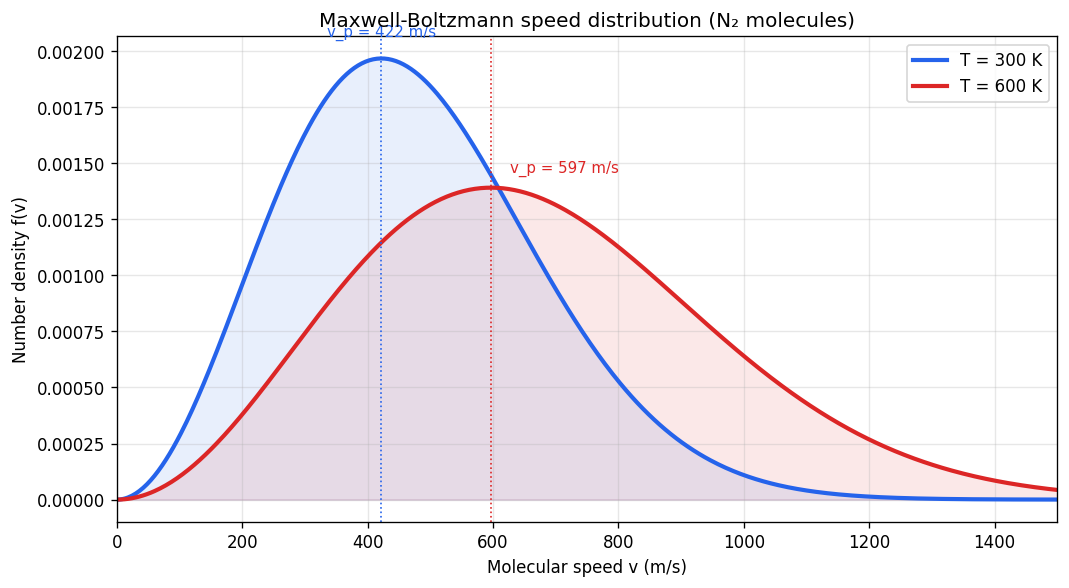
Study the Maxwell-Boltzmann speed distribution at two temperatures and answer:
As temperature increases, the speed distribution becomes:
ASharper and shifted left
BBroader and shifted right
CSame as before
DBecomes a delta function
The relationship between the most probable speed (v_p), average speed (v_avg) and rms speed (v_rms) is:
Av_p < v_avg < v_rms
Bv_p > v_avg > v_rms
Cv_p = v_avg = v_rms
Dv_p > v_rms > v_avg
Explain how the Maxwell-Boltzmann distribution changes with temperature.
Show answersHide answers
1. Option 2 — Broader and shifted right
2. Option 1 — v_p < v_avg < v_rms
3. The Maxwell-Boltzmann distribution gives the fraction of molecules with speeds between v and v + dv. At higher temperatures: (i) the most probable speed v_p = √(2kT/m) shifts to higher values; (ii) the curve becomes broader and flatter — more molecules have higher speeds. The total area under each curve equals 1 (all molecules are accounted for). Three characteristic speeds: most probable v_p = √(2kT/m), average v_avg = √(8kT/πm), root-mean-square v_rms = √(3kT/m). They are in the ratio v_p : v_avg : v_rms = 1 : 1.128 : 1.225, so v_p < v_avg < v_rms always.