SUMMARY: The chapter on Thermodynamics in Class 11 Physics explores the principles governing heat, work, and energy transformations in physical systems. KEY TOPICS: thermodynamic systems, first law of thermodynamics, second law of thermodynamics, heat engines, refrigerators, Carnot cycle, entropy, thermodynamic processes, internal energy, specific heat capacity
The first law of thermodynamics is a statement of conservation of:
AMass
BMomentum
CEnergy
DCharge
Check answerHide answer
Correct answer: Option 3 — Energy
Q21 Mark
For an isolated system the internal energy:
AAlways increases
BAlways decreases
CRemains constant
DBecomes zero
Check answerHide answer
Correct answer: Option 3 — Remains constant
Q31 Mark
In an isothermal process for an ideal gas:
AΔT = 0
BΔU = 0
CBoth ΔT and ΔU = 0
DNeither
Check answerHide answer
Correct answer: Option 3 — Both ΔT and ΔU = 0
Q41 Mark
The efficiency of a heat engine working between temperatures T₁ (hot) and T₂ (cold) is:
AT₁/T₂
BT₂/T₁
C1 − T₂/T₁
D1 + T₂/T₁
Check answerHide answer
Correct answer: Option 3 — 1 − T₂/T₁
Q51 Mark
The second law of thermodynamics is sometimes called the:
ALaw of inertia
BLaw of conservation
CLaw of entropy increase
DLaw of universal gravitation
Check answerHide answer
Correct answer: Option 3 — Law of entropy increase
Short Answer Questions5 questions
Q63 Marks
State the first law of thermodynamics and write its mathematical form.
View sample solutionHide solution
First law: energy can neither be created nor destroyed; it can only be converted from one form to another. Mathematical form: ΔU = Q + W (sign convention: Q is heat absorbed by system; W is work done ON the system) OR ΔU = Q − W (if W is work done BY system on surroundings). Both are equivalent statements of energy conservation.
Q73 Marks
Distinguish between isothermal and adiabatic processes.
View sample solutionHide solution
Isothermal process: temperature constant throughout (ΔT = 0); heat exchange Q ≠ 0 (compensates work). For ideal gas ΔU = 0 ⇒ Q = W. Slow (quasi-static) process. Adiabatic process: no heat exchange (Q = 0) — typically rapid (no time for heat flow). ΔU = W; temperature changes during the process. Both are reversible if quasi-static.
Q83 Marks
Calculate the work done when a gas expands isothermally from V₁ to V₂ at temperature T.
View sample solutionHide solution
For ideal gas isothermal process: PV = nRT (constant). Work W = ∫P dV from V₁ to V₂ = ∫(nRT/V) dV = nRT ln(V₂/V₁). The work is done BY the gas on surroundings. For example 1 mol of ideal gas at 300 K expanding from 5 L to 10 L: W = (1)(8.314)(300) ln(2) = 1729 J ≈ 1.73 kJ.
Q93 Marks
State Hess's law of constant heat summation.
View sample solutionHide solution
Hess's law: total enthalpy change for a chemical reaction is independent of the path taken; depends only on initial and final states. Useful for calculating ΔH of reactions that cannot be measured directly by combining ΔH values of related reactions. Example: ΔH for C + ½O₂ → CO can be obtained from ΔH(C + O₂ → CO₂) and ΔH(CO + ½O₂ → CO₂) by subtraction.
Q103 Marks
Define entropy. State the second law of thermodynamics in terms of entropy.
View sample solutionHide solution
Entropy (S) is a measure of disorder or randomness in a system. dS = dQ_rev/T (for a reversible process). It is a state function. Second law: total entropy of an isolated system never decreases — for natural (spontaneous) processes total entropy increases (ΔS > 0); for reversible processes ΔS = 0. Equivalently: heat flows spontaneously from hot to cold not the reverse.
Long Answer Questions6 questions
Q116 Marks
Derive the equation for adiabatic process: PV^γ = constant for an ideal gas where γ = C_p/C_v.
View sample solutionHide solution
For an adiabatic process Q = 0. First law: dU = −P dV (since W done ON gas). For ideal gas dU = nC_v dT. So nC_v dT = −P dV. Using ideal gas law PV = nRT: T = PV/(nR) ⇒ dT = (P dV + V dP)/(nR). Substituting: C_v(P dV + V dP)/R = −P dV. Multiplying through by R/C_v and noting R = C_p − C_v: P dV + V dP = −(R/C_v) P dV. Rearranging: V dP + (1 + R/C_v) P dV = 0 ⇒ V dP + γ P dV = 0 (since C_p/C_v = 1 + R/C_v = γ). Dividing by PV: dP/P + γ dV/V = 0. Integrating: ln P + γ ln V = constant ⇒ PV^γ = constant.
Q126 Marks
A Carnot engine operates between 500 K and 300 K. (i) Find its efficiency. (ii) If 1000 J of heat is absorbed from the hot reservoir per cycle calculate the work done and heat rejected.
View sample solutionHide solution
(i) Efficiency η = 1 − T_cold/T_hot = 1 − 300/500 = 1 − 0.6 = 0.4 = 40%. (ii) Work done per cycle W = η × Q_hot = 0.4 × 1000 = 400 J. Heat rejected Q_cold = Q_hot − W = 1000 − 400 = 600 J. Verification: Q_cold/Q_hot should equal T_cold/T_hot for a Carnot cycle: 600/1000 = 0.6 = 300/500 ✓.
Q136 Marks
Discuss the first and second laws of thermodynamics with their significance.
View sample solutionHide solution
First law: energy conservation. Heat added to system + work done on it = change in internal energy. Limitation: doesn't tell us the direction of natural processes — both directions are allowed by energy conservation alone. Second law: there is always some lost (low-grade thermal) energy in any cycle — no heat engine can be 100% efficient. Specific forms: (a) Kelvin-Planck — no engine can convert heat completely to work; (b) Clausius — heat does not spontaneously flow from cold to hot; (c) Entropy — entropy of an isolated system never decreases. Together they govern the direction and efficiency of all energy conversions.
Q146 Marks
Calculate the work done by 1 mole of an ideal gas during isothermal reversible expansion from 1 L to 10 L at 27°C. (R = 8.314 J/mol·K)
View sample solutionHide solution
For isothermal reversible: W = nRT ln(V₂/V₁). With n = 1 mol R = 8.314 J/mol·K T = 300 K V₂/V₁ = 10/1 = 10. W = (1)(8.314)(300) ln(10) = (2494.2)(2.303) = 5743 J ≈ 5.74 kJ. The gas does 5.74 kJ of work on the surroundings; for isothermal of ideal gas ΔU = 0 so Q = W = +5.74 kJ (heat absorbed = work done).
Q156 Marks
State the second law of thermodynamics in different forms (Kelvin-Planck Clausius and entropy form). Show their equivalence.
View sample solutionHide solution
Kelvin-Planck: it is impossible to construct a cyclic engine that converts ALL absorbed heat into work — there must be some heat rejected to a cold reservoir. Clausius: heat cannot spontaneously flow from a colder body to a hotter body without external work. Entropy form: entropy of an isolated system never decreases; equality only for reversible processes. Equivalence: violating any one of the three implies violating the others. E.g., a Kelvin-Planck violation could be combined with a normal heat pump to construct a Clausius violation. All three are reformulations of the same physical principle: time has a preferred direction in nature (the arrow of time).
Q166 Marks
Compare isothermal and adiabatic processes with the help of a table.
Assertion–Reason Questions5 questions
Q171 Mark
Assertion (A): Energy is conserved in all thermodynamic processes.
Reason (R): The first law of thermodynamics states that the change in internal energy equals heat added minus work done by the system.
Show explanationHide explanation
Correct answer: Option 1 —
Both A and R are true, and R is the correct explanation of A.
Q181 Mark
Assertion (A): For an isothermal process of an ideal gas ΔU = 0.
Reason (R): Internal energy of an ideal gas depends only on temperature; constant T implies constant U.
Show explanationHide explanation
Correct answer: Option 1 —
Both A and R are true, and R is the correct explanation of A.
Q191 Mark
Assertion (A): Adiabatic compression heats up a gas.
Reason (R): No heat is exchanged so the work done on the gas increases its internal energy and thus its temperature.
Show explanationHide explanation
Correct answer: Option 1 —
Both A and R are true, and R is the correct explanation of A.
Q201 Mark
Assertion (A): The Carnot engine has the maximum theoretical efficiency operating between two given temperatures.
Reason (R): Carnot's theorem: no engine working between two reservoirs can be more efficient than a reversible engine operating between the same reservoirs.
Show explanationHide explanation
Correct answer: Option 1 —
Both A and R are true, and R is the correct explanation of A.
Q211 Mark
Assertion (A): The entropy of the universe always increases.
Reason (R): The second law applied to the isolated system of the entire universe gives ΔS_universe ≥ 0 with equality only for reversible processes.
Show explanationHide explanation
Correct answer: Option 1 —
Both A and R are true, and R is the correct explanation of A.
Statement-Based Questions5 questions
Q221 Mark
Statement 1: The first law of thermodynamics is a statement of energy conservation.
Statement 2: It can be written as ΔU = Q + W or ΔU = Q − W depending on sign convention.
Show answerHide answer
Correct answer: Option 1 —
Both statements are true.
Q231 Mark
Statement 1: Isothermal processes occur at constant temperature.
Statement 2: Adiabatic processes occur with no heat exchange.
Show answerHide answer
Correct answer: Option 1 —
Both statements are true.
Q241 Mark
Statement 1: Entropy is a measure of disorder.
Statement 2: For a reversible adiabatic process entropy is constant.
Show answerHide answer
Correct answer: Option 1 —
Both statements are true.
Q251 Mark
Statement 1: No heat engine can be 100% efficient.
Statement 2: The Carnot engine has the maximum efficiency for given hot and cold reservoirs.
Show answerHide answer
Correct answer: Option 1 —
Both statements are true.
Q261 Mark
Statement 1: Heat does not flow spontaneously from cold to hot.
Statement 2: The total entropy of an isolated system never decreases.
Show answerHide answer
Correct answer: Option 1 —
Both statements are true.
Case Study / Passage Questions3 questions
Q273 Marks
A Carnot engine operates between a hot reservoir at 600 K and a cold reservoir at 300 K. The engine absorbs 1500 J of heat per cycle from the hot source. The engineer wants to find (i) efficiency (ii) work output per cycle (iii) heat rejected to cold reservoir.
The efficiency of the engine equals:
A25%
B40%
C50%
D60%
Work done per cycle equals:
A375 J
B500 J
C750 J
D1000 J
Could this engine ever achieve 100% efficiency?
Show answersHide answers
1. Option 3 — 50%
2. Option 3 — 750 J
3. Carnot efficiency: η = 1 − T_cold/T_hot = 1 − 300/600 = 1 − 0.5 = 0.5 = 50%. Work per cycle: W = η × Q_hot = 0.5 × 1500 = 750 J. Heat rejected: Q_cold = Q_hot − W = 1500 − 750 = 750 J. Verification using Carnot relation: Q_cold/Q_hot = T_cold/T_hot = 300/600 = 0.5 ✓.
Q283 Marks
A monoatomic ideal gas undergoes adiabatic compression from initial state (P₁ = 1 atm V₁ = 8 L T₁ = 300 K) to final volume V₂ = 1 L. γ = 5/3. The student wants to find the final pressure final temperature and the work done on the gas.
The final pressure equals:
A8 atm
B16 atm
C32 atm
D48 atm
The final temperature equals:
A300 K
B600 K
C900 K
D1200 K
Why does adiabatic compression heat the gas?
Show answersHide answers
1. Option 3 — 32 atm
2. Option 4 — 1200 K
3. Adiabatic relation: P V^γ = constant ⇒ P₂ = P₁ (V₁/V₂)^γ = 1 × 8^(5/3) = 8^(5/3) = 32 atm. T V^(γ−1) = constant ⇒ T₂ = T₁ (V₁/V₂)^(γ−1) = 300 × 8^(2/3) = 300 × 4 = 1200 K. Work done ON the gas (Q = 0 in adiabatic): W = ΔU = nC_v ΔT > 0 (gas heats up because work is done on it).
Q293 Marks
A gas absorbs 500 J of heat from its surroundings while doing 200 J of work on the surroundings during expansion. Apply the first law of thermodynamics to compute the change in internal energy and identify what each term represents.
The change in internal energy is:
A200 J
B300 J
C500 J
D700 J
A positive Q means:
AHeat absorbed by system
BHeat released by system
CWork done by system
DWork done on system
Verify using ΔU = Q + W (with W as work done ON the system).
Show answersHide answers
1. Option 2 — 300 J
2. Option 1 — Heat absorbed by system
3. First law: ΔU = Q − W (sign convention: Q absorbed by system positive; W done BY system positive). Q = +500 J (heat absorbed); W = +200 J (work done by gas). ΔU = 500 − 200 = +300 J. Internal energy increased by 300 J. Alternative convention: ΔU = Q + W if W is work done ON system. Both conventions are equivalent — just sign-of-W.
Table-Based Questions3 questions
Q303 Marks
Study common thermodynamic processes:
Process
Constant
Q
W
ΔU
Isothermal
T
≠ 0
Q (= W for ideal gas)
0
Adiabatic
Q = 0
0
−ΔU
−W
Isochoric
V
ΔU
0
Q
Isobaric
P
ΔU + PΔV
PΔV
Q − PΔV
A process at constant volume is called:
AIsothermal
BAdiabatic
CIsochoric
DIsobaric
For an ideal gas in which process is ΔU always zero?
AIsothermal
BAdiabatic
CIsochoric
DIsobaric
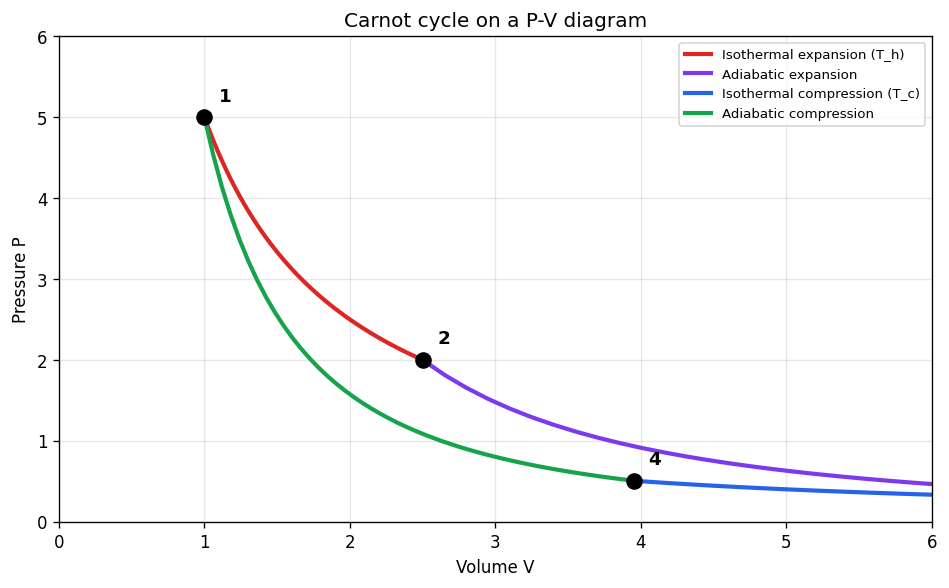
Sketch a P-V diagram for a Carnot cycle.
Show answersHide answers
1. Option 3 — Isochoric
2. Option 1 — Isothermal
3. Four basic thermodynamic processes are characterized by what's held constant. Isothermal (T const): for ideal gas ΔU = 0 so Q = W. Adiabatic (Q = 0): ΔU = −W; gas cools when expanding heats when compressed. Isochoric (V const): no work done; all heat goes into ΔU. Isobaric (P const): some heat goes into work some into ΔU. Real engines use combinations: Carnot cycle uses 2 isothermal + 2 adiabatic.
Q313 Marks
Study the second law of thermodynamics:
Statement
Description
Kelvin-Planck
No engine can convert heat completely to work — some must be rejected to a cold reservoir.
Clausius
Heat does not spontaneously flow from a colder body to a hotter body.
Entropy
The total entropy of an isolated system never decreases.
Which formulation of the 2nd law involves the term entropy?
AKelvin-Planck
BClausius
CEntropy
DAll three
Kelvin-Planck implies a heat engine:
ACannot have 100% efficiency
BCannot have 0% efficiency
CCannot have any efficiency
DHas unlimited efficiency
Show by contradiction that violating Clausius's statement also violates Kelvin-Planck's.
Show answersHide answers
1. Option 3 — Entropy
2. Option 1 — Cannot have 100% efficiency
3. The second law has multiple equivalent formulations all expressing the same physical principle: there is a fundamental asymmetry in nature between heat and work. Kelvin-Planck rules out perfect heat engines. Clausius rules out heat flowing 'uphill'. Entropy formulation generalizes both: ΔS_universe ≥ 0 for any process. Equality only for reversible processes — natural (irreversible) processes always increase entropy.
Q326 Marks
A Carnot engine operates between 727°C (1000 K) and 27°C (300 K). It absorbs 2000 J per cycle from the hot source. Compute (i) efficiency, (ii) work output, (iii) heat rejected.
Quantity
Value
Hot reservoir T_hot
1000 K
Cold reservoir T_cold
300 K
Heat absorbed Q_hot
2000 J
Picture-Based Questions1 question
Q333 Marks
Study the Carnot cycle on the P-V diagram and answer:
The Carnot cycle consists of:
A2 isothermal + 2 adiabatic
B2 isobaric + 2 isochoric
C4 isothermal
D4 adiabatic
The maximum efficiency of a Carnot engine is:
Aη = 1 + T_cold/T_hot
Bη = T_cold/T_hot
Cη = 1 − T_cold/T_hot
Dη = T_hot/T_cold
Describe the four processes of the Carnot cycle and derive its efficiency formula.
Show answersHide answers
1. Option 1 — 2 isothermal + 2 adiabatic
2. Option 3 — η = 1 − T_cold/T_hot
3. Carnot cycle has 4 reversible processes: (1→2) isothermal expansion at T_hot — heat Q_h absorbed from hot reservoir, work done by gas; (2→3) adiabatic expansion — gas cools to T_cold; (3→4) isothermal compression at T_cold — heat Q_c rejected to cold reservoir; (4→1) adiabatic compression — gas heats back to T_hot. Efficiency: η = W/Q_h = (Q_h − Q_c)/Q_h = 1 − T_c/T_h. This is the maximum possible efficiency for any heat engine operating between two given temperatures (Carnot's theorem). Real engines are always less efficient due to irreversibilities (friction, finite-rate heat transfer, etc.).