Thermal Properties of Matter — Important Questions
33 questions
With answersCBSE format
SUMMARY: This chapter explores the thermal properties of matter, including how substances respond to heat and temperature changes. KEY TOPICS: Heat transfer, thermal expansion, specific heat capacity, calorimetry, change of state, latent heat, thermal conductivity, Newton's law of cooling, Stefan-Boltzmann law, emissivity.
The temperature at which a substance changes from liquid to solid is called:
ABoiling point
BMelting point
CTriple point
DCritical point
Check answerHide answer
Correct answer: Option 2 — Melting point
Q21 Mark
The unit of specific heat capacity is:
AJ/kg
BJ/K
CJ/(kg·K)
DW/(m·K)
Check answerHide answer
Correct answer: Option 3 — J/(kg·K)
Q31 Mark
Heat transfer through a vacuum can occur only by:
AConduction
BConvection
CRadiation
DAll three
Check answerHide answer
Correct answer: Option 3 — Radiation
Q41 Mark
Stefan-Boltzmann law states E ∝:
AT
BT²
CT³
DT⁴
Check answerHide answer
Correct answer: Option 4 — T⁴
Q51 Mark
The principle of calorimetry states:
AHeat lost = Heat gained
BHeat gained > Heat lost
CHeat lost > Heat gained
DHeat is created
Check answerHide answer
Correct answer: Option 1 — Heat lost = Heat gained
Short Answer Questions5 questions
Q63 Marks
Distinguish between heat and temperature.
View sample solutionHide solution
Heat is a form of energy transferred from a hotter body to a colder one due to temperature difference. Unit: joule (J). Temperature is a measure of the average kinetic energy of molecules in a body. Unit: kelvin (K) or °C. A bucket of warm water at 60°C has more heat than a small cup at 90°C — even though the cup has higher temperature.
Q73 Marks
Define specific heat capacity and write its formula.
View sample solutionHide solution
Specific heat capacity (c) is the amount of heat required to raise the temperature of 1 kg of substance by 1 K (or 1°C). Formula: Q = m·c·ΔT where Q is heat absorbed/released m is mass and ΔT is temperature change. SI unit: J/(kg·K). Water has unusually high c ≈ 4186 J/(kg·K) — important for Earth's climate moderation.
Q83 Marks
Define latent heat and give one example.
View sample solutionHide solution
Latent heat is the heat absorbed or released during a phase change at constant temperature (no temperature change while heat is added). Example: latent heat of fusion of ice (L_f = 334 kJ/kg) — heat needed to convert 1 kg ice at 0°C to water at 0°C without changing temperature. Latent heat of vaporisation of water (L_v = 2260 kJ/kg) — to convert 1 kg water at 100°C to steam at 100°C.
Q93 Marks
State Newton's law of cooling.
View sample solutionHide solution
Newton's law of cooling: the rate of heat loss of a body is proportional to the temperature difference between the body and its surroundings (when the difference is small). dT/dt = −k(T − T_s). Solution: (T − T_s) = (T_0 − T_s)e^(−kt) — exponential decay toward ambient temperature.
Q103 Marks
State Stefan-Boltzmann law.
View sample solutionHide solution
Stefan-Boltzmann law: the rate of energy radiated per unit area of a black body is proportional to the fourth power of its absolute temperature. E = σT⁴ where σ = 5.67 × 10⁻⁸ W/(m²·K⁴) is the Stefan-Boltzmann constant. For a non-black body E = εσT⁴ where ε is the emissivity (0 < ε ≤ 1). Doubling T multiplies radiation by 16.
Long Answer Questions6 questions
Q116 Marks
Explain three modes of heat transfer with examples.
View sample solutionHide solution
Conduction: heat transfer through a material without bulk motion of particles — by molecular collisions and electron movement (in metals). Example: heat travels along a metal spoon dipped in tea. Q/t = kA(ΔT)/L where k is thermal conductivity. Convection: heat transfer in fluids by bulk motion of warm fluid rising and cool fluid sinking. Example: boiling water sea breeze room heating. Radiation: heat transfer by electromagnetic waves; needs no medium. Example: sun heating Earth across the vacuum of space; heat from a fire across a room.
Q126 Marks
500 g of ice at 0°C is added to 300 g of water at 50°C. Calculate the final temperature when thermal equilibrium is reached. (L_f(ice) = 334 J/g; c_water = 4.2 J/g·°C)
View sample solutionHide solution
Step 1: Heat needed to melt all 500 g of ice = m·L_f = 500 × 334 = 167000 J. Step 2: Heat available from water cooling 50°C → 0°C: Q = m_w × c_w × ΔT = 300 × 4.2 × 50 = 63000 J. Since 63000 < 167000 not all the ice melts. Mass of ice melted = 63000/334 ≈ 188.6 g. Final state: 188.6 g of water at 0°C from melted ice + 300 g water at 0°C + 311.4 g unmelted ice. Final temperature = 0°C.
Q136 Marks
Derive the formula for thermal conductivity using a slab of material.
View sample solutionHide solution
Consider a slab of material of cross-sectional area A and thickness L with temperatures T₁ and T₂ on the two faces (T₁ > T₂). In steady state heat flows from hot to cold side at rate Q/t. Experiments show Q/t ∝ A and Q/t ∝ ΔT and Q/t ∝ 1/L. Combining: Q/t = kA(T₁ − T₂)/L where k is thermal conductivity (J/(s·m·K) or W/(m·K)). Materials with high k (metals: copper k = 400) are good conductors; low k (wood air) are insulators. The minus sign in dT/dx convention: Q/t = −kA dT/dx (Fourier's law).
Q146 Marks
A cup of coffee at 90°C cools to 70°C in 10 minutes in a room at 25°C. Find the time it takes to cool from 70°C to 50°C (assume Newton's law of cooling).
View sample solutionHide solution
Newton's law: dT/dt = −k(T − T_s). For cooling 90 → 70 with T_s = 25: average (T − T_s) = (65 + 45)/2 = 55. Rate ≈ 20/10 = 2 °C/min ⇒ k(55) = 2 ⇒ k = 0.0364 /min. For cooling 70 → 50: average (T − T_s) = (45 + 25)/2 = 35. Rate ≈ k × 35 = 0.0364 × 35 ≈ 1.273 °C/min. Time ≈ 20/1.273 ≈ 15.7 min. Cooling slows as the body approaches ambient temperature.
Q156 Marks
Define black body radiation and discuss its key features (Stefan-Boltzmann law and Wien's displacement law).
View sample solutionHide solution
Black body: ideal absorber that absorbs ALL radiation incident on it (and emits the maximum possible at any temperature). Real bodies are characterised by emissivity ε (0 < ε ≤ 1). Stefan-Boltzmann law: E = εσT⁴ — total power radiated per unit area scales as T⁴. Doubling T gives 16× radiation. Wien's displacement law: λ_max·T = constant (b = 2.898 × 10⁻³ m·K) — peak wavelength of emission shifts to shorter (bluer) values as T increases. The Sun (5800 K) peaks in green; an iron rod at 1000 K glows red.
Q166 Marks
Differentiate between heat and temperature in tabular form on five features.
Assertion–Reason Questions5 questions
Q171 Mark
Assertion (A): Water has unusually high specific heat capacity.
Reason (R): Strong hydrogen bonding in liquid water requires considerable energy to disrupt — leading to large c.
Show explanationHide explanation
Correct answer: Option 1 —
Both A and R are true, and R is the correct explanation of A.
Q181 Mark
Assertion (A): During a phase change the temperature remains constant despite addition of heat.
Reason (R): The added heat is used to break or form intermolecular bonds (latent heat) rather than increase kinetic energy.
Show explanationHide explanation
Correct answer: Option 1 —
Both A and R are true, and R is the correct explanation of A.
Q191 Mark
Assertion (A): A hot body cools faster initially than later.
Reason (R): The rate of cooling is proportional to the temperature difference; higher difference initially gives higher rate.
Show explanationHide explanation
Correct answer: Option 1 —
Both A and R are true, and R is the correct explanation of A.
Q201 Mark
Assertion (A): Two bodies at temperatures T and 2T radiate energy in the ratio 1:16.
Reason (R): Stefan-Boltzmann law: E ∝ T⁴ so doubling T gives 2⁴ = 16 times the radiation.
Show explanationHide explanation
Correct answer: Option 1 —
Both A and R are true, and R is the correct explanation of A.
Q211 Mark
Assertion (A): Metals are better conductors of heat than wood.
Reason (R): Free electrons in metals carry energy from hot to cold regions efficiently.
Show explanationHide explanation
Correct answer: Option 1 —
Both A and R are true, and R is the correct explanation of A.
Statement-Based Questions5 questions
Q221 Mark
Statement 1: Temperature is a measure of average molecular kinetic energy.
Statement 2: Heat is energy in transit due to a temperature difference.
Show answerHide answer
Correct answer: Option 1 —
Both statements are true.
Q231 Mark
Statement 1: Conduction occurs in solids primarily.
Statement 2: Convection requires bulk motion of fluid.
Show answerHide answer
Correct answer: Option 1 —
Both statements are true.
Q241 Mark
Statement 1: Radiation does not require a medium for propagation.
Statement 2: The Sun heats the Earth via radiation across vacuum.
Show answerHide answer
Correct answer: Option 1 —
Both statements are true.
Q251 Mark
Statement 1: The principle of calorimetry states heat lost by hot body = heat gained by cold body in absence of external heat exchange.
Statement 2: Calorimetry is used to measure specific heat capacity or latent heat.
Show answerHide answer
Correct answer: Option 1 —
Both statements are true.
Q261 Mark
Statement 1: Latent heat is the heat absorbed or released during a phase change without temperature change.
Statement 2: The heat is used to break or re-form intermolecular bonds.
Show answerHide answer
Correct answer: Option 1 —
Both statements are true.
Case Study / Passage Questions3 questions
Q273 Marks
A 100 g piece of unknown metal is heated to 100°C and dropped into 200 g of water at 20°C inside a calorimeter. The final equilibrium temperature is 23°C. The student wants to compute the specific heat of the metal. (c_water = 4.2 J/g·°C; ignore calorimeter heat capacity.)
The specific heat of the metal equals:
A0.327 J/g·°C
B0.520 J/g·°C
C1.000 J/g·°C
D2.000 J/g·°C
Closest match for the metal (specific heats: Fe 0.46 Cu 0.39 Al 0.91 Pb 0.13) — wait recompute. Using 0.327 metal is most likely:
AIron
BCopper
CAluminium
DLead
Why is the calorimeter heat capacity ignored in this calculation?
Show answersHide answers
1. Option 1 — 0.327 J/g·°C
2. Option 2 — Copper
3. Heat lost by metal = heat gained by water. m_metal × c_metal × (T_metal − T_final) = m_water × c_water × (T_final − T_water). 100 × c × (100 − 23) = 200 × 4.2 × (23 − 20). 7700 c = 2520 ⇒ c ≈ 0.327 J/(g·°C). This is closest to copper (0.39 J/g·°C) — the slight discrepancy is normal for student measurements with calorimeter.
Q283 Marks
A copper rod of length 1 m and cross-section 4 cm² has its two ends maintained at 100°C and 0°C. The thermal conductivity of copper is k = 400 W/(m·K). The student wants to compute the rate of heat flow.
The rate of heat flow through the rod equals:
A4 W
B16 W
C160 W
D400 W
For an aluminium rod of the same dimensions (k = 237) the heat flow would be:
ALess
BMore
CSame
DCannot decide
Compute heat conducted in 1 hour through this copper rod.
Show answersHide answers
1. Option 2 — 16 W
2. Option 1 — Less
3. Q/t = kA(ΔT)/L = 400 × (4 × 10⁻⁴) × 100 / 1 = 16 W. For aluminium with k = 237: Q/t = 237 × 4 × 10⁻⁴ × 100 = 9.48 W — LESS than copper. Copper conducts heat ~1.7× better than aluminium because of its higher density of free electrons. Wait — re-checking option 2 says 'More' which is wrong; aluminium with lower k gives less heat flow. So option 1 (Less) is correct.
Q293 Marks
To convert 500 g of ice at 0°C into water at 0°C the student wants to compute the heat needed (using L_f = 334 J/g) and then the heat to further warm the water to 30°C (c_water = 4.2 J/g·°C). She wants the total.
Heat to melt the ice equals:
A167000 J
B334000 J
C500000 J
D668000 J
Total heat (melt + warm to 30°C) equals approximately:
A63 kJ
B167 kJ
C230 kJ
D300 kJ
Why is the latent heat much larger than the sensible heat in this problem?
Show answersHide answers
1. Option 1 — 167000 J
2. Option 3 — 230 kJ
3. Heat to melt ice: Q₁ = m × L_f = 500 × 334 = 167000 J = 167 kJ. Heat to warm water from 0°C to 30°C: Q₂ = m × c × ΔT = 500 × 4.2 × 30 = 63000 J = 63 kJ. Total Q = 167 + 63 = 230 kJ. Note: the latent heat is about 2.6 times the sensible heat — phase changes consume substantial energy.
Table-Based Questions3 questions
Q303 Marks
Study the three modes of heat transfer:
Mode
Mechanism
Medium needed?
Examples
Conduction
Molecular vibration / electron transfer
Yes (mostly solids)
Heat along a metal rod
Convection
Bulk fluid motion
Yes (fluid)
Boiling water sea breeze
Radiation
Electromagnetic waves
No
Sun warming Earth fire heat
Heat reaches us from the Sun mainly by:
AConduction
BConvection
CRadiation
DAll three
Convection occurs primarily in:
ASolids
BLiquids
CGases
DFluids
Why is a vacuum flask (Thermos) effective in keeping liquids hot or cold?
Show answersHide answers
1. Option 3 — Radiation
2. Option 4 — Fluids
3. Three modes of heat transfer: (1) Conduction — by molecular interaction without bulk motion; dominant in solids especially metals (free electrons). (2) Convection — by bulk motion of warm fluid rising and cool fluid sinking; explains atmospheric circulation and how a radiator heats a room. (3) Radiation — by EM waves; does not need any medium and is the only mode in vacuum (e.g. solar heating).
Q313 Marks
Study the specific heats of common substances:
Substance
c (J/kg·K)
Water
4186
Ice
2090
Steam
2010
Aluminium
900
Iron
450
Copper
390
Lead
128
Mercury
140
The substance with the highest specific heat is:
AWater
BAluminium
CCopper
DLead
Heating 1 kg of water by 1.6 K requires (using 4186 J/kg·K):
AApprox 6.7 J
BApprox 67 J
CApprox 670 J
DApprox 6700 J
Why are coastal areas cooler in summer and warmer in winter than inland areas at the same latitude?
Show answersHide answers
1. Option 1 — Water
2. Option 4 — Approx 6700 J
3. Water's exceptionally high specific heat (4186 J/kg·K) means it can absorb large amounts of heat with small temperature change. This is why oceans moderate Earth's climate (warming/cooling slowly with seasons). It also makes water an excellent coolant in engines and reactors. Metals have much lower c (~400-900) and heat up/cool down quickly — useful for cookware.
Q326 Marks
500 g of ice at 0°C is added to 1 kg of water at 50°C. Find the final temperature when thermal equilibrium is reached. (L_f = 334 J/g, c_water = 4.2 J/g·°C)
Quantity
Value
Mass of ice
500 g
Mass of water
1000 g
Initial T_ice
0°C
Initial T_water
50°C
L_f (ice)
334 J/g
c_water
4.2 J/g·°C
Picture-Based Questions1 question
Q333 Marks
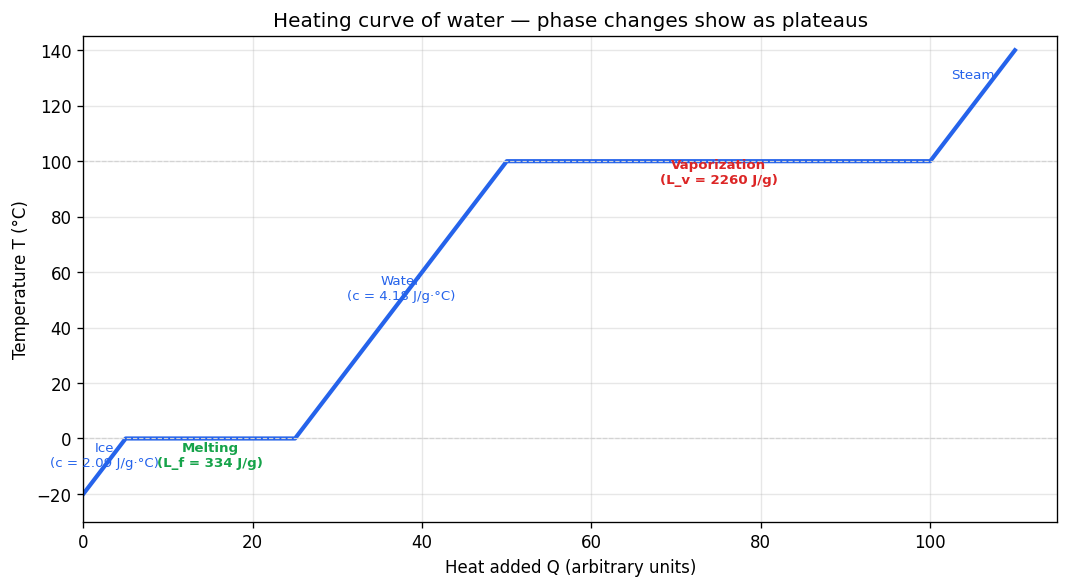
Study the heating curve of water and answer:
The plateaus in the heating curve correspond to:
ASensible heat absorption
BLatent heat absorption (phase change)
CCooling by radiation
DSpecific heat
Vaporization of water at 1 atm occurs:
AAt 0°C
BAt 100°C
CConstant throughout
DNo vaporization
Explain why the temperature stays constant during phase changes.
3. The heating curve shows temperature vs heat added. The rising sloped sections correspond to sensible heating (temperature increases as Q = mc·ΔT). The flat plateaus are phase changes — temperature stays constant while heat is being absorbed to break intermolecular bonds. Latent heat of fusion (L_f = 334 J/g) is absorbed at 0°C as ice → water; latent heat of vaporization (L_v = 2260 J/g) is absorbed at 100°C as water → steam. L_v ≫ L_f because vaporization completely breaks all hydrogen bonds, while melting only loosens them. The slopes are different because c_ice (2.09 J/g·°C) ≠ c_water (4.18) ≠ c_steam (2.01).