SUMMARY: The chapter "Oscillations" in Class 11 Physics explores the fundamental concepts and mathematical descriptions of oscillatory motion. KEY TOPICS: Simple harmonic motion, oscillation of a spring, energy in simple harmonic motion, damped oscillations, forced oscillations and resonance, angular simple harmonic motion, phase of oscillation, time period and frequency.
Correct answer: Option 2 — Periodic and oscillatory
Q31 Mark
The time period of a spring-mass system is:
A2π√(k/m)
B2π√(m/k)
C(1/2π)√(k/m)
D(1/2π)√(m/k)
Check answerHide answer
Correct answer: Option 2 — 2π√(m/k)
Q41 Mark
At what point is the velocity in SHM maximum?
AMaximum displacement
BMean position
CQuarter amplitude
DThree-quarter amplitude
Check answerHide answer
Correct answer: Option 2 — Mean position
Q51 Mark
The acceleration in SHM is:
AConstant
BProportional to displacement and in same direction
CProportional to displacement and in opposite direction
DIndependent of displacement
Check answerHide answer
Correct answer: Option 3 — Proportional to displacement and in opposite direction
Short Answer Questions5 questions
Q63 Marks
Define Simple Harmonic Motion (SHM) and write the differential equation governing it.
View sample solutionHide solution
SHM: a periodic motion in which the restoring force is directly proportional to the displacement from the mean position and acts toward the mean position. Differential equation: d²x/dt² = −ω²x where ω is the angular frequency. Solution: x(t) = A sin(ωt + φ) where A is amplitude and φ is initial phase. T = 2π/ω.
Q73 Marks
Write the expressions for displacement velocity and acceleration in SHM.
View sample solutionHide solution
x(t) = A sin(ωt + φ) — displacement. v(t) = dx/dt = Aω cos(ωt + φ) — velocity. a(t) = dv/dt = −Aω² sin(ωt + φ) = −ω²x — acceleration. Note a is always opposite in sign to x and proportional in magnitude. Velocity is max at mean position (x = 0) where v_max = Aω; acceleration is max at extreme positions where a_max = Aω².
Q83 Marks
Find the time period of a simple pendulum of length 1 m. (g = 9.8 m/s²)
View sample solutionHide solution
T = 2π√(L/g) = 2π√(1/9.8) = 2π × 0.3194 = 2.007 s ≈ 2 s. A pendulum of length 1 m at the surface of Earth has a period of approximately 2 seconds — historical 'second pendulum' for clock making.
Q93 Marks
Distinguish between damped and forced oscillations.
View sample solutionHide solution
Damped oscillation: amplitude decreases with time due to dissipative forces (friction air resistance internal viscosity). Energy is lost. Mathematical form: x = A e^(−bt/2m) cos(ω't + φ). Forced oscillation: an external periodic force drives the system at its driving frequency ω_d. After transients die down the system oscillates at ω_d. Resonance occurs when ω_d ≈ natural frequency ω_0 — large amplitude buildup.
Q103 Marks
What is resonance?
View sample solutionHide solution
Resonance: large amplitude buildup in a forced oscillation when the driving frequency matches the natural frequency of the oscillator. At resonance very small driving force produces large response. Examples: tuning a radio; pushing a child on a swing in time with the swing's natural frequency; the Tacoma Narrows Bridge collapse (1940). Resonance can be useful (musical instruments) or destructive (aircraft wings flutter).
Long Answer Questions6 questions
Q116 Marks
Derive the expression for the time period of a simple pendulum.
View sample solutionHide solution
Consider a simple pendulum of length L bob mass m. When displaced by small angle θ the restoring force is the component of gravity along the arc: F = −mg sin θ ≈ −mgθ for small θ. The arc length s = Lθ ⇒ θ = s/L. F = −(mg/L)s. This is SHM with effective k = mg/L. From F = ma (where a = d²s/dt²): d²s/dt² = −(g/L)s ⇒ ω² = g/L ⇒ ω = √(g/L). Time period T = 2π/ω = 2π√(L/g). Independent of mass m and amplitude (for small angles).
Q126 Marks
Derive the equation for the time period of a spring-mass system. A 0.5 kg mass attached to a spring of force constant 200 N/m is set into oscillation. Find its period.
View sample solutionHide solution
For a spring of force constant k attached to a mass m: restoring force F = −kx ⇒ ma = −kx ⇒ d²x/dt² = −(k/m)x. This is SHM with ω² = k/m ⇒ ω = √(k/m). Time period T = 2π/ω = 2π√(m/k). Independent of amplitude. For m = 0.5 kg k = 200 N/m: T = 2π√(0.5/200) = 2π√(0.0025) = 2π × 0.05 = 0.314 s.
Q136 Marks
Show that the energy of a body in SHM remains constant. Derive expressions for KE PE and total energy.
View sample solutionHide solution
For SHM x = A sin(ωt) v = Aω cos(ωt). KE = (1/2)mv² = (1/2)mA²ω² cos²(ωt). PE (against restoring force F = −kx where k = mω²): PE = (1/2)kx² = (1/2)mω²A² sin²(ωt). Total = KE + PE = (1/2)mω²A²(cos²ωt + sin²ωt) = (1/2)mω²A² = (1/2)kA² = constant. Energy oscillates between purely KE (at mean position, x = 0) and purely PE (at extremes, v = 0) — but the sum is conserved.
Q146 Marks
A body executes SHM with amplitude 5 cm and time period 2 s. Find its (i) velocity at mean position (ii) velocity at 3 cm from mean position (iii) maximum acceleration.
View sample solutionHide solution
ω = 2π/T = 2π/2 = π rad/s. Amplitude A = 0.05 m. (i) v_max at mean position: v_max = Aω = 0.05 × π = 0.157 m/s. (ii) v at displacement x = 0.03 m: v = ω √(A² − x²) = π √(0.0025 − 0.0009) = π √0.0016 = π × 0.04 = 0.126 m/s. (iii) Maximum acceleration at extreme: a_max = Aω² = 0.05 × π² = 0.05 × 9.87 = 0.494 m/s².
Q156 Marks
Discuss damped oscillations. Derive the equation of motion and explain underdamped critically damped and overdamped cases.
View sample solutionHide solution
Equation: m ẍ + b ẋ + kx = 0 where b is damping constant. Define ω₀² = k/m and γ = b/(2m). The equation becomes ẍ + 2γẋ + ω₀²x = 0. Three cases based on the discriminant γ² − ω₀²: (1) Underdamped (γ < ω₀): oscillatory decay x = A e^(−γt) cos(ω't + φ) with ω' = √(ω₀² − γ²); useful in pendulums and musical instruments. (2) Critically damped (γ = ω₀): fastest return to equilibrium without oscillation; used in shock absorbers and door closers. (3) Overdamped (γ > ω₀): slow non-oscillatory return to equilibrium.
Q166 Marks
Differentiate between simple harmonic motion and uniform circular motion in tabular form.
Assertion–Reason Questions5 questions
Q171 Mark
Assertion (A): SHM is a special type of periodic motion.
Reason (R): The restoring force is proportional to displacement and directed toward the equilibrium position.
Show explanationHide explanation
Correct answer: Option 1 —
Both A and R are true, and R is the correct explanation of A.
Q181 Mark
Assertion (A): A pendulum's time period is independent of mass.
Reason (R): The mass cancels in the equation of motion when the restoring force is gravitational.
Show explanationHide explanation
Correct answer: Option 1 —
Both A and R are true, and R is the correct explanation of A.
Q191 Mark
Assertion (A): The total mechanical energy of an SHM is conserved in the absence of damping.
Reason (R): No dissipative forces act so KE + PE remains constant; energy oscillates between KE and PE forms.
Show explanationHide explanation
Correct answer: Option 1 —
Both A and R are true, and R is the correct explanation of A.
Q201 Mark
Assertion (A): At resonance amplitude of forced oscillation is maximum.
Reason (R): Driving frequency matches the natural frequency so energy transfer is most efficient.
Show explanationHide explanation
Correct answer: Option 1 —
Both A and R are true, and R is the correct explanation of A.
Q211 Mark
Assertion (A): Damping reduces the amplitude of oscillations over time.
Reason (R): Dissipative forces (friction air resistance) convert mechanical energy to heat reducing amplitude.
Show explanationHide explanation
Correct answer: Option 1 —
Both A and R are true, and R is the correct explanation of A.
Statement-Based Questions5 questions
Q221 Mark
Statement 1: In SHM acceleration is proportional to displacement from mean position.
Statement 2: The acceleration is always directed toward the mean position.
Show answerHide answer
Correct answer: Option 1 —
Both statements are true.
Q231 Mark
Statement 1: The period of a simple pendulum is T = 2π√(L/g).
Statement 2: The period is independent of the bob's mass and amplitude (for small angles).
Show answerHide answer
Correct answer: Option 1 —
Both statements are true.
Q241 Mark
Statement 1: The period of a spring-mass system is T = 2π√(m/k).
Statement 2: Stiffer springs (larger k) give shorter periods.
Show answerHide answer
Correct answer: Option 1 —
Both statements are true.
Q251 Mark
Statement 1: Total energy of SHM = (1/2)kA² where A is amplitude.
Statement 2: Energy is purely kinetic at the mean position and purely potential at the extreme positions.
Show answerHide answer
Correct answer: Option 1 —
Both statements are true.
Q261 Mark
Statement 1: Critical damping returns the system to equilibrium fastest without oscillation.
Statement 2: Door closers and shock absorbers use critical damping for smooth operation.
Show answerHide answer
Correct answer: Option 1 —
Both statements are true.
Case Study / Passage Questions3 questions
Q273 Marks
A student measures the time for 20 oscillations of a simple pendulum and finds it to be 40 s. The length of the pendulum is 1 m. The student wants to compute (i) period (ii) angular frequency (iii) value of g implied.
The time period equals:
A1 s
B2 s
C4 s
D8 s
The angular frequency equals:
Aπ rad/s
B2π rad/s
Cπ/2 rad/s
Dπ/4 rad/s
Why is the pendulum's period independent of mass and amplitude (for small angles)?
Show answersHide answers
1. Option 2 — 2 s
2. Option 1 — π rad/s
3. Period T = (total time)/(number of oscillations) = 40/20 = 2 s. Angular frequency ω = 2π/T = π rad/s. From T = 2π√(L/g) ⇒ g = 4π²L/T² = 4π² × 1 / 4 = π² ≈ 9.87 m/s² — close to standard 9.8 m/s². The simple pendulum is one of the oldest methods to measure g.
Q283 Marks
A 0.2 kg mass attached to a spring of constant k = 50 N/m oscillates with amplitude 0.1 m. The student wants to compute the angular frequency total energy maximum velocity and maximum acceleration.
The angular frequency equals approximately:
A5 rad/s
B10 rad/s
C15.8 rad/s
D25 rad/s
The total energy of oscillation equals:
A0.025 J
B0.25 J
C2.5 J
D25 J
At what point in oscillation is KE max and PE max?
Show answersHide answers
1. Option 3 — 15.8 rad/s
2. Option 2 — 0.25 J
3. ω = √(k/m) = √(50/0.2) = √250 = 15.81 rad/s. Total energy E = (1/2)kA² = (1/2)(50)(0.01) = 0.25 J. Maximum velocity v_max = Aω = 0.1 × 15.81 = 1.58 m/s (occurs at mean position). Max acceleration a_max = Aω² = 0.1 × 250 = 25 m/s² (at extreme positions).
Q293 Marks
A car's shock absorber is designed so that after a bump the body returns to equilibrium in the shortest possible time without overshoot. The car body has natural frequency 2 Hz when undamped. The engineer wants to identify the type of damping and compute the time constant.
The shock absorber should be:
AUnderdamped
BCritically damped
COverdamped
DUndamped
Critically damped means the system:
AReturns slowly with no oscillation
BReturns fastest with no overshoot
COscillates with decreasing amplitude
DDoes not return
Why is critical damping (not underdamped) used in shock absorbers?
Show answersHide answers
1. Option 2 — Critically damped
2. Option 2 — Returns fastest with no overshoot
3. Critical damping (γ = ω₀) is the optimum for shock absorbers — fastest return to equilibrium without oscillation. With under-damping (γ < ω₀) the car would bounce up and down after a bump making the ride uncomfortable. With over-damping (γ > ω₀) the suspension is too stiff and slow. Critical damping in real cars uses oil or gas-filled cylinders providing velocity-dependent resistance.
Table-Based Questions4 questions
Q303 Marks
Study SHM characteristics:
Quantity
Formula at displacement x
Restoring force F
−kx
Acceleration a
−ω²x
Velocity v
ω √(A² − x²)
KE
(1/2)mω²(A² − x²)
PE
(1/2)mω²x² = (1/2)kx²
Total Energy
(1/2)kA² = (1/2)mω²A²
At the mean position (x = 0):
AMaximum KE
BMaximum PE
CBoth equal
DBoth zero
At the extreme position (x = A):
AMaximum KE
BMaximum PE
CBoth equal
DBoth maximum
At what fraction of A is PE = KE?
Show answersHide answers
1. Option 1 — Maximum KE
2. Option 2 — Maximum PE
3. In SHM at the mean position (x = 0): velocity is maximum so KE is max; PE = 0. At extreme positions (x = ±A): velocity = 0 so KE = 0; PE is max. Total energy = KE + PE = (1/2)kA² remains constant throughout the oscillation. The energy continuously transforms between KE and PE — at intermediate points it's a mixture.
Q313 Marks
Compare three pendulum types:
Pendulum
Period T
Simple pendulum (length L)
2π √(L/g)
Compound pendulum (about pivot)
2π √(I/(mgd))
Torsional pendulum
2π √(I/c)
For T = 2π√(L/g) we have a:
ASimple
BCompound
CTorsional
DAll same
The simple pendulum's period does NOT depend on:
AL
Bm
Cg
Dd
Why is a wall clock pendulum about 1 m long?
Show answersHide answers
1. Option 1 — Simple
2. Option 2 — m
3. Three pendulum types: (1) Simple — point mass on light string; T = 2π√(L/g); independent of mass and amplitude (for small angles). (2) Compound — rigid body pivoted at a point; T depends on I and on distance d from pivot to COM. (3) Torsional — rigid body suspended by a wire that twists when rotated; restoring torque proportional to angle through torsion constant c. All three exhibit SHM for small displacements.
Q326 Marks
A 0.5 kg mass is attached to a spring of force constant 200 N/m. Compute (i) the angular frequency ω, (ii) the time period T, (iii) the maximum velocity if amplitude is 0.05 m.
Quantity
Value
Mass m
0.5 kg
Spring constant k
200 N/m
Amplitude A
0.05 m
Q336 Marks
A simple pendulum of length 1 m oscillates on Earth (g = 9.8 m/s²) and on the Moon (g = 1.6 m/s²). Compute the period in each location and the ratio.
Location
g (m/s²)
Earth
9.8
Moon
1.6
Pendulum length L
1 m
Picture-Based Questions1 question
Q343 Marks
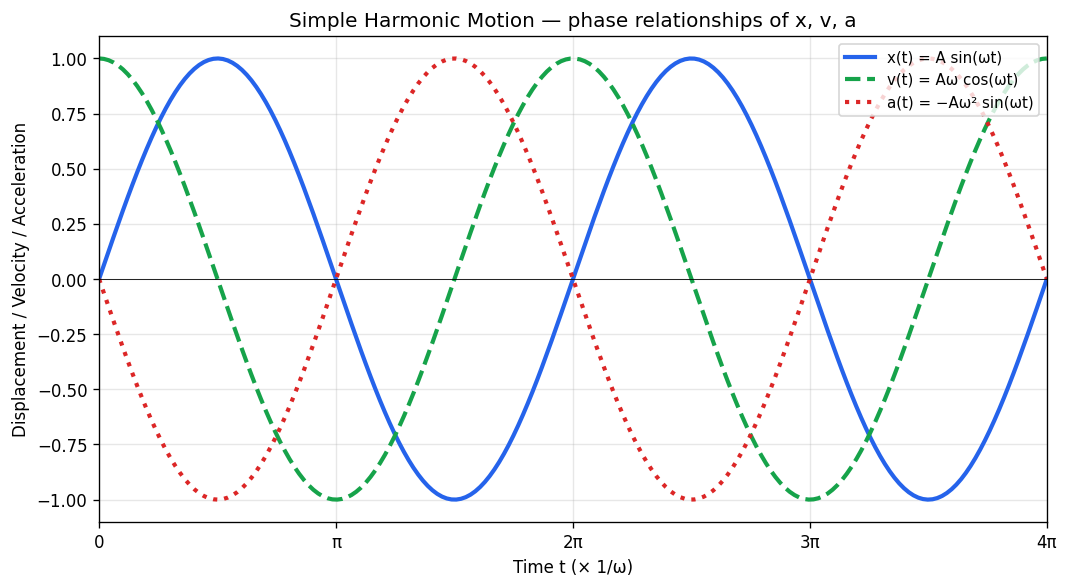
Study the displacement, velocity, and acceleration curves for SHM and answer:
In SHM, the velocity v(t) leads the displacement x(t) by a phase of:
A0
Bπ/4
Cπ/2
Dπ
The acceleration a(t) is always:
ASame direction as x
BOpposite to x
CPerpendicular to x
DIndependent of x
Explain the phase relationships between x, v, and a in SHM.
Show answersHide answers
1. Option 3 — π/2
2. Option 2 — Opposite to x
3. In SHM with x(t) = A sin(ωt): v(t) = dx/dt = Aω cos(ωt) = Aω sin(ωt + π/2) — so velocity LEADS displacement by π/2 (90°). a(t) = dv/dt = −Aω² sin(ωt) = −ω²x — so acceleration is opposite in direction to displacement (restoring force pulls toward equilibrium) and proportional to it. Key features: x = 0 (mean position): v_max, a = 0; x = ±A (extreme positions): v = 0, a_max in opposite direction to x. Energy oscillates between KE (max at mean) and PE (max at extremes); total = constant.