SUMMARY: This chapter focuses on the study of motion along a straight line, introducing fundamental concepts of kinematics. KEY TOPICS: reference point, path length, displacement, average velocity, instantaneous velocity, average speed, instantaneous speed, acceleration, equations of motion, graphical representation of motion
A body moves with uniform velocity. Its acceleration is:
AConstant non-zero
BZero
CIncreasing
DDecreasing
Check answerHide answer
Correct answer: Option 2 — Zero
Q21 Mark
The slope of a position-time graph gives:
AVelocity
BAcceleration
CDisplacement
DSpeed
Check answerHide answer
Correct answer: Option 1 — Velocity
Q31 Mark
The area under a velocity-time graph represents:
AAcceleration
BDisplacement
CSpeed
DForce
Check answerHide answer
Correct answer: Option 2 — Displacement
Q41 Mark
An object thrown vertically upward returns to the starting point. Its average velocity over the round trip is:
AEqual to its initial velocity
BZero
CEqual to g
DEqual to its average speed
Check answerHide answer
Correct answer: Option 2 — Zero
Q51 Mark
The third equation of motion v² = u² + 2as is valid for:
AVariable acceleration
BUniform acceleration
CCircular motion
DVibratory motion
Check answerHide answer
Correct answer: Option 2 — Uniform acceleration
Short Answer Questions5 questions
Q63 Marks
Distinguish between distance and displacement.
View sample solutionHide solution
Distance is the total path length travelled and is a SCALAR quantity — always positive. Displacement is the straight-line vector from initial to final position — has both magnitude and direction; can be zero or negative. For a round trip distance is non-zero but displacement is zero. |Displacement| ≤ Distance always.
Q73 Marks
Define average velocity and instantaneous velocity.
View sample solutionHide solution
Average velocity = total displacement / total time taken (a scalar quotient with vector direction). Instantaneous velocity = limit of average velocity as time interval → 0 = dx/dt. Instantaneous velocity at any point on a position-time graph equals the slope of the tangent at that point.
Q83 Marks
A body starts from rest and accelerates uniformly at 2 m/s². Find its velocity after 5 s.
View sample solutionHide solution
Using v = u + at with u = 0 a = 2 m/s² and t = 5 s: v = 0 + (2)(5) = 10 m/s.
Q93 Marks
Derive the equation v² = u² + 2as from the equations of uniformly accelerated motion.
View sample solutionHide solution
From v = u + at: t = (v − u)/a. Substituting in s = ut + (1/2)at²: s = u(v − u)/a + (1/2)a((v − u)/a)² = (uv − u²)/a + (v − u)²/(2a). Multiplying by 2a: 2as = 2(uv − u²) + (v − u)² = 2uv − 2u² + v² − 2uv + u² = v² − u². Hence v² = u² + 2as.
Q103 Marks
A stone is dropped from a height of 80 m. Find the time it takes to reach the ground. (g = 10 m/s²)
View sample solutionHide solution
Using s = ut + (1/2)gt² with u = 0 (dropped) g = 10 m/s² s = 80 m: 80 = (1/2)(10)t² ⇒ t² = 16 ⇒ t = 4 s.
Long Answer Questions6 questions
Q116 Marks
A car moving at 20 m/s decelerates uniformly and stops in 10 s. Find (i) the deceleration, (ii) the distance travelled before stopping.
View sample solutionHide solution
u = 20 m/s, v = 0, t = 10 s. (i) v = u + at ⇒ 0 = 20 + a(10) ⇒ a = −2 m/s² (deceleration). (ii) Using v² = u² + 2as: 0 = 400 + 2(−2)s ⇒ s = 400/4 = 100 m. Or s = (u + v)t/2 = (20 + 0)(10)/2 = 100 m.
Q126 Marks
A ball is thrown vertically upward with velocity 19.6 m/s. Find (i) maximum height reached, (ii) time of ascent, (iii) total time of flight. (g = 9.8 m/s²)
View sample solutionHide solution
u = 19.6 m/s g = 9.8 m/s² (downward). (i) At max height v = 0. v² = u² − 2gs: 0 = 19.6² − 2(9.8)s ⇒ s = 384.16/19.6 = 19.6 m. (ii) Time of ascent: 0 = 19.6 − 9.8 t ⇒ t = 2 s. (iii) By symmetry total flight time = 2 × 2 = 4 s.
Q136 Marks
Derive the kinematic equations of motion graphically using a velocity-time graph for uniform acceleration.
View sample solutionHide solution
On a v–t graph for uniform acceleration the velocity rises linearly from u (at t = 0) to v (at time t). (i) Slope = acceleration: a = (v − u)/t ⇒ v = u + at. (ii) Area under graph = displacement: s = (1/2)(u + v)t. (iii) Substituting v: s = (1/2)(u + u + at)t = ut + (1/2)at². (iv) Eliminating t: t = (v − u)/a ⇒ s = (u + v)(v − u)/(2a) = (v² − u²)/(2a) ⇒ v² = u² + 2as. Three equations of motion.
Q146 Marks
A particle moves along the x-axis with x = 5t² + 3t + 2. Find (i) initial velocity (ii) velocity at t = 2 s (iii) acceleration.
View sample solutionHide solution
x(t) = 5t² + 3t + 2. (i) v(t) = dx/dt = 10t + 3. v(0) = 3 m/s (initial). (ii) v(2) = 10(2) + 3 = 23 m/s. (iii) a(t) = dv/dt = 10 m/s² (constant). The particle has uniform acceleration of 10 m/s² and starts with initial velocity 3 m/s at position 2 m.
Q156 Marks
Two cars start from the same point. Car A moves with constant velocity 30 m/s. Car B starts from rest and accelerates at 4 m/s². When does B catch up with A and what distance has each travelled?
View sample solutionHide solution
Car A position: x_A = 30 t. Car B (from rest): x_B = (1/2)(4)t² = 2 t². They meet when x_A = x_B: 30t = 2t² ⇒ 2t² − 30t = 0 ⇒ t(t − 15) = 0. Excluding t = 0: t = 15 s. Distance: x_A = 30(15) = 450 m; x_B = 2(15²) = 450 m ✓ (same). Note: at t = 15 s B's velocity = 4(15) = 60 m/s — twice A's velocity.
Q166 Marks
Compare distance and displacement with the help of a table on five features.
Assertion–Reason Questions5 questions
Q171 Mark
Assertion (A): A body moving with uniform velocity has zero acceleration.
Reason (R): Acceleration is the rate of change of velocity; uniform velocity means no change.
Show explanationHide explanation
Correct answer: Option 1 —
Both A and R are true, and R is the correct explanation of A.
Q181 Mark
Assertion (A): For a round trip the average velocity is zero but the average speed is non-zero.
Reason (R): Average velocity uses displacement (zero in a round trip) while average speed uses distance (non-zero).
Show explanationHide explanation
Correct answer: Option 1 —
Both A and R are true, and R is the correct explanation of A.
Q191 Mark
Assertion (A): A body in free fall has uniform acceleration g.
Reason (R): All bodies near Earth's surface fall with the same acceleration ignoring air resistance.
Show explanationHide explanation
Correct answer: Option 1 —
Both A and R are true, and R is the correct explanation of A.
Q201 Mark
Assertion (A): The slope of a velocity-time graph gives acceleration.
Reason (R): a = dv/dt and the slope is the rate of change of velocity with time.
Show explanationHide explanation
Correct answer: Option 1 —
Both A and R are true, and R is the correct explanation of A.
Q211 Mark
Assertion (A): Equations of motion v = u + at and s = ut + (1/2)at² apply only for uniform acceleration.
Reason (R): Their derivation assumes constant acceleration — for variable acceleration calculus is required.
Show explanationHide explanation
Correct answer: Option 1 —
Both A and R are true, and R is the correct explanation of A.
Statement-Based Questions5 questions
Q221 Mark
Statement 1: Distance is a scalar quantity.
Statement 2: Displacement is a vector quantity.
Show answerHide answer
Correct answer: Option 1 —
Both statements are true.
Q231 Mark
Statement 1: The slope of position-time graph is velocity.
Statement 2: The area under a velocity-time graph is displacement.
Show answerHide answer
Correct answer: Option 1 —
Both statements are true.
Q241 Mark
Statement 1: Speed is the magnitude of velocity.
Statement 2: Average speed is always greater than or equal to the magnitude of average velocity.
Show answerHide answer
Correct answer: Option 1 —
Both statements are true.
Q251 Mark
Statement 1: All freely falling bodies near Earth's surface have the same acceleration.
Statement 2: Air resistance can cause heavy and light objects to fall at different rates in real conditions.
Show answerHide answer
Correct answer: Option 1 —
Both statements are true.
Q261 Mark
Statement 1: The equations of motion apply only to uniform acceleration.
Statement 2: For variable acceleration calculus methods are needed.
Show answerHide answer
Correct answer: Option 1 —
Both statements are true.
Case Study / Passage Questions3 questions
Q273 Marks
A car travelling at 20 m/s on a highway suddenly notices an obstacle ahead. The driver applies brakes and the car decelerates uniformly to a stop in 5 s. The investigator wants to determine the deceleration the distance travelled before stopping and the average velocity during the stopping period.
The deceleration of the car equals:
A−2 m/s²
B−4 m/s²
C−5 m/s²
D−10 m/s²
The distance travelled before stopping is:
A25 m
B50 m
C75 m
D100 m
Verify the stopping distance using the equation v² = u² + 2as.
Show answersHide answers
1. Option 2 — −4 m/s²
2. Option 2 — 50 m
3. u = 20 m/s v = 0 t = 5 s. Deceleration: a = (v − u)/t = (0 − 20)/5 = −4 m/s². Distance: s = ut + (1/2)at² = 20(5) + (1/2)(−4)(25) = 100 − 50 = 50 m. Equivalently s = (u + v)/2 × t = 10 × 5 = 50 m. Average velocity = (20 + 0)/2 = 10 m/s.
Q283 Marks
A construction worker drops a hammer from the top of a 45 m building. Ignoring air resistance and taking g = 10 m/s² compute the time taken to reach the ground the velocity just before impact and the time taken to fall the last 5 m.
Time to reach the ground equals:
A2 s
B3 s
C4 s
D5 s
The velocity just before hitting the ground is:
A15 m/s
B30 m/s
C45 m/s
D60 m/s
Compute the velocity at the midpoint (height 22.5 m above ground).
Show answersHide answers
1. Option 2 — 3 s
2. Option 2 — 30 m/s
3. Using s = (1/2)gt² with s = 45 m: 45 = (1/2)(10)t² ⇒ t² = 9 ⇒ t = 3 s. Velocity at impact: v = gt = 10 × 3 = 30 m/s (or v = √(2gs) = √900 = 30 m/s). Last 5 m: at distance 40 m from top v² = 2(10)(40) = 800 ⇒ v = 28.28 m/s. Time to cover next 5 m: 5 = 28.28 t + (1/2)(10) t²; solve 5t² + 28.28t − 5 = 0 ⇒ t ≈ 0.17 s.
Q293 Marks
An athlete runs along a circular track of radius 50 m. After completing exactly half a circle the athlete continues to the diametrically opposite point. The coach wants to determine (i) the distance covered (ii) the magnitude of displacement (iii) the average speed if it took 30 s.
The distance covered (half circumference) is:
A50 m
B100 m
Cπ × 50 m
D200 m
The magnitude of displacement is:
A50 m
B100 m
Cπ × 50 m
D200 m
Compute the average speed and magnitude of average velocity.
Show answersHide answers
1. Option 3 — π × 50 m
2. Option 2 — 100 m
3. Distance = arc length = πR = π × 50 ≈ 157 m. Displacement = chord from start to opposite point = diameter = 2R = 100 m. Average speed = distance/time = 157/30 ≈ 5.24 m/s. Average velocity (magnitude) = displacement/time = 100/30 ≈ 3.33 m/s. Average speed > |average velocity| because the path is not straight.
Table-Based Questions4 questions
Q303 Marks
Study the kinematic equations of motion (uniform acceleration):
Equation
Variables related
v = u + at
v u a t
s = ut + (1/2)at²
s u a t
v² = u² + 2as
v u a s
s = (u + v)t/2
s u v t
Which equation does NOT involve time?
Av = u + at
Bs = ut + (1/2)at²
Cv² = u² + 2as
Ds = (u + v)t/2
These equations are valid for:
AVariable acceleration
BUniform velocity
CUniform acceleration
DRandom motion
Use v² = u² + 2as to find the distance travelled by a body decelerating from 20 m/s to rest at −5 m/s².
Show answersHide answers
1. Option 3 — v² = u² + 2as
2. Option 3 — Uniform acceleration
3. The four kinematic equations describe motion under uniform (constant) acceleration in one dimension. Each relates 4 of the 5 quantities (u v a s t); choosing the right one depends on which quantity is unknown and which 3 are given. For non-uniform acceleration calculus methods (integration of dv = a dt) are required.
Q313 Marks
Study the position-velocity-acceleration table at different times for a body in uniformly accelerated motion (u = 0 a = 2 m/s²):
Time t (s)
Velocity v (m/s)
Distance s (m)
0
0
0
1
2
1
2
4
4
3
6
9
4
8
16
5
10
25
The relation between velocity and time is:
ALinear
BQuadratic
CCubic
DConstant
The relation between distance and time is:
ALinear
BQuadratic
CConstant
DLogarithmic
At t = 10 s what would be the velocity and distance?
Show answersHide answers
1. Option 1 — Linear
2. Option 2 — Quadratic
3. For uniform acceleration with u = 0: v = at — linear in t. s = (1/2)at² — quadratic in t. For a = 2 m/s²: v = 2t s = t². At t = 3 s: v = 6 s = 9 ✓. The body's position grows quadratically while its velocity grows linearly — characteristic of uniformly accelerated motion.
Q326 Marks
A car decelerates uniformly from 25 m/s to rest. The deceleration is 5 m/s². Compute (i) the time to stop, (ii) the distance covered before stopping, (iii) the distance covered in the third second.
Quantity
Value
Initial velocity u
25 m/s
Final velocity v
0 m/s
Deceleration a
−5 m/s²
Q336 Marks
A ball is dropped from a height of 80 m. Compute (i) the time taken to reach the ground, (ii) the velocity just before impact, (iii) the time taken to fall the last 5 m. (g = 10 m/s²)
Quantity
Value
Initial velocity
0 (dropped)
Height h
80 m
g
10 m/s²
Picture-Based Questions1 question
Q343 Marks
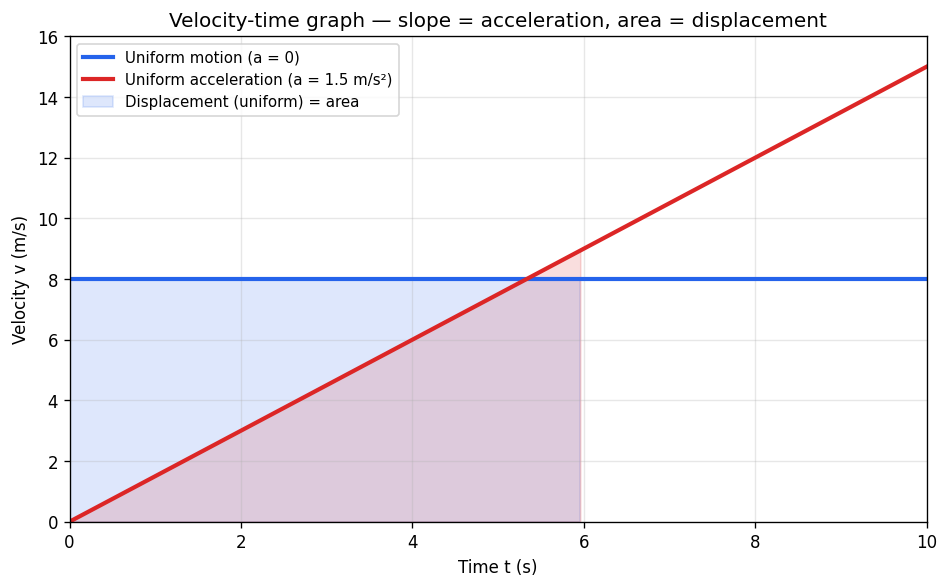
Study the velocity-time graph and answer:
The slope of the velocity-time graph represents:
AThe velocity
BThe acceleration
CThe displacement
DThe mass
The area under the velocity-time graph represents:
AVelocity
BAcceleration
CDisplacement
DForce
State and explain what slope and area under a velocity-time graph represent.
Show answersHide answers
1. Option 2 — The acceleration
2. Option 3 — Displacement
3. For a velocity-time graph: slope = dv/dt = acceleration (zero for the horizontal blue line, constant positive for the inclined red line). Area under the curve from t = 0 to t = T equals ∫v dt = displacement traversed. A straight horizontal line means uniform velocity (no acceleration); a straight inclined line means uniform acceleration; a curved line means non-uniform acceleration.