SUMMARY: The chapter on Straight Lines in Class 11 Mathematics explores the concepts and equations related to lines in a two-dimensional plane. KEY TOPICS: slope of a line, point-slope form, slope-intercept form, general form of a line, distance of a point from a line, angle between two lines, parallel and perpendicular lines, collinearity of points, intersection of lines, family of lines
Convert the equation y = 3x + 4 into general form.
View sample solutionHide solution
y = 3x + 4 ⇒ 3x − y + 4 = 0. In general form Ax + By + C = 0: A = 3 B = −1 C = 4.
Long Answer Questions6 questions
Q116 Marks
Find the equation of the line passing through the point of intersection of the lines x + y = 5 and 2x − y = 1, and parallel to the line 3x + 4y = 7.
View sample solutionHide solution
Solve x + y = 5 and 2x − y = 1: adding gives 3x = 6 ⇒ x = 2 and y = 3. So intersection point is (2, 3). Line 3x + 4y = 7 has slope −3/4. Parallel line through (2, 3): y − 3 = (−3/4)(x − 2) ⇒ 3x + 4y = 18.
Q126 Marks
Show that the points (1, 2), (3, 6) and (5, 10) are collinear.
View sample solutionHide solution
Slope of segment 1: (6 − 2)/(3 − 1) = 4/2 = 2. Slope of segment 2: (10 − 6)/(5 − 3) = 4/2 = 2. Slopes equal so the three points are collinear.
Q136 Marks
Find the equation of the line passing through (3, 4) and perpendicular to 2x − 3y + 5 = 0.
Find the area of the triangle formed by the lines y = 0, x = 4 and y = x + 2.
View sample solutionHide solution
Vertices: y = 0 and y = x + 2 meet at (−2, 0); x = 4 and y = 0 meet at (4, 0); x = 4 and y = x + 2 meet at (4, 6). Triangle with vertices (−2, 0), (4, 0), (4, 6) has base 6 (along x-axis from −2 to 4) and height 6. Area = (1/2)(6)(6) = 18 sq units.
Q166 Marks
Compare slope-intercept form and point-slope form of a straight line with the help of a table.
Assertion–Reason Questions5 questions
Q171 Mark
Assertion (A): Slope of a line through (x₁ y₁) and (x₂ y₂) is (y₂ − y₁)/(x₂ − x₁) for x₁ ≠ x₂.
Reason (R): Slope measures the rate of change of y with respect to x.
Show explanationHide explanation
Correct answer: Option 1 —
Both A and R are true, and R is the correct explanation of A.
Q181 Mark
Assertion (A): Two non-vertical lines are parallel iff their slopes are equal.
Reason (R): Parallel lines never meet so they share the same direction (slope).
Show explanationHide explanation
Correct answer: Option 1 —
Both A and R are true, and R is the correct explanation of A.
Q191 Mark
Assertion (A): Two non-vertical lines are perpendicular iff the product of their slopes is −1.
Reason (R): The negative reciprocal relation reflects that perpendicular lines meet at 90°.
Show explanationHide explanation
Correct answer: Option 1 —
Both A and R are true, and R is the correct explanation of A.
Q201 Mark
Assertion (A): The equation of the x-axis is y = 0.
Reason (R): Every point on the x-axis has y-coordinate equal to 0.
Show explanationHide explanation
Correct answer: Option 1 —
Both A and R are true, and R is the correct explanation of A.
Q211 Mark
Assertion (A): A line with x-intercept a and y-intercept b satisfies x/a + y/b = 1.
Reason (R): The line passes through (a 0) and (0 b) and the equation can be derived by the two-point form.
Show explanationHide explanation
Correct answer: Option 1 —
Both A and R are true, and R is the correct explanation of A.
Statement-Based Questions5 questions
Q221 Mark
Statement 1: The equation y = mx + c has slope m.
Statement 2: The equation y = mx + c has y-intercept c.
Show answerHide answer
Correct answer: Option 1 —
Both statements are true.
Q231 Mark
Statement 1: A horizontal line has slope 0.
Statement 2: A vertical line has undefined slope.
Show answerHide answer
Correct answer: Option 1 —
Both statements are true.
Q241 Mark
Statement 1: Two lines with slopes 2 and −1/2 are perpendicular.
Statement 2: Their slopes have product −1.
Show answerHide answer
Correct answer: Option 1 —
Both statements are true.
Q251 Mark
Statement 1: The point-slope form of a line is y − y₁ = m(x − x₁).
Statement 2: The two-point form generalises the point-slope form using two known points.
Show answerHide answer
Correct answer: Option 1 —
Both statements are true.
Q261 Mark
Statement 1: A line with x-intercept 4 and y-intercept 3 has equation x/4 + y/3 = 1.
Statement 2: An equation in intercept form passes through (a 0) and (0 b).
Show answerHide answer
Correct answer: Option 1 —
Both statements are true.
Case Study / Passage Questions3 questions
Q273 Marks
A straight road passes through the points P(2, 3) and Q(5, 7). A bridge perpendicular to the road must be built at the point R(4, 5).
The slope of the road equals:
A3/4
B4/3
C1
D−1
The slope of the bridge (perpendicular) equals:
A4/3
B−3/4
C3/4
D−4/3
Write the equation of the bridge in slope-intercept and general forms.
Show answersHide answers
1. Option 2 — 4/3
2. Option 2 — −3/4
3. Slope of PQ = (7 − 3)/(5 − 2) = 4/3. Perpendicular slope = −1/(4/3) = −3/4. Equation of bridge through R(4, 5): y − 5 = −3/4 (x − 4) ⇒ 4y + 3x = 32.
Q283 Marks
A triangular plot has vertices A(0, 0), B(4, 0) and C(0, 3). The owner wants the area equations of the three sides and the slope of each side.
The area of the triangle equals:
A3
B4
C6
D12
The slope of side BC equals:
A3/4
B−3/4
C4/3
D−4/3
Write the equation of side BC in intercept form.
Show answersHide answers
1. Option 3 — 6
2. Option 2 — −3/4
3. Area = (1/2)·base·height = (1/2)·4·3 = 6 sq units. Slope AB = 0 (horizontal). Slope AC = undefined (vertical). Slope BC = (3 − 0)/(0 − 4) = −3/4. Equation BC: x/4 + y/3 = 1.
Q293 Marks
A surveyor wants to measure the perpendicular distance from the point (3, −2) to the line 4x − 3y + 5 = 0.
The distance from (3, −2) to the line equals:
A5
B5/√7
C23/5
D5/2
The formula |Ax₀ + By₀ + C|/√(A² + B²) gives:
APerpendicular distance from a point to a line
BDistance between two parallel lines
CDistance between two intersecting lines
DLength of the line
Compute the distance step by step.
Show answersHide answers
1. Option 3 — 23/5
2. Option 1 — Perpendicular distance from a point to a line
3. Vertical lines have undefined slope. Horizontal lines have slope 0. Lines in slope-intercept form y = mx + c have slope m. Lines in general form Ax + By + C = 0 have slope −A/B (when B ≠ 0).
Q313 Marks
Study the equations of standard lines:
Form
Equation
Slope-intercept
y = mx + c
Point-slope
y − y₁ = m(x − x₁)
Two-point
(y − y₁)/(y₂ − y₁) = (x − x₁)/(x₂ − x₁)
Intercept
x/a + y/b = 1
General
Ax + By + C = 0
The form y − y₁ = m(x − x₁) is the:
ASlope-intercept
BPoint-slope
CTwo-point
DIntercept
The form x/a + y/b = 1 is the:
ATwo-point
BSlope-intercept
CIntercept
DGeneral
Convert y − 2 = 3(x + 1) to general form.
Show answersHide answers
1. Option 2 — Point-slope
2. Option 3 — Intercept
3. Each form is suited to different given information. Slope-intercept needs slope and y-intercept; point-slope needs slope and any point; two-point needs two points; intercept needs both intercepts; general form is the most flexible.
Q326 Marks
From the points in the table, find the slope of each line segment and identify which two are parallel and which are perpendicular.
Line
Point 1
Point 2
L1
(1, 2)
(4, 8)
L2
(0, 3)
(3, 9)
L3
(2, 5)
(4, 4)
Picture-Based Questions1 question
Q333 Marks
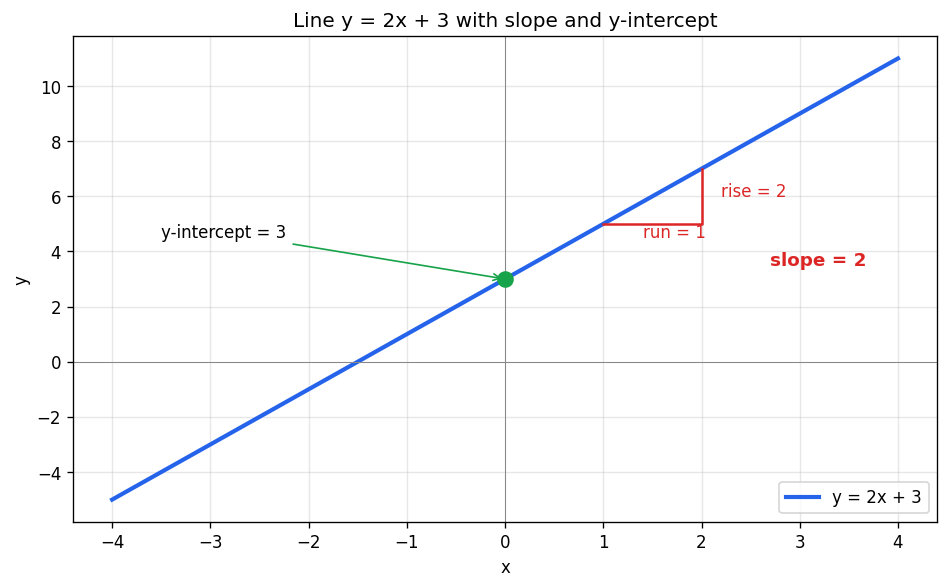
Study the line y = 2x + 3 with slope-intercept marked and answer:
The slope of the line equals:
A1
B2
C3
D−2
The y-intercept is at the point:
A(0, 0)
B(0, 2)
C(0, 3)
D(3, 0)
State the slope-intercept form and identify m and c.
Show answersHide answers
1. Option 2 — 2
2. Option 3 — (0, 3)
3. Slope-intercept form y = mx + c immediately gives slope m and y-intercept c. Here y = 2x + 3 has slope 2 and y-intercept 3. Slope = rise/run = 2/1 — for every unit increase in x, y increases by 2 units.