SUMMARY: This chapter introduces the fundamental concepts of limits and derivatives, laying the groundwork for calculus. KEY TOPICS: limits of functions, algebra of limits, derivatives, derivative of a function, derivative of polynomials, derivative of trigonometric functions, first principle of derivatives, continuity, differentiability, applications of derivatives
Using the standard limit lim sin θ/θ = 1: (sin 3x)/(sin 5x) = (3x · sin 3x/(3x))/(5x · sin 5x/(5x)) = (3/5) · (sin 3x/(3x))/(sin 5x/(5x)). As x → 0 both fractions → 1 so the limit equals 3/5.
Q136 Marks
Find the derivative of f(x) = (x + 1)/(x − 1) using the quotient rule.
View sample solutionHide solution
u = x + 1 v = x − 1; u' = 1 v' = 1. d/dx (u/v) = (u' v − u v')/v² = ((x − 1) − (x + 1))/(x − 1)² = (−2)/(x − 1)².
Q146 Marks
Find the derivative of y = x sin x using product rule.
View sample solutionHide solution
u = x v = sin x; u' = 1 v' = cos x. dy/dx = u' v + u v' = sin x + x cos x.
Q156 Marks
Use first principles to find the derivative of f(x) = √x at x = 4.
Compare limit and continuity of a function with the help of a table.
Assertion–Reason Questions5 questions
Q171 Mark
Assertion (A): A limit may exist even when the function is undefined at the point.
Reason (R): Limits depend on the behaviour as x approaches the point not the function value at that point.
Show explanationHide explanation
Correct answer: Option 1 —
Both A and R are true, and R is the correct explanation of A.
Q181 Mark
Assertion (A): lim(x → 0) (sin x)/x = 1.
Reason (R): For small x: sin x ≈ x so the ratio approaches 1.
Show explanationHide explanation
Correct answer: Option 1 —
Both A and R are true, and R is the correct explanation of A.
Q191 Mark
Assertion (A): The derivative of a constant function is zero.
Reason (R): A constant function has zero rate of change everywhere.
Show explanationHide explanation
Correct answer: Option 1 —
Both A and R are true, and R is the correct explanation of A.
Q201 Mark
Assertion (A): d/dx (xⁿ) = n xⁿ⁻¹ for any rational n.
Reason (R): The power rule follows from the binomial expansion of (x + h)ⁿ in the limit definition.
Show explanationHide explanation
Correct answer: Option 1 —
Both A and R are true, and R is the correct explanation of A.
Q211 Mark
Assertion (A): Differentiability at a point implies continuity at that point.
Reason (R): If f is differentiable at a then the limit defining the derivative exists which forces f to be continuous.
Show explanationHide explanation
Correct answer: Option 1 —
Both A and R are true, and R is the correct explanation of A.
Statement-Based Questions5 questions
Q221 Mark
Statement 1: A limit lim(x → a) f(x) exists iff the left and right hand limits are equal.
Statement 2: The two-sided limit equals the common value when LHL = RHL.
Show answerHide answer
Correct answer: Option 1 —
Both statements are true.
Q231 Mark
Statement 1: The derivative measures the instantaneous rate of change.
Statement 2: The derivative is the slope of the tangent line.
Show answerHide answer
Correct answer: Option 1 —
Both statements are true.
Q241 Mark
Statement 1: d/dx (sin x) = cos x.
Statement 2: d/dx (cos x) = −sin x.
Show answerHide answer
Correct answer: Option 1 —
Both statements are true.
Q251 Mark
Statement 1: The limit of a polynomial as x → a equals the polynomial evaluated at a.
Statement 2: Polynomials are continuous everywhere.
Show answerHide answer
Correct answer: Option 1 —
Both statements are true.
Q261 Mark
Statement 1: The product rule states (uv)' = u'v + uv'.
Statement 2: The quotient rule states (u/v)' = (u'v − uv')/v².
Show answerHide answer
Correct answer: Option 1 —
Both statements are true.
Case Study / Passage Questions3 questions
Q273 Marks
A car's displacement is given by s(t) = 4t² + 3t metres at time t seconds. A physicist wants the instantaneous velocity at t = 2 seconds and the average velocity over [0 4].
The velocity v(t) = ds/dt equals:
A8t + 3
B4t + 3
C8t
D3t
The instantaneous velocity at t = 2 s is:
A11 m/s
B15 m/s
C16 m/s
D19 m/s
Compute the average velocity and compare with v(2).
Show answersHide answers
1. Option 1 — 8t + 3
2. Option 4 — 19 m/s
3. v(t) = ds/dt = 8t + 3. v(2) = 16 + 3 = 19 m/s. Average velocity over [0 4]: (s(4) − s(0))/4 = (64 + 12 − 0)/4 = 76/4 = 19 m/s. So average and instantaneous coincide at t = 2 — consistent with mean value theorem on linear v.
Q283 Marks
A student must compute lim(x → 1) (x² − 1)/(x − 1). Direct substitution gives 0/0 — a removable indeterminate form.
The limit equals:
A0
B1
C2
DDoes not exist
The technique used is:
AFactor and cancel
BApply L'Hopital's rule
CUse squeeze theorem
DUse trigonometric identity
Confirm using L'Hopital's rule (differentiate numerator and denominator).
Show answersHide answers
1. Option 3 — 2
2. Option 1 — Factor and cancel
3. x² − 1 = (x − 1)(x + 1). So (x² − 1)/(x − 1) = x + 1 for x ≠ 1. Limit as x → 1: 1 + 1 = 2. The function value at x = 1 is undefined but the limit exists (removable discontinuity).
Q293 Marks
For the curve y = x² + 1 a graphics designer needs the slope of the tangent at the point (2 5) to draw it accurately.
The slope of the tangent at (2 5) equals:
A2
B3
C4
D5
The equation of the tangent at (2 5) is:
Ay = 4x − 3
By = 2x + 1
Cy = 4x + 5
Dy = 2x − 3
Write the equation of the normal at (2 5).
Show answersHide answers
1. Option 3 — 4
2. Option 1 — y = 4x − 3
3. dy/dx = 2x. At x = 2: slope = 4. Point (2, 5): y − 5 = 4(x − 2) ⇒ y = 4x − 3.
Table-Based Questions4 questions
Q303 Marks
Study the standard derivatives:
f(x)
f'(x)
xⁿ
n xⁿ⁻¹
sin x
cos x
cos x
−sin x
eˣ
eˣ
ln x
1/x
The derivative of xⁿ is:
An xⁿ
Bn xⁿ⁻¹
Cxⁿ⁻¹
Dn
The derivative of cos x is:
A−sin x
Bsin x
Ccos x
D−cos x
Differentiate y = x² · sin x using the product rule.
Show answersHide answers
1. Option 2 — n xⁿ⁻¹
2. Option 1 — −sin x
3. Standard derivatives are the building blocks. Combining with sum rule product rule quotient rule and chain rule any complicated function can be differentiated.
Q313 Marks
Study standard limits:
Limit
Value
lim(x → 0) sin x / x
1
lim(x → 0) (1 − cos x)/x
0
lim(x → 0) (eˣ − 1)/x
1
lim(x → 0) (1 + x)^(1/x)
e
lim(x → 0) (ln(1 + x))/x
1
The value of lim(x → 0) sin x / x equals:
A0
B1
CDoes not exist
De
The value of lim(x → 0) (1 + x)^(1/x) equals:
A1
Be
Cπ
DDoes not exist
Compute lim(x → 0) (sin 3x)/(sin 5x) using the standard limit.
Show answersHide answers
1. Option 2 — 1
2. Option 2 — e
3. These standard limits are encountered repeatedly. They are used in proving derivative formulas and computing limits of compound expressions. The limit (1 + x)^(1/x) → e is the very definition of the natural exponential.
Q326 Marks
Use the table of standard limits to evaluate the listed expressions.
Standard limit
Value
lim(x → 0) sin x/x
1
lim(x → 0) (1 − cos x)/x²
1/2
lim(x → 0) (eˣ − 1)/x
1
lim(x → 0) (1 + x)^(1/x)
e
Q336 Marks
Differentiate each function with respect to x using suitable rules.
Function
Rule to apply
x⁴
Power
sin x · cos x
Product
(x + 1)/(x − 1)
Quotient
sin(3x²)
Chain
Picture-Based Questions1 question
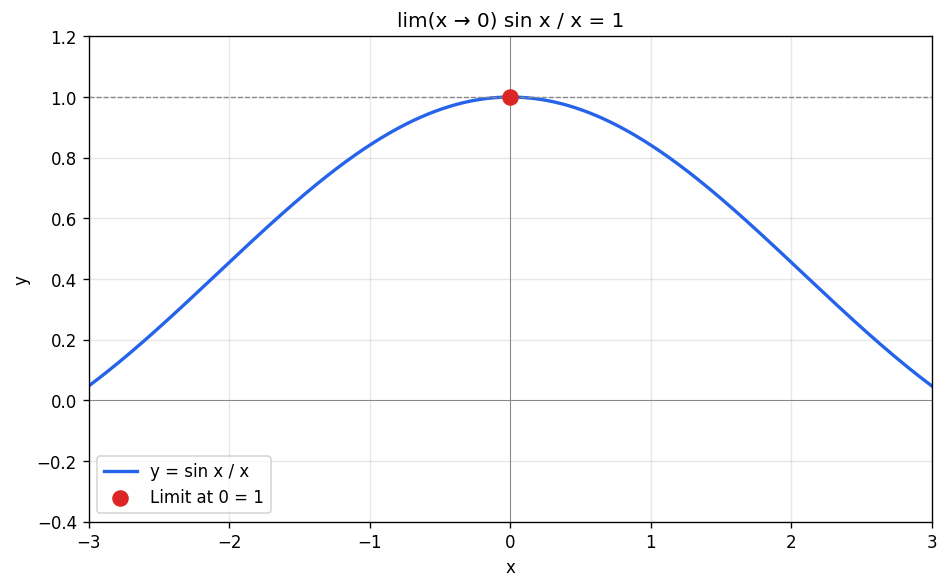
Q343 Marks
Study the graph of y = sin x / x near x = 0 and answer:
The limit lim(x → 0) sin x / x equals:
A0
B1
C∞
DDoes not exist
The function f(x) = sin x / x is best described as:
AContinuous at x = 0
BHas a removable discontinuity at x = 0
CHas a jump discontinuity at x = 0
DHas a vertical asymptote at x = 0
Why is the discontinuity at x = 0 called removable?
Show answersHide answers
1. Option 2 — 1
2. Option 2 — Has a removable discontinuity at x = 0
3. f(x) = sin x / x is undefined at x = 0 (0/0 form) but the two-sided limit exists and equals 1. We can fill the hole by defining f(0) = 1, giving a continuous extension. This is a removable discontinuity. The standard limit lim(x → 0) sin x / x = 1 underlies the derivative d/dx (sin x) = cos x.