Complex Numbers and Quadratic Equations — Important Questions
33 questions
With answersCBSE format
SUMMARY: This chapter introduces complex numbers, their algebraic properties, and their application in solving quadratic equations. KEY TOPICS: complex numbers, imaginary unit, algebra of complex numbers, polar representation, quadratic equations, roots of quadratic equations, discriminant, modulus and argument, conjugate of a complex number, solving quadratic equations using complex numbers
Find the roots of 2x² − 3x + 5 = 0 and express them in the form a + bi.
View sample solutionHide solution
Discriminant = (−3)² − 4·2·5 = 9 − 40 = −31. Roots = (3 ± √(−31))/(4) = 3/4 ± (√31/4) i. So roots are 3/4 + (√31/4) i and 3/4 − (√31/4) i.
Q126 Marks
Express (1 + i)/(1 − i) in standard form a + bi.
View sample solutionHide solution
Multiply numerator and denominator by the conjugate (1 + i): ((1+i)(1+i))/((1−i)(1+i)) = (1 + 2i + i²)/(1 − i²) = (1 + 2i − 1)/(1 + 1) = 2i/2 = i. So (1 + i)/(1 − i) = 0 + 1·i.
Q136 Marks
Show that for any complex number z |z|² = z · z̄ where z̄ is the conjugate. Verify with z = 3 − 4i.
View sample solutionHide solution
Let z = a + bi. Then z̄ = a − bi and z·z̄ = (a + bi)(a − bi) = a² − (bi)² = a² + b² = |z|². For z = 3 − 4i: |z|² = 9 + 16 = 25; z·z̄ = (3 − 4i)(3 + 4i) = 9 + 16 = 25. ✓
Q146 Marks
Find the square root of −15 − 8i in the form a + bi.
View sample solutionHide solution
Let √(−15 − 8i) = a + bi where a b ∈ R. Then a² − b² = −15 and 2ab = −8 i.e. ab = −4. From a² − b² = −15 and a² + b² = √(15² + 8²) = √(225 + 64) = √289 = 17. So a² = 1 and b² = 16. Combined with ab = −4: (a b) = (1 −4) or (−1 4). Hence square roots are ±(1 − 4i).
Q156 Marks
For the quadratic equation x² − 2x + 5 = 0 find the roots and verify the sum and product of roots formulas.
Reason (R): The modulus is multiplicative under complex multiplication.
Show explanationHide explanation
Correct answer: Option 1 —
Both A and R are true, and R is the correct explanation of A.
Q201 Mark
Assertion (A): A quadratic equation with discriminant less than zero has complex (non-real) roots.
Reason (R): The square root of a negative number is imaginary so the quadratic formula gives complex roots when D < 0.
Show explanationHide explanation
Correct answer: Option 1 —
Both A and R are true, and R is the correct explanation of A.
Q211 Mark
Assertion (A): If z + z̄ is twice the real part of z then it is always real.
Reason (R): Adding a complex number to its conjugate cancels the imaginary parts leaving only the real part doubled.
Show explanationHide explanation
Correct answer: Option 1 —
Both A and R are true, and R is the correct explanation of A.
Statement-Based Questions5 questions
Q221 Mark
Statement 1: i³ = −i.
Statement 2: i⁴ = 1.
Show answerHide answer
Correct answer: Option 1 —
Both statements are true.
Q231 Mark
Statement 1: The modulus of a complex number is always non-negative.
Statement 2: The modulus equals zero only when the complex number is zero.
Show answerHide answer
Correct answer: Option 1 —
Both statements are true.
Q241 Mark
Statement 1: Every quadratic equation has roots in C.
Statement 2: Complex roots always occur in conjugate pairs for quadratics with real coefficients.
Show answerHide answer
Correct answer: Option 1 —
Both statements are true.
Q251 Mark
Statement 1: The conjugate of a sum equals the sum of the conjugates.
Statement 2: The conjugate of a product equals the product of the conjugates.
Show answerHide answer
Correct answer: Option 1 —
Both statements are true.
Q261 Mark
Statement 1: Every real number is a complex number.
Statement 2: Not every complex number is a real number.
Show answerHide answer
Correct answer: Option 1 —
Both statements are true.
Case Study / Passage Questions3 questions
Q273 Marks
In an AC circuit the impedance of two components is given by Z₁ = 3 + 4i ohms and Z₂ = 2 − i ohms (where i represents the imaginary unit). The engineer needs the total impedance for a series and a parallel connection.
The total impedance for the series connection Z₁ + Z₂ equals:
A physics student solves the quadratic equation x² − 4x + 13 = 0 to find a complex amplitude. The student wants the discriminant the roots and the sum and product to verify.
A complex number z = 1 + i is plotted on the Argand plane. The student wants to know its modulus argument and the polar form.
The modulus |z| equals:
A1
B√2
C2
D√3
The argument arg(z) equals:
Aπ/6
Bπ/4
Cπ/3
Dπ/2
Write z in polar form.
Show answersHide answers
1. Option 2 — √2
2. Option 2 — π/4
3. |z| = √(1² + 1²) = √2. arg(z) = tan⁻¹(1/1) = π/4 (first quadrant). Polar form: z = √2 (cos π/4 + i sin π/4) = √2 e^(iπ/4).
Table-Based Questions3 questions
Q303 Marks
Study the powers of i:
Power
Value
i¹
i
i²
−1
i³
−i
i⁴
1
i⁵
i
The value of i⁴ equals:
A1
Bi
C−1
D−i
The value of i^25 equals:
Ai
B−i
C−1
D1
Compute i^100 using the cyclic pattern.
Show answersHide answers
1. Option 1 — 1
2. Option 1 — i
3. Powers of i cycle with period 4: i¹ = i i² = −1 i³ = −i i⁴ = 1. For i^25 = i^(4·6 + 1) = i. The cycle property makes computing high powers of i straightforward.
Q313 Marks
Study the operations on complex numbers:
Operation
Result
Type
(2 + 3i) + (1 − i)
3 + 2i
Complex
(2 + 3i)(1 − i)
5 + i
Complex
(2 + 3i)/(1 − i)
(−1/2) + (5/2)i
Complex
|3 + 4i|
5
Real
arg(1 + i)
π/4
Real
The sum (2 + 3i) + (1 − i) equals:
A3 + 2i
B3 − 2i
C1 + 2i
D−1 + 2i
The modulus |3 + 4i| equals:
A3
B4
C5
D7
Compute (2 + 3i)(1 − i) step by step.
Show answersHide answers
1. Option 1 — 3 + 2i
2. Option 3 — 5
3. |3 + 4i| = √(3² + 4²) = √25 = 5. The modulus represents the distance from the origin to the point 3 + 4i on the Argand plane and is a real non-negative number.
Q326 Marks
For z₁ = 3 + 4i and z₂ = 1 − 2i, compute (i) z₁ + z₂, (ii) z₁ · z₂, (iii) z₁/z₂, (iv) |z₁| and arg(z₁).
Complex number
Real
Imaginary
z₁
3
4
z₂
1
−2
Picture-Based Questions1 question
Q333 Marks
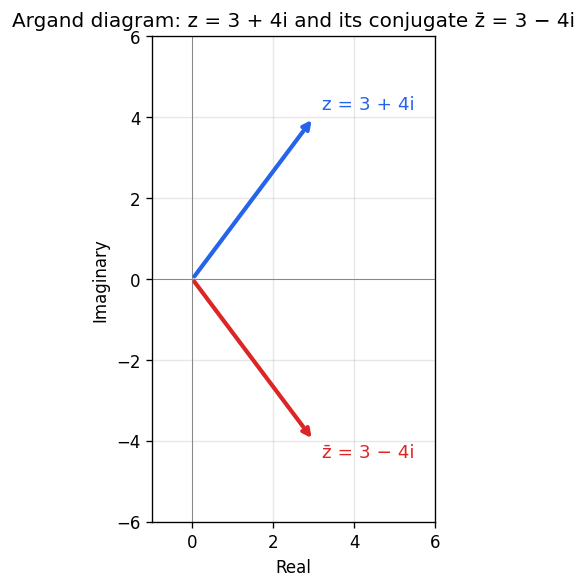
Study the Argand diagram of z = 3 + 4i and its conjugate z̄ and answer:
The modulus |z| = |3 + 4i| equals:
A3
B4
C5
D7
z and z̄ are reflections of each other about the:
Ax-axis
By-axis
Cline y = x
Dorigin
Compute |z|² using z · z̄ and verify the result.
Show answersHide answers
1. Option 3 — 5
2. Option 1 — x-axis
3. |z|² = z · z̄ = (3 + 4i)(3 − 4i) = 9 − (4i)² = 9 + 16 = 25, so |z| = 5. Geometrically, |z| is the distance from the origin to the point z on the Argand plane — here a 3-4-5 right-triangle gives |z| = 5.