Introduction to Three Dimensional Geometry — Important Questions
33 questions
With answersCBSE format
SUMMARY: This chapter introduces the basic concepts of three-dimensional geometry, including the coordinate system and the representation of points in space. KEY TOPICS: three-dimensional coordinate system, coordinates of a point in space, distance formula in 3D, section formula in 3D, direction cosines, direction ratios, equations of a line in space, equations of a plane in space
Find the coordinates of the point equidistant from the points A(1, 0, 0), B(0, 2, 0) and C(0, 0, 3) on the x-axis.
View sample solutionHide solution
Let P = (x, 0, 0) on the x-axis. PA = |x − 1|. PB = √(x² + 4). PC = √(x² + 9). Setting PA² = PB²: (x − 1)² = x² + 4 ⇒ −2x + 1 = 4 ⇒ x = −3/2. Verify with PC²: (−3/2)² + 9 = 9/4 + 9 = 45/4. PA² = (−3/2 − 1)² = 25/4. These are unequal so no point on the x-axis is equidistant from all three; the problem has no solution restricted to x-axis.
Q166 Marks
Differentiate between cartesian coordinates in 2D and 3D in tabular form.
Assertion–Reason Questions5 questions
Q171 Mark
Assertion (A): The 3D coordinate system has 8 octants.
Reason (R): The three coordinate planes divide space into 8 regions based on signs of x y and z.
Show explanationHide explanation
Correct answer: Option 1 —
Both A and R are true, and R is the correct explanation of A.
Q181 Mark
Assertion (A): The xy-plane has equation z = 0.
Reason (R): Every point on the xy-plane has z-coordinate equal to 0.
Show explanationHide explanation
Correct answer: Option 1 —
Both A and R are true, and R is the correct explanation of A.
Q191 Mark
Assertion (A): The distance between (x₁ y₁ z₁) and (x₂ y₂ z₂) is √((x₂ − x₁)² + (y₂ − y₁)² + (z₂ − z₁)²).
Reason (R): The 3D distance formula generalises the 2D Pythagorean distance to three dimensions.
Show explanationHide explanation
Correct answer: Option 1 —
Both A and R are true, and R is the correct explanation of A.
Q201 Mark
Assertion (A): The midpoint of (x₁ y₁ z₁) and (x₂ y₂ z₂) is ((x₁+x₂)/2 (y₁+y₂)/2 (z₁+z₂)/2).
Reason (R): Midpoint is the average of corresponding coordinates.
Show explanationHide explanation
Correct answer: Option 1 —
Both A and R are true, and R is the correct explanation of A.
Q211 Mark
Assertion (A): The origin (0 0 0) is equidistant from all three coordinate axes.
Reason (R): The distance from origin to each coordinate axis is 0.
Show explanationHide explanation
Correct answer: Option 1 —
Both A and R are true, and R is the correct explanation of A.
Statement-Based Questions5 questions
Q221 Mark
Statement 1: There are three coordinate planes in 3D: xy yz and zx.
Statement 2: The three coordinate planes divide space into 8 octants.
Show answerHide answer
Correct answer: Option 1 —
Both statements are true.
Q231 Mark
Statement 1: A point in 3D space is represented by an ordered triplet (x y z).
Statement 2: The first coordinate is the x-coordinate the second the y-coordinate and the third the z-coordinate.
Show answerHide answer
Correct answer: Option 1 —
Both statements are true.
Q241 Mark
Statement 1: The distance from origin to (a b c) is √(a² + b² + c²).
Statement 2: The distance is non-negative and zero only when (a b c) = (0 0 0).
Show answerHide answer
Correct answer: Option 1 —
Both statements are true.
Q251 Mark
Statement 1: The section formula in 3D extends the 2D section formula coordinate-wise.
Statement 2: The midpoint corresponds to the section formula with ratio 1:1.
Show answerHide answer
Correct answer: Option 1 —
Both statements are true.
Q261 Mark
Statement 1: Three points in 3D are collinear iff they lie on a single straight line.
Statement 2: Collinearity of three points can be tested by checking if direction ratios of segments are proportional.
Show answerHide answer
Correct answer: Option 1 —
Both statements are true.
Case Study / Passage Questions3 questions
Q273 Marks
A surveyor uses 3D coordinates to mark three corners of a triangular field: A(0, 0, 0), B(6, 0, 0), C(0, 8, 0). The surveyor wants the centroid the lengths of all sides and to verify it is a right triangle.
The centroid of the triangle equals:
A(2, 8/3, 0)
B(2, 8/3, 1)
C(3, 4, 0)
D(2, 4, 0)
The triangle is best classified as:
AEquilateral
BRight-angled
CIsosceles
DScalene
Verify the right-angle property using the side lengths.
Show answersHide answers
1. Option 1 — (2, 8/3, 0)
2. Option 2 — Right-angled
3. Centroid = ((0 + 6 + 0)/3, (0 + 0 + 8)/3, 0) = (2, 8/3, 0). Sides: AB = 6, AC = 8, BC = √(6² + 8²) = √100 = 10. Since 6² + 8² = 36 + 64 = 100 = 10² it satisfies Pythagoras — right-angled triangle at A.
Q283 Marks
Two satellites are positioned at P(2, 3, 6) km and Q(5, 7, 14) km from the centre of Earth. A telecommunications engineer needs the distance between them.
A line segment runs from A(2, 3, 5) to B(8, 9, 17). The road planner wants to find the point on the segment that divides it in the ratio 2:1 from A to B.
The dividing point is:
A(4, 5, 9)
B(6, 7, 13)
C(5, 6, 11)
D(7, 8, 15)
The midpoint corresponds to the section ratio:
A1:1
B1:2
C2:1
D3:1
Compute the midpoint of A and B.
Show answersHide answers
1. Option 2 — (6, 7, 13)
2. Option 1 — 1:1
3. Section formula 2:1 from A: P = ((2·8 + 1·2)/3, (2·9 + 1·3)/3, (2·17 + 1·5)/3) = (18/3, 21/3, 39/3) = (6, 7, 13). Midpoint corresponds to 1:1.
Table-Based Questions3 questions
Q303 Marks
Study the eight octants of 3D space:
Octant
Sign of (x, y, z)
I
(+, +, +)
II
(−, +, +)
III
(−, −, +)
IV
(+, −, +)
V
(+, +, −)
VI
(−, +, −)
VII
(−, −, −)
VIII
(+, −, −)
The point (5, 7, 9) lies in octant:
AI
BII
CIII
DIV
The point (−2, −3, −1) lies in octant:
AIV
BV
CVI
DVII
Identify the octant containing (3, −4, 6).
Show answersHide answers
1. Option 1 — I
2. Option 4 — VII
3. Octant labelling depends on signs of (x, y, z). (5, 7, 9) has all positive coordinates so octant I. (−2, −3, −1) has all negative coordinates so octant VII. Octants are conventionally numbered with octant I being the all-positive one.
Q313 Marks
Study standard distances and midpoints in 3D:
Pair of points
Distance
Midpoint
(0, 0, 0) and (3, 4, 0)
5
(1.5, 2, 0)
(0, 0, 0) and (1, 2, 2)
3
(0.5, 1, 1)
(1, 1, 1) and (4, 5, 6)
√50 = 5√2
(2.5, 3, 3.5)
(0, 0, 0) and (1, 1, 1)
√3
(0.5, 0.5, 0.5)
(2, −1, 3) and (4, 1, 5)
2√3
(3, 0, 4)
The distance from (0, 0, 0) to (3, 4, 0) equals:
A3
B4
C5
D√7
The distance from (0, 0, 0) to (1, 1, 1) equals:
A√3
B√4
C√5
D√6
Compute the midpoint of (1, 1, 1) and (4, 5, 6).
Show answersHide answers
1. Option 3 — 5
2. Option 1 — √3
3. Distance formula in 3D: √((x₂ − x₁)² + (y₂ − y₁)² + (z₂ − z₁)²). For (0, 0, 0) to (3, 4, 0): √(9 + 16 + 0) = √25 = 5. Midpoint: ((x₁+x₂)/2, (y₁+y₂)/2, (z₁+z₂)/2).
Q326 Marks
For the points A(1, 2, 3), B(4, 5, 6) and C(7, 8, 10), compute the lengths of all three sides of triangle ABC and check whether it is right-angled.
Vertex
Coordinates
A
(1, 2, 3)
B
(4, 5, 6)
C
(7, 8, 10)
Picture-Based Questions1 question
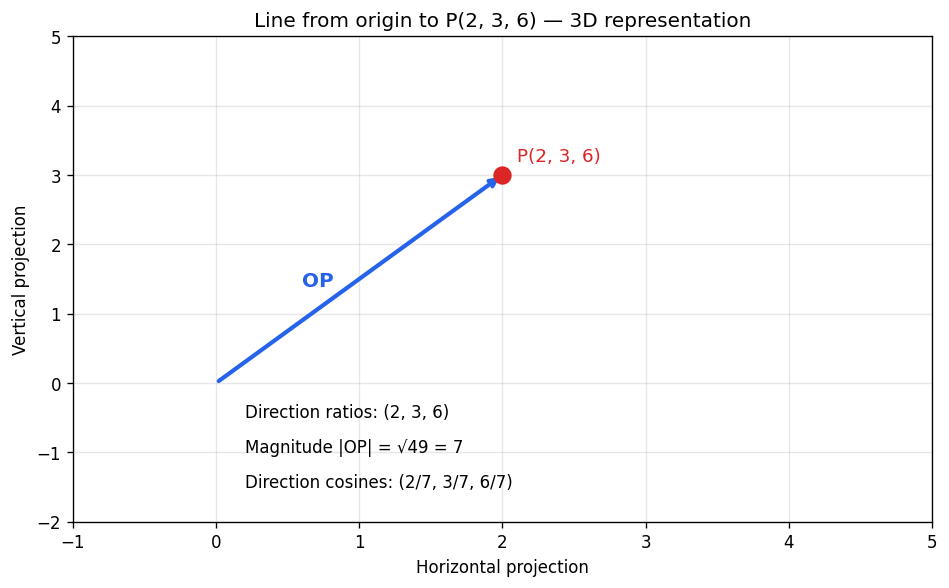
Q333 Marks
Study the line through origin to P(2, 3, 6) and answer:
The magnitude |OP| equals:
A5
B6
C7
D8
The direction cosines of OP are:
A(2, 3, 6)
B(2/7, 3/7, 6/7)
C(7, 7, 7)
D(0, 0, 0)
Verify the identity l² + m² + n² = 1 for the direction cosines.
Show answersHide answers
1. Option 3 — 7
2. Option 2 — (2/7, 3/7, 6/7)
3. |OP| = √(2² + 3² + 6²) = √49 = 7. Direction ratios are (2, 3, 6) and direction cosines are obtained by dividing each by the magnitude: (2/7, 3/7, 6/7). Verification: (2/7)² + (3/7)² + (6/7)² = 49/49 = 1, confirming the identity l² + m² + n² = 1.