SUMMARY: The chapter on Linear Inequalities in Class 11 Mathematics introduces students to the concept of inequalities, their representation, and solutions in one and two variables. KEY TOPICS: linear inequalities, algebraic solutions, graphical representation, inequalities in one variable, inequalities in two variables, solution sets, intersection of solutions, union of solutions, applications of linear inequalities, word problems involving inequalities
On a number line the inequality −3 ≤ x < 2 is represented by:
AOpen at −3 and 2
BClosed at −3 and open at 2
CClosed at both
DOpen at both
Check answerHide answer
Correct answer: Option 2 — Closed at −3 and open at 2
Q41 Mark
If 4x − 3 ≤ 5x + 2 then x lies in:
A(−∞, −5]
B[−5, ∞)
C(−∞, 5]
D[5, ∞)
Check answerHide answer
Correct answer: Option 2 — [−5, ∞)
Q51 Mark
Multiplying or dividing both sides of an inequality by a negative number:
AReverses the inequality sign
BKeeps the sign unchanged
CMakes both sides equal
DHas no effect
Check answerHide answer
Correct answer: Option 1 — Reverses the inequality sign
Short Answer Questions5 questions
Q63 Marks
Solve 5x − 3 < 7 and represent the solution on a number line.
View sample solutionHide solution
5x − 3 < 7 ⇒ 5x < 10 ⇒ x < 2. Solution: (−∞, 2). Number line: open dot at 2 with arrow shaded to the left.
Q73 Marks
Solve 2(x − 1) ≥ x + 3.
View sample solutionHide solution
2x − 2 ≥ x + 3 ⇒ x ≥ 5. Solution: x ∈ [5, ∞).
Q83 Marks
Solve −2 < 3x + 1 ≤ 7 and write the solution in interval form.
View sample solutionHide solution
Subtract 1: −3 < 3x ≤ 6. Divide by 3: −1 < x ≤ 2. Solution interval: (−1, 2].
Q93 Marks
Solve x/2 − 1 > x/3.
View sample solutionHide solution
Multiply both sides by 6: 3x − 6 > 2x ⇒ x > 6. Solution: (6, ∞).
Q103 Marks
If x ≥ 0 and 3x − 2 ≤ 7 find the integer values of x.
View sample solutionHide solution
3x − 2 ≤ 7 ⇒ 3x ≤ 9 ⇒ x ≤ 3. Combined with x ≥ 0: 0 ≤ x ≤ 3. Integer values: x = 0 1 2 3.
Long Answer Questions6 questions
Q116 Marks
Solve the system: 2x + y < 8, x + 2y < 8, x ≥ 0, y ≥ 0 and describe the feasible region.
View sample solutionHide solution
The feasible region is the intersection of four half-planes in the first quadrant. Boundary lines: 2x + y = 8 (intercepts (4, 0) and (0, 8)) and x + 2y = 8 (intercepts (8, 0) and (0, 4)). They intersect at (8/3, 8/3). The region is a polygon with vertices (0, 0), (4, 0), (8/3, 8/3), (0, 4).
Q126 Marks
Solve 3 ≤ 2x − 5 ≤ 11 and represent the solution on a number line.
View sample solutionHide solution
Add 5: 8 ≤ 2x ≤ 16. Divide by 2: 4 ≤ x ≤ 8. Solution: [4, 8]. Number line: closed dots at 4 and 8 with line segment between them shaded.
Q136 Marks
A man wants to mix two types of acids — 50% acid A and 80% acid A — to make 100 litres of a mixture containing at least 60% acid A. Find the range of litres of the 50% acid he can use.
View sample solutionHide solution
Let x = litres of 50% acid; then (100 − x) is the 80% acid. Acid in mixture: 0.5x + 0.8(100 − x) ≥ 60 ⇒ 0.5x + 80 − 0.8x ≥ 60 ⇒ −0.3x ≥ −20 ⇒ x ≤ 200/3 ≈ 66.67. Also x ≥ 0 and (100 − x) ≥ 0 i.e. x ≤ 100. Combined: 0 ≤ x ≤ 200/3.
Q146 Marks
Solve the inequality |x − 2| < 3 graphically and as an interval.
View sample solutionHide solution
|x − 2| < 3 means the distance of x from 2 is less than 3 — i.e. x is within 3 units of 2. So 2 − 3 < x < 2 + 3 i.e. −1 < x < 5. Interval form: (−1, 5).
Q156 Marks
Solve the system 2x − 3 ≥ 7 and 4x + 1 ≤ 13 simultaneously.
View sample solutionHide solution
From 2x − 3 ≥ 7: 2x ≥ 10 ⇒ x ≥ 5. From 4x + 1 ≤ 13: 4x ≤ 12 ⇒ x ≤ 3. The two conditions are x ≥ 5 and x ≤ 3 which have no common solution. Hence the system has no solution: solution set is ∅.
Q166 Marks
Differentiate between linear inequality in one variable and two variables in tabular form.
Assertion–Reason Questions5 questions
Q171 Mark
Assertion (A): If we multiply both sides of an inequality by a negative number the inequality sign reverses.
Reason (R): Multiplying −1 by both sides of 2 < 3 gives −2 > −3 reversing the order.
Show explanationHide explanation
Correct answer: Option 1 —
Both A and R are true, and R is the correct explanation of A.
Q181 Mark
Assertion (A): Adding the same constant to both sides of an inequality preserves the inequality.
Reason (R): Translation of both sides by the same amount does not change their relative order.
Show explanationHide explanation
Correct answer: Option 1 —
Both A and R are true, and R is the correct explanation of A.
Q191 Mark
Assertion (A): The solution set of x ≥ 2 is the closed half-line [2 ∞).
Reason (R): The set includes 2 and all real numbers greater than 2.
Show explanationHide explanation
Correct answer: Option 1 —
Both A and R are true, and R is the correct explanation of A.
Q201 Mark
Assertion (A): |x| < a (with a > 0) is equivalent to −a < x < a.
Reason (R): The absolute value measures distance from 0 so |x| < a means x is within distance a from origin.
Show explanationHide explanation
Correct answer: Option 1 —
Both A and R are true, and R is the correct explanation of A.
Q211 Mark
Assertion (A): The simultaneous solution of two inequalities is the intersection of their individual solution sets.
Reason (R): A value satisfies both inequalities iff it satisfies each separately.
Show explanationHide explanation
Correct answer: Option 1 —
Both A and R are true, and R is the correct explanation of A.
Statement-Based Questions5 questions
Q221 Mark
Statement 1: Adding the same number to both sides of an inequality preserves the inequality.
Statement 2: Multiplying both sides of an inequality by a positive number preserves the inequality.
Show answerHide answer
Correct answer: Option 1 —
Both statements are true.
Q231 Mark
Statement 1: |x| > 0 for all x ≠ 0.
Statement 2: |x| = 0 if and only if x = 0.
Show answerHide answer
Correct answer: Option 1 —
Both statements are true.
Q241 Mark
Statement 1: An open interval (a b) does not include its endpoints.
Statement 2: A closed interval [a b] includes its endpoints.
Show answerHide answer
Correct answer: Option 1 —
Both statements are true.
Q251 Mark
Statement 1: The system x > 1 and x < 0 has no solution.
Statement 2: The system x > 1 or x < 0 has solution set R − [0 1].
Show answerHide answer
Correct answer: Option 1 —
Both statements are true.
Q261 Mark
Statement 1: A linear inequality in two variables divides the plane into two half-planes.
Statement 2: A strict inequality has a dashed boundary line and a non-strict one has a solid boundary.
Show answerHide answer
Correct answer: Option 1 —
Both statements are true.
Case Study / Passage Questions3 questions
Q273 Marks
A small factory produces two products: x units of A and y units of B. Each unit of A needs 2 hours of machine time and each unit of B needs 3 hours. Total available machine hours per day = 24. Profits per unit are ₹50 for A and ₹70 for B.
The machine-time constraint is:
A2x + 3y ≤ 24
B3x + 2y ≤ 24
C2x + 3y ≥ 24
D2x + 3y = 24
The profit objective function is:
AZ = 50x + 70y
BZ = 70x + 50y
CZ = 2x + 3y
DZ = 24
Find the corner points of the feasible region.
Show answersHide answers
1. Option 1 — 2x + 3y ≤ 24
2. Option 1 — Z = 50x + 70y
3. Constraints: 2x + 3y ≤ 24 (machine) plus x ≥ 0 and y ≥ 0. Objective: maximise Z = 50x + 70y. Feasible region in first quadrant bounded by 2x + 3y = 24. Optimum at corner — typically by graphical method.
Q283 Marks
A dietician requires that a meal contain at least 12 units of protein and 8 units of carbohydrates. Two foods F1 and F2 supply protein and carbs as follows: F1 has 3 units protein and 2 units carbs per kg; F2 has 4 units protein and 1 unit carb per kg.
The dietary constraints (besides x y ≥ 0) include:
A3x + 4y ≥ 12
B2x + y ≥ 8
CBoth
DNeither
The LP optimization problem here is most naturally a:
AMaximisation
BMinimisation
CEquality
DMixed
Express the LP problem fully (objective + constraints).
Show answersHide answers
1. Option 3 — Both
2. Option 2 — Minimisation
3. Constraints: 3x + 4y ≥ 12 (protein) and 2x + y ≥ 8 (carbs) plus x y ≥ 0. Objective: minimise cost (since the question implies meeting needs at least cost). Feasible region is unbounded — corner point evaluation gives the minimum.
Q293 Marks
A student is asked to solve the compound inequality −2 < 3x + 1 ≤ 7 and represent the solution on a number line.
The solution interval is:
A(−1, 2]
B(−1, 2)
C[−1, 2]
D[−1, 2)
The number line representation has:
AOpen at −1 closed at 2
BClosed at −1 open at 2
CClosed at both
DOpen at both
Compute and represent the solution set on a number line.
Show answersHide answers
1. Option 1 — (−1, 2]
2. Option 1 — Open at −1 closed at 2
3. Subtract 1: −3 < 3x ≤ 6. Divide by 3: −1 < x ≤ 2. Solution: (−1, 2]. Number line: open dot at −1 closed dot at 2 with line segment between them shaded.
Table-Based Questions3 questions
Q303 Marks
Study the inequalities and their solution sets:
Inequality
Solution set
x > 3
(3, ∞)
x ≤ −2
(−∞, −2]
−1 ≤ x < 4
[−1, 4)
|x| < 5
(−5, 5)
|x| ≥ 2
(−∞, −2] ∪ [2, ∞)
The solution set of x > 3 is:
A(3, ∞)
B[3, ∞)
C(−∞, 3)
D(−∞, 3]
The solution set of |x| < 5 is:
A(−5, 5)
B[−5, 5]
C(−∞, −5) ∪ (5, ∞)
DR
State the equivalence between |x| > a and a union of intervals.
Show answersHide answers
1. Option 1 — (3, ∞)
2. Option 1 — (−5, 5)
3. |x| < a is equivalent to −a < x < a (for a > 0). |x| ≥ a is equivalent to x ≤ −a or x ≥ a. The solutions translate intuitive distance-from-zero conditions into intervals.
Q313 Marks
Study the LP corner points and Z = 4x + 3y values:
Corner point
Z value
(0, 0)
0
(0, 6)
18
(4, 4)
28
(6, 0)
24
(0, 0) (origin)
0
The corner that maximises Z is:
A(0, 0)
B(0, 6)
C(4, 4)
D(6, 0)
The maximum value of Z is:
A18
B24
C28
D30
Why does evaluating Z at corners alone suffice?
Show answersHide answers
1. Option 3 — (4, 4)
2. Option 3 — 28
3. Evaluate Z at every corner: (0,0)=0; (0,6)=18; (4,4)=28; (6,0)=24. Maximum = 28 at (4, 4). Corner-point theorem of LP: optimum is achieved at a vertex of the feasible polygon for bounded regions.
Q326 Marks
For an LP problem with feasible region having corners listed below, evaluate Z = 3x + 5y at each corner and identify the maximum.
Corner point
(x, y)
C1
(0, 0)
C2
(0, 6)
C3
(4, 4)
C4
(6, 0)
Picture-Based Questions1 question
Q333 Marks
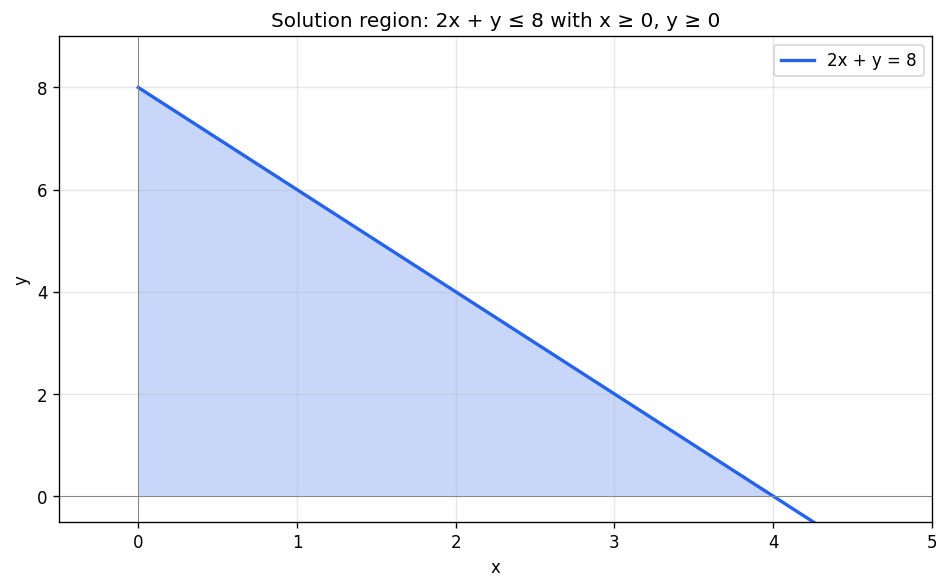
Study the shaded feasible region and answer:
The shaded region with x ≥ 0, y ≥ 0 represents:
A2x + y ≤ 8
B2x + y ≥ 8
C2x + y = 8
D2x − y ≤ 8
The corner points of the feasible region include:
A(0, 0)
B(4, 0)
C(0, 8)
DAll of these
Identify the vertices of the feasible region.
Show answersHide answers
1. Option 1 — 2x + y ≤ 8
2. Option 4 — All of these
3. The boundary 2x + y = 8 passes through the points (4, 0) and (0, 8). Together with the axes x = 0 and y = 0 the feasible region is a triangle with vertices (0, 0), (4, 0), (0, 8). For a strict inequality the boundary would be drawn as a dashed line.