SUMMARY: The chapter on the Binomial Theorem in Class 11 Mathematics introduces the theorem for positive integral indices and its applications in algebraic expansions. KEY TOPICS: binomial theorem, binomial expansion, Pascal's triangle, binomial coefficients, general term, middle term, properties of binomial coefficients, applications of binomial theorem, expansion of (x + y)^n, combinatorial identities
Find the term independent of x in the expansion of (x + 1/x²)⁹.
View sample solutionHide solution
T_{r+1} = C(9 r) x^(9−r) (1/x²)^r = C(9 r) x^(9 − r − 2r) = C(9 r) x^(9 − 3r). Term independent of x ⇒ 9 − 3r = 0 ⇒ r = 3. So term = C(9 3) = 84.
Q126 Marks
Use the binomial theorem to evaluate (1.01)⁵ approximately.
View sample solutionHide solution
(1.01)⁵ = (1 + 0.01)⁵ = 1 + 5(0.01) + 10(0.01)² + 10(0.01)³ + 5(0.01)⁴ + (0.01)⁵ ≈ 1 + 0.05 + 0.001 + ≈ 1.0510... Truncating after the third term gives ≈ 1.0510.
Q136 Marks
Show that the coefficients equidistant from the beginning and end of the expansion of (a + b)ⁿ are equal.
View sample solutionHide solution
The coefficient of the (r + 1)ᵗʰ term is C(n r). The coefficient of the (n − r + 1)ᵗʰ term (counting from the beginning) is C(n n − r). By the symmetry property C(n r) = C(n n − r). Hence coefficients equidistant from the two ends are equal.
Q146 Marks
Find the coefficient of x⁴ in (2 − x + 3x²)⁵ using the binomial expansion approach.
View sample solutionHide solution
This trinomial requires expansion via repeated application or by multinomial theorem. Using multinomial: (2 + (−x) + 3x²)⁵ = Σ (5!/(i! j! k!)) 2^i (−x)^j (3x²)^k where i + j + k = 5 and j + 2k = 4. Solutions (i j k): (3 0 2) (2 2 1) (1 4 0). Contributions: (5!/(3!0!2!))·2³·1·9 = 10·8·9 = 720; (5!/(2!2!1!))·2²·1·3 = 30·4·3 = 360; (5!/(1!4!0!))·2·1·1 = 5·2 = 10. Coefficient of x⁴ = 720 + 360 + 10 = 1090.
Q156 Marks
Prove that C(n 0) + C(n 1) + ... + C(n n) = 2ⁿ.
View sample solutionHide solution
By the binomial theorem (1 + x)ⁿ = C(n 0) + C(n 1) x + ... + C(n n) xⁿ. Setting x = 1: 2ⁿ = C(n 0) + C(n 1) + ... + C(n n). Hence the sum of all binomial coefficients of order n equals 2ⁿ.
Assertion–Reason Questions5 questions
Q161 Mark
Assertion (A): The expansion of (a + b)ⁿ has (n + 1) terms.
Reason (R): Each term corresponds to a value of r from 0 to n inclusive giving (n + 1) values.
Show explanationHide explanation
Correct answer: Option 1 —
Both A and R are true, and R is the correct explanation of A.
Q171 Mark
Assertion (A): For an even integer n the middle term of (a + b)ⁿ is the (n/2 + 1)ᵗʰ term.
Reason (R): When n is even there is exactly one middle term whose position is n/2 + 1.
Show explanationHide explanation
Correct answer: Option 1 —
Both A and R are true, and R is the correct explanation of A.
Q181 Mark
Assertion (A): C(n r) = C(n n − r) for 0 ≤ r ≤ n.
Reason (R): Choosing r objects from n is the same as choosing (n − r) objects to leave behind so the counts are equal.
Show explanationHide explanation
Correct answer: Option 1 —
Both A and R are true, and R is the correct explanation of A.
Q191 Mark
Assertion (A): A term independent of x in an expansion exists only when the sum of x-exponents in that term is zero.
Reason (R): A term independent of x means x⁰ which requires the exponent of x to be zero in that term.
Show explanationHide explanation
Correct answer: Option 1 —
Both A and R are true, and R is the correct explanation of A.
Q201 Mark
Assertion (A): The entries in Pascal's triangle are binomial coefficients.
Reason (R): Each row n of Pascal's triangle gives the coefficients C(n 0) C(n 1) ... C(n n).
Show explanationHide explanation
Correct answer: Option 1 —
Both A and R are true, and R is the correct explanation of A.
Statement-Based Questions5 questions
Q211 Mark
Statement 1: C(n 0) = 1.
Statement 2: C(n n) = 1.
Show answerHide answer
Correct answer: Option 1 —
Both statements are true.
Q221 Mark
Statement 1: The sum of binomial coefficients in (1 + x)ⁿ equals 2ⁿ.
Statement 2: The alternating sum of the same coefficients equals 0 for n ≥ 1.
Show answerHide answer
Correct answer: Option 1 —
Both statements are true.
Q231 Mark
Statement 1: The coefficient of xⁿ in (1 + x)ⁿ is 1.
Statement 2: The coefficient of x⁰ in (1 + x)ⁿ is 1.
Show answerHide answer
Correct answer: Option 1 —
Both statements are true.
Q241 Mark
Statement 1: C(n + 1 r) = C(n r − 1) + C(n r).
Statement 2: Pascal's identity follows from splitting subsets according to whether they include a chosen element.
Show answerHide answer
Correct answer: Option 1 —
Both statements are true.
Q251 Mark
Statement 1: If n is even the expansion has exactly one middle term.
Statement 2: If n is odd the expansion has exactly two middle terms.
Show answerHide answer
Correct answer: Option 1 —
Both statements are true.
Case Study / Passage Questions3 questions
Q263 Marks
A physics student needs to approximate (1.02)⁵ to 3 decimal places using the binomial expansion. (1.02)⁵ = (1 + 0.02)⁵.
A student is asked to find the coefficient of x⁵ in the expansion of (1 + 2x)¹⁰.
The coefficient of x⁵ equals:
A8064
B7920
C7560
D5040
The coefficient is given by:
AC(10 5)
BC(10 5) · 2⁵
CC(10 5) · 2¹⁰
DC(10 5) · 2
Compute the coefficient step by step.
Show answersHide answers
1. Option 1 — 8064
2. Option 2 — C(10 5) · 2⁵
3. General term: T_(r+1) = C(10, r)·1^(10−r)·(2x)^r = C(10, r)·2^r·x^r. For x⁵ set r = 5: coefficient = C(10, 5)·2⁵ = 252·32 = 8064.
Q283 Marks
A student needs to find the middle term in the expansion of (x + 1/x)⁸.
For an even n = 8 the middle term is the (n/2 + 1)ᵗʰ = 5ᵗʰ term:
AT₃
BT₄
CT₅
DT₆
The numerical coefficient of the middle term equals:
A40
B56
C70
D84
Find the middle term of (x + 1/x)¹⁰ similarly.
Show answersHide answers
1. Option 3 — T₅
2. Option 3 — 70
3. For (x + 1/x)⁸ middle term is T₅ (since n = 8 even). T₅ = C(8 4) x^(8 − 4) (1/x)⁴ = 70 · x⁰ = 70. So the middle term is 70 — independent of x.
Table-Based Questions3 questions
Q293 Marks
Study Pascal's triangle (rows 0 to 5):
Row n
Coefficients
0
1
1
1, 1
2
1, 2, 1
3
1, 3, 3, 1
4
1, 4, 6, 4, 1
5
1, 5, 10, 10, 5, 1
The first entry of every row of Pascal's triangle is:
A1
B2
C3
D4
The middle entry of row 4 is:
A4
B6
C10
D15
Use Pascal's triangle to expand (a + b)⁴.
Show answersHide answers
1. Option 1 — 1
2. Option 2 — 6
3. Each row n contains the binomial coefficients C(n 0) C(n 1) ... C(n n). Row 4: 1 4 6 4 1. The middle entry (when n is even) is C(n n/2). For n = 4 that's C(4 2) = 6.
Q303 Marks
Study the binomial coefficient identities:
Identity
Statement
Sum of row n
Σ C(n, r) = 2ⁿ
Symmetry
C(n, r) = C(n, n − r)
Pascal
C(n + 1, r) = C(n, r − 1) + C(n, r)
Alternating sum
Σ (−1)ʳ C(n, r) = 0 for n ≥ 1
End values
C(n, 0) = C(n, n) = 1
The sum of all binomial coefficients in (1 + x)ⁿ equals:
An²
B2ⁿ
Cn!
D(n + 1)!
The first and last coefficients of any row equal:
A1
B2
Cn
D2ⁿ
Verify the alternating-sum identity by setting x = −1 in (1 + x)ⁿ.
Show answersHide answers
1. Option 2 — 2ⁿ
2. Option 1 — 1
3. Setting x = 1 in (1 + x)ⁿ: 2ⁿ = Σ C(n r). The end values are always 1 because there is exactly one way to choose 0 or n objects from n. The symmetry C(n r) = C(n n − r) reflects choosing what to include vs leave out.
Q316 Marks
Find the coefficient of x⁵ in (1 + 2x)¹⁰ and the term independent of x in (x + 1/x²)⁹.
Expansion
Required
(1 + 2x)¹⁰
Coefficient of x⁵
(x + 1/x²)⁹
Term independent of x
Picture-Based Questions1 question
Q323 Marks
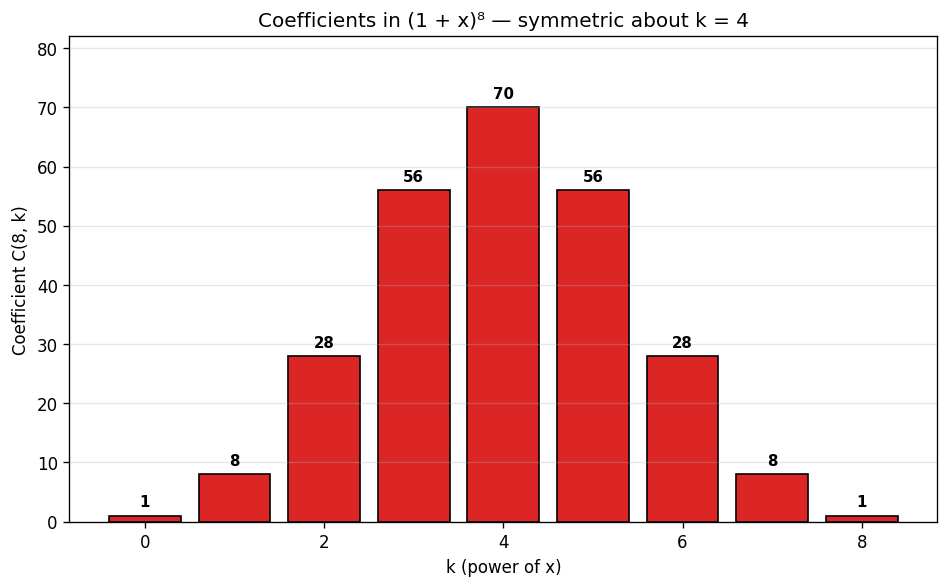
Study the coefficients in (1 + x)⁸ and answer:
The number of terms in the expansion (1 + x)⁸ equals:
A8
B9
C10
D16
The middle coefficient (k = 4) equals C(8, 4) =
A56
B70
C28
D8
Why does the expansion have exactly (n + 1) terms?
Show answersHide answers
1. Option 2 — 9
2. Option 2 — 70
3. (1 + x)ⁿ has (n + 1) terms because k runs from 0 to n. The middle term for even n appears at k = n/2 and is the largest coefficient C(n, n/2). For (1 + x)⁸ the middle term has coefficient C(8, 4) = 70.