SUMMARY: This chapter introduces the concept of trigonometric functions, their properties, and applications. KEY TOPICS: angles, trigonometric functions, unit circle, graphs of trigonometric functions, trigonometric identities, inverse trigonometric functions, domain and range, periodicity, transformations, applications of trigonometric functions
If sin θ = 3/5 where θ is in the first quadrant, then cos θ equals:
A3/5
B4/5
C5/3
D5/4
Check answerHide answer
Correct answer: Option 2 — 4/5
Q31 Mark
The general solution of sin x = 0 is:
Ax = nπ
Bx = (2n + 1)π/2
Cx = nπ/2
Dx = 2nπ
Check answerHide answer
Correct answer: Option 1 — x = nπ
Q41 Mark
sin(A + B) is equal to:
AsinA cosB − cosA sinB
BsinA cosB + cosA sinB
CcosA cosB − sinA sinB
DcosA cosB + sinA sinB
Check answerHide answer
Correct answer: Option 2 — sinA cosB + cosA sinB
Q51 Mark
The value of tan 75° equals:
A2 + √3
B2 − √3
C√3 − 1
D1 + √3
Check answerHide answer
Correct answer: Option 1 — 2 + √3
Short Answer Questions5 questions
Q63 Marks
Convert 60° to radians.
View sample solutionHide solution
60° = 60 × (π/180) = π/3 radians.
Q73 Marks
If tan θ = 4/3 and θ is in the first quadrant, find sin θ and cos θ.
View sample solutionHide solution
In a 3-4-5 right triangle, opposite = 4, adjacent = 3, hypotenuse = 5. So sin θ = 4/5 and cos θ = 3/5.
Q83 Marks
Prove that sin²θ + cos²θ = 1.
View sample solutionHide solution
In a right triangle with hypotenuse h opposite a and adjacent b: sin θ = a/h cos θ = b/h. Then sin²θ + cos²θ = (a² + b²)/h². By Pythagoras a² + b² = h² so the sum equals h²/h² = 1.
Q93 Marks
Find the value of cos 15° using the identity for cos(A − B).
View sample solutionHide solution
cos 15° = cos(45° − 30°) = cos 45° cos 30° + sin 45° sin 30° = (√2/2)(√3/2) + (√2/2)(1/2) = √6/4 + √2/4 = (√6 + √2)/4.
Q103 Marks
Find the period of f(x) = sin 3x.
View sample solutionHide solution
The period of sin x is 2π. For sin(kx) the period is 2π/|k|. Here k = 3 so period = 2π/3.
Long Answer Questions6 questions
Q116 Marks
Prove the identity (1 + cos 2x)/sin 2x = cot x.
View sample solutionHide solution
LHS = (1 + cos 2x)/sin 2x. Using cos 2x = 2 cos²x − 1 we get 1 + cos 2x = 2 cos²x. Using sin 2x = 2 sin x cos x: LHS = 2 cos²x / (2 sin x cos x) = cos x / sin x = cot x = RHS.
Q126 Marks
Find the general solution of cos 2x = 1/2.
View sample solutionHide solution
cos 2x = 1/2 = cos(π/3). General solution: 2x = ±π/3 + 2nπ where n ∈ Z. Hence x = ±π/6 + nπ. Equivalently x = nπ ± π/6.
Q136 Marks
Prove that sin 3x = 3 sin x − 4 sin³ x.
View sample solutionHide solution
sin 3x = sin(2x + x) = sin 2x cos x + cos 2x sin x = 2 sin x cos²x + (1 − 2 sin²x) sin x = 2 sin x (1 − sin²x) + sin x − 2 sin³x = 2 sin x − 2 sin³x + sin x − 2 sin³x = 3 sin x − 4 sin³x.
Q146 Marks
Find the maximum and minimum values of 3 sin x + 4 cos x.
View sample solutionHide solution
For an expression a sin x + b cos x, the maximum is √(a² + b²) and minimum is −√(a² + b²). Here a = 3 b = 4 so √(9 + 16) = √25 = 5. Maximum = 5 and minimum = −5.
Q156 Marks
In a triangle ABC if A + B + C = π prove that sin A + sin B + sin C = 4 cos(A/2) cos(B/2) cos(C/2).
View sample solutionHide solution
sin A + sin B = 2 sin((A+B)/2) cos((A−B)/2). Since A + B + C = π we have (A + B)/2 = π/2 − C/2 so sin((A+B)/2) = cos(C/2). Also sin C = 2 sin(C/2) cos(C/2). Combining: sin A + sin B + sin C = 2 cos(C/2)[cos((A−B)/2) + sin(C/2)] = 2 cos(C/2) · 2 cos(A/2) cos(B/2) = 4 cos(A/2) cos(B/2) cos(C/2).
Q166 Marks
Differentiate between degree measure and radian measure of an angle in tabular form.
Assertion–Reason Questions5 questions
Q171 Mark
Assertion (A): sin²x + cos²x = 1 for every real x.
Reason (R): This identity follows from the unit-circle definition of sine and cosine.
Show explanationHide explanation
Correct answer: Option 1 —
Both A and R are true, and R is the correct explanation of A.
Q181 Mark
Assertion (A): The function sin x has period 2π.
Reason (R): sin(x + 2π) = sin x for every real x.
Show explanationHide explanation
Correct answer: Option 1 —
Both A and R are true, and R is the correct explanation of A.
Q191 Mark
Assertion (A): tan x is undefined at x = π/2.
Reason (R): At x = π/2 cos x = 0 and division by zero is undefined.
Show explanationHide explanation
Correct answer: Option 1 —
Both A and R are true, and R is the correct explanation of A.
Q201 Mark
Assertion (A): The maximum value of 5 sin x is 5.
Reason (R): The maximum of sin x is 1 so 5 sin x has maximum 5 · 1 = 5.
Show explanationHide explanation
Correct answer: Option 1 —
Both A and R are true, and R is the correct explanation of A.
Q211 Mark
Assertion (A): 180° equals π radians.
Reason (R): A full circle of 360° equals 2π radians so half a circle equals π radians.
Show explanationHide explanation
Correct answer: Option 1 —
Both A and R are true, and R is the correct explanation of A.
Statement-Based Questions5 questions
Q221 Mark
Statement 1: sin(−x) = −sin x.
Statement 2: cos(−x) = cos x.
Show answerHide answer
Correct answer: Option 1 —
Both statements are true.
Q231 Mark
Statement 1: The minimum of cos x is −1.
Statement 2: The maximum of sin x is 1.
Show answerHide answer
Correct answer: Option 1 —
Both statements are true.
Q241 Mark
Statement 1: sin 30° = 1/2.
Statement 2: cos 60° = 1/2.
Show answerHide answer
Correct answer: Option 1 —
Both statements are true.
Q251 Mark
Statement 1: sin(π/2 − x) = cos x.
Statement 2: cos(π/2 − x) = sin x.
Show answerHide answer
Correct answer: Option 1 —
Both statements are true.
Q261 Mark
Statement 1: sin 2x = 2 sin x cos x.
Statement 2: cos 2x = cos²x − sin²x.
Show answerHide answer
Correct answer: Option 1 —
Both statements are true.
Case Study / Passage Questions3 questions
Q273 Marks
From a point 50 m from the base of a tower the angle of elevation of its top is 30°. From the same point the angle of elevation of the top of an antenna mounted on the tower is 45°. The architect wants to find the heights.
The height of the tower equals:
A50/√3 m
B50 m
C50√3 m
D100 m
The height of the antenna alone equals:
A50 m
B50/√3 m
C100 m
D50(1 − 1/√3) m
Compute the antenna height to two decimal places.
Show answersHide answers
1. Option 1 — 50/√3 m
2. Option 4 — 50(1 − 1/√3) m
3. tan 30° = h₁/50 ⇒ h₁ = 50 tan 30° = 50/√3 m. Total to antenna top: tan 45° = (h₁ + a)/50 ⇒ h₁ + a = 50 m. So antenna height a = 50 − 50/√3 = 50(1 − 1/√3) m ≈ 21.13 m.
Q283 Marks
A coastal port observes that the height (in metres) of the tide at time t hours after midnight is approximately h(t) = 5 + 3 sin(πt/6). The port engineer wants to know maximum height minimum height period and the time of first high tide.
The maximum tide height equals:
A5 m
B8 m
C3 m
D2 m
The period of h(t) is:
A3 hr
B6 hr
C12 hr
D24 hr
Find the time of the first low tide and compute h(0).
Show answersHide answers
1. Option 2 — 8 m
2. Option 3 — 12 hr
3. Max h = 5 + 3·1 = 8 m occurs when sin(πt/6) = 1 ⇒ πt/6 = π/2 ⇒ t = 3. So first high tide is at t = 3 h. Min h = 5 − 3 = 2 m. Period of sin(πt/6) is 2π/(π/6) = 12 hours.
Q293 Marks
A student is asked to verify whether the identity sin(x + y) = sin x cos y + cos x sin y holds for x = π/3 and y = π/6 by computing both sides separately.
The value of sin(x + y) for x = π/3 y = π/6 equals:
3. x + y = π/3 + π/6 = π/2; sin(π/2) = 1. Right side: sin(π/3)cos(π/6) + cos(π/3)sin(π/6) = (√3/2)(√3/2) + (1/2)(1/2) = 3/4 + 1/4 = 1. ✓
Table-Based Questions4 questions
Q303 Marks
Study the standard angle values of sine and cosine:
Angle
sin
cos
tan
0
0
1
0
π/6
1/2
√3/2
1/√3
π/4
√2/2
√2/2
1
π/3
√3/2
1/2
√3
π/2
1
0
undefined
The value of sin(π/3) is:
A1/2
B√3/2
C√2/2
D1
The value of tan(π/2) is:
ADefined
BUndefined
CEqual to 1
DEqual to 0
Why is tan(π/2) undefined?
Show answersHide answers
1. Option 2 — √3/2
2. Option 2 — Undefined
3. At π/2 cos = 0 so tan(π/2) = sin(π/2)/cos(π/2) = 1/0 which is undefined. The standard table gives a quick reference for angles 0 π/6 π/4 π/3 and π/2.
Q313 Marks
Study the periods of trigonometric functions:
Function
Period
sin x
2π
cos x
2π
tan x
π
sin 2x
π
cos(πx/3)
6
The period of sin x is:
Aπ
B2π
Cπ/2
D1
The period of cos(πx/3) is:
A1
B3
C6
D12
Find the period of f(x) = sin(2πx/5).
Show answersHide answers
1. Option 2 — 2π
2. Option 3 — 6
3. For sin(kx) and cos(kx) the period is 2π/|k|. For tan(kx) it is π/|k|. So sin x has period 2π and tan x has period π. cos(πx/3) has |k| = π/3 hence period = 2π/(π/3) = 6.
Q326 Marks
Use the table of standard angle values to evaluate (i) sin(π/6) + cos(π/3) (ii) sin(π/4) · cos(π/4) (iii) tan(π/3) − tan(π/6).
Angle
sin
cos
tan
π/6
1/2
√3/2
1/√3
π/4
√2/2
√2/2
1
π/3
√3/2
1/2
√3
Q336 Marks
Verify the identity sin(A + B) = sin A cos B + cos A sin B for A = π/3 and B = π/6 using the values in the table.
Angle
sin
cos
π/3
√3/2
1/2
π/6
1/2
√3/2
π/2
1
0
Picture-Based Questions1 question
Q343 Marks
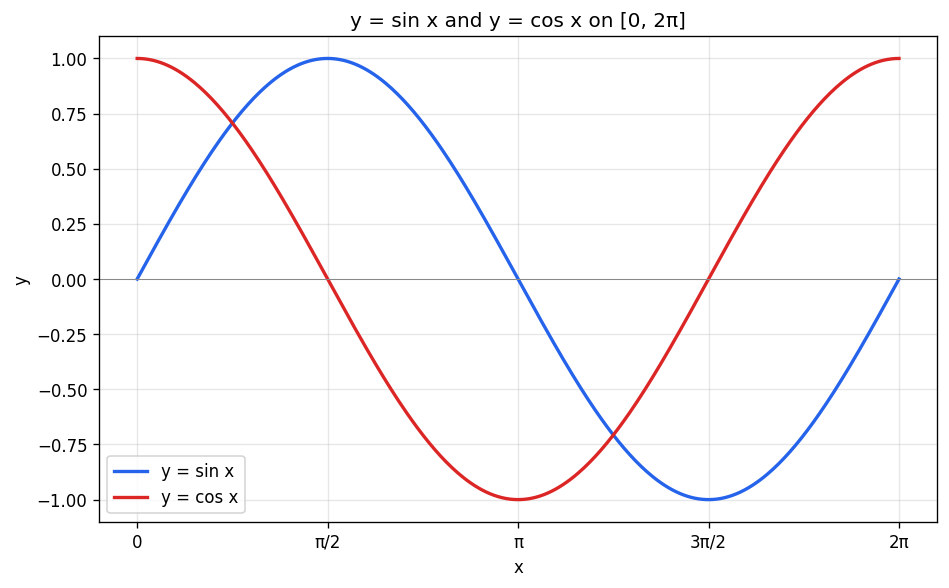
Study the graphs of y = sin x and y = cos x on [0, 2π] and answer:
The period of both sin x and cos x is:
Aπ
B2π
Cπ/2
D3π/2
cos x equals zero at:
Ax = 0
Bx = π/2
Cx = π
Dx = 3π/2
Describe the relationship between the graphs of sin x and cos x.
Show answersHide answers
1. Option 2 — 2π
2. Option 2 — x = π/2
3. sin x and cos x are co-functions: cos x = sin(π/2 − x). The graph of cos x is the graph of sin x shifted to the left by π/2. Both have amplitude 1 and period 2π and oscillate between −1 and +1.