SUMMARY: This chapter introduces the fundamental concepts of relations and functions, exploring their definitions, types, and properties. KEY TOPICS: Cartesian product, relations, domain and range, types of relations, functions, types of functions, composition of functions, invertible functions, binary operations, identity function.
The relation R on A = {1, 2, 3} given by R = {(1, 1), (2, 2), (3, 3)} is:
AReflexive only
BSymmetric only
CEquivalence
DTransitive only
Check answerHide answer
Correct answer: Option 3 — Equivalence
Q21 Mark
If A = {1, 2} and B = {3, 4}, the number of relations from A to B is:
A4
B8
C16
D32
Check answerHide answer
Correct answer: Option 3 — 16
Q31 Mark
For f(x) = 2x + 3, f(2) equals:
A5
B7
C9
D11
Check answerHide answer
Correct answer: Option 2 — 7
Q41 Mark
The domain of f(x) = 1/(x − 2) is:
AR
BR − {0}
CR − {2}
D[2, ∞)
Check answerHide answer
Correct answer: Option 3 — R − {2}
Q51 Mark
The range of f(x) = x² where x ∈ R is:
AR
B[0, ∞)
C(0, ∞)
D(−∞, 0]
Check answerHide answer
Correct answer: Option 2 — [0, ∞)
Short Answer Questions5 questions
Q63 Marks
Define a relation and a function. Give one example of a relation that is not a function.
View sample solutionHide solution
A relation from A to B is any subset of A × B. A function is a relation in which every element of A is paired with exactly one element of B. Example of relation that is not a function: R = {(1, 2), (1, 3)} on A = {1, 2} to B = {2, 3} — element 1 has two images.
Q73 Marks
Find the domain and range of f(x) = √(x − 1).
View sample solutionHide solution
Domain: x − 1 ≥ 0 ⇒ x ≥ 1, so domain = [1, ∞). Range: as x varies in [1, ∞), √(x − 1) varies in [0, ∞).
Q83 Marks
If f(x) = x² and g(x) = x + 1, find (f + g)(2).
View sample solutionHide solution
f(2) = 4, g(2) = 3, so (f + g)(2) = 4 + 3 = 7.
Q93 Marks
List all possible relations on A = {1, 2}.
View sample solutionHide solution
A × A = {(1,1), (1,2), (2,1), (2,2)} has 4 elements, so there are 2⁴ = 16 possible relations on A — namely all subsets of A × A from the empty relation to A × A itself.
Q103 Marks
Verify whether f: R → R defined by f(x) = 2x − 1 is one-one.
View sample solutionHide solution
Suppose f(a) = f(b) ⇒ 2a − 1 = 2b − 1 ⇒ 2a = 2b ⇒ a = b. Hence f is one-one (injective).
Long Answer Questions6 questions
Q116 Marks
Let R be the relation on Z defined by R = {(a, b) : a − b is divisible by 5}. Show R is an equivalence relation and describe its equivalence classes.
View sample solutionHide solution
Reflexive: a − a = 0 = 5·0, divisible by 5, so aRa. Symmetric: if a − b = 5k, then b − a = −5k, divisible by 5, so bRa. Transitive: if a − b = 5k and b − c = 5m, then a − c = 5(k + m), divisible by 5. Hence R is an equivalence relation. Equivalence classes: [0], [1], [2], [3], [4] — integers grouped by remainder mod 5, partitioning Z into 5 disjoint classes.
Q126 Marks
For f(x) = (x + 1)/(x − 1), find f(f(x)) and simplify.
View sample solutionHide solution
f(f(x)) = f((x+1)/(x−1)) = ((x+1)/(x−1) + 1) / ((x+1)/(x−1) − 1) = ((x+1+x−1)/(x−1)) / ((x+1−x+1)/(x−1)) = (2x/(x−1)) / (2/(x−1)) = 2x/(x−1) · (x−1)/2 = x. So f(f(x)) = x — f is its own inverse.
Q136 Marks
Define one-one and onto functions. Show that f: R → R, f(x) = 3x + 2 is bijective and find its inverse.
View sample solutionHide solution
f is one-one: f(a) = f(b) ⇒ 3a + 2 = 3b + 2 ⇒ a = b. f is onto: for any y ∈ R, set x = (y − 2)/3, then f(x) = y. So f is bijective. Inverse: y = 3x + 2 ⇒ x = (y − 2)/3, hence f⁻¹(y) = (y − 2)/3.
Q146 Marks
Let A = {1, 2, 3} and B = {a, b}. Find (i) A × B, (ii) the number of relations from A to B, (iii) the number of functions from A to B.
View sample solutionHide solution
(i) A × B = {(1,a), (1,b), (2,a), (2,b), (3,a), (3,b)} — 6 elements. (ii) Number of relations from A to B = 2^|A×B| = 2⁶ = 64. (iii) Number of functions from A to B = |B|^|A| = 2³ = 8.
Q156 Marks
For f: R → R, f(x) = x² + 1, find the range and prove that f is not one-one.
View sample solutionHide solution
Range: x² ≥ 0 for all x, so f(x) = x² + 1 ≥ 1. Range = [1, ∞). Not one-one: f(2) = 5 = f(−2) but 2 ≠ −2, so two distinct inputs share the same image. Hence f is many-one.
Q166 Marks
Compare relation and function with the help of a table on five features.
Assertion–Reason Questions5 questions
Q171 Mark
Assertion (A): The identity relation on a set is always reflexive symmetric and transitive.
Reason (R): The identity relation contains exactly the pairs (a a) for every element which trivially satisfies all three properties.
Show explanationHide explanation
Correct answer: Option 1 —
Both A and R are true, and R is the correct explanation of A.
Q181 Mark
Assertion (A): The number of relations on a set with n elements is 2^(n²).
Reason (R): A relation on A is a subset of A × A which has n² elements so the number of subsets is 2^(n²).
Show explanationHide explanation
Correct answer: Option 1 —
Both A and R are true, and R is the correct explanation of A.
Q191 Mark
Assertion (A): The function f(x) = x is one-one and onto on R.
Reason (R): Distinct inputs give distinct outputs and every real number has itself as a preimage.
Show explanationHide explanation
Correct answer: Option 1 —
Both A and R are true, and R is the correct explanation of A.
Q201 Mark
Assertion (A): The function f(x) = x² from R to R is not one-one.
Reason (R): f(2) = 4 = f(−2) shows two different inputs give the same output.
Show explanationHide explanation
Correct answer: Option 1 —
Both A and R are true, and R is the correct explanation of A.
Q211 Mark
Assertion (A): The domain of 1/(x² − 4) is R − {2 −2}.
Reason (R): The denominator must not be zero so we must exclude the values that make x² − 4 = 0.
Show explanationHide explanation
Correct answer: Option 1 —
Both A and R are true, and R is the correct explanation of A.
Statement-Based Questions5 questions
Q221 Mark
Statement 1: Every function is a relation.
Statement 2: Every relation is a function.
Show answerHide answer
Correct answer: Option 1 —
Both statements are true.
Q231 Mark
Statement 1: The identity function is one-one.
Statement 2: The identity function is onto.
Show answerHide answer
Correct answer: Option 1 —
Both statements are true.
Q241 Mark
Statement 1: A constant function from R to R has range that is a singleton.
Statement 2: A constant function is one-one.
Show answerHide answer
Correct answer: Option 1 —
Both statements are true.
Q251 Mark
Statement 1: If A has m elements and B has n elements then A × B has mn elements.
Statement 2: The number of relations from A to B equals 2^(mn).
Show answerHide answer
Correct answer: Option 1 —
Both statements are true.
Q261 Mark
Statement 1: The domain of f(x) = 1/x is R − {0}.
Statement 2: The range of f(x) = 1/x is R − {0}.
Show answerHide answer
Correct answer: Option 1 —
Both statements are true.
Case Study / Passage Questions3 questions
Q273 Marks
A taxi service charges ₹50 base fare plus ₹15 per kilometre. Let f(x) be the total fare in rupees for a journey of x kilometres. The customer wants to know how the fare grows with distance and what type of function this is.
The function f(x) describing the fare equals:
Af(x) = 15x
Bf(x) = 50x
Cf(x) = 50 + 15x
Df(x) = 50x + 15
If the total fare is ₹200 the distance travelled is:
A5 km
B10 km
C15 km
D20 km
Determine whether f is one-one and find its range.
Show answersHide answers
1. Option 3 — f(x) = 50 + 15x
2. Option 2 — 10 km
3. f(x) = 50 + 15x is a linear function. From f(x) = 200: 50 + 15x = 200 ⇒ x = 10 km. The function is one-one (injective) and onto its range [50 ∞).
Q283 Marks
A swimming pool has a depth measuring function d(x) = √(x − 4) where x is distance in metres from the shallow end. The pool starts being submersible at x = 4 (shallow end) and continues to deeper end up to x = 20.
The domain of d(x) restricted to the pool is:
A[0, ∞)
B[4, ∞)
C[4, 20]
D[0, 16]
The range of d(x) on this domain is:
A[0, 4]
B[0, ∞)
C[0, 16]
D[4, 16]
Compute d(13) and explain its meaning physically.
Show answersHide answers
1. Option 3 — [4, 20]
2. Option 3 — [0, 16]
3. For d(x) to be defined we need x − 4 ≥ 0 ⇒ x ≥ 4. With x ∈ [4 20] d(x) varies from √0 = 0 to √16 = 4. So range = [0 4]. Wait — option 3 says [0 16] but √16 = 4 not 16. Range should be [0 4].
Q293 Marks
A factory produces items in two stages. Stage 1 doubles the input (machine f: f(x) = 2x). Stage 2 adds 3 (machine g: g(x) = x + 3). The factory floor manager wants to know the output if items are processed first by f then by g.
The composite g(f(x)) equals:
A2x + 3
B2(x + 3)
C3x + 2
D2x − 3
The composite f(g(x)) equals:
A2x + 3
B2x + 6
C3x + 2
D3 + 2x
Compute g(f(5)) and f(g(5)).
Show answersHide answers
1. Option 1 — 2x + 3
2. Option 2 — 2x + 6
3. g(f(x)) = g(2x) = 2x + 3. f(g(x)) = f(x + 3) = 2(x + 3) = 2x + 6. So g ∘ f ≠ f ∘ g — composition is not commutative.
Table-Based Questions3 questions
Q303 Marks
Study the function values:
x
f(x) = x²
g(x) = x + 1
(f + g)(x)
−2
4
−1
3
−1
1
0
1
0
0
1
1
1
1
2
3
2
4
3
7
The value of g(0) is:
A−1
B0
C1
D2
The value of (f + g)(2) is:
A1
B3
C5
D7
Verify (f + g)(−2) using the table.
Show answersHide answers
1. Option 3 — 1
2. Option 4 — 7
3. (f + g)(2) = f(2) + g(2) = 4 + 3 = 7. The sum function (f + g) is defined pointwise: (f + g)(x) = f(x) + g(x).
Q313 Marks
Study the relation R from A to B:
(a, b)
Belongs to R?
(1, x)
Yes
(1, y)
Yes
(2, x)
No
(2, y)
Yes
(3, x)
Yes
The number of pairs in R is:
A2
B3
C4
D5
The relation R is best classified as:
AFunction
BRelation but not function
CEmpty relation
DConstant relation
Why is R not a function?
Show answersHide answers
1. Option 3 — 4
2. Option 2 — Relation but not function
3. R has 4 ordered pairs: (1,x), (1,y), (2,y), (3,x). Element 1 of A is paired with both x and y so R is not a function (an element of A maps to more than one element of B).
Q326 Marks
For the function f(x) = 2x + 1 and g(x) = x², compute f(g(2)), g(f(2)), and (f + g)(3).
Function
Definition
f(x)
2x + 1
g(x)
x²
Picture-Based Questions1 question
Q333 Marks
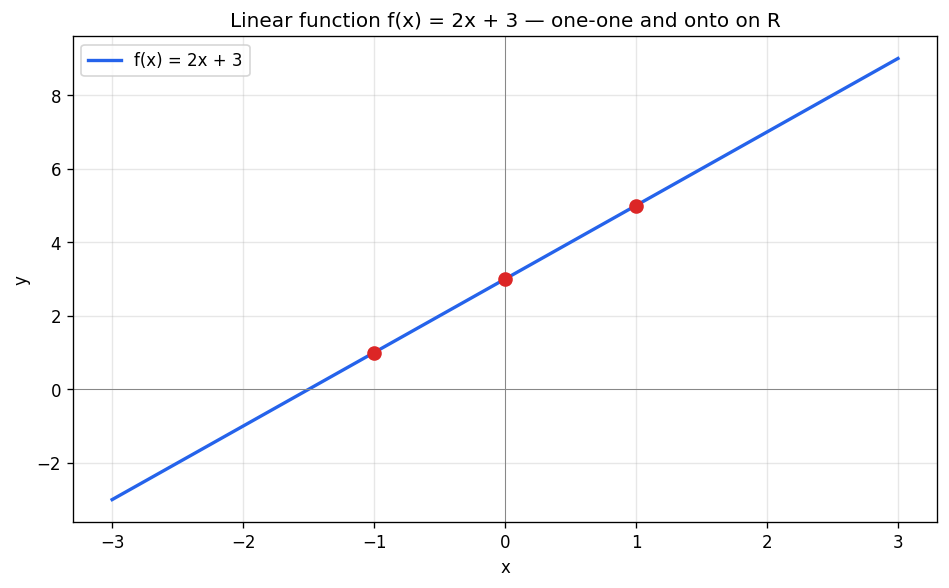
Study the graph of f(x) = 2x + 3 and answer:
As a function from R to R, f is:
AOne-one and onto
BOne-one but not onto
CMany-one and onto
DMany-one and not onto
The range of f when domain is R is:
AR
B[0, ∞)
C(0, ∞)
D{3}
Show that f is bijective and find its inverse.
Show answersHide answers
1. Option 1 — One-one and onto
2. Option 1 — R
3. A linear function with non-zero slope is one-one because distinct inputs give distinct outputs, and onto because every real y has a preimage x = (y − 3)/2. Hence f is bijective and has the inverse f⁻¹(y) = (y − 3)/2.