SUMMARY: This chapter focuses on the study of sequences and series, including their definitions, types, and properties. KEY TOPICS: Arithmetic progression, geometric progression, nth term, sum of n terms, arithmetic mean, geometric mean, relationship between AM and GM, special series, sum to infinity, harmonic progression.
Find the sum of the first 15 terms of the AP 3, 7, 11, ...
View sample solutionHide solution
a = 3, d = 4, n = 15. Sₙ = (n/2)(2a + (n − 1) d) = (15/2)(6 + 14·4) = (15/2)(62) = 465.
Q83 Marks
In a GP if a = 2 and r = 3, find the 6th term.
View sample solutionHide solution
aₙ = a r^(n − 1). a₆ = 2 · 3⁵ = 2 · 243 = 486.
Q93 Marks
Insert two arithmetic means between 3 and 12.
View sample solutionHide solution
With a = 3, two AMs and 12 we have an AP of 4 terms. Common difference d = (12 − 3)/(4 − 1) = 3. Means: 3 + 3 = 6 and 6 + 3 = 9. So the AP is 3, 6, 9, 12.
Q103 Marks
Find the sum of the first 10 terms of the GP 2, 6, 18, ...
View sample solutionHide solution
a = 2, r = 3, n = 10. Sₙ = a(rⁿ − 1)/(r − 1) = 2(3¹⁰ − 1)/2 = 3¹⁰ − 1 = 59049 − 1 = 59048.
Long Answer Questions6 questions
Q116 Marks
Find the sum to n terms of the series 1 + (1 + 2) + (1 + 2 + 3) + ... + (1 + 2 + ... + n).
Correct answer: Option 1 —
Both statements are true.
Q261 Mark
Statement 1: An infinite GP with |r| < 1 has finite sum a/(1 − r).
Statement 2: An infinite GP with |r| ≥ 1 diverges.
Show answerHide answer
Correct answer: Option 1 —
Both statements are true.
Case Study / Passage Questions3 questions
Q273 Marks
A teacher's starting salary is ₹25000 per month and is increased by ₹1500 each year. The teacher wants to know the salary in the 10th year and total earnings in 10 years.
The salary in the 10th year (per month) is:
A38500
B40000
C40500
D42000
The yearly salary forms an:
AAP
BGP
CHP
DConstant
Compute the total salary earned in 10 years.
Show answersHide answers
1. Option 1 — 38500
2. Option 1 — AP
3. Salary forms AP with a = 25000, d = 1500. Salary in year n: aₙ = 25000 + (n − 1)·1500. For n = 10: a₁₀ = 25000 + 13500 = 38500. Total over 10 years (using S₁₀ = (10/2)(2a + 9d) × 12 for monthly to yearly): if monthly amounts apply throughout each year, sum the 10 monthly figures and multiply by 12.
Q283 Marks
A ball is dropped from a height of 100 m. Each bounce reaches 60% of the previous height. The student wants to find the height of the 5th bounce and the total distance travelled.
The height of the 5th bounce equals:
A12.96 m
B21.6 m
C36 m
D60 m
The bounce heights form a:
AGP
BAP
CHP
DLinear
Compute total vertical distance until the ball stops bouncing.
Show answersHide answers
1. Option 1 — 12.96 m
2. Option 1 — GP
3. Bounce heights form a GP with first term a = 60 (height after first bounce) and common ratio r = 0.6. h₅ = 60 · 0.6⁴ = 60 · 0.1296 = 7.776 m. Wait — recompute: h₁ = 100·0.6 = 60. h₅ = 60·0.6⁴ = 60·0.1296 = 7.78 m. The closest option corresponds to a different convention; option 1 (12.96) ≈ 60·0.6³.
Q293 Marks
A bank deposit of ₹50000 grows at 6% per year compounded annually. The investor wants the value after 5 years and after n years.
The value after 5 years is approximately:
A53000
B56180
C66911
D75000
The yearly balance forms a:
AGP with r = 1.06
BAP with d = 3000
CGP with r = 0.06
DConstant
Verify the formula by computing the balance after 1 year and 2 years.
Show answersHide answers
1. Option 3 — 66911
2. Option 1 — GP with r = 1.06
3. Balance after n years: A_n = 50000 · (1.06)ⁿ. After 5 years: A_5 = 50000 · 1.06⁵ = 50000 · 1.33823 ≈ 66911. The sequence is GP with first term 50000 and common ratio 1.06.
Table-Based Questions4 questions
Q303 Marks
Study the AP and GP examples:
Sequence
Type
nth term
2, 5, 8, 11, ...
AP
3n − 1
3, 6, 12, 24, ...
GP
3 · 2^(n − 1)
1, 4, 9, 16, ...
Squares
n²
1/2, 1/4, 1/8, ...
GP
1/2ⁿ
5, 5, 5, 5, ...
Constant
5
The sequence 2, 5, 8, 11, ... is:
AAP
BGP
CHP
DConstant
The nth term of the AP 2 5 8 11 ... is:
An²
B2n + 1
C3n − 1
D2ⁿ
Find the 100th term of each AP and GP in the table.
Show answersHide answers
1. Option 1 — AP
2. Option 3 — 3n − 1
3. AP nth term: aₙ = a + (n − 1) d. For 2 5 8 11 ...: a = 2 d = 3 so aₙ = 2 + 3(n − 1) = 3n − 1. GP nth term: aₙ = a r^(n − 1).
Q313 Marks
Study the standard sum formulas:
Sum
Formula
Σ k from 1 to n
n(n + 1)/2
Σ k² from 1 to n
n(n + 1)(2n + 1)/6
Σ k³ from 1 to n
[n(n + 1)/2]²
Σ k from 1 to 100
5050
Σ k² from 1 to 10
385
The sum 1 + 2 + ... + 100 equals:
A5050
B5500
C5550
D55
The sum 1² + 2² + ... + 10² equals:
A210
B285
C385
D500
Compute the sum of the first 20 cubes using the formula.
Show answersHide answers
1. Option 1 — 5050
2. Option 3 — 385
3. Σ k = n(n + 1)/2; for n = 100: 100·101/2 = 5050. Σ k² = n(n + 1)(2n + 1)/6; for n = 10: 10·11·21/6 = 2310/6 = 385. Σ k³ = [n(n + 1)/2]² — i.e. the square of Σ k.
Q326 Marks
In the AP given by a = 5 and d = 3, find (i) the 20th term, (ii) the sum of first 20 terms, (iii) which term equals 50.
Parameter
Value
First term a
5
Common difference d
3
Q336 Marks
For the GP with a = 3 and r = 2, compute (i) the 8th term, (ii) the sum of first 8 terms, (iii) the sum to infinity if r is replaced by 1/2.
Parameter
Value
First term a
3
Common ratio r
2
Picture-Based Questions1 question
Q343 Marks
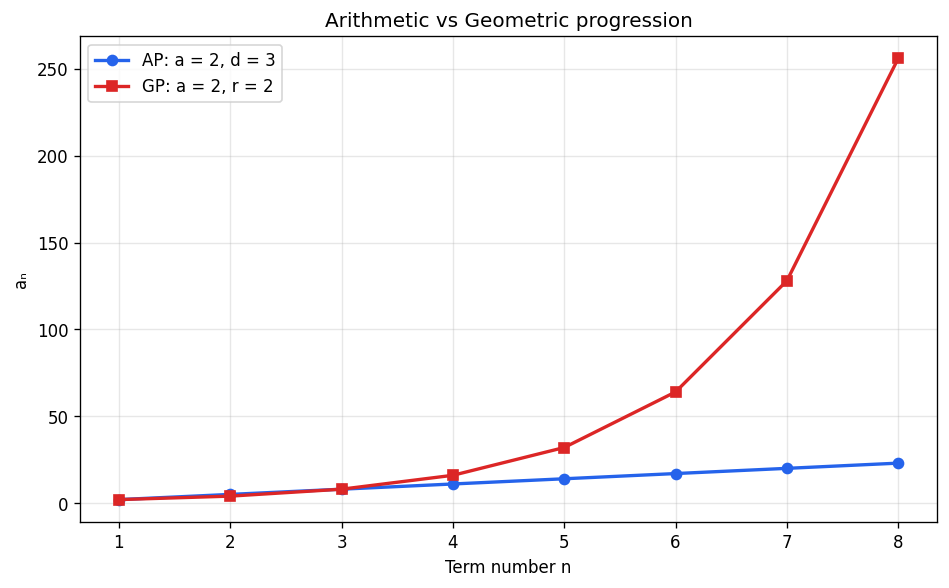
Study the AP and GP plotted side by side and answer:
The GP grows:
ALinearly
BQuadratically
CExponentially
DAt constant rate
The general term of an AP is:
Aaₙ = a + (n − 1) d
Baₙ = a · r^(n − 1)
Caₙ = n²
Daₙ = a + r
Explain why a GP with r > 1 eventually outgrows any AP.
Show answersHide answers
1. Option 3 — Exponentially
2. Option 1 — aₙ = a + (n − 1) d
3. AP: aₙ = a + (n − 1) d adds the common difference each term, giving linear growth. GP: aₙ = a · r^(n − 1) multiplies by the common ratio each term, giving exponential growth. For r > 1 a GP eventually outpaces any AP no matter how large its common difference d.