SUMMARY: The chapter on Probability in Class 11 Mathematics introduces the fundamental concepts and principles of probability, including its classical definition and applications. KEY TOPICS: random experiments, sample space, events, probability of an event, axiomatic approach to probability, mutually exclusive events, exhaustive events, complementary events, conditional probability, independent events
The probability of getting a head when a fair coin is tossed is:
A0
B1/4
C1/2
D1
Check answerHide answer
Correct answer: Option 3 — 1/2
Q51 Mark
For two mutually exclusive events: P(A ∪ B) equals:
AP(A) + P(B)
BP(A) − P(B)
CP(A) · P(B)
DP(A) / P(B)
Check answerHide answer
Correct answer: Option 1 — P(A) + P(B)
Short Answer Questions5 questions
Q63 Marks
Define mutually exclusive events with an example.
View sample solutionHide solution
Two events are mutually exclusive if they cannot occur simultaneously, i.e. A ∩ B = ∅. Example: in tossing a die, the events 'rolling an even' and 'rolling an odd' are mutually exclusive.
Q73 Marks
A die is rolled. Find the probability of getting an even number.
View sample solutionHide solution
Sample space S = {1, 2, 3, 4, 5, 6}, |S| = 6. Even outcomes = {2, 4, 6}, count = 3. P(even) = 3/6 = 1/2.
Q83 Marks
Two coins are tossed. Find the probability of getting at least one head.
View sample solutionHide solution
Sample space {HH, HT, TH, TT}, size 4. Outcomes with at least one H: {HH, HT, TH}, count 3. P = 3/4.
Q93 Marks
A card is drawn from a standard deck of 52. Find the probability that it is a king.
View sample solutionHide solution
Number of kings = 4; total cards = 52. P(king) = 4/52 = 1/13.
Q103 Marks
For events A and B with P(A) = 0.5, P(B) = 0.4 and P(A ∩ B) = 0.2, find P(A ∪ B).
View sample solutionHide solution
P(A ∪ B) = P(A) + P(B) − P(A ∩ B) = 0.5 + 0.4 − 0.2 = 0.7.
Long Answer Questions6 questions
Q116 Marks
A fair die is rolled twice. Find the probability that the sum of the numbers is 7.
View sample solutionHide solution
Sample space size = 6 × 6 = 36. Outcomes with sum 7: (1, 6), (2, 5), (3, 4), (4, 3), (5, 2), (6, 1) — count 6. P = 6/36 = 1/6.
Q126 Marks
A bag contains 3 red 4 blue and 5 green balls. Two balls are drawn at random without replacement. Find the probability that both are red.
View sample solutionHide solution
Total balls = 12. Number of ways to choose 2 reds from 3 = C(3, 2) = 3. Number of ways to choose any 2 from 12 = C(12, 2) = 66. P(both red) = 3/66 = 1/22.
Q136 Marks
Two cards are drawn from a deck without replacement. Find the probability that both are aces.
View sample solutionHide solution
P(first ace) = 4/52. Given first is ace P(second ace) = 3/51. P(both aces) = (4/52)(3/51) = 12/2652 = 1/221.
Q146 Marks
A card is drawn at random from a deck. Find the probability that it is a king or a heart.
View sample solutionHide solution
P(king) = 4/52; P(heart) = 13/52; P(king and heart) = P(king of hearts) = 1/52. By inclusion-exclusion: P(king or heart) = 4/52 + 13/52 − 1/52 = 16/52 = 4/13.
Q156 Marks
Three coins are tossed once. Find the probability of (i) exactly 2 heads (ii) at least 2 heads (iii) all heads.
View sample solutionHide solution
Sample space size 2³ = 8. (i) Exactly 2 heads: {HHT, HTH, THH} count 3. P = 3/8. (ii) At least 2 heads: 3 heads + 2 heads = 1 + 3 = 4. P = 4/8 = 1/2. (iii) All heads: {HHH} count 1. P = 1/8.
Q166 Marks
Compare classical and empirical (frequentist) definitions of probability with the help of a table.
Assertion–Reason Questions5 questions
Q171 Mark
Assertion (A): The probability of any event lies between 0 and 1 inclusive.
Reason (R): Probability is the ratio of favourable outcomes to total outcomes both of which are non-negative integers with the favourable count not exceeding the total.
Show explanationHide explanation
Correct answer: Option 1 —
Both A and R are true, and R is the correct explanation of A.
Q181 Mark
Assertion (A): The probability of an impossible event is 0.
Reason (R): An impossible event has no favourable outcomes so its probability is 0/n = 0.
Show explanationHide explanation
Correct answer: Option 1 —
Both A and R are true, and R is the correct explanation of A.
Q191 Mark
Assertion (A): P(A) + P(A') = 1.
Reason (R): Either A occurs or its complement does — the two are mutually exclusive and exhaustive.
Show explanationHide explanation
Correct answer: Option 1 —
Both A and R are true, and R is the correct explanation of A.
Q201 Mark
Assertion (A): For mutually exclusive events: P(A ∪ B) = P(A) + P(B).
Reason (R): Since A and B cannot occur together their intersection is empty so the inclusion-exclusion correction term vanishes.
Show explanationHide explanation
Correct answer: Option 1 —
Both A and R are true, and R is the correct explanation of A.
Q211 Mark
Assertion (A): For independent events: P(A ∩ B) = P(A) · P(B).
Reason (R): Independence means the occurrence of one event does not affect the probability of the other so probabilities multiply.
Show explanationHide explanation
Correct answer: Option 1 —
Both A and R are true, and R is the correct explanation of A.
Statement-Based Questions5 questions
Q221 Mark
Statement 1: The probability of a sure event is 1.
Statement 2: The probability of an impossible event is 0.
Show answerHide answer
Correct answer: Option 1 —
Both statements are true.
Q231 Mark
Statement 1: The probability of getting a head on a fair coin toss is 1/2.
Statement 2: The probability of getting tails on the same toss is also 1/2.
Show answerHide answer
Correct answer: Option 1 —
Both statements are true.
Q241 Mark
Statement 1: The probability of rolling a 6 on a fair die is 1/6.
Statement 2: The probability of rolling a number less than 7 on a fair die is 1.
Show answerHide answer
Correct answer: Option 1 —
Both statements are true.
Q251 Mark
Statement 1: P(A') = 1 − P(A).
Statement 2: The complement rule is equivalent to P(A) + P(A') = 1.
Show answerHide answer
Correct answer: Option 1 —
Both statements are true.
Q261 Mark
Statement 1: For independent events A and B: P(A and B) = P(A) · P(B).
Statement 2: If A and B are independent then P(A | B) = P(A).
Show answerHide answer
Correct answer: Option 1 —
Both statements are true.
Case Study / Passage Questions3 questions
Q273 Marks
Two fair coins are tossed simultaneously. A statistician wants the probability distribution of the number of heads X and to compute E(X) and the probability of at least one head.
The probability of getting at least one head equals:
A1/4
B1/2
C3/4
D1
The expectation E(X) (mean number of heads) equals:
A card is drawn at random from a standard deck of 52 cards. A student wants the probability that it is (i) a spade (ii) an ace and (iii) a spade or an ace.
The probability of drawing a spade is:
A1/4
B1/13
C1/52
D3/13
The probability of drawing a spade or an ace is:
A4/13
B16/52
C1/4
D17/52
Compute the probability of drawing a king or a heart.
Study the standard probabilities of common events:
Event
P
Coin shows H
1/2
Die shows 6
1/6
Two coins both H
1/4
Card is a heart
1/4
Die shows even
1/2
Spade or club
1/2
P(two coins both heads) equals:
A1/2
B1/4
C1/8
D1/16
P(drawing a heart from a deck) equals:
A1/4
B1/13
C1/52
D1/2
Compute P(getting at least one head in two tosses).
Show answersHide answers
1. Option 2 — 1/4
2. Option 1 — 1/4
3. For two independent coin tosses P(HH) = (1/2)·(1/2) = 1/4. There are 13 hearts in 52 cards so P(heart) = 13/52 = 1/4. Independent events allow us to multiply probabilities; mutually exclusive events allow us to add.
Q326 Marks
For the probability distribution of a discrete random variable X, find (i) the value of k, (ii) E(X), (iii) Var(X), (iv) P(X ≥ 2).
X
P(X)
1
k
2
2k
3
3k
4
4k
Q336 Marks
Two events A and B have the probabilities listed. Compute (i) P(A ∪ B), (ii) P(A | B), (iii) check whether A and B are independent.
Event
Probability
P(A)
0.5
P(B)
0.4
P(A ∩ B)
0.2
Picture-Based Questions1 question
Q343 Marks
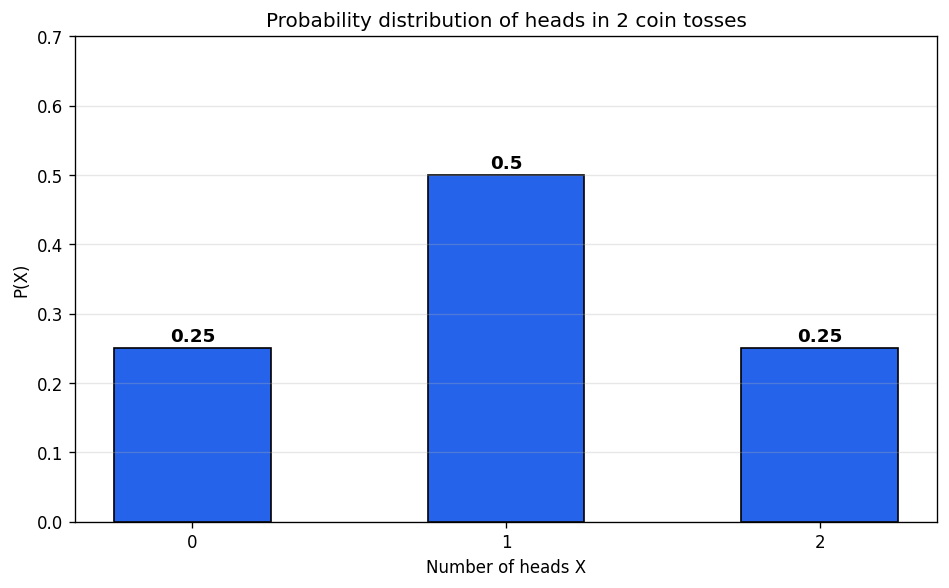
Study the PMF of two-coin toss and answer:
The number of heads X with the highest probability is:
A0
B1
C2
D0.5
The expectation E(X) of the distribution equals:
A0
B0.5
C1
D2
Verify the probability distribution by checking that the probabilities sum to 1.
Show answersHide answers
1. Option 2 — 1
2. Option 3 — 1
3. Sample space {HH, HT, TH, TT}. P(0 heads) = 1/4, P(1 head) = 1/2, P(2 heads) = 1/4. E(X) = 0·(1/4) + 1·(1/2) + 2·(1/4) = 1. Sum of probabilities = 1/4 + 1/2 + 1/4 = 1, satisfying the axiom of total probability.