Non-competitive Markets (Microeconomics) — Important Questions
59 questions
With answersCBSE format
SUMMARY: The chapter on Non-competitive Markets in Class 11 Economics explores the characteristics and functioning of markets that do not meet the criteria of perfect competition, such as monopoly, monopolistic competition, and oligopoly. KEY TOPICS: monopoly, monopolistic competition, oligopoly, market power, price maker, barriers to entry, product differentiation, non-price competition, kinked demand curve, collusion
In the kinked demand curve model of oligopoly, what assumption is made about rivals' reactions when a firm raises its price?
ARivals will also raise their prices to maintain market share
BRivals will not follow the price increase, so the firm loses customers
CRivals will lower their prices to undercut the firm
DRivals will exit the market, giving the firm more customers
Check answerHide answer
Correct answer: Option 2 — Rivals will not follow the price increase, so the firm loses customers
Q151 Mark
Collusion among oligopolistic firms leads to which of the following outcomes?
AFirms behave like perfect competitors and price equals marginal cost
BFirms collectively act like a monopoly to maximise joint profits
CFirms engage in intense price competition to capture market share
DFirms produce at the socially optimal level of output
Check answerHide answer
Correct answer: Option 2 — Firms collectively act like a monopoly to maximise joint profits
Short Answer Questions10 questions
Q163 Marks
State any two features of a monopoly market.
View sample solutionHide solution
(i) A single seller facing many buyers — the monopolist is the industry. (ii) Strong entry barriers keep potential rivals out — statutory licences, patents, control over a key resource, or large economies of scale. (iii) The monopolist faces a downward-sloping demand curve and is a price maker.
Q173 Marks
State any two features of monopolistic competition.
View sample solutionHide solution
(i) A large number of sellers, each small enough to have limited market power individually. (ii) Product differentiation — each firm sells a product that is similar but not identical to its rivals, giving the firm some downward-sloping demand curve and scope for non-price competition (branding, advertising, packaging).
Q183 Marks
What is price discrimination and what are the conditions for it to succeed?
View sample solutionHide solution
Price discrimination is the practice of charging different prices for the same good to different buyers for reasons not based on cost. Conditions: (i) the seller must have monopoly power (i.e. a downward-sloping demand); (ii) markets must be separable so that resale from cheap to costly market is impossible (geographical, temporal or based on consumer type); (iii) elasticities of demand in the two markets must differ.
Q193 Marks
Why is MR less than AR for a monopolist?
View sample solutionHide solution
Because the monopolist faces a downward-sloping demand (AR) curve. To sell an additional unit the monopolist must cut the price not just on the last unit but on all previous units. So the revenue added by the extra unit (MR) is less than the price at which it is sold (AR). Consequently, MR lies below AR at every level of output beyond the first.
Q203 Marks
State any two features of an oligopoly market.
View sample solutionHide solution
(i) A few large sellers dominate the market. (ii) Interdependence — each firm's price / output decision directly affects and is affected by its rivals, leading to strategic behaviour. Other features: product may be homogeneous (pure oligopoly, e.g. cement) or differentiated (cars, smartphones); barriers to entry are typically high; non-price competition through advertising and branding is common.
Q213 Marks
What is meant by a 'price maker' in the context of monopoly?
View sample solutionHide solution
A price maker is a firm that has the power to set its own price rather than accepting the market price. In a monopoly, since there is only one seller with no close substitutes, the firm can control the price by adjusting its output level.
Q223 Marks
Define monopolistic competition and give one example.
View sample solutionHide solution
Monopolistic competition is a market structure where many firms sell products that are similar but not identical, meaning each firm has some degree of market power due to product differentiation. An example is the market for toothpaste brands, where each brand is slightly different in taste, packaging, or ingredients.
Q233 Marks
What are barriers to entry? Name any two types of barriers to entry in a monopoly market.
View sample solutionHide solution
Barriers to entry are obstacles that prevent new firms from entering a market and competing with existing firms. Two common types are legal barriers such as patents or government licenses, and natural barriers such as control over a key raw material or very high startup costs.
Q243 Marks
Distinguish between price competition and non-price competition.
View sample solutionHide solution
Price competition refers to firms competing by lowering or adjusting prices to attract customers, whereas non-price competition involves firms competing through means other than price, such as advertising, product quality, packaging, and after-sales service. Non-price competition is commonly observed in monopolistic competition and oligopoly.
Q253 Marks
What is product differentiation? How does it give a firm market power?
View sample solutionHide solution
Product differentiation refers to the process by which firms make their products distinct from competitors' products through differences in quality, design, branding, or features. It gives a firm market power because consumers perceive the product as unique, making them less sensitive to price changes and allowing the firm to charge a price above the competitive level.
Long Answer Questions6 questions
Q266 Marks
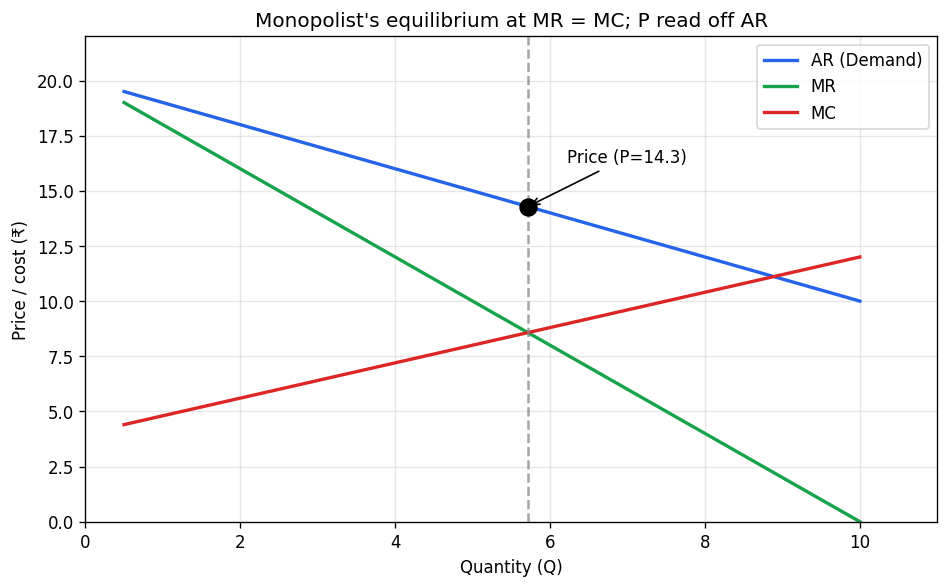
Explain the equilibrium of a monopoly firm.
View sample solutionHide solution
A monopolist is a single seller with market power; it faces the market demand (AR) curve, which is downward-sloping. As a result, MR lies below AR and also slopes downward. Equilibrium is determined where MC = MR and MC is rising (second-order condition). The price is read off the AR (demand) curve at the equilibrium quantity — this price is higher than MC. Profit or loss is decided by the relationship between price and ATC: if P > ATC, supernormal profit (rectangle between P and ATC over Q); if P = ATC, normal profit; if P < ATC but ≥ AVC, loss minimised by continuing production; below AVC, shut down. Unlike perfect competition, supernormal profits can persist even in the long run because entry barriers prevent new firms from competing away the profits. Monopoly equilibrium is typically at a higher price and lower quantity than the socially optimal P = MC outcome.
Q276 Marks
Compare monopoly with perfect competition.
View sample solutionHide solution
(1) Number of sellers: perfect competition has very many; monopoly has exactly one. (2) Nature of product: homogeneous in perfect competition; the monopolist's product has no close substitutes. (3) Demand facing firm: perfectly elastic horizontal line in competition; downward-sloping in monopoly. (4) Price: competitive firm is a price-taker (AR = MR = P); monopolist is a price-maker with P = AR > MR. (5) Equilibrium price and output: competitive P = MC = minimum LAC; monopoly P > MC, and typically Q is lower than the competitive outcome. (6) Profits: competition → only normal profits in the long run; monopoly → supernormal profits can persist because entry is blocked. (7) Efficiency: competition yields allocative and productive efficiency; monopoly is typically allocatively and productively inefficient — consumers pay a higher price and the socially optimal output is not produced. (8) Consumer surplus: higher under competition than under monopoly.
Q286 Marks
Explain the features of monopolistic competition.
View sample solutionHide solution
Monopolistic competition (Chamberlin, 1933) shares features of both competition and monopoly. Features: (i) Large number of sellers — each too small to directly affect the market as a whole. (ii) Product differentiation — products are slightly different in quality, packaging, branding, location or after-sales service; think toothpaste, soap, fast food. (iii) Free entry and exit in the long run. (iv) Limited price-setting power — each firm faces a downward-sloping but highly elastic demand curve because close substitutes exist. (v) Non-price competition — advertising, branding, product development. Short-run equilibrium resembles monopoly (P > MC, possibly with supernormal profits); long-run equilibrium resembles perfect competition in that entry competes profits away so P = LAC, but productive inefficiency remains because firms produce at a scale below the minimum LAC (excess capacity).
Q296 Marks
Discuss price discrimination and its main forms.
View sample solutionHide solution
Price discrimination occurs when a seller with monopoly power charges different prices for the same good to different customers for reasons unrelated to cost. Conditions: (i) monopoly power; (ii) market segmentation — buyers in segments A and B can be separated (geographically, by time, by buyer identity); (iii) no resale between segments; (iv) different elasticities of demand in the segments. Forms: (1) First-degree (perfect) price discrimination — the monopolist charges each buyer exactly what they are willing to pay; captures all consumer surplus (theoretical benchmark). (2) Second-degree — prices vary by quantity purchased (quantity discounts, block tariffs on electricity). (3) Third-degree — segments defined by identifiable groups (students, senior citizens, corporate vs individual buyers); monopolist charges a higher price in the less elastic segment. In practice third-degree is most common (airlines, telecom, cinema tickets).
Q306 Marks
Explain the characteristics of an oligopoly market.
View sample solutionHide solution
Oligopoly is a market structure dominated by a small number of large firms. Key characteristics: (i) Few sellers — usually 2 to 10; each has significant market share. (ii) Interdependence — each firm's pricing and output decisions affect, and are affected by, its rivals. Strategic behaviour and game theory apply. (iii) Product may be homogeneous (pure oligopoly — cement, steel) or differentiated (cars, smartphones). (iv) Barriers to entry — large capital requirements, economies of scale, brand loyalty, patents, government licences. (v) Non-price competition — advertising, branding, product innovation, quality improvements. (vi) Price rigidity — prices tend to be stable (kinked demand curve hypothesis); firms avoid price wars. (vii) Possibility of collusion — explicit (cartels like OPEC) or tacit (price leadership). (viii) High profits can persist because entry is blocked. Government regulation is common, especially against anti-competitive collusion and mergers that reduce competition.
Q316 Marks
Define monopoly and explain its key characteristics. How does a monopolist act as a price maker in the market?
View sample solutionHide solution
Monopoly is a market structure where there is a single seller of a product that has no close substitutes. The key characteristics of monopoly include: (1) Single seller – only one firm controls the entire market supply; (2) No close substitutes – the product offered has no near alternatives, giving the monopolist unique market power; (3) Price maker – the monopolist has full control over the price of the product and can set it at a level that maximizes profit; (4) High barriers to entry – new firms cannot easily enter the market due to legal, technological, or resource-based restrictions; (5) Downward sloping demand curve – unlike perfect competition, the monopolist faces the entire market demand curve which slopes downward.
As a price maker, the monopolist does not take the market price as given. Instead, it chooses the price-quantity combination on its demand curve that maximizes its profit. Since the demand curve slopes downward, to sell more units the monopolist must lower the price. The monopolist sets output where Marginal Revenue (MR) equals Marginal Cost (MC) and then determines the price from the demand curve at that output level. This ability to set prices above marginal cost leads to allocative inefficiency and is a key distinction from perfectly competitive markets.
Assertion–Reason Questions8 questions
Q321 Mark
Assertion (A): A monopoly produces less output and charges a higher price than a perfectly competitive market would.
Reason (R): The monopolist restricts output to the point where marginal revenue equals marginal cost to maximise profit.
Show explanationHide explanation
Correct answer: Option 1 —
Both A and R are true, and R is the correct explanation of A.
Q331 Mark
Assertion (A): Firms in monopolistic competition have some price-setting power.
Reason (R): Product differentiation gives each firm a slightly downward-sloping demand curve.
Show explanationHide explanation
Correct answer: Option 1 —
Both A and R are true, and R is the correct explanation of A.
Q341 Mark
Assertion (A): Oligopoly is characterised by strong interdependence among firms.
Reason (R): Each firm's pricing or output decision directly affects its rivals who therefore react strategically.
Show explanationHide explanation
Correct answer: Option 1 —
Both A and R are true, and R is the correct explanation of A.
Q351 Mark
Assertion (A): Price discrimination can raise the monopolist's total revenue.
Reason (R): Charging higher prices where demand is inelastic and lower prices where demand is elastic extracts more consumer surplus.
Show explanationHide explanation
Correct answer: Option 1 —
Both A and R are true, and R is the correct explanation of A.
Q361 Mark
Assertion (A): A monopolist does not have a supply curve in the usual sense.
Reason (R): Under monopoly price and quantity are chosen jointly to maximise profit so there is no one-to-one mapping from price to quantity.
Show explanationHide explanation
Correct answer: Option 1 —
Both A and R are true, and R is the correct explanation of A.
Q371 Mark
Assertion (A): A monopolist is a price maker, not a price taker.
Reason (R): In a monopoly, there is only one seller who controls the entire market supply and faces no competition.
Show explanationHide explanation
Correct answer: Option 1 —
Both A and R are true, and R is the correct explanation of A.
Q381 Mark
Assertion (A): In monopolistic competition, firms earn only normal profits in the long run.
Reason (R): The presence of barriers to entry prevents new firms from entering the market and competing away supernormal profits.
Show explanationHide explanation
Correct answer: Option 3 —
A is true, but R is false.
Q391 Mark
Assertion (A): Product differentiation is a key feature of monopolistic competition.
Reason (R): Firms under monopolistic competition sell identical products to attract a larger customer base.
Show explanationHide explanation
Correct answer: Option 3 —
A is true, but R is false.
Statement-Based Questions8 questions
Q401 Mark
Statement 1: A monopolist faces a downward-sloping demand curve.
Statement 2: Marginal revenue is always less than average revenue for the monopolist.
Show answerHide answer
Correct answer: Option 1 —
Both statements are true.
Q411 Mark
Statement 1: In the long run, firms under monopolistic competition earn only normal economic profit.
Statement 2: Free entry and exit drive down supernormal profits until only normal profit remains.
Show answerHide answer
Correct answer: Option 1 —
Both statements are true.
Q421 Mark
Statement 1: Oligopoly firms rely heavily on advertising and branding.
Statement 2: Non-price competition is an important way for firms to attract customers when price competition is muted.
Show answerHide answer
Correct answer: Option 1 —
Both statements are true.
Q431 Mark
Statement 1: Price discrimination requires that the different markets be clearly separable.
Statement 2: Resale of the good between the two markets must be practically impossible for price discrimination to persist.
Show answerHide answer
Correct answer: Option 1 —
Both statements are true.
Q441 Mark
Statement 1: A monopolist chooses output where price equals marginal revenue.
Statement 2: A monopolist maximises profit where price equals marginal cost.
Show answerHide answer
Correct answer: Option 2 —
Only Statement 1 is true.
Q451 Mark
Statement 1: A monopolist is a price maker who can set the price of its product in the market.
Statement 2: In a monopoly, there are many sellers competing with each other for the same product.
Show answerHide answer
Correct answer: Option 2 —
Only Statement 1 is true.
Q461 Mark
Statement 1: Barriers to entry in a monopoly market prevent new firms from entering and competing with the existing firm.
Statement 2: In perfect competition, barriers to entry are very high, making it difficult for new firms to enter.
Show answerHide answer
Correct answer: Option 2 —
Only Statement 1 is true.
Q471 Mark
Statement 1: Product differentiation is a key feature of monopolistic competition.
Statement 2: In monopolistic competition, firms sell identical and homogeneous products with no distinguishing features.
Show answerHide answer
Correct answer: Option 2 —
Only Statement 1 is true.
Case Study / Passage Questions4 questions
Q483 Marks
Company X holds a 20-year patent on a life-saving drug. During the patent period only X can produce and sell the drug. X faces the market demand curve for the drug and sets both price and quantity to maximise profit.
The AR (demand) curve of Company X is:
AHorizontal
BDownward sloping
CUpward sloping
DVertical
The MR of Company X is:
AEqual to AR
BLess than AR
CGreater than AR
DZero
Why is MR less than AR for a monopolist?
Show answersHide answers
1. Option 2 — Downward sloping
2. Option 2 — Less than AR
3. Because the monopolist faces a downward-sloping demand curve, selling one more unit requires cutting the price not just on that unit but on all previous units. The marginal revenue from the extra unit is therefore less than its price (AR). Hence MR lies below AR for every output beyond the first.
Q493 Marks
India's toothpaste market has many brands — Colgate, Pepsodent, Close-Up, Dabur Red, Sensodyne, Patanjali Dant Kanti, etc. Each brand is slightly different in flavour, packaging and claims. Each seller has some limited power to set its own price.
This market is best described as:
APerfect competition
BMonopoly
CMonopolistic competition
DOligopoly
Products in this market are:
AHomogeneous
BDifferentiated
CIdentical
DOnly one product
What is the long-run outcome in monopolistic competition?
Show answersHide answers
1. Option 3 — Monopolistic competition
2. Option 2 — Differentiated
3. In the long run, free entry and exit of brands drives economic profits to zero — P = LAC. However, each firm produces at a scale below its minimum LAC (excess capacity) because the demand curve facing each brand is downward sloping rather than horizontal. Product differentiation remains but economic profits are competed away.
Q503 Marks
India's cement industry is dominated by about a dozen large players — UltraTech, Shree, Ambuja, ACC, Dalmia Bharat, etc. Each firm watches the others closely; if one raises prices, it is unsure whether rivals will follow; if it cuts prices, rivals may match to avoid losing market share.
This market structure is best described as:
APerfect competition
BMonopoly
CMonopolistic competition
DOligopoly
The central feature of decisions in such a market is:
AIndependence
BInterdependence
CCompetition with no interaction
DPerfect cooperation
Explain why prices tend to be rigid in an oligopoly.
Show answersHide answers
1. Option 4 — Oligopoly
2. Option 2 — Interdependence
3. If an oligopolist raises price, rivals may not follow and the firm loses market share — demand is elastic above the current price. If the firm cuts price, rivals match to defend share — demand is inelastic below the current price. The resulting 'kinked demand curve' makes firms reluctant to change price, so prices tend to be rigid and non-price competition (advertising, branding, innovation) dominates.
Q514 Marks
A pharmaceutical company holds a patent on a life-saving drug, giving it exclusive rights to produce and sell the drug for 20 years. During this period, no other firm can enter the market to produce the same drug. The company acts as a price maker, setting the price well above its marginal cost to maximize profits. Consumers have no alternative but to purchase the drug at the price set by the company. The government occasionally intervenes by regulating the price to protect consumers. This situation is a classic example of monopoly, where a single seller dominates the entire market, faces no competition, and controls the supply of the product. High barriers to entry, in this case a legal patent, prevent other firms from entering and competing in the market.
What type of market structure is described in the passage?
APerfect Competition
BMonopolistic Competition
CMonopoly
DOligopoly
Which of the following best describes a 'price maker'?
AA firm that accepts the market price as given
BA firm that has the power to set its own price
CA firm that competes with many sellers
DA firm that sells homogeneous products
What is the barrier to entry mentioned in the passage, and why is it significant for maintaining the monopoly?
In a monopoly, the firm sets price above marginal cost. What does this imply about the efficiency of resource allocation?
Show answersHide answers
1. Option 3 — Monopoly
2. Option 2 — A firm that has the power to set its own price
3. The barrier to entry mentioned is a legal patent. It is significant because it grants the pharmaceutical company exclusive rights to produce and sell the drug for 20 years, preventing other firms from entering the market and competing. This allows the monopolist to maintain control over supply and price without any competitive pressure.
4. When a monopolist sets price above marginal cost, it leads to allocative inefficiency. Resources are not optimally allocated because the price consumers pay exceeds the cost of producing an additional unit. This results in a deadweight loss — fewer units are produced and consumed than would be socially optimal, meaning some mutually beneficial transactions do not take place.
Table-Based Questions4 questions
Q523 Marks
Study the comparison of market structures and answer:
Feature
Perfect competition
Monopoly
Monopolistic competition
Oligopoly
Number of sellers
Very many
One
Many
Few
Product
Homogeneous
Unique
Differentiated
Homogeneous or differentiated
Barriers to entry
None
High
Low
High
Price setting
Price taker
Price maker
Limited power
Interdependent
Which market has the highest barriers to entry?
APerfect competition
BMonopoly
CMonopolistic competition
DOligopoly
Which market has a price-taker firm?
APerfect competition
BMonopoly
CMonopolistic competition
DOligopoly
Why are real-world markets rarely perfectly competitive?
Show answersHide answers
1. Option 2 — Monopoly
2. Option 1 — Perfect competition
3. The four structures differ mainly in the number of sellers and the extent of product differentiation. These in turn determine the firm's control over price and its profitability in the long run. Perfect competition is the benchmark of efficiency but rarely observed; most real-world markets fall between monopoly and monopolistic competition or oligopoly.
Q533 Marks
Study the monopoly revenue schedule and answer:
Q
Price / AR
TR
MR
1
20
20
20
2
18
36
16
3
16
48
12
4
14
56
8
5
12
60
4
6
10
60
0
In a monopoly the general rule is:
AMR > AR
BMR < AR
CMR = AR
DMR = 0
TR is at its maximum at:
AQ = 4
BQ = 5
CQ = 6
DQ = 1
What is the relationship between MR and total revenue?
Show answersHide answers
1. Option 2 — MR < AR
2. Option 3 — Q = 6
3. TR rises as long as MR is positive and reaches a maximum where MR = 0 (here at Q = 6). Beyond that point MR becomes negative and TR falls. Profit-maximising output is where MC = MR, typically at a Q lower than the TR-maximising Q, because MC > 0 for the producer.
Q545 Marks
The demand schedule faced by a monopolist is given. Compute Total Revenue and Marginal Revenue and locate the revenue-maximising output.
Quantity Q
Price (₹) = AR
1
20
2
18
3
16
4
14
5
12
6
10
Q556 Marks
Observe the following table showing the demand schedule faced by a monopolist and answer the questions below:
Output (Units)
Price (₹)
Total Revenue (₹)
Marginal Revenue (₹)
1
100
100
100
2
90
180
80
3
80
240
60
4
70
280
40
5
60
300
20
6
50
300
0
7
40
280
-20
Picture-Based Questions4 questions
Q563 Marks
Study the monopolist's equilibrium diagram and answer:
For a monopolist:
AAR = MR
BMR < AR
CMR > AR
DMR = 0 at all Q
The monopolist's profit-maximising output is where:
AMR = 0
BMR = AR
CMR = MC
DAR = MC
Why is MR less than AR for a monopolist?
Show answersHide answers
1. Option 2 — MR < AR
2. Option 3 — MR = MC
3. A monopolist faces the full market demand curve, which slopes downward. To sell an extra unit the monopolist must cut the price on all previous units too; therefore the revenue from the extra unit (MR) is less than its price (AR). This is why MR lies below AR at every output beyond the first, and why the monopolist's profit-maximising price exceeds marginal cost.
Q574 Marks
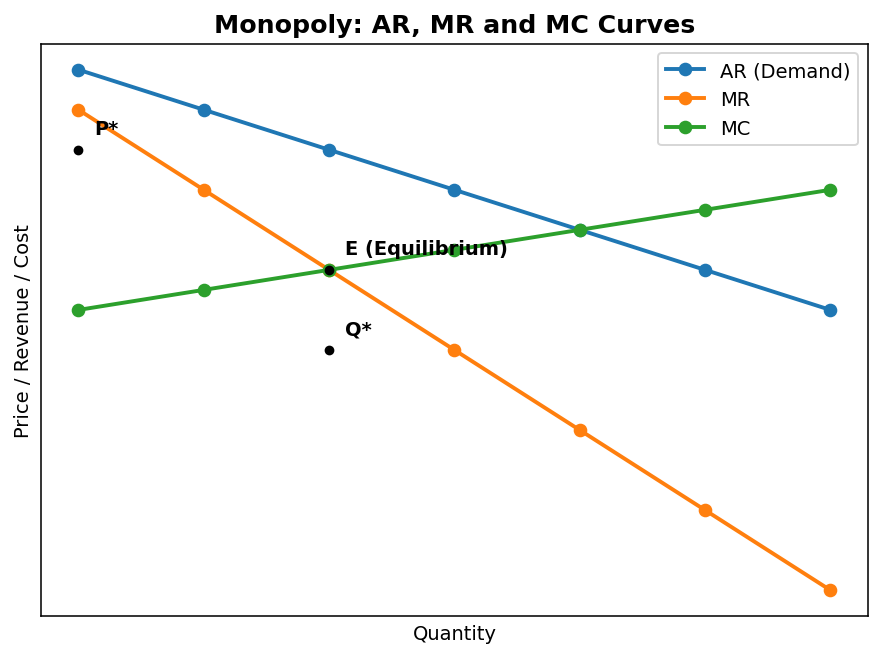
Based on the given graph showing the demand and revenue curves of a monopoly firm, answer the following:
At what condition does a monopolist achieve equilibrium output?
AMR = AR
BMC = MR
CMC = AR
DMR = 0
In the given graph, the MR curve lies below the AR curve. What does this indicate about the monopolist's market power?
Which of the following best describes the price charged by a monopolist at equilibrium?
APrice equals MC
BPrice equals MR
CPrice is greater than MC
DPrice is less than MC
What happens to the MR of a monopolist when the AR (demand) curve is a downward-sloping straight line?
AMR is parallel to AR
BMR has twice the slope of AR
CMR bisects the horizontal axis at the same point as AR
DMR and AR are identical
Show answersHide answers
1. Option 2 — MC = MR
2. The MR curve lying below the AR curve indicates that the monopolist is a price maker. To sell more units, the monopolist must lower the price for all units, so marginal revenue falls faster than average revenue (price). This reflects the monopolist's ability to influence market price.
3. Option 3 — Price is greater than MC
4. Option 3 — MR bisects the horizontal axis at the same point as AR
Q584 Marks
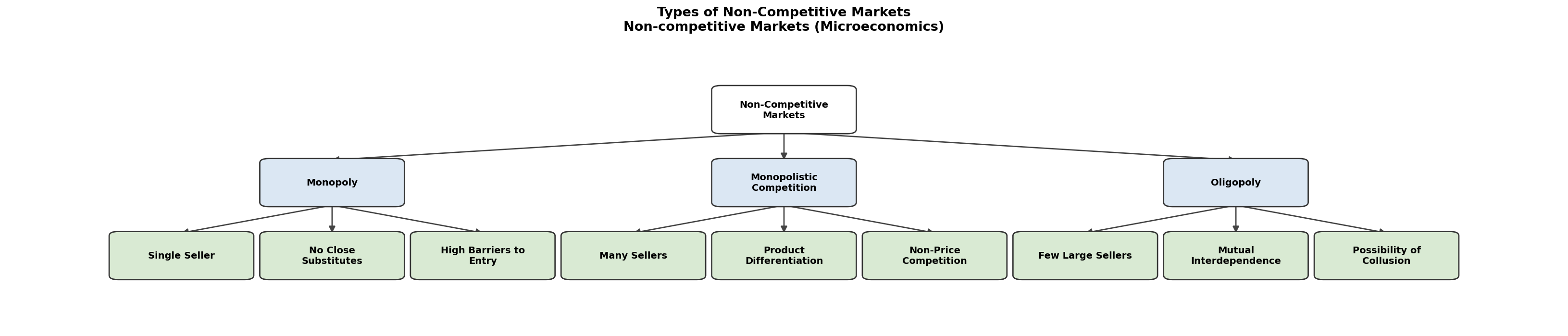
Based on the given flowchart showing the classification of non-competitive market structures, answer the following:
Which market structure shown in the flowchart is characterised by a single seller with no close substitutes?
AOligopoly
BMonopolistic Competition
CMonopoly
DPerfect Competition
What is meant by 'product differentiation' as shown under Monopolistic Competition in the flowchart?
Which feature listed under Oligopoly in the flowchart explains why firms in this market do not frequently change their prices?
AFew Large Sellers
BMutual Interdependence
CPossibility of Collusion
DHigh Barriers to Entry
Explain the concept of 'collusion' as a feature of oligopoly and give one example.
Show answersHide answers
1. Option 3 — Monopoly
2. Product differentiation refers to the practice of making a product appear different from competing products through differences in quality, design, branding, packaging, or features. In monopolistic competition, each firm sells a product that is slightly different from rivals, giving it some degree of market power.
3. Option 2 — Mutual Interdependence
4. Collusion in oligopoly refers to a formal or informal agreement among competing firms to fix prices, limit output, or divide markets in order to maximise joint profits. Example: OPEC (Organisation of Petroleum Exporting Countries) is a classic example where member countries collude to set oil production levels and prices.
Q594 Marks
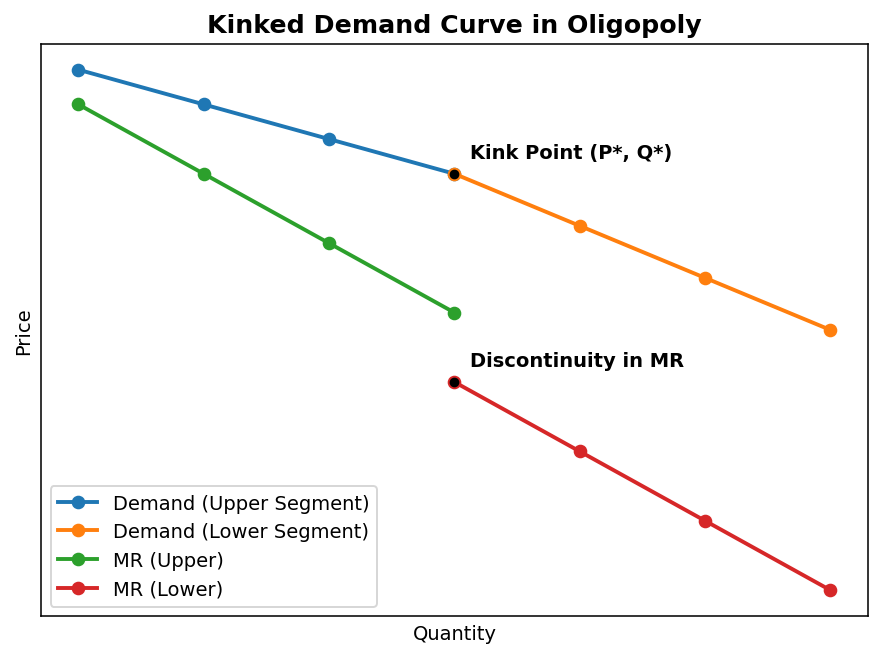
Based on the given graph showing the kinked demand curve model in oligopoly, answer the following:
What does the 'kink' in the demand curve of an oligopolist represent?
AThe point where the firm earns maximum revenue
BThe prevailing market price at which rivals match price cuts but not price rises
CThe point where MC equals MR
DThe minimum price at which the firm can operate
Why is the MR curve discontinuous (has a gap) at the kink point in the kinked demand curve model?
Which of the following best explains why oligopolistic firms tend to maintain price rigidity?
AThey have no market power
BThey fear government intervention
CA price rise loses customers while a price cut triggers a price war
DTheir products are homogeneous
In the kinked demand curve model, the demand curve above the kink is relatively elastic. What does this imply for the oligopolist if it raises its price?
Show answersHide answers
1. Option 2 — The prevailing market price at which rivals match price cuts but not price rises
2. The MR curve is discontinuous at the kink because the demand curve has two segments with different elasticities. The upper segment (elastic) gives a higher MR, and the lower segment (inelastic) gives a much lower MR. At the kink point, there is a sudden drop in MR, creating a vertical gap. This discontinuity means that even if MC shifts within this gap, the equilibrium price and output remain unchanged, explaining price rigidity in oligopoly.
3. Option 3 — A price rise loses customers while a price cut triggers a price war
4. If the demand curve above the kink is relatively elastic, it means that a price rise by the oligopolist will lead to a proportionately larger fall in quantity demanded. Since rivals do not raise their prices, customers switch to competitors, causing the firm to lose a significant share of its market. This makes price increases unprofitable for the oligopolist.