Statistics in the plural sense refers to:
Introduction (Statistics for Economics) — Important Questions
SUMMARY: The chapter "Introduction" in Class 11 Economics provides an overview of the role and importance of statistics in the field of economics.
KEY TOPICS: definition of statistics, importance of statistics in economics, types of data, collection of data, presentation of data, statistical tools, limitations of statistics, scope of statistics in economics, uses of statistics in economic planning, role of statistics in policy formulation.
Who is regarded as the father of modern statistics?
Check answerHide answer
Which of the following is NOT a limitation of statistics?
Check answerHide answer
Which of the following is a function of statistics in economics?
Check answerHide answer
Statistics is best described as:
Check answerHide answer
Which of the following best defines 'Statistics' in the context of economics?
Check answerHide answer
Which of the following is NOT a function of statistics in economics?
Check answerHide answer
Data that is collected for the first time by the investigator for a specific purpose is known as:
Check answerHide answer
Which of the following statements correctly describes a limitation of statistics?
Check answerHide answer
In economic planning, statistics is primarily used to:
Check answerHide answer
Which of the following is an example of secondary data?
Check answerHide answer
The statement 'Statistics are like clay of which you can make a god or devil as you please' highlights which limitation of statistics?
Check answerHide answer
Which of the following tools is used in the presentation of statistical data?
Check answerHide answer
A researcher studying the relationship between income levels and consumer spending is using statistics to:
Check answerHide answer
Which of the following correctly distinguishes between the two meanings of the word 'statistics'?
Check answerHide answer
Define statistics in both the singular and plural senses.
View sample solutionHide solution
State any two limitations of statistics.
View sample solutionHide solution
Distinguish between primary data and secondary data.
View sample solutionHide solution
What is meant by 'statistics is both a science and an art'?
View sample solutionHide solution
State any two functions of statistics in economics.
View sample solutionHide solution
Define statistics in the context of economics.
View sample solutionHide solution
Why is statistics considered important in economics?
View sample solutionHide solution
What is meant by the 'presentation of data' in statistics?
View sample solutionHide solution
Explain any two uses of statistics in economic planning.
View sample solutionHide solution
How does statistics assist in policy formulation?
View sample solutionHide solution
Explain the scope and importance of statistics in the study of economics.
View sample solutionHide solution
Describe the main stages of a statistical investigation.
View sample solutionHide solution
Examine the principal limitations of statistics with examples.
View sample solutionHide solution
Compare 'statistics in singular' and 'statistics in plural' senses, with examples.
View sample solutionHide solution
Discuss the characteristics of good statistical data.
View sample solutionHide solution
Define statistics and explain its importance in the field of economics. How does statistics help economists in understanding economic phenomena?
View sample solutionHide solution
Assertion (A): Statistics in the singular sense refers to the science of methods of data handling.
Reason (R): In the singular sense, statistics denotes the systematic body of principles and techniques for collecting, analysing and interpreting data.
Show explanationHide explanation
Assertion (A): Statistics studies aggregates of facts rather than isolated observations.
Reason (R): A single observation cannot by itself be compared or analysed in the probabilistic sense that statistics requires.
Show explanationHide explanation
Assertion (A): Statistics is indispensable for formulating economic policy.
Reason (R): Policy decisions rely on quantitative estimates of current conditions and of the effect of proposed measures.
Show explanationHide explanation
Assertion (A): Statistics can prove any proposition.
Reason (R): Statistical methods are tied to the accuracy and coverage of the underlying data; they can mislead if misused, but cannot prove arbitrary claims.
Show explanationHide explanation
Assertion (A): Statistics can be described as both a science and an art.
Reason (R): It is a science because its rules are systematic; it is an art because their correct application requires judgement and experience.
Show explanationHide explanation
Assertion (A): Statistics is an indispensable tool for an economist.
Reason (R): Statistics helps economists to collect, present, and analyse numerical data related to economic problems.
Show explanationHide explanation
Assertion (A): Data collected for the first time by the investigator is called secondary data.
Reason (R): Primary data is original data collected directly from the source for a specific purpose.
Show explanationHide explanation
Assertion (A): Statistics can be used to establish a definite cause-and-effect relationship between two variables.
Reason (R): Statistical methods only show the degree of association or correlation between variables and cannot prove causation.
Show explanationHide explanation
Statement 1: Statistics in the plural sense refers to numerical aggregates of facts.
Statement 2: Statistics in the singular sense refers to the scientific method of handling data.
Show answerHide answer
Statement 1: Primary data are collected originally for a specific purpose.
Statement 2: Secondary data are always costlier than primary data.
Show answerHide answer
Statement 1: Statistics helps to condense large masses of numerical data.
Statement 2: Statistics is useful in the formulation and testing of economic hypotheses.
Show answerHide answer
Statement 1: Statistics simplifies complex data sets.
Statement 2: Statistics can be fully understood without any formal training.
Show answerHide answer
Statement 1: Statistics is useful for studying aggregate economic trends.
Statement 2: Statistics is equally useful for studying a single isolated observation.
Show answerHide answer
Statement 1: Statistics is defined as the science of collecting, organising, presenting, analysing and interpreting numerical data.
Statement 2: Statistics can only be used in natural sciences and has no relevance in economics.
Show answerHide answer
Statement 1: Primary data is collected directly from the original source by the investigator himself.
Statement 2: Secondary data is also collected directly from the original source by the investigator.
Show answerHide answer
Statement 1: Statistics helps economists in understanding and solving economic problems by providing quantitative data.
Statement 2: Statistical tools are used in economic planning and policy formulation.
Show answerHide answer
-
Statistics in the singular sense refers to:AOnly dataBOnly methods for collecting and analysing dataCOnly opinionsDOnly forecasts
-
Statistics usually studies:AIndividual householdsBAggregates of factsCSingle observationsDSmall groups only
-
Explain in your own words how statistics helps in evaluating such a policy.
Show answersHide answers
-
The data used by Researcher A is an example of:APrimary dataBSecondary dataCTertiary dataDQualitative data
-
The data used by Researcher B is an example of:APrimary dataBSecondary dataCExperimental dataDQualitative data
-
Compare primary and secondary data in terms of reliability and cost.
Show answersHide answers
-
Which of the following is the main problem with the newspaper's statement?AStatistical methods were used correctlyBAverages can hide important distributional differencesCPer-capita income is always inaccurateDAll Indians gained equally
-
Statistics typically reveals:AIndividual casesBAggregate averagesCQualitative detailsDTime trends
-
Explain why a headline average can mislead in economic reporting.
Show answersHide answers
-
Which of the following is NOT a function of statistics in economics?ACollection of dataBInterpretation of dataCManufacturing of goodsDPresentation of data
-
Which organisation in India is responsible for collecting and publishing national statistical data?ARBIBSEBICCSODNABARD
-
Why is statistics considered the backbone of economic analysis?
-
Statistics helps in forecasting future economic trends. True or False? Justify your answer.
Show answersHide answers
Study the comparison of primary and secondary data and answer:
| Characteristic | Primary data | Secondary data |
|---|---|---|
| Source | Collected originally by the researcher | Published by another agency |
| Cost | High | Low |
| Time | Slow | Fast |
| Relevance to research question | Very high | Depends |
-
Which type of data is typically more expensive to obtain?APrimary dataBSecondary dataCBoth equalDNeither
-
Which type of data is typically faster to obtain?APrimary dataBSecondary dataCBoth equalDNeither
-
Why do researchers usually consult secondary data before collecting primary data?
Show answersHide answers
Study the subject matter of statistics and answer:
| Function of statistics | Example in economics |
|---|---|
| Collection | Household consumption survey |
| Presentation | GDP growth bar chart |
| Analysis | Computing mean income, standard deviation |
| Interpretation | Identifying rising inequality |
-
Which function is best illustrated by a household consumption survey?ACollectionBPresentationCAnalysisDInterpretation
-
Which function is illustrated by a GDP growth bar chart?ACollectionBPresentationCAnalysisDInterpretation
-
What does the table show about the scope of statistics?
Show answersHide answers
Observe the following table showing the uses of statistics in different areas of economics and answer the questions below:
| Area of Economics | Use of Statistics | Example |
|---|---|---|
| Economic Planning | Forecasting future trends | GDP growth projection |
| Policy Formulation | Data-driven decision making | Tax rate determination |
| Market Analysis | Demand and supply estimation | Price index calculation |
| National Income | Measurement and comparison | Per capita income data |
The following table shows different types of data used in economics. Study the table carefully and answer the questions:
| Type of Data | Definition | Example |
|---|---|---|
| Primary Data | Collected directly by the investigator for the first time | Survey of farmers' income |
| Secondary Data | Data already collected and used by someone else | Census data published by government |
| Quantitative Data | Data expressed in numerical form | Production figures in tonnes |
| Qualitative Data | Data expressed in descriptive form | Consumer satisfaction levels |
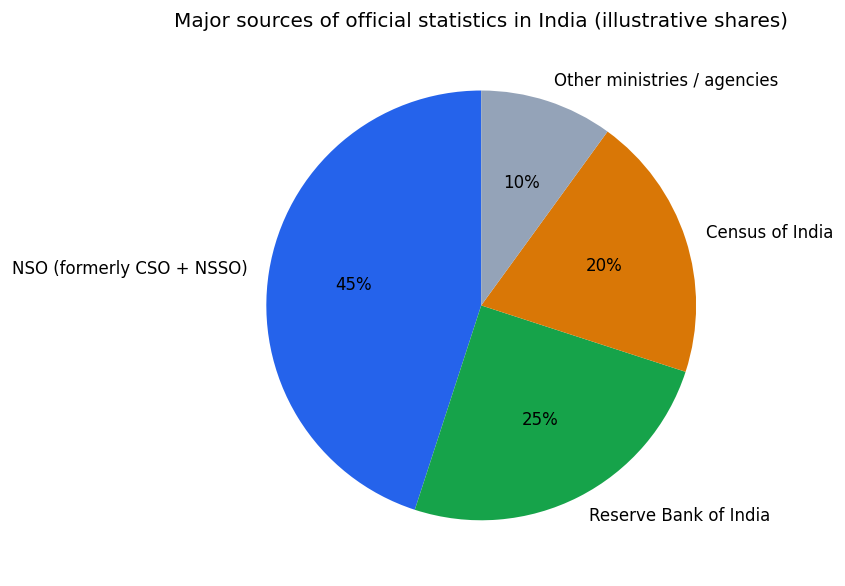
Study the sources of official statistics in India and answer:
-
The largest share of official statistics in India is published by:ANSOBRBICCensus of IndiaDMinistry of Commerce
-
The Census of India is conducted:AOnce a yearBEvery quarterCOnce in 10 yearsDEvery month
-
Why does India have multiple agencies producing official statistics?
Show answersHide answers
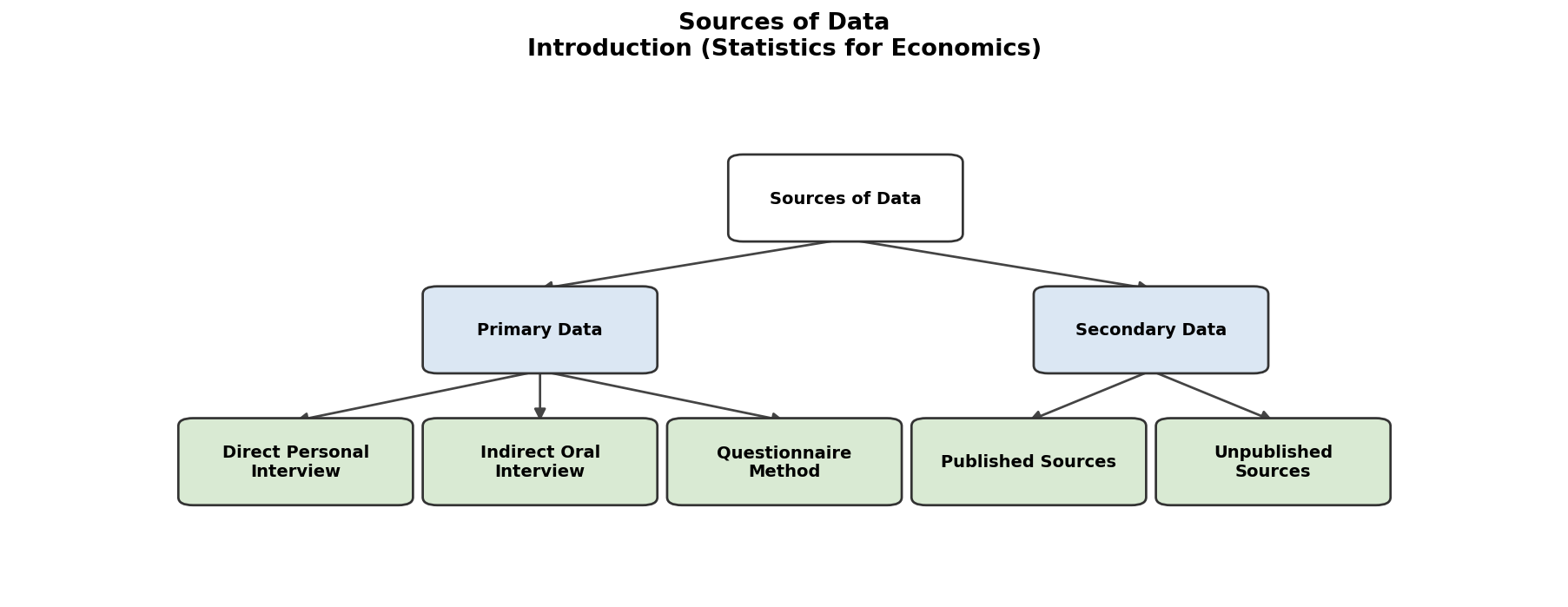
Based on the given diagram, answer the following:
-
Which of the following is a method of collecting Primary Data?APublished SourcesBUnpublished SourcesCDirect Personal InterviewDGovernment Reports
-
Define Primary Data.
-
Which of the following is NOT a source of Secondary Data?APublished SourcesBUnpublished SourcesCQuestionnaire MethodDGovernment Publications
-
State one advantage of using Secondary Data over Primary Data.
-
Which of the following best describes the role of statistics in economic planning?AIt makes data more complex and detailedBIt provides numerical data to help planners make informed decisionsCIt eliminates the need for government interventionDIt only deals with past economic data
-
How does statistics help in policy formulation? Explain with an example.
-
Which function of statistics involves finding the connection between two or more economic variables?ASimplifies Complex DataBPresents Facts in Definite FormCEstablishes RelationshipsDHelps in Comparison
-
Why is it important for statistics to present facts in a definite form?
-
Which of the following is a limitation of statistics?AIt helps in economic planningBIt studies numerical factsCIt does not study individualsDIt is used in research
-
Explain with an example how statistics can be misused.
-
According to the diagram, which of the following correctly describes the scope of statistics?AStatistics can study qualitative phenomena directlyBStatistics is used in economics, business, and planningCStatistics gives exact results for every individualDStatistics does not require any expertise
-
Why is it said that 'statistical results are true only on average'? Give an example.
-
What is the key difference between Primary Data and Secondary Data?
-
Which of the following is an example of a Published Secondary Source?APersonal diary of a researcherBCensus of India reportsCField survey notesDDirect observation records
-
Which use of statistics helps the government decide on economic policies such as taxation and subsidies?ASimplifies Complex DataBHelps in ComparisonCHelps in Policy FormulationDPresents Facts in Definite Form
-
Explain how statistics helps in economic planning with an example.
-
Which of the following best describes the use of statistics in 'Forecasting'?ARecording past economic eventsBPredicting future trends based on past dataCComparing data of two countriesDSimplifying large tables of data
-
Why is it important for statistics to present facts in a definite numerical form?
-
Which limitation of statistics means that it cannot measure qualitative aspects like honesty or intelligence?ADoes not Study IndividualsBResults are True only on AverageCStudies only Quantitative FactsDCan be Misused
-
Explain with an example how statistics can be misused to give misleading conclusions.
-
What does the limitation 'Does not Study Individuals' mean in the context of statistics?AStatistics ignores group behaviourBStatistics deals with aggregates and not individual data points in isolationCStatistics cannot be applied to large populationsDStatistics only studies government data
-
Why is homogeneity of data necessary for statistical analysis? What happens if data is not homogeneous?
Show answersHide answers
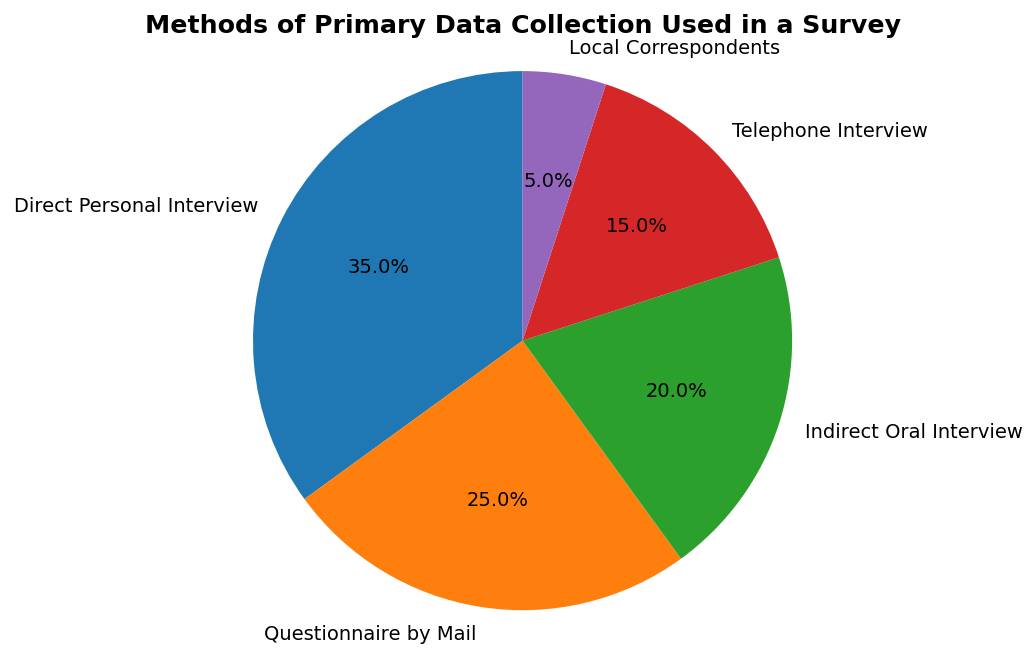
Based on the given chart showing the distribution of data collection methods used in an economic survey, answer the following:
-
Which method of primary data collection was used most frequently in the survey?AQuestionnaire by MailBIndirect Oral InterviewCDirect Personal InterviewDTelephone Interview
-
What percentage of the survey used either 'Indirect Oral Interview' or 'Telephone Interview'?A25%B30%C35%D40%
-
State one limitation of the 'Questionnaire by Mail' method of data collection.
-
Why is Direct Personal Interview considered a reliable method of primary data collection?
Show answersHide answers
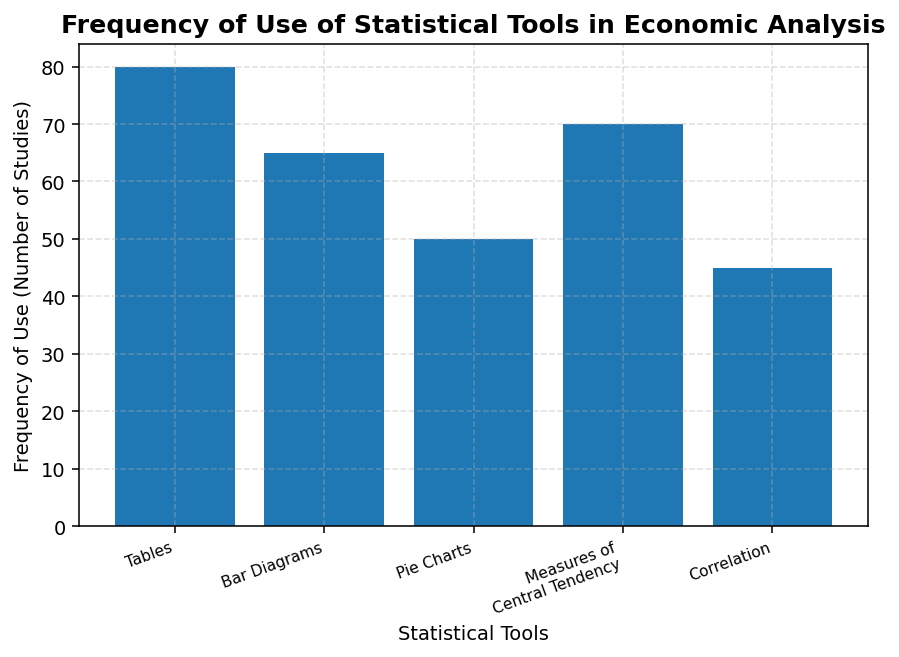
Based on the given bar chart showing the importance of statistical tools used in economic analysis, answer the following:
-
Which statistical tool was used most frequently in economic analysis as shown in the chart?ABar DiagramsBCorrelationCTablesDPie Charts
-
What is the difference in frequency of use between 'Measures of Central Tendency' and 'Correlation'?A15B20C25D30
-
Why are statistical tools important in the study of economics? Mention any two tools and their uses.
-
Based on the chart, which two tools have the closest frequency of use, and what does this suggest about their role in economic analysis?
Show answersHide answers
Make a full Economics paper on Introduction (Statistics for Economics).
Pick the question mix, set the marks, hit generate. You get a ready-to-print paper with an answer key.
Generate your paper — free