Market Equilibrium (Microeconomics) — Important Questions
59 questions
With answersCBSE format
SUMMARY: The chapter on Market Equilibrium in Class 11 Economics explores how supply and demand interact to determine the price and quantity of goods in a market. KEY TOPICS: demand and supply curves, equilibrium price, equilibrium quantity, shifts in demand and supply, excess demand, excess supply, price ceiling, price floor, market adjustments, consumer and producer surplus.
In a free market, when there is excess demand at the prevailing price, the market adjusts by:
APrice falling until quantity supplied decreases to match demand
BPrice rising until quantity demanded falls and quantity supplied rises to restore equilibrium
CGovernment intervention to fix the price at a lower level
DProducers reducing output to create artificial scarcity
Check answerHide answer
Correct answer: Option 2 — Price rising until quantity demanded falls and quantity supplied rises to restore equilibrium
Q141 Mark
Suppose the supply of a commodity decreases while demand simultaneously decreases by a greater magnitude. What happens to equilibrium price and quantity?
APrice rises, quantity falls
BPrice falls, quantity falls
CPrice rises, quantity rises
DPrice falls, quantity rises
Check answerHide answer
Correct answer: Option 2 — Price falls, quantity falls
Q151 Mark
Producer surplus is represented graphically as:
AThe area above the demand curve and below the equilibrium price
BThe area below the supply curve and above the equilibrium price
CThe area above the supply curve and below the equilibrium price
DThe area below the demand curve and above the equilibrium price
Check answerHide answer
Correct answer: Option 3 — The area above the supply curve and below the equilibrium price
Short Answer Questions10 questions
Q163 Marks
Define market equilibrium.
View sample solutionHide solution
Market equilibrium is a state in which market price is such that the quantity demanded equals the quantity supplied and there is no tendency for price or quantity to change. At this price there is neither shortage nor surplus; buyers and sellers are simultaneously in equilibrium.
Q173 Marks
State two effects on equilibrium of a rise in consumer income for a normal good.
View sample solutionHide solution
For a normal good, a rise in income shifts the demand curve rightward. Along the unchanged upward-sloping supply curve, (i) the equilibrium price rises, and (ii) the equilibrium quantity also rises. The extent of change in each depends on the elasticities of demand and supply.
Q183 Marks
What is a price ceiling? Give one example.
View sample solutionHide solution
A price ceiling is a government-imposed maximum legal price at which a commodity can be sold, set below the equilibrium price. Example: rent-control laws in metropolitan cities cap monthly rent on certain housing stock. When binding, the ceiling causes a persistent shortage because quantity demanded exceeds quantity supplied.
Q193 Marks
Explain minimum wages as a price floor.
View sample solutionHide solution
A minimum wage is a legally mandated price floor in the labour market set above the competitive equilibrium wage. At the higher wage quantity supplied of labour exceeds quantity demanded, creating unemployment. The policy trade-off is higher earnings for those who retain jobs against fewer jobs and reduced demand by firms.
Q203 Marks
How does an improvement in technology in production of a good affect its equilibrium price and quantity?
View sample solutionHide solution
A technological improvement lowers production cost and shifts the supply curve rightward. Along the unchanged downward-sloping demand curve the equilibrium price falls and the equilibrium quantity rises. Consumers benefit from lower prices and larger output; producers may still gain if the cost saving is sufficiently large.
Q213 Marks
Define equilibrium price in a market.
View sample solutionHide solution
Equilibrium price is the price at which the quantity demanded by consumers equals the quantity supplied by producers. At this price, the market clears with no excess demand or excess supply. It is also called the market-clearing price.
Q223 Marks
What is meant by excess demand in a market?
View sample solutionHide solution
Excess demand occurs when the quantity demanded by consumers exceeds the quantity supplied by producers at a given price. This situation typically arises when the market price is below the equilibrium price. Excess demand puts upward pressure on prices, pushing them back toward equilibrium.
Q233 Marks
Distinguish between a price ceiling and a price floor.
View sample solutionHide solution
A price ceiling is a government-imposed maximum price set below the equilibrium price, intended to keep goods affordable for consumers. A price floor is a government-imposed minimum price set above the equilibrium price, intended to protect producers' incomes. Price ceilings lead to excess demand, while price floors lead to excess supply.
Q243 Marks
What is consumer surplus and how is it represented on a demand curve?
View sample solutionHide solution
Consumer surplus is the difference between the maximum price a consumer is willing to pay for a good and the actual market price they pay. It represents the extra benefit consumers receive beyond what they spend. On a demand curve, it is shown as the area above the equilibrium price and below the demand curve.
Q253 Marks
Explain what happens to equilibrium price and quantity when there is an increase in demand, assuming supply remains constant.
View sample solutionHide solution
When demand increases, the demand curve shifts rightward, indicating consumers want more of the good at every price. This creates excess demand at the original equilibrium price, putting upward pressure on prices. As a result, both the equilibrium price and equilibrium quantity rise to a new higher level.
Long Answer Questions6 questions
Q266 Marks
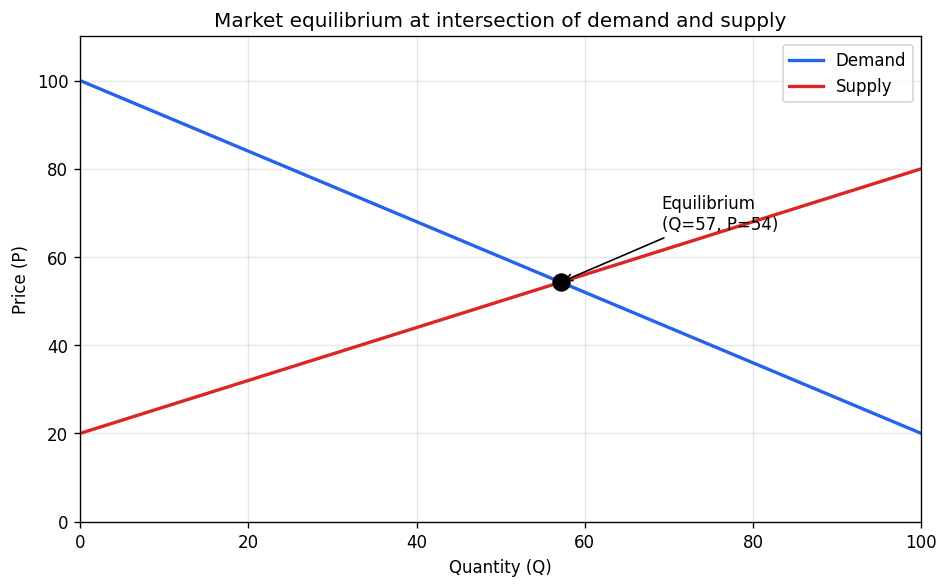
Explain market equilibrium under perfect competition using demand and supply diagrams.
View sample solutionHide solution
Market equilibrium is the intersection of the market demand curve and the market supply curve. The demand curve slopes downward (law of demand) and the supply curve slopes upward (law of supply). At the equilibrium price Pe, quantity demanded equals quantity supplied (Qe). If price is set above Pe, quantity supplied exceeds quantity demanded — a surplus emerges; suppliers cut the price to clear stocks and the market moves to Pe. If price is below Pe, quantity demanded exceeds quantity supplied — a shortage emerges; buyers bid up the price and the market moves to Pe. Equilibrium is stable when any deviation sets in motion forces that push price back to Pe. Changes in demand or supply shift the respective curves and produce a new equilibrium at a different Pe and Qe.
Q276 Marks
Explain the effects of shifts in demand and supply on market equilibrium.
View sample solutionHide solution
(a) Demand shifts with supply unchanged: a rise in demand (rightward shift) increases both equilibrium price and quantity; a fall in demand (leftward shift) decreases both. (b) Supply shifts with demand unchanged: a rise in supply (rightward shift) lowers equilibrium price and raises quantity; a fall in supply raises equilibrium price and lowers quantity. (c) Simultaneous shifts — four combinations: (i) both rise — quantity rises; price change is ambiguous depending on the relative magnitudes of the two shifts; (ii) both fall — quantity falls; price change ambiguous; (iii) demand rises, supply falls — price rises; quantity change ambiguous; (iv) demand falls, supply rises — price falls; quantity change ambiguous. The ambiguous outcomes can be resolved only when the relative magnitudes of the two shifts are known.
Q286 Marks
Explain the concept of a price ceiling and its consequences using rent control as an example.
View sample solutionHide solution
A price ceiling is a government-mandated maximum price that a seller can charge, set below the competitive equilibrium price. Example: rent control in big Indian cities freezes rents on certain categories of older housing stock. Consequences: (i) shortage — at the capped rent, quantity demanded exceeds quantity supplied; (ii) non-price rationing — long queues, waiting lists, informal under-the-table payments, discrimination by landlords; (iii) decline in quality — landlords have no incentive to maintain or upgrade property; (iv) black markets — illicit sub-letting at market prices; (v) reduced investment in new rental housing over the long run, further shrinking supply. Hence rent control may protect existing tenants in the short run but typically worsens the housing shortage over time. Modern policy response favours targeted rental vouchers for the poor rather than blanket price controls.
Q296 Marks
Explain the concept of a price floor with minimum support prices (MSP) for crops as an example.
View sample solutionHide solution
A price floor is a government-mandated minimum price, set above the competitive equilibrium. Example: India's Minimum Support Price for wheat and paddy guarantees farmers a floor price regardless of market conditions; the government through FCI buys at this price. Consequences: (i) surplus — at the floor, quantity supplied exceeds quantity demanded; (ii) the government must buy and store the surplus (buffer stock), incurring storage and holding costs; (iii) assured income for farmers encourages them to continue producing cereals and discourages diversification into pulses, oilseeds or vegetables; (iv) price floors distort market signals and may keep inefficient producers in business. The MSP is defended as necessary to protect small farmers' incomes and national food security; critics argue for direct-benefit transfers and crop-insurance alternatives.
Q306 Marks
Analyse the four cases of simultaneous shifts in demand and supply on equilibrium price and quantity.
View sample solutionHide solution
Case 1 — Demand rises, supply rises: D shifts right, S shifts right. Equilibrium quantity definitely rises. Price change depends on relative magnitudes: if ΔD > ΔS, price rises; if ΔD < ΔS, price falls; if equal, price stays. Case 2 — Demand falls, supply falls: Q definitely falls; price change depends on which contraction is larger. Case 3 — Demand rises, supply falls: D right, S left. Price definitely rises. Quantity change ambiguous: if ΔD dominates, Q rises; if ΔS dominates, Q falls. Case 4 — Demand falls, supply rises: Price definitely falls. Quantity change ambiguous, mirror of Case 3. Generalisation: when the two curves shift in the same direction the quantity change is definite and the price change is ambiguous; when they shift in opposite directions the price change is definite and the quantity change is ambiguous.
Q316 Marks
Differentiate between excess demand and excess supply in tabular form.
Assertion–Reason Questions8 questions
Q321 Mark
Assertion (A): Market equilibrium is reached when quantity demanded equals quantity supplied.
Reason (R): At that price neither excess demand nor excess supply exists so price has no tendency to change.
Show explanationHide explanation
Correct answer: Option 1 —
Both A and R are true, and R is the correct explanation of A.
Q331 Mark
Assertion (A): A binding price ceiling creates a shortage in the market.
Reason (R): At the legal maximum price quantity demanded exceeds quantity supplied.
Show explanationHide explanation
Correct answer: Option 1 —
Both A and R are true, and R is the correct explanation of A.
Q341 Mark
Assertion (A): A Minimum Support Price above the equilibrium price acts as a price floor for agricultural crops.
Reason (R): It guarantees farmers a minimum return and so stabilises their income.
Show explanationHide explanation
Correct answer: Option 1 —
Both A and R are true, and R is the correct explanation of A.
Q351 Mark
Assertion (A): A production subsidy shifts the supply curve leftward.
Reason (R): A subsidy reduces the marginal cost of production for firms.
Show explanationHide explanation
Correct answer: Option 4 —
A is false, but R is true.
Q361 Mark
Assertion (A): A rise in demand, with supply unchanged, raises both equilibrium price and quantity.
Reason (R): The supply curve is upward sloping.
Show explanationHide explanation
Correct answer: Option 1 —
Both A and R are true, and R is the correct explanation of A.
Q371 Mark
Assertion (A): At equilibrium price, the quantity demanded equals the quantity supplied in the market.
Reason (R): Equilibrium is the state where the market clears with no excess demand or excess supply.
Show explanationHide explanation
Correct answer: Option 1 —
Both A and R are true, and R is the correct explanation of A.
Q381 Mark
Assertion (A): When there is excess demand in the market, the price tends to rise.
Reason (R): Excess demand means buyers are willing to purchase more than what sellers are offering at the current price, putting upward pressure on price.
Show explanationHide explanation
Correct answer: Option 1 —
Both A and R are true, and R is the correct explanation of A.
Q391 Mark
Assertion (A): A price ceiling set above the equilibrium price leads to a shortage of goods in the market.
Reason (R): A price ceiling is a government-imposed maximum price limit on a commodity.
Show explanationHide explanation
Correct answer: Option 4 —
A is false, but R is true.
Statement-Based Questions8 questions
Q401 Mark
Statement 1: A shortage occurs when the quantity demanded exceeds the quantity supplied.
Statement 2: A surplus occurs when the quantity supplied exceeds the quantity demanded.
Show answerHide answer
Correct answer: Option 1 —
Both statements are true.
Q411 Mark
Statement 1: A rise in the price of a substitute good increases demand for the original good.
Statement 2: This shifts the demand curve for the original good to the right.
Show answerHide answer
Correct answer: Option 1 —
Both statements are true.
Q421 Mark
Statement 1: A minimum wage set above the equilibrium wage tends to create unemployment.
Statement 2: Firms hire a smaller quantity of labour when the wage is legally raised.
Show answerHide answer
Correct answer: Option 1 —
Both statements are true.
Q431 Mark
Statement 1: Rent control set below the market rent causes a housing shortage.
Statement 2: The quality of rental housing may also decline because landlords have weaker incentives to maintain their properties.
Show answerHide answer
Correct answer: Option 1 —
Both statements are true.
Q441 Mark
Statement 1: A price support scheme typically requires the government to purchase the surplus at the floor price.
Statement 2: Without such purchases a persistent surplus would accumulate in the market.
Show answerHide answer
Correct answer: Option 1 —
Both statements are true.
Q451 Mark
Statement 1: Equilibrium price is the price at which quantity demanded equals quantity supplied.
Statement 2: At equilibrium price, there is neither excess demand nor excess supply in the market.
Show answerHide answer
Correct answer: Option 1 —
Both statements are true.
Q461 Mark
Statement 1: Excess demand occurs when the market price is above the equilibrium price.
Statement 2: Excess demand puts upward pressure on the market price.
Show answerHide answer
Correct answer: Option 3 —
Only Statement 2 is true.
Q471 Mark
Statement 1: A price ceiling is set above the equilibrium price to protect consumers from high prices.
Statement 2: A price ceiling typically leads to excess demand in the market.
Show answerHide answer
Correct answer: Option 3 —
Only Statement 2 is true.
Case Study / Passage Questions4 questions
Q483 Marks
In a small local market the monthly demand for tea is: at ₹100/kg — 100 kg; at ₹120/kg — 80 kg; at ₹140/kg — 60 kg. The supply is: at ₹100/kg — 40 kg; at ₹120/kg — 80 kg; at ₹140/kg — 120 kg.
The equilibrium price of tea is:
A₹100
B₹120
C₹140
DNone of these
At a price of ₹100/kg the market would have a:
AShortage
BSurplus
CExact clearing
DUnchanged
How does the market adjust when price is initially above or below equilibrium?
Show answersHide answers
1. Option 2 — ₹120
2. Option 1 — Shortage
3. At a price below equilibrium (₹100) quantity demanded (100 kg) exceeds quantity supplied (40 kg), creating a shortage of 60 kg. Buyers bid up the price. At a price above equilibrium (₹140) quantity supplied (120 kg) exceeds quantity demanded (60 kg), creating a surplus of 60 kg. Sellers cut the price. These adjustments push the market to the equilibrium price of ₹120 where Qd = Qs = 80 kg.
Q493 Marks
In a metropolitan city the equilibrium rent for a one-bedroom flat is ₹15 000 per month. The government decides to cap rents at ₹10 000 to protect tenants. At this rent, 1000 flats are demanded but only 400 are offered for rent.
The binding rent ceiling produces a:
ASurplus
BShortage
CNo effect
DNew equilibrium
An economically less distortionary alternative is:
ADirect rental subsidy to poor tenants
BHigher rent
CZero rent
DTaxing landlords more
List the pros and cons of rent control.
Show answersHide answers
1. Option 2 — Shortage
2. Option 1 — Direct rental subsidy to poor tenants
3. Short-run gains: protects existing tenants from rent hikes. Long-run costs: (i) chronic shortage of rental housing (600 unmet demand), (ii) deteriorating quality as landlords have no incentive to maintain, (iii) black markets with under-the-table payments, (iv) discouraged investment in new rental stock. Targeted housing vouchers are usually more efficient and more equitable.
Q503 Marks
The free-market price of wheat is ₹22 per kg. To protect farmers' income the government announces an MSP of ₹28 per kg and promises to purchase any quantity farmers wish to sell at this price. At ₹28 per kg the market demand is 1 lakh tonnes but supply is 1.4 lakh tonnes.
A binding MSP above equilibrium creates a:
ASurplus
BShortage
CExact clearing
DNo effect
The surplus quantity in this case is bought by:
AThe private market
BThe Food Corporation of India
COnly farmers
DOnly consumers
Discuss the rationale for MSP and one alternative.
Show answersHide answers
1. Option 1 — Surplus
2. Option 2 — The Food Corporation of India
3. MSP protects farmers' incomes and food security. But it also (i) requires the government to buy and store the surplus (buffer stock) at significant cost, (ii) distorts cropping pattern — farmers grow more wheat and less of pulses/oilseeds, (iii) can create inefficiency if MSP is systematically higher than market-clearing. Direct-benefit transfers linked to land records are increasingly suggested as a more efficient substitute.
Q514 Marks
In a competitive market for wheat, the demand and supply curves intersect at a price of ₹20 per kg and a quantity of 500 tonnes per week. At this point, the market is said to be in equilibrium. If the price rises above ₹20, say to ₹25, the quantity supplied increases to 600 tonnes while the quantity demanded falls to 400 tonnes. This creates an excess supply of 200 tonnes, also known as a surplus. Competitive pressure from sellers unable to sell their goods will push the price back down toward ₹20. Conversely, if the price falls below ₹20, excess demand emerges, and buyers compete for limited goods, pushing the price back up. This self-correcting mechanism ensures the market always tends toward equilibrium.
What is the equilibrium price in the wheat market described in the passage?
A₹25 per kg
B₹20 per kg
C₹15 per kg
D₹30 per kg
When the price rises to ₹25, what is the amount of excess supply in the wheat market?
A100 tonnes
B500 tonnes
C200 tonnes
D600 tonnes
Explain the self-correcting mechanism that brings the market back to equilibrium when there is excess supply.
What happens to the market when the price falls below the equilibrium price of ₹20?
Show answersHide answers
1. Option 2 — ₹20 per kg
2. Option 3 — 200 tonnes
3. When there is excess supply, sellers are unable to sell all their goods at the prevailing price. To clear their unsold stock, sellers reduce the price. As the price falls, quantity demanded increases and quantity supplied decreases. This process continues until the price returns to the equilibrium level where quantity demanded equals quantity supplied, eliminating the surplus.
4. When the price falls below ₹20, quantity demanded exceeds quantity supplied, creating excess demand (shortage). Buyers compete for the limited available goods and are willing to pay higher prices. This competition among buyers pushes the price back up toward the equilibrium price of ₹20, restoring market balance.
Table-Based Questions4 questions
Q523 Marks
Study the demand and supply schedule and answer:
Price (₹)
Qd
Qs
Position
10
100
40
Shortage
15
80
60
Shortage
20
60
60
Equilibrium
25
40
90
Surplus
30
20
120
Surplus
The equilibrium price of the commodity is:
A₹10
B₹15
C₹20
D₹25
At ₹15 per unit the market experiences:
AShortage
BSurplus
CEquilibrium
DCannot say
Explain the self-correcting mechanism of the market.
Show answersHide answers
1. Option 3 — ₹20
2. Option 1 — Shortage
3. If price is below equilibrium, excess demand pushes buyers to bid up the price. If price is above equilibrium, excess supply pushes sellers to cut the price. The market converges to the price where Qd = Qs. At equilibrium there is no tendency for price to change unless one of the underlying curves shifts.
Q533 Marks
Study the effects of shifts on equilibrium and answer:
Shift
Effect on equilibrium price
Effect on equilibrium quantity
Demand rises, supply unchanged
Rises
Rises
Demand falls, supply unchanged
Falls
Falls
Supply rises, demand unchanged
Falls
Rises
Supply falls, demand unchanged
Rises
Falls
If supply rises with demand unchanged, equilibrium price:
ARises
BFalls
CNo change
DIndeterminate
If demand rises with supply unchanged, equilibrium quantity:
ARises
BFalls
CNo change
DIndeterminate
Generalise the result when both demand and supply shift together.
Show answersHide answers
1. Option 2 — Falls
2. Option 1 — Rises
3. A rightward shift in the curve representing the side that changed (demand or supply) increases equilibrium quantity; the effect on price depends on which side shifts. If both curves shift simultaneously, one of the two equilibrium variables becomes indeterminate unless we know the relative magnitudes of the shifts.
Q545 Marks
From the demand and supply schedule find the equilibrium price and quantity.
Price (₹)
Qd
Qs
10
100
20
20
80
40
30
60
60
40
40
80
50
20
100
Q555 Marks
Given a government-imposed price ceiling of ₹15 per unit analyse the market shortage.
Price (₹)
Qd
Qs
10
120
40
15
100
60
20
80
80
25
60
100
30
40
120
Picture-Based Questions4 questions
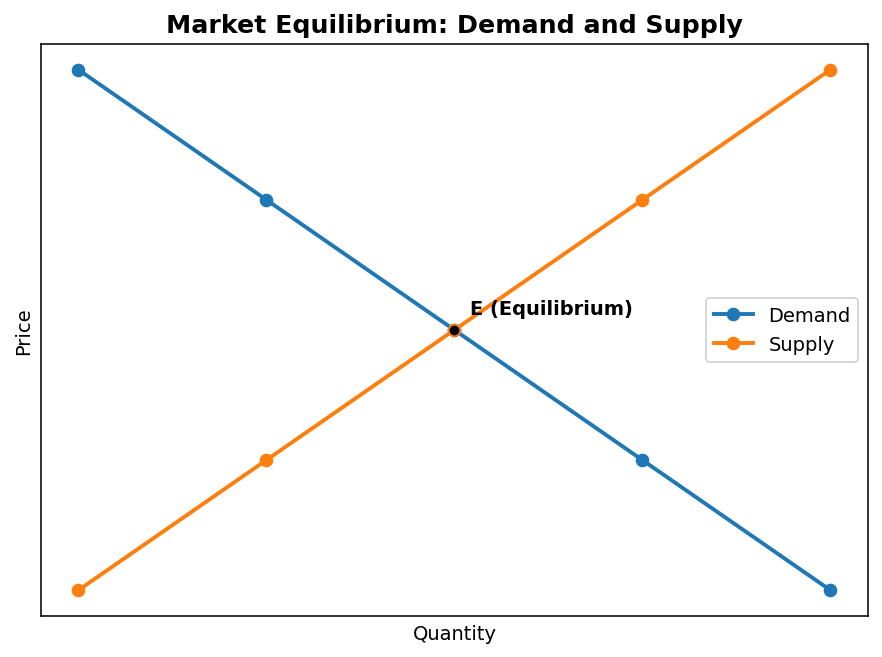
Q563 Marks
Study the market equilibrium diagram and answer:
Equilibrium price and quantity are determined:
AAt the intersection of demand and supply
BAt zero price
CAt zero quantity
DWhere demand is vertical
If the market price is set above the equilibrium price:
AA shortage develops
BA surplus develops
CThe market clears
DDemand falls
How does the market automatically adjust to disequilibrium?
Show answersHide answers
1. Option 1 — At the intersection of demand and supply
2. Option 2 — A surplus develops
3. Prices signal and co-ordinate: a shortage bids up the price until supply rises and demand falls to meet; a surplus pushes sellers to cut the price until demand expands and supply contracts. This decentralised adjustment mechanism, without any central planner, is the essence of the market system.
Q574 Marks
Based on the given graph, answer the following:
What is the equilibrium price in the given graph?
A10
B20
C30
D50
What is the equilibrium quantity in the given graph?
A1
B2
C3
D4
If the market price is set at 20 (below equilibrium), what situation arises in the market?
AExcess Supply
BExcess Demand
CMarket Equilibrium
DPrice Floor
Explain what happens to price when there is excess supply in the market, as shown in the graph.
Show answersHide answers
1. Option 3 — 30
2. Option 3 — 3
3. Option 2 — Excess Demand
4. When there is excess supply, the quantity supplied exceeds quantity demanded. Producers are unable to sell all their output, so they lower the price. This fall in price continues until the market reaches equilibrium where demand equals supply.
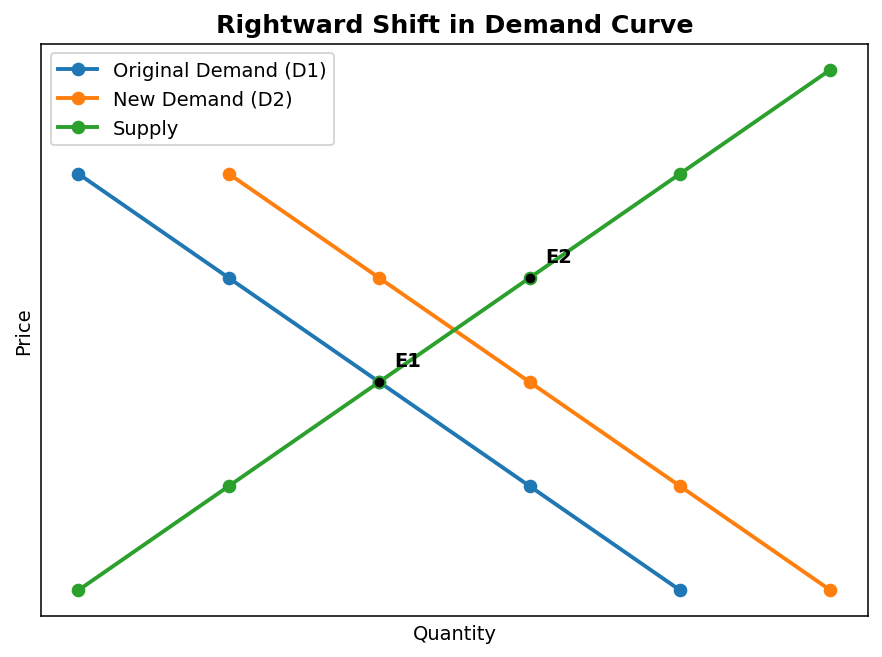
Q584 Marks
Based on the given graph showing a shift in the demand curve, answer the following:
What does a rightward shift of the demand curve (D1 to D2) indicate?
ADecrease in demand
BIncrease in demand
CDecrease in supply
DIncrease in supply
After the demand curve shifts from D1 to D2, what happens to the equilibrium price and quantity?
ABoth price and quantity decrease
BPrice increases, quantity decreases
CBoth price and quantity increase
DPrice decreases, quantity increases
Give two reasons that could cause the demand curve to shift rightward as shown in the graph.
At the original equilibrium price (E1), after the demand shifts to D2, what market condition temporarily exists?
AExcess Supply
BMarket Equilibrium
CExcess Demand
DPrice Floor
Show answersHide answers
1. Option 2 — Increase in demand
2. Option 3 — Both price and quantity increase
3. Two reasons for a rightward shift in demand: (1) Increase in consumer income, which raises purchasing power and increases demand. (2) Rise in the price of a substitute good, making this good relatively cheaper and increasing its demand.
4. Option 3 — Excess Demand
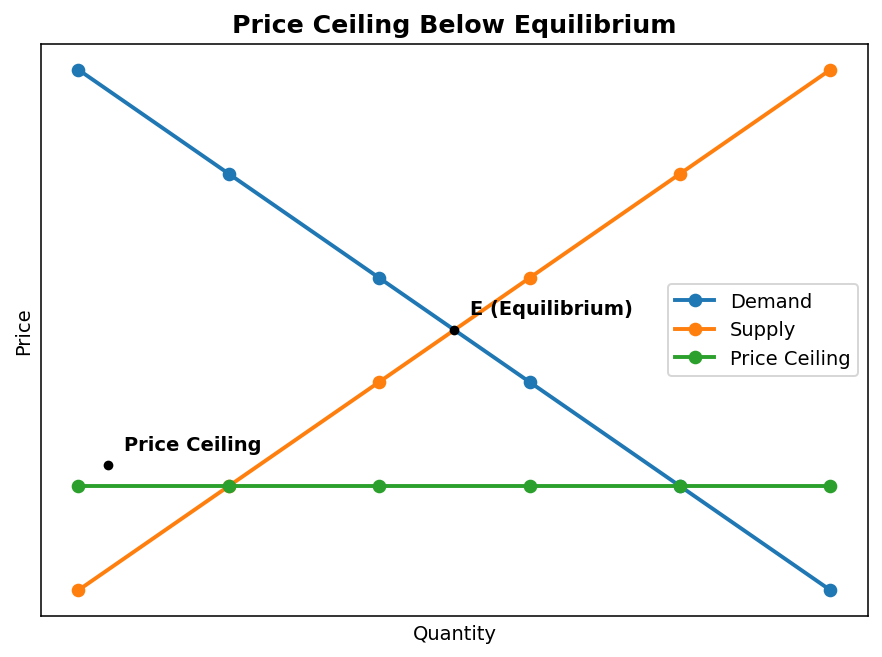
Q594 Marks
Based on the given graph showing a price ceiling, answer the following:
What is a price ceiling?
AA minimum price set above equilibrium by the government
BA maximum price set below equilibrium by the government
CA price automatically determined by market forces
DA minimum price set below equilibrium by the government
What market condition does a price ceiling create as shown in the graph?
AExcess Supply
BMarket Equilibrium
CExcess Demand
DConsumer Surplus elimination
Give one real-life example of a price ceiling and explain why the government imposes it.
If the price ceiling is set above the equilibrium price, what would be its effect on the market?
AIt would create excess demand
BIt would have no effect on the market
CIt would create excess supply
DIt would lower the equilibrium price
Show answersHide answers
1. Option 2 — A maximum price set below equilibrium by the government
2. Option 3 — Excess Demand
3. A real-life example of a price ceiling is the government fixing a maximum price for essential food grains like wheat or rice (as done through the Public Distribution System in India). The government imposes it to ensure that essential commodities remain affordable for low-income consumers and to prevent exploitation by sellers during shortages.
4. Option 2 — It would have no effect on the market