Skip to content
TestMacher
Chapter 1 · Class 11 Economics

Collection of Data (Statistics for Economics) — Important Questions

59 questions With answers CBSE format

SUMMARY: The chapter "Collection of Data" in Class 11 Economics focuses on the methods and principles involved in gathering data for statistical analysis in economics.
KEY TOPICS: primary data, secondary data, census method, sample survey, questionnaire design, pilot survey, sources of data, data collection methods, sampling errors, non-sampling errors.

Q1 1 Mark

A complete enumeration of every item in the population is known as:

ASample survey
BCensus survey
CPilot survey
DRandom survey
Check answerHide answer
Correct answer: Option 2 — Census survey
Q2 1 Mark

Which of the following is a method of collecting primary data?

ADirect personal investigation
BNewspapers
CPublished reports
DPrevious research studies
Check answerHide answer
Correct answer: Option 1 — Direct personal investigation
Q3 1 Mark

The National Statistical Office (NSO) was formed in 2019 by merging CSO and:

ANSSO
BRBI
CSEBI
DNITI Aayog
Check answerHide answer
Correct answer: Option 1 — NSSO
Q4 1 Mark

In a good questionnaire, questions should be:

ALeading and suggestive
BClear, simple and unambiguous
CLong and detailed
DTechnical and complex
Check answerHide answer
Correct answer: Option 2 — Clear, simple and unambiguous
Q5 1 Mark

In simple random sampling:

AEvery item has an equal chance of selection
BThe researcher picks preferred items
COnly the first item is random
DItems are grouped before selection
Check answerHide answer
Correct answer: Option 1 — Every item has an equal chance of selection
Q6 1 Mark

Which of the following is an example of primary data?

AData published in the Census of India report
BData collected by a researcher through personal interviews
CData obtained from the Reserve Bank of India bulletin
DData published in a newspaper
Check answerHide answer
Correct answer: Option 2 — Data collected by a researcher through personal interviews
Q7 1 Mark

In a census method of data collection, the survey is conducted on:

AA selected group of the population
BOnly urban areas of the population
CEvery unit of the entire population
DA randomly chosen sample
Check answerHide answer
Correct answer: Option 3 — Every unit of the entire population
Q8 1 Mark

A pilot survey is conducted before the main survey primarily to:

ACollect final data for analysis
BTest and refine the questionnaire
CPublish preliminary results
DTrain enumerators for the census
Check answerHide answer
Correct answer: Option 2 — Test and refine the questionnaire
Q9 1 Mark

Which of the following is NOT a method of collecting primary data?

APersonal interview
BMailed questionnaire
CPublished government reports
DTelephone interview
Check answerHide answer
Correct answer: Option 3 — Published government reports
Q10 1 Mark

Sampling errors in a survey arise due to:

AIncorrect recording of responses by the enumerator
BBias in the design of the questionnaire
CThe difference between the sample estimate and the true population value
DNon-response by selected respondents
Check answerHide answer
Correct answer: Option 3 — The difference between the sample estimate and the true population value
Q11 1 Mark

Which of the following statements correctly distinguishes secondary data from primary data?

ASecondary data is more accurate than primary data
BSecondary data is collected for the first time by the investigator
CSecondary data has already been collected and processed by someone else
DSecondary data can only be obtained through surveys
Check answerHide answer
Correct answer: Option 3 — Secondary data has already been collected and processed by someone else
Q12 1 Mark

Which of the following is an example of a non-sampling error?

AError due to studying only a part of the population
BError arising from a faulty sampling frame
CDifference between sample mean and population mean
DVariation due to random selection of units
Check answerHide answer
Correct answer: Option 2 — Error arising from a faulty sampling frame
Q13 1 Mark

A leading question in a questionnaire is considered problematic because it:

AIs too lengthy for respondents to answer
BInfluences the respondent towards a particular answer
CContains technical terms that are hard to understand
DRequires numerical data instead of qualitative responses
Check answerHide answer
Correct answer: Option 2 — Influences the respondent towards a particular answer
Q14 1 Mark

Which of the following best explains why the sample survey method is preferred over the census method in many economic studies?

ASample surveys eliminate all types of errors completely
BSample surveys cover every unit of the population ensuring accuracy
CSample surveys are less costly, less time-consuming and manageable for large populations
DSample surveys are mandated by the government for all statistical studies
Check answerHide answer
Correct answer: Option 3 — Sample surveys are less costly, less time-consuming and manageable for large populations
Q15 1 Mark

Consider a situation where a researcher collects data on household income by surveying only households in a high-income locality. This is an example of:

ASampling error due to random variation
BNon-sampling error due to biased sample selection
CCensus error due to incomplete enumeration
DPilot survey error due to inadequate testing
Check answerHide answer
Correct answer: Option 2 — Non-sampling error due to biased sample selection
Q16 3 Marks

Distinguish between census and sample methods of data collection.

View sample solutionHide solution
Census collects data from every unit of the population (e.g. Census of India). Sample collects data from a representative subset of the population. Census is more accurate but expensive and time-consuming; sample is faster and cheaper and, if properly drawn, gives fairly reliable estimates.
Q17 3 Marks

What is a pilot survey and why is it conducted?

View sample solutionHide solution
A pilot survey is a small-scale preliminary enquiry done before the main survey. It helps test the questionnaire, estimate response rates, check the sampling frame and training of investigators, and improve the design and costing of the main survey.
Q18 3 Marks

State any two methods of collecting primary data.

View sample solutionHide solution
(i) Direct personal investigation — the researcher personally contacts respondents (suitable for small area studies). (ii) Mailed questionnaire — a structured form is sent to respondents who return it by post or email (suitable for literate, scattered populations).
Q19 3 Marks

What is sampling error? How does it differ from non-sampling error?

View sample solutionHide solution
Sampling error is the difference between the sample estimate and the true population value; it arises because only a part of the population is studied and declines as sample size grows. Non-sampling error arises at any stage — questionnaire design, data entry, coverage — and can be present even in a census.
Q20 3 Marks

State the main sources of secondary data in India.

View sample solutionHide solution
Key sources: (i) published reports of the NSO, RBI, Economic Survey, and Census of India; (ii) international agencies such as the World Bank, IMF, UN; (iii) research institutions, NGOs, chambers of commerce, and newspapers. The analyst must check reliability, coverage and timeliness before use.
Q21 3 Marks

What is the difference between primary data and secondary data?

View sample solutionHide solution
Primary data is the data collected for the first time by the investigator directly from the source for a specific purpose. Secondary data, on the other hand, is data that has already been collected by someone else and is used by the investigator for their own research. For example, data collected through a personal survey is primary, while data taken from government publications is secondary.
Q22 3 Marks

Distinguish between the census method and the sample survey method of data collection.

View sample solutionHide solution
In the census method, data is collected from every single unit of the population, making it comprehensive and accurate but time-consuming and expensive. In the sample survey method, only a selected subset (sample) of the population is studied, and conclusions are drawn for the entire population. The sample method is more practical and cost-effective but may involve sampling errors.
Q23 3 Marks

Name any two sources of secondary data available in India.

View sample solutionHide solution
Two important sources of secondary data in India are publications by the Central Statistical Organisation (CSO) and the National Sample Survey Organisation (NSSO). Other valid sources include the Reserve Bank of India (RBI) bulletins and the Census of India reports. These organisations regularly publish data on various economic and social indicators.
Q24 3 Marks

What are the essential qualities of a good questionnaire?

View sample solutionHide solution
A good questionnaire should have simple, clear, and unambiguous questions that are easy for the respondent to understand. The questions should be arranged in a logical sequence and should not be leading or personal in nature. It should be concise, covering only the information necessary for the study, and should be pre-tested through a pilot survey.
Q25 3 Marks

What is meant by sampling error? How does it differ from non-sampling error?

View sample solutionHide solution
Sampling error arises because only a part of the population (sample) is studied instead of the whole population, leading to a difference between the sample estimate and the true population value. Non-sampling errors, however, can occur in both census and sample surveys and arise due to mistakes in data collection, recording, or processing. Non-sampling errors are generally more serious and harder to detect than sampling errors.
Q26 6 Marks

Explain various methods of collecting primary data.

View sample solutionHide solution
(1) Direct personal investigation — the researcher personally contacts respondents; gives accurate, first-hand data but is costly and slow; suits small-area studies. (2) Indirect oral investigation — evidence is gathered from witnesses or third parties (used by commissions of enquiry). (3) Information from local correspondents — reporters in different areas supply data regularly to a central agency (useful for prices). (4) Mailed questionnaire — a structured form is mailed to respondents who complete and return it; cheap and wide-reaching but non-response bias is common. (5) Schedule method — enumerators carry a schedule to respondents and fill it in themselves (used in census of India). Choice depends on the population, resources, literacy, sensitivity of information, and level of accuracy required.
Q27 6 Marks

Distinguish between census and sample methods of data collection. When is a sample preferred?

View sample solutionHide solution
Census covers every unit of the population; sample covers a representative subset. Census is more accurate, gives data for every sub-group, is exhaustive — but is costly, slow and resource-intensive (e.g. Census of India, done once in 10 years). Sample survey uses a fraction of the population; it is faster, cheaper, allows greater depth per case, and is preferred when (i) the population is very large, (ii) the object is destroyed in testing (quality control), (iii) time and budget are limited, or (iv) high-skill interviewers are scarce. If properly drawn, samples yield estimates with known levels of sampling error and are extensively used (NSSO surveys, opinion polls, market research). Non-sampling errors can arise in both methods.
Q28 6 Marks

Explain sampling and non-sampling errors.

View sample solutionHide solution
Sampling error: the difference between a sample estimate and the true population value that arises purely because only a part of the population is observed. It depends on sample size (shrinks as N rises), method (random vs non-random) and variability of the population. It is absent in a complete census. Non-sampling error: any error arising from faulty questionnaire design, respondent misreporting, coding and tabulation mistakes, interviewer bias or incomplete coverage. It can occur in both census and sample surveys. Because non-sampling errors do not reduce with larger samples, they are often the more serious problem in practice — strict training, pilot testing, and quality checks are used to control them.
Q29 6 Marks

Describe the main features of a good questionnaire.

View sample solutionHide solution
A good questionnaire has: (i) clear purpose and logical sequence — from general to specific, sensitive items at the end; (ii) simple, unambiguous language with no technical jargon; (iii) short, specific questions with one idea each; (iv) a mix of closed (tick-box) and open-ended questions, but mostly closed for easy coding; (v) avoidance of leading, loaded or double-barrelled questions; (vi) pre-coded options for analysis; (vii) a brief covering letter explaining purpose and confidentiality; (viii) space for respondent particulars; (ix) pretested on a pilot sample and revised. A well-designed questionnaire raises response rates and data quality — the two foundations of any survey.
Q30 6 Marks

Explain the roles of the Central Statistical Office (CSO) and the National Sample Survey Office (NSSO).

View sample solutionHide solution
CSO and NSSO were merged in 2019 into the National Statistical Office (NSO) under the Ministry of Statistics and Programme Implementation. Historically: CSO — responsible for coordinating the statistical activities of different ministries; compiling National Accounts Statistics (GDP, GVA), Index of Industrial Production, Consumer Price Index (Rural / Urban / Combined); maintaining the Annual Survey of Industries and Energy Statistics. NSSO — conducted large-scale sample surveys on employment-unemployment, consumer expenditure, health, education, informal-sector enterprises; household and establishment surveys under various rounds. Together they provide the statistical backbone on which economic policy and planning in India are based.
Q31 6 Marks

Differentiate between primary and secondary data in tabular form on five features.

Q32 1 Mark

Assertion (A): Sample surveys are preferred over a complete census when the population is very large.

Reason (R): Well-drawn samples give reliable estimates at a fraction of the cost and time of a full census.

Show explanationHide explanation
Correct answer: Option 1 — Both A and R are true, and R is the correct explanation of A.
Q33 1 Mark

Assertion (A): A pilot survey is conducted before the main survey.

Reason (R): It tests the questionnaire and procedures so that weaknesses can be corrected before large-scale data collection.

Show explanationHide explanation
Correct answer: Option 1 — Both A and R are true, and R is the correct explanation of A.
Q34 1 Mark

Assertion (A): Primary data must always be collected by direct personal investigation.

Reason (R): Direct personal contact is the only way to obtain reliable data.

Show explanationHide explanation
Correct answer: Option 3 — A is true, but R is false.
Q35 1 Mark

Assertion (A): Secondary data should be evaluated carefully before use.

Reason (R): The suitability of secondary data depends on its source and the purpose for which it was originally collected.

Show explanationHide explanation
Correct answer: Option 1 — Both A and R are true, and R is the correct explanation of A.
Q36 1 Mark

Assertion (A): The National Statistical Office is the nodal agency for official statistics in India.

Reason (R): It was formed in 2019 by merging the Central Statistical Office and the National Sample Survey Office.

Show explanationHide explanation
Correct answer: Option 1 — Both A and R are true, and R is the correct explanation of A.
Q37 1 Mark

Assertion (A): Primary data is collected directly from the original source by the investigator.

Reason (R): Primary data is more reliable and relevant to the specific purpose of investigation as it is gathered first-hand.

Show explanationHide explanation
Correct answer: Option 1 — Both A and R are true, and R is the correct explanation of A.
Q38 1 Mark

Assertion (A): Secondary data is always less accurate than primary data.

Reason (R): Secondary data is collected by someone other than the investigator and may have been gathered for a different purpose.

Show explanationHide explanation
Correct answer: Option 4 — A is false, but R is true.
Q39 1 Mark

Assertion (A): In a census method, every single unit of the population is studied.

Reason (R): Census method is suitable when the population size is very large and resources are limited.

Show explanationHide explanation
Correct answer: Option 3 — A is true, but R is false.
Q40 1 Mark

Statement 1: Primary data are collected originally for a specific research purpose.

Statement 2: Secondary data have already been collected and processed by someone else.

Show answerHide answer
Correct answer: Option 1 — Both statements are true.
Q41 1 Mark

Statement 1: In simple random sampling every unit has an equal chance of being selected.

Statement 2: Stratified sampling divides the population into homogeneous strata before sampling from each.

Show answerHide answer
Correct answer: Option 1 — Both statements are true.
Q42 1 Mark

Statement 1: A census covers every unit of the target population.

Statement 2: A sample covers a selected subset of the population chosen to represent the whole.

Show answerHide answer
Correct answer: Option 1 — Both statements are true.
Q43 1 Mark

Statement 1: A mailed questionnaire is cheaper than a personal interview.

Statement 2: A mailed questionnaire typically suffers from a higher non-response rate.

Show answerHide answer
Correct answer: Option 1 — Both statements are true.
Q44 1 Mark

Statement 1: Questionnaire items should be clear and unambiguous.

Statement 2: Leading questions improve the accuracy of the responses.

Show answerHide answer
Correct answer: Option 3 — Only Statement 2 is true.
Q45 1 Mark

Statement 1: Primary data is collected directly from the original source by the investigator.

Statement 2: Secondary data is also collected fresh for the first time by the investigator.

Show answerHide answer
Correct answer: Option 2 — Only Statement 1 is true.
Q46 1 Mark

Statement 1: In the census method, every unit of the population is studied.

Statement 2: The census method is also known as the complete enumeration method.

Show answerHide answer
Correct answer: Option 1 — Both statements are true.
Q47 1 Mark

Statement 1: A pilot survey is conducted after the main survey to verify results.

Statement 2: A pilot survey helps in testing the suitability of the questionnaire before the actual survey.

Show answerHide answer
Correct answer: Option 3 — Only Statement 2 is true.
Q48 3 Marks
The Census of India is conducted every 10 years and covers every person in the country. By contrast the NSSO's Household Consumer Expenditure Survey reaches about 1.5 lakh sample households and is conducted roughly every 5 years.
  1. The Census of India is an example of which method of data collection?
    ASample survey
    BCensus
    CPilot survey
    DRandom visit
  2. Why is a sample survey generally preferred to a census for a one-off economic study?
    AIt is quicker and cheaper
    BIt covers every unit of the population
    CIt has no sampling error
    DBoth a and c
  3. Compare census and sample survey in terms of accuracy, cost and coverage.
Show answersHide answers
1. Option 2 — Census
2. Option 4 — Both a and c
3. A census is exhaustive and gives data for every sub-group but is expensive and slow. A sample survey is cheaper, faster and allows greater depth per respondent, but its estimates are subject to sampling error. The choice depends on the required accuracy, coverage and budget.
Q49 3 Marks
A consumer-rights organisation wants to study complaints about online food delivery. It considers three methods: (i) personal interviews at delivery outlets, (ii) a mailed questionnaire to a list of users, and (iii) collecting complaints posted on social-media.
  1. Methods (i) and (ii) yield:
    APrimary data
    BSecondary data
    CTertiary data
    DExperimental data
  2. Data pulled from social-media complaints is an example of:
    APrimary
    BSecondary
    CMixed
    DExperimental
  3. Discuss the strengths and weaknesses of each of the three methods.
Show answersHide answers
1. Option 1 — Primary data
2. Option 2 — Secondary
3. Personal interviews give depth but are slow; a mailed questionnaire is wide-reaching but suffers from non-response bias; social-media data is cheap and fast but unrepresentative. A pragmatic study triangulates multiple methods and reports limitations.
Q50 3 Marks
Before launching a national survey on gig-economy workers, the NSSO first conducts a pilot survey of 500 workers in four cities. It refines the questionnaire, tests interviewer training and estimates the likely response rate.
  1. This preparatory step is best described as:
    APilot survey
    BFinal survey
    CCensus
    DExperiment
  2. The main purpose of this step is:
    AReducing cost only
    BTesting and improving the survey design
    CAvoiding statistics
    DReplacing the main survey
  3. Why is a pilot survey a worthwhile investment before a large-scale main survey?
Show answersHide answers
1. Option 1 — Pilot survey
2. Option 2 — Testing and improving the survey design
3. A pilot survey detects weaknesses early — ambiguous wording, time-consuming sequences, or low response — when fixes are still cheap. Skipping this step risks running the full survey with a faulty questionnaire, wasting the entire budget.
Q51 4 Marks
A researcher wanted to study the monthly expenditure pattern of households in a rural village. She decided to collect data directly from the households by visiting them personally and filling in a structured questionnaire. She interviewed 200 families and recorded their responses. This type of data, collected for the first time by the investigator herself, is known as primary data. The researcher also conducted a pilot survey before the main survey to test whether the questionnaire was clear and unambiguous. The pilot survey helped her identify confusing questions and revise them before the actual data collection began.
  1. The data collected by the researcher directly from households is called:
    ASecondary data
    BPrimary data
    CPublished data
    DProcessed data
  2. What is the main purpose of conducting a pilot survey?
    ATo collect final data for analysis
    BTo publish the findings of the research
    CTo test and refine the questionnaire before the main survey
    DTo select the sample size
  3. Explain the difference between primary data and secondary data with one example each.
  4. Which method of data collection did the researcher use in the passage?
    AMailing questionnaire
    BTelephonic interview
    CPersonal interview
    DObservation method
Show answersHide answers
1. Option 2 — Primary data
2. Option 3 — To test and refine the questionnaire before the main survey
3. Primary data is collected for the first time by the investigator himself/herself for a specific purpose. Example: A researcher conducting interviews to study household income. Secondary data is data that has already been collected and published by someone else. Example: Using census data published by the government for research purposes.
4. Option 3 — Personal interview
Q52 3 Marks

Study the sources of data in India and answer:

Agency / sourceType of dataPeriodicity
NSO (CSO + NSSO)National accounts, consumer expenditureMonthly / quinquennial
RBIMoney supply, forex reservesWeekly / monthly
Census of IndiaPopulation, housingOnce every 10 years
Labour BureauCPI-IW, employmentMonthly
  1. Which agency is the nodal source of national accounts and consumer expenditure data?
    ANSO
    BRBI
    CCensus
    DLabour Bureau
  2. How frequently is the Census of India conducted?
    AWeekly
    BMonthly
    COnce in 10 years
    DDaily
  3. Why does India have multiple agencies publishing economic data?
Show answersHide answers
1. Option 1 — NSO
2. Option 3 — Once in 10 years
3. Different agencies specialise in different kinds of data — fiscal, monetary, labour, demographic — and at different frequencies. Combining them gives a comprehensive picture; any single source is limited to its domain.
Q53 3 Marks

Study the sample sizes and coverage of major Indian surveys and answer:

SurveySample size (approx.)Frequency
Census of IndiaWhole population10 years
NSS Consumer Expenditure1.5 lakh households5 years
Periodic Labour Force Survey1 lakh householdsQuarterly / annual
Agricultural CensusAll operational holdings5 years
  1. Which survey covers the entire population rather than a sample?
    ACensus of India
    BNSS-CES
    CPLFS
    DAgricultural Census
  2. How often is the Agricultural Census conducted?
    AOnce in 10 years
    BOnce a year
    COnce in 5 years
    DQuarterly
  3. Why do even large Indian surveys rely on samples rather than complete enumeration?
Show answersHide answers
1. Option 1 — Census of India
2. Option 3 — Once in 5 years
3. Samples reduce cost and time and can be scientifically drawn to represent the population within a known margin of error. Large surveys with samples in lakhs yield highly reliable estimates — the census is retained for fine-grained sub-group data and demographic counts rather than because of any superiority in general accuracy.
Q54 6 Marks

Observe the following table showing methods of data collection used in different economic surveys and answer the questions below:

Method of Data CollectionType of DataCost InvolvedTime Required
Personal InterviewPrimaryHighHigh
Mailed QuestionnairePrimaryLowMedium
Telephone InterviewPrimaryMediumLow
Published Government ReportsSecondaryVery LowLow
Newspaper ArticlesSecondaryVery LowLow
Q55 6 Marks

The following table shows a comparison between Census Method and Sample Survey Method. Study the table and answer the questions:

FeatureCensus MethodSample Survey Method
CoverageAll units of populationSelected units only
CostVery HighRelatively Low
TimeVery LongShorter
AccuracyMore AccurateLess Accurate (sampling error possible)
SuitabilitySmall populationLarge population
Q56 3 Marks

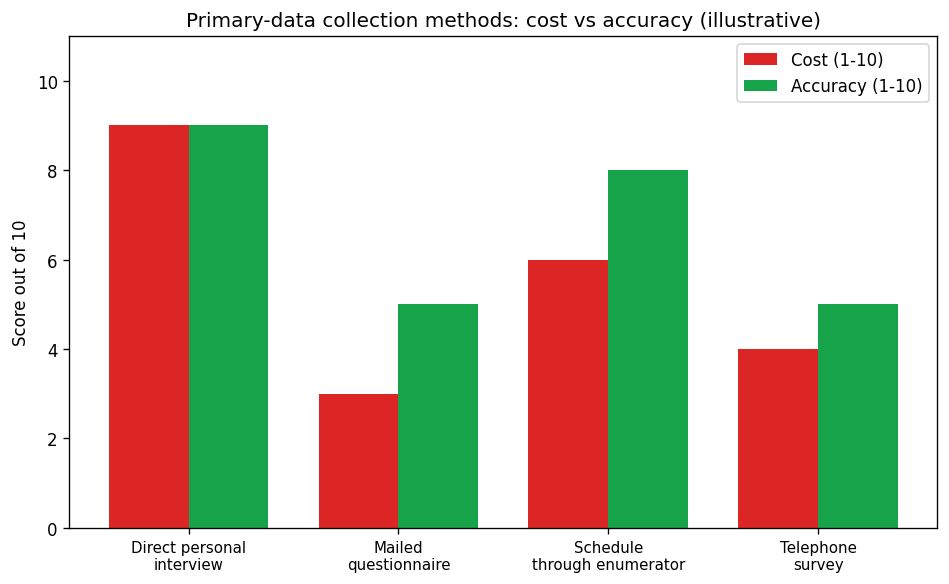
Study the comparison of primary-data collection methods and answer:

Collection of Data (Statistics for Economics) figure
  1. Which method has the highest cost?
    ADirect personal interview
    BMailed questionnaire
    CSchedule through enumerator
    DTelephone survey
  2. Which method combines high accuracy with moderate cost?
    ADirect personal interview
    BMailed questionnaire
    CSchedule through enumerator
    DTelephone survey
  3. How should a researcher choose between these methods?
Show answersHide answers
1. Option 1 — Direct personal interview
2. Option 3 — Schedule through enumerator
3. The right method depends on the research objective, the target population, the sensitivity of information, and available budget. Sensitive or complex topics need direct contact (high accuracy, high cost); large populations may be reached quickly via mailed or telephone surveys with lower cost but also lower response and reliability.
Q57 4 Marks

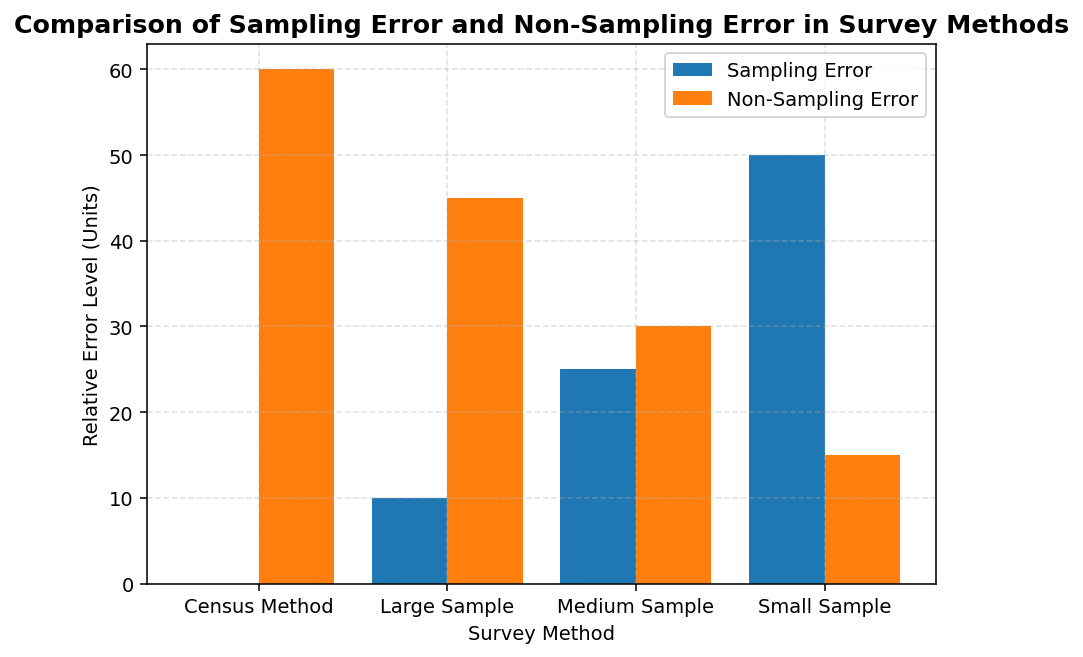
Based on the given bar chart showing the comparison of Sampling Errors and Non-Sampling Errors across different survey methods, answer the following:

Collection of Data (Statistics for Economics) figure
  1. According to the bar chart, which survey method has zero sampling error?
    ASmall Sample
    BMedium Sample
    CLarge Sample
    DCensus Method
  2. As the sample size decreases from Large Sample to Small Sample, what happens to the Sampling Error according to the chart?
    ASampling Error decreases
    BSampling Error remains constant
    CSampling Error increases
    DSampling Error becomes zero
  3. Why does the Census Method have the highest Non-Sampling Error compared to sample survey methods?
  4. Define Sampling Error and state one way to reduce it.
Show answersHide answers
1. Option 4 — Census Method
2. Option 3 — Sampling Error increases
3. The Census Method covers every unit of the population, making data collection an enormous task. This increases the chances of Non-Sampling Errors such as errors in data recording, interviewer bias, respondent errors, and processing mistakes. Since the scale of data collection is very large, managing accuracy becomes more difficult compared to a smaller sample survey.
4. Sampling Error is the difference between the actual value of a population parameter and the value estimated from a sample. It arises because only a part of the population is studied. One way to reduce Sampling Error is to increase the sample size, as a larger sample is more representative of the population and leads to more accurate estimates.
Q58 4 Marks

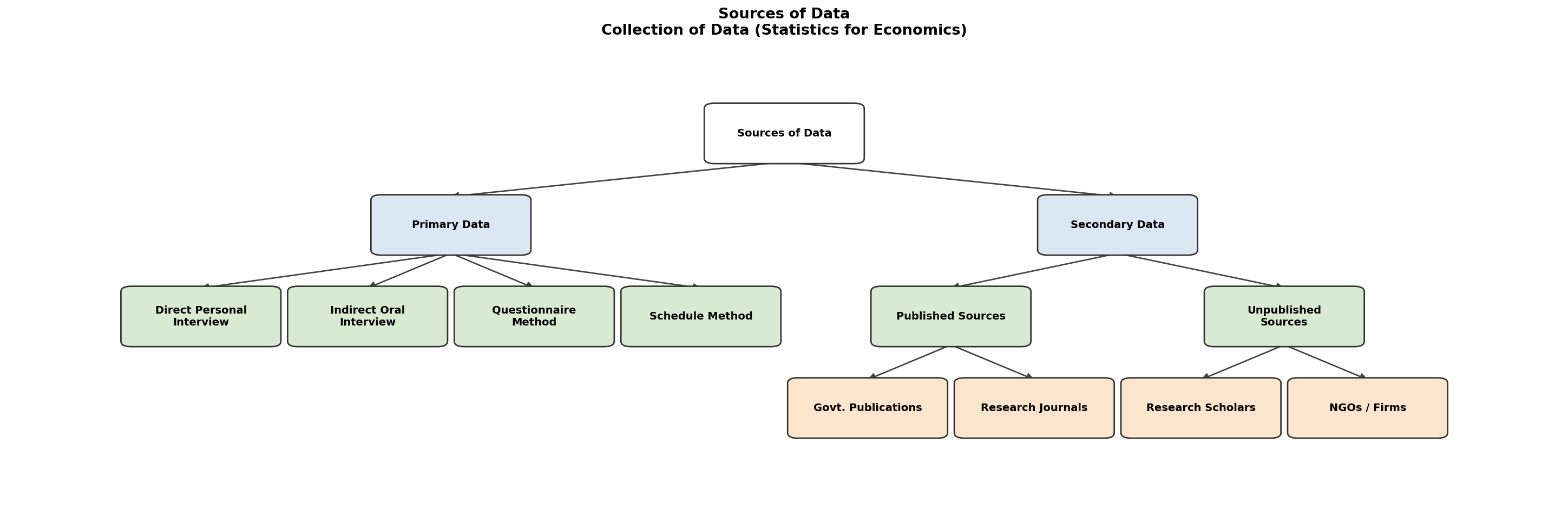
Based on the given diagram showing the classification of sources of data, answer the following:

Collection of Data (Statistics for Economics) figure
  1. Which of the following is a method of collecting Primary Data as shown in the diagram?
    AGovernment Publications
    BResearch Journals
    CIndirect Oral Interview
    DNGOs / Firms
  2. According to the diagram, under which category do 'Government Publications' and 'Research Journals' fall?
    APrimary Data — Direct Sources
    BSecondary Data — Published Sources
    CSecondary Data — Unpublished Sources
    DPrimary Data — Questionnaire Method
  3. Distinguish between Primary Data and Secondary Data as shown in the diagram. Give one example of each.
  4. Why is the Schedule Method considered more reliable than the Questionnaire Method for collecting Primary Data? Explain briefly.
Show answersHide answers
1. Option 3 — Indirect Oral Interview
2. Option 2 — Secondary Data — Published Sources
3. Primary Data is data collected for the first time by the investigator for a specific purpose. Example: Data collected through Direct Personal Interview. Secondary Data is data that has already been collected and published or recorded by someone else. Example: Government Publications such as Census reports.
4. In the Schedule Method, the enumerator personally visits the respondent and fills in the schedule based on responses, ensuring accuracy and minimising misunderstanding. In the Questionnaire Method, the respondent fills in the form themselves, which may lead to incomplete or incorrect answers due to lack of understanding. Hence, the Schedule Method is more reliable, especially when respondents are illiterate or the questions are complex.
Q59 12 Marks

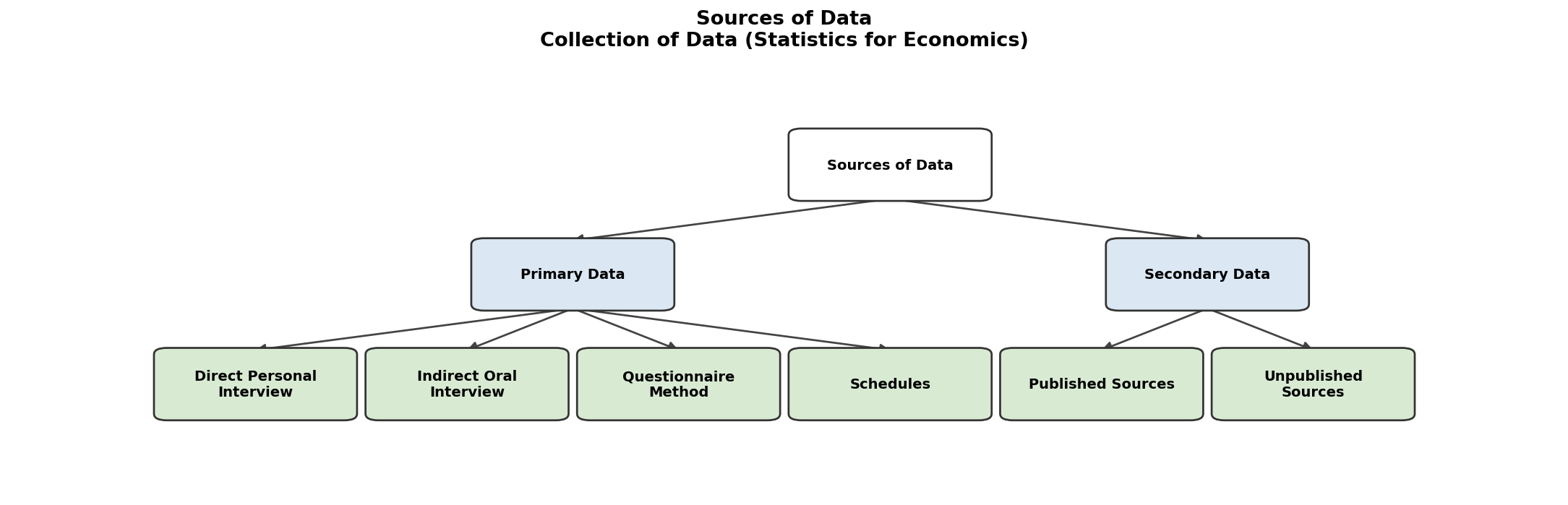
Based on the given diagram, answer the following:

Collection of Data (Statistics for Economics) figure
  1. Which of the following is a method of collecting Primary Data?
    APublished Sources
    BUnpublished Sources
    CDirect Personal Interview
    DGovernment Reports
  2. What is the key difference between Primary Data and Secondary Data?
  3. Which of the following is an example of a Published Secondary Source?
    APersonal diary of a researcher
    BUnpublished thesis
    CCensus of India report
    DDirect interview notes
  4. Name any two methods of collecting Primary Data as shown in the diagram.
  5. In Random Sampling, every unit of the population has:
    ANo chance of being selected
    BAn equal and known chance of being selected
    CA chance decided by the investigator's preference
    DA chance based on convenience
  6. Which sampling method involves dividing the population into groups and then selecting randomly from each group?
    ALottery Method
    BConvenience Sampling
    CStratified Sampling
    DQuota Sampling
  7. Distinguish between Random Sampling and Non-Random Sampling.
  8. Purposive Sampling is a type of:
    ARandom Sampling
    BStratified Sampling
    CNon-Random Sampling
    DSystematic Sampling
  9. Which of the following is an advantage of the Sample Survey over the Census Method?
    ANo sampling error
    BAll units are studied
    CLess time and cost
    DMore accurate results always
  10. Why does the Census Method not have sampling errors?
  11. Which method is most suitable when the population size is very large and resources are limited?
    ACensus Method
    BSample Survey
    CDirect Personal Interview
    DPilot Survey
  12. Define 'sampling error' and state one way to reduce it.
  13. What is the purpose of conducting a Pilot Survey before the final data collection?
  14. According to the diagram, which step immediately follows the Pilot Survey?
    ADefine Objective
    BDraft Questions
    CRevise Questionnaire
    DIdentify Target Population
  15. State any two essential qualities of a good questionnaire.
  16. Which of the following types of questions should be AVOIDED in a questionnaire?
    ASimple factual questions
    BClose-ended questions
    CPersonal and sensitive questions
    DQuestions with clear options
Show answersHide answers
1. Option 3 — Direct Personal Interview
2. Primary Data is collected for the first time by the investigator for a specific purpose, whereas Secondary Data is data that has already been collected and published or recorded by someone else.
3. Option 3 — Census of India report
4. Two methods of collecting Primary Data are: (1) Direct Personal Interview and (2) Questionnaire Method.
5. Option 2 — An equal and known chance of being selected
6. Option 3 — Stratified Sampling
7. In Random Sampling, every unit of the population has an equal and known probability of being selected, eliminating personal bias. In Non-Random Sampling, the selection is based on the investigator's judgment or convenience, which may introduce bias.
8. Option 3 — Non-Random Sampling
9. Option 3 — Less time and cost
10. The Census Method does not have sampling errors because every single unit of the population is studied. Since no unit is left out, there is no error arising from the selection of a sample.
11. Option 2 — Sample Survey
12. Sampling error is the difference between the value estimated from a sample and the true value of the population parameter. It can be reduced by increasing the sample size, as a larger sample is more representative of the population.
13. A Pilot Survey is conducted on a small group to test the questionnaire for any defects, ambiguities, or irrelevant questions. It helps identify and remove errors before the actual large-scale data collection, saving time and resources.
14. Option 3 — Revise Questionnaire
15. Two essential qualities of a good questionnaire are: (1) Questions should be clear, simple, and unambiguous so that respondents can understand them easily. (2) The questionnaire should be short and arranged in a logical sequence to maintain the respondent's interest and cooperation.
16. Option 3 — Personal and sensitive questions

Make a full Economics paper on Collection of Data (Statistics for Economics).

Pick the question mix, set the marks, hit generate. You get a ready-to-print paper with an answer key.

Generate your paper — free