Economics is best described as the study of:
Introduction (Microeconomics) — Important Questions
SUMMARY: The chapter introduces the fundamental concepts and scope of microeconomics, focusing on how individual economic units make decisions.
KEY TOPICS: definition of microeconomics, central problems of an economy, scarcity and choice, opportunity cost, production possibility frontier, economic systems, market economy, mixed economy, role of prices in resource allocation.
Who defined economics as a 'science of wealth'?
Check answerHide answer
The Production Possibility Frontier (PPF) represents:
Check answerHide answer
Opportunity cost of a decision is:
Check answerHide answer
Which of the following is NOT a central problem of every economy?
Check answerHide answer
Microeconomics is primarily concerned with the study of:
Check answerHide answer
Which of the following best describes 'scarcity' in economics?
Check answerHide answer
The concept of opportunity cost refers to:
Check answerHide answer
A Production Possibility Frontier (PPF) shows:
Check answerHide answer
Which of the following is NOT one of the central problems of an economy?
Check answerHide answer
In a market economy, the allocation of resources is primarily determined by:
Check answerHide answer
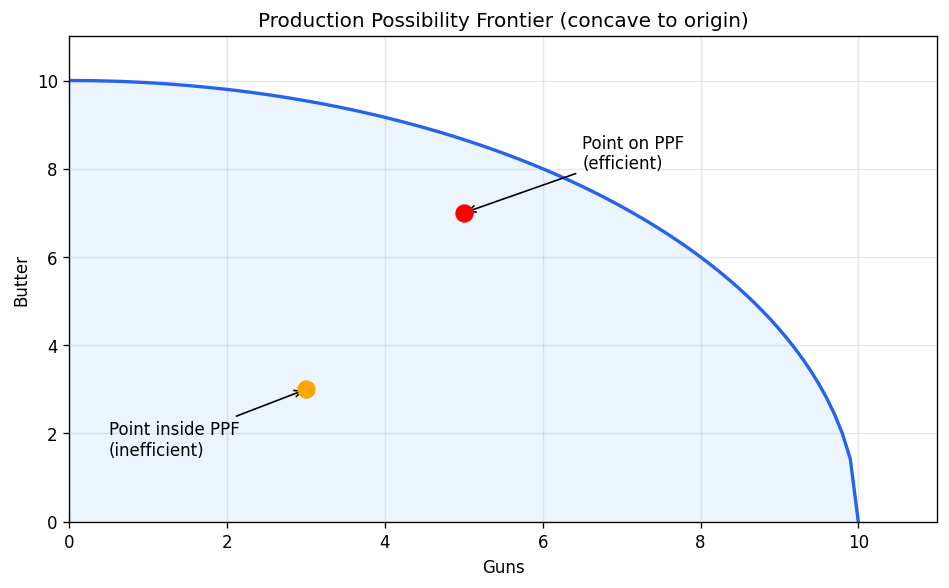
A point lying inside the Production Possibility Frontier indicates:
Check answerHide answer
In a mixed economy, which of the following statements is most accurate?
Check answerHide answer
If an economy moves from a point on the PPF to a point outside it, this would most likely be caused by:
Check answerHide answer
Country X produces only wheat and cloth. If it decides to produce more wheat, it must produce less cloth. This situation best illustrates which economic concept?
Check answerHide answer
Distinguish between microeconomics and macroeconomics with one example of each.
View sample solutionHide solution
What is the Production Possibility Frontier (PPF)? Why does it slope downward?
View sample solutionHide solution
State any two features of a mixed economy.
View sample solutionHide solution
Distinguish between positive and normative economics with one example each.
View sample solutionHide solution
State the three central problems of an economy.
View sample solutionHide solution
Define microeconomics and state its primary focus.
View sample solutionHide solution
What is meant by scarcity in economics? Why does it give rise to the problem of choice?
View sample solutionHide solution
What is opportunity cost? Give one example to illustrate your answer.
View sample solutionHide solution
What is a Production Possibility Frontier (PPF)? What does a point inside the PPF indicate?
View sample solutionHide solution
Why is the Production Possibility Frontier typically concave to the origin?
View sample solutionHide solution
Explain the concept of opportunity cost and illustrate it using a Production Possibility Frontier (PPF).
View sample solutionHide solution
Compare Adam Smith's, Lionel Robbins' and Paul Samuelson's definitions of economics.
View sample solutionHide solution
Explain the three central problems every economy faces, and describe how a market (capitalist) economy solves them.
View sample solutionHide solution
Explain the main features and shape of the Production Possibility Frontier.
View sample solutionHide solution
Distinguish between microeconomics and macroeconomics.
View sample solutionHide solution
Compare microeconomics and macroeconomics with the help of a table on five features.
Assertion (A): The Production Possibility Frontier is concave to the origin.
Reason (R): It reflects increasing opportunity costs because resources are not equally suited to the production of both goods.
Show explanationHide explanation
Assertion (A): The economic problem arises because of scarcity.
Reason (R): Human wants are unlimited while the resources to satisfy them are limited and have alternative uses.
Show explanationHide explanation
Assertion (A): Points inside the PPF represent efficient use of resources.
Reason (R): The PPF itself shows all combinations that use resources fully and efficiently.
Show explanationHide explanation
Assertion (A): Microeconomics studies individual decision-making units.
Reason (R): Microeconomics ignores price determination in individual markets.
Show explanationHide explanation
Assertion (A): In a socialist economy, resources are allocated solely through the price mechanism.
Reason (R): In a socialist economy, central planning authorities decide what and how to produce.
Show explanationHide explanation
Assertion (A): Microeconomics studies the economic behaviour of individual units such as a household, a firm, or an industry.
Reason (R): Microeconomics is concerned with the allocation of scarce resources among competing uses at the level of individual decision-makers.
Show explanationHide explanation
Assertion (A): Scarcity is the fundamental economic problem faced by all economies, whether rich or poor.
Reason (R): Human wants are unlimited while the resources available to satisfy those wants are limited.
Show explanationHide explanation
Assertion (A): Opportunity cost is the cost of the next best alternative foregone when a choice is made.
Reason (R): Because resources are scarce, choosing one option means giving up the benefit of the next best option.
Show explanationHide explanation
Statement 1: Scarcity gives rise to choice.
Statement 2: Choice makes opportunity cost a relevant concept in economic decisions.
Show answerHide answer
Statement 1: Technological progress can shift the PPF outward.
Statement 2: Natural disasters or war that destroy resources can shift the PPF inward.
Show answerHide answer
Statement 1: Capitalism features private ownership of the means of production.
Statement 2: Socialism features state or collective ownership of the means of production.
Show answerHide answer
Statement 1: Microeconomics ignores the concept of opportunity cost.
Statement 2: Microeconomics focuses only on total production in the economy.
Show answerHide answer
Statement 1: Positive statements are fact-based and can in principle be verified.
Statement 2: Normative statements involve value judgements about what ought to be.
Show answerHide answer
Statement 1: Microeconomics studies the economic behaviour of individual units such as households, firms, and industries.
Statement 2: Microeconomics is also known as the theory of income and employment.
Show answerHide answer
Statement 1: Scarcity means that resources are limited relative to unlimited human wants.
Statement 2: Because of scarcity, every economy must make choices about what to produce, how to produce, and for whom to produce.
Show answerHide answer
Statement 1: Opportunity cost is the value of the next best alternative foregone when a choice is made.
Statement 2: Opportunity cost is always measured in monetary terms only.
Show answerHide answer
-
A point representing unemployment of resources lies:AOn the frontierBOutside the frontierCInside the frontierDAt the origin
-
Moving along the PPF from more butter to more guns involves a trade-off known as:AEqual exchange, no costBOpportunity costCScarcity costDMoney cost
-
What does an outward shift of the PPF indicate?
Show answersHide answers
-
Deciding between roads or schools is an example of the central problem:AWhat to produceBHow to produceCFor whom to produceDWho will finance it
-
Choosing between labour-intensive and capital-intensive techniques is the central problem of:AWhat to produceBHow to produceCFor whom to produceDHow much to consume
-
How does a mixed economy solve these central problems?
Show answersHide answers
-
The opportunity cost of Rohan's decision is the best alternative he gave up:A0 Math marksB20 Math marksC25 Eco marksD4 hours
-
Choice is necessary in this case primarily:ABecause resources are unlimitedBBecause wants and time are limitedCBecause Rohan is lazyDBecause Math is easier
-
Define opportunity cost in your own words and give one more economic example.
Show answersHide answers
-
Microeconomics primarily studies the behaviour of:AThe entire economy as a wholeBIndividual economic units such as consumers and firmsCInternational trade and financeDGovernment fiscal and monetary policies
-
What is opportunity cost?
-
The fundamental economic problem of scarcity arises because:AGovernments fail to distribute resources equallyBHuman wants are unlimited while resources are limitedCTechnology is not advanced enoughDMarkets do not function efficiently
-
Explain why scarcity forces every economy to make choices.
Show answersHide answers
Study the three economic systems and answer:
| Feature | Capitalism | Socialism | Mixed economy |
|---|---|---|---|
| Ownership of resources | Private | State | Both |
| Production decisions | Price mechanism | Central planning | Combination |
| Profit motive | Strong | Weak / absent | Moderate |
| Examples | USA | Former USSR | India |
-
Which system relies primarily on the price mechanism?ACapitalismBSocialismCMixedDBarter
-
Which system relies primarily on central planning?ACapitalismBSocialismCMixedDNeither
-
Why do most countries today follow a mixed economy?
Show answersHide answers
Study the PPF schedule of an economy and answer:
| Combination | Guns | Butter (tonnes) | Opportunity cost of extra butter |
|---|---|---|---|
| A | 100 | 0 | - |
| B | 95 | 10 | 5 guns |
| C | 85 | 20 | 10 guns |
| D | 70 | 30 | 15 guns |
| E | 40 | 40 | 30 guns |
-
The opportunity cost of butter is:AConstantBIncreasingCDecreasingDZero
-
Based on the schedule the PPF will be:AConcave to originBConvex to originCStraight-lineDHorizontal
-
Explain why the opportunity cost of butter rises.
Show answersHide answers
Observe the following Production Possibility Schedule for an economy producing Guns and Butter and answer the questions below:
| Production Possibility | Guns (units) | Butter (units) |
|---|---|---|
| A | 0 | 20 |
| B | 1 | 18 |
| C | 2 | 14 |
| D | 3 | 8 |
| E | 4 | 0 |
The following table shows different combinations of two goods X and Y that an economy can produce. Study the table and answer:
| Combination | Good X (units) | Good Y (units) | Attainable? (Yes/No) |
|---|---|---|---|
| P | 0 | 30 | Yes |
| Q | 5 | 25 | Yes |
| R | 10 | 15 | Yes |
| S | 15 | 0 | Yes |
| T | 8 | 20 | Yes |
| U | 12 | 18 | No |
Study the Production Possibility Frontier and answer:
-
A point inside the PPF represents:AInefficient (unemployment)BEfficient (full employment)CImpossibleDAt maximum capacity
-
The concave shape of the PPF reflects:AConstant opportunity costBIncreasing opportunity costCDecreasing opportunity costDZero opportunity cost
-
What does an outward shift of the PPF indicate?
Show answersHide answers
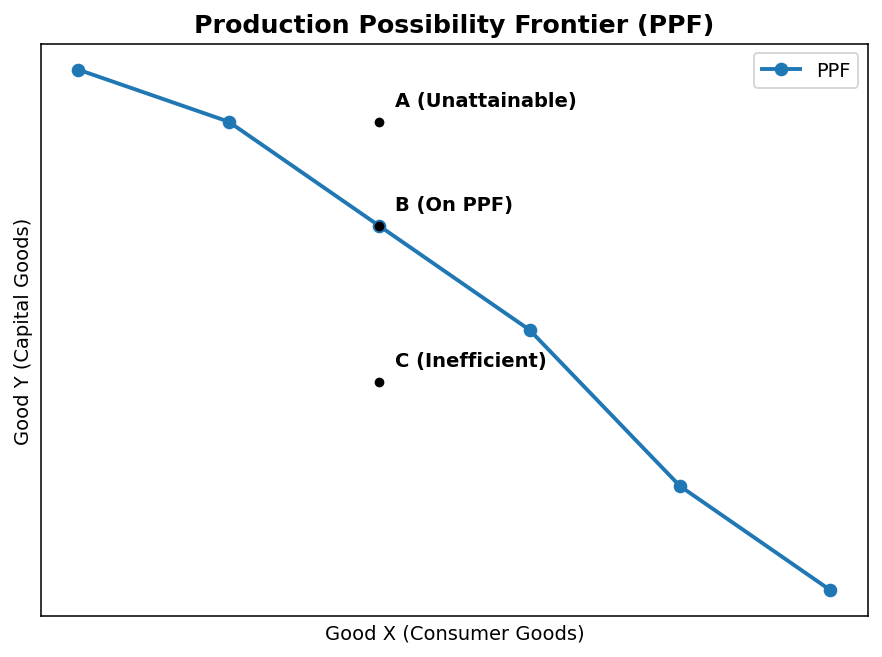
Based on the given diagram of the Production Possibility Frontier, answer the following:
-
What does a point inside the Production Possibility Frontier (like point C) represent?AFull and efficient utilisation of resourcesBUnderutilisation or inefficient use of resourcesCA combination that is beyond the economy's capacityDOptimal allocation of resources
-
What does a point outside the PPF (like point A) indicate?AEfficient productionBUnderemployment of resourcesCAn unattainable combination with current resources and technologyDMaximum production of Good Y only
-
Why is the PPF curve concave to the origin?
-
What is the opportunity cost concept illustrated by the PPF?
-
What happens to the PPF when there is technological advancement in the economy?AThe PPF shifts inwardBThe PPF remains unchangedCThe PPF shifts outward, indicating increased production capacityDThe PPF becomes a straight line
Show answersHide answers
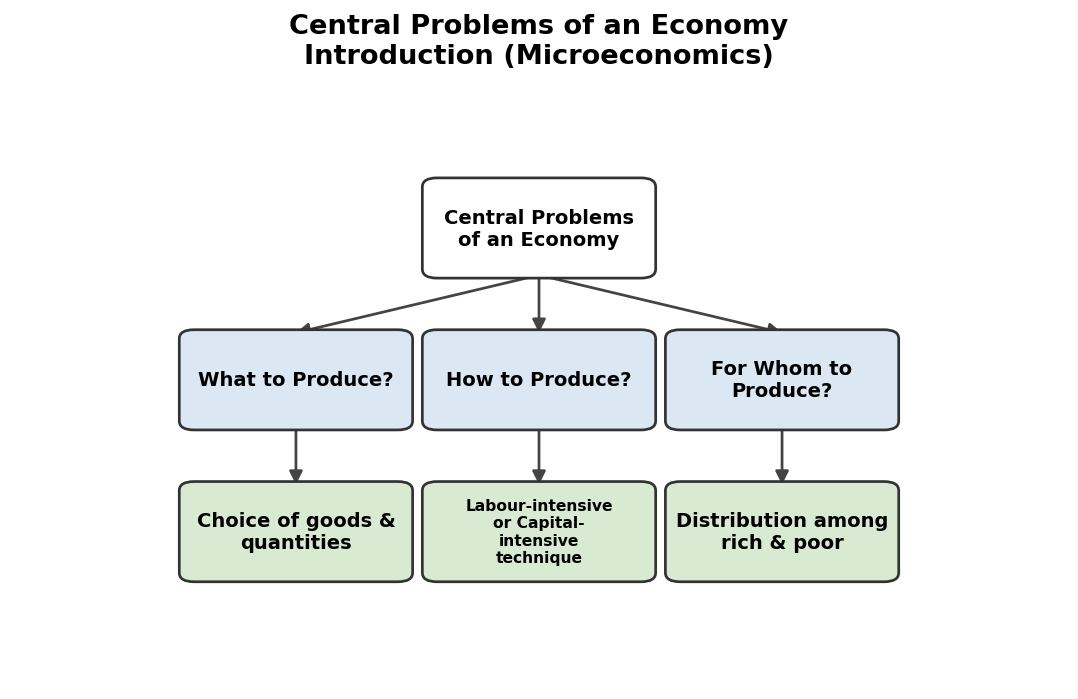
Based on the given flowchart, answer the following:
-
Which central problem deals with the choice of technique of production?AWhat to produce?BFor whom to produce?CHow to produce?DWhen to produce?
-
The problem 'For Whom to Produce?' is essentially related to:ASelection of production technologyBDistribution of national product among members of societyCDeciding which goods to produceDMaximising total output
-
Why do central problems arise in every economy?
-
Give one example each to explain the problems 'What to Produce?' and 'How to Produce?'
-
In a market economy, who determines the allocation of resources?AThe central governmentBThe price mechanism through demand and supplyCInternational organisationsDPublic sector enterprises
-
Which economic system combines features of both a market economy and a centrally planned economy?ACapitalist economyBSocialist economyCMixed economyDTraditional economy
-
What is the role of the price mechanism in solving the central problems of a market economy?
-
State one advantage and one disadvantage of a centrally planned economy.
-
What is opportunity cost in economics?AThe monetary price paid for a good or serviceBThe value of the next best alternative foregone when a choice is madeCThe total cost of producing all goods in an economyDThe cost of importing goods from another country
-
According to the flowchart, what two factors together give rise to the 'Problem of Choice'?ADemand and SupplyBPrice mechanism and Government policyCScarcity of Resources and Unlimited Human WantsDTechnology and Labour
-
Give a real-life example to illustrate the concept of opportunity cost.
-
How does scarcity make microeconomics relevant? Explain briefly.
Show answersHide answers
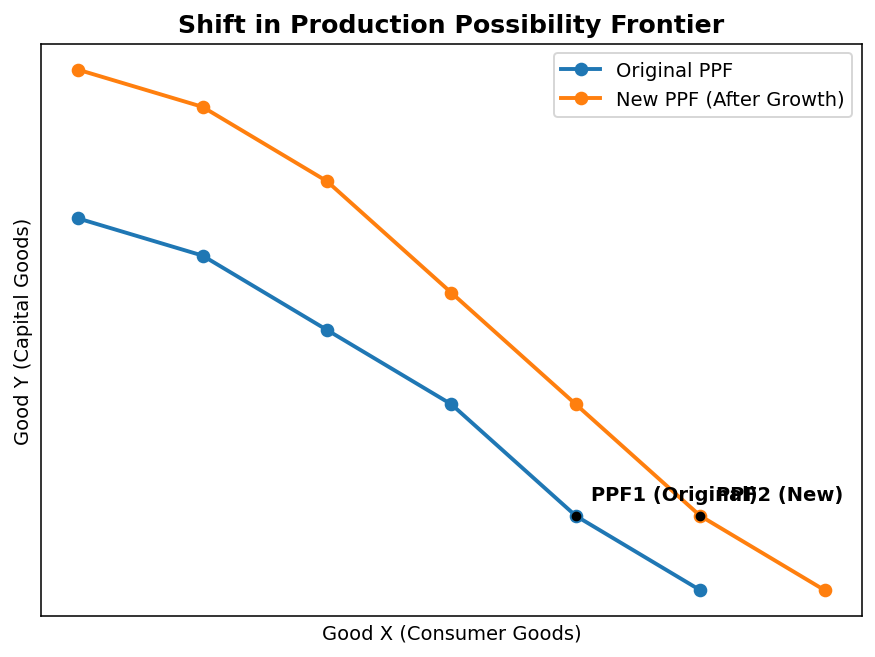
Based on the given graph showing a shift in the Production Possibility Frontier, answer the following:
-
What does an outward (rightward) shift of the PPF indicate?AA decrease in the production of consumer goodsBEconomic growth due to increase in resources or improvement in technologyCInefficient use of available resourcesDA fall in the price of goods
-
Which of the following can cause the PPF to shift outward?AA natural disaster destroying resourcesBTechnological advancement in productionCIncrease in unemploymentDDecrease in consumer demand
-
What would cause the PPF to shift inward (leftward), and give one real-life example?
-
Explain how the concept of scarcity is related to the PPF.
Show answersHide answers
Make a full Economics paper on Introduction (Microeconomics).
Pick the question mix, set the marks, hit generate. You get a ready-to-print paper with an answer key.
Generate your paper — free