Index Numbers (Statistics for Economics) — Important Questions
59 questions
With answersCBSE format
SUMMARY: The chapter "Index Numbers" in Class 11 Economics focuses on the construction, use, and significance of index numbers in economic analysis. KEY TOPICS: definition of index numbers, uses of index numbers, methods of constructing index numbers, Laspeyres index, Paasche index, Fisher's ideal index, problems in constructing index numbers, base year selection, consumer price index, wholesale price index
BRelative (percentage) measures that compare against a base
CCompulsory for all surveys
DProduced only by NSO
Check answerHide answer
Correct answer: Option 2 — Relative (percentage) measures that compare against a base
Q21 Mark
Laspeyres' price index uses weights from the:
ABase period
BCurrent period
CGeometric mean of the two
D
Check answerHide answer
Correct answer: Option 1 — Base period
Q31 Mark
CPI in India is compiled by the:
ANational Statistical Office
BRBI
CMinistry of Finance
DSEBI
Check answerHide answer
Correct answer: Option 1 — National Statistical Office
Q41 Mark
The Consumer Price Index for Industrial Workers (CPI-IW) is published by the:
ALabour Bureau
BRBI
CNSO
DMinistry of Commerce
Check answerHide answer
Correct answer: Option 1 — Labour Bureau
Q51 Mark
Fisher's ideal price index is the:
AArithmetic mean of Laspeyres' and Paasche's indexes
BGeometric mean of Laspeyres' and Paasche's indexes
CMedian of the two
DDifference of the two
Check answerHide answer
Correct answer: Option 2 — Geometric mean of Laspeyres' and Paasche's indexes
Q61 Mark
Which of the following best defines an index number?
AA measure of absolute change in a variable over time
BA statistical measure that shows relative changes in a variable with respect to a base period
CA graphical representation of economic data
DA measure used only for price changes in wholesale markets
Check answerHide answer
Correct answer: Option 2 — A statistical measure that shows relative changes in a variable with respect to a base period
Q71 Mark
The Consumer Price Index (CPI) is primarily used to measure:
AChanges in the prices of goods traded between countries
BChanges in the wholesale prices of industrial goods
CChanges in the cost of living of a specific group of consumers
DChanges in the production levels of consumer goods
Check answerHide answer
Correct answer: Option 3 — Changes in the cost of living of a specific group of consumers
Q81 Mark
In the Laspeyres Price Index, the weights used are:
AQuantities of the current year
BQuantities of the base year
CAverage of base year and current year quantities
DPrices of the base year
Check answerHide answer
Correct answer: Option 2 — Quantities of the base year
Q91 Mark
Which index number is known as Fisher's Ideal Index?
ASimple average of Laspeyres and Paasche index
BGeometric mean of Laspeyres and Paasche index
CArithmetic mean of Laspeyres and Paasche index
DHarmonic mean of Laspeyres and Paasche index
Check answerHide answer
Correct answer: Option 2 — Geometric mean of Laspeyres and Paasche index
Q101 Mark
The Wholesale Price Index (WPI) in India is used to measure:
APrice changes at the retail level for consumers
BPrice changes of goods at the wholesale stage before reaching consumers
CChanges in the wages of industrial workers
DChanges in the volume of goods exported from India
Check answerHide answer
Correct answer: Option 2 — Price changes of goods at the wholesale stage before reaching consumers
Q111 Mark
If the price index for the current year is 150 with base year 2010, it means:
APrices have fallen by 50% compared to 2010
BPrices have increased by 150% compared to 2010
CPrices have increased by 50% compared to 2010
DPrices are 1.5 times lower than in 2010
Check answerHide answer
Correct answer: Option 3 — Prices have increased by 50% compared to 2010
Q121 Mark
Which of the following is a major problem in constructing index numbers?
AAvailability of too many base years to choose from
BSelection of an appropriate base year and representative commodities
CDifficulty in using arithmetic mean as a method of averaging
DInability to use index numbers for comparing prices across regions
Check answerHide answer
Correct answer: Option 2 — Selection of an appropriate base year and representative commodities
Q131 Mark
The Paasche Price Index uses current year quantities as weights. Compared to the Laspeyres Index, the Paasche Index tends to:
AOverestimate inflation because it uses outdated quantities
BUnderestimate inflation because consumers substitute cheaper goods in the current year
CGive the same result as the Laspeyres Index in all situations
DOverestimate inflation because current year quantities are always higher
Check answerHide answer
Correct answer: Option 2 — Underestimate inflation because consumers substitute cheaper goods in the current year
Q141 Mark
Fisher's Ideal Index is considered 'ideal' because it satisfies which important statistical tests?
AUnit test and circular test
BTime reversal test and factor reversal test
CCommodity reversal test and chain base test
DCircular test and commodity reversal test
Check answerHide answer
Correct answer: Option 2 — Time reversal test and factor reversal test
Q151 Mark
A base year for constructing an index number should ideally be:
AA year with the highest economic growth rate
BThe most recent year available in the data
CA normal year free from extreme economic fluctuations
DA year in which prices were at their lowest level
Check answerHide answer
Correct answer: Option 3 — A normal year free from extreme economic fluctuations
Short Answer Questions10 questions
Q163 Marks
Define an index number.
View sample solutionHide solution
An index number is a statistical measure expressed as a percentage of a base value. It shows the relative change in a variable or group of variables — price, quantity, value or composite indicators — between two periods, so that the base period is conventionally set at 100.
Q173 Marks
Distinguish between Laspeyres' and Paasche's price indexes.
View sample solutionHide solution
Laspeyres' index uses base-period quantities as weights: L = Σ(p1 q0) / Σ(p0 q0) × 100. Paasche's index uses current-period quantities: P = Σ(p1 q1) / Σ(p0 q1) × 100. Laspeyres tends to overstate and Paasche to understate inflation; Fisher's index takes the geometric mean of the two.
Q183 Marks
What is the Consumer Price Index (CPI) and what does it measure?
View sample solutionHide solution
The Consumer Price Index measures the average change over time in the prices paid by consumers for a fixed basket of goods and services. It is used to gauge retail-level inflation, to adjust wages and pensions (dearness allowance), and to deflate nominal income series into real terms.
Q193 Marks
How is Wholesale Price Index (WPI) different from CPI?
View sample solutionHide solution
WPI measures price changes at the wholesale (bulk) transaction stage and covers primary articles, fuel and manufactured products. CPI measures retail price changes faced by consumers. WPI is used mainly as a general inflation indicator and by producers and policy-makers; CPI is used for wage indexation and for targeting household-level inflation.
Q203 Marks
State any two uses of index numbers.
View sample solutionHide solution
(i) Measurement and comparison of changes in price level or production over time — CPI and WPI are used to track inflation. (ii) Adjustment of nominal income into real terms — wages, pensions and national-income series are deflated by a price index to remove the inflation effect.
Q213 Marks
Define an index number and state its primary purpose in economics.
View sample solutionHide solution
An index number is a statistical measure that shows the relative change in a variable or a group of related variables over time or across different situations. It is expressed as a percentage relative to a base period. Its primary purpose is to measure changes in price levels, production, or other economic variables that cannot be directly measured.
Q223 Marks
What is the base year in the context of index numbers, and what value is assigned to it?
View sample solutionHide solution
The base year is the reference year against which changes in other years are measured. It is typically a normal year, free from extreme economic fluctuations such as wars or famines. The index value for the base year is always set at 100.
Q233 Marks
Distinguish between the Wholesale Price Index (WPI) and the Consumer Price Index (CPI).
View sample solutionHide solution
The Wholesale Price Index (WPI) measures changes in the prices of goods at the wholesale level, i.e., prices at which goods are traded in bulk between businesses. The Consumer Price Index (CPI), on the other hand, measures changes in the retail prices of goods and services purchased by consumers for their daily needs. CPI directly reflects the cost of living for households.
Q243 Marks
What is a simple aggregative price index? Write its formula.
View sample solutionHide solution
A simple aggregative price index measures the percentage change in the total sum of prices of a basket of commodities in the current year compared to the base year. Its formula is: P01 = (ΣP1 / ΣP0) × 100, where ΣP1 is the sum of current year prices and ΣP0 is the sum of base year prices.
Q253 Marks
State two important uses of index numbers in economic analysis.
View sample solutionHide solution
First, index numbers are used to measure changes in the price level over time, helping to assess inflation or deflation in an economy. Second, they are used to compare the cost of living across different time periods or regions, which helps in adjusting wages and salaries to maintain the real purchasing power of workers.
Long Answer Questions6 questions
Q266 Marks
Explain the different types of index numbers with examples.
View sample solutionHide solution
(1) Price Index — measures changes in prices; e.g. Consumer Price Index (CPI), Wholesale Price Index (WPI), Producer Price Index. (2) Quantity Index — measures changes in volume of production or consumption; e.g. Index of Industrial Production (IIP), agricultural production index. (3) Value Index — measures changes in total value (price × quantity); it combines price and quantity movements. (4) Composite or General Index — combines several sub-indices into one summary measure; e.g. Human Development Index combines income, education and life expectancy. Indexes are also classified by weighting: simple (unweighted) vs weighted (Laspeyres, Paasche, Fisher). Each type answers a specific question; the appropriate one depends on whether price, quantity, value or a broader concept is being tracked.
Q276 Marks
Compute the Laspeyres' and Paasche's price indexes for the data: base prices p0 = 10, 5, 8; current prices p1 = 14, 7, 10; base quantities q0 = 5, 10, 6; current quantities q1 = 6, 8, 7.
View sample solutionHide solution
Laspeyres' index L = Σ(p1·q0) / Σ(p0·q0) × 100. Σ p1 q0 = 14×5 + 7×10 + 10×6 = 70 + 70 + 60 = 200. Σ p0 q0 = 10×5 + 5×10 + 8×6 = 50 + 50 + 48 = 148. L = 200 / 148 × 100 ≈ 135.14. Paasche's index P = Σ(p1·q1) / Σ(p0·q1) × 100. Σ p1 q1 = 14×6 + 7×8 + 10×7 = 84 + 56 + 70 = 210. Σ p0 q1 = 10×6 + 5×8 + 8×7 = 60 + 40 + 56 = 156. P = 210 / 156 × 100 ≈ 134.62. Both suggest prices rose by about 35% from base to current period; they differ slightly because of different quantity weights. Fisher's ideal = √(L × P) ≈ √(135.14 × 134.62) ≈ 134.88.
Q286 Marks
Explain the construction of the Consumer Price Index (CPI).
View sample solutionHide solution
Steps in constructing CPI: (1) Decide scope — target population (rural, urban, industrial workers, etc.), coverage area, and base period. (2) Select the basket of goods and services that represent the typical consumption of the target population — food, clothing, housing, fuel, transport, education, etc. (3) Obtain the base-period expenditure of each item to derive weights — items with larger share in the budget receive higher weights. (4) Collect current prices from representative retail outlets in sample centres on a regular schedule. (5) Convert each current price into a price relative — (p1 / p0) × 100. (6) Compute weighted average of price relatives using the chosen weights; the Laspeyres formula is typical. (7) Publish the result alongside sub-indices (food, fuel, etc.). CPI is used to index wages and pensions, gauge inflation, and deflate nominal variables into real terms.
Q296 Marks
Discuss the uses and limitations of index numbers in economics.
View sample solutionHide solution
Uses: (1) Measurement of changes in price level — CPI and WPI track inflation. (2) Adjustment of nominal variables — wages, pensions, national income are deflated by a price index to obtain real values. (3) Cost-of-living estimates — CPI-based dearness allowance. (4) Business forecasting — producer price index informs production and inventory decisions. (5) International comparisons — purchasing power parity uses price indices. (6) Guide to monetary policy — RBI targets CPI-based inflation. Limitations: (1) Choice of base period is arbitrary and can bias comparisons if the base period is abnormal. (2) Sample basket becomes unrepresentative over time as consumption patterns change. (3) Laspeyres' formula overstates and Paasche's understates inflation. (4) Quality improvements of goods are not always captured. (5) Errors in price collection and weighting reduce accuracy. Interpretation must therefore be done with the construction methodology in mind.
Q306 Marks
Discuss how the Index of Industrial Production (IIP) is constructed and what it measures.
View sample solutionHide solution
The Index of Industrial Production is a quantity index that measures changes in the physical volume of production of select industrial sub-sectors in India, compiled monthly by the National Statistical Office. Construction steps: (1) Select a base year (presently 2011-12 = 100). (2) Define three broad categories — Mining, Manufacturing, and Electricity — and further split Manufacturing into 23 industry groups. (3) Identify representative items within each group; weights are derived from their share in base-year Gross Value Added. (4) Collect monthly production data for each item from designated source agencies (ministries, DGCIS, industry associations). (5) Compute production relatives against the base year and take weighted average, giving sub-indices and a headline index. Uses: it is a quick indicator of industrial growth, used to gauge business cycles and to calculate GDP estimates with sectoral breakdowns. Limitations: IIP has a narrow basket (mostly organised sector), relies on timely responses from source agencies, and does not capture the service sector's contribution to the economy.
Q316 Marks
Compare laspeyres and Paasche price index numbers with the help of a table.
Assertion–Reason Questions8 questions
Q321 Mark
Assertion (A): Index numbers are relative measures.
Reason (R): They express the value of a variable in a given period as a percentage of its value in a base period.
Show explanationHide explanation
Correct answer: Option 1 —
Both A and R are true, and R is the correct explanation of A.
Q331 Mark
Assertion (A): Consumer Price Index is used to measure retail inflation.
Reason (R): It tracks the change in the cost of a basket of goods and services purchased by a typical household.
Show explanationHide explanation
Correct answer: Option 1 —
Both A and R are true, and R is the correct explanation of A.
Q341 Mark
Assertion (A): Laspeyres' index tends to overstate the rise in prices over time.
Reason (R): Using fixed base-year weights does not account for substitution by consumers towards cheaper alternatives.
Show explanationHide explanation
Correct answer: Option 1 —
Both A and R are true, and R is the correct explanation of A.
Q351 Mark
Assertion (A): Wholesale Price Index is used to measure price changes at the wholesale level.
Reason (R): It uses current-period quantity weights to compute the index.
Show explanationHide explanation
Correct answer: Option 3 —
A is true, but R is false.
Q361 Mark
Assertion (A): CPI can be used to compute real income from nominal income.
Reason (R): Real income = Nominal income × 100 / CPI — dividing by the index strips out the effect of price changes.
Show explanationHide explanation
Correct answer: Option 1 —
Both A and R are true, and R is the correct explanation of A.
Q371 Mark
Assertion (A): Index numbers are called economic barometers.
Reason (R): Index numbers measure changes in economic variables like prices and production over time, helping to gauge the overall economic condition.
Show explanationHide explanation
Correct answer: Option 1 —
Both A and R are true, and R is the correct explanation of A.
Q381 Mark
Assertion (A): The base year chosen for constructing an index number should be a normal year.
Reason (R): A normal year is free from extreme economic fluctuations, wars, or natural calamities, making it a stable reference point for comparison.
Show explanationHide explanation
Correct answer: Option 1 —
Both A and R are true, and R is the correct explanation of A.
Q391 Mark
Assertion (A): Fisher's Ideal Index is considered ideal because it uses only the base year quantities as weights.
Reason (R): Fisher's Ideal Index is the geometric mean of Laspeyres and Paasche indices, satisfying both the time reversal and factor reversal tests.
Show explanationHide explanation
Correct answer: Option 4 —
A is false, but R is true.
Statement-Based Questions8 questions
Q401 Mark
Statement 1: Index numbers are expressed as percentages.
Statement 2: The value of the base period is conventionally set at 100.
Show answerHide answer
Correct answer: Option 1 —
Both statements are true.
Q411 Mark
Statement 1: CPI is used to adjust wages and pensions for inflation.
Statement 2: Dearness allowance in government pay scales is linked to the CPI.
Show answerHide answer
Correct answer: Option 1 —
Both statements are true.
Q421 Mark
Statement 1: Fisher's price index is the geometric mean of Laspeyres' and Paasche's indexes.
Statement 2: Fisher's index is therefore often referred to as an ideal index.
Show answerHide answer
Correct answer: Option 1 —
Both statements are true.
Q431 Mark
Statement 1: WPI covers wholesale transactions.
Statement 2: CPI covers the retail purchases of a typical household.
Show answerHide answer
Correct answer: Option 1 —
Both statements are true.
Q441 Mark
Statement 1: Index numbers can show changes in the cost of living.
Statement 2: Index numbers are absolute numbers rather than relative measures.
Show answerHide answer
Correct answer: Option 3 —
Only Statement 2 is true.
Q451 Mark
Statement 1: Index numbers measure changes in a variable or a group of related variables over time.
Statement 2: Index numbers can only be used to measure price changes and have no other economic applications.
Show answerHide answer
Correct answer: Option 2 —
Only Statement 1 is true.
Q461 Mark
Statement 1: The Consumer Price Index (CPI) measures the average change in prices paid by consumers for a basket of goods and services.
Statement 2: The Wholesale Price Index (WPI) measures changes in retail prices of commodities.
Show answerHide answer
Correct answer: Option 2 —
Only Statement 1 is true.
Q471 Mark
Statement 1: Fisher's Ideal Index is the arithmetic mean of Laspeyres and Paasche index numbers.
Statement 2: Fisher's Ideal Index satisfies both the time reversal test and the factor reversal test.
Show answerHide answer
Correct answer: Option 3 —
Only Statement 2 is true.
Case Study / Passage Questions4 questions
Q483 Marks
The Consumer Price Index (CPI-combined) for India rose from 120 in 2020 to 144 in 2024 (base year 2012 = 100). A middle-class household's nominal monthly income was ₹50 000 in 2020 and ₹60 000 in 2024.
The percentage change in CPI between 2020 and 2024 is:
A10%
B15%
C20%
D24%
The household's nominal income has:
ARose
BFell
CRemained constant
DCannot be determined
Compute the real income in both years and interpret.
Show answersHide answers
1. Option 3 — 20%
2. Option 1 — Rose
3. CPI rose by (144 − 120) / 120 × 100 = 20%. Nominal income rose by (60 000 − 50 000) / 50 000 × 100 = 20%. Real income in 2024-prices = (60 000 × 100) / 144 ≈ ₹41 667, while real income in 2020-prices was (50 000 × 100) / 120 ≈ ₹41 667. The household's real purchasing power is unchanged — the 20% nominal rise only offset the 20% rise in CPI.
Q493 Marks
An economist computes both the Laspeyres and Paasche price indexes for a simple basket of three goods. The Laspeyres index is 110 and the Paasche index is 108.
The Laspeyres index uses _____ quantity weights.
ABase-year
BCurrent-year
CAverage of two
DMedian of two
The ideal index that is the geometric mean of the two is the _____ index.
ALaspeyres
BPaasche
CFisher
DMean
Compute Fisher's ideal index and explain its advantage.
Show answersHide answers
1. Option 1 — Base-year
2. Option 3 — Fisher
3. Laspeyres uses base-year quantities as weights and tends to overstate inflation because it ignores consumer substitution toward cheaper goods. Paasche uses current-year quantities as weights and tends to understate inflation because the basket already reflects the substitution. Fisher's index = √(L × P) = √(110 × 108) ≈ 108.995 ≈ 109 is considered ideal because it averages the two biases.
Q503 Marks
The Government of India's dearness allowance for central government employees is linked to the CPI-IW (Consumer Price Index for Industrial Workers). Whenever CPI-IW rises, DA is revised upward.
CPI-IW in India is compiled by the:
ARBI
BLabour Bureau
CMinistry of Finance
DNSO
The main purpose of linking DA to CPI-IW is:
ATo increase nominal wages arbitrarily
BTo protect the real purchasing power of employees against inflation
CTo fund the welfare scheme
DTo reduce public debt
Explain how the indexation works and why it matters.
Show answersHide answers
1. Option 2 — Labour Bureau
2. Option 2 — To protect the real purchasing power of employees against inflation
3. When prices rise, a fixed nominal wage buys fewer goods. Linking DA to CPI-IW means that as the CPI rises, the employee's allowance is automatically revised to preserve the purchasing power in the base year. The same principle is used to adjust pensions and social-security payments around the world.
Q514 Marks
Index numbers are statistical tools used to measure changes in the magnitude of a group of related variables over time or across different locations. They are expressed as percentages relative to a base period. The base year is typically assigned a value of 100, and subsequent years are compared to this benchmark. Index numbers are widely used in economics to measure changes in prices, quantities, and values. The Consumer Price Index (CPI) measures changes in the price level of a basket of consumer goods and services purchased by households. The Wholesale Price Index (WPI) measures the average change in prices of goods at the wholesale level. These indices help policymakers, businesses, and individuals understand inflation trends and make informed economic decisions. The selection of the base year is crucial — it should be a normal year, free from extreme economic fluctuations.
What value is typically assigned to the base year in an index number?
A0
B50
C100
D1000
Which index measures changes in the price level of goods at the wholesale level?
AConsumer Price Index (CPI)
BWholesale Price Index (WPI)
CFisher's Ideal Index
DLaspeyres Index
Why is the selection of the base year considered crucial in the construction of index numbers?
How do index numbers help in understanding inflation?
Show answersHide answers
1. Option 3 — 100
2. Option 2 — Wholesale Price Index (WPI)
3. The base year should be a normal year, free from extreme economic fluctuations such as wars, famines, or economic crises. If the base year is abnormal, comparisons made with it will be misleading and inaccurate, distorting the index values.
4. Index numbers, especially the Consumer Price Index (CPI) and Wholesale Price Index (WPI), track changes in price levels over time. When these indices rise, it indicates inflation (increase in general price level). Policymakers use this information to formulate monetary and fiscal policies to control inflation.
Table-Based Questions4 questions
Q523 Marks
Study the CPI data and answer:
Year
CPI (2012 = 100)
2015
112
2018
125
2020
130
2022
142
2024
156
The total percentage rise in CPI between 2012 and 2024 is:
A10%
B20%
C56%
D100%
In which year was CPI exactly 30% above the base year?
A2015
B2018
C2020
D2022
Compute the cumulative inflation and comment on its impact.
Show answersHide answers
1. Option 3 — 56%
2. Option 3 — 2020
3. CPI rose from 100 in 2012 to 156 in 2024 — a 56% rise over 12 years or roughly 3.8% per year on average. Cumulative inflation over the period has eroded purchasing power, so nominal incomes in 2024 need to have risen by at least 56% to just maintain 2012-level real incomes.
Q533 Marks
Study the Laspeyres computation example and answer:
Item
p0
q0
p1
p0q0
p1q0
Rice
20
10
25
200
250
Wheat
15
8
18
120
144
Pulses
40
5
48
200
240
Total
-
-
-
520
634
Laspeyres' price index (rounded) is:
A118
B121
C122
D125
The price level of this basket from base to current period:
AHas fallen
BHas risen by about 22%
CHas remained constant
DCannot be determined
Show the Laspeyres calculation and interpret the result.
Show answersHide answers
1. Option 3 — 122
2. Option 2 — Has risen by about 22%
3. L = (Σ p1 q0 / Σ p0 q0) × 100 = (634 / 520) × 100 ≈ 121.9. So prices for this basket have risen by about 22% from base to current period. Laspeyres uses base-year quantities as weights, so it answers: 'what would the same basket cost today compared with the base period?'
Q546 Marks
Compute the Laspeyres' price index for the given basket of goods.
Item
Base price p0
Base quantity q0
Current price p1
Rice
20
10
25
Wheat
15
8
18
Pulses
40
5
48
Q556 Marks
Calculate Paasche's and Fisher's ideal price indexes from the data below.
Item
p0
q0
p1
q1
Rice
20
10
25
12
Wheat
15
8
18
7
Pulses
40
5
48
6
Picture-Based Questions4 questions
Q563 Marks
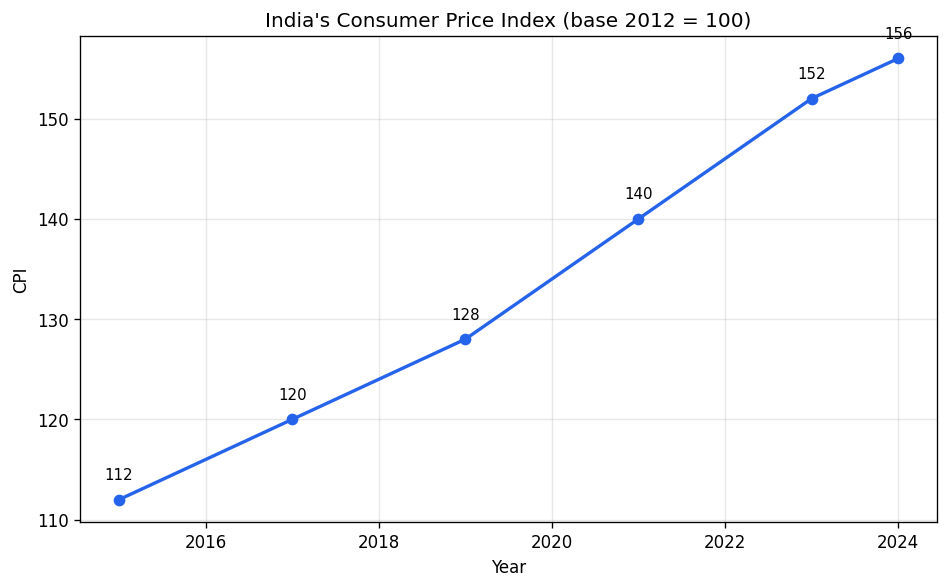
Study India's Consumer Price Index trend and answer:
Between 2015 and 2024 the CPI:
ARose by about 12 points
BRose by about 44 points
CRose by about 56 points
DRose by about 100 points
The CPI value for the base year (2012) is:
A100 (by convention)
B156
CZero
DVaries every year
How is CPI used to convert nominal income into real income?
Show answersHide answers
1. Option 2 — Rose by about 44 points
2. Option 1 — 100 (by convention)
3. Real wage or real income is computed as (Nominal wage × 100) / CPI. By dividing by the CPI and multiplying by 100, we strip out the effect of price changes and get the purchasing power of that income in base-year prices. This adjustment underpins wage indexation (DA), real GDP calculation, and any cross-year comparison of monetary variables.
Q574 Marks
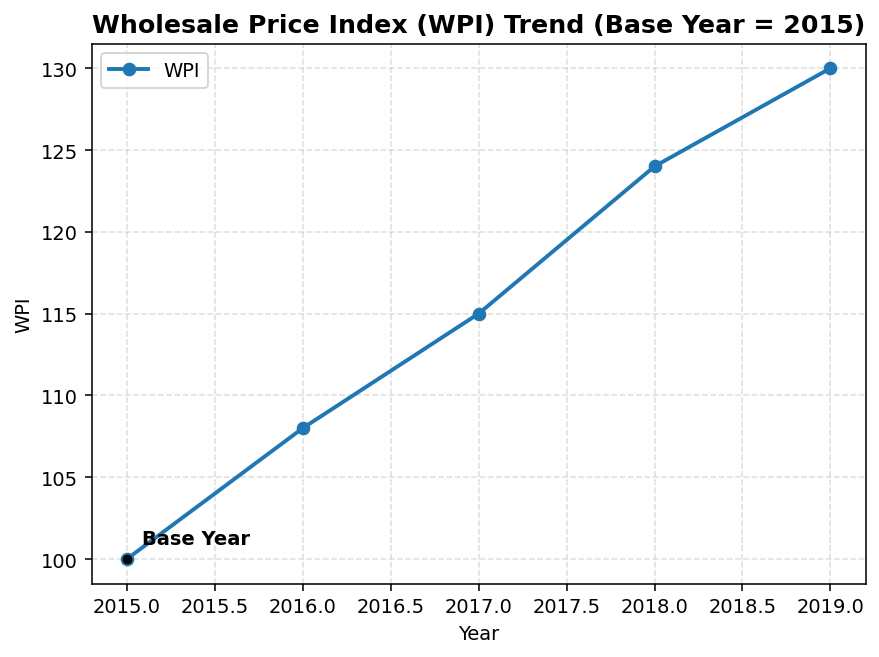
Based on the given chart showing the Wholesale Price Index (WPI) over five years, answer the following:
What is the value of WPI in the base year 2015?
A108
B100
C115
D130
By how many points did the WPI increase from 2015 to 2019?
A20
B24
C30
D15
What does a continuously rising WPI indicate about the economy?
Which of the following best describes the use of WPI?
ATo measure changes in retail prices paid by consumers
BTo measure changes in prices of goods at the wholesale level
CTo measure changes in industrial production
DTo measure changes in national income
Show answersHide answers
1. Option 2 — 100
2. Option 3 — 30
3. A continuously rising WPI indicates inflation in the economy, meaning the general price level of wholesale goods is increasing over time.
4. Option 2 — To measure changes in prices of goods at the wholesale level
Q584 Marks
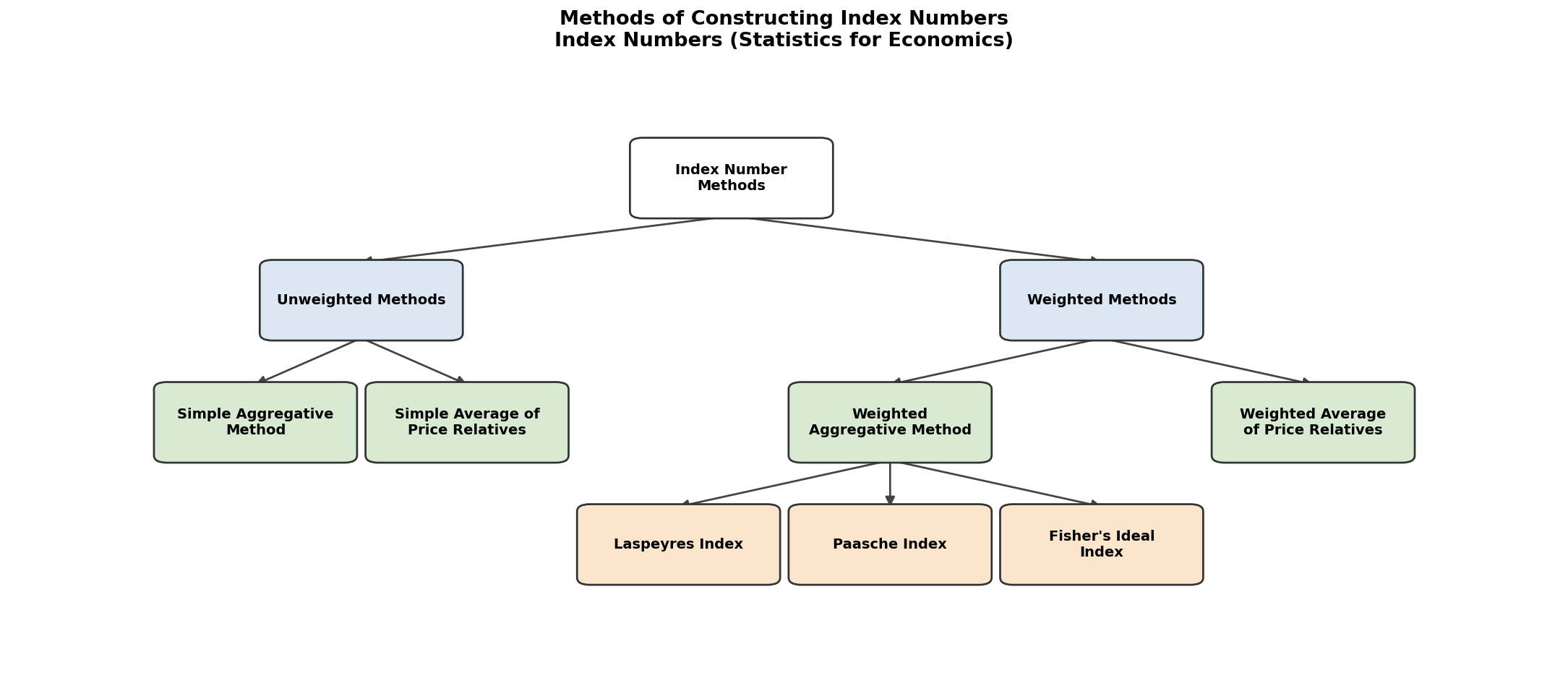
Based on the given flowchart showing the methods of constructing Index Numbers, answer the following:
Which of the following is NOT an unweighted method of constructing index numbers?
ASimple Aggregative Method
BSimple Average of Price Relatives
CLaspeyres Index
DBoth A and B
Why is Fisher's Ideal Index considered 'ideal'?
In the Laspeyres index, which year's quantities are used as weights?
ACurrent year quantities
BBase year quantities
CAverage of base and current year quantities
DAny convenient year's quantities
State one limitation of the Simple Aggregative Method of constructing index numbers.
Show answersHide answers
1. Option 3 — Laspeyres Index
2. Fisher's Ideal Index is considered 'ideal' because it is the geometric mean of Laspeyres and Paasche indices. It satisfies both the Time Reversal Test and the Factor Reversal Test, making it free from bias.
3. Option 2 — Base year quantities
4. A major limitation of the Simple Aggregative Method is that it gives undue importance to commodities with higher prices, as it does not assign any weights to the commodities. The result is influenced by the units in which prices are quoted.
Q594 Marks
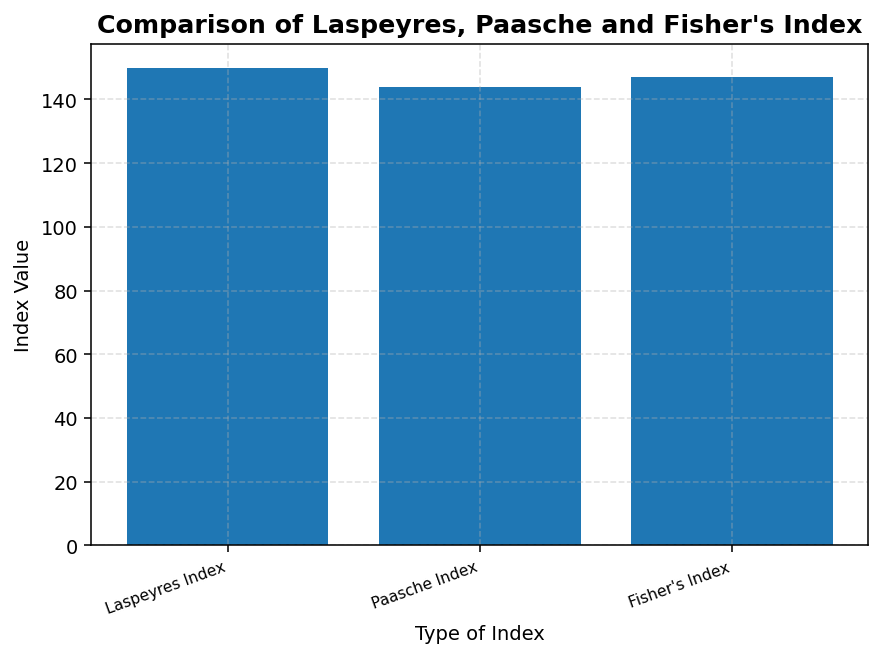
Based on the given bar chart comparing Laspeyres, Paasche, and Fisher's Index values for a given dataset, answer the following:
Which index has the highest value as shown in the chart?
APaasche Index
BFisher's Index
CLaspeyres Index
DAll are equal
How is Fisher's Ideal Index calculated from Laspeyres and Paasche indices?
In the Paasche index, which year's quantities are used as weights?
ABase year quantities
BCurrent year quantities
CGeometric mean of both years
DArithmetic mean of both years
Why does the Laspeyres index tend to overestimate and the Paasche index tend to underestimate the price change?
Show answersHide answers
1. Option 3 — Laspeyres Index
2. Fisher's Ideal Index is calculated as the geometric mean of Laspeyres and Paasche indices. Formula: Fisher's Index = √(Laspeyres Index × Paasche Index). Here, √(150 × 144) = √21600 ≈ 147.
3. Option 2 — Current year quantities
4. The Laspeyres index uses base year quantities as weights. Since consumers tend to buy less of goods that become more expensive, using old quantities overstates the cost of living — leading to overestimation. The Paasche index uses current year quantities, which already reflect substitution away from expensive goods, so it tends to underestimate the true price change.