Skip to content
TestMacher
Chapter 9 · Class 11 Business Studies

Social Responsibilities of Business and Business Ethics — Important Questions

58 questions With answers CBSE format

SUMMARY: This chapter discusses the concept of social responsibility in business and the importance of business ethics in guiding corporate behavior.
KEY TOPICS: social responsibility, business ethics, stakeholders, environmental protection, ethical decision-making, corporate social responsibility (CSR), legal responsibilities, ethical dilemmas, sustainability, social values.

Q1 1 Mark

The concept of social responsibility of business means:

AProfit maximisation only
BObligation of business towards society
CIgnoring stakeholders
DTax avoidance
Check answerHide answer
Correct answer: Option 2 — Obligation of business towards society
Q2 1 Mark

The Companies Act 2013 mandates CSR for companies with net profit of at least:

A₹1 crore
B₹5 crore
C₹10 crore
D₹100 crore
Check answerHide answer
Correct answer: Option 2 — ₹5 crore
Q3 1 Mark

Carbon footprint refers to:

ACost of carbon paper
BGreenhouse gas emissions caused by an entity
CProfit margin
DMarketing expense
Check answerHide answer
Correct answer: Option 2 — Greenhouse gas emissions caused by an entity
Q4 1 Mark

Business ethics refers to:

AGovernment regulation
BMoral principles guiding business conduct
CTax laws
DAuditing rules
Check answerHide answer
Correct answer: Option 2 — Moral principles guiding business conduct
Q5 1 Mark

A whistle-blower is a person who:

AReports unethical practices in their organisation
BSells whistles
CMarkets products
DAudits accounts
Check answerHide answer
Correct answer: Option 1 — Reports unethical practices in their organisation
Q6 1 Mark

What is the primary focus of corporate social responsibility (CSR)?

AMaximizing profits for shareholders
BBalancing profit-making with social good
CReducing operational costs
DIncreasing market share
Check answerHide answer
Correct answer: Option 2 — Balancing profit-making with social good
Q7 1 Mark

Which of the following is NOT a stakeholder in a business?

AEmployees
BCustomers
CCompetitors
DSuppliers
Check answerHide answer
Correct answer: Option 3 — Competitors
Q8 1 Mark

What does business ethics primarily deal with?

ALegal compliance
BMoral principles guiding business behavior
CFinancial performance
DMarket competition
Check answerHide answer
Correct answer: Option 2 — Moral principles guiding business behavior
Q9 1 Mark

Which of the following is an example of an ethical dilemma?

AChoosing between two suppliers based on cost
BDeciding whether to report a colleague's misconduct
CSelecting a marketing strategy
DDetermining product pricing
Check answerHide answer
Correct answer: Option 2 — Deciding whether to report a colleague's misconduct
Q10 1 Mark

Environmental protection in business is primarily concerned with:

AReducing costs
BSustainable practices
CIncreasing production
DMaximizing sales
Check answerHide answer
Correct answer: Option 2 — Sustainable practices
Q11 1 Mark

What is the role of stakeholders in business ethics?

ATo ensure maximum profit
BTo influence ethical decision-making
CTo reduce competition
DTo increase market share
Check answerHide answer
Correct answer: Option 2 — To influence ethical decision-making
Q12 1 Mark

Which of the following best describes sustainability in business?

AShort-term profit maximization
BLong-term resource management
CIncreasing production efficiency
DExpanding market reach
Check answerHide answer
Correct answer: Option 2 — Long-term resource management
Q13 1 Mark

Legal responsibilities of a business are:

AVoluntary commitments
BMandatory obligations set by law
CEthical guidelines
DSocial expectations
Check answerHide answer
Correct answer: Option 2 — Mandatory obligations set by law
Q14 1 Mark

Which of the following is a characteristic of ethical decision-making?

AFocus on profit
BConsideration of stakeholder impact
CAvoiding legal issues
DMaximizing shareholder value
Check answerHide answer
Correct answer: Option 2 — Consideration of stakeholder impact
Q15 1 Mark

What is the impact of unethical behavior on a business?

AImproved customer loyalty
BIncreased profitability
CDamage to reputation
DEnhanced employee morale
Check answerHide answer
Correct answer: Option 3 — Damage to reputation
Q16 3 Marks

Define social responsibility of business and state any three reasons for it.

View sample solutionHide solution
Social responsibility of business is the obligation of businesspersons to pursue policies and make decisions that benefit society as a whole, beyond the immediate interest of the firm and its shareholders. Reasons: (i) businesses use society's resources (natural raw materials, human resources, capital) and must give back; (ii) long-term self-interest — sustainable business needs sustainable communities; (iii) image and reputation — socially responsible firms attract better talent and customers; (iv) avoidance of regulation — voluntary good behaviour pre-empts mandatory laws; (v) corporate citizenship — being a good neighbour in the community.
Q17 3 Marks

Distinguish between social responsibility and business ethics.

View sample solutionHide solution
SOCIAL RESPONSIBILITY — broader concept; refers to obligations toward different groups (shareholders, employees, customers, suppliers, community, government, environment); often involves CSR activities. BUSINESS ETHICS — narrower; refers to moral principles that guide day-to-day decisions and conduct in business (honesty, fairness, integrity); applies to individual choices and organisational policies. Social responsibility looks outward at impact on society; ethics looks at how business is conducted (means, not just ends). A socially responsible firm is usually ethical; an ethical firm should be socially responsible.
Q18 3 Marks

Explain CSR (Corporate Social Responsibility) under Companies Act 2013.

View sample solutionHide solution
CSR under Section 135 of Companies Act 2013 — companies meeting any one of these thresholds must spend at least 2% of average net profits of preceding 3 years on CSR: (a) net worth ≥ ₹500 crore, (b) turnover ≥ ₹1000 crore, (c) net profit ≥ ₹5 crore. Each company must constitute a CSR Committee of the Board. Permitted CSR activities (Schedule VII): poverty eradication, education, healthcare, gender equality, environment sustainability, rural development, sports, technology, slum development, etc. CSR has institutionalised social spending by Indian corporates — billions of rupees flow annually.
Q19 3 Marks

List any three responsibilities of business towards employees.

View sample solutionHide solution
(1) Fair wages and timely payment — adequate compensation for work done. (2) Safe and healthy working conditions — appropriate equipment, ventilation, hygiene. (3) Job security and benefits — minimum wage, PF, ESI, gratuity, leave entitlements. (4) Training and skill development — investment in employee growth. (5) Equal opportunity and non-discrimination — fair treatment regardless of caste, gender, religion. (6) Recognition and respect — appreciation for performance. (7) Grievance redressal mechanism. The relationship between employer and employee should be based on mutual trust and respect.
Q20 3 Marks

Explain the importance of business ethics.

View sample solutionHide solution
Business ethics is important because: (1) Builds trust with customers, employees, suppliers, and society. (2) Long-term success — ethical firms have sustainable competitive advantage; unethical firms eventually face scandals and decline. (3) Avoids legal trouble — ethical conduct prevents fines, lawsuits, regulatory action. (4) Attracts and retains talent — top employees prefer ethical employers. (5) Customer loyalty — ethical brands enjoy repeat business. (6) Investor confidence — ESG investing favours ethical firms. (7) Social welfare — ethics ensures business contributes positively. (8) Self-respect — owners and employees take pride in working for an ethical organisation.
Q21 3 Marks

What is social responsibility in business?

View sample solutionHide solution
Social responsibility in business refers to the obligation of companies to act in ways that benefit society at large, beyond just generating profit for shareholders. It encompasses ethical practices, environmental stewardship, and contributions to community welfare.
Q22 3 Marks

Define business ethics and its significance in corporate behavior.

View sample solutionHide solution
Business ethics are the principles and standards that guide behavior in the world of business. They are significant as they help ensure that a company operates fairly, transparently, and responsibly, fostering trust among stakeholders.
Q23 3 Marks

Who are stakeholders in a business context?

View sample solutionHide solution
Stakeholders are individuals or groups that have an interest in the activities and performance of a business. This includes employees, customers, suppliers, investors, and the community, all of whom can be affected by the company's actions.
Q24 3 Marks

What is corporate social responsibility (CSR)?

View sample solutionHide solution
Corporate social responsibility (CSR) is a business model in which companies integrate social and environmental concerns into their operations and interactions with stakeholders. It reflects a commitment to ethical behavior and sustainable practices.
Q25 3 Marks

How does environmental protection relate to social responsibility?

View sample solutionHide solution
Environmental protection is a key aspect of social responsibility as businesses are expected to minimize their ecological footprint and contribute positively to the environment. This includes sustainable resource use, waste management, and reducing pollution.
Q26 6 Marks

Discuss the role of business in environmental protection.

View sample solutionHide solution
Business has a critical role in environmental protection because industrial activities are major contributors to pollution, climate change, deforestation, and resource depletion. Roles: (1) REDUCE EMISSIONS — adopt clean technologies, energy-efficient processes, renewable energy. (2) WASTE MANAGEMENT — reduce, reuse, recycle; treat industrial effluents; manage e-waste responsibly. (3) RESOURCE EFFICIENCY — water conservation, raw material optimisation. (4) SUSTAINABLE PROCUREMENT — sourcing from eco-friendly suppliers. (5) CARBON OFFSETTING — afforestation, renewable energy projects. (6) ENVIRONMENTAL DISCLOSURE — reporting carbon footprint, water usage in annual reports. (7) COMPLIANCE — adhering to laws like Air Act 1981, Water Act 1974, Environment Protection Act 1986. (8) GREEN PRODUCTS — designing products that minimise environmental harm. (9) EMPLOYEE AWARENESS — environmental training. (10) STAKEHOLDER ENGAGEMENT — addressing community concerns. Increasingly stringent regulations and growing consumer awareness make environmental responsibility business-critical.
Q27 6 Marks

Explain the various dimensions of social responsibility (towards different stakeholder groups).

View sample solutionHide solution
Business has responsibilities to multiple stakeholder groups: (1) TOWARDS OWNERS/SHAREHOLDERS — fair return on investment, transparent reporting, responsible use of capital, good governance. (2) TOWARDS EMPLOYEES — fair wages, safe working conditions, training, non-discrimination, grievance redressal, job security. (3) TOWARDS CUSTOMERS — quality products, fair prices, accurate information, after-sales service, grievance handling, no false advertising. (4) TOWARDS SUPPLIERS — fair prices, timely payment, long-term partnerships, ethical sourcing. (5) TOWARDS GOVERNMENT — paying taxes honestly, complying with laws, supporting national priorities. (6) TOWARDS COMMUNITY — local employment, infrastructure development, supporting local businesses, philanthropy. (7) TOWARDS ENVIRONMENT — pollution control, resource conservation, sustainable practices. (8) TOWARDS COMPETITORS — fair competition, no industrial espionage. The relative weight given to each group varies by industry and company; modern stakeholder theory says all groups deserve consideration.
Q28 6 Marks

Discuss the role of business ethics in business management.

View sample solutionHide solution
Business ethics provides the moral compass for managerial decisions. ROLE: (1) DECISION-MAKING — managers face daily ethical dilemmas (whether to disclose risks, whether to honour an unprofitable contract, whether to reduce quality to cut costs). Ethics provides the framework. (2) STAKEHOLDER RELATIONS — ethical conduct with customers (no fraud), employees (fair treatment), suppliers (timely payment), competitors (fair play). (3) CORPORATE CULTURE — ethics shapes the values and practices that define how a firm operates. (4) RISK MANAGEMENT — unethical actions create legal, reputational, and operational risks. (5) BRAND BUILDING — ethical reputation is a long-term asset. (6) WHISTLEBLOWER PROTECTION — ethical organisations encourage employees to report wrongdoing. (7) CORPORATE GOVERNANCE — ethics underlies the principles of board oversight, transparency, fairness. (8) ESG PERFORMANCE — environmental, social, governance metrics increasingly drive investment decisions. (9) GLOBAL OPERATIONS — ethics provides common ground when operating across cultures. (10) LONG-TERM SUSTAINABILITY — only ethical businesses survive over generations.
Q29 6 Marks

Explain CSR and its provisions under the Companies Act 2013.

View sample solutionHide solution
Corporate Social Responsibility (CSR) is the obligation of corporates to contribute to economic development while improving the quality of life of the workforce, their families, the local community, and society at large. PROVISIONS UNDER COMPANIES ACT 2013 (Section 135 and Schedule VII): (1) APPLICABILITY — companies meeting any of these in any financial year: net worth ≥ ₹500 crore, OR turnover ≥ ₹1000 crore, OR net profit ≥ ₹5 crore. (2) CSR COMMITTEE — Board must constitute a CSR Committee of at least 3 directors (1 independent for listed companies). (3) CSR POLICY — Committee formulates a policy specifying activities to be undertaken. (4) MINIMUM SPEND — at least 2% of average net profits of preceding 3 financial years. (5) ELIGIBLE ACTIVITIES (Schedule VII) — eradicating poverty and hunger, education, gender equality, environmental sustainability, healthcare, sports, technology incubators, slum area development, rural development, war veteran welfare. (6) DISCLOSURE — annual report must contain CSR details and reasons for under-spend if any. (7) PENALTY — for non-compliance, company and directors face penalties as per Section 135(7). (8) IMPLEMENTATION — through company itself, registered trust, society, Section 8 company, or government bodies. CSR has channelled billions into social causes and become a defining feature of Indian corporate practice.
Q30 6 Marks

Discuss the various elements of business ethics.

View sample solutionHide solution
Elements of business ethics include: (1) HONESTY — telling the truth in dealings with customers, employees, suppliers, regulators. (2) INTEGRITY — adherence to moral principles even when no one is watching. (3) FAIRNESS — equitable treatment of stakeholders; non-discrimination. (4) TRUSTWORTHINESS — keeping promises and commitments. (5) RESPECT — for employees, customers, partners, competitors. (6) RESPONSIBILITY — accountability for actions and decisions. (7) CITIZENSHIP — abiding by the law and contributing to community welfare. (8) COMPLIANCE — following all applicable laws and regulations. (9) CONFIDENTIALITY — protecting sensitive information of clients and employees. (10) AVOIDING CONFLICTS OF INTEREST — separating personal and business interests. ETHICAL CULTURE is built through: (a) clear code of conduct and ethics policy; (b) ethics training programmes; (c) ethical role-modelling by leaders; (d) whistleblower protection mechanisms; (e) regular ethics audits; (f) consequences for unethical behaviour. Modern firms institutionalise ethics through Chief Ethics Officers, Ethics Committees, anonymous reporting hotlines.
Q31 6 Marks

Differentiate between business risk and entrepreneurial risk in tabular form.

Q32 1 Mark

Assertion (A): Business has a responsibility towards society.

Reason (R): Business uses society's resources and must give back through socially beneficial activities.

Show explanationHide explanation
Correct answer: Option 1 — Both A and R are true, and R is the correct explanation of A.
Q33 1 Mark

Assertion (A): CSR is mandatory for large companies in India.

Reason (R): Section 135 of Companies Act 2013 requires eligible companies to spend at least 2% of average profits on CSR.

Show explanationHide explanation
Correct answer: Option 1 — Both A and R are true, and R is the correct explanation of A.
Q34 1 Mark

Assertion (A): Businesses have a major responsibility for environmental protection.

Reason (R): Industrial activities are significant contributors to pollution and climate change.

Show explanationHide explanation
Correct answer: Option 1 — Both A and R are true, and R is the correct explanation of A.
Q35 1 Mark

Assertion (A): Business ethics builds long-term competitive advantage.

Reason (R): Trustworthy firms attract better customers employees and investors than untrustworthy ones.

Show explanationHide explanation
Correct answer: Option 1 — Both A and R are true, and R is the correct explanation of A.
Q36 1 Mark

Assertion (A): Whistleblower protection encourages reporting of unethical practices.

Reason (R): Without protection employees fear retaliation and remain silent about wrongdoing.

Show explanationHide explanation
Correct answer: Option 1 — Both A and R are true, and R is the correct explanation of A.
Q37 1 Mark

Assertion (A): Social responsibility is essential for the long-term success of a business.

Reason (R): Businesses that engage in socially responsible practices tend to build better relationships with their stakeholders.

Show explanationHide explanation
Correct answer: Option 1 — Both A and R are true, and R is the correct explanation of A.
Q38 1 Mark

Assertion (A): Business ethics are only relevant to large corporations.

Reason (R): Ethical practices are important for businesses of all sizes to maintain trust and credibility.

Show explanationHide explanation
Correct answer: Option 4 — A is false, but R is true.
Q39 1 Mark

Assertion (A): Corporate social responsibility (CSR) focuses solely on profit maximization.

Reason (R): CSR encompasses a broader commitment to societal well-being beyond just profits.

Show explanationHide explanation
Correct answer: Option 4 — A is false, but R is true.
Q40 1 Mark

Statement 1: Business has responsibilities to multiple stakeholders.

Statement 2: These include shareholders employees customers suppliers community and environment.

Show answerHide answer
Correct answer: Option 1 — Both statements are true.
Q41 1 Mark

Statement 1: A company with net profit of ₹5 crore is liable for CSR.

Statement 2: The Companies Act 2013 mandates CSR for companies meeting certain financial thresholds.

Show answerHide answer
Correct answer: Option 1 — Both statements are true.
Q42 1 Mark

Statement 1: Honesty and integrity are core elements of business ethics.

Statement 2: Ethical conduct underlies all stakeholder relationships.

Show answerHide answer
Correct answer: Option 1 — Both statements are true.
Q43 1 Mark

Statement 1: Education and healthcare are common CSR activities in India.

Statement 2: Schedule VII of Companies Act 2013 lists permissible CSR activities.

Show answerHide answer
Correct answer: Option 1 — Both statements are true.
Q44 1 Mark

Statement 1: Environmental responsibility is increasingly important.

Statement 2: Climate change pollution and resource depletion threaten long-term business viability.

Show answerHide answer
Correct answer: Option 1 — Both statements are true.
Q45 1 Mark

Statement 1: Social responsibility refers to the obligation of a business to contribute to the well-being of society.

Statement 2: Business ethics are only concerned with legal compliance and do not involve moral values.

Show answerHide answer
Correct answer: Option 2 — Only Statement 1 is true.
Q46 1 Mark

Statement 1: Corporate social responsibility (CSR) is a concept that encourages businesses to conduct themselves ethically and contribute to economic development.

Statement 2: CSR initiatives can sometimes conflict with a company's profit motives.

Show answerHide answer
Correct answer: Option 1 — Both statements are true.
Q47 1 Mark

Statement 1: Stakeholders in a business include only shareholders and employees.

Statement 2: Stakeholders can also include customers, suppliers, and the community.

Show answerHide answer
Correct answer: Option 3 — Only Statement 2 is true.
Q48 3 Marks
M/s Vikram Textiles is a textile dyeing factory near a river. Local villagers complain that the factory's untreated effluent is polluting the river killing fish and harming villagers' health. The State Pollution Control Board issues a notice. The owner Mr Vikram considers either installing a ₹50 lakh effluent treatment plant or relocating the factory.
  1. Mr Vikram has a duty to address pollution because of:
    ACompliance with law
    BEnvironmental responsibility
    CBoth
    DNeither
  2. Indian environmental laws applicable include:
    AAir Act 1981
    BWater Act 1974
    CEnvironment Protection Act 1986
    DAll of these
  3. Recommend the right course of action and explain Vikram's responsibilities.
Show answersHide answers
1. Option 3 — Both
2. Option 4 — All of these
3. Mr Vikram has both LEGAL and ETHICAL obligations. LEGAL: (1) Water (Prevention and Control of Pollution) Act 1974 — sets standards for effluent discharge; SPCB can order closure. (2) Environment (Protection) Act 1986 — broader environmental framework. (3) Companies Act CSR provisions if applicable. Failure to comply can result in fines, prosecution, and closure. ETHICAL responsibility: businesses use society's resources (water, land, air) and must NOT harm society in return. Polluting the river is a clear ethical breach — it harms the health and livelihood of villagers, kills wildlife, and damages the ecosystem. RECOMMENDATION: Install effluent treatment plant. The ₹50 lakh investment is recoverable through: (1) avoiding fines and closure costs; (2) reduced pollution insurance premiums; (3) better community relations (no protests); (4) stronger reputation; (5) compliance demonstrating sustainability for ESG investors. Relocation only shifts the problem. The bigger lesson: integrate environmental responsibility from day one rather than as an afterthought. Indian textile industry is known for water pollution — Tirupur, Surat, and Sanganer have all faced similar issues; many have invested in zero liquid discharge systems.
Q49 3 Marks
M/s Sun Pharma had average net profit of ₹500 crore over 3 years. As per Companies Act 2013 it must spend 2% of average profits on CSR. The company's CSR Committee proposes initiatives in healthcare (free medicines for tuberculosis patients), education (scholarships for needy students), and environment (planting 10000 trees).
  1. The mandatory CSR spend is what % of average net profits?
    A1%
    B2%
    C5%
    D10%
  2. The required CSR amount per year for Sun Pharma is approximately:
    A₹5 crore
    B₹10 crore
    C₹100 crore
    DNo CSR required
  3. Calculate the CSR amount and discuss the policy framework.
Show answersHide answers
1. Option 2 — 2%
2. Option 2 — ₹10 crore
3. Sun Pharma's CSR is governed by Section 135 of Companies Act 2013. APPLICABILITY: companies meeting any of these in any financial year — net worth ≥ ₹500 crore OR turnover ≥ ₹1000 crore OR net profit ≥ ₹5 crore. Sun Pharma meets the threshold. CSR AMOUNT: 2% of average net profits of preceding 3 years = 2% × 500 crore = ₹10 crore per year. PERMISSIBLE ACTIVITIES (Schedule VII of Companies Act 2013): include healthcare, education, environment sustainability, gender equality, poverty alleviation, sports, technology incubators, slum development, rural development. The company's proposals (TB medicines, scholarships, tree planting) all qualify. CSR COMMITTEE: must have at least 3 directors, including 1 independent for listed companies. Committee formulates the CSR Policy. ANNUAL REPORT: must contain CSR details and reasons for under-spend (if any). PENALTY for non-compliance: company and officers face penalties as per Section 135(7) — including the unspent amount being treated as a charge. CSR has institutionalised social spending in India — billions of rupees flow into health, education, and environment annually. The healthcare focus is particularly relevant for a pharma company — leveraging its core competence for societal benefit (giving medicines and supporting public health). Tree planting addresses environmental concerns. The mix balances different stakeholder needs.
Q50 3 Marks
Mr Ramesh is a senior accountant at M/s Lite Industries. He notices that the company has been overstating revenues by booking sales not actually made. He believes this misleads investors. He reports this to the Audit Committee through the company's whistleblower hotline.
  1. Mr Ramesh first reports the fraud to:
    AAudit Committee
    BBank
    CCustomers
    DGovernment
  2. A person who exposes unethical practices in their organisation is called:
    AA traitor
    BA whistleblower
    CA spy
    DAn auditor
  3. Discuss the role of whistleblowing in promoting business ethics.
Show answersHide answers
1. Option 1 — Audit Committee
2. Option 2 — A whistleblower
3. WHISTLEBLOWING is the act of reporting unethical or illegal practices observed within an organisation. Mr Ramesh's action is ETHICAL and LEGAL: (1) ACCOUNTING FRAUD harms investors who rely on financial statements for investment decisions; (2) Section 177 of Companies Act 2013 mandates large companies to have a whistleblower mechanism (Vigil Mechanism); (3) ETHICAL employees have a duty to flag wrongdoing not just maximise personal gain. PROTECTION FOR WHISTLEBLOWER: (a) Companies Act protects from retaliation; (b) Whistleblowers Protection Act 2014 provides general protection; (c) good companies have anti-retaliation policies. PROCEDURE: (1) Internal first — Audit Committee or whistleblower hotline. (2) External (if no action internally) — SEBI, Ministry of Corporate Affairs, or media. Ramesh's choice to use INTERNAL channels first is appropriate — gives company chance to investigate and act. EXPECTED CONSEQUENCES: (1) Audit Committee investigates with external help (forensic auditors); (2) If proven, company restates accounts, takes action against responsible officers; (3) SEBI may impose penalties for misleading investors; (4) Lessons for stronger internal controls. The Satyam scandal (2009) — biggest accounting fraud in Indian corporate history — was exposed by founder's confession but a whistleblower could have caught it earlier. STRONG WHISTLEBLOWER FRAMEWORKS prevent and detect fraud, protect investor interests, and enforce business ethics.
Q51 4 Marks
Tata Group has long been recognized as one of India's most socially responsible corporations. The company invests heavily in education, healthcare, and rural development programs. Tata Steel, for instance, runs schools and hospitals in Jamshedpur for its employees and the surrounding community. The group also focuses on environmental protection by reducing carbon emissions and adopting sustainable manufacturing practices. Tata's approach reflects the idea that businesses have responsibilities not just to their shareholders but to all stakeholders — including employees, customers, the local community, and society at large. This philosophy aligns with the concept of Corporate Social Responsibility (CSR), which encourages businesses to go beyond profit-making and contribute positively to society. The Companies Act, 2013 in India mandates that companies above a certain threshold spend 2% of their average net profits on CSR activities.
  1. Corporate Social Responsibility (CSR) primarily means that businesses should:
    AMaximize profits for shareholders only
    BContribute positively to society beyond profit-making
    CAvoid paying taxes legally
    DFocus solely on employee welfare
  2. Under the Companies Act, 2013, eligible companies are required to spend what percentage of their average net profits on CSR activities?
    A1%
    B3%
    C2%
    D5%
  3. Who are stakeholders in the context of social responsibility of business?
  4. Tata Group's investment in schools and hospitals in Jamshedpur is an example of which dimension of social responsibility?
    AEconomic responsibility
    BLegal responsibility
    CEthical responsibility
    DSocial responsibility towards the community
Show answersHide answers
1. Option 2 — Contribute positively to society beyond profit-making
2. Option 3 — 2%
3. Stakeholders are all those individuals and groups who are affected by or have an interest in the operations and decisions of a business. They include shareholders, employees, customers, suppliers, the local community, government, and society at large.
4. Option 4 — Social responsibility towards the community
Q52 3 Marks

Stakeholder responsibilities of business:

StakeholderKey responsibilities
Owners/ShareholdersFair return; transparent reporting; good governance
EmployeesFair wages; safe conditions; training; non-discrimination
CustomersQuality products; fair prices; truthful advertising; service
SuppliersFair prices; timely payment; long-term partnerships
GovernmentHonest tax payment; legal compliance
CommunityLocal employment; CSR; social development
EnvironmentPollution control; resource conservation; sustainable practices
CompetitorsFair competition; no industrial espionage
  1. Timely payment is a responsibility primarily towards:
    ACustomers
    BSuppliers
    CGovernment
    DOwners
  2. Pollution control is responsibility towards:
    AQuality products
    BPollution control
    CFair return
    DLocal employment
  3. Why is balancing all stakeholders better than focusing only on shareholders?
Show answersHide answers
1. Option 2 — Suppliers
2. Option 2 — Pollution control
3. Modern stakeholder theory recognises that business has obligations to multiple groups. Each stakeholder contributes resources or has interests; business must balance all. OWNERS/SHAREHOLDERS provide capital and bear residual risk — responsibilities: fair return, transparent reporting, good governance, dividend, capital appreciation. EMPLOYEES provide labour — responsibilities: fair wages, safe working conditions, training, non-discrimination, grievance redressal, recognition. CUSTOMERS provide revenue — responsibilities: quality products at fair prices, truthful advertising, after-sales service, grievance handling. SUPPLIERS provide inputs — responsibilities: fair prices, timely payment, ethical sourcing, long-term partnerships. GOVERNMENT provides legal infrastructure — responsibilities: honest tax payment, legal compliance, supporting national priorities. COMMUNITY provides operating environment — responsibilities: local employment, CSR, infrastructure development. ENVIRONMENT provides natural resources — responsibilities: pollution control, resource conservation, sustainable practices, climate action. COMPETITORS — responsibilities: fair competition, no industrial espionage. Failing any stakeholder weakens the business. Modern firms publish ESG reports detailing their performance across all stakeholder dimensions.
Q53 3 Marks

Elements of business ethics:

ElementMeaningExample
HonestyTruth in dealingsNo false advertising
IntegrityAdhering to principlesEven when no one is watching
FairnessEquitable treatmentEqual pay for equal work
RespectFor all stakeholdersListening to grievances
ResponsibilityAccountabilityOwning up to mistakes
CitizenshipAbiding by lawTax compliance
ConfidentialityProtecting informationCustomer data privacy
Avoiding conflicts of interestPersonal vs business interestsDisclose conflicts
  1. Which is an element of business ethics?
    AHonesty
    BFairness
    CConfidentiality
    DAll
  2. Customer data privacy is part of business ethics.
    AYes
    BNo
    CSometimes
    DOptional
  3. Why is having a code of conduct alone insufficient for ethical behaviour?
Show answersHide answers
1. Option 4 — All
2. Option 1 — Yes
3. Business ethics is a system of moral principles that guide business decisions. The KEY ELEMENTS work together to create an ethical organisation. HONESTY in advertising, financial reporting, and stakeholder communication. INTEGRITY means adhering to principles even when there's no immediate cost — important during market downturns when temptation to compromise is high. FAIRNESS in pay, promotion, customer treatment, supplier dealings. RESPECT for employees, customers, partners, competitors, and community. RESPONSIBILITY for actions and decisions; willingness to face consequences. CITIZENSHIP — abiding by laws and contributing to society. CONFIDENTIALITY of sensitive customer and employee data; especially crucial in digital age. AVOIDING CONFLICTS OF INTEREST — disclosing personal stakes that might bias business decisions. To INSTITUTIONALISE these elements: (1) clear code of conduct; (2) ethics training; (3) ethical role-modelling by leaders; (4) whistleblower mechanisms; (5) regular ethics audits; (6) consequences for unethical behaviour. Modern firms increasingly have Chief Ethics Officers, Ethics Committees, anonymous reporting hotlines. Ethics is now seen as a competitive advantage, not just a constraint.
Q54 6 Marks

Compute the mandatory CSR amount for a company under Companies Act 2013.

ItemAmount
Net Profit Year 1₹400 crore
Net Profit Year 2₹500 crore
Net Profit Year 3₹600 crore
Average Net Profit (3 years)? ₹500 crore
CSR Rate2%
CSR Amount per Year? ₹10 crore
Q55 6 Marks

Match each business stakeholder with the corresponding responsibility.

StakeholderResponsibility
Shareholders? Fair return + transparent reporting
Employees? Fair wages + safe conditions
Customers? Quality + fair price
Suppliers? Fair price + timely payment
Government? Tax + compliance
Community? Local employment + CSR
Environment? Pollution control + sustainability
Q56 3 Marks

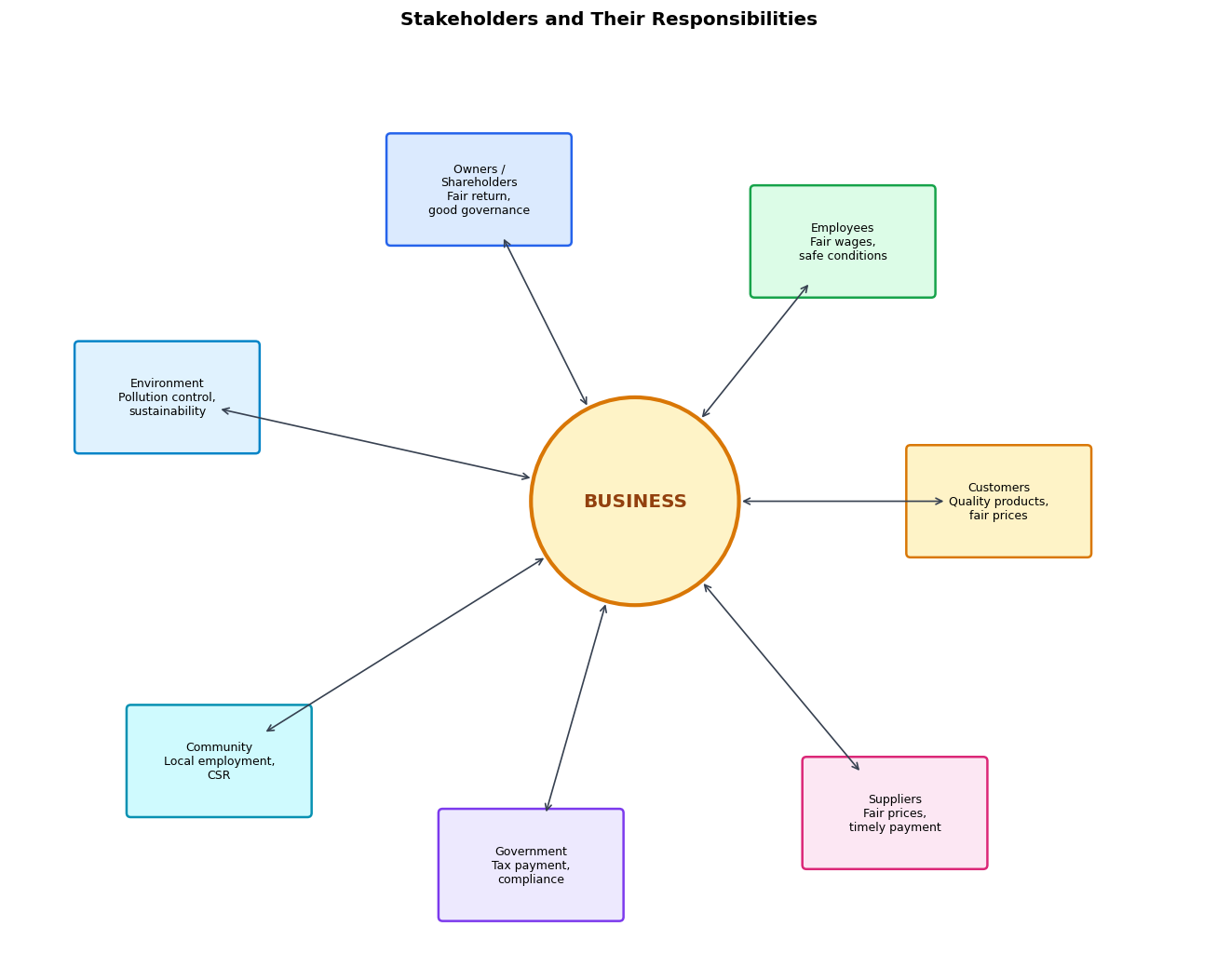
Study the stakeholder responsibility wheel and answer:

Social Responsibilities of Business and Business Ethics figure
  1. Modern stakeholder theory says business has obligations to:
    AShareholders only
    BGovernment only
    CMultiple groups
    DCustomers only
  2. Timely payment is a responsibility primarily towards:
    ACustomers
    BSuppliers
    CGovernment
    DOwners
  3. Explain the responsibilities of business towards each stakeholder group.
Show answersHide answers
1. Option 3 — Multiple groups
2. Option 2 — Suppliers
3. Modern stakeholder theory recognises that business has obligations to multiple groups, not just shareholders. Each stakeholder contributes resources or has interests; business must balance all. OWNERS/SHAREHOLDERS provide capital and bear residual risk — responsibilities: fair return, transparent reporting, good governance. EMPLOYEES provide labour — responsibilities: fair wages, safe working conditions, training, non-discrimination, grievance redressal. CUSTOMERS provide revenue — responsibilities: quality products at fair prices, truthful advertising, after-sales service. SUPPLIERS provide inputs — responsibilities: fair prices, timely payment, ethical sourcing. GOVERNMENT provides legal infrastructure — responsibilities: honest tax payment, legal compliance. COMMUNITY provides operating environment — responsibilities: local employment, CSR, infrastructure development. ENVIRONMENT provides natural resources — responsibilities: pollution control, resource conservation, sustainable practices. Failing any stakeholder weakens the business. Modern firms publish ESG reports.
Q57 28 Marks

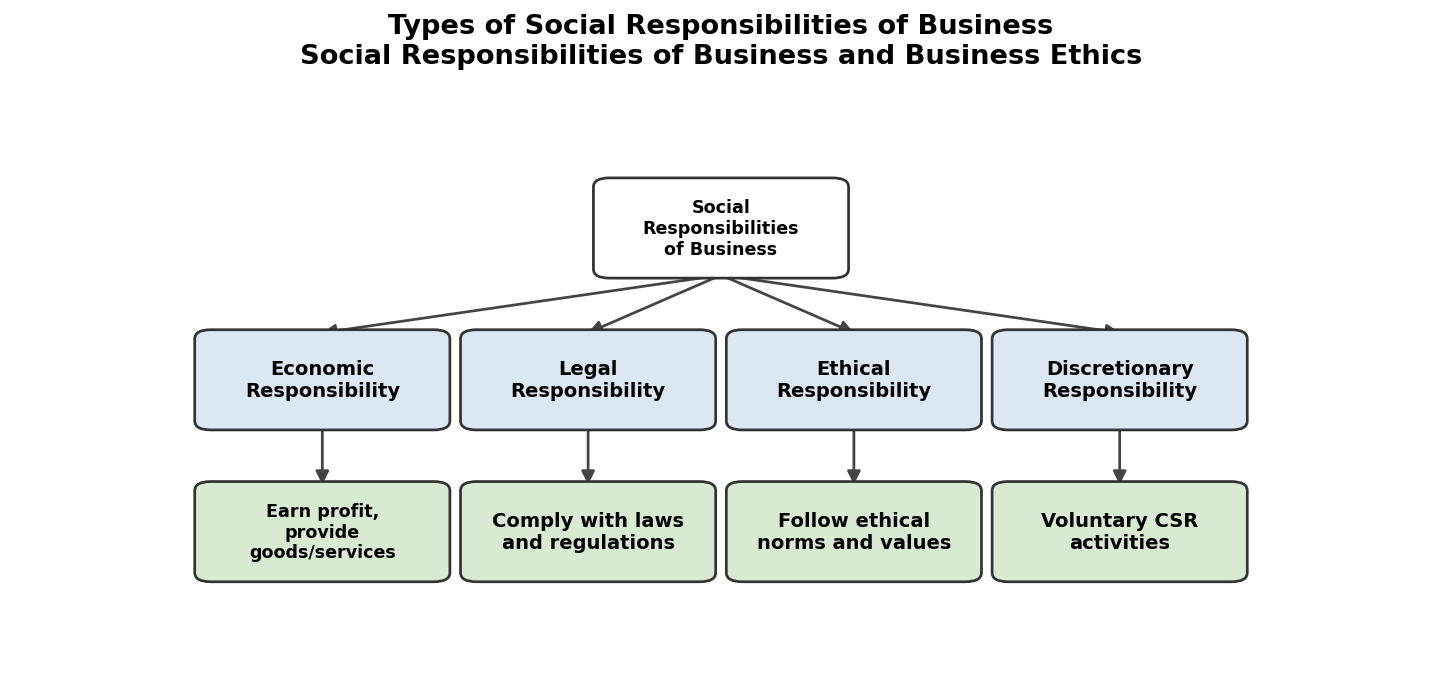
Based on the given diagram, answer the following:

Social Responsibilities of Business and Business Ethics figure
  1. Which type of social responsibility refers to a business's obligation to comply with laws and regulations set by the government?
    AEconomic Responsibility
    BEthical Responsibility
    CLegal Responsibility
    DDiscretionary Responsibility
  2. According to the diagram, which responsibility is considered the foundation of all other responsibilities and why?
  3. Discretionary Responsibility as shown in the diagram refers to:
    AMandatory compliance with tax laws
    BVoluntary CSR activities beyond legal requirements
    CFollowing ethical norms set by society
    DEarning maximum profit for shareholders
  4. Distinguish between Ethical Responsibility and Legal Responsibility as shown in the diagram.
  5. Which of the following is an INTERNAL stakeholder of a business as shown in the diagram?
    AGovernment
    BConsumers
    CEmployees
    DCommunity
  6. What is the social responsibility of a business towards its consumers as depicted in the diagram?
  7. According to the diagram, the responsibility of a business towards the Government includes:
    APaying fair wages to workers
    BPaying taxes honestly and following regulations
    CProviding quality products to consumers
    DProtecting the natural environment
  8. Why is 'Community/Society' classified as an external stakeholder? Explain the business's responsibility towards it.
  9. Which element of business ethics shown in the diagram ensures that a company does not engage in fraud or deception?
    AFairness in Dealing
    BHonesty and Integrity
    CCompliance with Laws
    DTransparency and Accountability
  10. How does 'Environmental Responsibility' as shown in the diagram relate to the concept of sustainability in business ethics?
  11. Transparency and Accountability as an element of business ethics means:
    AKeeping all financial records secret from the public
    BOpen and honest reporting of business activities to stakeholders
    CMaximizing profit at any cost
    DAvoiding payment of taxes
  12. Define Business Ethics. Explain any two elements shown in the diagram that help a business maintain ethical standards.
  13. Which type of social responsibility refers to a business obeying all applicable laws and regulations?
    AEconomic Responsibility
    BEthical Responsibility
    CLegal Responsibility
    DDiscretionary Responsibility
  14. According to the diagram, which responsibility is considered the foundation of all other responsibilities?
    ADiscretionary Responsibility
    BEthical Responsibility
    CLegal Responsibility
    DEconomic Responsibility
  15. Distinguish between Ethical Responsibility and Discretionary Responsibility as shown in the diagram.
  16. Give one example of a business fulfilling its Discretionary Responsibility.
  17. Which of the following is an INTERNAL stakeholder of a business?
    ACustomers
    BGovernment
    CEmployees
    DCreditors
  18. What is the social responsibility of a business towards its customers as shown in the diagram?
    AMaximise profits at all costs
    BProvide quality goods at fair prices and avoid misleading advertisements
    CPay taxes to the government regularly
    DProvide safe working conditions
  19. Explain the responsibility of a business towards the community/society as one of its external stakeholders.
  20. Why are shareholders considered the most important internal stakeholders of a business?
  21. Which element of business ethics involves creating written guidelines for employee conduct?
    ATop Management Commitment
    BPublication of Code of Ethics
    CMeasuring Ethical Results
    DEstablishment of Compliance Mechanism
  22. Why is 'Top Management Commitment' considered the most critical element of business ethics?
    ABecause top managers earn the highest salaries
    BBecause top management sets the ethical tone and culture for the entire organisation
    CBecause top management is responsible for legal compliance only
    DBecause top management deals directly with customers
  23. What is meant by 'Establishment of Compliance Mechanism' as an element of business ethics? Explain with an example.
  24. Define Business Ethics and state any two reasons why it is important for a business to follow ethical practices.
  25. Which level of CSR shown in the diagram is considered the foundation without which a business cannot survive?
    ALegal Responsibility
    BEthical Responsibility
    CEconomic Responsibility
    DPhilanthropic Responsibility
  26. Distinguish between Legal Responsibility and Ethical Responsibility as shown in the diagram.
  27. Which of the following best describes Philanthropic Responsibility as depicted in the diagram?
    APaying taxes on time to the government
    BVoluntarily contributing to social welfare activities
    CEnsuring products meet legal safety standards
    DMaximising shareholder wealth
  28. Why is it important for a business to fulfil all four levels of CSR shown in the diagram rather than focusing only on economic responsibility? Explain briefly.
  29. According to the diagram, which element of business ethics involves leaders setting an ethical tone for the entire organisation?
    ACode of Conduct
    BCompliance Mechanism
    CTop Management Commitment
    DStakeholder Awareness
  30. What is a 'Code of Conduct' as shown in the diagram? Why is it important for a business organisation?
  31. Which element in the diagram refers to monitoring and enforcing ethical practices within a business?
    AEthical Decision Making
    BStakeholder Awareness
    CTop Management Commitment
    DCompliance Mechanism
  32. Explain the concept of 'Ethical Decision Making' as depicted in the diagram and describe a situation where a business might face an ethical dilemma.
Show answersHide answers
1. Option 3 — Legal Responsibility
2. Economic Responsibility is considered the foundation because a business must first earn profits and provide goods/services to survive. Without economic viability, a business cannot fulfill its other responsibilities.
3. Option 2 — Voluntary CSR activities beyond legal requirements
4. Legal Responsibility involves complying with laws and regulations enforced by the government, whereas Ethical Responsibility involves following moral norms, values, and standards that society expects from a business, even if not legally mandated.
5. Option 3 — Employees
6. The social responsibility of a business towards consumers includes providing quality goods and services at fair prices, ensuring accurate information, avoiding misleading advertisements, and protecting consumer rights.
7. Option 2 — Paying taxes honestly and following regulations
8. Community/Society is an external stakeholder because it is outside the internal structure of the business but is affected by its operations. A business's responsibility towards society includes generating employment, avoiding pollution, supporting social causes, and contributing to community development through CSR activities.
9. Option 2 — Honesty and Integrity
10. Environmental Responsibility in business ethics means that businesses must adopt sustainable practices such as reducing pollution, conserving natural resources, and minimizing waste. This ensures that the needs of the present generation are met without compromising the ability of future generations to meet their own needs, thus linking directly to the concept of sustainability.
11. Option 2 — Open and honest reporting of business activities to stakeholders
12. Business Ethics refers to the application of ethical principles and moral standards to business activities, decisions, and relationships. Two elements: (1) Honesty and Integrity – A business must be truthful in its dealings, avoid fraud, and maintain trust with all stakeholders. (2) Fairness in Dealing – A business must treat all parties — employees, customers, suppliers — equitably and without discrimination or exploitation.
13. Option 3 — Legal Responsibility
14. Option 4 — Economic Responsibility
15. Ethical Responsibility involves following moral norms and values that go beyond legal requirements, such as fair trade practices. Discretionary Responsibility refers to voluntary activities undertaken by a business for social welfare, such as donating to charity or running community programs, which are not legally mandated.
16. A business setting up schools or hospitals in rural areas, or funding environmental conservation projects voluntarily, is an example of fulfilling Discretionary (CSR) Responsibility.
17. Option 3 — Employees
18. Option 2 — Provide quality goods at fair prices and avoid misleading advertisements
19. A business has the responsibility towards the community to avoid polluting the environment, generate employment, contribute to social welfare activities, support local development, and not engage in practices that harm public health or social values.
20. Shareholders are considered the most important internal stakeholders because they invest capital in the business, bear the risk of loss, and are entitled to a fair return on their investment (dividends). The business has a primary responsibility to ensure their investment is protected and yields reasonable returns.
21. Option 2 — Publication of Code of Ethics
22. Option 2 — Because top management sets the ethical tone and culture for the entire organisation
23. Establishment of Compliance Mechanism refers to creating systems and procedures within the organisation that allow employees to report unethical behaviour without fear of retaliation. For example, setting up a confidential helpline or a whistleblower policy where employees can report fraud, corruption, or violations of the code of ethics.
24. Business Ethics refers to the application of ethical principles and moral standards to business activities, relationships, and decisions. Importance: (1) It builds trust and goodwill among customers, employees, and the public, enhancing the long-term reputation of the business. (2) It helps avoid legal penalties and regulatory actions by ensuring the business operates within the bounds of law and moral norms.
25. Option 3 — Economic Responsibility
26. Legal Responsibility refers to the obligation of a business to comply with laws and regulations set by the government, whereas Ethical Responsibility refers to following moral norms and values that go beyond legal requirements. Legal responsibilities are mandatory, while ethical responsibilities are based on what is considered right and fair by society.
27. Option 2 — Voluntarily contributing to social welfare activities
28. Focusing only on economic responsibility means a business only aims at profit, which can lead to exploitation of stakeholders and society. Fulfilling all four levels ensures the business operates legally, behaves ethically, and contributes to social welfare, thereby building trust, goodwill, and long-term sustainability. It also helps maintain a positive relationship with all stakeholders including customers, employees, government, and the community.
29. Option 3 — Top Management Commitment
30. A Code of Conduct is a set of written rules and guidelines that define acceptable behaviour for employees and management within an organisation. It is important because it provides clear standards for ethical behaviour, helps prevent misconduct, ensures consistency in decision-making, and builds trust among stakeholders. It serves as a reference point for resolving ethical dilemmas.
31. Option 4 — Compliance Mechanism
32. Ethical Decision Making involves choosing the right course of action over the merely profitable one when faced with a conflict between business interests and moral values. For example, a business might face an ethical dilemma when it discovers that a cheaper raw material supplier uses child labour. The ethical decision would be to stop sourcing from that supplier despite higher costs, because using child labour violates moral and social values, even if it is not explicitly illegal in that region. This reflects the principle of choosing what is right over what is merely profitable.

Q58 11 Marks

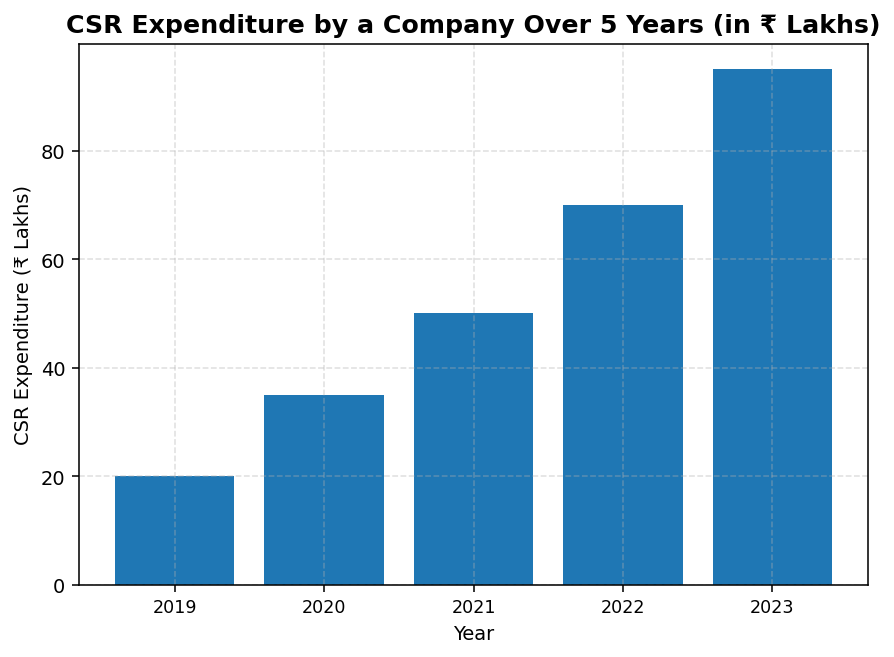
Based on the given chart, answer the following:

Social Responsibilities of Business and Business Ethics figure
  1. In which year was the CSR expenditure the highest according to the bar chart?
    A2019
    B2021
    C2022
    D2023
  2. Calculate the total CSR expenditure of the company over all five years as shown in the chart.
  3. The steady increase in CSR expenditure shown in the chart indicates that the company is:
    AReducing its profit margins year on year
    BIncreasingly fulfilling its discretionary social responsibilities
    CViolating legal norms of business
    DFocusing only on economic responsibilities
  4. What is Corporate Social Responsibility (CSR)? Why is it important for a business to increase its CSR spending over time?
  5. According to the pie chart, which area receives the highest share of CSR spending?
    AHealthcare
    BRural Development
    CEducation
    DEnvironmental Protection
  6. What percentage of CSR spending is directed towards Environmental Protection and Healthcare combined, as shown in the chart?
  7. The inclusion of 'Environmental Protection' as a CSR activity in the pie chart reflects which key concept of business social responsibility?
    AEconomic Responsibility towards shareholders
    BLegal obligation to pay taxes
    CResponsibility towards the natural environment and sustainability
    DResponsibility to maximize production output
  8. Explain why businesses should invest in 'Women Empowerment' and 'Rural Development' as part of their CSR activities, as shown in the pie chart.
  9. What is the total CSR expenditure of the company over all 5 years shown in the chart?
    A₹200 Lakhs
    B₹250 Lakhs
    C₹300 Lakhs
    D₹350 Lakhs
  10. The bar chart shows a consistent increase in CSR expenditure. What does this trend indicate about the company's attitude towards social responsibility?
  11. Under the Companies Act 2013, which companies are mandated to spend on CSR activities? State the minimum percentage of profit required to be spent.
  12. What percentage of CSR spending is directed towards Environmental Protection and Healthcare combined?
    A35%
    B40%
    C45%
    D50%
  13. The pie chart shows that the company spends only 10% on Rural Development. As a business ethics consultant, suggest two ways the company can increase its contribution to rural development.
  14. Explain the responsibility of a business towards environmental protection. Why is sustainability important in the context of social responsibility?
Show answersHide answers
1. Option 4 — 2023
2. Total CSR Expenditure = 20 + 35 + 50 + 70 + 95 = ₹270 Lakhs
3. Option 2 — Increasingly fulfilling its discretionary social responsibilities
4. CSR refers to the voluntary commitment of businesses to contribute to sustainable development by improving the quality of life of employees, their families, the local community, and society at large. Increasing CSR spending is important because it helps build a positive brand image, strengthens community relations, ensures long-term sustainability, and fulfills the business's moral obligation towards society.
5. Option 3 — Education
6. Environmental Protection (25%) + Healthcare (20%) = 45% of total CSR spending is directed towards these two areas.
7. Option 3 — Responsibility towards the natural environment and sustainability
8. Businesses should invest in Women Empowerment because it promotes gender equality, increases workforce participation, and contributes to inclusive economic growth. Investment in Rural Development helps bridge the urban-rural divide, improves infrastructure, creates employment in underdeveloped areas, and ensures that the benefits of business growth reach all sections of society. Both activities reflect the business's commitment to its social responsibilities and ethical values.
9. Option 2 — ₹250 Lakhs
10. The consistent increase in CSR expenditure indicates that the company is becoming increasingly committed to its social responsibilities. It shows that the business recognises its obligations towards society and is voluntarily investing more resources in community welfare, environmental protection, and other social causes over time.
11. Under the Companies Act 2013, companies with a net worth of ₹500 crore or more, or a turnover of ₹1000 crore or more, or a net profit of ₹5 crore or more are mandated to spend on CSR activities. They are required to spend at least 2% of their average net profits of the preceding three financial years on CSR activities.
12. Option 3 — 45%
13. (1) The company can invest in building rural infrastructure such as roads, sanitation facilities, and clean drinking water projects in nearby villages. (2) The company can set up skill development and vocational training centres in rural areas to enhance employability and support local livelihoods, thereby contributing to sustainable rural development.
14. A business has the responsibility to minimise pollution, manage waste responsibly, reduce carbon emissions, and conserve natural resources. It should adopt eco-friendly production methods and comply with environmental laws. Sustainability is important because it ensures that the needs of the present generation are met without compromising the ability of future generations to meet their own needs. A socially responsible business must balance economic growth with environmental protection to ensure long-term viability for both the business and society.

Make a full Business Studies paper on Social Responsibilities of Business and Business Ethics.

Pick the question mix, set the marks, hit generate. You get a ready-to-print paper with an answer key.

Generate your paper — free